

ISO/DIS 4254-19.3
(Main)Agricultural machinery — Safety — Part 19: Livestock feed and bedding machines
General Information
- Abstract
This document, used together with ISO 4254-1, specifies the safety requirements and their verification for the design and construction of livestock feed and bedding machines that have a combination of two or more of the following functions loading, mixing, chopping and distributing materials . In addition, it specifies the type of information on safe working practices to be provided by the manufacturer. NOTE Livestock feed and bedding machines (for example feed mixers, bale processors, silage block cutters) can be stationary, mounted, semi-mounted, interchangeable towed or self-propelled. When requirements of this document are different from those which are stated in ISO 4254-1, the requirements of this document take precedence over the requirements of ISO 4254-1 for machines that have been designed and built according to the requirements of this document. This part of ISO 4254 is not applicable to: — machines which pick up or transport crop material directly from the field; — loading cranes; —automated, semi-autonomous and autonomous functions (for example, those covered by ISO 3991) — the integrity of safety-related parts of control systems in relation to the specification of performance levels; — environmental hazards (excluding noise), road safety and hazards associated with moving transmission parts; — hazards associated with maintenance or repairs carried out by professional service personnel. This document deals with the significant hazards, hazardous situations and events relevant to machines for loading, mixing and/or chopping and distributing silage and/or other feedstuffs, when they are used as intended and under the conditions foreseen by the manufacturer as listed in Annex A, except for the hazards arising from: — failure of the control circuit; — inadequate seating; — inadequate lighting; — travelling of machinery related to road safety; — break-up of parts rotating at high speed; This document is not applicable to machines manufactured before the date of publication of this document. Examples of machines and components covered by this document are shown in Annex B.
- Status
- Not Published
- Technical Committee
- ISO/TC 23/SC 3 - Safety and comfort
- Drafting Committee
- ISO/TC 23/SC 3/WG 24 - Safety of feed mixing machines (ISO 4254-19)
- Current Stage
- 4060 - Close of voting
- Start Date
- 17-Jun-2026
- Completion Date
- 16-Jun-2026
Buy Documents
ISO/CD 4254-19.2 - Agricultural machinery — Safety — Part 19: Feed processing machines/2/2023
ISO/CD 4254-19.2 - Titre manque — Partie 19: Titre manque/19/2023
Overview
ISO/DIS 4254-19.3: Agricultural machinery - Safety - Part 19: Livestock feed and bedding machines is an international draft standard developed by the International Organization for Standardization (ISO). This document details essential safety requirements and verification methods for the design and construction of livestock feed and bedding machines that combine functions such as loading, mixing, chopping, and distributing animal feed or bedding materials. Used alongside ISO 4254-1, this standard outlines safety measures for various equipment, including feed mixers, bale processors, and silage block cutters, whether stationary, mounted, towed, or self-propelled.
Key Topics
Scope and Exclusions
- Covers safety for machines combining loading, mixing, chopping, and distributing functions for animal feed and bedding.
- Excludes machines designed to pick up or transport crop materials directly from the field, loading cranes, and autonomous or semi-autonomous feeds (see ISO 3991).
- Does not address environmental hazards (except noise), road safety, or professional maintenance operations.
Significant Hazards Addressed
- Identifies hazardous situations related to machine operation, such as risks from moving parts, entanglement, and unexpected movements.
- Specifies safety features for machine controls, emergency stops, and operator visibility.
Design and Verification
- Sets requirements for safe design, including guards, interlocks, emergency stops, and safe operator workstations.
- Outlines specific safety distances and design considerations for mixing, chopping, cutting, and loading devices.
- Addresses noise reduction as a component of operator safety.
Information for Safe Use
- Requires manufacturers to provide comprehensive information on safe operating practices.
- Specifies details for operator’s manuals, safety markings, and signage for correct and safe use.
Applications
ISO/DIS 4254-19.3 is critical for manufacturers, designers, and distributors of agricultural machinery intended for livestock operations. It ensures that livestock feed and bedding machines are engineered to minimize risks to operators, service personnel, and bystanders during use and maintenance.
Typical applications include:
- Feed mixers and processors: Equipment used to blend, chop, and distribute feed rations efficiently on farms.
- Bale processors and silage block cutters: Machines for handling baled or compacted feedstocks, improving labor safety and productivity.
- Multi-function livestock machinery: Devices that combine several feed and bedding distribution tasks to reduce handling frequency and exposure to machine hazards.
Adherence to this standard fosters:
- Increased operator protection by reducing risks of entanglement, crushing, or unauthorized access to dangerous parts.
- Streamlined regulatory compliance, particularly in regions where adoption of ISO machinery safety standards is recognized or required.
- Enhanced clarity in user instructions, minimization of accidents, and reduction in liability for manufacturers.
Related Standards
ISO 4254-1 - Agricultural machinery - Safety - Part 1: General requirements
(Primary companion document for overall safety requirements.)ISO 12100 - Safety of machinery - General principles for design - Risk assessment and risk reduction
(Guidance for risk assessment across machinery.)ISO 13857 - Safety distances to prevent hazard zones being reached by upper and lower limbs
(Referenced for determining safe distances in guarding.)ISO 13851 - Safety of machinery - Two-hand control devices - Principles for design and selection
ISO 15817 - Safety requirements for remote operator control systems
(Applies to remote-controlled machines.)ISO 3991 (in preparation) - Automated and autonomous feed processing systems
Compliance with ISO/DIS 4254-19.3 showcases a commitment to machinery safety and helps organizations align with global best practices in agricultural equipment safety for livestock feeding and bedding processes.
Keywords: ISO 4254-19.3, agricultural machinery safety, livestock feed mixers, bedding machines, machine design standards, operator safety, feed processing equipment compliance.
Relations
- Effective Date
- 12-Feb-2026
Buy Documents
ISO/CD 4254-19.2 - Agricultural machinery — Safety — Part 19: Feed processing machines/2/2023
ISO/CD 4254-19.2 - Titre manque — Partie 19: Titre manque/19/2023
Get Certified
Connect with accredited certification bodies for this standard

Control Union Certifications
Global certification for agriculture and sustainability.

ECOCERT
Organic and sustainability certification.

FSC International
Forest Stewardship Council certification.
Sponsored listings
Frequently Asked Questions
ISO/DIS 4254-19.3 is a draft published by the International Organization for Standardization (ISO). Its full title is "Agricultural machinery — Safety — Part 19: Livestock feed and bedding machines". This standard covers: This document, used together with ISO 4254-1, specifies the safety requirements and their verification for the design and construction of livestock feed and bedding machines that have a combination of two or more of the following functions loading, mixing, chopping and distributing materials . In addition, it specifies the type of information on safe working practices to be provided by the manufacturer. NOTE Livestock feed and bedding machines (for example feed mixers, bale processors, silage block cutters) can be stationary, mounted, semi-mounted, interchangeable towed or self-propelled. When requirements of this document are different from those which are stated in ISO 4254-1, the requirements of this document take precedence over the requirements of ISO 4254-1 for machines that have been designed and built according to the requirements of this document. This part of ISO 4254 is not applicable to: — machines which pick up or transport crop material directly from the field; — loading cranes; —automated, semi-autonomous and autonomous functions (for example, those covered by ISO 3991) — the integrity of safety-related parts of control systems in relation to the specification of performance levels; — environmental hazards (excluding noise), road safety and hazards associated with moving transmission parts; — hazards associated with maintenance or repairs carried out by professional service personnel. This document deals with the significant hazards, hazardous situations and events relevant to machines for loading, mixing and/or chopping and distributing silage and/or other feedstuffs, when they are used as intended and under the conditions foreseen by the manufacturer as listed in Annex A, except for the hazards arising from: — failure of the control circuit; — inadequate seating; — inadequate lighting; — travelling of machinery related to road safety; — break-up of parts rotating at high speed; This document is not applicable to machines manufactured before the date of publication of this document. Examples of machines and components covered by this document are shown in Annex B.
This document, used together with ISO 4254-1, specifies the safety requirements and their verification for the design and construction of livestock feed and bedding machines that have a combination of two or more of the following functions loading, mixing, chopping and distributing materials . In addition, it specifies the type of information on safe working practices to be provided by the manufacturer. NOTE Livestock feed and bedding machines (for example feed mixers, bale processors, silage block cutters) can be stationary, mounted, semi-mounted, interchangeable towed or self-propelled. When requirements of this document are different from those which are stated in ISO 4254-1, the requirements of this document take precedence over the requirements of ISO 4254-1 for machines that have been designed and built according to the requirements of this document. This part of ISO 4254 is not applicable to: — machines which pick up or transport crop material directly from the field; — loading cranes; —automated, semi-autonomous and autonomous functions (for example, those covered by ISO 3991) — the integrity of safety-related parts of control systems in relation to the specification of performance levels; — environmental hazards (excluding noise), road safety and hazards associated with moving transmission parts; — hazards associated with maintenance or repairs carried out by professional service personnel. This document deals with the significant hazards, hazardous situations and events relevant to machines for loading, mixing and/or chopping and distributing silage and/or other feedstuffs, when they are used as intended and under the conditions foreseen by the manufacturer as listed in Annex A, except for the hazards arising from: — failure of the control circuit; — inadequate seating; — inadequate lighting; — travelling of machinery related to road safety; — break-up of parts rotating at high speed; This document is not applicable to machines manufactured before the date of publication of this document. Examples of machines and components covered by this document are shown in Annex B.
ISO/DIS 4254-19.3 is classified under the following ICS (International Classification for Standards) categories: 65.060.99 - Other agricultural machines and equipment. The ICS classification helps identify the subject area and facilitates finding related standards.
ISO/DIS 4254-19.3 has the following relationships with other standards: It is inter standard links to prEN ISO 4254-19. Understanding these relationships helps ensure you are using the most current and applicable version of the standard.
ISO/DIS 4254-19.3 is available in PDF format for immediate download after purchase. The document can be added to your cart and obtained through the secure checkout process. Digital delivery ensures instant access to the complete standard document.
Standards Content (Sample)
DRAFT INTERNATIONAL STANDARD
ISO/DIS 4254-19.2
ISO/TC 23/SC 3 Secretariat: DIN
Voting begins on: Voting terminates on:
2023-06-16 2023-08-11
Agricultural machinery — Safety —
Part 19:
Feed mixing machines
Matériel agricole — Sécurité —
Partie 19: Machines de mélange des aliments
ICS: 65.060.99
This document is circulated as received from the committee secretariat.
THIS DOCUMENT IS A DRAFT CIRCULATED
FOR COMMENT AND APPROVAL. IT IS
ISO/CEN PARALLEL PROCESSING
THEREFORE SUBJECT TO CHANGE AND MAY
NOT BE REFERRED TO AS AN INTERNATIONAL
STANDARD UNTIL PUBLISHED AS SUCH.
IN ADDITION TO THEIR EVALUATION AS
BEING ACCEPTABLE FOR INDUSTRIAL,
TECHNOLOGICAL, COMMERCIAL AND
USER PURPOSES, DRAFT INTERNATIONAL
STANDARDS MAY ON OCCASION HAVE TO
BE CONSIDERED IN THE LIGHT OF THEIR
POTENTIAL TO BECOME STANDARDS TO
WHICH REFERENCE MAY BE MADE IN
Reference number
NATIONAL REGULATIONS.
ISO/DIS 4254-19.2:2023(E)
RECIPIENTS OF THIS DRAFT ARE INVITED
TO SUBMIT, WITH THEIR COMMENTS,
NOTIFICATION OF ANY RELEVANT PATENT
RIGHTS OF WHICH THEY ARE AWARE AND TO
PROVIDE SUPPORTING DOCUMENTATION. © ISO 2023
ISO/DIS 4254-19.2:2023(E)
DRAFT INTERNATIONAL STANDARD
ISO/DIS 4254-19.2
ISO/TC 23/SC 3 Secretariat: DIN
Voting begins on: Voting terminates on:
Agricultural machinery — Safety —
Part 19:
Feed mixing machines
Matériel agricole — Sécurité —
Partie 19: Machines de mélange des aliments
ICS: 65.060.99
This document is circulated as received from the committee secretariat.
THIS DOCUMENT IS A DRAFT CIRCULATED
FOR COMMENT AND APPROVAL. IT IS
© ISO 2023
ISO/CEN PARALLEL PROCESSING
THEREFORE SUBJECT TO CHANGE AND MAY
All rights reserved. Unless otherwise specified, or required in the context of its implementation, no part of this publication may
NOT BE REFERRED TO AS AN INTERNATIONAL
be reproduced or utilized otherwise in any form or by any means, electronic or mechanical, including photocopying, or posting on STANDARD UNTIL PUBLISHED AS SUCH.
the internet or an intranet, without prior written permission. Permission can be requested from either ISO at the address below
IN ADDITION TO THEIR EVALUATION AS
or ISO’s member body in the country of the requester. BEING ACCEPTABLE FOR INDUSTRIAL,
TECHNOLOGICAL, COMMERCIAL AND
ISO copyright office
USER PURPOSES, DRAFT INTERNATIONAL
CP 401 • Ch. de Blandonnet 8
STANDARDS MAY ON OCCASION HAVE TO
BE CONSIDERED IN THE LIGHT OF THEIR
CH-1214 Vernier, Geneva
POTENTIAL TO BECOME STANDARDS TO
Phone: +41 22 749 01 11
WHICH REFERENCE MAY BE MADE IN
Reference number
Email: copyright@iso.org
NATIONAL REGULATIONS.
Website: www.iso.org ISO/DIS 4254-19.2:2023(E)
RECIPIENTS OF THIS DRAFT ARE INVITED
Published in Switzerland
TO SUBMIT, WITH THEIR COMMENTS,
NOTIFICATION OF ANY RELEVANT PATENT
RIGHTS OF WHICH THEY ARE AWARE AND TO
ii
PROVIDE SUPPORTING DOCUMENTATION. © ISO 2023
ISO/DIS 4254-19.2:2023(E)
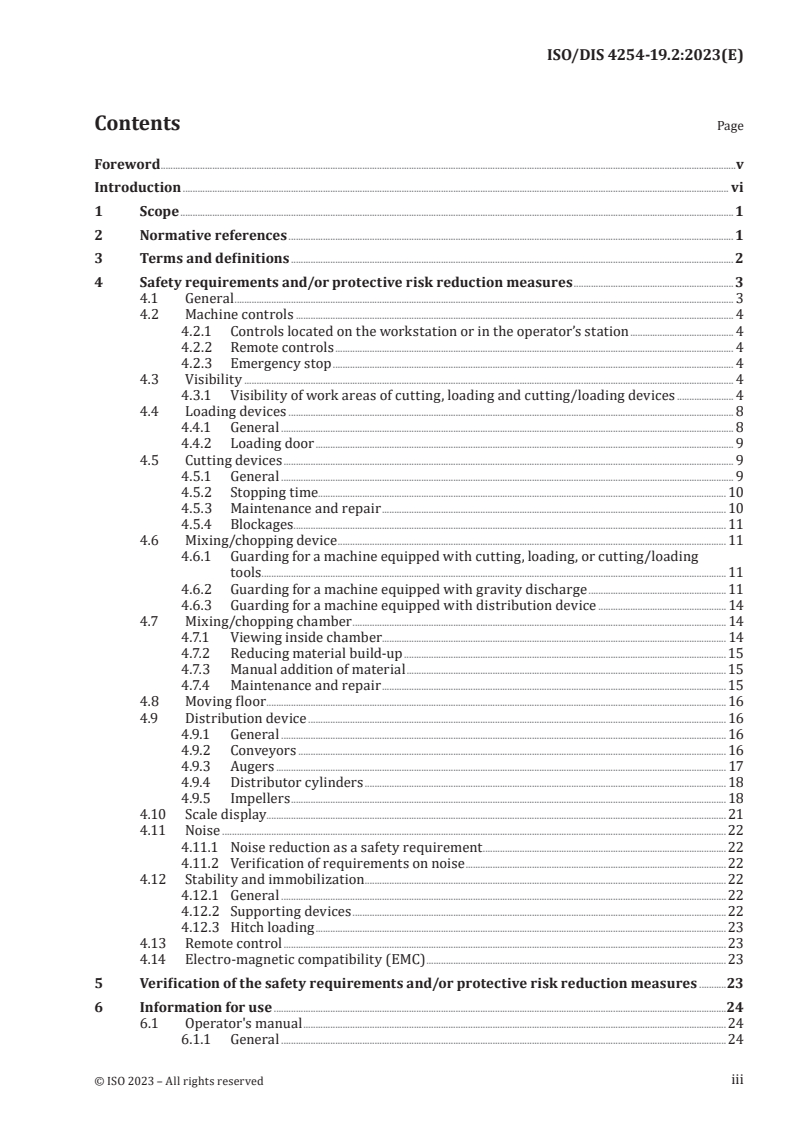
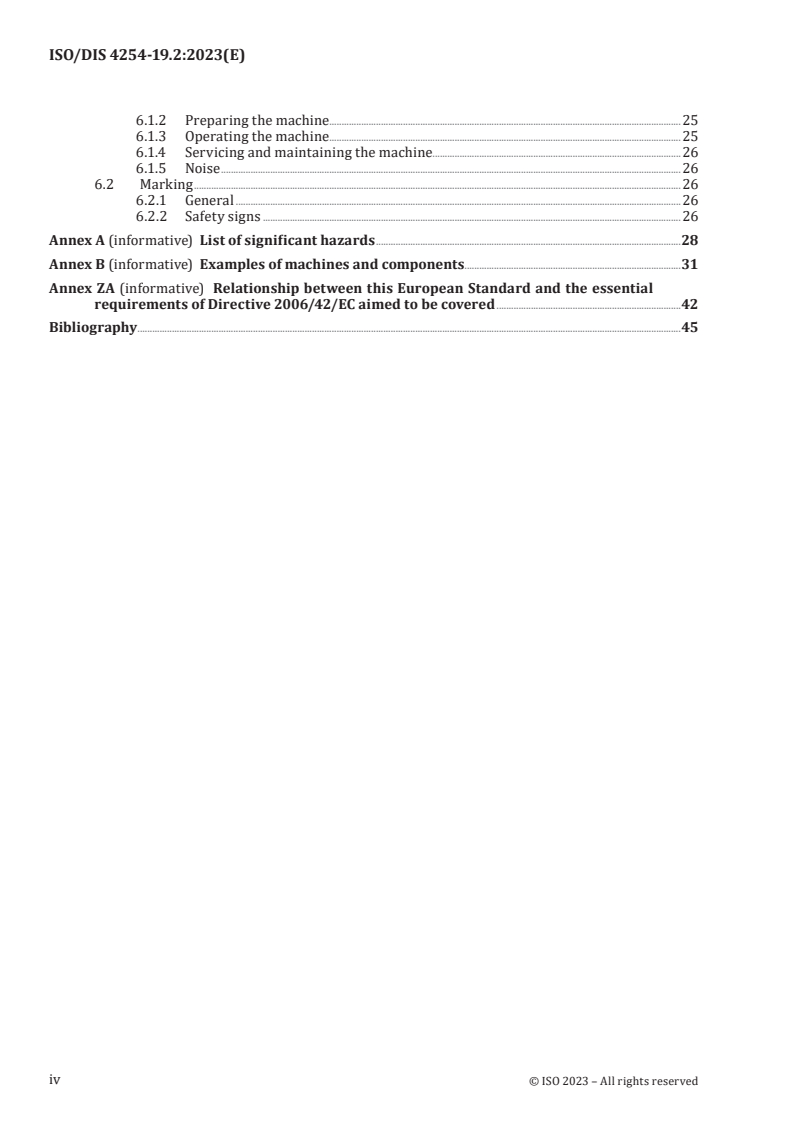
Contents Page
Foreword .v
Introduction . vi
1 Scope . 1
2 Normative references . 1
3 Terms and definitions . 2
4 Safety requirements and/or protective risk reduction measures .3
4.1 General . 3
4.2 Machine controls . 4
4.2.1 Controls located on the workstation or in the operator’s station . 4
4.2.2 Remote controls . 4
4.2.3 Emergency stop . 4
4.3 Visibility . 4
4.3.1 Visibility of work areas of cutting, loading and cutting/loading devices . 4
4.4 Loading devices . 8
4.4.1 General . 8
4.4.2 Loading door . 9
4.5 Cutting devices . 9
4.5.1 General . 9
4.5.2 Stopping time. 10
4.5.3 Maintenance and repair . 10
4.5.4 Blockages. 11
4.6 Mixing/chopping device . 11
4.6.1 Guarding for a machine equipped with cutting, loading, or cutting/loading
tools . . 11
4.6.2 Guarding for a machine equipped with gravity discharge . 11
4.6.3 Guarding for a machine equipped with distribution device . 14
4.7 Mixing/chopping chamber . 14
4.7.1 Viewing inside chamber. 14
4.7.2 Reducing material build-up . 15
4.7.3 Manual addition of material . 15
4.7.4 Maintenance and repair . 15
4.8 Moving floor . 16
4.9 Distribution device . 16
4.9.1 General . 16
4.9.2 Conveyors . 16
4.9.3 Augers . 17
4.9.4 Distributor cylinders . 18
4.9.5 Impellers . 18
4.10 Scale display. 21
4.11 Noise . 22
4.11.1 Noise reduction as a safety requirement .22
4.11.2 Verification of requirements on noise . 22
4.12 Stability and immobilization . 22
4.12.1 General .22
4.12.2 Supporting devices .22
4.12.3 Hitch loading . 23
4.13 Remote control . 23
4.14 Electro-magnetic compatibility (EMC) . 23
5 Verification of the safety requirements and/or protective risk reduction measures .23
6 Information for use .24
6.1 Operator's manual . 24
6.1.1 General . 24
iii
ISO/DIS 4254-19.2:2023(E)
6.1.2 Preparing the machine. 25
6.1.3 Operating the machine . 25
6.1.4 Servicing and maintaining the machine . . 26
6.1.5 Noise . 26
6.2 Marking . 26
6.2.1 General . 26
6.2.2 Safety signs . 26
Annex A (informative) List of significant hazards .28
Annex B (informative) Examples of machines and components.31
Annex ZA (informative) Relationship between this European Standard and the essential
requirements of Directive 2006/42/EC aimed to be covered .42
Bibliography .45
iv
ISO/DIS 4254-19.2:2023(E)
Foreword
ISO (the International Organization for Standardization) is a worldwide federation of national standards
bodies (ISO member bodies). The work of preparing International Standards is normally carried out
through ISO technical committees. Each member body interested in a subject for which a technical
committee has been established has the right to be represented on that committee. International
organizations, governmental and non-governmental, in liaison with ISO, also take part in the work.
ISO collaborates closely with the International Electrotechnical Commission (IEC) on all matters of
electrotechnical standardization.
The procedures used to develop this document and those intended for its further maintenance are
described in the ISO/IEC Directives, Part 1. In particular, the different approval criteria needed for the
different types of ISO documents should be noted. This document was drafted in accordance with the
editorial rules of the ISO/IEC Directives, Part 2 (see www.iso.org/directives).
Attention is drawn to the possibility that some of the elements of this document may be the subject of
patent rights. ISO shall not be held responsible for identifying any or all such patent rights. Details of
any patent rights identified during the development of the document will be in the Introduction and/or
on the ISO list of patent declarations received (see www.iso.org/patents).
Any trade name used in this document is information given for the convenience of users and does not
constitute an endorsement.
For an explanation of the voluntary nature of standards, the meaning of ISO specific terms and
expressions related to conformity assessment, as well as information about ISO's adherence to
the World Trade Organization (WTO) principles in the Technical Barriers to Trade (TBT), see
www.iso.org/iso/foreword.html.
This document was prepared by Technical Committee ISO/TC 23, Tractors and machinery for
agriculture and forestry, Subcommittee SC 3, Safety and comfort.
A list of all parts in the ISO 4254 series can be found on the ISO website.
Any feedback or questions on this document should be directed to the user’s national standards body. A
complete listing of these bodies can be found at www.iso.org/members.html.
v
ISO/DIS 4254-19.2:2023(E)
Introduction
This document is a type-C standard as stated in ISO 12100:2010.
This document is of relevance, in particular, for the following stakeholder groups representing the
market players with regard to machinery safety:
— machine manufacturers (small, medium and large enterprises);
— health and safety bodies (regulators, accident prevention organisations, market surveillance, etc.)
Others can be affected by the level of machinery safety achieved with the means of the document by the
above-mentioned stakeholder groups:
— machine users/employers (small, medium and large enterprises);
— machine users/employees (e.g. trade unions, organizations for people with special needs);
— service providers, e.g. for maintenance (small, medium and large enterprises);
— consumers (in case of machinery intended for use by consumers).
The above-mentioned stakeholder groups have been given the possibility to participate at the drafting
process of this document.
The machinery concerned and the extent to which hazards, hazardous situations or hazardous events
are covered are indicated in the Scope of this document.
When requirements of this type-C standard are different from those which are stated in type-A or
type-B standards, the requirements of this type-C standard take precedence over the requirements of
the other standards for machines that have been designed and built according to the requirements of
this type-C standard.
NOTE Examples of machine and components, illustrating the terms and definitions in Clause 3, are given in
Annex B.
vi
DRAFT INTERNATIONAL STANDARD ISO/DIS 4254-19.2:2023(E)
Agricultural machinery — Safety —
Part 19:
Feed mixing machines
1 Scope
This document, used together with ISO 4254-1, specifies the safety requirements and their
verification for the design and construction of feed processing machines (for example feed mixers,
bale processors, silage block cutters). Feed processing machines can be stationary, mounted, semi-
mounted, interchangeable towed or self-propelled machines that have a combination of two or more of
the following functions: loading, mixing, chopping and distributing materials used for animal feed or
bedding. In addition, it specifies the type of information on safe working practices to be provided by the
manufacturer.
This document does not apply to:
— machines which pick up crop material directly from the field;
— loading cranes not attached to a feed processing machine;
— Autonomous feed processing machines (including robotic feed systems dealt with in ISO 3991
(under preparation))
This document deals with the significant hazards, hazardous situations and events relevant to machines
for loading, mixing and/or chopping and distributing silage and/or other feedstuffs, when they are used
as intended and under the conditions foreseen by the manufacturer as listed in Annex A, except for the
hazards arising from:
— failure of the control circuit;
— inadequate seating;
— inadequate lighting;
— travelling of machinery related to road safety;
— break-up of parts rotating at high speed;
It is not applicable to environmental hazards (except noise).
This document is not applicable to machines manufactured before the date of publication of this
document.
Examples of machines and components covered by this document are shown in Annex B.
2 Normative references
The following documents are referred to in the text in such a way that some or all of their content
constitutes requirements of this document. For dated references, only the edition cited applies. For
undated references, the latest edition of the referenced document (including any amendments) applies.
ISO 3600:2015, Tractors, machinery for agriculture and forestry, powered lawn and garden equipment —
Operator’s manuals — Content and format
ISO 4254-1:2013, Agricultural machinery — Safety — Part 1: General requirements
ISO/DIS 4254-19.2:2023(E)
ISO 12100:2010, Safety of machinery — General principles for design — Risk assessment and risk reduction
ISO 13851:2019, Safety of machinery — Two-hand control devices — Principles for design and selection
ISO 13857:2019, Safety of machinery — Safety distances to prevent hazard zones being reached by upper
and lower limbs
ISO 15817:2012, Earth-moving machinery — Safety requirements for remote operator control systems
3 Terms and definitions
For the purposes of this document, the following terms and definitions given in ISO 12100:2010 and the
following apply.
ISO and IEC maintain terminological databases for use in standardization at the following addresses:
— ISO Online browsing platform: available at https:// www .iso .org/ obp
— IEC Electropedia: available at https:// www .electropedia .org/
3.1
Machines
3.1.1
feed processer
machine with a chamber and powered mixing/chopping device(s) for blending of feed stocks and
supplements, and a means for dispensing the blended material
Note 1 to entry: The mixing/chopping devices can consist of, but are not limited to, rotating augers, rotors (for
example paddles, ribbons, bars, knives), or a combination of augers and rotors.
3.1.2
bale processor
device with an open-top chamber and powered chopping elements intended to chop baled materials
and distribute the processed material
3.1.3
silage block cutter
device with cutting edge(s) that is used to cut a block of material from the remaining material and
transport the material for processing or distribution while maintaining the material density and form
3.2
Functions
3.2.1
mixing
operation to blend two or more different materials to create a mixture
3.2.2
chopping
operation to break up or reduce the size of the constituent elements of a mass of material
3.2.3
cutting
operation to sever a portion of material from the remaining material
3.3
loading device
element or set of elements attached to the machine that moves material into the chamber
ISO/DIS 4254-19.2:2023(E)
3.3.1
loading crane
powered crane, attached to the machine, comprising a column, which pivots about a base, and a boom
system which is attached to the top of the column for loading material into the chamber
[SOURCE: EN 12999:2011, definition 3.1.1 modified]
3.3.2
loading door
moveable portion of the chamber that opens to serve a loading function of the machine and closes
during mixing or processing of material
3.3.3
loading conveyor
powered mechanism that continually moves material into the chamber
3.4
cutting/loading device
element or set of elements attached to the machine that alone or in combination, serve the functions of
a cutting device and a loading device.
3.5
mixing/chopping device
element or set of elements that performs the mixing and/or chopping function(s) on the material in the
chamber
3.6
cutting device
element or set of elements attached to the machine that performs the cutting function
3.7
distribution device
powered element or set of elements, attached to the machine, which moves the material from the
chamber to a desired location (for example conveyor, belt, auger, distributor cylinder, impeller, blower)
3.8
unloading door
moveable portion of the chamber that opens to unload material
3.9
moving floor
powered conveyor for moving the material within the chamber or on the loading door
3.10
workstation
position on the machine, other than the operator's station, from which control of at least some machine
functions is possible
3.11
operator's station
position of the operator during machine operations including transport
4 Safety requirements and/or protective risk reduction measures
4.1 General
4.1.1 Machinery shall comply with the safety requirements or protective risk reduction measures of
this clause. In addition, the machine shall be designed according to the principles of relevant parts of
ISO 12100 for hazards relevant but not significant, which are not dealt with by this document.
ISO/DIS 4254-19.2:2023(E)
4.1.2 Unless otherwise specified in this document, the machines shall comply with the requirements
of ISO 4254-1 and with ISO 13857:2019, Table 1, Table 3, Table 4 and Table 6 as appropriate.
4.2 Machine controls
4.2.1 Controls located on the workstation or in the operator’s station
4.2.1.1 Controls shall be designed so that the operator can reach them where intended, for example
by means of an adjustable position.
4.2.1.2 It shall not be possible for the operator to reach unguarded moving working elements while
actuating the control.
4.2.1.3 It shall not be possible to reach the manual controls from inside the mixing/chopping
chamber(s).
4.2.1.4 Stop controls shall have priority over all other controls.
4.2.1.5 Workstation controls shall be hold-to-run.
4.2.1.6 It shall be possible to deactivate workstation functions to limit control to the operator’s
station only.
4.2.1.7 Two-hand controls shall comply with ISO 13851.
4.2.2 Remote controls
Remote operator-controlled machinery shall comply with the requirements as specified in ISO 15817.
4.2.3 Emergency stop
An emergency stop control according to ISO 4254-1:2013, 4.19 shall be installed on self-propelled
machines
4.3 Visibility
4.3.1 Visibility of work areas of cutting, loading and cutting/loading devices
4.3.1.1 For work area at front of the machine
The operator shall have visibility of the work area at the front of the machine from the operator’s station
and/or the workstation.
The width of the work area is the entire width of any cutting, loading, and cutting/loading devices,
including any entrapment zones.
The height of the work area extends from the highest working position of any cutting, loading, and
cutting/loading devices to a height of 1 m or less from the ground when the machine is in its loading
position.
The location of the work area is 200 mm measured from the edge of any cutting, loading, and cutting/
loading devices (see Figure 1). If direct visibility cannot be achieved, devices such as mirrors or closed-
circuit television (CCTV) shall be used to ensure indirect visibility.
ISO/DIS 4254-19.2:2023(E)
Dimensions in millimetres
Key
1 eye position
2 cutting/loading device
3 visibility zone
Figure 1 — Checking of the direct visibility of a self-propelled machine
4.3.1.2 For work area at rear of the machine
The operator shall have visibility of the work area at the rear of the machine from the operator’s station
and/or the workstation.
The width of the work area is the entire width of any cutting, loading, and cutting/loading devices,
including any entrapment zones [see d2 of Figure 2b) and 2d)].
The height of the work area extends from the highest working position of any cutting, loading, and
cutting/loading devices to a height of 1,5 m or less from the ground when the machine is in its loading
position.
NOTE The height of 1,5 m is under further investigation and could be replaced by 1,0 m in the future.
The location of the work area is 200 mm to the rear of:
— the edge of any cutting, loading, and cutting/loading devices;
— the machine when the loading door is closed.
If direct visibility of the work area cannot be achieved, at least one of the following shall be achieved:
— indirect visibility through the use of devices such as mirrors or closed-circuit television (CCTV)
and a sound and/or light signal emitted during actuation of cutting, loading, and cutting/loading
devices; or
— a device(s) to detect persons in the hazard zone and inform the operator.
ISO/DIS 4254-19.2:2023(E)
4.3.1.3 For work areas at sides of machine
The operator shall have visibility of the work area at the side of the machine from the operator’s station
and/or the workstation.
The width of the work area is 200 mm measured from the sides of any cutting, loading, and cutting/
loading devices of the machine [see d4 in Figures 2b) and 2d)].
The height of the work area extends from the highest working position of any cutting, loading, and
cutting/loading devices to a height of 1,5 m or less from the ground when the machine is in its loading
position.
The location of the work area is 200 mm to the rear of:
— the edge of any cutting, loading, and cutting/loading devices; or
— the machine when the loading door is closed.
If direct visibility of the work area cannot be achieved, at least one of the following shall be achieved:
— indirect visibility through the use of devices such as mirrors or closed-circuit television (CCTV)
and a sound and/or light signal emitted during actuation of cutting, loading, and cutting/loading
devices;
— a device(s) to detect persons in the hazard zone and inform the operator.
Verification: shall be by measurement on an empty machine.
4.3.1.4 Operator’s eye position
The position of the operator’s eye is defined as shown in Figure 1 and Figure 3. A lateral displacement of
the eye of the operator is allowed within ±300 mm from the centre position.
a) Checking of the visibility for trailed machines with loading door - side view
ISO/DIS 4254-19.2:2023(E)
b) Checking of the visibility for trailed machines with loading door – top view
c) Checking of the visibility for trailed machines with cutting/loading tools – side view
d) Checking of the visibility for trailed machines with cutting/loading tools
Key
h highest position to a minimum height of 1,5 m from the ground of the work area of the cutting/loading tools
and the loading door
d width of the loading tools
d width of the visibility area - interior width of the machine
d excluded width of the visibility area (sides of the machine)
d width of the visibility area on sideways = 200 mm
d length of the visibility area to rear = 200 mm
Figure 2 — Checking of the visibility for trailed machines
ISO/DIS 4254-19.2:2023(E)
Dimensions in millimetres
Key
1 eye position
2 clevis or hook
3 ground
a) case of clevis or hook-type connection between trailed machine and tractor
Key
1 eye position
2 lower hitch point
3 ground
b) case of lower hitch point connection between trailed machine and tractor
Figure 3 — determination of the conventional eye position
4.4 Loading devices
4.4.1 General
4.4.1.1 To avoid unexpected movement of the loading device during maintenance and transport,
locking devices complying with ISO 4254-1:2013, 4.11 shall be provided. If a mechanical support is
used, it shall not be detachable from the machine.
ISO/DIS 4254-19.2:2023(E)
4.4.1.2 A means shall be provided to prevent the loading device from moving without being actuated
during maintenance and transport, (for example, a pilot-operated check valve).
4.4.1.3 The controls of loading devices shall be hold-to-run if outside of the operator's station, except
for the rotation of loading conveyors, which may be hold-to-run or require an intentional action.
4.4.2 Loading door
4.4.2.1 When the loading door is open, at least one of the following measures shall be taken to protect
the operator against contact, entanglement and drawing-in hazards generated by the mixing/chopping
device(s).
— the mixing/chopping device shall not operate; or
— the mixing/chopping device shall only operate by a hold-to-run control; or
— the safety distances established in ISO 13857:2019, Tables 1, 3, 4 and 6 shall be maintained by an
automatically deployed protective device (for example, moveable interlocked wall).
4.4.2.2 To ensure the protection of the operator against crushing and shearing hazards related to a
failure of the hydraulic circuit, the door shall be fitted with a device to prevent unintended lowering
(for example, pilot-operated check valve).
4.4.2.3 A machine with a loading door that rises to close (the type of machine illustrated in Figure B.9
of Annex B) shall allow the operator to remove the net wrap or strings from a bale after it has been
loaded:
— without entering the mixing/chopping chamber; and
— without operating the mixing/chopping device.
4.5 Cutting devices
4.5.1 General
4.5.1.1 The controls of cutting devices shall require an intentional action.
4.5.1.2 Cutting devices that pose a hazard when not in use shall be guarded, either
— by location, such as making possible and instructing the operator to position the cutting device(s)
out of reach. The repositioning of the cutting device(s) shall be possible from the operator’s station.
or
— directly with a guard that prevents inadvertent contact with the cutting device(s). The guard shall
be self-closing or actuated from the operator’s station.
In case of rotating cutting devices, the front guard shall be self-closing and shall extend on the working
" by front at least 110° from the vertical to the cutting device axis (see Figure 4), with the machine in
travelling position.
ISO/DIS 4254-19.2:2023(E)
Key
1 front guard
α ≥ 110°
Figure 4 — Protection of rotating tools when not in use
4.5.2 Stopping time
4.5.2.1 General
4.5.2.1.1 The stopping time is the time from the moment the control device is switched to the off
position until the cutting device has come to a complete stop.
4.5.2.2 Requirements
4.5.2.2.1 The stopping time of cutting device(s) shall not exceed 5 seconds for self-propelled machines
and 10 seconds for other machines.
4.5.2.2.2 It shall not be possible to reach unguarded cutting elements during the run-down time.
4.5.2.3 Measurement conditions
4.5.2.3.1 The cutting device shall not be under load.
4.5.2.3.2 The speed for the test shall be the nominal rotation speed as specified by the manufacturer.
4.5.2.3.3 If the cutting device is hydraulically driven the hydraulic oil temperature during the test
shall be (65 ± 5) °C.
4.5.3 Maintenance and repair
4.5.3.1 To avoid inadvertent lowering of the cutting device during maintenance and repair, locking
devices complying with ISO 4254-1:2013, 4.11 shall be provided. If a mechanical support is used, it shall
not be detachable from the machine.
4.5.3.2 Cutting devices shall be moveable as required for maintenance and repair without operating
the machine.
ISO/DIS 4254-19.2:2023(E)
4.5.3.3 Cutting devices shall be lockable as required for maintenance and repair without operating
the machine.
4.5.4 Blockages
4.5.4.1 General
4.5.4.1.1 The machines shall be designed and built to minimize the probability and frequency of
blockages and to prevent a hazard arising should clearance of blockages become necessary.
4.5.4.1.2 This general requirement shall be achieved by the following risk reduction measures:
a) as far as practicable, avoid the need to approach the danger zone by providing means to allow
clearing of blockages without interrupting the power to the machine, either from the operator's
station or, if the normal operation is controlled from workstation, from the workstation. Such
means are for example:
— device to enlarge the section of passage of the material;
— reverse direction of the appropriate machine elements, independently from the cutting tools.
b) if a) is not fully achievable, assist in the clearing of blockages and cleaning after the machine is
stopped, by means of, for example:
— freewheel of the cutting tool axle to allow manual rotation without external power;
— hand tools to remove blockages.
4.5.4.2 Protection against inadvertent re-engagement in case of mechanical elements stopped
by blockage
Automatic restarting of hazardous movement following clearance of a blockage by an operator in the
hazard zone shall be prevented. A restart shall require the intentional actuation of a control outside
the hazard zone (for example, torque limiter reset which requires a complete stop of the PTO to be re-
engaged).
4.6 Mixing/chopping device
4.6.1 Guarding for a machine equipped with cutting, loading, or cutting/loading tools
If the machine is equipped with cutting, loading, or cutting/loading tools, safety distances for
protection against contact with hazardous moving parts of the mixing/chopping device shall comply
with the safety distances of ISO 13857:2019, Tables 1, 3, 4 and 6 when the cutting, loading, or cutting/
loading tools are in the position for mixing and/or chopping, the loading door is closed, or both.
4.6.2 Guarding for a machine equipped with gravity discharge
A machine equipped with a gravity discharge shall meet at least one of the following when the machine
is empty:
— guarding to the extent practicable that prevents unintentional contact with the hazardous moving
parts of the mixing/chopping device and that does not contact the mixing/chopping device when a
horizontal force of 500 N is applied;
— the safety distances of ISO 13857:2019, Tables 1, 3, 4 and 6 to prevent unintended contact with
hazardous moving parts of the mixing/chopping device;
ISO/DIS 4254-19.2:2023(E)
— a distance ≥ 550 mm between the outermost edges of the discharge opening and the outer path
of the mixing/chopping device to ≥ 100 mm below a horizontal plane of the bottom edge of the
discharge opening (see Figure 5). If the distance h (see Figures 6 and 7) between the ground and the
lower edge of the guard is ≤ 800 mm,
— dimension a shall be ≥ 550 mm; and
— dimension b shall be ≥ 100 mm
If the distance h (see Figures 6 and 7) between the ground and the lower edge of the guard is >
800 mm,
— dimension a shall be ≥ 850 mm; and
— dimension b shall be ≥ 100 mm.
Dimensions in millimetres
Key
a distance between the guard and the distributor cylinder
b vertical distance between the edge of the guard and the distributor cylinder
h distance between the ground and the lower edge of the guard
Figure 5 — Guarding to prevent unintended contact with mixing/chopping device (machine
with gravity discharge)
ISO/DIS 4254-19.2:2023(E)
Key
1 distributor cylinder
2 guard
a distance between the guard and the distributor cylinder
b vertical distance between the edge of the guard and the distributor cylinder
h distance between the ground and the lower edge of the guard
Figure 6 — Protection against pinching hazard with a distributor cylinder – Horizontal
Key
1 distributor cylinder
2 guard
a distance between the guard and the distributor cylinder
b vertical distance between the edge of the guard and the distributor cylinder
h distance between the ground and the lower edge of the guard
Figure 7 — Protection against pinching hazard with a distributor cylinder – Vertical
ISO/DIS 4254-19.2:2023(E)
4.6.3 Guarding for a machine equipped with distribution device
A machine equipped with a distribution device shall meet at least one of the following in any distribution
condition:
— guarding to the extent practicable that prevents unintentional contact with the hazardous moving
parts of the mixing/chopping device and that does not contact the mixing/chopping device when a
horizontal force of 500 N is applied;
— the safety distances of ISO 13857:2019, Tables 1, 3, 4 and 6 to prevent unintended contact with
hazardous moving parts of the mixing/chopping device;
— a distance ≥ 550 mm between the outermost edge of the distribution device and the outer path of
the mixing/chopping device and a distance ≥ 550 mm between any point on the side guards of the
distribution device and the outer path of the mixing/chopping device. (see Figure 8)
NOTE See 4.9 for guarding of the distribution device.
Dimensions in millimetres
Figure 8 — Guarding to prevent unintended contact with mixing/chopping device (machine
with distribution device)
4.7 Mixing/chopping chamber
4.7.1 Viewing inside chamber
Where the upper edge of the mixing/chopping chamber at its lowest point is at more than 1,60 m above
the ground, at least one of the following means for viewing inside the chamber shall be provided:
a) an opening or observation means (for example, window, grid) to provide the operator direct
visibility while maintaining the safety distances of ISO 13857:2019, Tables 1, 3, 4 and 6 to prevent
contact with moving mechanical parts inside the mixing/chopping chamber;
ISO/DIS 4254-19.2:2023(E)
b) a platform of the machine, complying with ISO 4254-1:2013, 4.7.2. The distance between the
platform floor and the upper edge of the mixing/chopping chamber or platform railing shall
measure > 1,10 m and ≤ 1,60 m. Steps or ladders for platforms shall comply with ISO 4254-1:2013,
4.7.1.2;
c) a boarding means (for example, ladder fixed on the machine) which shall comply with
ISO 4254-1:2013, 4.7.1.2. The distance between the upper step and the upper edge of the mixing/
chopping chamber shall measure > 1,10 m and ≤ 1,60 m.
d) an observation means to allow indirect visibility from the operator's station (for example, mirrors,
closed-circuit television (CCTV)).
4.7.2 Reducing material build-up
The top edges of the mixing/chopping chamber shall be designed to minimize the accumulation of
material and to reduce the need for access to the top edges of the chamber. Examples for such designs
are:
— sloped edges;
— rounded profiles;
— limited horizontal surfaces.
4.7.3 Manual addition of material
4.7.3.1 When a means to allow the manual addition of material into the mixing/chopping chamber is
provided, it shall include one of the following while maintaining the safety distances of ISO 13857:2019,
Tables 1, 3, 4 and 6 to prevent contact with moving mechanical parts inside the mixing/chopping
chamber:
— a platform according to ISO 4254-1:2013, 4.7.2; or
— accessible from the ground.
4.7.3.2 When a means for manual addition of material is not provided, the operator’s manual shall
state that manual addition of material is not allowed. It shall also include instructions to use appropriate
loading means to add even small amounts of material.
4.7.4 Maintenance and repair
4.7.4.1 Mixing/chopping devices shall be moveable as required for maintenance and repair without
operating the machine.
4.7.4.2 Mixing/chopping devices shall be lockable as required for maintenance and repair.
4.7.4.3 Machines with a vertical mixing/chopping device shall include a means for access to the
mixing/chopping device by at least one of the following:
— an access opening (for example, unloading door, service panel), having a minimum clear diameter of
600 mm for entry into the mixing/chopping chamber; or
— for machines with a capacity of less then 2 m and where safe access for maintenance from the
ground level cannot be provided, alternative access means shall be provided (for example, removable
panel).
4.7.4.4
...
PROJET DE NORME INTERNATIONALE
ISO/DIS 4254-19.2
ISO/TC 23/SC 3 Secrétariat: DIN
Début de vote: Vote clos le:
2023-06-16 2023-08-11
Matériel agricole — Sécurité —
Partie 19:
Machines de mélange des aliments
Agricultural machinery — Safety —
Part 19: Feed mixing machines
ICS: 65.060.99
Le présent document est distribué tel qu’il est parvenu du secrétariat du comité.
CE DOCUMENT EST UN PROJET DIFFUSÉ POUR
OBSERVATIONS ET APPROBATION. IL EST DONC
SUSCEPTIBLE DE MODIFICATION ET NE PEUT
ÊTRE CITÉ COMME NORME INTERNATIONALE
TRAITEMENT PARALLÈLE ISO/CEN
AVANT SA PUBLICATION EN TANT QUE TELLE.
OUTRE LE FAIT D’ÊTRE EXAMINÉS POUR
ÉTABLIR S’ILS SONT ACCEPTABLES À DES
FINS INDUSTRIELLES, TECHNOLOGIQUES ET
COMMERCIALES, AINSI QUE DU POINT DE VUE
DES UTILISATEURS, LES PROJETS DE NORMES
INTERNATIONALES DOIVENT PARFOIS ÊTRE
CONSIDÉRÉS DU POINT DE VUE DE LEUR
POSSIBILITÉ DE DEVENIR DES NORMES
POUVANT SERVIR DE RÉFÉRENCE DANS LA
RÉGLEMENTATION NATIONALE.
Numéro de référence
LES DESTINATAIRES DU PRÉSENT PROJET ISO/DIS 4254-19.2:2023(F)
SONT INVITÉS À PRÉSENTER, AVEC LEURS
OBSERVATIONS, NOTIFICATION DES DROITS
DE PROPRIÉTÉ DONT ILS AURAIENT
ÉVENTUELLEMENT CONNAISSANCE ET À
FOURNIR UNE DOCUMENTATION EXPLICATIVE.
ISO/DIS 4254-19.2:2023(F)
ISO/TC 23/SC 3
Date : 2023-06-09
ISO/DIS 4254-19.2:2023(F)
ISO/TC 23/SC 3
Secrétariat : DIN
Matériel agricole — Sécurité — Partie 19: Machines de mélange
des aliments
Agricultural machinery — Safety — Part 19: Feed processing machines
Avertissement
Ce document n'est pas une Norme internationale de l'ISO. Il est distribué pour examen et observations.
Il est susceptible de modification sans préavis et ne peut être cité comme Norme internationale.
Les destinataires du présent projet sont invités à présenter, avec leurs observations, notification des
droits de propriété dont ils auraient éventuellement connaissance et à fournir une documentation
explicative.
ICS : 65.060.99
DOCUMENT PROTÉGÉ PAR COPYRIGHT
© ISO 2023
Tous droits réservés. Sauf prescription différente ou nécessité dans le contexte de sa mise en œuvre, aucune partie de cette
publication ne peut être reproduite ni utilisée sous quelque forme que ce soit et par aucun procédé, électronique ou mécanique,
y compris la photocopie, ou la diffusion sur l’internet ou sur un intranet, sans autorisation écrite préalable. Une autorisation peut
être demandée à l’ISO à l’adresse ci-après ou au comité membre de l’ISO dans le pays du demandeur.
Type de document : Norme internationale
ISO copyright office
Sous-type de document :
Case postale 401 • Ch. de Blandonnet 8
Stade du document : (40) Enquête
CH-1214 Vernier, Genève
Langue du document : F
Tél.: +41 22 749 01 11
E-mail: copyright@iso.org
H:\Secteur2\Normes à publier\ISO\ISO 4254-19\DIS2_Traduction\DIS2_ISO_4254-
Web: www.iso.org
19_(F)_clean.docx STD Version 2.9a
Publié en Suisse
ii
ISO/DIS 4254-19.2:2023(F)
Sommaire Page
Avant-propos . v
Introduction . vi
1 Domaine d'application . 1
2 Références normatives . 2
3 Termes et définitions . 2
4 Prescriptions de sécurité et/ou mesures de protection/réduction du risque . 5
4.1 Généralités . 5
4.2 Commandes de la machine . 5
4.2.1 Commandes situées sur le poste de travail ou dans le poste de l'opérateur . 5
4.2.2 Commandes à distance . 5
4.2.3 Arrêt d'urgence . 5
4.3 Visibilité . 6
4.3.1 Visibilité des zones de travail des dispositifs de coupe, de chargement et de
coupe/chargement . 6
4.4 Dispositifs de chargement . 11
4.4.1 Généralités . 11
4.4.2 Porte de chargement . 11
4.5 Dispositifs de coupe. 11
4.5.1 Généralités . 11
4.5.2 Temps d'arrêt . 12
4.5.3 Entretien et réparation . 13
4.5.4 Bourrages . 13
4.6 Dispositif de mélange/hachage . 14
4.6.1 Protecteurs pour machine équipée d'outils de coupe, de chargement ou de
coupe/chargement . 14
4.6.2 Protecteurs pour machine équipée d'un système d'éjection par gravité . 14
4.6.3 Protecteurs pour une machine équipée d'un dispositif de distribution . 16
4.7 Chambre de mélange/hachage . 17
4.7.1 Visualisation de l'intérieur de la chambre . 17
4.7.2 Réduction de l'accumulation de matière . 18
4.7.3 Ajout manuel de matériaux . 18
4.7.4 Entretien et réparation . 18
4.8 Fond mouvant . 19
4.9 Dispositif de distribution . 19
4.9.1 Généralités . 19
4.9.2 Convoyeurs . 19
4.9.3 Vis sans fin . 21
4.9.4 Rotors de distribution . 22
4.9.5 Turbines . 22
4.10 Affichage de la balance . 25
4.11 Bruit . 26
4.11.1 Réduction du bruit en tant que prescription de sécurité . 26
4.11.2 Vérification des prescriptions relatives au bruit . 27
4.12 Stabilité et immobilisation . 27
4.12.1 Généralités . 27
4.12.2 Dispositifs de support . 27
iii
ISO/DIS 4254-19.2:2023(F)
4.12.3 Chargement de l'attelage . 27
4.13 Commande à distance . 28
4.14 Compatibilité électromagnétique (CEM) . 28
5 Vérification des prescriptions de sécurité et/ou mesures de protection/ réduction du
risque . 28
6 Informations pour l'utilisation . 29
6.1 Manuel de l'opérateur . 29
6.1.1 Généralités. 29
6.1.2 Préparation de la machine. 30
6.1.3 Fonctionnement de la machine . 30
6.1.4 Entretien et maintenance de la machine . 31
6.1.5 Bruit . 32
6.2 Marquage . 32
6.2.1 Généralités. 32
6.2.2 Signaux de sécurité . 32
(informative) Liste des phénomènes dangereux significatifs . 33
(informative) Exemple de machines et composants . 37
Annexe ZA (informative) Relation entre la présente Norme européenne et les exigences
essentielles concernées de la Directive UE 2006/42/CE . 48
Bibliographie . 52
iv
ISO/DIS 4254-19.2:2023(F)
Avant-propos
L'ISO (Organisation internationale de normalisation) est une fédération mondiale d'organismes nationaux
de normalisation (comités membres de l'ISO). L'élaboration des Normes internationales est en général
confiée aux comités techniques de l'ISO. Chaque comité membre intéressé par une étude a le droit de faire
partie du comité technique créé à cet effet. Les organisations internationales, gouvernementales et non
gouvernementales, en liaison avec l'ISO participent également aux travaux. L'ISO collabore étroitement avec
la Commission électrotechnique internationale (IEC) en ce qui concerne la normalisation électrotechnique.
Les procédures utilisées pour élaborer le présent document et celles destinées à sa mise à jour sont décrites
dans les Directives ISO/IEC, Partie 1. Il convient, en particulier de prendre note des différents critères
d'approbation requis pour les différents types de documents ISO. Le présent document a été rédigé
conformément aux règles de rédaction données dans les Directives ISO/IEC, Partie 2
(voir www.iso.org/directives).
L'attention est attirée sur le fait que certains des éléments du présent document peuvent faire l'objet de
droits de propriété intellectuelle ou de droits analogues. L'ISO ne saurait être tenue pour responsable de ne
pas avoir identifié de tels droits de propriété et averti de leur existence. Les détails concernant les références
aux droits de propriété intellectuelle ou autres droits analogues identifiés lors de l'élaboration du document
sont indiqués dans l'Introduction et/ou dans la liste des déclarations de brevets reçues par l'ISO
(voir www.iso.org/brevets).
Les appellations commerciales éventuellement mentionnées dans le présent document sont données pour
information, par souci de commodité, à l’intention des utilisateurs et ne sauraient constituer un engagement.
Pour une explication de la nature volontaire des normes, la signification des termes et expressions
spécifiques de l'ISO liés à l'évaluation de la conformité, ou pour toute information au sujet de l'adhésion de
l'ISO aux principes de l’Organisation mondiale du commerce (OMC) concernant les obstacles techniques au
commerce (OTC), voir le lien suivant : www.iso.org/iso/fr/avant-propos.
Le présent document a été élaboré par le comité technique ISO/TC 23, Tracteurs et matériels agricoles et
forestiers, sous-comité SC 3, Sécurité et confort.
Une liste de toutes les parties de la série ISO 4254 se trouve sur le site web de l’ISO.
Il convient que l’utilisateur adresse tout retour d’information ou toute question concernant le présent
document à l’organisme national de normalisation de son pays. Une liste exhaustive desdits organismes se
trouve à l’adresse www.iso.org/fr/members.html.
v
ISO/DIS 4254-19.2:2023(F)
Introduction
Le présent document est une norme de type C tel que mentionné dans l'ISO 12100:2010.
Le contenu du présent document concerne, en particulier, les groupes de parties prenantes suivants
représentant les acteurs du marché en ce qui concerne la sécurité des machines :
— fabricants de machines (petites, moyennes et grandes entreprises) ;
— organismes de santé et de sécurité (autorités réglementaires, organismes de prévention des risques
professionnels, surveillance du marché, etc.).
D'autres groupes peuvent être concernés par le niveau de sécurité des machines atteint à l'aide du document
par les parties prenantes mentionnées ci-dessus :
— utilisateurs de machines/employeurs (petites, moyennes et grandes entreprises) ;
— utilisateurs de machines/salariés (par exemple syndicats de salariés, organisations représentant des
personnes ayant des besoins particuliers) ;
— prestataires de services, par exemple sociétés de maintenance (petites, moyennes et grandes
entreprises) ;
— consommateurs (dans le cas de machines destinées à être utilisées par des consommateurs).
Les groupes de parties prenantes mentionnés ci-dessus ont eu la possibilité de participer à l'élaboration du
présent document.
Les machines et systèmes concernés, ainsi que l'étendue des phénomènes dangereux, situations
dangereuses ou événements dangereux couverts, sont indiqués dans le Domaine d'application du présent
document.
Lorsque des exigences de la présente norme de type C diffèrent de celles indiquées dans une norme de type
A ou de type B, ces exigences prévalent sur celles des autres normes, et ce pour les machines conçues et
fabriquées conformément aux exigences de la présente norme de type C.
NOTE Des exemples de machines et composants illustrant les termes et définitions de l’Article 3 sont donnés en
Annexe B.
vi
PROJET DE NORME INTERNATIONALE ISO/DIS 4254-19.2:2023(F)
Matériel agricole — Sécurité — Partie 19: Machines de mélange
des aliments
1 Domaine d'application
Le présent document, utilisé conjointement avec l'ISO 4254-1, spécifie les prescriptions de sécurité et
leurs vérifications pour la conception et la construction des machines de mélange des aliments (par
exemple, mélangeurs d'alimentation, pailleuses, désileuses bloc). Les machines de mélange des aliments
peuvent être des machines fixes, portées, semi-portées, interchangeables, tractées ou automotrices, qui
combinent deux ou plusieurs des fonctions suivantes : chargement, mélange, hachage et distribution des
matériaux utilisées pour l'alimentation ou la litière des animaux. En outre, elle spécifie le type
d'informations que le fabricant doit fournir sur les pratiques d'utilisation sûre.
Le présent document ne s'applique pas aux :
machines qui ramassent le fourrage directement dans le champ ;
grues de chargement non fixées à une machine de mélange des aliments ;
machines autonomes de mélange des aliments [y compris les systèmes d'alimentation robotisés
traités dans l'ISO 3991 (en cours d'élaboration)].
Le présent document traite des phénomènes dangereux, des situations dangereuses et des événements
dangereux significatifs applicables aux machines pour le chargement, le mélange et/ou le hachage et la
distribution d'ensilage et/ou d'autres matériaux d'alimentation, lorsqu'elles sont utilisées normalement
et dans des conditions prévues par le fabricant telles qu'énumérées à l'Annexe A, à l'exception des
phénomènes dangereux engendrés par :
une défaillance du circuit de commande ;
un siège inadapté ;
un éclairage inadapté ;
le déplacement de la machine en lien avec la sécurité routière ;
la rupture de pièces en rotation à grande vitesse.
Il ne traite pas des phénomènes dangereux dus à l'environnement (à l'exception du bruit).
Le présent document n'est pas applicable aux machines fabriquées avant sa date de publication.
Des exemples de machines et de composants couverts par le présent document sont présentés à
l'Annexe B.
ISO/DIS 4254-19.2:2023(F)
2 Références normatives
Les documents suivants sont cités dans le texte de sorte qu'ils constituent, pour tout ou partie de leur
contenu, des exigences du présent document. Pour les références datées, seule l'édition citée s'applique.
Pour les références non datées, la dernière édition du document de référence s'applique (y compris les
éventuels amendements).
ISO 3600:2015, Tracteurs, matériels agricoles et forestiers, matériel à moteur pour jardins et pelouses —
Manuels d'utilisation — Contenu et présentation
ISO 4254-1:2013, Matériel agricole — Sécurité — Partie 1 : Exigences générales
ISO 12100:2010, Sécurité des machines — Principes généraux de conception — Appréciation du risque et
réduction du risque
ISO 13851:2019, Sécurité des machines — Dispositifs de commande bimanuelle — Principes de conception
et de choix
ISO 13857:2019, Sécurité des machines — Distances de sécurité empêchant les membres supérieurs et
inférieurs d'atteindre les zones dangereuses
ISO 15817:2012, Engins de terrassement — Exigences de sécurité relatives aux systèmes de commande à
distance utilisés par l'opérateur
3 Termes et définitions
Pour les besoins du présent document, les termes et définitions suivants de l'ISO 12100:2010 ainsi que
les suivants, s'appliquent.
L'ISO et l'IEC tiennent à jour des bases de données terminologiques destinées à être utilisées en
normalisation, consultables aux adresses suivantes :
ISO Online browsing platform : disponible à l'adresse https://www.iso.org/obp
IEC Electropedia : disponible à l'adresse https://www.electropedia.org/
ISO/DIS 4254-19.2:2023(F)
3.1
Machines
3.1.1
mélangeur d'alimentation
machine comportant une chambre et un ou plusieurs dispositifs de mélange et de hachage animés pour
mélanger des aliments pour animaux et des compléments, ainsi qu'un moyen permettant de distribuer le
mélange obtenu
Note 1 à l'article : Les dispositifs de mélange/de hachage peuvent se composer, sans toutefois s'y limiter, de vis
rotatives, de rotors (par exemple des palettes, des rubans, des barres, des couteaux), ou d'une combinaison de vis
et de rotors.
3.1.2
pailleuse
dispositif comportant une chambre découverte et des éléments de coupe animés destinés à hacher les
matériaux en balles et à distribuer le matériau traité
3.1.3
désileuse bloc
dispositif comportant un ou plusieurs dispositifs de coupe, utilisé pour découper un bloc de matière à
partir de le matériau restant et pour transporter le matériau en vue de son traitement ou de sa
distribution tout en préservant sa densité et sa forme
3.2
Fonctions
3.2.1
mélange
opération consistant à mélanger deux ou plusieurs matériaux différents en vue de créer un mélange
3.2.2
hachage
opération consistant à briser ou à réduire la taille des éléments constitutifs d'un amas de matériaux
3.2.3
coupe
opération consistant à séparer une partie de matériau du reste du matériau
3.3
dispositif de chargement
élément ou ensemble d'éléments fixés à la machine qui déplace le matériau dans la chambre
3.3.1
grue de chargement
appareil de levage à charge suspendue motorisé, fixé à la machine, comprenant un fût qui pivote par
rapport à une base et un système de flèche qui est fixé au sommet du fût et conçu pour le chargement du
matériau dans la chambre
[SOURCE : EN 12999:2011, définition 3.1.1 modifiée]
ISO/DIS 4254-19.2:2023(F)
3.3.2
porte de chargement
partie mobile de la chambre qui s'ouvre pour assurer une fonction de chargement de la machine et se
ferme pendant le mélange ou le traitement du matériau
3.3.3
convoyeur de chargement
mécanisme motorisé qui déplace en continu le matériau dans la chambre
3.4
dispositif de coupe/chargement
élément ou ensemble d'éléments fixés à la machine, qui, seuls ou en combinaison, assurent les fonctions
de dispositif de coupe et de dispositif de chargement
3.5
dispositif de mélange/hachage
élément ou ensemble d'éléments qui effectuent la(les) fonction(s) de mélange et/ou hachage du matériau
dans la chambre
3.6
dispositif de coupe
élément ou ensemble d'éléments fixés à la machine qui assurent la fonction de coupe
3.7
dispositif de distribution
élément ou ensemble d'éléments animés, fixés à la machine, qui déplacent le matériau de la chambre vers
un emplacement souhaité (par exemple, convoyeur, bande, vis, rotor de distribution, turbine, ventilateur)
3.8
porte de déchargement
partie mobile de la chambre qui s'ouvre pour décharger le matériau
3.9
fond mouvant
convoyeur motorisé qui déplace le matériau dans la chambre ou sur la porte de chargement
3.10
poste de travail
emplacement sur la machine, autre que le poste de l'opérateur, à partir duquel il est possible de
commander au moins certaines fonctions de la machine
3.11
poste de l'opérateur
emplacement de l'opérateur pendant le fonctionnement de la machine, y compris le transport
ISO/DIS 4254-19.2:2023(F)
4 Prescriptions de sécurité et/ou mesures de protection/réduction du risque
4.1 Généralités
4.1.1 Les machines doivent satisfaire aux prescriptions de sécurité ou aux mesures de
protection/réduction du risque du présent article. De plus, les machines doivent être conçues suivant les
principes des parties pertinentes de l'ISO 12100 pour les phénomènes dangereux pertinents, mais non
significatifs qui ne sont pas traités dans le présent document.
4.1.2 Sauf spécification contraire dans le présent document, les machines doivent satisfaire aux
prescriptions de l'ISO 4254-1 et à l'ISO 13857:2019, Tableau 1, Tableau 3, Tableau 4 et Tableau 6, comme
approprié.
4.2 Commandes de la machine
4.2.1 Commandes situées sur le poste de travail ou dans le poste de l'opérateur
4.2.1.1 Les commandes doivent être conçues de sorte que l'opérateur puisse les atteindre à l'endroit
prévu, par exemple, au moyen d'une position réglable.
4.2.1.2 Il ne doit pas être possible pour l'opérateur d'atteindre des éléments de travail mobiles non
protégés lorsqu'il actionne la commande.
4.2.1.3 Il ne doit pas être possible d'atteindre les organes de service depuis l'intérieur de la ou des
chambres de mélange/hachage.
4.2.1.4 Les commandes d'arrêt doivent avoir la priorité sur toutes les autres commandes.
4.2.1.5 Les commandes du poste de travail doivent être du type à action maintenue.
4.2.1.6 Il doit être possible de désactiver les fonctions du poste de travail pour limiter les commandes à
celles du seul poste de l'opérateur.
4.2.1.7 Les commandes bimanuelles doivent être conformes à l'ISO 13851.
4.2.2 Commandes à distance
Les machines commandées à distance par l'opérateur doivent être conformes aux prescriptions
spécifiées dans l'ISO 15817.
4.2.3 Arrêt d'urgence
Une commande d'arrêt d'urgence conforme à l'ISO 4254-1:2013, 4.19 doit être installée sur les machines
automotrices.
ISO/DIS 4254-19.2:2023(F)
4.3 Visibilité
4.3.1 Visibilité des zones de travail des dispositifs de coupe, de chargement et de
coupe/chargement
4.3.1.1 Pour la zone de travail située à l'avant de la machine
L'opérateur doit avoir une bonne visibilité de la zone de travail à l'avant de la machine depuis le poste de
l'opérateur et/ou le poste de travail.
La largeur de la zone de travail correspond à la largeur totale de tous les dispositifs de coupe, de
chargement et de coupe/chargement, y compris les zones de happement éventuelles.
La hauteur de la zone de travail s'étend de la position de travail la plus haute de tout dispositif de coupe,
de chargement et de coupe/chargement jusqu'à une hauteur de 1 m du sol ou inférieure lorsque la
machine est dans sa position de chargement.
L'emplacement de la zone de travail est situé à 200 mm du bord de tout dispositif de coupe, de
chargement et de coupe/chargement (voir Figure 1). S'il n'est pas possible d'obtenir une visibilité directe,
des dispositifs tels que des miroirs ou des circuits fermés de télévision (CCTV) doivent être utilisés pour
assurer une visibilité indirecte.
Dimensions en millimètres
Légende
1 position de l'œil
2 dispositif de coupe/chargement
3 zone de visibilité
Figure 1 — Vérification de la visibilité directe d'une machine automotrice
ISO/DIS 4254-19.2:2023(F)
4.3.1.2 Pour la zone de travail située à l'arrière de la machine
L'opérateur doit avoir une bonne visibilité de la zone de travail à l'arrière de la machine depuis le poste
de l'opérateur et/ou le poste de travail.
La largeur de la zone de travail correspond à la largeur totale de tous les dispositifs de coupe, de
chargement et de coupe/chargement, y compris les zones de happement éventuelles [voir d2 des
Figures 2b) et 2d)].
La hauteur de la zone de travail s'étend de la position de travail la plus haute de tout dispositif de coupe,
de chargement et de coupe/chargement jusqu'à une hauteur de 1,5 m du sol ou inférieure lorsque la
machine est dans sa position de chargement.
NOTE La hauteur de 1,5 m fait l'objet d'une étude plus approfondie et pourrait être remplacée par une hauteur
de 1,0 m à l’avenir.
L'emplacement de la zone de travail est situé à 200 mm à l'arrière
du bord de tout dispositif de coupe, de chargement et de coupe/chargement ;
de la machine lorsque la porte de chargement est fermée.
S'il n'est pas possible d'obtenir une visibilité directe de la zone de travail, au moins l'un des points
suivants doit être respecté :
une visibilité indirecte par l'utilisation de dispositifs tels que des miroirs ou des circuits fermés de
télévision (CCTV) et un signal sonore et/ou lumineux émis lors de l'actionnement des dispositifs de
coupe, de chargement et de coupe/chargement ; ou
un ou plusieurs dispositif(s) permettant de détecter les personnes se trouvant dans la zone
dangereuse et d'en informer l'opérateur.
4.3.1.3 Pour les zones de travail situées sur les côtés de la machine
L'opérateur doit avoir une bonne visibilité des zones de travail situées sur les côtés de la machine depuis
le poste de l'opérateur et/ou le poste de travail.
La largeur de la zone de travail est de 200 mm mesurée à partir des côtés de tout dispositif de coupe, de
chargement et de coupe/chargement de la machine [voir d4 dans les Figures 2b) et 2d)].
La hauteur de la zone de travail s'étend de la position de travail la plus haute de tout dispositif de coupe,
de chargement et de coupe/chargement jusqu'à une hauteur de 1,5 m du sol ou inférieure lorsque la
machine est dans sa position de chargement.
L'emplacement de la zone de travail est situé à 200 mm à l'arrière :
le bord des dispositifs de coupe, de chargement et de coupe/hachage ; ou
la machine, lorsque la porte de chargement est fermée.
S'il n'est pas possible d'avoir une visibilité directe de la zone de travail, l'une au moins des mesures
suivantes doit être prise :
ISO/DIS 4254-19.2:2023(F)
une visibilité indirecte par l'utilisation de dispositifs tels que des miroirs ou des circuits fermés de
télévision (CCTV) et un signal sonore et/ou lumineux émis lors de l'actionnement des dispositifs de
coupe, de chargement et de coupe/chargement ;
un ou plusieurs dispositif(s) permettant de détecter les personnes se trouvant dans la zone
dangereuse et d'en informer l'opérateur.
Vérification : Doit être vérifié par mesurage sur une machine à vide.
4.3.1.4 Position de l'œil de l'opérateur
La position de l'œil de l'opérateur est définie comme illustré à la Figure 1 et à la Figure 3. Un déplacement
latéral de l'œil de l'opérateur est permis dans la limite de ± 300 mm depuis la position centrale.
a) Vérification de la visibilité pour les machines traînées
avec porte de chargement — vue de côté
b) Vérification de la visibilité pour les machines traînées
avec porte de chargement — vue de dessus
ISO/DIS 4254-19.2:2023(F)
c) Vérification de la visibilité pour les machines traînées
avec outils de coupe/chargement — vue de côté
d) Vérification de la visibilité pour les machines traînées
avec outils de coupe/chargement
Légende
h position la plus haute jusqu'à une hauteur minimale de 1,5 m à partir du sol de la zone de travail des outils de
coupe/chargement, et de la porte de chargement
d1 largeur des outils de chargement
d2 largeur de la zone de visibilité - largeur intérieure de la machine
d3 largeur exclue de la zone de visibilité (côtés de la machine)
d4 largeur de la zone de visibilité sur les côtés = 200 mm
d5 Longueur de la zone de visibilité vers l’arrière = 200 mm
Figure 2 — Vérification de la visibilité pour les machines traînées
ISO/DIS 4254-19.2:2023(F)
Dimensions en millimètres
Légende
1 position de l'œil
2 chape ou crochet
3 sol
a) cas d'une connexion par chape ou par crochet entre la machine traînée et le tracteur
Légende
1 position de l'œil
2 point d'attelage le plus bas
3 sol
b) cas d'une connexion par le point d'attelage le plus bas entre la machine traînée et le tracteur
Figure 3 — détermination de la position conventionnelle de l'œil
ISO/DIS 4254-19.2:2023(F)
4.4 Dispositifs de chargement
4.4.1 Généralités
4.4.1.1 Pour éviter tout mouvement inattendu du dispositif de chargement pendant l'entretien et le
transport, des dispositifs de verrouillage conformes à l'ISO 4254-1:2013, 4.11 doivent être prévus. Si un
support mécanique est utilisé, celui-ci ne doit pas être séparable de la machine.
4.4.1.2 Un moyen doit être prévu pour empêcher le dispositif de chargement de se déplacer sans être
actionné pendant l'entretien et le transport (par exemple, un clapet anti-retour piloté).
4.4.1.3 Les commandes des dispositifs de chargement doivent être du type à action maintenue si elles
sont situées en dehors du poste de l'opérateur, sauf pour la rotation des convoyeurs de chargement, où
la commande peut être de type à action maintenue ou nécessiter une action volontaire.
4.4.2 Porte de chargement
4.4.2.1 Lorsque la porte de chargement est ouverte, au moins l'une des mesures suivantes doit être prise
pour protéger l'opérateur contre les risques de contact, de happement, d'enroulement et d'entraînement
engendrés par le ou les dispositifs de mélange/hachage :
le dispositif de mélange/de hachage ne doit pas être activé ; ou
le dispositif de mélange/de hachage ne doit être activé que par une commande à action maintenue ;
ou
les distances de sécurité établies dans l'ISO 13857:2019, Tableaux 1, 3, 4 et 6 doivent être
maintenues par un dispositif de protection à déploiement automatique (par exemple, une paroi
mobile verrouillée).
4.4.2.2 Pour assurer la protection de l'opérateur contre les risques d'écrasement et de cisaillement liés
à une défaillance du circuit hydraulique, la porte doit être munie d'un dispositif qui empêche
l'abaissement involontaire (par exemple, un clapet anti-retour piloté).
4.4.2.3 Une machine dotée d'une porte de chargement qui se lève pour se fermer (le type de machine
illustré à la Figure B.9 de l'Annexe B) doit permettre à l'opérateur de retirer le filet ou les ficelles d'une
balle après son chargement :
sans entrer dans la chambre de mélange/hachage ; et
sans activer le dispositif de mélange/hachage.
4.5 Dispositifs de coupe
4.5.1 Généralités
4.5.1.1 Les commandes des dispositifs de coupe doivent nécessiter une action volontaire.
ISO/DIS 4254-19.2:2023(F)
4.5.1.2 Les dispositifs de coupe qui constituent un phénomène dangereux lorsqu'ils ne sont pas utilisés
doivent être protégés, soit
par positionnement, par exemple en permettant et en indiquant à l'opérateur de placer le ou les
dispositifs de coupe hors de portée. Le repositionnement du ou des dispositifs de coupe doit être
possible depuis le poste de l'opérateur ;
soit
directement au moyen d'un dispositif de protection empêchant tout contact par inadvertance avec le
ou les dispositifs de coupe. Le protecteur doit se fermer automatiquement ou être actionné depuis le
poste de l'opérateur.
Dans le cas des dispositifs rotatifs de coupe, le protecteur avant doit se fermer automatiquement et doit
s'étendre sur l'avant de la zone de travail sur au moins 110° entre la verticale et l'axe du dispositif de
coupe (voir Figure 4), avec la machine en position de déplacement.
Légende
1 protecteur avant
α ≥ 110°
Figure 4 — Protection des outils rotatifs lorsqu'ils ne sont pas en cours d'utilisation
4.5.2 Temps d'arrêt
4.5.2.1 Généralités
4.5.2.1.1 Le temps d'arrêt doit être mesuré à partir du moment où l'organe de service est mis en
position d'arrêt jusqu'à l'arrêt complet du dispositif de coupe.
4.5.2.2 Exigences
4.5.2.2.1 Le temps d'arrêt du ou des dispositifs de coupe ne doit pas dépasser 5 secondes pour les
machines automotrices et 10 secondes pour les autres machines.
4.5.2.2.2 Il ne doit pas être possible d'atteindre des éléments de coupe non protégés pendant le temps
de décélération.
ISO/DIS 4254-19.2:2023(F)
4.5.2.3 Conditions de mesure
4.5.2.3.1 Le dispositif de coupe ne doit être soumis à aucune charge.
4.5.2.3.2 La vitesse de l'essai doit être la vitesse de rotation nominale spécifiée par le fabricant.
4.5.2.3.3 Si le dispositif de coupe est à entraînement hydraulique, la température de l'huile hydraulique
pendant l'essai doit être de (65 ± 5) °C.
4.5.3 Entretien et réparation
4.5.3.1 Pour éviter tout abaissement intempestif du dispositif de coupe pendant l'entretien et la
réparation, des dispositifs de verrouillage conformes à l'ISO 4254-1:2013, 4.11 doivent être prévus. Si un
support mécanique est utilisé, celui-ci ne doit pas être séparable de la machine.
4.5.3.2 Les dispositifs de coupe doivent pouvoir être déplacés si ceci est requis pour l'entretien et les
réparations, sans avoir à actionner la machine.
4.5.3.3 Les dispositifs de coupe doivent pouvoir être verrouillés si ceci est requis pour l'entretien et les
réparations, sans avoir à actionner la machine.
4.5.4 Bourrages
4.5.4.1 Généralités
4.5.4.1.1 Les machines doivent être conçues et fabriquées de manière à réduire à un minimum la
probabilité et la fréquence des bourrages et à empêcher tout phénomène dangereux si un débourrage
s'avère nécessaire.
4.5.4.1.2 Cette prescription générale doit être satisfaite par les mesures de réduction du risque
suivantes :
a) autant que faire se peut, éviter la nécessité d'approcher la zone dangereuse en prévoyant des
dispositifs permettant le débourrage sans couper l'alimentation de la machine, soit depuis le poste
de l'opérateur, soit depuis le poste de travail si l'opération normale est commandée depuis le poste
de travail. Ces dispositifs peuvent être par exemple :
un dispositif pour élargir la section de passage du matériau ;
une direction inverse des éléments appropriés de la machine, indépendamment des outils de
coupe ;
b) si a) n'est pas complètement réalisable, permettre le débourrage et le nettoyage après l'arrêt de la
machine, au moyen, par exemple :
d'une roue libre de l'axe de l'outil de coupe pour permettre la rotation manuelle sans
alimentation externe ;
d'outils manuels pour le débourrage.
ISO/DIS 4254-19.2:2023(F)
4.5.4.2 Protection contre un réenclenchement involontaire en cas d'éléments mécaniques arrêtés
par un bourrage
Le redémarrage automatique d'un mouvement dangereux suite au débourrage par l'opérateur dans la
zone dangereuse doit être empêché. Un redémarrage doit nécessiter l'actionnement volontaire d'une
commande en dehors de la zone dangereuse (par exemple, réarmement du limiteur de couple qui
nécessite un arrêt complet de la prise de force à réenclencher).
4.6 Dispositif de mélange/hachage
4.6.1 Protecteurs pour machine équipée d'outils de coupe, de chargement ou de
coupe/chargement
4.6.1.1 Si la machine est équipée d'outils de coupe, de chargement ou de coupe/chargement, les
distances de sécurité pour la protection contre le contact avec les parties mobiles dangereuses du
dispositif de mélange/hachage doivent être conformes aux distances de sécurité de l'ISO 13857:2019,
Tableaux 1, 3, 4 et 6, lorsque les outils de coupe, de chargement ou de coupe/chargement sont en position
de mélange et/ou de hachage, que la porte de chargement est fermée ou les deux.
4.6.2 Protecteurs pour machine équipée d'un système d'éjection par gravité
Une machine équipée d'un système d'éjection par gravité doit répondre à au moins une des exigences
suivantes lorsque la machine est à vide :
dans la mesure du possible, les protecteurs doivent empêcher tout contact involontaire avec les
parties mobiles dangereuses du dispositif de mélange/hachage et ne pas entrer en contact avec le
dispositif de mélange/hachage lorsqu'une force horizontale de 500 N est appliquée ;
les distances de sécurité de l'ISO 13857:2019, Tableaux 1, 3, 4 et 6 pour empêcher tout contact
involontaire avec les parties mobiles dangereuses du dispositif de mélange/hachage ;
une distance ≥ 550 mm entre les bords les plus éloignés de l'ouverture de la goulotte d'éjection et le
trajet extérieur du dispositif de mélange/hachage à ≥ 100 mm sous un plan horizontal du bord
inférieur de l’ouverture de déchargement (voir Figure 5). Si la distance h (voir Figures 6 et 7) entre
le sol et le bord inférieur du protecteur est ≤ 800 mm.
ISO/DIS 4254-19.2:2023(F)
Dimensions en millimètres
Légende
a distance entre le protecteur et le rotor de distribution
b distance verticale entre le bord du protecteur et le rotor de distribution
h distance entre le sol et le bord inférieur du protecteur
Figure 5 — Protection contre le phénomène dangereux de pincement avec une éjection libre
ISO/DIS 4254-19.2:2023(F)
Légende
1 rotor de distribution
2 protecteur
a distance entre le protecteur et le rotor de distribution
b distance verticale entre le bord du protecteur et le rotor de distribution
h distance entre le sol et le bord inférieur du protecteur
Figure 6 — Protection contre le risque de pincement avec un rotor de distribution - Horizontal
Key
1 rotor de distribution
2 protecteur
a distance entre le protecteur et le rotor de distribution
b distance verticale entre le bord du protecteur et le rotor de distribution
h distance entre le sol et le bord inférieur du protecteur
Figure 7 — Protection contre le risque de pincement avec un rotor de distribution – Vertical
4.6.3 Protecteurs pour une machine équipée d'un dispositif de distribution
Une machine équipée d'un dispositif de distribution doit répondre à au moins une des exigences
suivantes dans toutes les conditions de distribution :
ISO/DIS 4254-19.2:2023(F)
dans la mesure du possible, les protecteurs doivent empêcher tout contact involontaire avec les
parties mobiles dangereuses du dispositif de mélange/hachage et ne pas entrer en contact avec le
dispositif de mélange/hachage lorsqu'une force horizontale de 500 N est appliquée ;
les distances de sécurité de l'ISO 13857:2019, Tableaux 1, 3, 4 et 6 pour empêcher tout contact
involontaire avec les parties mobiles dangereuses du dispositif de mélange/hachage ;
une distance ≥ 550 mm entre le bord le plus éloigné du disposi
...