


ISO Guide 47:1986
(Main)Presentation of translations of ISO publications
Presentation of translations of ISO publications
This Guide establishes rules for the presentation of translations of ISO publications into languages other than the official ISO languages. It applies to translations of draft International Standards, International Standards, Technical Reports, Guides, other copyrighted ISO publications. It does not apply to translations of International Standards which are published in the form of national standards or regional standards. This Guide has been drawn up with the object of achieving a degree of uniformity in the presentation of these translations so that their origin and status may be easily recognized.
Présentation des traductions des publications de l'ISO
General Information
- Status
- Withdrawn
- Publication Date
- 30-Sep-1986
- Withdrawal Date
- 30-Sep-1986
- Technical Committee
- ISO/TMBG - Technical Management Board - groups
- Drafting Committee
- ISO/TMBG - Technical Management Board - groups
- Current Stage
- 9599 - Withdrawal of International Standard
- Start Date
- 18-Jun-2014
- Completion Date
- 12-Feb-2026
ISO Guide 47:1986 - Presentation of translations of ISO publications
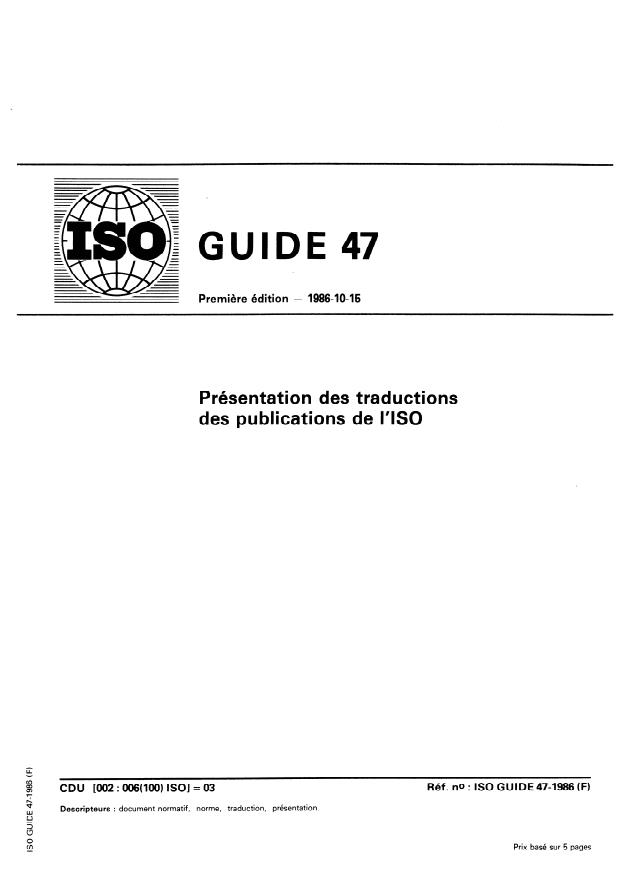

ISO Guide 47:1986 - Présentation des traductions des publications de l'ISO
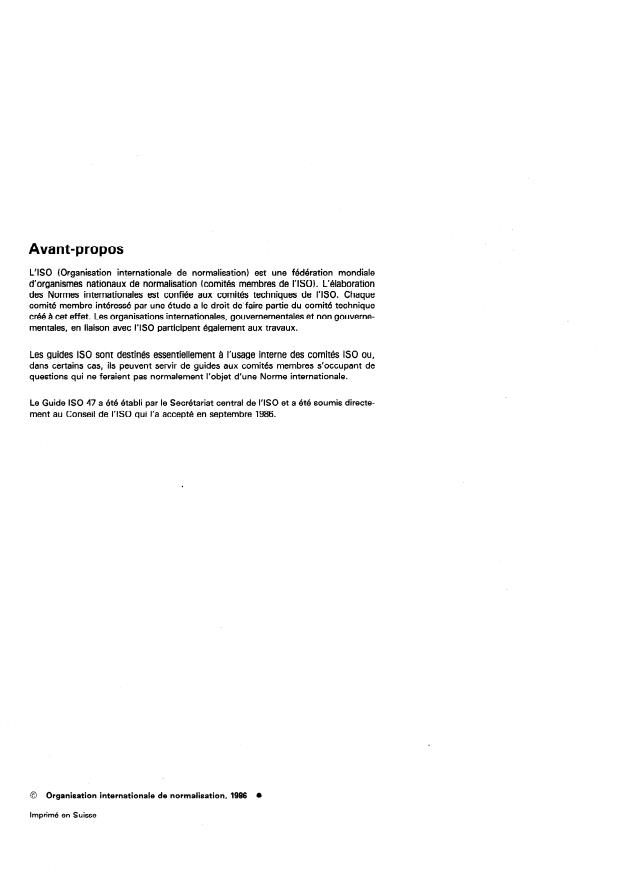
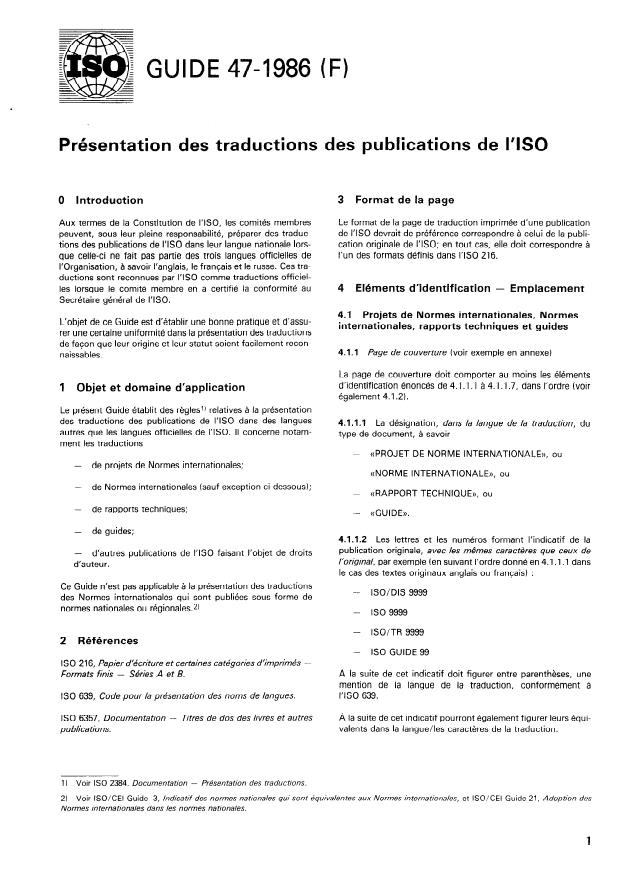

ISO Guide 47:1986 - Présentation des traductions des publications de l'ISO
Frequently Asked Questions
ISO Guide 47:1986 is a guide published by the International Organization for Standardization (ISO). Its full title is "Presentation of translations of ISO publications". This standard covers: This Guide establishes rules for the presentation of translations of ISO publications into languages other than the official ISO languages. It applies to translations of draft International Standards, International Standards, Technical Reports, Guides, other copyrighted ISO publications. It does not apply to translations of International Standards which are published in the form of national standards or regional standards. This Guide has been drawn up with the object of achieving a degree of uniformity in the presentation of these translations so that their origin and status may be easily recognized.
This Guide establishes rules for the presentation of translations of ISO publications into languages other than the official ISO languages. It applies to translations of draft International Standards, International Standards, Technical Reports, Guides, other copyrighted ISO publications. It does not apply to translations of International Standards which are published in the form of national standards or regional standards. This Guide has been drawn up with the object of achieving a degree of uniformity in the presentation of these translations so that their origin and status may be easily recognized.
ISO Guide 47:1986 is classified under the following ICS (International Classification for Standards) categories: 01.120 - Standardization. General rules. The ICS classification helps identify the subject area and facilitates finding related standards.
ISO Guide 47:1986 is available in PDF format for immediate download after purchase. The document can be added to your cart and obtained through the secure checkout process. Digital delivery ensures instant access to the complete standard document.
Standards Content (Sample)
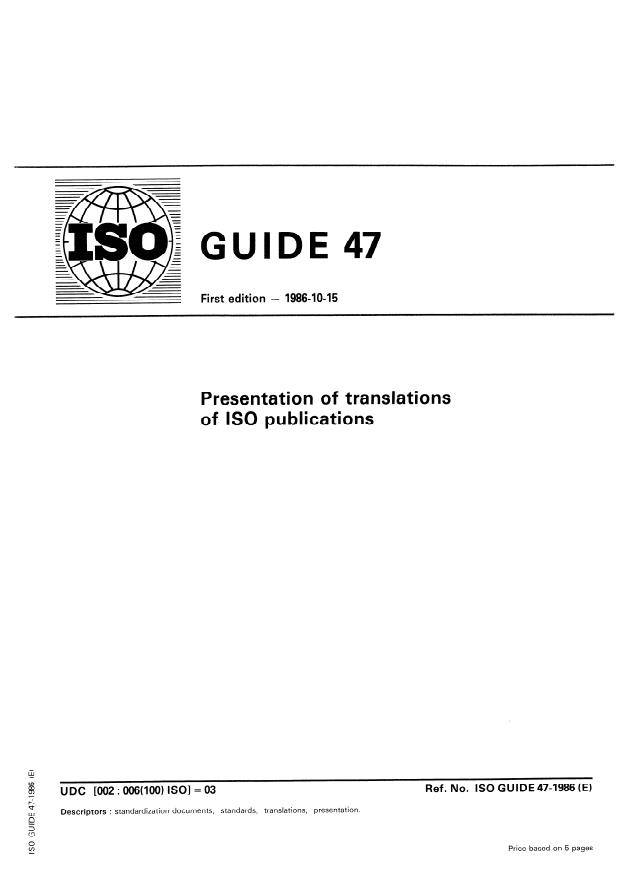
First edition
Presentation of translations
of IS0 publications
UDC [002: 006(100) IS01 = 03 Ref. No. IS0 GUIDE 47-1986 (E)
: standardization documents, standards, translations, presentation.
Descriptors
-
Price based on 5 pages
I
I
I
*
i u
* I
i’, p n I
*
‘i J* r
$ “p? c
r
f
n.
I *
I
t
t J
/
J
‘:,y
I’
x
+
d
f
r
F
‘1
i
J .
47-1
GUIDE 986 (E)
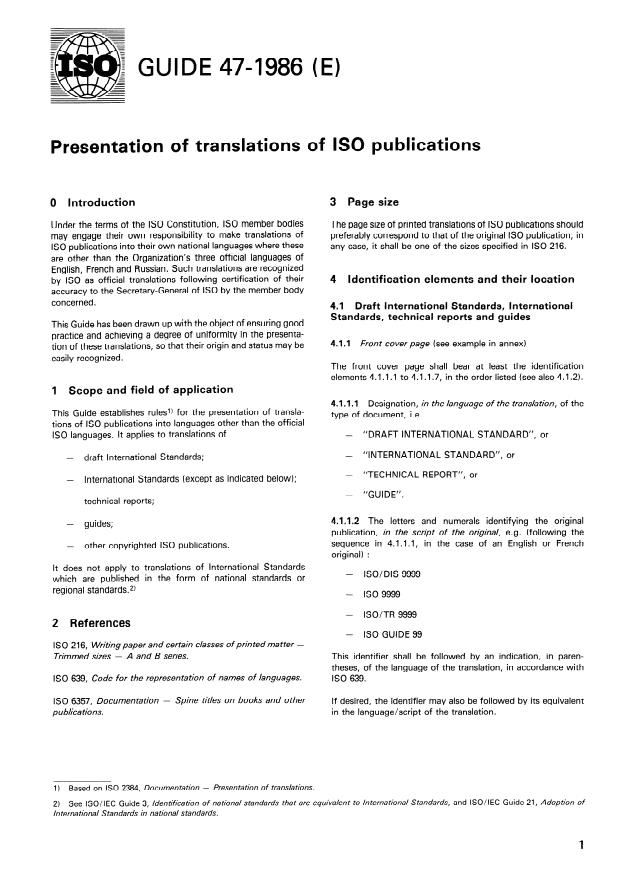
Presentation of translations of IS0 publications
0 Introduction 3 Page size
Under the terms of the IS0 Constitution, IS0 member bodies The page size of printed translations of IS0 publications should
may engage their own responsibility to make translations of preferably correspond to that of the original IS0 publication; in
IS0 publications into their own national languages where these any case, it shall be one of the sizes specified in IS0 216.
are other than the Organization’s three official languages of
English, French and Russian. Such translations are recognized
by IS0 as official translations following certification of their
4 Identification elements and their location
accuracy to the Secretary-General of IS0 by the member body
concerned.
4.1 Draft International Standards, International
Standards, technical reports and guides
This Guide has been drawn up with the object of ensuring good
practice and achieving a degree of uniformity in the presenta-
4.1.1 Front cover page (see example in annex)
tion of these translations, so that their origin and status may be
easily recognized.
The front cover page shall bear at least the identification
elements 4.1.1.1 to 4.1.1.7, in the order listed (see also 4.1.2).
Scope and field of application
4.1.1.1 Designation, language translation,
This Guide establishes rulesl) for the presentation of transla-
type of document, i.e
tions of IS0 publications into languages other than the official
-
IS0 languages. It applies to translations of
“DRAFT INTERNATIONAL STANDARD”, or
-
“INTERNATIONAL STANDARD”, or
draft International Standards;
-
“TECHNICAL REPORT”, or
-
International Standards (except as indicated below);
-
“GUIDE”.
technical reports;
4.1.1.2 The letters and numerals identifying the original
guides;
publication, in the script of the original, e.g. (following the
- sequence in 4.1 .I .I, in the case of an English or French
other copyrighted IS0 publications.
original) :
It does not apply to translations of International Standards
- ISO/DIS 9999
which are published in the form of national standards or
regional standards?)
- IS0 9999
- lSO/TR 9999
2 References
- IS0 GUIDE 99
classes of printed matter -
IS0 216, Writing paper and certain
Trimmed sizes - A and B series.
This identifier shall be followed by an indication, in paren-
theses, of the language of the translation, in accordance with
IS0 639, Code for the representation of names of languages.
IS0 639.
Spine titles on books and other
IS0 6357, Documentation - If desi red, the identifier may
also be followed by its equivalent
publications.
in the language/script of the translation.
1) Based on IS0 2384, Documentation - Presentation of translations.
2) See ISO/IEC Guide 3, identification of national standards that are equivalent to international Standards, and ISO/IEC Guide 21, Adoption of
In terna tional Standards in national standards.
IS0 GUIDE 47-1986 (El
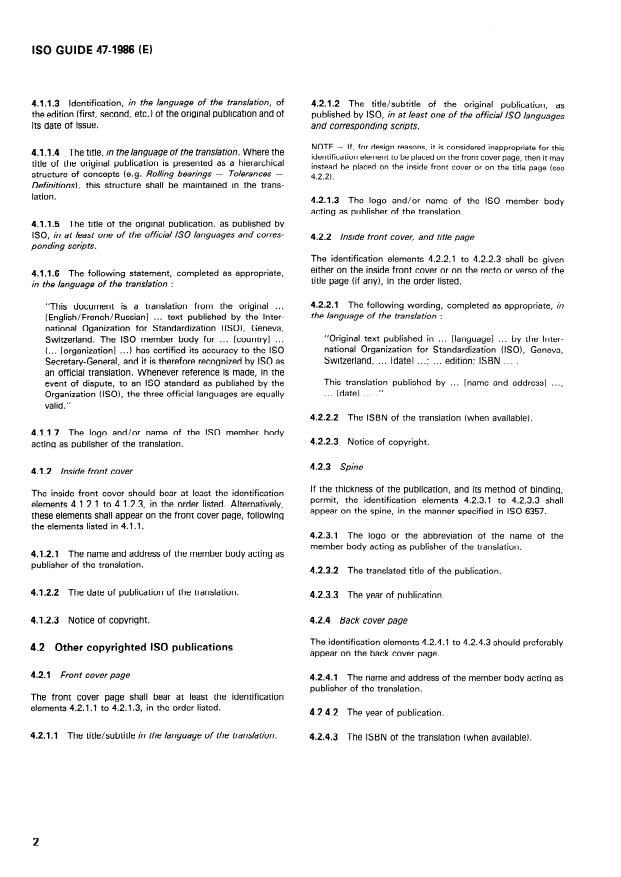
4.2.1.2 The title/subtitle of the original publication, as
4.1.1.3 Identification, in the language of the translation, of
the edition (first, second, etc.) of the original publication and of published by ISO, in at least one of the official /SO languages
and corresponding scripts.
its date of issue.
NOTE - if, for design reasons, it is considered inappropriate for this
4.1 .I .4 The title, in the language of the translation. Where the
‘
identification element to be placed on the front cover page, then it may
title of the original publication is presented as a hierarchical
instead be placed on the inside front cover or on the title page (see
structure of concepts (e.g. Roling bearings - Tolerances -
42.2).
Definitions), this structure shall be maintained in the trans-
lation.
4.2.1.3 The logo and/or name of the IS0 member body
acting as publisher of the translation.
4.1.1.5 The title of the original publication, as published by
ISO, in at least one of the official /SO languages and corres-
4.2.2 Inside front cover, and title page
ponding scripts.
The identification elements 4.2.2.1 to 4.2.2.3 shall be given
either on the inside front cover or on the recta or verso of the
completed as appropriate,
4. 1 .I .6 The following statement,
title page (if any), in the order listed.
in the language of the translation :
4.2.2.1 The
followi ng wording, completed as appropriate, in
“This document is a translation from the original . . .
the language of the translation :
[English/French/Russian] . . . text published by the Inter-
national Oganization for Standardization (ISO), Geneva,
“Original text published in . . . [language] . . . by the Inter-
Switzerland. The IS0 member body for . . . [country] . . .
national Organization for Standardization (ISO), Geneva,
. . . ) has certified its accuracy to the IS0
(. . . [organization]
Switzerland, . . . [date] . . .; . . . edition; IS BN . . . .
Secretary-General, and it is therefore recognized by IS0 as
an official translation. Whenever reference is made, in the
This translation published by . . . [name and address] . . . ,
event of dispute, to an IS0 standard as published by the
. . . [date] . . . .I’
Organization (ISO), the three official languages are equally
valid.”
4.2.2.2 The ISBN of the translation (when available).
4.1.1.7 The logo and/or name of the IS0 member body
4.2.2.3 Notice of copyright.
acting as publisher of the translation.
4.2.3 Spine
4.1.2 Inside front cover
If the thickness of the publication, and its method of binding,
The inside front cover should bear at least the identification
permit, the identification elements 4.2.3.1 to 4.2.3.3 shall
elements 4.1.2.1 to 4.1.2.3, in the order listed. Alternatively,
appear on the spine, in the manner specified in IS0 6357.
these elements shall appear on the front cover page, following
the elements listed in 4.1.1.
4.2.3.1 The logo or the abbreviation of the na me of the
member body acting as publ
...
GUID E 47
Première édition - 1986- 1 O-15
Présentation des traductions
des publications de I’ISO
Réf. no : ISO GUIDE 47-1986 (F)
CDU [002 : 006(100) ISOI = 03
Descripteurs : document normatif, norme, traduction, présentation.
cn Prix basé sur 5 pages
-
Avant-propos
LIS0 (Organisation internationale de normalisation) est une fédération mondiale
d’organismes nationaux de normalisation (comités membres de I’ISO). L’élaboration
des Normes internationales est confiée aux comités techniques de I’ISO. Chaque
comité membre intéressé par une étude a le droit de’faire partie du comité technique
créé à cet effet. Les organisations internationales, gouvernementales et non gouverne-
mentales, en liaison avec I’ISO participent également aux travaux.
Les guides ISO sont destinés essentiellement à l’usage interne des comités ISO ou,
dans certains cas, ils peuvent servir de guides aux comités membres s’occupant de
questions qui ne feraient pas normalement l’objet d’une Norme internationale.
Le Guide ISO 47 a été établi par le Secrétariat central de I’ISO et a été soumis directe-
ment au Conseil de I’ISO qui l’a accepté en septembre 1986.
0 Organisation internationale de normalisation, 1986
Imprimé en Suisse
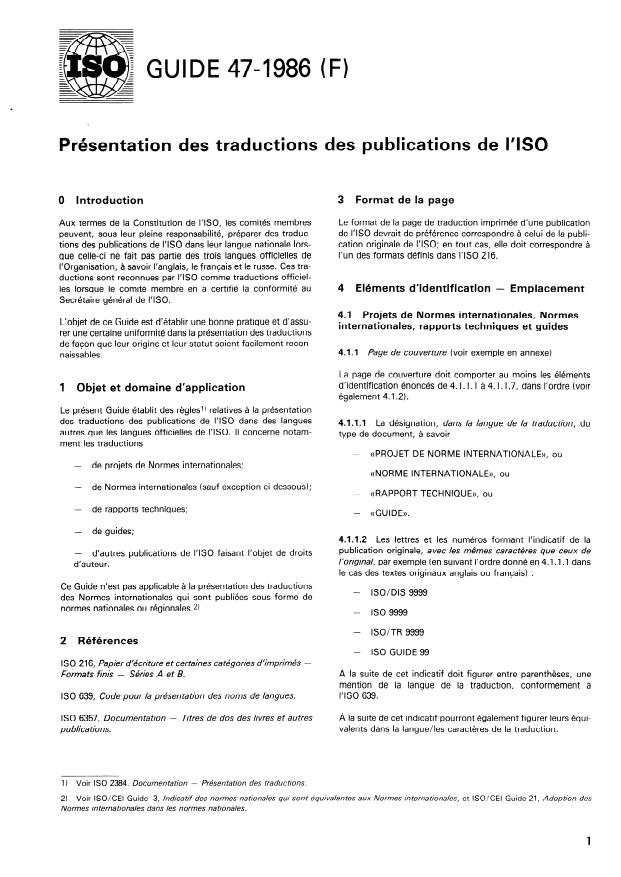
Présentation des traductions des publications de IWO
3 Format de la page
0 Introduction
Le format de la page de traduction imprimée d’une publication
Aux termes de la Constitution de I’ISO, les comités membres
de I’ISO devrait de préférence correspondre à celui de la publi-
peuvent, sous leur pleine responsabilité, préparer des traduc-
cation originale de I’ISO; en tout cas, elle doit correspondre à
tions des publications de I’ISO dans leur langue nationale lors-
l’un des formats définis dans I’ISO 216.
que celle-ci ne fait pas partie des trois langues officielles de
l’Organisation, à savoir l’anglais, le francais et le russe. Ces tra-.
ductions sont reconnues par I’ISO comme traductions officiel-
les lorsque le comité membre en a certifié la conformité au 4 Eléments d’identification - Emplacement
Secrétaire général de I’ISO.
4.1 Projets de Normes internationales, Normes
L’objet de ce Guide est d%tablir une bonne pratique et d’assu-
internationales, rapports techniques et guides
rer une certaine uniformité dans la présentation des traductions
de facon que leur origine et leur statut soient facilement recon-
4.1 .l Page de couverture (voir exemple en annexe)
naissables.
La page de couverture doit comporter au moins les éléments
d’identification énoncés de 4.1.1 .l à 4.1.1.7, dans l’ordre (voir
1 Objet et domaine d’application
également 4.1.2).
Le présent Guide établit des règles’) relatives à la présentation
des traductions des publications de I’ISO dans des langues
4.1.1.1 La désignation, dans fa langue de la traduction, du
autres que les langues officielles de I’ISO. II concerne notam-
type de document, à savoir
ment les traductions
-
«PROJET DE NORME INTERNATIONALE», ou
- de projets de Normes internationales;
-
«NORME INTERNATIONALE», ou
-
de Normes internationales (sauf exception ci-dessous);
-
«RAPPORT TECHNIQUE», ou
- de rapports techniques;
-
«GUIDE».
- de guides;
4.1.1.2 Les lettres et les numéros formant l’indicatif de la
publication originale, avec /es memes caractères que ceux de
-
d’autres publications de I’ISO faisant l’objet de droits
l’original, par exemple (en suivant l’ordre donné en 4.1.1.1 dans
d’auteur.
le cas des textes originaux anglais ou francais) :
,
Ce Guide n’est pas applicable à la présentation des traductions
- ISO/DIS 9999
des Normes internationales qui sont publiées sous forme de
normes nationales ou régionales. 2)
- ISO 9999
- ISO/TR 9999
2 Références
- ISO GUIDE 99
I S 0 2 16, Papier d’écriture et certaines catégories d’imprimés -
À la suite de cet indicatif doit figurer entre parenthèses, une
Formats finis - Séries A et B.
mention de la langue de la traduction, conformément à
I’ISO 639.
ISO 639, Code pour la présentation des noms de langues.
ISO 6357, Documentation - Titres de dos des livres et autres À la suite de cet indicatif pourront également figurer leurs équi-
valents dans la langue/les caractères de la traduction.
publications.
-
1) Voir ISO 2384, Documentation - Présentation des traductions.
2) Voir ISOICEI Guide 3, indicatif des normes nationales qui sont é quivalen tes Normes in terna tionales, et ISOKEI Guide 21, Adoption des
nationales.
Normes in terna tionales dans les normes
Page blanche
ISO GUIDE 47-1986 (F)
5 Présentation de la traduction 9 Translittération
Dans le cas d’une traduction imprimée dans une langue dont
Les subdivisions du texte original en chapitres, paragraphes et
alinéas et leur numérotation doivent être respectées dans la tra- les caractères ne sont pas ceux utilisés dans l’original, la trans-
duction. Si, exceptionnellement, des différences existent entre Iittération doit être conforme aux Normes internationales
la traduction et le texte original, que ces différences soient des correspondantes.
omissions, des corrections, des raccourcissements ou des
adjonctions à des passages du texte, à des index ou à la biblio-
graphie, elles doivent être clairement indiquées et justifiées 10 Noms et sigles d’organismes
dans de
...
GUID E 47
Première édition - 1986- 1 O-15
Présentation des traductions
des publications de I’ISO
Réf. no : ISO GUIDE 47-1986 (F)
CDU [002 : 006(100) ISOI = 03
Descripteurs : document normatif, norme, traduction, présentation.
cn Prix basé sur 5 pages
-
Avant-propos
LIS0 (Organisation internationale de normalisation) est une fédération mondiale
d’organismes nationaux de normalisation (comités membres de I’ISO). L’élaboration
des Normes internationales est confiée aux comités techniques de I’ISO. Chaque
comité membre intéressé par une étude a le droit de’faire partie du comité technique
créé à cet effet. Les organisations internationales, gouvernementales et non gouverne-
mentales, en liaison avec I’ISO participent également aux travaux.
Les guides ISO sont destinés essentiellement à l’usage interne des comités ISO ou,
dans certains cas, ils peuvent servir de guides aux comités membres s’occupant de
questions qui ne feraient pas normalement l’objet d’une Norme internationale.
Le Guide ISO 47 a été établi par le Secrétariat central de I’ISO et a été soumis directe-
ment au Conseil de I’ISO qui l’a accepté en septembre 1986.
0 Organisation internationale de normalisation, 1986
Imprimé en Suisse
Présentation des traductions des publications de IWO
3 Format de la page
0 Introduction
Le format de la page de traduction imprimée d’une publication
Aux termes de la Constitution de I’ISO, les comités membres
de I’ISO devrait de préférence correspondre à celui de la publi-
peuvent, sous leur pleine responsabilité, préparer des traduc-
cation originale de I’ISO; en tout cas, elle doit correspondre à
tions des publications de I’ISO dans leur langue nationale lors-
l’un des formats définis dans I’ISO 216.
que celle-ci ne fait pas partie des trois langues officielles de
l’Organisation, à savoir l’anglais, le francais et le russe. Ces tra-.
ductions sont reconnues par I’ISO comme traductions officiel-
les lorsque le comité membre en a certifié la conformité au 4 Eléments d’identification - Emplacement
Secrétaire général de I’ISO.
4.1 Projets de Normes internationales, Normes
L’objet de ce Guide est d%tablir une bonne pratique et d’assu-
internationales, rapports techniques et guides
rer une certaine uniformité dans la présentation des traductions
de facon que leur origine et leur statut soient facilement recon-
4.1 .l Page de couverture (voir exemple en annexe)
naissables.
La page de couverture doit comporter au moins les éléments
d’identification énoncés de 4.1.1 .l à 4.1.1.7, dans l’ordre (voir
1 Objet et domaine d’application
également 4.1.2).
Le présent Guide établit des règles’) relatives à la présentation
des traductions des publications de I’ISO dans des langues
4.1.1.1 La désignation, dans fa langue de la traduction, du
autres que les langues officielles de I’ISO. II concerne notam-
type de document, à savoir
ment les traductions
-
«PROJET DE NORME INTERNATIONALE», ou
- de projets de Normes internationales;
-
«NORME INTERNATIONALE», ou
-
de Normes internationales (sauf exception ci-dessous);
-
«RAPPORT TECHNIQUE», ou
- de rapports techniques;
-
«GUIDE».
- de guides;
4.1.1.2 Les lettres et les numéros formant l’indicatif de la
publication originale, avec /es memes caractères que ceux de
-
d’autres publications de I’ISO faisant l’objet de droits
l’original, par exemple (en suivant l’ordre donné en 4.1.1.1 dans
d’auteur.
le cas des textes originaux anglais ou francais) :
,
Ce Guide n’est pas applicable à la présentation des traductions
- ISO/DIS 9999
des Normes internationales qui sont publiées sous forme de
normes nationales ou régionales. 2)
- ISO 9999
- ISO/TR 9999
2 Références
- ISO GUIDE 99
I S 0 2 16, Papier d’écriture et certaines catégories d’imprimés -
À la suite de cet indicatif doit figurer entre parenthèses, une
Formats finis - Séries A et B.
mention de la langue de la traduction, conformément à
I’ISO 639.
ISO 639, Code pour la présentation des noms de langues.
ISO 6357, Documentation - Titres de dos des livres et autres À la suite de cet indicatif pourront également figurer leurs équi-
valents dans la langue/les caractères de la traduction.
publications.
-
1) Voir ISO 2384, Documentation - Présentation des traductions.
2) Voir ISOICEI Guide 3, indicatif des normes nationales qui sont é quivalen tes Normes in terna tionales, et ISOKEI Guide 21, Adoption des
nationales.
Normes in terna tionales dans les normes
Page blanche
ISO GUIDE 47-1986 (F)
5 Présentation de la traduction 9 Translittération
Dans le cas d’une traduction imprimée dans une langue dont
Les subdivisions du texte original en chapitres, paragraphes et
alinéas et leur numérotation doivent être respectées dans la tra- les caractères ne sont pas ceux utilisés dans l’original, la trans-
duction. Si, exceptionnellement, des différences existent entre Iittération doit être conforme aux Normes internationales
la traduction et le texte original, que ces différences soient des correspondantes.
omissions, des corrections, des raccourcissements ou des
adjonctions à des passages du texte, à des index ou à la biblio-
graphie, elles doivent être clairement indiquées et justifiées 10 Noms et sigles d’organismes
dans de
...
Questions, Comments and Discussion
Ask us and Technical Secretary will try to provide an answer. You can facilitate discussion about the standard in here.
Loading comments...