

ISO 234-2:1982
(Main)Files and rasps — Part 2: Characteristics of cut
General Information
- Abstract
- Status
- Published
- Publication Date
- 30-Apr-1982
- Technical Committee
- ISO/TC 29 - Small tools
- Drafting Committee
- ISO/TC 29 - Small tools
- Current Stage
- 9093 - International Standard confirmed
- Start Date
- 05-Dec-2023
- Completion Date
- 29-Aug-2026
Buy Documents

ISO 234-2:1982 - Files and rasps — Part 2: Characteristics of cut Released:5/1/1982

ISO 234-2:1982 - Limes et râpes — Partie 2: Caractéristiques de taille Released:5/1/1982

ISO 234-2:1982 - Limes et râpes — Partie 2: Caractéristiques de taille Released:5/1/1982
Overview
ISO 234-2:1982 is an international standard published by the International Organization for Standardization (ISO) that specifies the characteristics of cut for files and rasps. This standard complements ISO 234-1, which covers dimensions, by defining key parameters such as cutting angles, coarseness of cut, and the number of teeth for various types of files and rasps. Established by ISO Technical Committee ISO/TC 29 on Small Tools, this standard aims to unify terminology and technical specifications used in the trade worldwide, enhancing compatibility and quality assurance in tool manufacturing and usage.
Key Topics
Coarseness of Cut
Defines the number of teeth per centimetre for files and per square centimetre for rasps, including tolerance levels. Coarseness categories such as bastard, second cut, smooth, coarse, medium, and fine cuts are detailed for various tool types.Cutting Angle
Specifies the angle between the principal cut and the file centerline. For example, engineer’s files typically have a cutting angle of 60° ±5°, while the cutting angles on rasp edges may differ.File Types Covered
- Engineer’s files (double cut): hand, flat, half-round, round, square, three-square
- Mill files (single cut): flat, half-round, round, cabinet
- Taper saw files (single cut): triangular section files
- Wood rasps: taper or blunt, flat section with square or round edges or one round edge
Measurement Methods
Details the method of tooth counting for files (principal cut teeth counted along the centreline) and rasps (teeth per square centimetre on the non-tapered part).Tolerances
Outlines standard tolerances on the cut for different tool types, ensuring consistency in manufacturing.
Applications
ISO 234-2:1982 is essential for manufacturers, quality control engineers, and users of hand tools such as files and rasps. It helps:
- Ensure uniform quality of files and rasps across suppliers and international markets
- Define clear specifications for designing and producing files and rasps with specific cutting performances
- Guide tool selection based on cut coarseness and application requirements in metalworking, woodworking, and maintenance tasks
- Facilitate compatibility in tooling components by standardizing key parameters such as cutting angle and teeth count
This standard supports industries such as mechanical engineering, metal fabrication, woodworking, and maintenance services, improving efficiency and tool life.
Related Standards
ISO 234-1: Files and Rasps - Dimensions
Provides dimensional specifications that complement the cutting characteristics defined in ISO 234-2.ISO 234-7 (Draft Stage): Files and Rasps - Additional parts detailing further dimensions and properties.
By referencing ISO 234-2 in conjunction with related ISO parts, users gain a comprehensive framework for specifying and verifying file and rasp tools used in diverse industrial and craft applications.
Keywords: ISO 234-2, files and rasps, cut characteristics, cutting angle, coarseness of cut, hand tools, files, rasps, tool standards, technical specifications, cut tolerance, manufacturer guidelines, woodworking tools, metalworking files
Buy Documents
ISO 234-2:1982 - Files and rasps — Part 2: Characteristics of cut Released:5/1/1982
ISO 234-2:1982 - Limes et râpes — Partie 2: Caractéristiques de taille Released:5/1/1982
ISO 234-2:1982 - Limes et râpes — Partie 2: Caractéristiques de taille Released:5/1/1982
Get Certified
Connect with accredited certification bodies for this standard

DVS-ZERT GmbH
German welding certification society.
CARES (UK Certification Authority for Reinforcing Steels)
UK certification for reinforcing steels and construction.
EWF/IIW (European/International Welding Federation)
International welding personnel certification.
Sponsored listings
Frequently Asked Questions
ISO 234-2:1982 is a standard published by the International Organization for Standardization (ISO). Its full title is "Files and rasps — Part 2: Characteristics of cut". This standard covers: Files and rasps — Part 2: Characteristics of cut
Files and rasps — Part 2: Characteristics of cut
ISO 234-2:1982 is classified under the following ICS (International Classification for Standards) categories: 25.100.60 - Files. The ICS classification helps identify the subject area and facilitates finding related standards.
ISO 234-2:1982 is available in PDF format for immediate download after purchase. The document can be added to your cart and obtained through the secure checkout process. Digital delivery ensures instant access to the complete standard document.
Standards Content (Sample)
International Standard
INTERNATlONAi ORGANIZATION FOR STANDARDIZATION*MEXI(CIYHAPOflHAR OPfAHM3AlJMR l-l0 CTAH~APT~3AlJ4VWORGANlSAilON INTERNATIONALE DE NORMALISATION
Files and rasps -
Part 2 : Characteristics of cut
Limes et r&es - Pahe 2 : Caract&istiques de taifle
First edition - 1982~05-15
UDC 621.918.2
Ref. No. IS0 234/2-1982 (E)
Descriptors : tools, hand tools, files (tools), dimensions, shape,
length, cutting angle, characteristics.
Price based on 2 pages
PreisgL \Q
Foreword
IS0 (the International Organization for Standardization) is a worldwide federation of
national standards institutes (IS0 member bodies). The work of developing Inter-
national Standards is carried out through IS0 technical committees. Every member
body interested in a subject for which a technical committee has been set up has the
right to be represented on that committee. International organizations, governmental
and non-governmental, in liaison with ISO, also take part in the work.
Draft International Standards adopted by the technical committees are circulated to
the member bodies for approval before their acceptance as International Standards by
the IS0 Council.
International Standard IS0 234/2 (formerly draft International Standard ISO/DIS 6350)
was developed by Technical Committee ISO/TC 29, Small too/s, and was circulated to
the member bodies in March 1980.
It has been approved by the member bodies of the following countries :
India
Australia South Africa, Rep. of
Belgium Israel Spain
Czechoslovakia Italy Sweden
Finland Korea, Rep. of United Kingdom
France Mexico USSR
Germany, F. R. Netherlands
Hungary Romania
following countries expressed disapproval of the document
The member bodies of the
on technical grounds :
Austria
0 International Organization for Standardization, 1982
Printed in Switzerland
IS0 234/24982 (E)
INTERNATIONAL STANDARD
FI les and rasps
Part 2 I Characteristics of cut
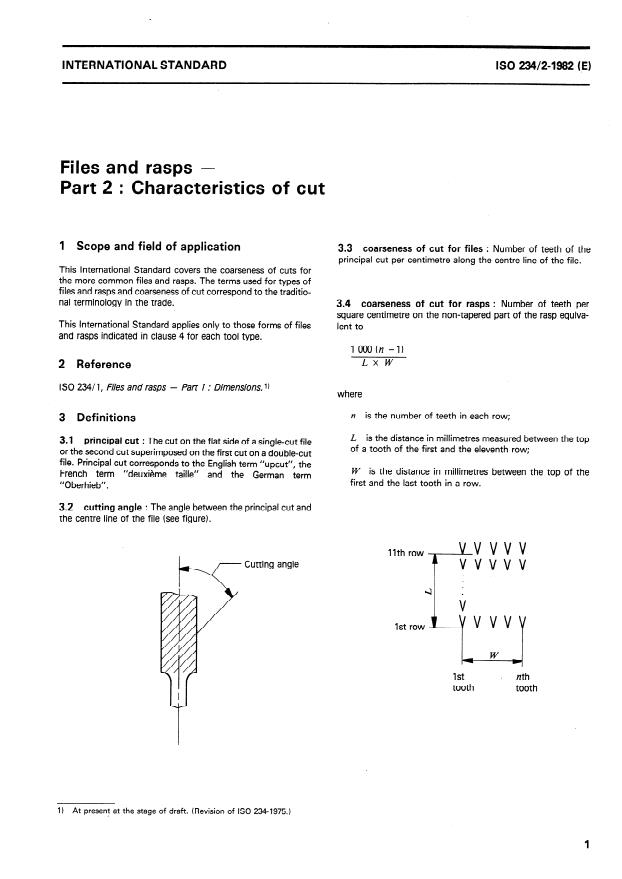
1 Scope and field of application 3.3 coarseness of cut for files : Number of teeth of the
principal cut per centimetre along the centre line of the file.
This International Standard covers the coarseness of cuts for
the more common files and rasps. The terms used for types of
files and rasps and coarseness of cut correspond to the traditio-
nal terminology in the trade. 3.4 coarseness of cut for rasps : Number of teeth per
square centimetre on the non-tapered part of the rasp equiva-
This International Standard applies only to those forms of files
lent to
and rasps indicated in clause 4 for each tool type.
1 ooo (n -1)
...
Norme internationale
INTERNATIONAL ORGANIZATION FOR STANDARDlZATION*MEIK~YHAPO~HAR OPf-AHkl3AL&lR l-l0 CTAH,QAPTkl3ALWl~ORGANISAilON INTERNATIONALE DE NORMALISATION
Limes et râpes -
Partie 2 : Caractéristiques de taille
Files and rasps - Part 2 : Characteristics of tut
Première édition - 1982-05-15
Réf. no : ISO 234/2-1982 (F)
CDU 621.918.2
Descripteurs : outil, outil à main, lime, dimension, forme, longueur, angle d’attaque, caractéristique.
Prix basé sur 2 pages
Avant-propos
L’ISQ (Organisation internationale de normalisation) est une fédération mondiale
d’organismes nationaux de normalisation (comités membres de I’ISO). L’élaboration
des Normes internationales est confiée aux comités techniques de I’ISO. Chaque
comité membre intéressé par une étude a le droit de faire partie du comité technique
correspondant. Les organisations internationales, gouvernementales et non gouverne-
mentales, en liaison avec I’ISO, participent également aux travaux.
Les projets de Normes internationales adoptés par les comités techniques sont soumis
aux comités membres pour approbation, avant leur acceptation comme Normes inter-
nationales par le Conseil de I’ISO.
La Norme internationale ISO 234/2 (précédemment projet de Norme internationale
ISO/DIS 6350) a été élaborée par le comité technique ISWTC 29, Petit outi//age, et a
été soumise aux comités membres en mars 1980.
Les comités membres des pays suivants l’ont approuvée :
Afrique du Sud, Rép. d’ France Roumanie
Allemagne, R. F. Hongrie Royaume-Uni
Australie Inde
Suède
Belgique Israël Tchécoslovaquie
Corée, Rép. de Italie
URSS
Espagne Mexique
Finlande
Pays- Bas
Les comités membres des pays suivants l’ont désapprouvée pour des raisons techni-
ques :
Autriche
Pologne
0 Organisation internationale de normalisation, 1982
Imprimé en Suisse
NORME INTERNATIONALE BS0 23412~1982 QF)
Limes et râpes -
artie 2 : Caractéristiques de taille
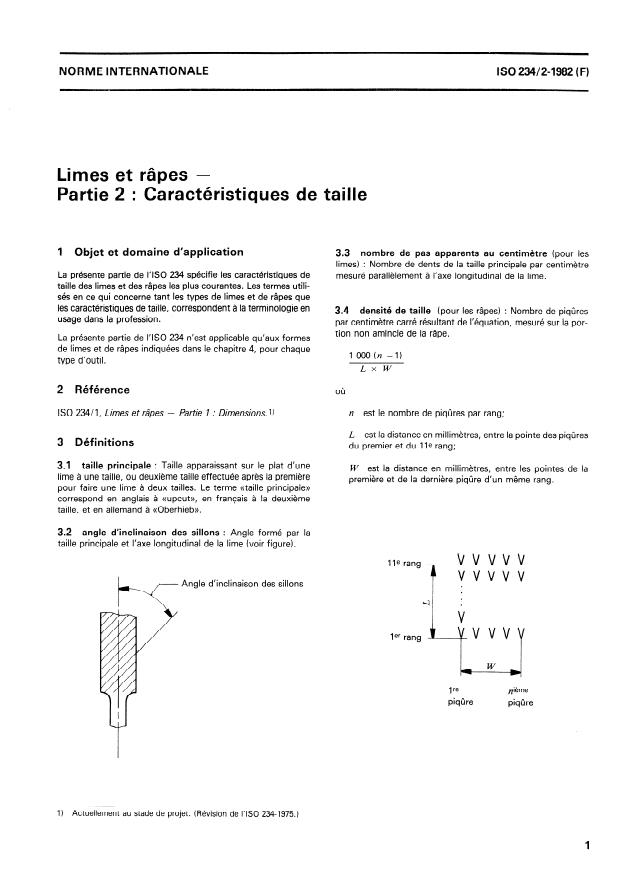
1 Objet et domaine d’application 33 nombre de pas apparents au centihtre (pour les
limes) : Nombre de dents de la taille principale par centimètre
La présente partie de I’ISO 234 spécifie les caractéristiques de mesuré parallèlement à l’axe longitudinal de la lime.
taille des limes et des râpes les plus courantes. Les termes utili-
sés en ce qui concerne tant les types de limes et de râpes que
les caractéristiques de taille, correspondent à la terminologie en
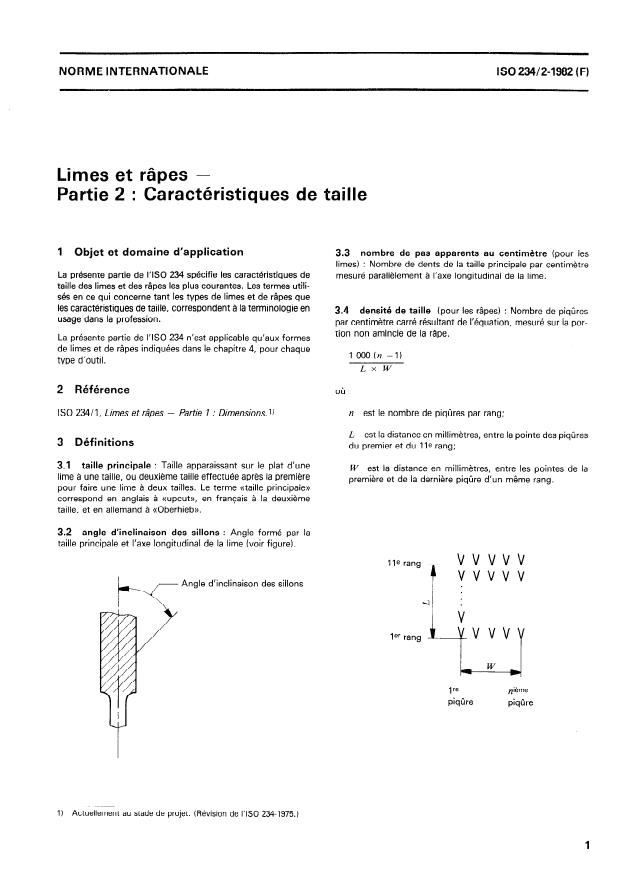
3.4 densité de taille (pour les râpes) : Nombre de piqûres
usage dans la profession.
par centimètre carré résultant de l’équation, mesuré sur la por-
tion non amincie de la râpe.
La présente partie de I’ISO 234 n’est applicable qu’aux formes
de limes et de râpes indiquées dans le chapitre 4, pour chaque
1 OOO(n -1)
type d’outil.
Lx w
2 Référence Où
I SO 234/ 1, Limes et râpes - Partie I : Dimensions. 1) y1 est le n
...
Norme internationale
INTERNATIONAL ORGANIZATION FOR STANDARDlZATION*MEIK~YHAPO~HAR OPf-AHkl3AL&lR l-l0 CTAH,QAPTkl3ALWl~ORGANISAilON INTERNATIONALE DE NORMALISATION
Limes et râpes -
Partie 2 : Caractéristiques de taille
Files and rasps - Part 2 : Characteristics of tut
Première édition - 1982-05-15
Réf. no : ISO 234/2-1982 (F)
CDU 621.918.2
Descripteurs : outil, outil à main, lime, dimension, forme, longueur, angle d’attaque, caractéristique.
Prix basé sur 2 pages
Avant-propos
L’ISQ (Organisation internationale de normalisation) est une fédération mondiale
d’organismes nationaux de normalisation (comités membres de I’ISO). L’élaboration
des Normes internationales est confiée aux comités techniques de I’ISO. Chaque
comité membre intéressé par une étude a le droit de faire partie du comité technique
correspondant. Les organisations internationales, gouvernementales et non gouverne-
mentales, en liaison avec I’ISO, participent également aux travaux.
Les projets de Normes internationales adoptés par les comités techniques sont soumis
aux comités membres pour approbation, avant leur acceptation comme Normes inter-
nationales par le Conseil de I’ISO.
La Norme internationale ISO 234/2 (précédemment projet de Norme internationale
ISO/DIS 6350) a été élaborée par le comité technique ISWTC 29, Petit outi//age, et a
été soumise aux comités membres en mars 1980.
Les comités membres des pays suivants l’ont approuvée :
Afrique du Sud, Rép. d’ France Roumanie
Allemagne, R. F. Hongrie Royaume-Uni
Australie Inde
Suède
Belgique Israël Tchécoslovaquie
Corée, Rép. de Italie
URSS
Espagne Mexique
Finlande
Pays- Bas
Les comités membres des pays suivants l’ont désapprouvée pour des raisons techni-
ques :
Autriche
Pologne
0 Organisation internationale de normalisation, 1982
Imprimé en Suisse
NORME INTERNATIONALE BS0 23412~1982 QF)
Limes et râpes -
artie 2 : Caractéristiques de taille
1 Objet et domaine d’application 33 nombre de pas apparents au centihtre (pour les
limes) : Nombre de dents de la taille principale par centimètre
La présente partie de I’ISO 234 spécifie les caractéristiques de mesuré parallèlement à l’axe longitudinal de la lime.
taille des limes et des râpes les plus courantes. Les termes utili-
sés en ce qui concerne tant les types de limes et de râpes que
les caractéristiques de taille, correspondent à la terminologie en
3.4 densité de taille (pour les râpes) : Nombre de piqûres
usage dans la profession.
par centimètre carré résultant de l’équation, mesuré sur la por-
tion non amincie de la râpe.
La présente partie de I’ISO 234 n’est applicable qu’aux formes
de limes et de râpes indiquées dans le chapitre 4, pour chaque
1 OOO(n -1)
type d’outil.
Lx w
2 Référence Où
I SO 234/ 1, Limes et râpes - Partie I : Dimensions. 1) y1 est le n
...