

ISO 234-1:1983
(Main)Files and rasps — Part 1: Dimensions
General Information
- Abstract
In contrast to the previous edition (ISO 234-1975), this part of ISO 234 is limited to the most commonly used files and rasps. Does not apply to files and rasps of special manufacture as well as precision files with milled teeth. Specifies the lengths and cross-sections of engineers' files with double cut taper saw files with single cut, mill files and rasps.
- Status
- Published
- Publication Date
- 30-Nov-1983
- Technical Committee
- ISO/TC 29 - Small tools
- Drafting Committee
- ISO/TC 29 - Small tools
- Current Stage
- 9093 - International Standard confirmed
- Start Date
- 04-Sep-2023
- Completion Date
- 29-Aug-2026
Buy Documents
ISO 234-1:1983 - Files and rasps — Part 1: Dimensions Released:12/1/1983
ISO 234-1:1983 - Limes et râpes — Partie 1: Dimensions Released:12/1/1983
ISO 234-1:1983 - Limes et râpes — Partie 1: Dimensions Released:12/1/1983
Overview
ISO 234-1:1983, titled "Files and Rasps - Part 1: Dimensions," is an international standard developed by the International Organization for Standardization (ISO). This part of ISO 234 specifies the dimensions-including lengths and cross-sections-of the most commonly used engineering files and rasps. The standard focuses on practical, widely-utilized tool types, excluding specialized or precision files such as those with milled teeth. It aims to provide clear, uniform dimensional guidelines to facilitate manufacturing, quality control, and interoperability in hand tools.
The standard was developed by the ISO Technical Committee ISO/TC 29 (Small Tools) and replaces the earlier 1975 edition (ISO 234-1975), reflecting updated selection criteria focused on standard types prevalent in global markets.
Key Topics
Scope and Limitations
ISO 234-1 applies exclusively to the most frequent types of files and rasps used in engineering and workshop settings. It excludes:- Special manufacture files (precision and custom types)
- Files with milled teeth
- Chain saw files with evolving dimensions
Types Covered
The standard defines dimensions for four main tool categories:- Workshop files (two standard sizes)
- Taper saw files with single cut
- Mill files
- Rasps
Dimensional Specifications
Dimensions like length, width, thickness, and diameter are given in millimeters, with inch equivalents provided in an annex for a transitional period of five years.
Key parameters include:- Overall length (excluding the tang)
- Cross-sectional shapes such as rectangular, half-round, round, square, and triangular
- Dimensions of the file’s body and pointed tips, where applicable
- Tolerances on length and cross-section are defined to ensure precise manufacturing
Terminology and Definitions
The document provides clear definitions of file parts such as tip, tapered section, tang, and parallel body. It also distinguishes between parallel-edged and pointed files based on dimensional ratios.
Applications
ISO 234-1:1983 is fundamental for:
- Manufacturers producing standard files and rasps, ensuring products meet international dimensional criteria for quality and compatibility.
- Quality assurance teams implementing consistent inspection standards to verify compliance and minimize rejects.
- Tool distributors and retailers who require standardized product specifications to inform purchasers and maintain inventory consistency.
- Workshops and engineers who rely on standardized hand tools to guarantee interchangeability and performance worldwide.
- Technical documentation and training where uniform terminology and dimensions support clarity in instructions and technical references.
Understanding and using this standard help reduce variability, promote tooling efficiency, and streamline global trade in hand tools.
Related Standards
ISO 234-2: 1983 - Files and rasps - Part 2: Teeth characteristics
Complements Part 1 by specifying the cutting surface parameters of files and rasps, including tooth pattern and pitch.ISO/TC 29 Small Tools standards
A broader suite of standards that cover various aspects of hand tool manufacturing, use, and safety.National standards aligned with ISO 234
Many countries adopt or reference ISO 234 to harmonize domestic tooling dimensions with international practice.
Keywords
Files dimensions, rasps standards, ISO 234-1, engineering files sizes, hand tools standardization, workshop files dimensions, taper saw files, mill files dimensions, rasps measurements, ISO tool standards, small tools dimensions, tool length tolerances, file cross-sections
Buy Documents
ISO 234-1:1983 - Files and rasps — Part 1: Dimensions Released:12/1/1983
ISO 234-1:1983 - Limes et râpes — Partie 1: Dimensions Released:12/1/1983
ISO 234-1:1983 - Limes et râpes — Partie 1: Dimensions Released:12/1/1983
Get Certified
Connect with accredited certification bodies for this standard

DVS-ZERT GmbH
German welding certification society.
CARES (UK Certification Authority for Reinforcing Steels)
UK certification for reinforcing steels and construction.
EWF/IIW (European/International Welding Federation)
International welding personnel certification.
Sponsored listings
Frequently Asked Questions
ISO 234-1:1983 is a standard published by the International Organization for Standardization (ISO). Its full title is "Files and rasps — Part 1: Dimensions". This standard covers: In contrast to the previous edition (ISO 234-1975), this part of ISO 234 is limited to the most commonly used files and rasps. Does not apply to files and rasps of special manufacture as well as precision files with milled teeth. Specifies the lengths and cross-sections of engineers' files with double cut taper saw files with single cut, mill files and rasps.
In contrast to the previous edition (ISO 234-1975), this part of ISO 234 is limited to the most commonly used files and rasps. Does not apply to files and rasps of special manufacture as well as precision files with milled teeth. Specifies the lengths and cross-sections of engineers' files with double cut taper saw files with single cut, mill files and rasps.
ISO 234-1:1983 is classified under the following ICS (International Classification for Standards) categories: 25.100.60 - Files. The ICS classification helps identify the subject area and facilitates finding related standards.
ISO 234-1:1983 is available in PDF format for immediate download after purchase. The document can be added to your cart and obtained through the secure checkout process. Digital delivery ensures instant access to the complete standard document.
Standards Content (Sample)
International Standard
234/I
INTERNATIONAL ORGANIZATION FOR STANDARDlZATIONWEIKJJYHAPOflHAR OPrAHH3AUHR fl0 CTAH~Prl43AlJWWORGANlSATlON INTERNATIONALE DE NORMALISATION
Files and rasps -
Part 1 I Dimensions
Limes et dpes - Par-tie I : Dimensions
First edition - 1983-12-15
UDC 621.918.12.4
Ref. No. IS0 234/l-1983 (E)
Descriptors : tools, hand tools, files (tools), dimensions, length, cross sections.
Price based on 6 pages
Prek~~ q $J
Foreword
IS0 (the International Organization for Standardization) is a worldwide federation of
national standards bodies (IS0 member bodies). The work of developing International
Standards is carried out through IS0 technical committees. Every member body
interested in a subject for which a technical committee has been authorized has the
right to be represented on that committee. International organizations, governmental
and non-governmental, in liaison with ISO, also take part in the work.
Draft International Standards adopted by the technical committees are circulated to
the member bodies for approval before their acceptance as International Standards by
the IS0 Council.
International Standard IS0 234/l was developed by Technical Committee ISO/TC 29,
Small too/s, and was circulated to the member bodies in November 1982.
It has been approved by the member bodies of the following countries:
Belgium Germany, F. R. Romania
Hungary South Africa, Rep. of
Brazil
Bulgaria India Spain
Israel Sweden
Canada
China Italy Switzerland
United Kingdom
Czechoslovakia Mexico
Egypt, Arab Rep. of Netherlands USSR
France Poland
The member bodies of the following countries expressed disapproval of the document
on technical grounds :
Australia
Austria
This International Standard cancels and replaces International Standard IS0 2344975.
International Organization for Standardization, 1983
Printed in Switzerland
IS0 234/l-1983 (E)
INTERNATIONAL STANDARD
Files and rasps -
Part 1 : Dimensions
Scope and field of application
0 Introduction 1
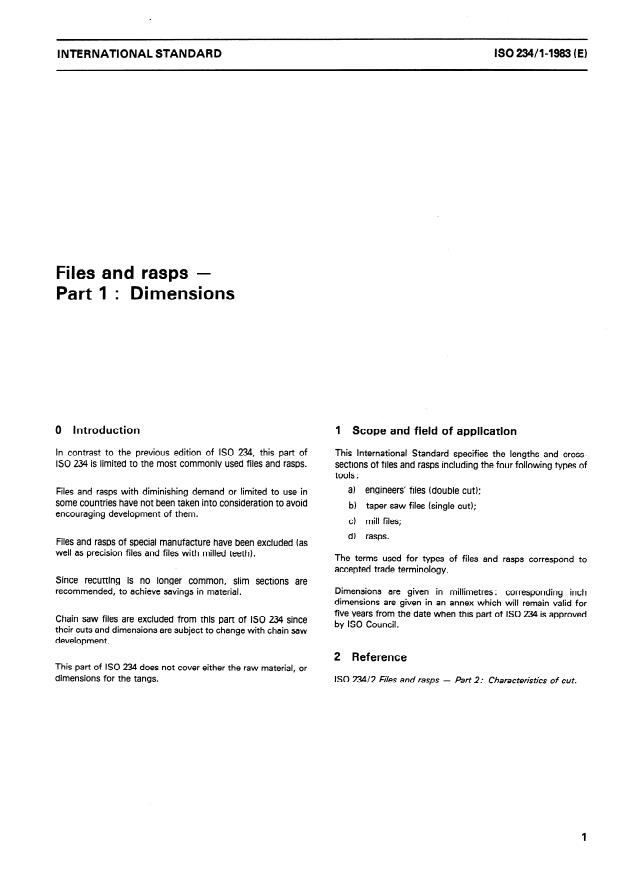
This International Standard specifies the lengths and cross-
In contrast to the previous edition of IS0 234, this part of
sections of files and rasps including the four following types of
IS0 234 is limited to the most commonly used files and rasps.
tools :
a) engineers’ files (double cut);
Files and rasps with diminishing demand or limited to use in
some countries have not been taken into consideration to avoid
b) taper saw files (single cut);
encouraging development of them.
c) mill files;
d) rasps.
Files and rasps of special manufacture have been excluded (as
well as precision files and files with milled teeth).
The terms used for types of files and rasps correspond to
accepted trade terminology.
Since recutting is no longer common, slim sections are
Dimensions are given in millimetres : corresponding inch
recommended, to achieve savings in material.
dimensions are given in an annex which will remain valid for
five years from the date when this part of IS0 234 is approved
Chain saw files are excluded from this part of IS0 234 since
by IS0 Council.
their cuts and dimensions are subject to change with chain saw
development.
2 Reference
This part of IS0 234 does not cover either the raw material, or
dimensions for the tangs. IS0 23412 Files and rasps - Part 2: Characteristics of cut.
e
IS0 234/l-1983 (E)
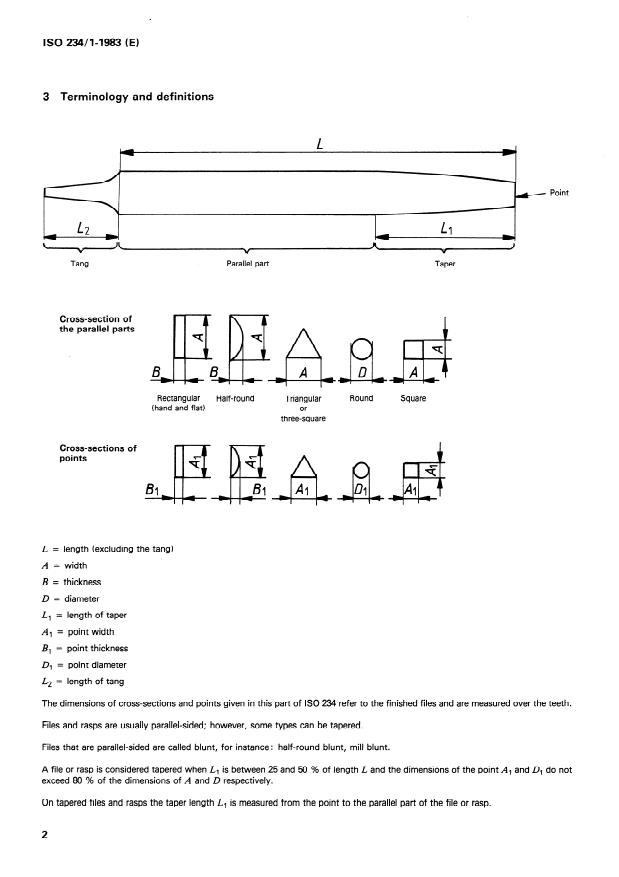
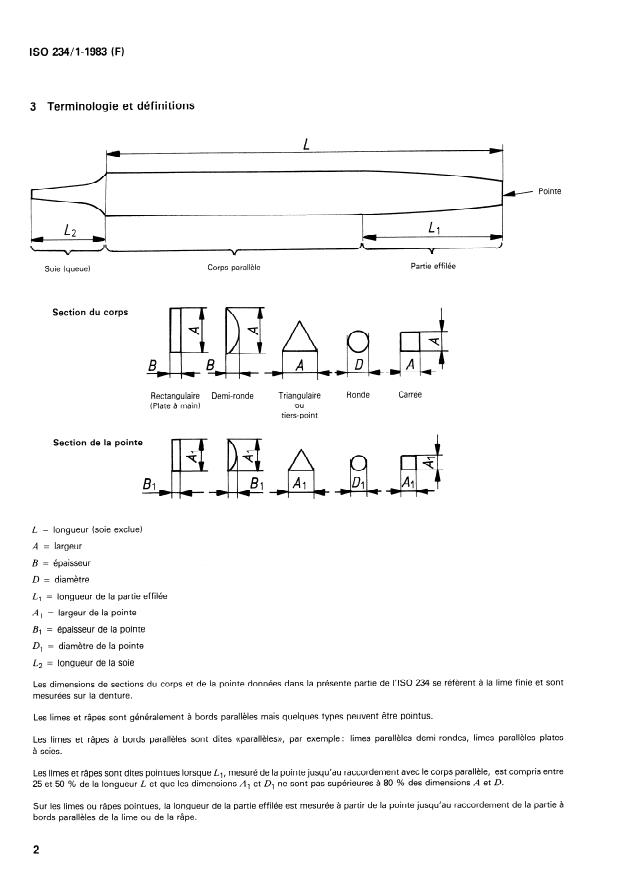
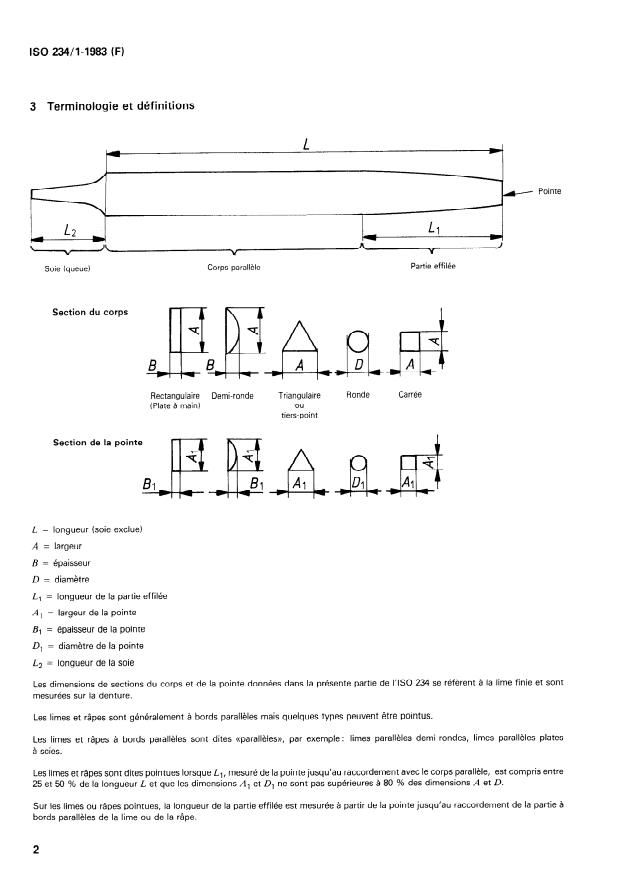
3 Terminology and definitions
e Point
Tang Parallel part
Taper
Cross-section of
the parallel parts
Rectangular Round
Half-round Triangular Square
(hand and flat) or
three-square
Cross-sections of
points
-c
A
-EE/
L = length (excluding the tang)
A = width
B= thickness
D= diameter
= length of taper
Ll
= point width
Al
= point thickness
= point diameter
D1
L* = length of tang
The dimensions of cross-sections and points given in this part of IS0 234 refer to the finished files a
...
Norme internationale
INTERNATIONAL ORGANIZATION FOR STANDARDIZATION.MEX~YHAPOfiHAR OPrAHM3Al@lR Il0 CTAH~APTl43Al@Wl~ORGANISATION INTERNATIONALE DE NORMALISATION
Limes et râpes -
Partie 1 : Dimensions
Part 7 : Dimensions
Files and rasps -
Première édition - 1983-12-15
CDU 621.918.12.4 Réf. no : ISO 234/1-1983 (F)
Descripteurs : outil, outil à main, lime, dimension, longueur, section transversale.
Prix basé sur 6 pages
Avant-propos
L’ISO (Organisation internationale de normalisation) est une fédération mondiale
d’organismes nationaux de normalisation (comités membres de I’ISO). L’élaboration
des Normes internationales est confiée aux comités techniques de I’ISO. Chaque
comité membre intéressé par une étude a le droit de faire partie du comité technique
correspondant. Les organisations internationales, gouvernementales et non gouverne-
mentales, en liaison avec I’ISO, participent également aux travaux.
Les projets de Normes internationales adoptés par les comités techniques sont soumis
aux comités membres pour approbation, avant leur acceptation comme Normes inter-
nationales par le Conseil de I’ISO.
La Norme internationale ISO 234/1 a été élaborée par le comité technique ISO/TC 29,
Petit outillage, et a été soumise aux comités membres en novembre 1982.
Les comités membres des pays suivants l’ont approuvée:
Afrique du Sud, Rép. d’ Espagne Pologne
Allemagne, R.F. France
Roumanie
Belgique Hongrie Royaume-Uni
Brésil Inde
Suède
Bulgarie Izraël Suisse
Canada Italie Tchécoslovaquie
Chine Mexique
URSS
Égypte, Rép. arabe d’ Pays-Bas
Les comités membres des pays suivants l’ont désapprouvée pour des raisons
techniques :
Australie
Autriche
Cette Norme internationale annule et remplace la Norme internationale ISO 234-1975.
@ Organisation internationale de normalisation, 1983
Imprimé en Suisse
ISO 234/1-1983 (F)
NORME INTERNATIONALE
Limes et râpes -
Partie 1 : Dimensions
0 Introduction 1 Objet et domaine d’application
Comparée à la précédente édition de I’ISO 234, la présente par- La présente partie de I’ISO 234 fixe les longueurs et spécifie les
tie de I’ISO 234 ne traite que les limes et râpes les plus fréquem-
sections transversales des limes et des râpes comprenant les
ment utilisées. quatre types d’outils suivants :
a) limes d’atelier (deux tailles);
Les types de limes et râpes dont l’utilisation diminue, ou
demandés par un nombre restreint de pays, n’ont pas été pris
b) limes à scies (une taille);
en considération afin de ne pas en favoriser le développement.
c) limes plates à scies;
Les limes et râpes relevant de fabrication spéciale en ont été
exclues (telles que les limes de précision et les limes à denture
d) râpes.
fraisée) .
La terminologie utilisée pour chaque type de limes ou râpes cor-
Le retaillage des limes et des râpes étant de moins en moins fré-
respond à des termes de métier.
quent, des sections plus faibles ont été retenues afin de favori-
ser les économies de matière.
Les dimensions sont données en millimètres, les valeurs corres-
pondantes en inches figurent dans l’annexe pour une période
Les limes pour scies à chaîne ne sont pas traitées dans la pré-
de cinq ans à partir de la date d’approbation de la présente par-
sente partie de I’ISO 234, leur taille et leurs dimensions étant
tie de I’ISO 234 par le Conseil de I’ISO.
susceptibles de changer en fonction de l’évolution des scies à
chaîne.
2 Référence
La présente partie de I’ISO 234 ne traite ni de la matière pre-
mière, ni des dimensions de soie. ISO 23412 Limes et râpes - Partie 2 : Carat téris tiques de taJle.
60 234/1-1983 (FI
3 Terminologie et définitions
Pointe
Partie effilée
Soie (queue) Corps parallèle
Section du corps
T---T I
Rectangulaire Demi-ronde Triangulaire Ronde Carrée
(Plate à main)
DU
tiers-point
Section de la pointe
-c
A
Il3
L = longueur (soie exclue)
A = largeur
B = épaisseur
D = diamètre
L, = longueur de la partie effilée
A, = largeur de la pointe
B, = épaisseur de la pointe
D, = diamètre de la pointe
L, = longueur de la soie
Les dimensions de sections du corps et de la pointe données dans la présente partie de I’ISO 234 se réfèrent à la lime finie et sont
mesurées sur la denture.
Les limes et râpes sont g
...
Norme internationale
INTERNATIONAL ORGANIZATION FOR STANDARDIZATION.MEX~YHAPOfiHAR OPrAHM3Al@lR Il0 CTAH~APTl43Al@Wl~ORGANISATION INTERNATIONALE DE NORMALISATION
Limes et râpes -
Partie 1 : Dimensions
Part 7 : Dimensions
Files and rasps -
Première édition - 1983-12-15
CDU 621.918.12.4 Réf. no : ISO 234/1-1983 (F)
Descripteurs : outil, outil à main, lime, dimension, longueur, section transversale.
Prix basé sur 6 pages
Avant-propos
L’ISO (Organisation internationale de normalisation) est une fédération mondiale
d’organismes nationaux de normalisation (comités membres de I’ISO). L’élaboration
des Normes internationales est confiée aux comités techniques de I’ISO. Chaque
comité membre intéressé par une étude a le droit de faire partie du comité technique
correspondant. Les organisations internationales, gouvernementales et non gouverne-
mentales, en liaison avec I’ISO, participent également aux travaux.
Les projets de Normes internationales adoptés par les comités techniques sont soumis
aux comités membres pour approbation, avant leur acceptation comme Normes inter-
nationales par le Conseil de I’ISO.
La Norme internationale ISO 234/1 a été élaborée par le comité technique ISO/TC 29,
Petit outillage, et a été soumise aux comités membres en novembre 1982.
Les comités membres des pays suivants l’ont approuvée:
Afrique du Sud, Rép. d’ Espagne Pologne
Allemagne, R.F. France
Roumanie
Belgique Hongrie Royaume-Uni
Brésil Inde
Suède
Bulgarie Izraël Suisse
Canada Italie Tchécoslovaquie
Chine Mexique
URSS
Égypte, Rép. arabe d’ Pays-Bas
Les comités membres des pays suivants l’ont désapprouvée pour des raisons
techniques :
Australie
Autriche
Cette Norme internationale annule et remplace la Norme internationale ISO 234-1975.
@ Organisation internationale de normalisation, 1983
Imprimé en Suisse
ISO 234/1-1983 (F)
NORME INTERNATIONALE
Limes et râpes -
Partie 1 : Dimensions
0 Introduction 1 Objet et domaine d’application
Comparée à la précédente édition de I’ISO 234, la présente par- La présente partie de I’ISO 234 fixe les longueurs et spécifie les
tie de I’ISO 234 ne traite que les limes et râpes les plus fréquem-
sections transversales des limes et des râpes comprenant les
ment utilisées. quatre types d’outils suivants :
a) limes d’atelier (deux tailles);
Les types de limes et râpes dont l’utilisation diminue, ou
demandés par un nombre restreint de pays, n’ont pas été pris
b) limes à scies (une taille);
en considération afin de ne pas en favoriser le développement.
c) limes plates à scies;
Les limes et râpes relevant de fabrication spéciale en ont été
exclues (telles que les limes de précision et les limes à denture
d) râpes.
fraisée) .
La terminologie utilisée pour chaque type de limes ou râpes cor-
Le retaillage des limes et des râpes étant de moins en moins fré-
respond à des termes de métier.
quent, des sections plus faibles ont été retenues afin de favori-
ser les économies de matière.
Les dimensions sont données en millimètres, les valeurs corres-
pondantes en inches figurent dans l’annexe pour une période
Les limes pour scies à chaîne ne sont pas traitées dans la pré-
de cinq ans à partir de la date d’approbation de la présente par-
sente partie de I’ISO 234, leur taille et leurs dimensions étant
tie de I’ISO 234 par le Conseil de I’ISO.
susceptibles de changer en fonction de l’évolution des scies à
chaîne.
2 Référence
La présente partie de I’ISO 234 ne traite ni de la matière pre-
mière, ni des dimensions de soie. ISO 23412 Limes et râpes - Partie 2 : Carat téris tiques de taJle.
60 234/1-1983 (FI
3 Terminologie et définitions
Pointe
Partie effilée
Soie (queue) Corps parallèle
Section du corps
T---T I
Rectangulaire Demi-ronde Triangulaire Ronde Carrée
(Plate à main)
DU
tiers-point
Section de la pointe
-c
A
Il3
L = longueur (soie exclue)
A = largeur
B = épaisseur
D = diamètre
L, = longueur de la partie effilée
A, = largeur de la pointe
B, = épaisseur de la pointe
D, = diamètre de la pointe
L, = longueur de la soie
Les dimensions de sections du corps et de la pointe données dans la présente partie de I’ISO 234 se réfèrent à la lime finie et sont
mesurées sur la denture.
Les limes et râpes sont g
...