


ISO/IEC/IEEE FDIS 32857
(Main)Telecommunications and information exchange between systems — Wireless Smart Utility Network Field Area Network (FAN)
Telecommunications and information exchange between systems — Wireless Smart Utility Network Field Area Network (FAN)
Télécommunications et échange d'information entre systèmes — Réseau de terrain (FAN) sans fil pour services publics intelligents
General Information
- Status
- Not Published
- Current Stage
- 5020 - FDIS ballot initiated: 2 months. Proof sent to secretariat
- Start Date
- 29-Sep-2025
- Completion Date
- 29-Sep-2025
Overview
ISO/IEC/IEEE FDIS 32857:2025 is an international standard focusing on telecommunications and information exchange between systems within the Wireless Smart Utility Network (Wi-SUN) Field Area Network (FAN). Developed by the ISO/IEC JTC 1/SC 6 in collaboration with IEEE and endorsed by the Wi-SUN Alliance, this standard defines the technical framework to enable reliable, secure, and efficient wireless communication for utility networks.
The standard provides comprehensive specifications covering the physical (PHY), data link, network, transport, and security layers, essential for the interoperability of smart utility devices operating within Field Area Networks. This development supports the ongoing trend towards smart grid automation and Internet of Things (IoT) applications in utility management.
Key Topics
Wireless Smart Utility Network (Wi-SUN) FAN Architecture
Detailed architecture considerations are outlined to ensure scalable and flexible deployment of FANs. This includes node behavior protocols, communication layering, and interaction models between layers for optimized network performance.Technical Requirements and Layer Specifications
The standard defines:- PHY Layer: Regional operating frequencies, data rates, modulation schemes, and channel hopping mechanisms that comply with regulatory requirements.
- Data Link Layer: Frequency hopping sequences, MAC operations, routing, and forwarding strategies for reliable data transmission.
- Network and Transport Layers: Protocols supporting IPv6 addressing, routing, transport services, and timing synchronization across nodes.
- Security: Mechanisms such as Public Key Infrastructure (PKI), node-to-node pairwise authentication, frame security, and node hardening to protect sensitive utility data and infrastructure.
Reliability and Synchronization
Sets reliability targets and adjacent node time synchronization methods to ensure consistent network availability and precision timing in distributed network environments.Advanced Security Measures
Includes specifications for key generation, access control, protection against key reinstallation attacks (KRACK), and maintenance of security states during power cycling.Appendices for Implementation Support
Appended sections offer detailed examples on frame exchanges, hashing functions, IPv6 addressing architecture, neighbor discovery optimization, and physical layer operating modes. This documentation supports practical deployment and testing of FAN devices.
Applications
ISO/IEC/IEEE FDIS 32857:2025 is primarily designed for:
Smart Grid and Utility Networks
Enabling efficient, secure wireless communication among meters, sensors, and control devices in electricity, gas, and water utility networks.Field Area Networks (FANs)
Providing a reliable mesh network infrastructure for smart meter data collection, distributed energy resource management, and automated utility operations.Internet of Things (IoT) in Utilities
Facilitating interoperable IoT device communication within utility field deployments, promoting automation, remote monitoring, and enhanced operational intelligence.Industrial and Commercial Applications
Enhancing wireless network design in industrial automation and commercial facility management by ensuring compliance with internationally harmonized network specifications.
Related Standards
Wi-SUN Alliance Specifications
The ISO/IEC/IEEE FDIS 32857 aligns with Wi-SUN technical profiles and certification guidelines, ensuring interoperability within certified device ecosystems.IEEE Standards in Telecommunications
Complements related IEEE 802 and protocol standards addressing wireless communication, security, and network interoperability layers.IETF IPv6 and Network Protocols
Integrates recognized protocols for IP addressing, neighbor discovery, and routing suitable for mesh network topologies.Regional Telecommunication Standards
Adapts frequency bands, transmission power limits, and channel plans based on ANSI/TIA and regional regulatory directives for wireless network deployment.
Keywords: Wireless Smart Utility Network, Field Area Network, Wi-SUN FAN, ISO/IEC/IEEE 32857, smart grid communications, wireless mesh network, smart utility metering, network security, utility IoT, wireless telecommunications standard, FAN protocol, utility network interoperability, IPv6 FAN addressing, wireless network reliability, PHY layer specification.
Get Certified
Connect with accredited certification bodies for this standard

TL 9000 QuEST Forum
Telecommunications quality management system.

ANCE
Mexican certification and testing association.

Intertek Slovenia
Intertek testing, inspection, and certification services in Slovenia.
Sponsored listings
Frequently Asked Questions
ISO/IEC/IEEE FDIS 32857 is a draft published by the International Organization for Standardization (ISO). Its full title is "Telecommunications and information exchange between systems — Wireless Smart Utility Network Field Area Network (FAN)". This standard covers: Telecommunications and information exchange between systems — Wireless Smart Utility Network Field Area Network (FAN)
Telecommunications and information exchange between systems — Wireless Smart Utility Network Field Area Network (FAN)
ISO/IEC/IEEE FDIS 32857 is classified under the following ICS (International Classification for Standards) categories: 33.040.40 - Data communication networks. The ICS classification helps identify the subject area and facilitates finding related standards.
ISO/IEC/IEEE FDIS 32857 is available in PDF format for immediate download after purchase. The document can be added to your cart and obtained through the secure checkout process. Digital delivery ensures instant access to the complete standard document.
Standards Content (Sample)
FINAL DRAFT
International
Standard
ISO/IEC/IEEE
FDIS
ISO/IEC JTC 1/SC 6
Telecommunications and
Secretariat: KATS
information exchange between
Voting begins on:
systems — Wireless Smart Utility
2025-09-04
Network Field Area Network (FAN)
Voting terminates on:
2026-01-22
This document has not been edited by the ISO Central Secretariat.
RECIPIENTS OF THIS DRAFT ARE INVITED TO SUBMIT,
WITH THEIR COMMENTS, NOTIFICATION OF ANY
RELEVANT PATENT RIGHTS OF WHICH THEY ARE AWARE
AND TO PROVIDE SUPPOR TING DOCUMENTATION.
IN ADDITION TO THEIR EVALUATION AS
BEING ACCEPTABLE FOR INDUSTRIAL, TECHNO
FAST TRACK PROCEDURE
LOGICAL, COMMERCIAL AND USER PURPOSES, DRAFT
INTERNATIONAL STANDARDS MAY ON OCCASION HAVE
TO BE CONSIDERED IN THE LIGHT OF THEIR POTENTIAL
TO BECOME STAN DARDS TO WHICH REFERENCE MAY BE
MADE IN NATIONAL REGULATIONS.
Reference number
FINAL DRAFT
International
Standard
ISO/IEC/IEEE
FDIS
ISO/IEC JTC 1/SC 6
Telecommunications and
Secretariat: KATS
information exchange between
Voting begins on:
systems — Wireless Smart Utility
Network Field Area Network (FAN)
Voting terminates on:
This document has not been edited by the ISO Central Secretariat.
RECIPIENTS OF THIS DRAFT ARE INVITED TO SUBMIT,
WITH THEIR COMMENTS, NOTIFICATION OF ANY
RELEVANT PATENT RIGHTS OF WHICH THEY ARE AWARE
AND TO PROVIDE SUPPORTING D OCUMENTATION.
IN ADDITION TO THEIR EVALUATION AS
© IEEE 2025
BEING ACCEPTABLE FOR INDUSTRIAL, TECHNO
FAST TRACK PROCEDURE
LOGICAL, COMMERCIAL AND USER PURPOSES, DRAFT
All rights reserved. Unless otherwise specified, or required in the context of its implementation, no part of this publication may
INTERNATIONAL STANDARDS MAY ON OCCASION HAVE
be reproduced or utilized otherwise in any form or by any means, electronic or mechanical, including photocopying, or posting on
TO BE CONSIDERED IN THE LIGHT OF THEIR POTENTIAL
the internet or an intranet, without prior written permission. Permission can be requested from IEEE at the address below.
TO BECOME STAND ARDS TO WHICH REFERENCE MAY BE
MADE IN NATIONAL REGULATIONS.
Institute of Electrical and Electronics Engineers, Inc
3 Park Avenue, New York
NY 10016-5997, USA
Email: stds.ipr@ieee.org
Website: www.ieee.org
Published in Switzerland Reference number
© IEEE 2021
© IEEE 2025 – All rights reserved
ii
Field Area Network Working Group
Field Area Network Technical Profile Specification
This document is provided under the terms of the agreement (18 Nov 2019) between Wi-SUN Alliance and IEEE. The
contents of this document are Copyright © Wi-SUN Alliance ™.
© IEEE 2021 – All rights reserved
iii
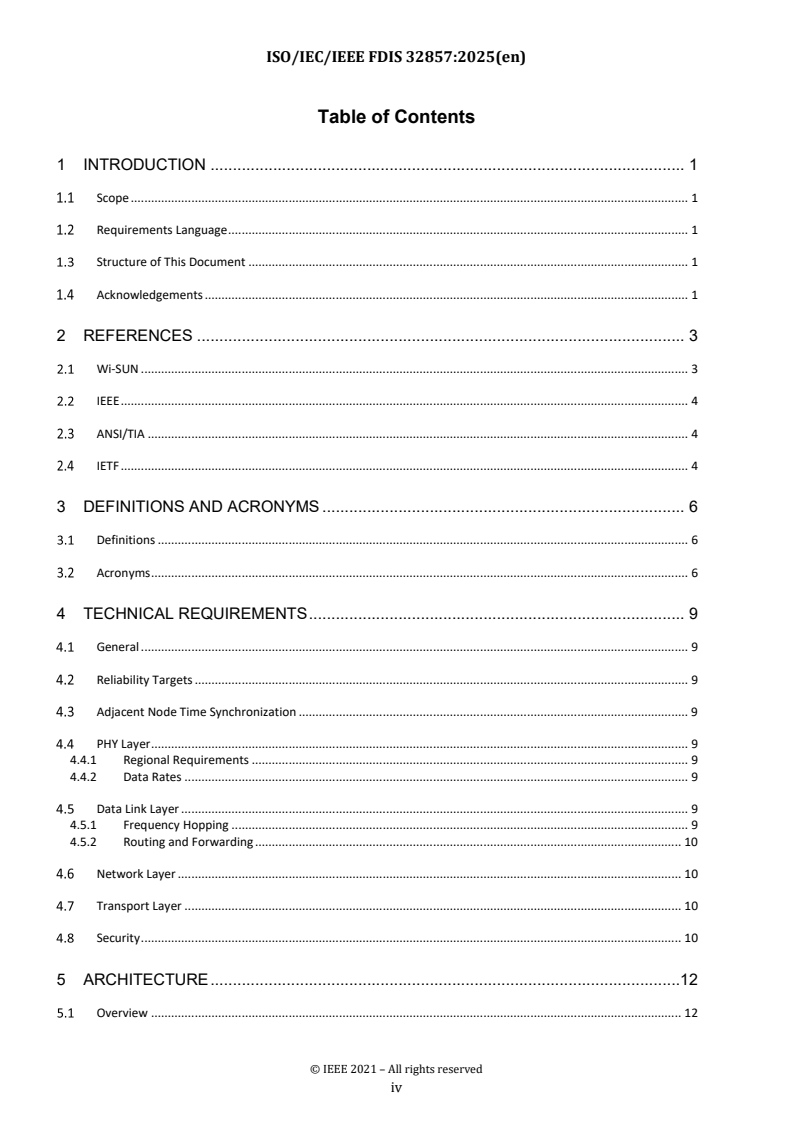
Table of Contents
1 INTRODUCTION . 1
Scope . 1
Requirements Language . 1
Structure of This Document . 1
Acknowledgements . 1
2 REFERENCES . 3
Wi-SUN . 3
IEEE . 4
ANSI/TIA . 4
IETF . 4
3 DEFINITIONS AND ACRONYMS . 6
Definitions . 6
Acronyms . 6
4 TECHNICAL REQUIREMENTS . 9
General . 9
Reliability Targets . 9
Adjacent Node Time Synchronization . 9
PHY Layer . 9
4.4.1 Regional Requirements . 9
4.4.2 Data Rates . 9
Data Link Layer . 9
4.5.1 Frequency Hopping . 9
4.5.2 Routing and Forwarding . 10
Network Layer . 10
Transport Layer . 10
Security . 10
5 ARCHITECTURE .12
Overview . 12
© IEEE 2021 – All rights reserved
iv
Upper Layer Considerations . 14
Transport Service. 14
5.3.1 General Principles . 14
5.3.2 Node Behavior . 14
Network Service . 14
5.4.1 General Principles . 14
5.4.2 Node Behavior . 15
Data Link Service . 15
5.5.1 General Principles . 15
5.5.2 Node Behavior . 15
PHY Service . 21
5.6.1 General Principles . 21
5.6.2 Node Behavior . 22
Security . 22
6 SPECIFICATION .23
Transport Layer . 23
6.1.1 Operation . 23
Network Layer . 23
6.2.1 Constants . 23
6.2.2 Data Structures. . 23
6.2.3 Operation . 24
Data Link Layer . 33
6.3.1 Constants . 33
6.3.2 Data Structures . 37
6.3.3 LLC Operation . 58
6.3.4 MAC Operation . 61
6.3.5 Service Access Points . 75
PHY Layer . 80
6.4.1 Operating Modes . 81
6.4.2 Preamble Length . 81
6.4.3 Radio Specifications . 81
Security . 81
6.5.1 Public Key Infrastructure . 82
6.5.2 FAN Access Control and Group Key Placement . 83
6.5.3 Node to Node Pairwise (N2NP) Authentication and Key Generation . 92
6.5.4 Frame Security . 125
6.5.5 Node Hardening . 129
6.5.6 State Maintenance Through Power Cycling . 129
7 APPENDIX A – TR51 CHANNEL FUNCTION .130
Random Number Generation . 130
Channel Table Calculation . 130
© IEEE 2021 – All rights reserved
v
Calculating the First Element and Step Size . 132
Computation of Hopping Sequence Channel Table. . 133
8 APPENDIX B - UNICAST FRAME EXCHANGE EXAMPLES .135
Directed Frame Exchange: . 135
8.1.1 Unacknowledged Data . 135
8.1.2 Acknowledged Data . 135
Extended Directed Frame Exchange:. 136
8.2.1 Qualified Frame Exchange . 136
8.2.2 Multi-Packet Frame Exchange . 137
8.2.3 Frame Exchange with Initial Data . 138
8.2.4 Bi Directional Frame Exchange . 139
9 APPENDIX C DIRECT HASH CHANNEL FUNCTION .141
Example Usage of Jenkins Hash . 141
The Jenkins Hash . 142
Examples . 146
10 APPENDIX D FAN IPV6 ADDRESSING ARCHITECTURE .148
11 APPENDIX E UNICAST / BROADCAST / DISCOVERY EXAMPLE .149
12 APPENDIX F IPV6 NEIGHBOR DISCOVERY OPTIMIZATIONS. .152
13 APPENDIX G FRAME COUNTER, FRAME SEQUENCE NUMBER, AND MPX-IE
TRANSACTION ID .153
14 APPENDIX H UNICAST TIMING CALCULATION EXAMPLE .154
Node1 Timing Calculations . 154
Node2 Timing Calculations . 155
15 APPENDIX J FAN NODE BOOTSTRAP MESSAGING FLOW .156
16 APPENDIX K EAPOL TARGET SELECTION .157
17 APPENDIX L KEY REINSTALLATION ATTACK (KRACK) .158
18 APPENDIX M PHYSICAL LAYER.160
PHY Specification . 160
18.1.1 PPDU Format . 160
18.1.2 Modulation and Coding . 160
© IEEE 2021 – All rights reserved
vi
18.1.3 Symbol rate and Modulation Index . 160
18.1.4 Frequency Bands and Channel Parameters . 161
18.1.5 FEC . 163
18.1.6 Data Whitening. 163
PHY RF Requirements . 163
18.2.1 Transmit Spectral Mask . 163
Regional Considerations . 163
18.3.1 Brazil Region . 163
PHY Test Mode Requirements . 164
© IEEE 2021 – All rights reserved
vii
Table of Figures
FIGURE 5-1 COMMUNICATIONS REFERENCE MODEL . 12
FIGURE 5-2 SAMPLE LAYER 3 ROUTED FAN. 13
FIGURE 5-3 SAMPLE LAYER 2 ROUTED FAN. 14
FIGURE 5-4 UPPER LAYER PROTOCOL DISPATCH . 16
FIGURE 5-5 UNICAST FREQUENCY HOPPING . 19
FIGURE 5-6 BROADCAST FREQUENCY HOPPING . 20
FIGURE 5-7 BROADCAST AND UNICAST SCHEDULES . 21
FIGURE 6-1 EAPOL RELAY DATAGRAM . 24
FIGURE 6-2 ADDRESS REGISTRATION . 32
FIGURE 6-3 PA FRAME FORMAT . 37
FIGURE 6-4 PA FRAME CONTROL FORMAT . 37
FIGURE 6-5 PAS FRAME FORMAT . 38
FIGURE 6-6 PAS FRAME CONTROL FORMAT . 38
FIGURE 6-7 PC FRAME FORMAT . 38
FIGURE 6-8 PC FRAME CONTROL FORMAT . 39
FIGURE 6-9 PCS FRAME FORMAT . 39
FIGURE 6-10 PCS FRAME CONTROL FORMAT . 39
FIGURE 6-11 ULAD FORMAT. 40
FIGURE 6-12 ULAD FRAME CONTROL FORMAT . 40
FIGURE 6-13 ACKNOWLEDGEMENT FRAME FORMAT . 41
FIGURE 6-14 ACKNOWLEDGEMENT FRAME CONTROL FORMAT . 41
FIGURE 6-15 EAPOL FRAME FORMAT . 42
FIGURE 6-16 EAPOL FRAME CONTROL FORMAT . 42
FIGURE 6-17 WI-SUN HEADER IE . 44
FIGURE 6-18 UNICAST TIMING IE . 44
FIGURE 6-19 FRAME TYPES . 44
FIGURE 6-20 BROADCAST TIMING IE . 45
FIGURE 6-21 FLOW CONTROL IE. 45
FIGURE 6-22 RSL IE . 46
FIGURE 6-23 MHDS-IE . 46
FIGURE 6-24 VENDOR EXTENSION IE . 46
FIGURE 6-25 WI-SUN PAYLOAD IE . 47
FIGURE 6-26 UNICAST SCHEDULE IE . 48
FIGURE 6-27 BROADCAST SCHEDULE IE . 48
FIGURE 6-28 CHANNEL INFORMATION FIELDS . 48
FIGURE 6-29 EXCLUDED CHANNEL RANGES FIELD . 50
FIGURE 6-30 CHANNEL MASK BIT ORDER ILLUSTRATION (TRANSMIT ORDER … LEFT TO RIGHT) . 51
FIGURE 6-31 VENDOR EXTENSION IE . 51
FIGURE 6-32 PAN IE . 51
FIGURE 6-33 NETWORK NAME IE . 52
FIGURE 6-34 PAN VERSION IE . 52
FIGURE 6-35 GTK HASH IE . 53
FIGURE 6-36 L2 MESH PDU STRUCTURE AND FORMAT . 56
FIGURE 6-37 L2 MESH PDU HEADER STRUCTURE AND FORMAT . 56
FIGURE 6-38 L2 MESH PDU HEADER MHD-CONTROL FIELD FORMAT . 56
FIGURE 6-39 L2 MESH PDU HEADER ADDRESS LIST STRUCTURE AND FORMAT . 56
FIGURE 6-40 L2 MESH PDU DATA STRUCTURE AND FORMAT . 57
FIGURE 6-41 L2 MESH PDU DATA ELEMENT STRUCTURE AND FORMAT . 57
FIGURE 6-42 STATE TRANSITION DIAGRAM FOR DFE . 63
FIGURE 6-43 STATE TRANSITION DIAGRAM FOR EDFE . 64
FIGURE 6-44 FAN JOIN STATES . 72
FIGURE 6-45 SERVICE ACCESS POINTS (SAP) . 76
FIGURE 6-46 AUTHENTICATION AND GROUP KEY ACQUISITION FLOWS . 84
© IEEE 2021 – All rights reserved
viii
FIGURE 6-47 SHARED SECRET INITIATION . 93
FIGURE 6-48 - UML ASSOCIATION MANAGEMENT STATE MACHINE . 97
FIGURE 6-49 - STATE MACHINE SHAPES KEY . 97
FIGURE 6-50 - START STATE TRANSITIONS . 99
FIGURE 6-51 - ASSOCIATIONWAIT STATE TRANSITIONS . 100
FIGURE 6-52 - ACKWAIT STATE TRANSITIONS . 100
FIGURE 6-53 - SESSIONVALID STATE TRANSITIONS . 101
FIGURE 6-54 - COMMON TRANSITIONS . 102
FIGURE 6-55 ESTKEYTRUST PROCEDURE FLOW . 103
FIGURE 6-56 START STATE TRANSITIONS PART 1 . 106
FIGURE 6-57 START STATE TRANSITIONS - PART 2 . 107
FIGURE 6-58 SESSIONPENDING1 STATE TRANSITIONS. 108
FIGURE 6-59 SESSIONPENDING2 STATE TRANSITIONS. 110
FIGURE 6-60 SESSIONVALID STATE TRANSITIONS . 111
FIGURE 6-61 SESSIONOPEN STATE TRANSITIONS . 112
FIGURE 6-62 COMMON TRANSITIONS . 113
FIGURE 6-63 NEWASSOCIATION MESSAGE . 115
FIGURE 6-64 ASSOCIATIONRESPONSE MESSAGE . 116
FIGURE 6-65 ASSOCIATIONACK MESSAGE . 117
FIGURE 6-66 GETCERTS MESSAGE . 118
FIGURE 6-67 SENDCERTS MESSAGE . 118
FIGURE 6-68 CLOSEASSOCIATION MESSAGE . 119
FIGURE 6-69 NS SHARED SECRET INITIATION . 120
FIGURE 6-70 NS SHARED SECRET RESPONSE . 120
FIGURE 6-71 SM SPECIFIC ERROR MESSAGE . 123
FIGURE 6-72 GTK CYCLING . 128
FIGURE 8-1 DFE NON-ACKNOWLEDGED EXCHANGE . 135
FIGURE 8-2 DFE ACKNOWLEDGED EXCHANGE . 136
FIGURE 8-3 EDFE QUALIFIED FRAME EXCHANGE . 137
FIGURE 8-4 EDFE 2 MULTI-PACKET DATA EXCHANGE . 138
FIGURE 8-5 EDFE FRAME EXCHANGE WITH INITIAL DATA . 139
FIGURE 8-6 EDFE BI-DIRECTIONAL FRAME EXCHANGE . 140
FIGURE 15-1 JOINING NODE BOOTSTRAP MESSAGING FLOW (L3 ROUTING) . 156
© IEEE 2021 – All rights reserved
ix
Table of Tables
TABLE 6-1 NETWORK LAYER CONSTANTS 23
TABLE 6-2 DATA LINK LAYER CONSTANTS 33
TABLE 6-3 MULTIPLEX IDS 54
TABLE 6-4 INFORMATION ELEMENT REQUIREMENTS FOR FRAMES 55
TABLE 6-5 MLME-WS-ASYNC-FRAME.REQUEST PARAMETERS 79
TABLE 6-6 MLME-WS-ASYNC-FRAME.CONFIRM PARAMETERS 80
TABLE 6-7 MLME-WS-ASYNC-FRAME.INDICATION PARAMETERS 80
TABLE 6-8 - PREAMBLE LENGTHS PER OPERATING MODES 81
TABLE 6-9 - RADIO SPECIFICATION 81
TABLE 6-10 AUTHENTICATION AND PMK INSTALLATION FLOW 87
TABLE 6-11 PTK AND GTK INSTALLATION FLOW 90
TABLE 6-12 GROUP KEY UPDATE FLOW 91
TABLE 18-1 - PHY OPERATING MODES AND SYMBOL RATES 161
TABLE 18-2: SUPPORTED FREQUENCY BANDS AND CHANNEL PARAMETERS 161
TABLE 18-3: EXCLUDED CHANNELS IN BRAZIL 163
© IEEE 2021 – All rights reserved
x
Foreword
ISO (the International Organization for Standardization) and IEC (the International Electrotechnical
Commission) form the specialized system for worldwide standardization. National bodies that are members
of ISO or IEC participate in the development of International Standards through technical committees
established by the respective organization to deal with particular fields of technical activity. ISO and IEC
technical committees collaborate in fields of mutual interest. Other international organizations, governmental
and non-governmental, in liaison with ISO and IEC, also take part in the work.
The procedures used to develop this document and those intended for its further maintenance are described
in the ISO/IEC Directives, Part 1. In particular, the different approval criteria needed for the different types of
document should be noted.
IEEE Standards documents are developed within IEEE Societies and subcommittees of IEEE Standards
Association (IEEE SA) Board of Governors. IEEE develops its standards through an accredited consensus
development process, which brings together volunteers representing varied viewpoints and interests to
achieve the final product. IEEE standards are documents developed by volunteers with scientific, academic,
and industry-based expertise in technical working groups. Volunteers are not necessarily members of IEEE or
IEEE SA and participate without compensation from IEEE. While IEEE administers the process and establishes
rules to promote fairness in the consensus development process, IEEE does not independently evaluate, test,
or verify the accuracy of any of the information or the soundness of any judgments contained in its standards.
ISO and IEC draw attention to the possibility that the implementation of this document may involve the use of
(a) patent(s). ISO and IEC take no position concerning the evidence, validity or applicability of any claimed
patent rights in respect thereof. As of the date of publication of this document, ISO and IEC had not received
notice of (a) patent(s) which may be required to implement this document. However, implementers are
cautioned that this may not represent the latest information, which may be obtained from the patent database
available at www.iso.org/patents and https://patents.iec.ch. ISO and IEC shall not be held responsible for
identifying any or all such patent rights.
Any trade name used in this document is information given for the convenience of users and does not
constitute an endorsement.
For an explanation of the voluntary nature of standards, the meaning of ISO specific terms and expressions
related to conformity assessment, as well as information about ISO's adherence to the World Trade
Organization (WTO) principles in the Technical Barriers to Trade (TBT), see www.iso.org/iso/foreword.html.
In the IEC, see www.iec.ch/understanding-standards.
ISO/IEC/IEEE 32857 was prepared by the LAN/MAN of the IEEE Computer Society (as IEEE 2857-2021) and
drafted in accordance with its editorial rules. It was adopted, under the “fast-track procedure” defined in the
Partner Standards Development Organization cooperation agreement between ISO and IEEE, by Joint
Technical Committee ISO/IEC JTC 1, Information technology, Subcommittee SC 6, Telecommunications and
information exchange between systems.
Any feedback or questions on this document should be directed to the user’s national standards body. A
complete listing of these bodies can be found at www.iso.org/members.html and www.iec.ch/national-
committees.
© IEEE 2021 – All rights reserved
xi
1 Introduction
Scope
This document defines the technical implementation and behavior of a Wi-SUN Field Area Network which fulfills the
marketing requirements specified in [MRD]. With the details presented in this document, an implementer is enabled to
construct an interoperable and certifiable implementation of the Wi-SUN FAN.
Requirements Language
Requirements are specified using the terminology and conventions as described in [RFC2119]. Requirements key words
described in [RFC2119] must be capitalized.
Structure of This Document
The FAN Technical Profile Specification is developed in an iterative process as described in [FWGDP]. A brief overview of
each TPS section is provided below. Unless noted otherwise, all sections are informative.
1. Introduction. Self-explanatory.
2. References. Self-explanatory.
3. Definitions and Acronyms. Self-explanatory.
4. Technical Requirements (normative). This section defines the requirements which must be met by the Specification
section. It defines what functionality must be provided by the TPS. It does not define the technical specifics of how
the Technical Requirements are met, nor test cases required to verify that functionality.
5. Architecture. Overview of the design and operation of the FAN.
6. Specification (normative). The technical specifics of how the mechanisms of the FAN are to be implemented.
Normative clauses within this section require corresponding test case coverage be incorporated into the Wi-SUN FAN
Compliance and Interoperability Test Plans.
7. Appendix A. (normative). Description of the TR51 Channel Function.
8. Appendix B. Unicast Frame Exchange examples.
9. Appendix C. (normative). Description of the Direct Hash Channel Function.
10. Appendix D. Guidance for FAN IPv6 Addressing Architecture.
11. Appendix E. Unicast / Broadcast / Discovery Example.
12. Appendix F. Description of IPv6 Neighbor Discovery Optimizations.
13. Appendix G. Description of Frame Counter, Frame Sequence Number, and MPX-IE Transaction ID interaction.
14. Appendix H. Unicast Timing Calculation Example.
15. Appendix J. FAN Node Bootstrap Messaging Flow.
16. Appendix K. EAPOL Target Selection.
17. Appendix L. Key Reinstallation Attack.
Acknowledgements
The Wi-SUN Alliance acknowledges the substantial efforts of the following individuals who contributed to the production of
this document.
© IEEE 2021 – All rights reserved
• Keith Barnes, Itron • Anders Grauballe, Kamstrup
• Paul Dietrich, Silver Spring Networks • Ankush Sabharwal, Landis+Gyr
• Paul Duffy, Cisco Systems (Co-Chair and • Will San Filippo, Silver Spring Networks
Technical Editor)
• Koichi Sato, Renesas
• Gene Falendysz, Itron
• Cristina Seibert, Silver Spring Networks
• Veselin Ganev, Cisco Systems
• Kunal Shah, Itron (PHYWG Chair and Technical
• Elad Gottlib, Silver Spring Networks Editor)
• Thomas Herbst, Silver Spring Networks • Huimin She, Cisco Systems
• Chris Hett, Landis+Gyr • Shobhit Singh, Landis+Gyr
• Jonathan Hui, Cisco Systems • Michael St Johns, Silver Spring Networks
• Thomas Joyce, Analog Devices Inc. • Don Sturek, Itron (Co-Chair)
• Amarjeet Kumar, Procubed Inc. • Larry Taylor, Discrete Time Communications
• Rakesh Kumar, Procubed Inc. • Kumaran Vijayasankar, Texas Instruments
• Anand M, Procubed Inc. • Hans Waldmann, Analog Devices Inc.
• Ben Rolfe, Electric Power Research Institute • Lu Wang, Cisco Systems
• Ryota Yamada, Omron • Zhanglong Xia, Cisco Systems
© IEEE 2021 – All rights reserved
2 References
[SGNSRS] “Smart Grid Networks System Requirements Specification, Release Version 5, Final”,
http://osgug.ucaiug.org/UtiliComm/Shared%20Documents/Latest_Release_Deliverables/SG%20Network%20SRS%20Version
%20V5%20Final.pdf
[FCC-Part-15.247] “Code of Federal Regulations, Title 47 - Telecommunications, Section 15.247 - Operation within the
bands 902-928 MHz, 2400-2483.5 MHz, and 5725-5850 MHz”, http://www.gpo.gov/fdsys/pkg/CFR-2005-title47-
vol1/xml/CFR-2005-title47-vol1-sec15-247.xml
[OSIRM] ITU X.200 / ISO/IEC 7498-1 OSI Basic Reference Model, http://www.ecma-
international.org/activities/Communications/TG11/s020269e.pdf
[ETSI-TS-102-887-1]: "Electromagnetic compatibility and Radio spectrum Matters (ERM); Short Range Devices; Smart
Metering Wireless Access Protocol; Part 1: PHY layer"
https://www.etsi.org/deliver/etsi_ts/102800_102899/10288701/01.01.01_60/ts_10288701v010101p.pdf
[ETSI-TS-102-887-2] “Smart Metering Wireless Access Protocol; Part 2: Data Link Layer (MAC Sub-layer)”,
http://www.etsi.org/deliver/etsi_ts/102800_102899/10288702/01.01.01_60/ts_10288702v010101p.pdf
[CEPT ERC/REC 70-03] “ERC Recommendation 70-03 Relating to the use of Short Range Devices (SRD)”,
http://www.erodocdb.dk/Docs/doc98/official/pdf/REC7003E.PDF
[NFAP-WPC] “Government of India, Ministry of Telecommunications National Frequency Allocation Plan”,
https://dot.gov.in/sites/default/files/NFAP%202018.pdf
[WBXCF] “WAP Binary XML Content Format”, http://www.w3.org/TR/wbxml/
[SP800-108] “NIST Special Publication 800-108 Recommendation for Key Derivation Using Pseudorandom Function”,
http://csrc.nist.gov/publications/nistpubs/800-108/sp800-108.pdf
[SP800-38A] “Recommendation for Block Cipher Modes of Operation”, http://csrc.nist.gov/publications/nistpubs/800-
38a/sp800-38a.pdf
[SP800-38C], “Recommendation for Block Cipher Modes of Operation: The CCM Mode for Authentication and
Confidentiality”, http://csrc.nist.gov/publications/nistpubs/800-38C/SP800-38C_updated-July20_2007.pdf
[SP800-38D], “Recommendation for Block Cipher Modes of Operation: Galois/Counter Mode (GCM) and GMAC”,
http://csrc.nist.gov/publications/nistpubs/800-38D/SP-800-38D.pdf
[FIPS197] “Advanced Encryption Standard”, http://csrc.nist.gov/publications/fips/fips197/fips-197.pdf
[FIPS198-1] “The Keyed-Hash Message Authentication Code (HMAC)”, http://csrc.nist.gov/publications/fips/fips198-1/FIPS-
198-1_final.pdf
Wi-SUN
[FWGDP] “FAN Working Group Development Process”, https://dms.wi-
sun.org/htcomnet/Handlers/Download.ashx?action=download&file=FAN%20Profile%2FProcess%20Documents%2F2013061
8-FANWG-iterative%20process%20description-0v0
...
Questions, Comments and Discussion
Ask us and Technical Secretary will try to provide an answer. You can facilitate discussion about the standard in here.
Loading comments...