

ISO/PRF 7112
(Main)Machinery for forestry — Portable brush-cutters and grass-trimmers — Vocabulary
- Abstract
This document defines terms relating to portable hand-held brush-cutters and grass-trimmers, their cutting attachments and power sources.
- Status
- Not Published
- Technical Committee
- ISO/TC 23/SC 17 - Manually portable (hand-held) powered lawn and garden equipment and forest machinery
- Drafting Committee
- ISO/TC 23/SC 17/WG 4 - Safety
- Current Stage
- 5020 - Proof sent to secretariat or FDIS ballot initiated: 8 weeks - 50 Approval
- Start Date
- 02-Nov-2026
Buy Documents
ISO/PRF 7112 - Machinery for forestry — Portable brush-cutters and grass-trimmers — Vocabulary
REDLINE ISO/PRF 7112 - Machinery for forestry — Portable brush-cutters and grass-trimmers — Vocabulary
ISO/PRF 7112 is an ISO vocabulary standard for portable hand-held brush-cutters and grass-trimmers. It defines the terms used for the machines, their cutting attachments and their power sources, so manufacturers, technical writers, buyers and testers can use the same language.
What does ISO/PRF 7112 specify?
ISO/PRF 7112 specifies the vocabulary for portable hand-held brush-cutters and grass-trimmers and the parts and functions around them. Clause 1 sets that scope, clause 2 deals with normative references, and clause 3 contains the terms and definitions.
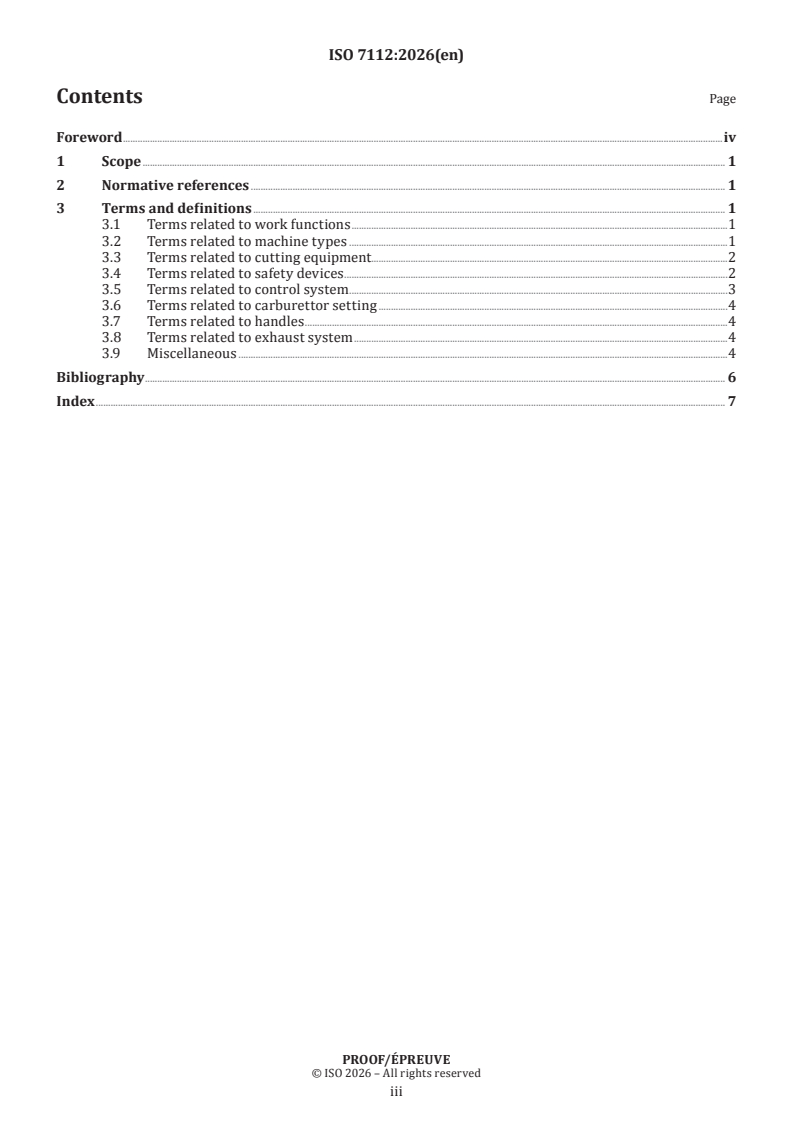
Clause 3 is organized into nine groups: work functions, machine types, cutting equipment, safety devices, control system, carburettor setting, handles, exhaust system and miscellaneous terms. That structure matters because it lets readers find the right term quickly when writing specifications, manuals, test plans or labels.
What are the key requirements of ISO/PRF 7112?
Machine types and cutting equipment
ISO/PRF 7112 defines the main machine categories in clause 3.2 and the cutting attachments in clause 3.3. It distinguishes a brush-cutter, a brush saw or clearing saw, a grass-trimmer and a lawn edge-trimmer by the type of cutting attachment and the vegetation they are intended to cut.
In practice, this helps a buyer or engineer match the machine to the task. It also avoids confusion in procurement documents, spare-part lists and instruction handbooks.
The standard also separates the cutting attachment into a cutting means, a saw blade and a flexible cutting means. That distinction matters because the safety, intended use and terminology differ for each attachment type.
Safety devices and operator protection
Clause 3.4 defines the main safety-related parts: cutting means retainer, cutting attachment guard, transport cover, quick-release mechanism, barrier, harness, hip pad, suspension point and throttle trigger lockout. These terms describe the hardware used to retain the cutting attachment, shield the operator and support the machine during use.
In practice, these definitions help designers and test teams describe protection features consistently. They also support clear instructions for transport, carrying and emergency release.
Control system and starting functions
Clause 3.5 covers the control system, including choke, stop switch, starter, recoil starter, electric starter, primer, throttle control latch, throttle trigger, throttle linkage and decompression valve. These are the parts that start the machine, control engine speed and stop the power source.
That matters because service instructions, operator training and troubleshooting notes depend on exact terminology. A reader can tell whether a part is for starting, speed control or shutdown.
Carburettor setting and operating speed
Clause 3.6 defines the idle-speed adjuster (T), low-speed mixture adjuster (L) and high-speed mixture adjuster (H). Clause 3.9 then defines idling speed, maximum power speed and racing speed.
These terms are useful when setting up or adjusting the engine. The note to maximum power speed points to ISO 20599 for how that speed is obtained, which helps readers connect this vocabulary standard with engine-performance terminology.
Handles, exhaust system and other machine parts
Clause 3.7 defines handle and handgrip, clause 3.8 defines the exhaust system, muffler or silencer and spark arrester, and clause 3.9 defines parts such as angle transmission, backpack power unit, clutch, power transmission shaft, output shaft, shaft tube and governor.
In practice, these terms support clear descriptions of machine layout, handling and exhaust-related safety features. Clause 3.9 also defines blade thrust and dry mass/weight, two terms that are often needed in safety discussions, product descriptions and comparison data.
What terms does ISO/PRF 7112 define?
- brush-cutter - a unit that uses a rotating cutting means to cut weeds, scrub, brush-wood and similar vegetation.
- grass-trimmer - a unit that uses a rotating flexible cutting means to cut weeds, grass or similar soft vegetation.
- cutting attachment - the cutting device, such as a cutting means, saw blade or flexible cutting means.
- quick-release mechanism - a device that lets the operator free themselves quickly from the unit in an emergency.
- blade thrust - a sudden sideways, forward or backward machine movement caused by contact between the rotating cutter and a solid object.
- idle-speed adjuster (T) - a device, normally a screw, used to adjust idling speed.
- maximum power speed - the engine speed at which maximum corrected brake power is obtained.
- dry mass/weight - the unit mass or weight with empty fuel/oil tanks and without the cutting attachment, guard or harness.
Who uses ISO/PRF 7112?
ISO/PRF 7112 is used by manufacturers of hand-held powered lawn and garden equipment and forest machinery, by designers of cutting attachments and power units, and by technical writers preparing handbooks and spare-part information. It is also useful to test laboratories, purchasers and safety specialists who need consistent names for parts, operating modes and protective devices.
What changed in ISO/PRF 7112 from the previous edition?
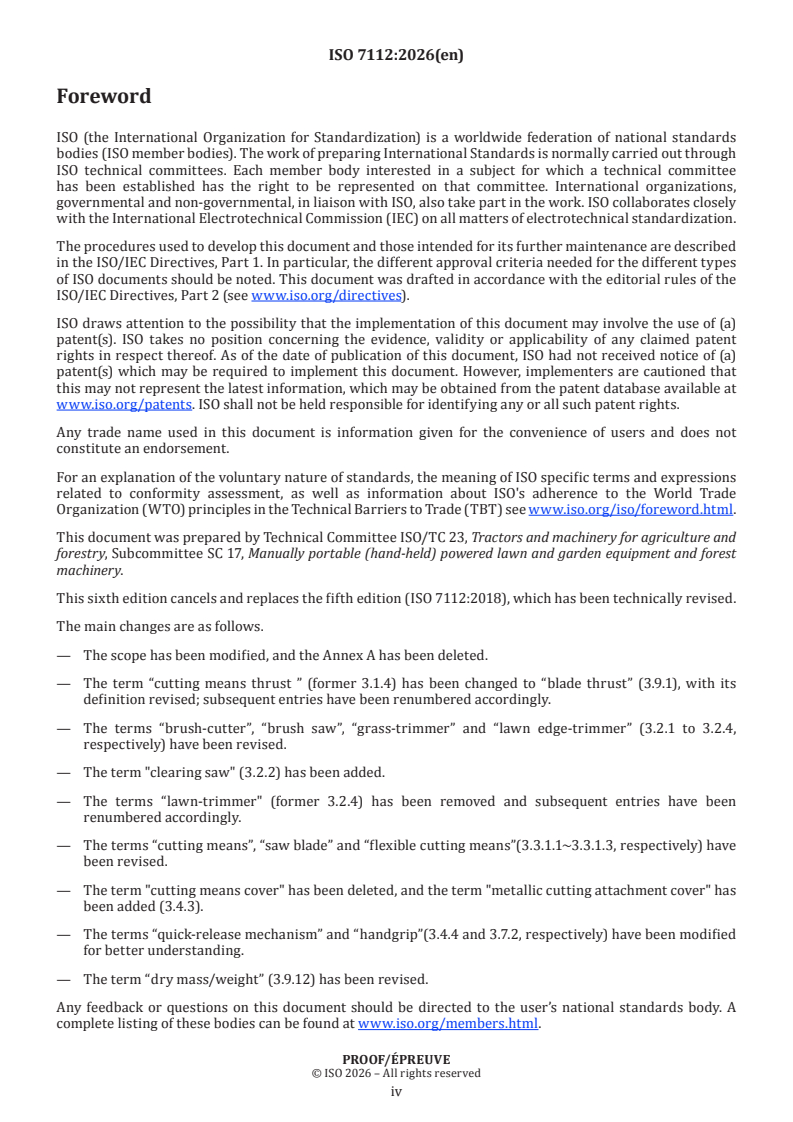
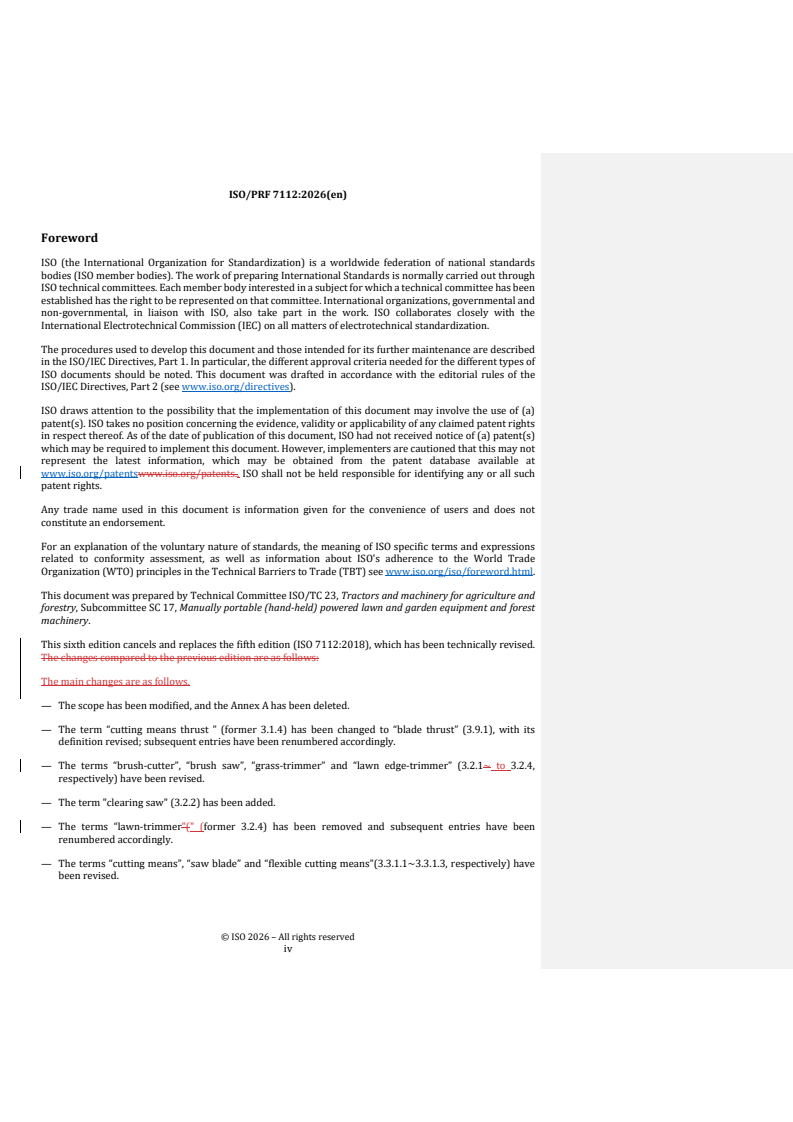
ISO/PRF 7112 cancels and replaces ISO 7112:2018. The foreword states these changes:
- the scope was modified and Annex A was deleted
- blade thrust replaced the former term cutting means thrust, with the definition revised and later entries renumbered
- brush-cutter, brush saw, grass-trimmer and lawn edge-trimmer were revised
- clearing saw was added
- lawn-trimmer was removed and later entries were renumbered
- cutting means, saw blade and flexible cutting means were revised
- cutting means cover was deleted and metallic cutting attachment cover was added
- quick-release mechanism and handgrip were modified for better understanding
- dry mass/weight was revised
- editorial corrections were made
Which standards are used with ISO/PRF 7112?
ISO/PRF 7112 has no normative references in clause 2. It does cite ISO 20599 in a note to maximum power speed, where that standard is used for determining that speed.
What does the ISO/PRF 7112 document contain?
ISO/PRF 7112 contains a foreword, a scope clause, a normative references clause, and a large clause of terms and definitions. Clause 3 is split into nine technical groups so readers can find vocabulary for machine types, cutting equipment, safety devices, controls, carburettor settings, handles, exhaust parts and other machine features.
The document also includes a bibliography and an index. Its main content is definitional rather than procedural: it gives the language used for design, documentation, product description and technical discussion of portable brush-cutters and grass-trimmers.
Relations
- Revises
ISO 7112:2018 - Machinery for forestry — Portable brush-cutters and grass-trimmers — Vocabulary - Effective Date
- 07-Jan-2025
Buy Documents
ISO/PRF 7112 - Machinery for forestry — Portable brush-cutters and grass-trimmers — Vocabulary
REDLINE ISO/PRF 7112 - Machinery for forestry — Portable brush-cutters and grass-trimmers — Vocabulary
Get Certified
Connect with accredited certification bodies for this standard

Control Union Certifications
Global certification for agriculture and sustainability.

ECOCERT
Organic and sustainability certification.

FSC International
Forest Stewardship Council certification.
Sponsored listings
Frequently Asked Questions
ISO/PRF 7112 is a draft published by the International Organization for Standardization (ISO). Its full title is "Machinery for forestry — Portable brush-cutters and grass-trimmers — Vocabulary". This standard covers: This document defines terms relating to portable hand-held brush-cutters and grass-trimmers, their cutting attachments and power sources.
This document defines terms relating to portable hand-held brush-cutters and grass-trimmers, their cutting attachments and power sources.
ISO/PRF 7112 is classified under the following ICS (International Classification for Standards) categories: 01.040.65 - Agriculture (Vocabularies); 65.060.80 - Forestry equipment. The ICS classification helps identify the subject area and facilitates finding related standards.
ISO/PRF 7112 has the following relationships with other standards: It is inter standard links to ISO 7112:2018. Understanding these relationships helps ensure you are using the most current and applicable version of the standard.
ISO/PRF 7112 is available in PDF format for immediate download after purchase. The document can be added to your cart and obtained through the secure checkout process. Digital delivery ensures instant access to the complete standard document.
Standards Content (Sample)
Contents
- 1 Scope
- 2 Normative references
- 3 Terms and definitions
- 3.1 Terms related to work functions
- 3.1.1 felling
- 3.1.2 shredding
- 3.1.3 trimming
- 3.2 Terms related to machine types
- 3.2.1 brush-cutter
- 3.2.2 brush saw
- 3.2.3 grass-trimmer
- 3.2.4 lawn edge-trimmer
- 3.3 Terms related to cutting equipment
- 3.3.1 cutting attachment
- 3.3.1.1 cutting means
- 3.3.1.2 saw blade
- 3.3.1.3 flexible cutting means
- 3.4 Terms related to safety devices
- 3.4.1 cutting means retainer
- 3.4.2 cutting attachment guard
- 3.4.3 transport cover
- 3.4.4 quick-release mechanism
- 3.4.5 barrier
- 3.4.6 harness
- 3.4.7 hip pad
- 3.4.8 suspension point
- 3.4.9 throttle trigger lockout
- 3.5 Terms related to control system
- 3.5.1 choke
- 3.5.2 stop switch
- 3.5.3 starter
- 3.5.3.1 recoil starter
- 3.5.3.2 electric starter
- 3.5.4 primer
- 3.5.5 throttle control latch
- 3.5.6 throttle trigger
- 3.5.7 throttle linkage
- 3.5.8 decompression valve
- 3.6 Terms related to carburettor setting
- 3.6.1 idle-speed adjuster
- 3.6.2 low-speed mixture adjuster
- 3.6.3 high-speed mixture adjuster
- 3.7 Terms related to handles
- 3.7.1 handle
- 3.7.2 handgrip
- 3.8 Terms related to exhaust system
- 3.8.1 exhaust system
- 3.8.2 muffler
- 3.8.3 spark arrester
- 3.9 Miscellaneous
- 3.9.1 blade thrust
- 3.9.2 angle transmission
- 3.9.3 backpack power unit
- 3.9.4 clutch
- 3.9.5 power transmission shaft
- 3.9.6 output shaft
- 3.9.7 shaft tube
- 3.9.8 governor
- 3.9.9 idling speed, noun
- 3.9.10 maximum power speed
- 3.9.11 racing speed
- 3.9.12 dry mass/weight
- Bibliography
1 Scope
This document defines terms related to portable hand-held brush-cutters and grass-trimmers, their cutting attachments and power sources.
2 Normative references
There are no normative references in this document.
3 Terms and definitions
ISO and IEC maintain terminology databases for use in standardization at the following addresses:
- ISO Online browsing platform: available at https:// www .iso .org/ obp
- IEC Electropedia: available at https:// www .electropedia .org/
3.1 Terms related to work functions
3.1.1 felling
separation of a standing tree from its root system
3.1.2 shredding
reduction of bushes, small trees and other growing organic materials to smaller pieces
3.1.3 trimming
cutting of weeds, grass and other similar soft vegetation
3.2 Terms related to machine types
3.2.1 brush-cutter
unit using a rotating cutting means (3.3.1.1), intended to cut weeds, scrub, brush-wood, and similar vegetation
3.2.2 brush saw
clearing saw unit using a rotating saw blade (3.3.1.2), intended to cut small trees and saplings
3.2.3 grass-trimmer
unit using a rotating flexible cutting means (3.3.1.3), intended to cut weeds, grass or similar soft vegetation PROOF/ÉPREUVE
ISO 7112:2026(en)
3.2.4 lawn edge-trimmer
powered grass-trimming machine where the cutting attachment (3.3.1) operates in a plane approximately perpendicular to the ground, intended to cut weeds, grass or similar soft vegetation
3.3 Terms related to cutting equipment
3.3.1 cutting attachment
cutting device such as a cutting means (3.3.1.1), saw blade (3.3.1.2) or a flexible cutting means (3.3.1.3)
3.3.1.1 cutting means
device made of metal or plastics with cutting edges, designed to cut weeds, brush, scrub and similar vegetation
3.3.1.2 saw blade
circular metal blade with peripheral cutting teeth, designed to cut wood, such as small trees and saplings, by continuously removing material
3.3.1.3 flexible cutting means
non-metallic device using flexible line(s), string(s) or similar non-rigid cutting elements, such as pivoting cutters, designed to cut weeds, grass or similar soft vegetation
3.4 Terms related to safety devices
3.4.1 cutting means retainer
saw blade retainer retainer mechanism which holds the cutting means (3.3.1.1) or saw blade (3.3.1.2) to the driving member
3.4.2 cutting attachment guard
device intended to protect the operator from unintentional contact with the cutting attachment (3.3.1) and from thrown objects
3.4.3 transport cover
metallic cutting attachment cover manually removable device covering the cutting edges of the cutting means (3.3.1.1) or the peripheral cutting teeth of the saw blade (3.3.1.2) during transportation or storage
3.4.4 quick-release mechanism
device enabled by the operator to free themself quickly from the unit in case of emergency
3.4.5 barrier
device attached to the unit, designed to maintain a minimum distance between the operator and the cutting attachment (3.3.1) when the unit is being operated
3.4.6 harness
adjustable equipment by which the unit is suspended from the operator PROOF/ÉPREUVE
ISO 7112:2026(en)
...
Contents
- 1 Scope
- 2 Normative references
- 3 Terms and definitions
- 3.1 Terms related to work functions
- 3.1.1 felling, noun
- 3.1.2 shredding, noun
- 3.1.3 trimming, noun
- 3.2 Terms related to machine types
- 3.2.1 brush-cutter, noun
- 3.2.2 brush saw, noun
- 3.2.3 grass-trimmer, noun
- 3.2.4 lawn edge-trimmer, noun
- 3.3 Terms related to cutting equipment
- 3.3.1 cutting attachment, noun
- 3.3.1.1 cutting means
- 3.3.1.2 saw blade
- 3.3.1.3 flexible cutting means
- 3.4 Terms related to safety devices
- 3.4.1 cutting means retainer, noun
- 3.4.2 cutting attachment guard, noun
- 3.4.3 transport cover, noun
- 3.4.4 quick-release mechanism, noun
- 3.4.5 barrier, noun
- 3.4.6 harness, noun
- 3.4.7 hip pad, noun
- 3.4.8 suspension point, noun
- 3.4.9 throttle trigger lockout, noun
- 3.5 Terms related to control system
- 3.5.1 choke, noun
- 3.5.2 stop switch, noun
- 3.5.3 starter, noun
- 3.5.3.1 recoil starter
- 3.5.3.2 electric starter
- 3.5.4 primer, noun
- 3.5.5 throttle control latch, noun
- 3.5.6 throttle trigger, noun
- 3.5.7 throttle linkage, noun
- 3.5.8 decompression valve, noun
- 3.6 Terms related to carburettor setting
- 3.6.1 idle-speed adjuster, noun
- 3.6.2 low-speed mixture adjuster, noun
- 3.6.3 high-speed mixture adjuster, noun
- 3.7 Terms related to handles
- 3.7.1 handle, noun
- 3.7.2 handgrip, noun
- 3.8 Terms related to exhaust system
- 3.8.1 exhaust system, noun
- 3.8.2 muffler
- 3.8.3 spark arrester
- 3.9 Miscellaneous
- 3.9.1 blade thrust
- 3.9.2 angle transmission, noun
- 3.9.3 backpack power unit, noun
- 3.9.4 clutch, noun
- 3.9.5 power transmission shaft, noun
- 3.9.6 output shaft, noun
- 3.9.7 shaft tube, noun
- 3.9.8 governor, noun
- 3.9.9 idling speed, noun
- 3.9.10 maximum power speed, noun
- 3.9.11 racing speed, noun
- 3.9.12 dry mass/weight, noun
- Bibliography
1 Scope
This document defines terms relatingrelated to portable hand-held brush-cutters and grass-trimmers, their cutting attachments and power sources.
2 Normative references
There are no normative references in this document.
3 Terms and definitions
ISO and IEC maintain terminologicalterminology databases for use in standardization at the following addresses:
- ISO Online browsing platform: available at https://www.iso.org/obphttps://www.iso.org/obp
- IEC Electropedia: available at https://www.electropedia.org/https://www.electropedia.org/
3.1 Terms related to work functions
3.1.1 felling, noun
separation of a standing tree from its root system
3.1.2 shredding, noun
reduction of bushes, small trees and other growing organic materials to smaller pieces
3.1.3 trimming, noun
cutting of weeds, grass and other similar soft vegetation
3.2 Terms related to machine types
3.2.1 brush-cutter, noun
unit using a rotating cutting means (3.3.1.1), intended to cut weeds, scrub, brush-wood, and similar vegetation
3.2.2 brush saw, noun
clearing saw, noun unit using a rotating saw blade (3.3.1.2), intended to cut small trees and saplings
3.2.3 grass-trimmer, noun
unit using a rotating flexible cutting means (3.3.1.3), intended to cut weeds, grass or similar soft vegetation
3.2.4 lawn edge-trimmer, noun
powered grass-trimming machine where the cutting attachment (3.3.1) operates in a plane approximately perpendicular to the ground, intended to cut weeds, grass or similar soft vegetation
ISO/PRF 7112:2026(en)
3.3 Terms related to cutting equipment
3.3.1 cutting attachment, noun
cutting device such as a cutting means (3.3.1.1) ,), saw blade (3.3.1.2) or a flexible cutting means (3.3.1.3)
3.3.1.1 cutting means
device made of metal or plastics with cutting edges, designed to cut weeds, brush, scrub and similar vegetation
3.3.1.2 saw blade
circular metal blade with peripheral cutting teeth, designed to cut wood, such as small trees and saplings, by continuously removing material
3.3.1.3 flexible cutting means
non-metallic device using flexible line(s), string(s) or similar non-rigid cutting elements, such as pivoting cutters, designed to cut weeds, grass or similar soft vegetation
3.4 Terms related to safety devices
3.4.1 cutting means retainer, noun
saw blade retainer, noun retainer, noun mechanism which holds the cutting means (3.3.1.1) or saw blade (3.3.1.2) to the driving member
3.4.2 cutting attachment guard, noun
device intended to protect the operator from unintentional contact with the cutting attachment (3.3.1) and from thrown objects
3.4.3 transport cover, noun
metallic cutting attachment cover, noun manually removable device covering the cutting edges of the cutting means (3.3.1.1) or the peripheral cutting teeth of the saw blade (3.3.1.2) during transportation or storage
3.4.4 quick-release mechanism, noun
device enabled by the operator to free themself quickly from the unit in case of emergency
3.4.5 barrier, noun
device attached to the unit, designed to maintain a minimum distance between the operator and the cutting attachment (3.3.1) when the unit is being operated
3.4.6 harness, noun
adjustable equipment by which the unit is suspended from the operator
...