

ISO 11998:2026
(Main)Paints and varnishes — Determination of wet-scrub resistance of coatings
- Abstract
This document specifies an accelerated method for the determination of wet-scrub resistance. The determination of cleanability is not covered in the scope of this document. NOTE The ability of coatings to withstand wear caused by repeated cleaning operations is an important consideration both from a practical point of view and when comparing and rating such coatings. Since wet-scrub resistance depends not only on the quality of a coating but also on the substrate, the method of application, the drying conditions and other factors, the results obtained are not directly transferable to actual practice. In this document, the evaluation of the coating is based on a defined substrate, a fixed application method, specified drying conditions and a defined method of wet scrubbing.
- Status
- Published
- Publication Date
- 15-Oct-2026
- Technical Committee
- ISO/TC 35/SC 9 - General test methods for paints and varnishes
- Drafting Committee
- ISO/TC 35/SC 9/WG 31 - Properties after application
- Current Stage
- 6060 - International Standard published - 60 Publication
- Start Date
- 16-Oct-2026
- Due Date
- 16-Oct-2026
- Completion Date
- 16-Oct-2026
Buy Documents

ISO 11998:2026 - Paints and varnishes — Determination of wet-scrub resistance of coatings
ISO 11998:2026 - Peintures et vernis — Détermination de la résistance au frottement humide des revêtements
ISO 11998:2026 is an ISO standard for determining the wet-scrub resistance of coatings. It specifies an accelerated test method for paints and varnishes, so laboratories, manufacturers and buyers can compare coatings under defined substrate, application and drying conditions.
The method is for controlled comparison, not direct prediction of performance in use, because the result is influenced by the substrate, application method and drying conditions. ISO 11998:2026 focuses on wet-scrub resistance, not cleanability.
What does ISO 11998:2026 specify?
ISO 11998:2026 specifies a controlled method for measuring how a dried coating film resists repeated wet scrubbing. It also sets out how to prepare the sample, how to run the test, how to calculate the result and what to record in the report.
The document is organized into Clauses 1 to 11 and Annexes A to F.
| Annex | What it covers |
|---|---|
| Annex A | Determination of dry-film density of the coating |
| Annex B | Quality control of the non-woven abrasive |
| Annex C | Acceptance of new non-woven abrasive |
| Annex D | Preparation and formulation of reference paint |
| Annex E | Example of reference paint |
| Annex F | Details on interlaboratory comparison |
What are the key requirements of ISO 11998:2026?
ISO 11998:2026 requires the coating to be applied to a defined test panel, dried under specified conditions, weighed, scrubbed for a defined number of cycles, washed, dried again and reweighed. The final assessment is based on the mean loss in film thickness, which is how the standard turns mass loss into a coating-performance result.
Test principle and evaluation
Clause 4 sets the principle: apply the coating with a film applicator, dry and condition the panel, expose it to wet scrubbing, then measure the loss in mass and convert it to mean loss in dry-film thickness. In practice, this means the test is not just a scrub challenge - it is a controlled measurement that can be compared across laboratories.
The assessment is made by comparing the mean loss in film thickness with a specified value agreed between the interested parties. Clause 9 states the calculation route, and the result is expressed in micrometres, which is useful when coating classes or product specifications need a measurable pass/fail or ranking value.
Reagents and equipment
Clause 5 specifies the washing liquid as sodium n-dodecylbenzenesulfonate in water of the required purity. This matters because the liquid has to be consistent from test to test so that changes in result come from the coating, not from the cleaning medium.
Clause 6 specifies the main equipment and where flexibility is allowed:
- the test panel is normally a rigid polyvinyl chloride (PVC) film, with another suitable substrate used if the coating attacks PVC or delaminates
- the film applicator should apply at the stated speed and gap clearance
- the scrub tester uses a reciprocating motion with the defined stroke length and cycle rate
- the scrub pad holder has a defined mass
- the technical non-woven abrasive has a defined size and a new pad is used for every test
- the balance must read to 0.1 mg, and the ruler is used to measure the scrubbed area
In practice, these requirements are there to reduce one of the main sources of variation in scrub testing: the machine, pad and balance setup.
Sampling, application and drying
Clause 7 requires a representative sample prepared in line with ISO 15528 and ISO 1513. Clause 8 then requires a draw-down that is long enough for the scrub length, and enough coated panels for threefold testing.
The drying atmosphere is controlled, and the drying time is recorded. If no film applicator is used, the coating is applied using the industrial method recommended in the product technical data sheet. This matters when the standard is used to compare a laboratory test with a product’s normal application route.
Wet-scrub test procedure
Clause 8 also fixes the test sequence. The panel is placed in the scrub machine, the washing liquid is applied, the abrasive pad is saturated, and the machine is run for the specified number of cycles. The pad must contact the coating with its unprinted side, and the panel is then rinsed, dried to constant mass and weighed again.
The standard also requires control of the non-woven abrasive through Annex B and acceptance of new abrasive through Annex C. That is important because the abrasive strongly affects the result, so the standard treats it as a controlled test consumable rather than a casual accessory.
Results, precision and reporting
Clause 9 gives the calculations for the scrubbed area, the loss in coating mass per unit area and the mean loss in film thickness. Annex A supplies the dry-film density needed for the thickness calculation.
Clause 10 provides precision information from an interlaboratory study, and Clause 11 lists the information that has to appear in the test report. That includes identification of the product, the standard used, drying conditions, dry-film density, abrasive identification, test results, laboratory name, deviations, anomalies and test date.
What terms does ISO 11998:2026 define?
ISO 11998:2026 defines key test-language terms so the scrub result is measured consistently.
- Scrub cycle - one reciprocal movement of the scrub pad over the scrub length in both directions.
- Scrub length - the stroke length plus the length of the pad.
- Stroke length - the distance traversed by one stroke of the apparatus.
- Wet-scrub resistance - the ability of a dry coating film to sustain less than a specified loss in film thickness over a defined area after a defined number of wet-scrub cycles.
These terms matter because they determine how the machine counts the test, how the scrubbed area is measured and how the coating is judged.
Who uses ISO 11998:2026?
ISO 11998:2026 is used by coating laboratories, paint and varnish manufacturers, product-development teams, quality-control laboratories and test houses. It is also useful for purchasers or specifiers who need wet-scrub resistance data for comparing coatings or checking a product against a classification or customer requirement.
In practice, users apply it to interior coatings and other products where repeated wet cleaning is relevant, while keeping the test conditions controlled enough for comparison.
What changed in ISO 11998:2026 from the previous edition?
ISO 11998:2026 is the third edition and it cancels and replaces ISO 11998:2006. The standard says it has been technically revised.
The main changes stated in the document are:
- the title has been changed to “Determination of wet-scrub resistance of coatings”
- the introduction has been deleted
- cleanability has been deleted completely
- weighing accuracy has been changed from 1 mg to 0.1 mg
- the description of the abrasive pad has been clarified
- five new annexes, B to F, have been added
- batch control of the non-woven abrasive has been introduced in Annex B
- criteria for acceptance of new non-woven abrasive have been introduced in Annex C
- preparation and formulation of a general reference paint have been introduced in Annex D
- an example reference paint has been introduced in Annex E
- details on the interlaboratory comparison have been introduced in Annex F
- statistical data on repeatability and reproducibility have been updated
Which standards are used with ISO 11998:2026?
ISO 11998:2026 relies on several other standards for sampling, terminology, water quality, precision and conditioning.
| Standard | What it contributes |
|---|---|
| ISO 1513 | Examination and preparation of test samples |
| ISO 15528 | Sampling of paints, varnishes and raw materials |
| ISO 3696 | Water quality for the washing liquid |
| ISO 4618 | Vocabulary used for paints and varnishes |
| ISO 5725-2 | Repeatability and reproducibility evaluation |
| ISO 3270 | Temperatures and humidities for conditioning and testing |
| EN 13300 | Classification context mentioned for scrub-cycle counts and coating classes |
| ISO 1524 | Fineness of grind used in reference paint preparation |
What does the ISO 11998:2026 document contain?
ISO 11998:2026 contains the test principle, apparatus requirements, sampling instructions, the full test procedure, calculation methods and precision data. It also includes figures showing the scrub pad holder and the test-panel clamping arrangement.
Annex A gives a method for dry-film density using paired coated and uncoated test pieces. Annexes B and C control the technical non-woven abrasive so the pad batch does not distort the result. Annex D and Annex E provide a reference paint formulation and an example formulation, and Annex F explains the interlaboratory comparison behind the precision data.
Relations
- Effective Date
- 12-Feb-2026
- Effective Date
- 15-Jun-2024
Buy Documents
ISO 11998:2026 - Paints and varnishes — Determination of wet-scrub resistance of coatings
ISO 11998:2026 - Peintures et vernis — Détermination de la résistance au frottement humide des revêtements
Frequently Asked Questions
ISO 11998:2026 is a standard published by the International Organization for Standardization (ISO). Its full title is "Paints and varnishes — Determination of wet-scrub resistance of coatings". This standard covers: This document specifies an accelerated method for the determination of wet-scrub resistance. The determination of cleanability is not covered in the scope of this document. NOTE The ability of coatings to withstand wear caused by repeated cleaning operations is an important consideration both from a practical point of view and when comparing and rating such coatings. Since wet-scrub resistance depends not only on the quality of a coating but also on the substrate, the method of application, the drying conditions and other factors, the results obtained are not directly transferable to actual practice. In this document, the evaluation of the coating is based on a defined substrate, a fixed application method, specified drying conditions and a defined method of wet scrubbing.
This document specifies an accelerated method for the determination of wet-scrub resistance. The determination of cleanability is not covered in the scope of this document. NOTE The ability of coatings to withstand wear caused by repeated cleaning operations is an important consideration both from a practical point of view and when comparing and rating such coatings. Since wet-scrub resistance depends not only on the quality of a coating but also on the substrate, the method of application, the drying conditions and other factors, the results obtained are not directly transferable to actual practice. In this document, the evaluation of the coating is based on a defined substrate, a fixed application method, specified drying conditions and a defined method of wet scrubbing.
ISO 11998:2026 is classified under the following ICS (International Classification for Standards) categories: 87.040 - Paints and varnishes. The ICS classification helps identify the subject area and facilitates finding related standards.
ISO 11998:2026 has the following relationships with other standards: It is inter standard links to EN ISO 11998:2026, ISO 11998:2006. Understanding these relationships helps ensure you are using the most current and applicable version of the standard.
ISO 11998:2026 is available in PDF format for immediate download after purchase. The document can be added to your cart and obtained through the secure checkout process. Digital delivery ensures instant access to the complete standard document.
Standards Content (Sample)
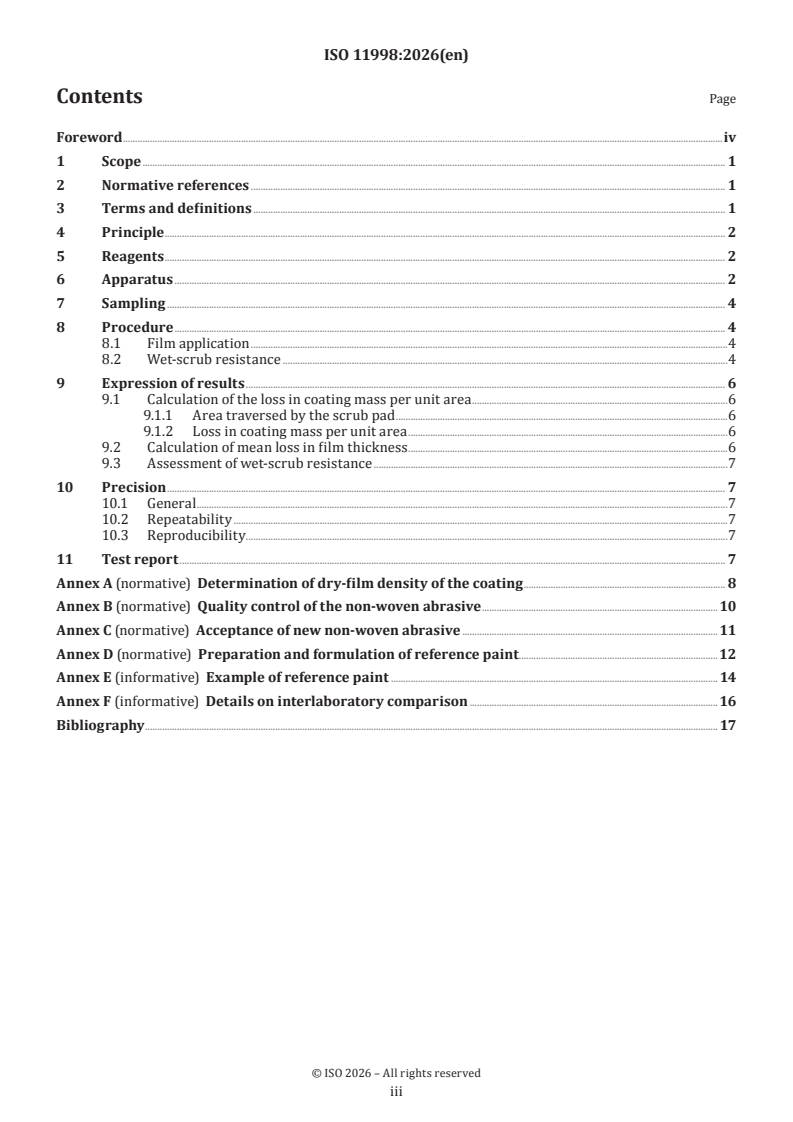
Contents
- 1 Scope
- 2 Normative references
- 3 Terms and definitions
- 3.1 scrub cycle
- 3.2 scrub length
- 3.3 stroke length
- 3.4 wet-scrub resistance
- 4 Principle
- 5 Reagents
- 6 Apparatus
- 7 Sampling
- 8 Procedure
- 8.1 Film application
- 8.2 Wet-scrub resistance
- 9 Expression of results
- 9.1 Calculation of the loss in coating mass per unit area
- 9.2 Calculation of mean loss in film thickness
- 9.3 Assessment of wet-scrub resistance
- 10 Precision
- 10.1 General
- 10.2 Repeatability
- 10.3 Reproducibility
- 11 Test report
- Annex A
- Annex B
- Annex C
- Annex D
- Annex E
- Annex F
- Bibliography
1 Scope
This document specifies an accelerated method for the determination of wet-scrub resistance. The determination of cleanability is not covered in the scope of this document. NOTE The ability of coatings to withstand wear caused by repeated cleaning operations is an important consideration both from a practical point of view and when comparing and rating such coatings. Since wet-scrub resistance depends not only on the quality of a coating but also on the substrate, the method of application, the drying conditions and other factors, the results obtained are not directly transferable to actual practice. In this document, the evaluation of the coating is based on a defined substrate, a fixed application method, specified drying conditions and a defined method of wet scrubbing.
2 Normative references
The following documents are referred to in the text in such a way that some or all of their content constitutes requirements of this document. For dated references, only the edition cited applies. For undated references, the latest edition of the referenced document (including any amendments) applies. ISO 1513, Paints and varnishes — Examination and preparation of test samples ISO 3696, Water for analytical laboratory use — Specification and test methods ISO 4618, Paints and varnishes — Vocabulary ISO 5725-2, Accuracy (trueness and precision) of measurement methods and results — Part 2: Basic method for the determination of repeatability and reproducibility of a standard measurement method ISO 15528, Paints, varnishes and raw materials for paints and varnishes — Sampling
3 Terms and definitions
For the purposes of this document, the terms and definitions given in ISO 4618 and the following apply. ISO and IEC maintain terminology databases for use in standardization at the following addresses:
- ISO Online browsing platform: available at https:// www .iso .org/ obp
- IEC Electropedia: available at https:// www .electropedia .org/
3.1 scrub cycle
one reciprocal movement of the scrub pad over the scrub length (3.2) in both directions
3.2 scrub length
stroke length (3.3) plus the length of the pad
3.3 stroke length
distance traversed by one stroke of the apparatus
ISO 11998:2026(en)
3.4 wet-scrub resistance
ability of a dry coating film to sustain less than a specified loss in film thickness, averaged over a defined area, when exposed to a defined number of wet-scrub cycles
4 Principle
The test coating is applied to a test panel using a film applicator at the appropriate gap clearance. After drying and conditioning, the coated panel is weighed and subjected to a defined number of wet-scrub cycles in a scrub testing machine as described in 8.2.
NOTE Some classification standards, e.g. EN 13300, require fewer scrub cycles. It is then washed, dried and weighed again to determine its loss in mass, from which the mean loss in film thickness is calculated.
Through comparison of the mean loss in film thickness with a specified value, as agreed between interested parties, the coating can be rated in wet-scrub resistance classes.
5 Reagents
5.1 Washing liquid. Use a 2,5 g/l solution of sodium n-dodecylbenzenesulfonate (CAS Registry Number ®1) 25155-30-0) in water conforming to the requirements of grade 3 of ISO 3696. Allow the solution to stand before use until all air-bubbles and foam have dissipated.
6 Apparatus
6.1 Test panel, made of polyvinyl chloride (PVC) film free of migration-susceptible chemical plasticizers, of sufficient rigidity to ensure a flat surface, impervious to and unaffected by water or aliphatic organic solvents and of a nominal thickness of 0,25 mm, approximately 430 mm long and not less than 80 mm wide. Other types of film may be used where the coating contains solvent, which can adversely affect the PVC film, e.g. a metal alloy with a thickness of about 0,25 mm. If the coating delaminates before or during the test, another more suitable substrate shall be used.
6.2 Film applicator, preferably an automatic film applicator, used at an application speed of 10 mm/s to 15 mm/s and fitted with a doctor blade with an appropriate gap clearance and a gap width of at least 60 mm. 6.3 Wet-scrub tester apparatus, consisting of a reciprocating scrub testing machine with a stroke length of (300 ± 10) mm and operating at approximately (37 ± 2) scrub cycles per minute. A counter for recording the number of scrub cycles shall be provided.
6.4 Scrub pad holder, consisting of a metal plate fitted with pins to hold the abrasive pad. A mounting device with elongated holes is loosely fitted on the top of the plate (see Figure 1 and Figure 2). Alternatively, other scrub pad holders, e.g. with hook-and-loop fastener, can be used. The mass of the scrub pad holder, which exerts a downward force on the test panel shall be (135 ± 1) g.
1) CAS Registry Number® is a trademark of the American Chemical Society (ACS). This information is given for the convenience of users of this document and does not constitute an endorsement by ISO of the product named. Equivalent products may be used if they can be shown to lead to the same results.
ISO 11998:2026(en) Figure 1 — Mounting device Dimensions in millimetres Key 1 pins Figure 2 — Scrub pad holder 6.5 Technical non-woven abrasive, a non-woven pad, consisting of a plastics material, with embedded abrasive, measuring (90,0 ± 0,5) mm × (39,0 ± 0,5) mm. A new abrasive pad shall be used for every test. 2) 3) TM TM NOTE Scotch-Brite 7448+ Vlies and Abraflex E-Type S-1200 Vlies have proven to be suitable. Since the quality of the technical non-woven abrasive has a direct impact on the test result, batch control of suitable technical non-woven pads is required. The quality of each batch shall be proven in accordance with Annex B.
2) Scotch-Brite 7448+ Vlies is the trade name of a product supplied by 3M. This information is given for the convenience of users of this document and does not constitute an endorsement by ISO of the product named. Equivalent products may be used if they can be shown to lead to the same results.
3) Abraflex E-Type S-1200 Vlies is the trade name of a product supplied by JÖST abrasives GmbH. This information is given for the convenience of users of this document and does not constitute an endorsement by ISO of the product named. Equivalent products may be used if they can be shown to lead to the same results.
ISO 11998:2026(en) New technical non-woven abrasives shall be proven in accordance with Annex C in an interlaboratory comparison.
A reference paint shall be chosen in accordance with Annex D for testing purposes of the non-woven abrasive. 6.6 Analytical balance, shielded from draughts, capable of weighing the test panel with applied coating to the nearest 0,1 mg.
6.7 Straight-edge ruler, with 0,5 mm divisions.
7 Sampling
Take a representative sample of the coating to be tested, as specified in ISO 15528. Examine and prepare the sample as specified in ISO 1513.
8 Procedure
8.1 Film application
Using the film applicator, make a draw-down of the prepared sample of coating material on the plastics film to achieve an even film at least 10 mm longer than the scrub length. Prepare one or more coated plastics film to be able to create enough test panels for threefold testing according to 8.2. Cut the coated plastics film(s) in three stripes according to dimension requirements given in 6.1 and 6.3. Ensure the gap clearance is sufficient so that the resulting dry film is of such a thickness that, after the defined number of wet-scrub cycles, the substrate is not exposed.
If no film applicator is used, apply the sample of coating material in accordance with the industrial application method recommended by the technical data sheet of the coating system to be tested. For the determination of wet-scrub resistance, dry the film at a temperature of (23 ± 2) °C and a relative humidity of (50 ± 5) % according to ISO 3270 for the required period. The drying time is specified by the customer on the basis of classification standards, legal requirements or technical soundness and shall be recorded during the test procedure.
Weigh the test panel with the dried coating film to the nearest 0,1 mg. NOTE 1 Duplicate panels are best prepared by using a standard panel measuring (165 × 430) mm and making a draw-down approximately 150 mm wide. After drying, the panel can then be cut in half lengthwise. NOTE 2 For interior wall paints, a drying period of 28 days is suitable for classification according to EN 13300.
8.2 Wet-scrub resistance
Ensure that the pad-displacing system is parallel to the surface of the test panel and that the mounting device is not in contact with the scrub pad holder (see Figure 3). Place the test panel with the applied coating film in the base pan of the scrub testing machine on a float glass support and hold it down with clamps (see Figure 4), but not so tight as to cause warping of the test panel. Spread the washing liquid with a soft paint brush on the surface of the coating. Leave the liquid in contact with the coating for (60 ± 5) s.
ISO 11998:2026(en) Key 1 mounting device 2 scrub pad holder 3 abrasive pad 4 pad-displacing thread A correct B incorrect Figure 3 — Mounting of scrub pad holder Key 1 test panel 2 coating 3 float glass 4 base pan 5 clamp Figure 4 — Test panel clamping arrangement Saturate the non-woven abrasive for (60 ± 5) s with washing liquid to a final mass of (4,0 ± 0,5) g. Place the abrasive pad on the scrub pad holder and in contact with the coating film. The unprinted side of the pad shall be the side in contact with the coating during the test.
...
Contents
- 1 Domaine d'application
- 2 Références normatives
- 3 Termes et définitions
- 3.1 cycle de frottement
- 3.2 longueur de déplacement
- 3.3 course
- 3.4 résistance au frottement humide
- 4 Principe
- 5 Réactifs
- 6 Appareillage
- 7 Échantillonnage
- 8 Mode opératoire
- 8.1 Application du film
- 8.2 Résistance au frottement humide
- 9 Expression des résultats
- 9.1 Calcul de la perte de masse du revêtement par unité de surface
- 9.2 Calcul de la perte moyenne d'épaisseur de film
- 9.3 Évaluation de la résistance au frottement humide
- 10 Fidélité
- 10.1 Généralités
- 10.2 Répétabilité
- 10.3 Reproductibilité
- 11 Rapport d'essai
- Annexe A
- Annexe B
- Annexe C
- Annexe D
- Annexe E
- Annexe F
- Bibliographie
1 Domaine d'application
Le présent document spécifie une méthode accélérée de détermination de la résistance au frottement humide. La détermination de l'aptitude au nettoyage n'entre pas dans le domaine d'application du présent document.
NOTE La capacité des revêtements (produits de peinture) à résister à l'usure provoquée par des opérations de nettoyage répétées est un critère important, tant d'un point de vue pratique que lors de la comparaison et de l'évaluation de ces produits. Étant donné que la résistance au frottement humide ne dépend pas uniquement de la qualité du produit, mais aussi du subjectile, de la méthode d'application, des conditions de séchage et d'autres facteurs, les résultats obtenus ne sont pas directement transposables dans la réalité pratique. Dans le présent document, l'évaluation du revêtement se fait sur la base d'un subjectile défini, d'une méthode d'application fixée, de conditions de séchage définies et d'une méthode de frottement humide définie.
2 Références normatives
Les documents suivants sont cités dans le texte de sorte qu’ils constituent, pour tout ou partie de leur contenu, des exigences du présent document. Pour les références datées, seule l’édition citée s’applique. Pour les références non datées, la dernière édition du document de référence s'applique (y compris les éventuels amendements).
ISO 1513, Peintures et vernis — Examen et préparation des échantillons pour essai ISO 3696, Eau pour laboratoire à usage analytique — Spécification et méthodes d'essai ISO 4618, Peintures et vernis — Vocabulaire ISO 5725-2, Exactitude (justesse et fidélité) des résultats et méthodes de mesure — Partie 2: Méthode de base pour la détermination de la répétabilité et de la reproductibilité d'une méthode de mesure normalisée ISO 15528, Peintures, vernis et matières premières pour peintures et vernis — Échantillonnage
3 Termes et définitions
Pour les besoins du présent document, les termes et définitions donnés dans l'ISO 4618 ainsi que les suivants, s'appliquent.
L’ISO et l’IEC tiennent à jour des bases de données terminologiques destinées à être utilisées en normalisation, consultables aux adresses suivantes:
- ISO Online browsing platform: disponible à l’adresse https:// www .iso .org/ obp
- IEC Electropedia: disponible à l’adresse https:// www .electropedia .org/
3.1 cycle de frottement
mouvement alternatif du patin de frottement sur une longueur de déplacement (3.2) correspondant à un aller-retour
ISO 11998:2026(fr)
3.2 longueur de déplacement
longueur de course (3.3) de l'appareil additionnée de la longueur du patin
3.3 course
distance parcourue lors d'un déplacement du dispositif muni du patin
3.4 résistance au frottement humide
capacité d'un film de revêtement sec à résister à une perte d'épaisseur de film inférieure à l'épaisseur définie, moyennée sur une surface définie, après un nombre défini de cycles de frottement humide
4 Principe
Le revêtement d'essai est appliqué sur une éprouvette à l'aide d'un applicateur de film réglé à l'épaisseur adéquate. Après séchage et conditionnement, l'éprouvette peinte est pesée puis soumise à un nombre défini de cycles de frottement humide dans une machine d'essai de frottement, comme décrit au 8.2. NOTE Dans certaines normes de classification, l'EN 13300 par exemple, un nombre inférieur de cycles est requis. Elle est ensuite lavée, séchée et pesée de nouveau pour déterminer sa perte de masse, à partir de laquelle est calculée la perte moyenne d'épaisseur de film.
En comparant la perte moyenne d'épaisseur de film avec une valeur spécifiée, convenue entre les parties, la classe de résistance au frottement humide peut être évaluée.
5 Réactifs
5.1 Lavage liquide. Utiliser une solution à 2,5 g/l de n-dodécylbenzènesulfonate de sodium (numéro ®1) de registre CAS 25155-30-0) dans de l'eau conforme aux exigences de classe 3 de l'ISO 3696. Avant utilisation, laisser reposer la solution jusqu'à la disparition totale des bulles d'air et de la mousse.
6 Appareillage
6.1 Éprouvette, réalisée en film de polychlorure de vinyle (PVC) exempt de plastifiant chimique susceptible de migrer, de rigidité suffisante pour garantir une surface plane, imperméable et non affectée par l'eau ou par des solvants organiques aliphatiques et d'une épaisseur nominale de 0,25 mm, de longueur d'environ 430 mm et de largeur au moins égale à 80 mm.
D'autres types de film peuvent être utilisés lorsque le revêtement contient un solvant, ce qui peut avoir un effet négatif sur le film PVC, par exemple un alliage métallique d'une épaisseur d'environ 0,25 mm. Si le produit s'écaille avant ou pendant l'essai, un autre subjectile, plus approprié, doit être utilisé. 6.2 Applicateur de film, de préférence un applicateur de film automatique, dont la vitesse d’application est comprise entre 10 mm/s et 15 mm/s et muni d’un couteau avec réglage d’épaisseur d’application appropriée et d’une largeur d’application d’au moins 60 mm.
6.3 Appareillage d'essai de frottement humide, machine d’essai animée d’un mouvement de va-et-vient dont la course est de (300 ± 10) mm et fonctionnant à environ (37 ± 2) cycles de frottement par minute. Un compteur qui enregistre le nombre de cycles de frottement doit être fourni.
1) Numéro de registre CAS est une marque déposée de l'American Chemical Society (ACS). Cette information est donnée par souci de commodité à l'intention des utilisateurs du présent document et ne saurait constituer un engagement de l'ISO à l'égard de ce produit. Des produits équivalents peuvent être utilisés s'il est démontré qu'ils conduisent aux mêmes résultats.
ISO 11998:2026(fr) 6.4 Support de patin de frottement, composé d'une plaque métallique munie de piques pour retenir le patin abrasif. Un dispositif de fixation percé de trous oblongs est fixé, sans être serré, sur le dessus de la plaque (voir la Figure 1 et la Figure 2). Il est possible d'utiliser d'autres supports de patin de frottement, par exemple avec un système de fixation à crochets et boucles. La masse du support de patin de frottement qui exerce une force vers le bas sur l'éprouvette doit être de (135 ± 1) g. Figure 1 — Dispositif de fixation Dimensions en millimètres Légende 1 piques Figure 2 — Support de patin de frottement 6.5 Abrasif technique non tissé, constitué d'un patin non tissé en matière plastique, avec abrasif incorporé, mesurant (90,0 ± 0,5) mm × (39,0 ± 0,5) mm. Un patin abrasif neuf doit être utilisé à chaque essai.
ISO 11998:2026(fr) TM 2) TM 3) NOTE Scotch-Brite 7448+ Vlies et Abraflex E-Type S-1200 Vlies se sont avérés appropriés. Étant donné que la qualité de l'abrasif technique non tissé a un impact direct sur le résultat de l'essai, le contrôle des lots de patins techniques non tissés appropriés est nécessaire. La qualité de chaque lot doit être démontrée conformément à l'Annexe B.
Les nouveaux abrasifs techniques non tissés doivent être validés conformément à l'Annexe C lors d'une comparaison interlaboratoires.
Une peinture de référence doit être choisie conformément à l'Annexe D pour les essais de l'abrasif non tissé. 6.6 Balance analytique, protégée des courants d'air, capable de peser l'éprouvette peinte avec une précision de 0,1 mg.
6.7 Règle, comportant des graduations de 0,5 mm.
7 Échantillonnage
Prélever un échantillon représentatif du revêtement soumis à essai de la manière spécifiée dans l'ISO 15528. Examiner l'échantillon et le préparer de la manière spécifiée dans l'ISO 1513.
8 Mode opératoire
8.1 Application du film
À l'aide de l'applicateur de film, appliquer, de haut en bas sur l'éprouvette, l'échantillon de peinture sur le film plastique pour obtenir un film uniforme au moins 10 mm plus long que la longueur de déplacement. Préparer un ou plusieurs films plastiques revêtus afin de pouvoir créer suffisamment d'éprouvettes pour réaliser un essai en triple conformément au 8.2. Couper le ou les films plastiques revêtus en trois bandes selon les exigences dimensionnelles données au 6.1 et au 6.3. Vérifier que l’épaisseur d’application est suffisante, pour que le film sec obtenu soit d’une épaisseur telle que, après le nombre défini de cycles de frottement, le subjectile ne soit pas mis à nu.
Si aucun applicateur de film n'est utilisé, appliquer l'échantillon de peinture conformément à la méthode d'application industrielle recommandée par la fiche technique du système de revêtement à soumettre à l'essai.
Pour la détermination de la résistance au frottement humide, sécher le film à une température de (23 ± 2) °C et une humidité relative de (50 ± 5) % selon l'ISO 3270 pendant la durée requise. Le temps de séchage est spécifié par le client sur la base des normes de classification, des exigences légales ou de la pertinence technique et il doit être enregistré pendant le mode opératoire d'essai. Peser à 0,1 mg près l'éprouvette revêtue du film de peinture séché. NOTE 1 La duplication d’éprouvettes est plus aisée si on utilise une éprouvette normalisée mesurant (165 × 430) mm et en réalisant une application de haut en bas sur une largeur d’environ 150 mm. Après séchage, l'éprouvette peut alors être coupée en deux dans le sens de la longueur.
2) Scotch-Brite 7448+ Vlies est l'appellation commerciale d'un produit distribué par 3M. Cette information est donnée par souci de commodité à l'intention des utilisateurs du présent document et ne saurait constituer un engagement de l'ISO à l'égard de ce produit. Des produits équivalents peuvent être utilisés s'il est démontré qu'ils conduisent aux mêmes résultats.
3) Abraflex E-Type S-1200 Vlies est l'appellation commerciale d'un produit distribué par JÖST abrasives GmbH. Cette information est donnée par souci de commodité à l'intention des utilisateurs du présent document et ne saurait constituer un engagement de l'ISO à l'égard de ce produit. Des produits équivalents peuvent être utilisés s'il est démontré qu'ils conduisent aux mêmes résultats.
ISO 11998:2026(fr) NOTE 2 Pour les peintures murales intérieures, une durée de séchage de 28 jours est appropriée pour la classification selon l'EN 13300.
8.2 Résistance au frottement humide
Vérifier que le système de déplacement du patin est parallèle à la surface de l'éprouvette et que le dispositif de fixation n'est pas en contact avec le support du patin de frottement (voir la Figure 3). Placer l'éprouvette peinte dans le bac inférieur de la machine d'essai de frottement sur un support de verre flotté et la maintenir à l'aide des pinces de serrage (voir la Figure 4), mais sans trop serrer, car l'éprouvette pourrait gondoler. Étaler le liquide de lavage à l'aide d'un pinceau doux sur la surface du revêtement. Laisser le liquide en contact avec le revêtement pendant (60 ± 5) s.
Légende 1 dispositif de fixation 2 support du patin de frottement 3 patin abrasif 4 patte de déplacement du patin A correct B incorrect Figure 3 — Fixation du support du patin de frottement
...