


ISO/FDIS 18436-9
(Main)Condition Monitoring and Diagnostics of Machine Systems — Requirements for training and certification of personnel — Part 9: Optical Gas Imaging
Condition Monitoring and Diagnostics of Machine Systems — Requirements for training and certification of personnel — Part 9: Optical Gas Imaging
This document reflects on the qualification of personnel performing Optical Gas Imaging (OGI) for fugitive emissions. The intention is to add a sub-category to ISO 18436 for this specific purpose as OGI requires a set of skills that is different than the traditional infrared condition monitoring. The skill set includes many similarities between traditional condition monitoring, such as system and component knowledge, but differs in that the user must recognize the conditions for successful gas imaging. Knowledge of Chemistry is essential as well as detector Physics to determine the proper wavelength instrument. The document is intended for end users, contractors, consultants, service providers and manufacturers.
Titre manque — Partie 9: Titre manque
General Information
- Status
- Not Published
- Technical Committee
- ISO/TC 108/SC 5 - Condition monitoring and diagnostics of machine systems
- Current Stage
- 5000 - FDIS registered for formal approval
- Start Date
- 11-Feb-2026
- Completion Date
- 29-Jan-2026
Overview
ISO/FDIS 18436-9:2025 specifies the requirements for the training, qualification, and certification of personnel conducting Optical Gas Imaging (OGI) for fugitive emissions detection in machine systems. As a new sub-category within the ISO 18436 family, this standard ensures that OGI practitioners possess the specialized skills distinct from traditional infrared condition monitoring. Its emphasis includes system and component knowledge, a grasp of chemistry, and detector physics, which are essential for effective fugitive emission detection.
This standard is designed for end users, contractors, consultants, service providers, and manufacturers involved in industrial machine condition monitoring, environmental compliance, or asset management.
Key Topics
- Certification Categories: The standard defines three categories-Category I, II, and III-each with ascending levels of competency, duties, and autonomy for optical gas imaging personnel.
- Training Requirements: It outlines minimum training durations, educational background recommendations, and detailed subject matter including both theoretical and practical elements relevant to OGI.
- Examination and Assessment: ISO/FDIS 18436-9 specifies examination structure, content, and passing criteria, ensuring personnel are comprehensively evaluated on both general theory and practical application.
- Experience Prerequisites: A minimum period of hands-on experience is required, varying by certification category, to ensure practitioners are proficient in real-world OGI activities.
- Equipment and Methodology: The standard covers OGI technology, camera operation, environmental considerations, data quality control, and instrument maintenance.
- Safety and Regulatory Compliance: Emphasis is placed on adherence to safety protocols, local and national regulations, and proper use of personal protective equipment, especially when operating in hazardous environments or with unmanned aerial systems (sUAS).
- Scientific Fundamentals: Understanding of chemistry, detector physics, heat transfer, and infrared science is integral to effective OGI practice.
Applications
ISO/FDIS 18436-9 is highly relevant across various industries where fugitive gas emissions pose risks to safety, compliance, and operational efficiency. Practical uses include:
- Leak Detection and Repair (LDAR): Ensuring timely identification and documentation of gas leaks in petrochemical plants, refineries, and natural gas facilities.
- Environmental Compliance: Supporting operators in meeting stringent regulatory requirements for emissions monitoring and reduction.
- Asset Management: Enabling predictive maintenance and minimizing unplanned downtime by locating leaks before escalation.
- Utilities and Power Generation: Monitoring infrastructure like pipelines, storage tanks, and compressors for gas leaks that could affect system reliability.
- Aerial Inspections: Utilizing sUAS for OGI expands coverage of large or difficult-to-access assets, increasing inspection safety and efficiency.
- Training and Personnel Development: Establishing industry-accepted certification pathways for in-house staff and third-party contractors.
Related Standards
Personnel and organizations adopting ISO/FDIS 18436-9 may also reference or integrate the following standards for a holistic condition monitoring and certification program:
- ISO 18436-1: General requirements for the certification process of condition monitoring personnel.
- ISO 13372: Terminology for condition monitoring and diagnostics of machines.
- ISO/IEC 17000: Principles for conformity assessment.
- ASNT SNT-TC-1A: Practice for personnel qualification in nondestructive testing, referenced for visual acuity assessment.
Conclusion
ISO/FDIS 18436-9 sets a globally recognized benchmark for the competency of personnel in Optical Gas Imaging for machine system condition monitoring. By adhering to this standard, organizations can improve safety, environmental stewardship, and operational reliability through effective detection and documentation of fugitive gas emissions. The certification structure instills confidence that practitioners are fully equipped-educationally, practically, and ethically-to carry out OGI inspections with precision and professionalism.


Get Certified
Connect with accredited certification bodies for this standard

BSI Group
BSI (British Standards Institution) is the business standards company that helps organizations make excellence a habit.

Bureau Veritas
Bureau Veritas is a world leader in laboratory testing, inspection and certification services.

DNV
DNV is an independent assurance and risk management provider.
Sponsored listings
Frequently Asked Questions
ISO/FDIS 18436-9 is a draft published by the International Organization for Standardization (ISO). Its full title is "Condition Monitoring and Diagnostics of Machine Systems — Requirements for training and certification of personnel — Part 9: Optical Gas Imaging". This standard covers: This document reflects on the qualification of personnel performing Optical Gas Imaging (OGI) for fugitive emissions. The intention is to add a sub-category to ISO 18436 for this specific purpose as OGI requires a set of skills that is different than the traditional infrared condition monitoring. The skill set includes many similarities between traditional condition monitoring, such as system and component knowledge, but differs in that the user must recognize the conditions for successful gas imaging. Knowledge of Chemistry is essential as well as detector Physics to determine the proper wavelength instrument. The document is intended for end users, contractors, consultants, service providers and manufacturers.
This document reflects on the qualification of personnel performing Optical Gas Imaging (OGI) for fugitive emissions. The intention is to add a sub-category to ISO 18436 for this specific purpose as OGI requires a set of skills that is different than the traditional infrared condition monitoring. The skill set includes many similarities between traditional condition monitoring, such as system and component knowledge, but differs in that the user must recognize the conditions for successful gas imaging. Knowledge of Chemistry is essential as well as detector Physics to determine the proper wavelength instrument. The document is intended for end users, contractors, consultants, service providers and manufacturers.
ISO/FDIS 18436-9 is classified under the following ICS (International Classification for Standards) categories: 03.100.30 - Management of human resources; 13.320 - Alarm and warning systems; 17.180.01 - Optics and optical measurements in general. The ICS classification helps identify the subject area and facilitates finding related standards.
ISO/FDIS 18436-9 is available in PDF format for immediate download after purchase. The document can be added to your cart and obtained through the secure checkout process. Digital delivery ensures instant access to the complete standard document.
Standards Content (Sample)
DRAFT
International
Standard
ISO/DIS 18436-9
ISO/TC 108/SC 5
Condition Monitoring and
Secretariat: SA
Diagnostics of Machine Systems —
Voting begins on:
Requirements for training and
2025-07-17
certification of personnel —
Voting terminates on:
2025-10-09
Part 9:
Optical Gas Imaging
ICS: 17.180.01; 13.320; 03.100.30
THIS DOCUMENT IS A DRAFT CIRCULATED
FOR COMMENTS AND APPROVAL. IT
IS THEREFORE SUBJECT TO CHANGE
AND MAY NOT BE REFERRED TO AS AN
INTERNATIONAL STANDARD UNTIL
PUBLISHED AS SUCH.
IN ADDITION TO THEIR EVALUATION AS
BEING ACCEPTABLE FOR INDUSTRIAL,
TECHNOLOGICAL, COMMERCIAL AND
USER PURPOSES, DRAFT INTERNATIONAL
STANDARDS MAY ON OCCASION HAVE TO
This document is circulated as received from the committee secretariat.
BE CONSIDERED IN THE LIGHT OF THEIR
POTENTIAL TO BECOME STANDARDS TO
WHICH REFERENCE MAY BE MADE IN
NATIONAL REGULATIONS.
RECIPIENTS OF THIS DRAFT ARE INVITED
TO SUBMIT, WITH THEIR COMMENTS,
NOTIFICATION OF ANY RELEVANT PATENT
RIGHTS OF WHICH THEY ARE AWARE AND TO
PROVIDE SUPPORTING DOCUMENTATION.
Reference number
ISO/DIS 18436-9:2025(en)
DRAFT
ISO/DIS 18436-9:2025(en)
International
Standard
ISO/DIS 18436-9
ISO/TC 108/SC 5
Condition Monitoring and
Secretariat: SA
Diagnostics of Machine Systems —
Voting begins on:
Requirements for training and
certification of personnel —
Voting terminates on:
Part 9:
Optical Gas Imaging
ICS: 17.180.01; 13.320; 03.100.30
THIS DOCUMENT IS A DRAFT CIRCULATED
FOR COMMENTS AND APPROVAL. IT
IS THEREFORE SUBJECT TO CHANGE
AND MAY NOT BE REFERRED TO AS AN
INTERNATIONAL STANDARD UNTIL
PUBLISHED AS SUCH.
IN ADDITION TO THEIR EVALUATION AS
BEING ACCEPTABLE FOR INDUSTRIAL,
© ISO 2025
TECHNOLOGICAL, COMMERCIAL AND
USER PURPOSES, DRAFT INTERNATIONAL
All rights reserved. Unless otherwise specified, or required in the context of its implementation, no part of this publication may
STANDARDS MAY ON OCCASION HAVE TO
be reproduced or utilized otherwise in any form or by any means, electronic or mechanical, including photocopying, or posting on
This document is circulated as received from the committee secretariat. BE CONSIDERED IN THE LIGHT OF THEIR
the internet or an intranet, without prior written permission. Permission can be requested from either ISO at the address below
POTENTIAL TO BECOME STANDARDS TO
WHICH REFERENCE MAY BE MADE IN
or ISO’s member body in the country of the requester.
NATIONAL REGULATIONS.
ISO copyright office
RECIPIENTS OF THIS DRAFT ARE INVITED
CP 401 • Ch. de Blandonnet 8
TO SUBMIT, WITH THEIR COMMENTS,
CH-1214 Vernier, Geneva
NOTIFICATION OF ANY RELEVANT PATENT
Phone: +41 22 749 01 11
RIGHTS OF WHICH THEY ARE AWARE AND TO
PROVIDE SUPPORTING DOCUMENTATION.
Email: copyright@iso.org
Website: www.iso.org
Published in Switzerland Reference number
ISO/DIS 18436-9:2025(en)
ii
ISO/DIS 18436-9:2025(en)
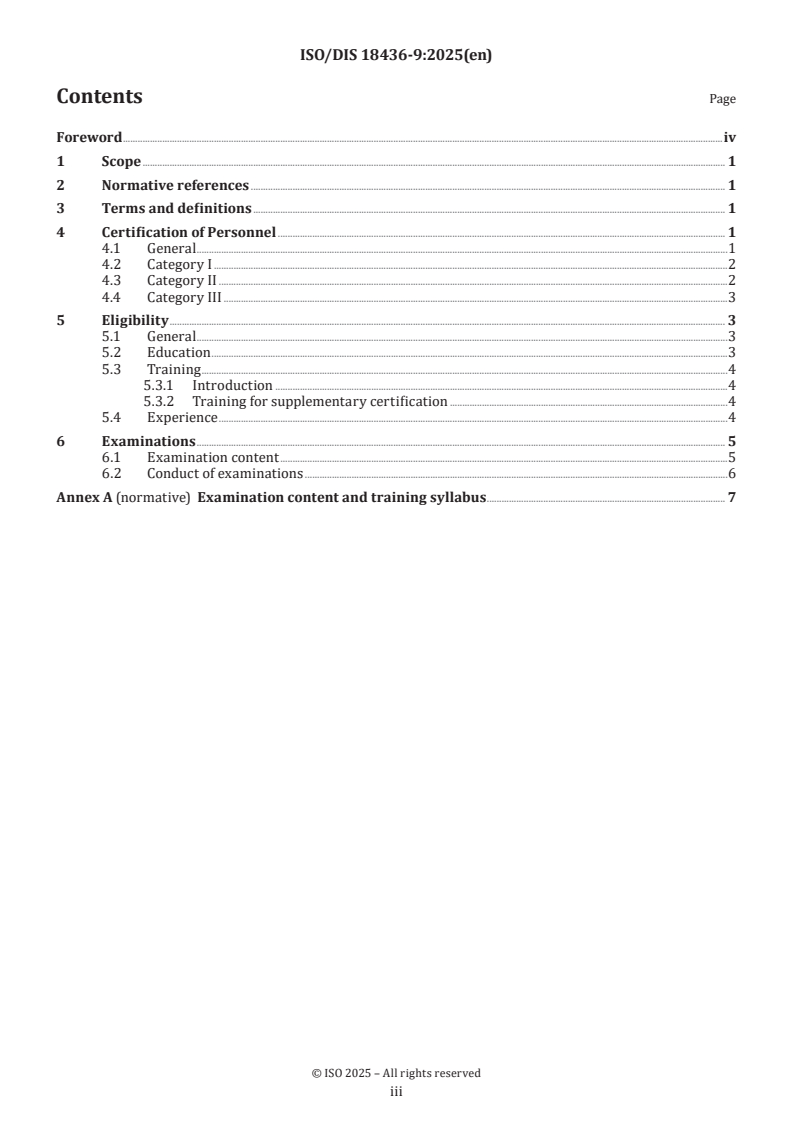
Contents Page
Foreword .iv
1 Scope . 1
2 Normative references . 1
3 Terms and definitions . 1
4 Certification of Personnel . 1
4.1 General .1
4.2 Category I .2
4.3 Category II .2
4.4 Category III .3
5 Eligibility . 3
5.1 General .3
5.2 Education .3
5.3 Training .4
5.3.1 Introduction .4
5.3.2 Training for supplementary certification .4
5.4 Experience .4
6 Examinations . 5
6.1 Examination content .5
6.2 Conduct of examinations .6
Annex A (normative) Examination content and training syllabus . 7
iii
ISO/DIS 18436-9:2025(en)
Foreword
ISO (the International Organization for Standardization) is a worldwide federation of national standards
bodies (ISO member bodies). The work of preparing International Standards is normally carried out through
ISO technical committees. Each member body interested in a subject for which a technical committee
has been established has the right to be represented on that committee. International organizations,
governmental and non-governmental, in liaison with ISO, also take part in the work. ISO collaborates closely
with the International Electrotechnical Commission (IEC) on all matters of electrotechnical standardization.
International Standards are drafted in accordance with the rules given in the ISO/IEC Directives, Part 2.
The main task of technical committees is to prepare International Standards. Draft International Standards
adopted by the technical committees are circulated to the member bodies for voting. Publication as an
International Standard requires approval by at least 75 % of the member bodies casting a vote.
Attention is drawn to the possibility that some of the elements of this document may be the subject of patent
rights. ISO shall not be held responsible for identifying any or all such patent rights.
ISO 18436-1 was prepared by Technical Committee ISO/TC 108, Mechanical vibration, shock and condition
monitoring, Subcommittee SC 5, Condition monitoring and diagnostics of machine systems.
The document ASNT Recommended Practice SNT-TC1A (2024), “Personnel Qualification and Certification in
Nondestructive Testing” was used as a reference for testing the visual acuity of candidates.
iv
DRAFT International Standard ISO/DIS 18436-9:2025(en)
Condition Monitoring and Diagnostics of Machine Systems —
Requirements for training and certification of personnel —
Part 9:
Optical Gas Imaging
1 Scope
This part of ISO 18436 specifies sector specific requirements for organizations (certification bodies)
operating conformity assessment systems who perform Optical Gas Imaging inspections to identify fugitive
emissions (e.g, but not limited to, hydrocarbons, ammonia, sulphur hexafluoride, carbon monoxide, carbon
dioxide, refrigerants) and who may recommend corrective action.
2 Normative references
The following documents, in whole or in part, are normatively referenced in this document and are
indispensable for its application. For dated references, only the edition cited applies. For undated references,
the latest edition of the referenced document (including any amendments) applies.
ISO 13372, Condition monitoring and diagnostics of machines — Vocabulary
ISO/IEC 17000:2004, Conformity assessment — Vocabulary and general principles
ISO 18436-1, Condition monitoring and diagnostics of machine systems — Requirements for certification of
personnel — Part 1: Sector specific requirements for certification bodies and the certification process
3 Terms and definitions
For the purposes of this document, the terms and definitions given in ISO/IEC 17000, and ISO 18436-1 apply.
sUAS when referenced in this document, refers to small Unmanned Aerial Systems.
ISO and IEC maintain terminology databases for use in standardization at the following addresses:
— ISO Online browsing platform: available at https:// www .iso .org/ obp
— IEC Electropedia: available at https:// www .electropedia .org/
4 Certification of Personnel
4.1 General
Certified persons are not only to have the knowledge areas covered in Annex A & B shall have the knowledge,
skills, and aptitude to adequately perform the job tasks for the appropriate categories as indicated in
clauses 4.2, 4.3, and 4.4.
ISO/DIS 18436-9:2025(en)
4.2 Category I
Individuals certified to Category I can perform Optical Gas Imaging according to established and recognized
procedures. Personnel certified to Category I shall be able to:
a) apply a specified optical gas imaging technique (e.g. utilize enhanced gas detection mode);
b) set up and operate the optical gas imaging equipment needed for safe data collection (e.g. fixed, portable
or aerial platforms);
c) identify, prevent and control poor data collection and potential error sources;
d) identify and follow an established inspection route;
e) identify gas leaks and fugitive emissions using established instructions;
f) record and document gas leaks and fugitive emissions using established instructions;
g) record and document the environmental conditions at the time of the test (e.g. ambient air temperature,
humidity, wind speed and direction;
h) verify that the background temperature (ΔT ) at the time of the inspection is suitable for obtaining
good data;
i) adjust the image as needed to highlight the gas leak/fugitive emission;
j) select an appropriate optical gas imaging mode (e.g. auto, manual, enhanced) for successful gas
detection;
k) perform instrument verification check as required by established instructions and/or regulatory
requirements;
l) perform any required optical gas imaging camera maintenance (e.g. camera body and lens cleaning) to
ensure successful emission detection;
m) report inspection results;
n) comply with all appropriate safety protocols;
o) comply with all local and national regulations regarding aerial platforms.
4.3 Category II
Individuals certified to Category II can perform optical gas imaging according to established and recognized
procedures. Personnel certified to Category II shall be able to perform all the duties of a Category I and shall
be able to:
a) determine the type of gas/fugitive emission that may be leaking;
b) analyse gas absorption/transmission curves or gas response factors and select the appropriate optical
gas imaging camera;
c) create safe inspection routes that assure 100 % inspection coverage;
d) identify and document difficult to monitor (DTM) and impossible to monitor (ITM) components prior to
and/or during an inspection;
e) locate/identify/quantify the source of the gas leak/fugitive emission;
f) maintain the calibration of the optical gas imaging equipment based on the manufacturer’s
recommendations;
g) measure emissivity and reflective background per established techniques;
ISO/DIS 18436-9:2025(en)
h) measure temperatures of components as required by established techniques;
i) establish the minimum and maximum safe altitudes for aerial platforms;
j) prepare inspection reports;
k) maintain a database of inspection results; and
l) provide guidance to and supervise Category I.
4.4 Category III
Individuals certified as Category III can perform optical gas imaging according to established and recognized
procedures. Personnel certified to Category III shall be able to perform all the duties of a Category II and
shall be able to:
a) develop and establish Optical Gas Imaging inspection programs, write inspection procedures and
instructions, determine frequency of testing, identify systems/components for periodic/continuous
monitoring and the use of advanced detection techniques;
b) assess the severity and compare to established acceptance criteria;
c) interpret and provide leak quantification calculations as required;
d) interpret and evaluate codes, standards, specifications, regulations and procedures;
e) designate the inspection methods, procedures and instructions to be used;
f) provide guidance and supervise Category I and II personnel;
g) recommend the use of alternative or supplemental leak detection technologies;
h) be able to establish and manage leak detection programs;
i) develop and implement Optical Gas Imaging inspection safety protocols.
NOTE It is the employer’s responsibility to ensure Category III personnel have the necessary competency in the
required management skill, for example creating budgets, preparing cost justifications, and managing personnel
development as required.
5 Eligibility
5.1 General
Candidates should have a combination of education, training, and experience to ensure that they understand
the principles and procedures applicable to optical gas leak detection and analysis.
It is advised that all candidates have their colour perception assessed by the Ishihara 24 plate test. A record
of test results should be retained and presented to the assessment body upon request. In the event of a color
perception deficiency, indicated by misreading four or more of the 24 plates is detected during the Ishihara
test, a further “task specific” test is to be carried out by an appropriate entity. Failure to pass this test may
require the candidate to use a monochrome palette. This “task specific” test and any requirements to use a
monochrome palette is to be documented and made available to the assessment body upon request.
5.2 Education
Candidates seeking certification do not need to provide evidence of formal education to establish eligibility.
However, it is recommended that candidates for Category I and Category II have at least a secondary
school graduate certification or its equivalent. Category II and III candidates shall be able to manipulate
simple algebraic equations, use a basic scientific calculator and be familiar with the operation of personal
computers. Successful completion of two or more years of mechanical technology, mechanical engineering,
ISO/DIS 18436-9:2025(en)
chemical engineering or petroleum engineering at an accredited college, university or technical school is
highly recommended for candidates seeking certification to Category III.
5.3 Training
5.3.1 Introduction
To be eligible to apply for certification based on this part of ISO 18436, the candidates shall provide evidence
of successful completion of training based on the requirements of Annex A. The documents listed in the
Bibliography should be used as the domain of knowledge for the training syllabus. Such training shall be
compliant with ISO 18436-3. The minimum duration of training is shown in Table 1. Training should be
in the form of lectures, demonstrations, practical exercises, or formal training courses. Certification
requirements shall be in accordance with this part of ISO 18436. Training time devoted to each subject shall
be in accordance with Annex A and Table 1. See Annex B for a non-exhaustive list of the topics and subtopics
to be covered. The curriculum may be adjusted for specific applications (buildings, sUAS, electrical, etc.) if
the total hours and broad subject matters are covered.
Table 1 — Minimum duration of cumulative training (hours)
Category I Category II Category III
24 48 72
Training may be modularized into two or more subject areas covering general scientific principles and
application-specific knowledge to allow for mutual recognition between non-destructive testing, condition
monitoring and optical gas imaging bodies.
5.3.2 Training for supplementary certification
The operation of small unmanned aerial systems (sUAS) for optical gas imaging requires unique skills and
knowledge. Supplementary training in the operation of such systems should include selection of the proper
payload; scanning speed, height above ground level for imaging, height above ground level for measurement,
proper sUAS positioning to minimize solar reflections, ability to recognize solar loading and competency in
local sUAS regulations, including any needed licensing.
5.4 Experience
To be eligible to apply for assessment based on this part of ISO 18436, the candidate shall provide evidence
to the ISO 18436-1 certification and body of experience in the field of Optical Gas Imaging in accordance
with Table 2. Certification to Category II and III requires previous certification at the lower category.
Table 2 — Minimum cumulative practical, interpretation and program management experience
requirements (months)
Category I Category II Category III
12 months 24 months 36 months
NOTE: The experience hours are based on 16 hours minimum per month of optical gas imaging experience in accordance with
clauses 4 and 5.
5.4.1 The minimum total experience durations specified (in months) are required to enable the acquisition
of experience in all category criteria in accordance with ISO 18436-1 and clause 5.4.
5.4.2 Candidates shall keep verifiable documentary evidence of hours and nature of work for their Optical
Gas Imaging inspections and reporting in accordance with ISO 18436-1. Candidates for Categories I and II
shall have this evidence validated by a Category II or III person or, in the absence of such a person, by the
candidate’s technical supervisor.
ISO/DIS 18436-9:2025(en)
5.4.3 Candidates for Category III shall have this evidence validated by a Category III person or, in the
absence of such a person, by the candidate’s technical supervisor.
5.4.4 The validation for all categories requires the signature of the validating person on the documentary
evidence. The validating person should augment this validation process via oral assessment, accompanied
task performance, report submission and review, procedure submission and review or a combination
thereof, to increase the confidence of the validation.
6 Examinations
6.1 Examination content
6.1.1 For each Category, candidates shall be required to answer a fixed minimum number of multiple-
choice questions in a specified time duration as indicated by Table 3.
6.1.2 Questions shall be of a practical nature yet test the candidate on concepts and principles required to
conduct Optical Gas Imaging on components.
6.1.3 The examination for Category I shall consist of a Part A — General Theory and a Part B — Practical
Application. The Part B examination shall cover quality data acquisition, the recognition, prevention and
control of error sources and basic leak detection. This examination may include physical data acquisition
tasks in addition to image interpretation.
6.1.4 The examination for Category II shall consist of a Part A — General Theory (50 %) and a Part B —
Practical Application (50 %). The Part B shall cover detector types, sensor selection, image analysis image
interpretation and quantification. This examination may include both physical data acquisition tasks in
addition to image interpretation and analysis.
6.1.5 The examination for Category III shall consist of a Part A — General Theory (50 %) and a Part B
— Practical Application (50 %). The Part B shall cover component operation (tanks, valves, separators,
wells, compressors, controllers, flares), leak verification methods, leak quantification methods, inspection
procedure development and program development. Part B may also include narrative and short answer
questions. Some questions shall involve the interpretation of thermal images and/o
...
Questions, Comments and Discussion
Ask us and Technical Secretary will try to provide an answer. You can facilitate discussion about the standard in here.
Loading comments...