

ISO 3857-1:1977
(Main)Compressors, pneumatic tools and machines — Vocabulary — Part 1: General
General Information
- Abstract
Establishes basic concepts in English and French as well as symbols and units. Table 1 tabulates symbols and units referred to ISO/R 31 and ISO 3857; table 2 contains letters used as symbols; table 3 comprises letters and figures used as subscripts. An annex gives references.
- Status
- Published
- Publication Date
- 31-Jul-1977
- Technical Committee
- ISO/TC 118/SC 6 - Air compressors and compressed air systems
- Drafting Committee
- ISO/TC 118/SC 6 - Air compressors and compressed air systems
- Current Stage
- 9093 - International Standard confirmed
- Start Date
- 04-Jul-2024
- Completion Date
- 29-Aug-2026


Overview
ISO 3857-1:1977, titled "Compressors, pneumatic tools and machines - Vocabulary - Part 1: General," is an international standard published by the International Organization for Standardization (ISO). This foundational document establishes the basic vocabulary, symbols, and units related to compressors, pneumatic tools, and pneumatic machines. Presented in both English and French, it serves as the initial part of a comprehensive vocabulary series, providing common terminology and definitions to ensure clarity and consistency across the industry.
The standard covers fundamental concepts and is intended for use by manufacturers, engineers, technical committees, and users working with pneumatic equipment. It consolidates critical symbols and unit references aligned with ISO/R 31 and ISO 3857 to promote standardized communication and interpretation worldwide.
Key Topics
- Basic Concepts: Defines essential terms such as atmospheric pressure, gauge pressure, absolute pressure, static and dynamic pressure, total pressure, critical and reduced pressures.
- Pressure and Temperature Definitions: Detailed explanations of pressure types (static, dynamic, total, absolute) and temperature forms including static, dynamic, total, critical, and reduced temperatures.
- Symbols and Units: Comprehensive tables list symbols used for quantities like pressure (P), volume (V), temperature (T), efficiency, power (P), and others, along with their corresponding SI units.
- Subscripts and Notations: Common letters and figures used as subscripts in equations and measurements, such as “0” for ambient conditions, “1” for inlet, “2” for discharge, and others indicating absolute, static, dynamic pressures, and more.
- References: Cross-references to complementary ISO standards related to measurement, vacuum technology, statistics, and legal metrology, supporting a broader understanding of technical language relating to pneumatic equipment.
Applications
- Engineering and Design: Enables engineers to adopt precise and uniform terms when specifying, designing, and analyzing compressors, pneumatic tools, and machinery, avoiding misunderstandings and errors.
- Standardization: Assists manufacturers in aligning product documentation, user manuals, and technical specifications with internationally recognized terminology.
- Education and Training: Provides educators and trainers with an authoritative resource for teaching the correct terminology in pneumatic technologies.
- Research and Development: Facilitates clear communication of technical details during innovation, ensuring all stakeholders share the same definitions.
- Regulatory Compliance: Supports compliance with international standards in procurement, quality control, and certification processes by providing a clear vocabulary foundation.
Related Standards
- ISO/R 31 (Parts 1 to 4 and 8) - Provides standardized symbols and units across various scientific and engineering disciplines.
- ISO 3529 - Vocabulary related to vacuum technology, critical for pneumatic system components working under reduced pressures.
- ISO 3534 - Statistical vocabulary and symbols, useful for analyzing pneumatic system performance and reliability.
- ISO 4006 - Vocabulary and symbols for fluid flow measurement in closed conduits, relevant for pneumatic machinery.
- Legal Metrology Vocabularies (OIML) - Defines terms used in legal metrology, supporting the accuracy of measurement in pneumatic systems.
ISO 3857-1:1977 is an essential reference that promotes uniformity, precision, and clarity in the language of compressors and pneumatic equipment industries. Its adoption aids global collaboration, enhances technical documentation standards, and supports efficient engineering practices. Utilizing this vocabulary helps ensure that professionals across different countries and sectors speak the same technical language regarding pneumatic tools and machines.
Relations
- Referred By
EN 1012-1:2010 - Compressors and vacuum pumps - Safety requirements - Part 1: Air compressors - Effective Date
- 25-Aug-2026
- Referred By
EN 1012-3:2013 - Compressors and vacuum pumps - Safety requirements - Part 3: Process compressors - Effective Date
- 01-Apr-2026
Get Certified
Connect with accredited certification bodies for this standard

DVS-ZERT GmbH
German welding certification society.
Institut za varilstvo d.o.o. (Welding Institute)
Slovenia's leading welding institute since 1952. ISO 3834, EN 1090, pressure equipment certification, NDT personnel, welder qualification. Only IIW Au
CARES (UK Certification Authority for Reinforcing Steels)
UK certification for reinforcing steels and construction.
Sponsored listings
Frequently Asked Questions
ISO 3857-1:1977 is a standard published by the International Organization for Standardization (ISO). Its full title is "Compressors, pneumatic tools and machines — Vocabulary — Part 1: General". This standard covers: Establishes basic concepts in English and French as well as symbols and units. Table 1 tabulates symbols and units referred to ISO/R 31 and ISO 3857; table 2 contains letters used as symbols; table 3 comprises letters and figures used as subscripts. An annex gives references.
Establishes basic concepts in English and French as well as symbols and units. Table 1 tabulates symbols and units referred to ISO/R 31 and ISO 3857; table 2 contains letters used as symbols; table 3 comprises letters and figures used as subscripts. An annex gives references.
ISO 3857-1:1977 is classified under the following ICS (International Classification for Standards) categories: 01.040.23 - Fluid systems and components for general use (Vocabularies); 01.040.25 - Manufacturing engineering (Vocabularies); 23.140 - Compressors and pneumatic machines; 25.140.10 - Pneumatic tools. The ICS classification helps identify the subject area and facilitates finding related standards.
ISO 3857-1:1977 has the following relationships with other standards: It is inter standard links to EN 1012-1:2010, EN 1012-3:2013. Understanding these relationships helps ensure you are using the most current and applicable version of the standard.
ISO 3857-1:1977 is available in PDF format for immediate download after purchase. The document can be added to your cart and obtained through the secure checkout process. Digital delivery ensures instant access to the complete standard document.
Standards Content (Sample)
~~~~ ~~
INTERNATIONAL STANDARD
NORME INTERNATIONALE
INTERNATIONAL ORGANIZATION FOR STANDARDIZATION l MEXaYHAPOAHA(I OPI-AHM3AUWX I-IO flAHAAPTM3AWW=ORGANISATION INTERNATIONALE DE NORMALISATION
Compressors, pneumatic tools and machines -
Vocabulary - Part I : General
First edition - 1977-08-01
Compresseurs, outils et machines pneumatiques - 1
Vocabulaire - Partie I : G6neralit6s
Premiere Edition - 1977-08-01
UDC/CDU 621.51 : 001.4 Ref. No./Rhf. no : ISO 3857/1-1977 (E/F)
Descriptors : pneumatic equipment, compressors, pneumatic tools, vocabulary , symbols/Descripteurs :
matkriel pneumatique, compresseur,
outil pour marteau pneumatique, vocabulaire, Symbole.
Price based on 6 pages/Prix bask sur 6 pages
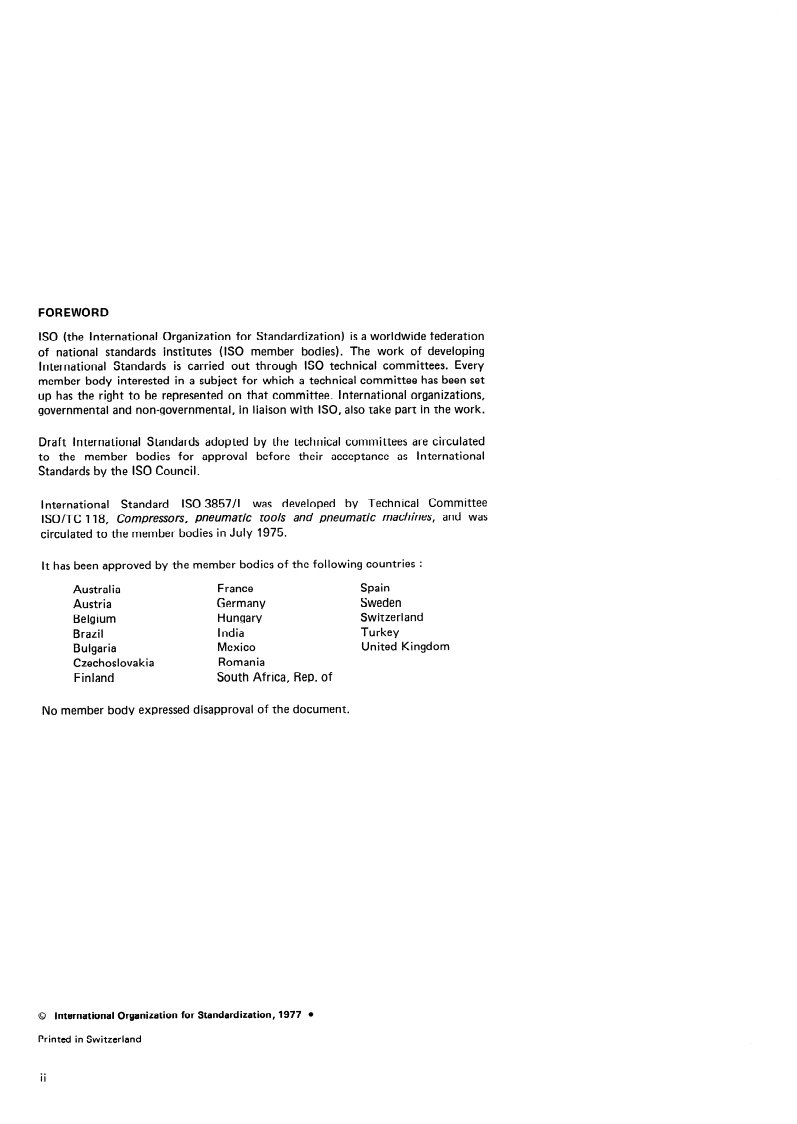
ISO (the International Organization for Standardization) is a worldwide federation
of national Standards institutes (ISO member bodies). The work of developing
International Standards is carried out through ISO technical committees. Every
member body interested in a subject for which a technical committee has been set
up has the right to be represented on that committee. International organizations,
governmental and non-governmental, in liaison with ISO, also take part in the work.
Draft International Standards adopted by the technical committees are circulated
to the member bodies for approval before their acceptance as International
Standards by the ISO Council.
International Standard ISO 3857/1 was developed by Technical Committee
ISOITC 118, Compressors, pneumatic tools and pneumatic machines, and was
circulated to the member bodies in July 1975.
lt has been approved by the member bodies of the following countries :
Austral ia France Spain
Austria Germany Sweden
Belgium Hungary Switzerland
Brazil I ndia Turkey
Bulgaria Mexico United Kingdom
Czechoslovakia Romania
Finland South Africa, Rep. of
No member body expressed disapproval of the document.
0 International Organization for Standardkation, 1977 l
Printed in Switzerland
ii
I
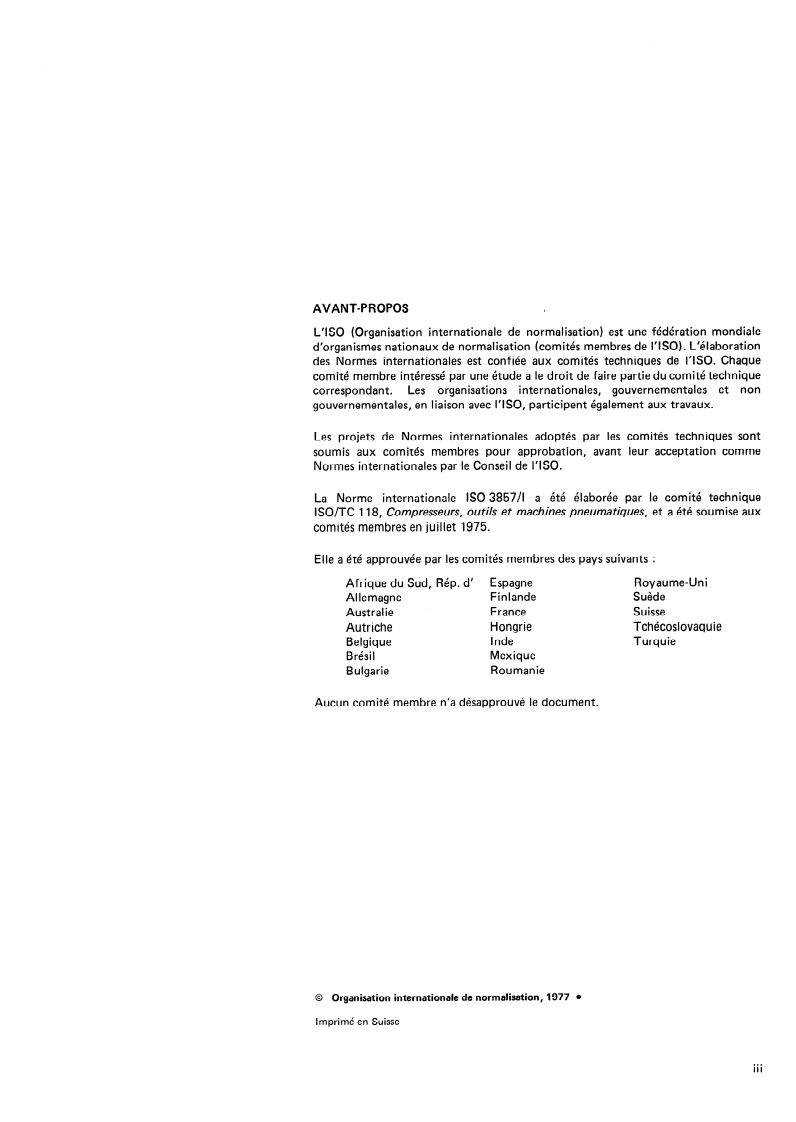
AVANT-PROPOS
L’ISO (Organisation internationale de normalisation) est une federation mondiale
d’organismes nationaux de normalisation (comites membres de I’ISO). L’elaboration
des Normes internationales est confiee aux comites techniques de I’ISO. Chaque
comite membre interesse par une etude a Ie droit de faire Partie du comite technique
correspondant. Les organisations internationales, gouvernementales et non
gouvernementales, en liaison avec I’ISO, participent egalement aux travaux.
Les projets de Normes internationales adoptes par les comites techniques sont
soumis aux comites membres pour approbation, avant leur acceptation comme
Normes internationales par Ie Conseil de I’ISO.
La Norme internationale ISO 3857/1 a et& elaboree par Ie comite technique
lSO/TC 118, Compresseurs, outils et machines pneumatiques, et a et6 soumise aux
comites membres en juillet 1975.
Elle a et6 approuvee par les comites membres des pays suivants :
Royaume-Uni
Afrique du Sud, Rep. d’ Espagne
Allemagne Finlande Suede
Australie France Suisse
Hongrie
Autriche Tchecoslovaquie
Inde
Belgique Turquie
Mexique
Bresil
Roumanie
Bulgarie
Aucun comite membre n’a desapprouve Ie document.
0 Organisation internationale de normalisation, 1977 l
Imprimh en Suisse
This page intentionally left blank
INTERNATIONAL STANDARD
ISO 3857/1-1977 (E/F)
NORME INTERNATIONALE
Compresseurs, outils et machines
Compressors, pneumatic tools and
machines - Vocabulary - pneumatiques - Vocabulaire -
Partie I : G6Mralites
Part I : General
OBJET ET DOMAINE D’APPLICATION
SCOPE AND FIELD OF APPLICATION
La presente Norme internationale constitue Ia premiere
This International Standard constitutes the first part of a
Partie d’un vocabulaire relatif aux compresseurs, outils
vocabulary relating to compressors, pneumatic tools and
et machines pneumatiques. Elle traite des notions
machines. lt deals with basic concepts, Symbols and units.
fondamentales, des Symboles et unites. La Partie II
Part II deals with compressors. Part llll) deals with
traite des compresseurs tandis que Ia Partie I I I l) traite
pneumatic tools and machines.
des outils et machines pneumatiques.
1 PRESSURES 1 PRESSIONS
1.1 atmospheric pressure : The absolute pressure of the 1.1 Pression atmospherique : Pression absolue de
atmosphere as measured at the place under consideration. I’atmosphere mesuree sur Ie lieu considere.
1.2 Pression effective (Pression manometrique) : Pression
1.2 gauge pressure : The pressure as measured with
mesuree par rapport 5 Ia Pression atmospherique.
reference to atmospheric pressure.
1.3 Pression absolue : Pression par rapport au zer-0
1.3 absolute pressure : The pressure with reference to
absolute Zero, i.e. with reference to an absolute vacuum. lt absolu, c’est-a-dire par rapport au vide absolu. Elle est egale
equals the algebraic sum of atmospheric pressure and gauge a Ia somme algebrique de Ia Pression atmospherique et de Ia
pressure (static pressure or total pressure). Pression effective (Pression statique ou Pression totale).
1.4 Pression statique : Pression mesuree dans un fluide,
1.4 static pressure : The pressure as measured in a fluid
dans des conditions telles que Ia vitesse de celui-ci n’ait
in such conditions that no effect on measurement is
aucune influence sur Ia mesure.
produced by the fluid velocity.
1.5 Pression dynamique :
1.5 dynamic pressure : That increase of pressure which Augmentation de Ia Pression
qui resulterait de Ia transformation integrale, c’est-a-dire
would result if the energy of the flow velocity in gas or air
flowing at uniform velocity were converted to pressure isentropique, de I’energie cinetique du fluide s’koulant 3
completely and without any losses, i.e. isentropically. une vitesse uniforme, en energie de Pression.
The pressure is equal to the product pc*/2, where JI is the Pression egale au produit pc*/2 dans lequel p est Ia masse
volumique du fluide et c Ia vitesse de I’ecoulement.
fluid density and c is the flow velocity.
1.6 Pression totale : Somme de Ia Pression statique et de
1.6 total pressure : The sum of the static and dynamic
Ia Pression dynamique.
pressures.
lt designates the fluid condition at which the flow energy Elle caracterise I’etat du fluide Iorsque son energie
of the fluid is converted into pressure without any losses. d’ecoulement est transformee integralement en Pression.
In a stationary body of fluid, the static pressure and total Dans un element stationnaire du fluide, Ia Pression statique
pressure are numerically equal. et Ia Pression totale sont numeriquement egales.
1) En prbparation.
1) In preparation.
ISO 3857/1-1977 (E/F)
1.7 critical pressure : The limiting pressure above which 1.7 Pression critique : Pression I imite au-dessus de
no discontinuity is observed between the gas Phase and the laquelle on n’observe pas de discontinuite entre Phase
liquid Phase, whatever the temperature. gazeuse et Phase liquide, quelle que soit Ia temperature.
1.8 reduced pressure : The quotient of the absolute 1.8 Pression rhduite : Rappor t de Ia p ression absolue 5 Ia
pressure and the absolute critica I pressure. press ion critiq ue absolue.
compressibil ity Z:A dimensionless factor 1.9 facteur de compressibilite Z : Facteur sans dimension
1.9 factor
desi gnating the actual gas sta te from i ts perfett state. caracterisant I’etat reel du gaz par rapport a son 6 tat parfait.
It is expressed by the formula : il s’exprime par Ia formule
p”rn
pv,
Z-
Z
Z==
RT
is the pressure; p est Ia Pression;
P
is the molar volume; est Ie volume molaire;
“rn
R is the molar gas constant;
R est Ia constante molaire du gaz;
T is the thermodynamic temperature. T est Ia temperature thermodynamique.
2 TEMPERATURES 2 TEMPliRATURES
2.1 static temperature : The temperature as measured 2.1 temphrature statique : Temperature mesuree dans un
in a fluid in such conditions that no effect on measurement fluide, dans des conditions telle
...
~~~~ ~~
INTERNATIONAL STANDARD
NORME INTERNATIONALE
INTERNATIONAL ORGANIZATION FOR STANDARDIZATION l MEXaYHAPOAHA(I OPI-AHM3AUWX I-IO flAHAAPTM3AWW=ORGANISATION INTERNATIONALE DE NORMALISATION
Compressors, pneumatic tools and machines -
Vocabulary - Part I : General
First edition - 1977-08-01
Compresseurs, outils et machines pneumatiques - 1
Vocabulaire - Partie I : G6neralit6s
Premiere Edition - 1977-08-01
UDC/CDU 621.51 : 001.4 Ref. No./Rhf. no : ISO 3857/1-1977 (E/F)
Descriptors : pneumatic equipment, compressors, pneumatic tools, vocabulary , symbols/Descripteurs :
matkriel pneumatique, compresseur,
outil pour marteau pneumatique, vocabulaire, Symbole.
Price based on 6 pages/Prix bask sur 6 pages
ISO (the International Organization for Standardization) is a worldwide federation
of national Standards institutes (ISO member bodies). The work of developing
International Standards is carried out through ISO technical committees. Every
member body interested in a subject for which a technical committee has been set
up has the right to be represented on that committee. International organizations,
governmental and non-governmental, in liaison with ISO, also take part in the work.
Draft International Standards adopted by the technical committees are circulated
to the member bodies for approval before their acceptance as International
Standards by the ISO Council.
International Standard ISO 3857/1 was developed by Technical Committee
ISOITC 118, Compressors, pneumatic tools and pneumatic machines, and was
circulated to the member bodies in July 1975.
lt has been approved by the member bodies of the following countries :
Austral ia France Spain
Austria Germany Sweden
Belgium Hungary Switzerland
Brazil I ndia Turkey
Bulgaria Mexico United Kingdom
Czechoslovakia Romania
Finland South Africa, Rep. of
No member body expressed disapproval of the document.
0 International Organization for Standardkation, 1977 l
Printed in Switzerland
ii
I
AVANT-PROPOS
L’ISO (Organisation internationale de normalisation) est une federation mondiale
d’organismes nationaux de normalisation (comites membres de I’ISO). L’elaboration
des Normes internationales est confiee aux comites techniques de I’ISO. Chaque
comite membre interesse par une etude a Ie droit de faire Partie du comite technique
correspondant. Les organisations internationales, gouvernementales et non
gouvernementales, en liaison avec I’ISO, participent egalement aux travaux.
Les projets de Normes internationales adoptes par les comites techniques sont
soumis aux comites membres pour approbation, avant leur acceptation comme
Normes internationales par Ie Conseil de I’ISO.
La Norme internationale ISO 3857/1 a et& elaboree par Ie comite technique
lSO/TC 118, Compresseurs, outils et machines pneumatiques, et a et6 soumise aux
comites membres en juillet 1975.
Elle a et6 approuvee par les comites membres des pays suivants :
Royaume-Uni
Afrique du Sud, Rep. d’ Espagne
Allemagne Finlande Suede
Australie France Suisse
Hongrie
Autriche Tchecoslovaquie
Inde
Belgique Turquie
Mexique
Bresil
Roumanie
Bulgarie
Aucun comite membre n’a desapprouve Ie document.
0 Organisation internationale de normalisation, 1977 l
Imprimh en Suisse
This page intentionally left blank
INTERNATIONAL STANDARD
ISO 3857/1-1977 (E/F)
NORME INTERNATIONALE
Compresseurs, outils et machines
Compressors, pneumatic tools and
machines - Vocabulary - pneumatiques - Vocabulaire -
Partie I : G6Mralites
Part I : General
OBJET ET DOMAINE D’APPLICATION
SCOPE AND FIELD OF APPLICATION
La presente Norme internationale constitue Ia premiere
This International Standard constitutes the first part of a
Partie d’un vocabulaire relatif aux compresseurs, outils
vocabulary relating to compressors, pneumatic tools and
et machines pneumatiques. Elle traite des notions
machines. lt deals with basic concepts, Symbols and units.
fondamentales, des Symboles et unites. La Partie II
Part II deals with compressors. Part llll) deals with
traite des compresseurs tandis que Ia Partie I I I l) traite
pneumatic tools and machines.
des outils et machines pneumatiques.
1 PRESSURES 1 PRESSIONS
1.1 atmospheric pressure : The absolute pressure of the 1.1 Pression atmospherique : Pression absolue de
atmosphere as measured at the place under consideration. I’atmosphere mesuree sur Ie lieu considere.
1.2 Pression effective (Pression manometrique) : Pression
1.2 gauge pressure : The pressure as measured with
mesuree par rapport 5 Ia Pression atmospherique.
reference to atmospheric pressure.
1.3 Pression absolue : Pression par rapport au zer-0
1.3 absolute pressure : The pressure with reference to
absolute Zero, i.e. with reference to an absolute vacuum. lt absolu, c’est-a-dire par rapport au vide absolu. Elle est egale
equals the algebraic sum of atmospheric pressure and gauge a Ia somme algebrique de Ia Pression atmospherique et de Ia
pressure (static pressure or total pressure). Pression effective (Pression statique ou Pression totale).
1.4 Pression statique : Pression mesuree dans un fluide,
1.4 static pressure : The pressure as measured in a fluid
dans des conditions telles que Ia vitesse de celui-ci n’ait
in such conditions that no effect on measurement is
aucune influence sur Ia mesure.
produced by the fluid velocity.
1.5 Pression dynamique :
1.5 dynamic pressure : That increase of pressure which Augmentation de Ia Pression
qui resulterait de Ia transformation integrale, c’est-a-dire
would result if the energy of the flow velocity in gas or air
flowing at uniform velocity were converted to pressure isentropique, de I’energie cinetique du fluide s’koulant 3
completely and without any losses, i.e. isentropically. une vitesse uniforme, en energie de Pression.
The pressure is equal to the product pc*/2, where JI is the Pression egale au produit pc*/2 dans lequel p est Ia masse
volumique du fluide et c Ia vitesse de I’ecoulement.
fluid density and c is the flow velocity.
1.6 Pression totale : Somme de Ia Pression statique et de
1.6 total pressure : The sum of the static and dynamic
Ia Pression dynamique.
pressures.
lt designates the fluid condition at which the flow energy Elle caracterise I’etat du fluide Iorsque son energie
of the fluid is converted into pressure without any losses. d’ecoulement est transformee integralement en Pression.
In a stationary body of fluid, the static pressure and total Dans un element stationnaire du fluide, Ia Pression statique
pressure are numerically equal. et Ia Pression totale sont numeriquement egales.
1) En prbparation.
1) In preparation.
ISO 3857/1-1977 (E/F)
1.7 critical pressure : The limiting pressure above which 1.7 Pression critique : Pression I imite au-dessus de
no discontinuity is observed between the gas Phase and the laquelle on n’observe pas de discontinuite entre Phase
liquid Phase, whatever the temperature. gazeuse et Phase liquide, quelle que soit Ia temperature.
1.8 reduced pressure : The quotient of the absolute 1.8 Pression rhduite : Rappor t de Ia p ression absolue 5 Ia
pressure and the absolute critica I pressure. press ion critiq ue absolue.
compressibil ity Z:A dimensionless factor 1.9 facteur de compressibilite Z : Facteur sans dimension
1.9 factor
desi gnating the actual gas sta te from i ts perfett state. caracterisant I’etat reel du gaz par rapport a son 6 tat parfait.
It is expressed by the formula : il s’exprime par Ia formule
p”rn
pv,
Z-
Z
Z==
RT
is the pressure; p est Ia Pression;
P
is the molar volume; est Ie volume molaire;
“rn
R is the molar gas constant;
R est Ia constante molaire du gaz;
T is the thermodynamic temperature. T est Ia temperature thermodynamique.
2 TEMPERATURES 2 TEMPliRATURES
2.1 static temperature : The temperature as measured 2.1 temphrature statique : Temperature mesuree dans un
in a fluid in such conditions that no effect on measurement fluide, dans des conditions telle
...