

ISO 9667:2017
(Main)Aircraft ground support equipment — Tow bars
General Information
- Abstract
ISO 9667:2017 specifies dimensional and physical requirements of tow bar connections to tractor and aircraft (see Figure 1). It is applicable to any new type of commercial transport category aircraft tow bar designed or built after publication of ISO 9667:2017. The purpose of ISO 9667:2017 is to standardize tow bar attachments to airplane and tractor according to the mass category of the towed aircraft, so that one tow bar head with different shear levels can be used for all aircraft that are within the same mass category and are manufactured in compliance with ISO 8267.
- Status
- Published
- Publication Date
- 02-Aug-2017
- Technical Committee
- ISO/TC 20/SC 9 - Air cargo and ground equipment
- Drafting Committee
- ISO/TC 20/SC 9 - Air cargo and ground equipment
- Current Stage
- 9093 - International Standard confirmed
- Start Date
- 09-Dec-2022
- Completion Date
- 29-Aug-2026
Buy Documents
ISO 9667:2017 - Aircraft ground support equipment -- Tow bars
ISO 9667:2017 - Aircraft ground support equipment — Tow bars/3/2017
Overview
ISO 9667:2017 - Aircraft ground support equipment - Tow bars - specifies the dimensional and physical requirements for tow bar connections to tractors and aircraft. Applicable to new commercial transport-category aircraft tow bars designed or built after publication, the standard harmonizes tow bar attachments by aircraft mass category so a single tow bar head (with appropriate shear levels) can serve all compatible aircraft manufactured to ISO 8267.
Key Topics
- Scope and applicability
- Applies to new tow bar types for commercial transport-category aircraft.
- Interfaces referenced to ISO 8267-1 / ISO 8267-2 for mainline and regional aircraft.
- Aircraft connection requirements
- Tow bar heads must be compatible with the aircraft horizontal pin per ISO 8267.
- Grip requirement: device shall uniformly engage 96–98% of pin length.
- Anti-disengagement design and clearance envelopes for safe engagement/disengagement.
- Protective provisions
- Mandatory shock/overload protection (e.g., shear pins, energy-absorbing devices) to protect nose landing gear.
- Devices must alert the tow tractor operator when actuated and remain captive to avoid FOD.
- Shear pin requirements: non-standard diameters, shear at or below manufacturer force, tolerance (+0/−10%), and defined shear plane with hardened bushings.
- Tractor connection
- Tow bar eye and rotating tow bar eye dimensions specified; pintle or hook hitches are discouraged to limit load spikes.
- Tow bar performance and undercarriage
- Tow bar shall sustain at least 150% of protective device functioning point.
- Unladen stability and towability up to 25 km/h (15 mph).
- Wheeled undercarriage with height adjustment and CG limits for safe hookup.
- Markings, documentation and tests
- Indelible markings for allowable aircraft types and maximum towing force; vendor nameplate required.
- Tests and instrumentation to substantiate protective-device operation on request.
- Options
- Flyaway designs, separable heads, warning systems, cable provisions and retention lanyards.
Applications
ISO 9667:2017 is used by:
- Tow bar manufacturers and GSE designers for compliant product design.
- Airlines, ground handling companies, airports, and MROs for procurement and safe operations.
- Safety engineers and procurement teams ensuring compatibility with aircraft nose gear interfaces and preventing FOD or overloading.
- Regulatory and standards bodies referencing consistent requirements for aircraft towing equipment.
Related Standards
- ISO 8267-1 / ISO 8267-2 - aircraft tow bar attachment interface requirements (mainline and regional).
- EN 12312-7 - aircraft movement equipment (related GSE requirements).
- SAE ARP1915 - noted harmonization in the ISO 9667:2017 revision.
Keywords: ISO 9667:2017, tow bars, aircraft ground support equipment, tow bar attachments, shear pins, tow tractor, nose landing gear, ISO 8267.
Relations
- Effective Date
- 10-Jun-2026
- Effective Date
- 04-Jun-2016
Buy Documents
ISO 9667:2017 - Aircraft ground support equipment -- Tow bars
ISO 9667:2017 - Aircraft ground support equipment — Tow bars/3/2017
Get Certified
Connect with accredited certification bodies for this standard

BUREAU VERITAS Certification Germany
Bureau Veritas certification in Germany.

Element Materials Technology
Materials testing and product certification.

AQMS Ltd.
AQMS provides ISO certification to SMEs across the UK.
Sponsored listings
Frequently Asked Questions
ISO 9667:2017 is a standard published by the International Organization for Standardization (ISO). Its full title is "Aircraft ground support equipment — Tow bars". This standard covers: ISO 9667:2017 specifies dimensional and physical requirements of tow bar connections to tractor and aircraft (see Figure 1). It is applicable to any new type of commercial transport category aircraft tow bar designed or built after publication of ISO 9667:2017. The purpose of ISO 9667:2017 is to standardize tow bar attachments to airplane and tractor according to the mass category of the towed aircraft, so that one tow bar head with different shear levels can be used for all aircraft that are within the same mass category and are manufactured in compliance with ISO 8267.
ISO 9667:2017 specifies dimensional and physical requirements of tow bar connections to tractor and aircraft (see Figure 1). It is applicable to any new type of commercial transport category aircraft tow bar designed or built after publication of ISO 9667:2017. The purpose of ISO 9667:2017 is to standardize tow bar attachments to airplane and tractor according to the mass category of the towed aircraft, so that one tow bar head with different shear levels can be used for all aircraft that are within the same mass category and are manufactured in compliance with ISO 8267.
ISO 9667:2017 is classified under the following ICS (International Classification for Standards) categories: 49.100 - Ground service and maintenance equipment. The ICS classification helps identify the subject area and facilitates finding related standards.
ISO 9667:2017 has the following relationships with other standards: It is inter standard links to EN 12312-7:2020, ISO 9667:2016. Understanding these relationships helps ensure you are using the most current and applicable version of the standard.
ISO 9667:2017 is available in PDF format for immediate download after purchase. The document can be added to your cart and obtained through the secure checkout process. Digital delivery ensures instant access to the complete standard document.
Standards Content (Sample)
INTERNATIONAL ISO
STANDARD 9667
Third edition
2017-07
Aircraft ground support equipment —
Tow bars
Équipement au sol pour aéronefs — Barres de tractage
Reference number
©
ISO 2017
© ISO 2017, Published in Switzerland
All rights reserved. Unless otherwise specified, no part of this publication may be reproduced or utilized otherwise in any form
or by any means, electronic or mechanical, including photocopying, or posting on the internet or an intranet, without prior
written permission. Permission can be requested from either ISO at the address below or ISO’s member body in the country of
the requester.
ISO copyright office
Ch. de Blandonnet 8 • CP 401
CH-1214 Vernier, Geneva, Switzerland
Tel. +41 22 749 01 11
Fax +41 22 749 09 47
copyright@iso.org
www.iso.org
ii © ISO 2017 – All rights reserved
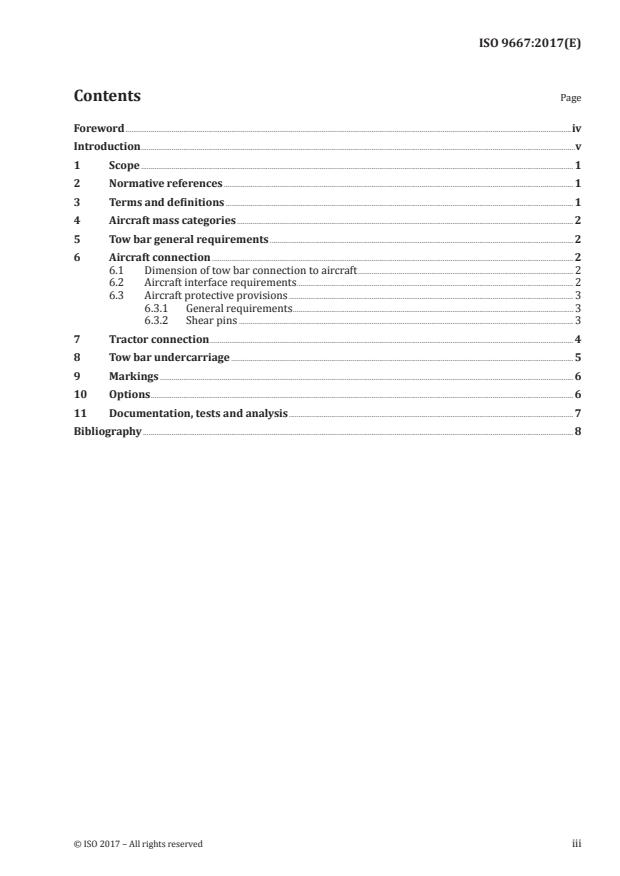
Contents Page
Foreword .iv
Introduction .v
1 Scope . 1
2 Normative references . 1
3 Terms and definitions . 1
4 Aircraft mass categories . 2
5 Tow bar general requirements . 2
6 Aircraft connection . 2
6.1 Dimension of tow bar connection to aircraft . 2
6.2 Aircraft interface requirements . . 2
6.3 Aircraft protective provisions . 3
6.3.1 General requirements . 3
6.3.2 Shear pins . 3
7 Tractor connection . 4
8 Tow bar undercarriage . 5
9 Markings . 6
10 Options . 6
11 Documentation, tests and analysis . 7
Bibliography . 8
Foreword
ISO (the International Organization for Standardization) is a worldwide federation of national standards
bodies (ISO member bodies). The work of preparing International Standards is normally carried out
through ISO technical committees. Each member body interested in a subject for which a technical
committee has been established has the right to be represented on that committee. International
organizations, governmental and non-governmental, in liaison with ISO, also take part in the work.
ISO collaborates closely with the International Electrotechnical Commission (IEC) on all matters of
electrotechnical standardization.
The procedures used to develop this document and those intended for its further maintenance are
described in the ISO/IEC Directives, Part 1. In particular the different approval criteria needed for the
different types of ISO documents should be noted. This document was drafted in accordance with the
editorial rules of the ISO/IEC Directives, Part 2 (see www .iso .org/ directives).
Attention is drawn to the possibility that some of the elements of this document may be the subject of
patent rights. ISO shall not be held responsible for identifying any or all such patent rights. Details of
any patent rights identified during the development of the document will be in the Introduction and/or
on the ISO list of patent declarations received (see www .iso .org/ patents).
Any trade name used in this document is information given for the convenience of users and does not
constitute an endorsement.
For an explanation on the voluntary nature of standards, the meaning of ISO specific terms and
expressions related to conformity assessment, as well as information about ISO’s adherence to the
World Trade Organization (WTO) principles in the Technical Barriers to Trade (TBT) see the following
URL: w w w . i s o .org/ iso/ foreword .html.
This document was prepared by Technical Committee ISO/TC 20, Aircraft and space vehicles,
Subcommittee SC 9, Air cargo and ground equipment.
This third edition cancels and replaces the second edition (ISO 9667:2016), which has been technically
revised.
The main changes compared to the previous edition are as follows:
— a complete revision of all clauses has been made to harmonize with SAE ARP1915;
— figures have been updated and minor editorial modifications have been made; and
— Clauses 9, 10 and 11 have been added.
iv © ISO 2017 – All rights reserved
Introduction
This document specifies the functional requirements defined by the manufacturers for the design of
aircraft tow bars.
Throughout this document, the minimum essential criteria are identified by use of the key word “shall”.
Recommended criteria are identified by use of the key word “should” and, while not mandatory, are
considered to be of primary importance in providing safe, economical and usable aircraft tow bars.
Deviation from recommended criteria should only occur after careful consideration and thorough
service evaluation have shown alternate methods to provide an equivalent level of safety.
INTERNATIONAL STANDARD ISO 9667:2017(E)
Aircraft ground support equipment — Tow bars
1 Scope
This document specifies dimensional and physical requirements of tow bar connections to tractor and
aircraft (see Figure 1). It is applicable to any new type of commercial transport category aircraft tow
bar designed or built after publication of this document.
The purpose of this document is to standardize tow bar attachments to airplane and tractor according
to the mass category of the towed aircraft, so that one tow bar head with different shear levels can be
used for all aircraft that are within the same mass category and are manufactured in compliance with
ISO 8267.
Key
1 tractor connection
2 aircraft connection
3 tow bar body
4 tow bar undercarriage
Figure 1 — Tow bar
2 Normative references
The following documents are referred to in the text in such a way that some or all of their content
constitutes requirements of this document. For dated references, only the edition cited applies. For
undated references, the latest edition of the referenced document (including any amendments) applies.
ISO 8267-1, Aircraft — Tow bar attachment fittings interface requirements — Part 1: Main line aircraft
ISO 8267-2, Aircraft — Tow bar attachment fittings interface requirements — Part 2: Regional aircraft
3 Terms and definitions
No terms and definitions are listed in this document.
ISO and IEC maintain terminological databases
...
INTERNATIONAL ISO
STANDARD 9667
Third edition
2017-07
Aircraft ground support equipment —
Tow bars
Équipement au sol pour aéronefs — Barres de tractage
Reference number
©
ISO 2017
© ISO 2017, Published in Switzerland
All rights reserved. Unless otherwise specified, no part of this publication may be reproduced or utilized otherwise in any form
or by any means, electronic or mechanical, including photocopying, or posting on the internet or an intranet, without prior
written permission. Permission can be requested from either ISO at the address below or ISO’s member body in the country of
the requester.
ISO copyright office
Ch. de Blandonnet 8 • CP 401
CH-1214 Vernier, Geneva, Switzerland
Tel. +41 22 749 01 11
Fax +41 22 749 09 47
copyright@iso.org
www.iso.org
ii © ISO 2017 – All rights reserved
Contents Page
Foreword .iv
Introduction .v
1 Scope . 1
2 Normative references . 1
3 Terms and definitions . 1
4 Aircraft mass categories . 2
5 Tow bar general requirements . 2
6 Aircraft connection . 2
6.1 Dimension of tow bar connection to aircraft . 2
6.2 Aircraft interface requirements . . 2
6.3 Aircraft protective provisions . 3
6.3.1 General requirements . 3
6.3.2 Shear pins . 3
7 Tractor connection . 4
8 Tow bar undercarriage . 5
9 Markings . 6
10 Options . 6
11 Documentation, tests and analysis . 7
Bibliography . 8
Foreword
ISO (the International Organization for Standardization) is a worldwide federation of national standards
bodies (ISO member bodies). The work of preparing International Standards is normally carried out
through ISO technical committees. Each member body interested in a subject for which a technical
committee has been established has the right to be represented on that committee. International
organizations, governmental and non-governmental, in liaison with ISO, also take part in the work.
ISO collaborates closely with the International Electrotechnical Commission (IEC) on all matters of
electrotechnical standardization.
The procedures used to develop this document and those intended for its further maintenance are
described in the ISO/IEC Directives, Part 1. In particular the different approval criteria needed for the
different types of ISO documents should be noted. This document was drafted in accordance with the
editorial rules of the ISO/IEC Directives, Part 2 (see www .iso .org/ directives).
Attention is drawn to the possibility that some of the elements of this document may be the subject of
patent rights. ISO shall not be held responsible for identifying any or all such patent rights. Details of
any patent rights identified during the development of the document will be in the Introduction and/or
on the ISO list of patent declarations received (see www .iso .org/ patents).
Any trade name used in this document is information given for the convenience of users and does not
constitute an endorsement.
For an explanation on the voluntary nature of standards, the meaning of ISO specific terms and
expressions related to conformity assessment, as well as information about ISO’s adherence to the
World Trade Organization (WTO) principles in the Technical Barriers to Trade (TBT) see the following
URL: w w w . i s o .org/ iso/ foreword .html.
This document was prepared by Technical Committee ISO/TC 20, Aircraft and space vehicles,
Subcommittee SC 9, Air cargo and ground equipment.
This third edition cancels and replaces the second edition (ISO 9667:2016), which has been technically
revised.
The main changes compared to the previous edition are as follows:
— a complete revision of all clauses has been made to harmonize with SAE ARP1915;
— figures have been updated and minor editorial modifications have been made; and
— Clauses 9, 10 and 11 have been added.
iv © ISO 2017 – All rights reserved
Introduction
This document specifies the functional requirements defined by the manufacturers for the design of
aircraft tow bars.
Throughout this document, the minimum essential criteria are identified by use of the key word “shall”.
Recommended criteria are identified by use of the key word “should” and, while not mandatory, are
considered to be of primary importance in providing safe, economical and usable aircraft tow bars.
Deviation from recommended criteria should only occur after careful consideration and thorough
service evaluation have shown alternate methods to provide an equivalent level of safety.
INTERNATIONAL STANDARD ISO 9667:2017(E)
Aircraft ground support equipment — Tow bars
1 Scope
This document specifies dimensional and physical requirements of tow bar connections to tractor and
aircraft (see Figure 1). It is applicable to any new type of commercial transport category aircraft tow
bar designed or built after publication of this document.
The purpose of this document is to standardize tow bar attachments to airplane and tractor according
to the mass category of the towed aircraft, so that one tow bar head with different shear levels can be
used for all aircraft that are within the same mass category and are manufactured in compliance with
ISO 8267.
Key
1 tractor connection
2 aircraft connection
3 tow bar body
4 tow bar undercarriage
Figure 1 — Tow bar
2 Normative references
The following documents are referred to in the text in such a way that some or all of their content
constitutes requirements of this document. For dated references, only the edition cited applies. For
undated references, the latest edition of the referenced document (including any amendments) applies.
ISO 8267-1, Aircraft — Tow bar attachment fittings interface requirements — Part 1: Main line aircraft
ISO 8267-2, Aircraft — Tow bar attachment fittings interface requirements — Part 2: Regional aircraft
3 Terms and definitions
No terms and definitions are listed in this document.
ISO and IEC maintain terminological databases
...