

SIST-TP CEN ISO/TR 22100-5:2022
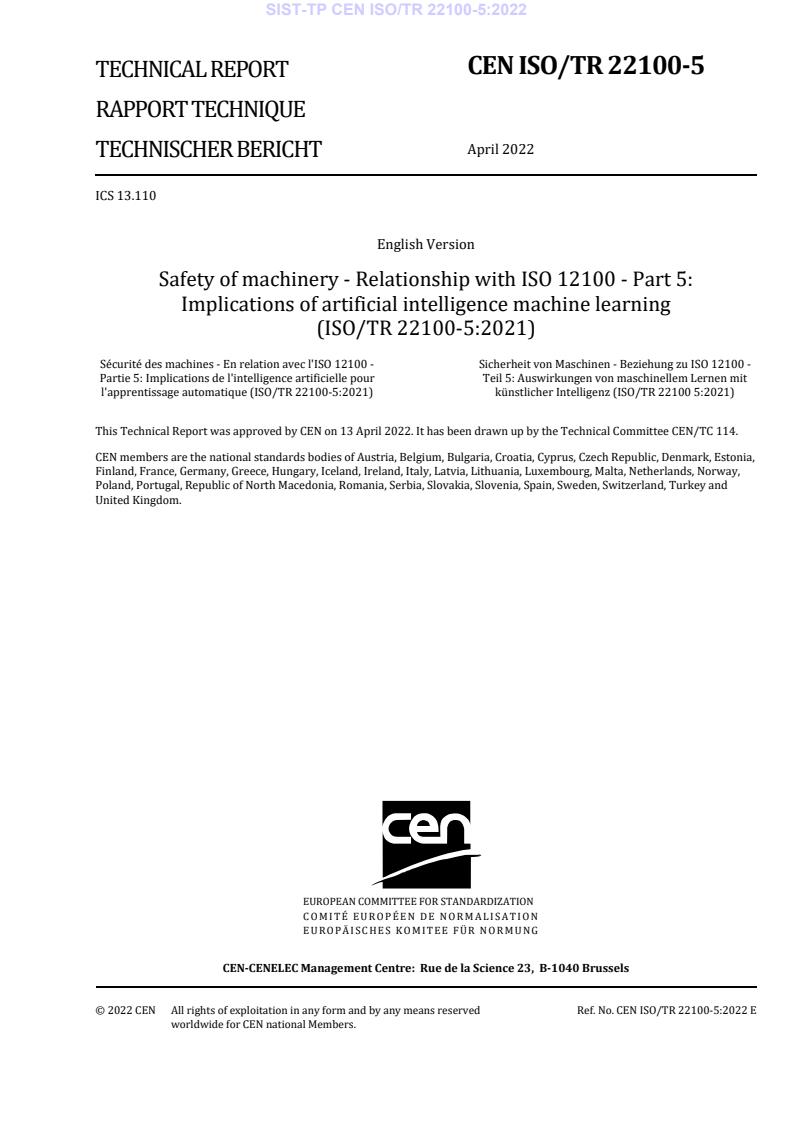
(Main)Safety of machinery - Relationship with ISO 12100 - Part 5: Implications of artificial intelligence machine learning (ISO/TR 22100-5:2021)
General Information
- Abstract
This document addresses how artificial intelligence machine learning can impact the safety of machinery and machinery systems.
This document describes how hazards being associated with artificial intelligence (AI) applications machine learning in machinery or machinery systems, and designed to act within specific limits, can be considered in the risk assessment process.
This document is not applicable to machinery or machinery systems with AI applications machine learning designed to act beyond specified limits that can result in unpredictable effects.
This document does not address safety systems with AI, for example, safety-related sensors and other safety-related parts of control systems.
- Status
- Published
- Publication Date
- 14-Jun-2022
- Technical Committee
- VSN - Safety of machinery
- Current Stage
- 6060 - National Implementation/Publication (Adopted Project)
- Start Date
- 05-May-2022
- Due Date
- 10-Jul-2022
- Completion Date
- 15-Jun-2022



Overview
CEN ISO/TR 22100-5:2022 (identical to ISO/TR 22100-5:2021) gives guidance on how artificial intelligence (AI) - specifically machine learning (ML) - can affect the safety of machinery and how those effects should be addressed using the risk assessment principles of ISO 12100. The technical report clarifies scope, terms (AI, machine learning), typical AI use cases in machinery, and practical examples showing when AI introduces no new hazards and when it does.
Key topics
- Scope and applicability
- Focuses on AI/ML applications designed to act within specified limits; not applicable to systems intended to act beyond limits causing unpredictable effects.
- Excludes safety-related systems with AI (e.g., safety sensors and other safety-related control parts).
- Definitions
- Clear definitions of artificial intelligence and machine learning as used in the machinery context.
- AI lifecycle in machinery
- Distinction between training and inference (autonomous operation) phases of ML-enabled control systems.
- Risk assessment alignment
- Guidance on how to apply the ISO 12100 risk assessment and risk reduction process to AI/ML functions in machines.
- Examples and analysis
- Illustrative cases: packaging robots, precision herbicide spraying, laser cutting part removal (examples without safety implications) and autonomous guided vehicles (AGVs) operating without perimeter safeguards (examples with safety implications).
Applications and practical value
- Helps machinery designers, safety engineers, and manufacturers determine whether an AI/ML function:
- Introduces new hazards or increases existing risks,
- Requires additional risk reduction measures beyond those for conventional designs.
- Practical use cases include:
- Quality control, process optimization, condition/failure monitoring, and predictive maintenance.
- Design decisions for AGVs, automated material handling, agricultural machinery and automated cutting systems.
- Useful for:
- Design teams integrating ML into control systems,
- Compliance managers preparing CE/market safety documentation,
- Risk assessors applying ISO 12100 to AI-enabled machinery.
Related standards
- ISO 12100 - General principles for risk assessment and risk reduction (primary reference for applying this report).
- Other ISO/IEC terminology and ML references cited in the report (for definitions and broader AI context).
This technical report is a practical resource for organizations integrating AI/ML into machinery - helping ensure safe design choices, consistent risk assessment, and better alignment with established machinery safety standards. Keywords: safety of machinery, ISO 12100, AI machine learning, risk assessment, AGV, predictive maintenance.
Get Certified
Connect with accredited certification bodies for this standard

CIS Institut d.o.o.
Personal Protective Equipment (PPE) certification body. Notified Body NB-2890 for EU Regulation 2016/425 PPE.

Kiwa BDA Testing
Building and construction product certification.
Kmetijski inštitut Slovenije
Agricultural Institute of Slovenia. Soil testing, plant health, agricultural product analysis.
Sponsored listings
Frequently Asked Questions
SIST-TP CEN ISO/TR 22100-5:2022 is a technical report published by the Slovenian Institute for Standardization (SIST). Its full title is "Safety of machinery - Relationship with ISO 12100 - Part 5: Implications of artificial intelligence machine learning (ISO/TR 22100-5:2021)". This standard covers: This document addresses how artificial intelligence machine learning can impact the safety of machinery and machinery systems. This document describes how hazards being associated with artificial intelligence (AI) applications machine learning in machinery or machinery systems, and designed to act within specific limits, can be considered in the risk assessment process. This document is not applicable to machinery or machinery systems with AI applications machine learning designed to act beyond specified limits that can result in unpredictable effects. This document does not address safety systems with AI, for example, safety-related sensors and other safety-related parts of control systems.
This document addresses how artificial intelligence machine learning can impact the safety of machinery and machinery systems. This document describes how hazards being associated with artificial intelligence (AI) applications machine learning in machinery or machinery systems, and designed to act within specific limits, can be considered in the risk assessment process. This document is not applicable to machinery or machinery systems with AI applications machine learning designed to act beyond specified limits that can result in unpredictable effects. This document does not address safety systems with AI, for example, safety-related sensors and other safety-related parts of control systems.
SIST-TP CEN ISO/TR 22100-5:2022 is classified under the following ICS (International Classification for Standards) categories: 13.110 - Safety of machinery. The ICS classification helps identify the subject area and facilitates finding related standards.
SIST-TP CEN ISO/TR 22100-5:2022 is available in PDF format for immediate download after purchase. The document can be added to your cart and obtained through the secure checkout process. Digital delivery ensures instant access to the complete standard document.
Standards Content (Sample)
SLOVENSKI STANDARD
01-julij-2022
Varnost strojev - Povezava z ISO 12100 - 5. del: Učinki strojnega učenja umetne
inteligence (ISO/TR 22100-5:2021)
Safety of machinery - Relationship with ISO 12100 - Part 5: Implications of artificial
intelligence machine learning (ISO/TR 22100-5:2021)
Sicherheit von Maschinen - Beziehung zu ISO 12100 - Teil 5: Auswirkungen von
maschinellem Lernen mit künstlicher Intelligenz (ISO/TR 22100 5:2021)
Sécurité des machines - En relation avec l'ISO 12100 - Partie 5: Implications de
l’intelligence artificielle pour l’apprentissage automatique (ISO/TR 22100-5:2021)
Ta slovenski standard je istoveten z: CEN ISO/TR 22100-5:2022
ICS:
13.110 Varnost strojev Safety of machinery
2003-01.Slovenski inštitut za standardizacijo. Razmnoževanje celote ali delov tega standarda ni dovoljeno.
CEN ISO/TR 22100-5
TECHNICAL REPORT
RAPPORT TECHNIQUE
April 2022
TECHNISCHER BERICHT
ICS 13.110
English Version
Safety of machinery - Relationship with ISO 12100 - Part 5:
Implications of artificial intelligence machine learning
(ISO/TR 22100-5:2021)
Sécurité des machines - En relation avec l'ISO 12100 - Sicherheit von Maschinen - Beziehung zu ISO 12100 -
Partie 5: Implications de l'intelligence artificielle pour Teil 5: Auswirkungen von maschinellem Lernen mit
l'apprentissage automatique (ISO/TR 22100-5:2021) künstlicher Intelligenz (ISO/TR 22100 5:2021)
This Technical Report was approved by CEN on 13 April 2022. It has been drawn up by the Technical Committee CEN/TC 114.
CEN members are the national standards bodies of Austria, Belgium, Bulgaria, Croatia, Cyprus, Czech Republic, Denmark, Estonia,
Finland, France, Germany, Greece, Hungary, Iceland, Ireland, Italy, Latvia, Lithuania, Luxembourg, Malta, Netherlands, Norway,
Poland, Portugal, Republic of North Macedonia, Romania, Serbia, Slovakia, Slovenia, Spain, Sweden, Switzerland, Turkey and
United Kingdom.
EUROPEAN COMMITTEE FOR STANDARDIZATION
COMITÉ EUROPÉEN DE NORMALISATION
EUROPÄISCHES KOMITEE FÜR NORMUNG
CEN-CENELEC Management Centre: Rue de la Science 23, B-1040 Brussels
© 2022 CEN All rights of exploitation in any form and by any means reserved Ref. No. CEN ISO/TR 22100-5:2022 E
worldwide for CEN national Members.
Contents Page
European foreword . 3
European foreword
The text of ISO/TR 22100-5:2021 has been prepared by Technical Committee ISO/TC 199 "Safety of
machinery” of the International Organization for Standardization (ISO) and has been taken over as
of which is held by DIN.
Attention is drawn to the possibility that some of the elements of this document may be the subject of
patent rights. CEN shall not be held responsible for identifying any or all such patent rights.
Any feedback and questions on this document should be directed to the users’ national standards body.
A complete listing of these bodies can be found on the CEN website.
Endorsement notice
The text of ISO/TR 22100-5:2021 has been approved by CEN as CEN ISO/TR 22100-5:2022 without any
modification.
TECHNICAL ISO/TR
REPORT 22100-5
First edition
2021-01
Safety of machinery — Relationship
with ISO 12100 —
Part 5:
Implications of artificial intelligence
machine learning
Sécurité des machines — En relation avec l'ISO 12100 —
Partie 5: Implications de l’intelligence artificielle pour l’apprentissage
automatique
Reference number
ISO/TR 22100-5:2021(E)
©
ISO 2021
ISO/TR 22100-5:2021(E)
© ISO 2021
All rights reserved. Unless otherwise specified, or required in the context of its implementation, no part of this publication may
be reproduced or utilized otherwise in any form or by any means, electronic or mechanical, including photocopying, or posting
on the internet or an intranet, without prior written permission. Permission can be requested from either ISO at the address
below or ISO’s member body in the country of the requester.
ISO copyright office
CP 401 • Ch. de Blandonnet 8
CH-1214 Vernier, Geneva
Phone: +41 22 749 01 11
Email: copyright@iso.org
Website: www.iso.org
Published in Switzerland
ii © ISO 2021 – All rights reserved
ISO/TR 22100-5:2021(E)
Contents Page
Foreword .iv
Introduction .v
1 Scope . 1
2 Normative references . 1
3 Terms and definitions . 1
4 Use of AI in the machinery sector . 2
4.1 General . 2
4.2 Examples for use of AI machine learning in machine applications . 2
4.2.1 Examples without safety implications . 2
4.2.2 Examples with safety implications . 3
5 Conclusion . 5
Bibliography . 6
ISO/TR 22100-5:2021(E)
Foreword
ISO (the International Organization for Standardization) is a worldwide federation of national standards
bodies (ISO member bodies). The work of preparing International Standards is normally carried out
through ISO technical committees. Each member body interested in a subject for which a technical
committee has been established has the right to be represented on that committee. International
organizations, governmental and non-governmental, in liaison with ISO, also take part in the work.
ISO collaborates closely with the International Electrotechnical Commission (IEC) on all matters of
electrotechnical standardization.
The procedures used to develop this document and those intended for its further maintenance are
described in the ISO/IEC Directives, Part 1. In particular, the different approval criteria needed for the
different types of ISO documents should be noted. This document was drafted in accordance with the
editorial rules of the ISO/IEC Directives, Part 2 (see www .iso .org/ directives).
Attention is drawn to the possibility that some of the elements of this document may be the subject of
patent rights. ISO shall not be held responsible for identifying any or all such patent rights. Details of
any patent rights identified during the development of the document will be in the Introduction and/or
on the ISO list of patent declarations received (see www .iso .org/ patents).
Any trade name used in this document is information given for the convenience of users and does not
constitute an endorsement.
For an explanation of the voluntary nature of standards, the meaning of ISO specific terms and
expressions related to conformity assessment, as well as information about ISO's adherence to the
World Trade Organization (WTO) principles in the Technical Barriers to Trade (TBT), see www .iso .org/
iso/ foreword .html.
This document was prepared by Technical Committee ISO/TC 199, Safety of machinery.
A list of all parts in the ISO/TR 22100 series can be found on the ISO website.
Any feedback or questions on this document should be directed to the user’s national standards body. A
complete listing of these bodies can be found at www .iso .org/ members .html.
iv © ISO 2021 – All rights reserved
ISO/TR 22100-5:2021(E)
Introduction
The primary purpose of this document is to provide guidance for the development of artificial
intelligence (AI) machine learning applications. Safety can be compromised due to the significant
complexity of introducing AI machine learning to machines.
A control system can use machine learning (a technology of artificial intelligence) to improve
performance of the machine or to execute tasks. The control system learns its expected behaviour
through training. This involves two stages: training and inference (autonomous operation).
This document assists machinery designers to develop solutions appropriate for their particular
applications. It describes how to apply the risk assessment process according to ISO 12100 to AI
machine learning applications.
AI machine learning is a rapidly evolving technology and has not been a subject of machinery safety
until now.
TECHNICAL REPORT ISO/TR 22100-5:2021(E)
Safety of machinery — Relationship with ISO 12100 —
Part 5:
Implications of artificial intelligence machine learning
1 Scope
This document addresses how artificial intelligence machine learning can impact the safety of
machinery and machinery systems.
This document describes how hazards being associated with artificial intelligence (AI) applications
machine learning in machinery or machinery systems, and designed to act within specific limits, can be
considered in the risk assessment process.
This document is not applicable to machinery or machinery systems with AI applications machine
learning designed to act beyond specified limits that can result in unpredictable effects.
This document does not address safety systems with AI, for example, safety-related sensors and other
safety-related parts of control systems.
2 Normative references
There are no normative refe
...