

oSIST prEN 1032:2026
(Main)Mechanical vibration - Testing of mobile machinery in order to determine the vibration emission value
- Abstract
This document specifies the determination of whole-body and hand-arm vibration emissions at
operator position(s) during testing of mobile machinery. The purpose of this document is to
assist technical standardization committees responsible for specific types of machinery in
preparing vibration test codes to ensure that such vibration test codes
— are as homogeneous as possible with each individual test code having the same basic
structure,
— are in full accordance with basic standards on measurement of vibration emission,
— reflect the latest technical knowledge of methods of determining the vibration emission
from the specific family of machinery under consideration,
— provide manufacturers with a standardized method for the determination and declaration
of the vibration emission value(s) of their machinery,
— enable the user of the machinery or the member of an inspection body to compare the
vibration emission values of different machinery and to verify the vibration emission
values provided by the manufacturer.
This document provides requirements for the preparation of vibration test codes (C-type
standards), including guidelines for the conditions under which the measurements shall be made
(e.g. operating conditions). Information to be included in a typical vibration test code is
summarized in Annex A.
This document applies to sitting and standing positions. It is applicable to all mobile machinery
producing periodic or random vibration with or without transients.
This document contains sufficient guidance for designing an appropriate test for machinery for
which no vibration test codes exist. It can also be used for the determination of vibration
emission values of individual machines.
This document is not applicable to rotational vibration and backrest vibration.
This document does not present limits or recommended vibration values.
- Status
- Not Published
- Public Enquiry End Date
- 30-Oct-2026
- Technical Committee
- I13 - Imaginarni 13
- Current Stage
- 4020 - Public enquire (PE) (Adopted Project)
- Start Date
- 21-Aug-2026
- Due Date
- 08-Jan-2027
- Completion Date
- 02-Nov-2026

oSIST prEN 1032:2026 is a CEN draft European Standard for testing mobile machinery to determine vibration emission values at the operator position. It specifies how to measure whole-body vibration and hand-transmitted vibration, and it is intended for machine manufacturers, technical standardization committees preparing machine-specific vibration test codes, and users who need comparable vibration values.
What does oSIST prEN 1032:2026 specify?
oSIST prEN 1032:2026 specifies how to determine whole-body and hand-transmitted vibration emissions during testing of mobile machinery in regular operation such as travelling, towing, lifting, or excavating. It supports the preparation of vibration test codes for specific machine families, and it can also be used directly when no family-specific code exists.
The document applies to sitting and standing positions and to mobile machinery that produces periodic or random vibration, with or without shocks. It does not apply to rotational vibration or backrest vibration, and it does not set limit values or recommended vibration values.
The document is organized into clauses on scope, normative references, terms and definitions, basic standards, description of the machine family, vibration characterization, instrumentation, test conditions, measurement procedure and validity, vibration emission values, and the measurement report.
| Annex | What it covers |
|---|---|
| Annex A | Minimum information to be given in the vibration test code |
| Annex B | Possible sources of measurement error |
| Annex C | Alternative method for seats when different seat models can be fitted |
| Annex D | Procedure for an artificial test track |
| Annex E | Procedure for a natural test track |
| Annex F | Example test report |
| Annex ZA | Relationship with Regulation (EU) 2023/1230 |
What are the key requirements of oSIST prEN 1032:2026?
oSIST prEN 1032:2026 focuses on making vibration tests comparable, repeatable, and usable for declaration and verification. The most important requirements are about what to measure, how to measure it, and how to report it.
Measurement quantities and directions
Clause 6 requires vibration to be described as frequency-weighted acceleration values measured in three axes. For whole-body vibration, the reported value is based on the highest of the three directional r.m.s. values; for continuous hand-transmitted vibration, the vector combination of the three directional values is used; and for repeated shock vibration, the peak magnitude of the flat frequency-weighted acceleration is used.
In practice, this means the test code must identify the relevant measurement directions and the emission value must reflect the machine condition that matters most for the operator.
Measurement position and mounting
Clause 6 and Clause 7 require measurements to be taken as close as possible to the point where vibration enters the body or hand. Whole-body vibration on a seat is measured with a transducer in a semi-rigid disc on the seat surface, while standing measurements are taken at the feet or platform. Hand-transmitted vibration is measured near the steering wheel or other controls, without obstructing normal grip.
This matters because the reported value depends on where the sensor is placed and how it is mounted. Poor placement can distort the result or make it hard to compare machines.
Instrumentation and filtering
Clause 7 requires the measuring chain to meet EN ISO 8041-1:2017 unless the test code says otherwise. It also specifies the use of the relevant frequency weighting filters, the integration time, environmental sensitivity requirements, and calibration before and after measurement sequences.
For the reader, this means the test setup must be suitable for vibration work, not just generic acceleration measurement. The test code also needs to define any special equipment used to control speed or other test conditions.
Machine setup and test conditions
Clause 8 requires the machine to be tested in a defined, representative configuration, including equipment, load, tyres, seats, tools, operator station position, and environmental conditions. The selected conditions should reflect typical use and, where possible, the higher-vibration end of normal operation.
In practice, this is where the test code fixes the exact machine configuration to be used. That is important for a buyer or manufacturer because seat type, tyre type, tools, and load can change the declared vibration value.
Measurement procedure and validity
Clause 9 requires warm-up before testing and a test series for each relevant configuration. For travelling tests on artificial test tracks, the test code must define the number of runs and the acceptable coefficient of variation. Where several operating modes are significant, the document allows separate values to be reported rather than combining unlike tasks.
This means the test has to show stable, usable results, not just a single reading. If a machine has several typical work modes, the report may need several emission values.
Declaration, verification, and reporting
Clause 10 requires declaration according to EN 12096:2026. The declared values include the mean vibration emission values and their associated uncertainties, and verification is to be done using the same procedure and operating conditions as the original determination.
Clause 11 and Annex A define what the measurement report must contain, including the machine identification, operating conditions, test surface, instruments, transducer locations, results, and any deviations from the vibration test code. This is the record that allows the test to be checked later.
What terms does oSIST prEN 1032:2026 define?
- Vibration test code - A type-C standard for a specific machine family or sub-family that gives the information needed to determine, declare, and verify vibration emission values consistently.
- Mode of operation - The task performed by the mobile machine for which a vibration emission value is determined, such as travelling, towing, lifting, or excavating.
- Operating conditions - The parameters that affect vibration emission in a given mode of operation, such as speed, surface, load, or material being handled.
- SEAT factor - The Seat Effective Amplitude Transmissibility used in Annex C to relate vibration values measured on different seat models.
- a_w - The whole-body vibration emission value used for declaration, together with its uncertainty K.
- a_hv - The continuous hand-transmitted vibration emission value used for declaration, together with its uncertainty K.
- p_hF - The vibration peak magnitude used for repeated shock vibration in the hand-arm system, together with its uncertainty K.
Who uses oSIST prEN 1032:2026?
oSIST prEN 1032:2026 is used by machine manufacturers, test laboratories, and technical standardization committees that prepare type-C standards for specific machine families. It gives them a common method for measuring and declaring vibration emission values.
Health and safety bodies, market surveillance authorities, inspection bodies, and regulators use it to compare results and verify manufacturer declarations. Machine users, employers, service providers, and consumers can use the reported values when selecting equipment and understanding vibration-related information in the instructions for use.
What changed in oSIST prEN 1032:2026 from the previous edition?
oSIST prEN 1032:2026 will supersede EN 1032:2003+A1:2008. The foreword lists these technical changes:
- updated the standard texts for B-type standards in the Introduction
- clarified the scope by moving pure information into the Introduction
- updated Clause 4 to the latest basic standards
- restructured the document with a clear separation between whole-body vibration and hand-transmitted vibration
- added the value for repeated shock vibration for hand-transmitted vibration
- changed Annex A from informative to normative
- deleted former Annex B because the frequency weighting curves are now in EN ISO 8041-1:2017
- made editorial changes
Which standards are used with oSIST prEN 1032:2026?
oSIST prEN 1032:2026 refers to these standards as its main companions:
- EN 12096:2026 - used for declaration and verification of vibration emission values
- EN ISO 8041-1:2017 - gives the requirements for vibration measuring instrumentation and the frequency weighting filters
- EN ISO 10326-1:2016 - gives the basic requirements for laboratory evaluation of vehicle seat vibration and the SEAT factor context
- EN ISO 5349-3:2025 - gives the calculation method for repeated shock vibration peak magnitude
- ISO 2041:2018 - provides vocabulary for mechanical vibration, shock, and condition monitoring
- ISO 5805:1997 - provides vocabulary for human exposure to vibration and shock
- EN ISO 5349-1 and ISO 2631-1 - named in the Introduction as references for workplace human-exposure guidance
The Introduction also places oSIST prEN 1032:2026 in the type-B standard framework of EN ISO 12100 and relates it to Regulation (EU) 2023/1230.
What does the oSIST prEN 1032:2026 document contain?
oSIST prEN 1032:2026 contains the coordinate systems and measurement layouts for whole-body and hand-transmitted vibration, including figures for seat, foot, and steering-wheel measurement positions. It also contains formulas for r.m.s. vibration values, repeated shock vibration, averages over test runs, and the coefficient of variation used for validity checks.
Annex D and Annex E give two development routes for machine-specific test methods, one using an artificial test track and one using a natural test track. Annex E adds a regression-based method for linking a control point to the vibration value at the operator position, which is useful when the track cannot be controlled in detail.
Annex C gives an alternative seat method for machines that can be fitted with different seat models, and Annex F provides a worked report structure for recording the test. Annex ZA links the document to Regulation (EU) 2023/1230 for machinery safety purposes.
Relations
- Effective Date
- 16-Jul-2025
Get Certified
Connect with accredited certification bodies for this standard

CIS Institut d.o.o.
Personal Protective Equipment (PPE) certification body. Notified Body NB-2890 for EU Regulation 2016/425 PPE.

Kiwa BDA Testing
Building and construction product certification.
Kmetijski inštitut Slovenije
Agricultural Institute of Slovenia. Soil testing, plant health, agricultural product analysis.
Sponsored listings
Frequently Asked Questions
oSIST prEN 1032:2026 is a draft published by the Slovenian Institute for Standardization (SIST). Its full title is "Mechanical vibration - Testing of mobile machinery in order to determine the vibration emission value". This standard covers: This document specifies the determination of whole-body and hand-arm vibration emissions at operator position(s) during testing of mobile machinery. The purpose of this document is to assist technical standardization committees responsible for specific types of machinery in preparing vibration test codes to ensure that such vibration test codes — are as homogeneous as possible with each individual test code having the same basic structure, — are in full accordance with basic standards on measurement of vibration emission, — reflect the latest technical knowledge of methods of determining the vibration emission from the specific family of machinery under consideration, — provide manufacturers with a standardized method for the determination and declaration of the vibration emission value(s) of their machinery, — enable the user of the machinery or the member of an inspection body to compare the vibration emission values of different machinery and to verify the vibration emission values provided by the manufacturer. This document provides requirements for the preparation of vibration test codes (C-type standards), including guidelines for the conditions under which the measurements shall be made (e.g. operating conditions). Information to be included in a typical vibration test code is summarized in Annex A. This document applies to sitting and standing positions. It is applicable to all mobile machinery producing periodic or random vibration with or without transients. This document contains sufficient guidance for designing an appropriate test for machinery for which no vibration test codes exist. It can also be used for the determination of vibration emission values of individual machines. This document is not applicable to rotational vibration and backrest vibration. This document does not present limits or recommended vibration values.
This document specifies the determination of whole-body and hand-arm vibration emissions at operator position(s) during testing of mobile machinery. The purpose of this document is to assist technical standardization committees responsible for specific types of machinery in preparing vibration test codes to ensure that such vibration test codes — are as homogeneous as possible with each individual test code having the same basic structure, — are in full accordance with basic standards on measurement of vibration emission, — reflect the latest technical knowledge of methods of determining the vibration emission from the specific family of machinery under consideration, — provide manufacturers with a standardized method for the determination and declaration of the vibration emission value(s) of their machinery, — enable the user of the machinery or the member of an inspection body to compare the vibration emission values of different machinery and to verify the vibration emission values provided by the manufacturer. This document provides requirements for the preparation of vibration test codes (C-type standards), including guidelines for the conditions under which the measurements shall be made (e.g. operating conditions). Information to be included in a typical vibration test code is summarized in Annex A. This document applies to sitting and standing positions. It is applicable to all mobile machinery producing periodic or random vibration with or without transients. This document contains sufficient guidance for designing an appropriate test for machinery for which no vibration test codes exist. It can also be used for the determination of vibration emission values of individual machines. This document is not applicable to rotational vibration and backrest vibration. This document does not present limits or recommended vibration values.
oSIST prEN 1032:2026 is classified under the following ICS (International Classification for Standards) categories: 13.160 - Vibration and shock with respect to human beings. The ICS classification helps identify the subject area and facilitates finding related standards.
oSIST prEN 1032:2026 has the following relationships with other standards: It is inter standard links to SIST EN 1032:2004+A1:2009. Understanding these relationships helps ensure you are using the most current and applicable version of the standard.
oSIST prEN 1032:2026 is associated with the following European legislation: EU Directives/Regulations: 2023/1230; Standardization Mandates: M/605. When a standard is cited in the Official Journal of the European Union, products manufactured in conformity with it benefit from a presumption of conformity with the essential requirements of the corresponding EU directive or regulation.
oSIST prEN 1032:2026 is available in PDF format for immediate download after purchase. The document can be added to your cart and obtained through the secure checkout process. Digital delivery ensures instant access to the complete standard document.
Standards Content (Sample)
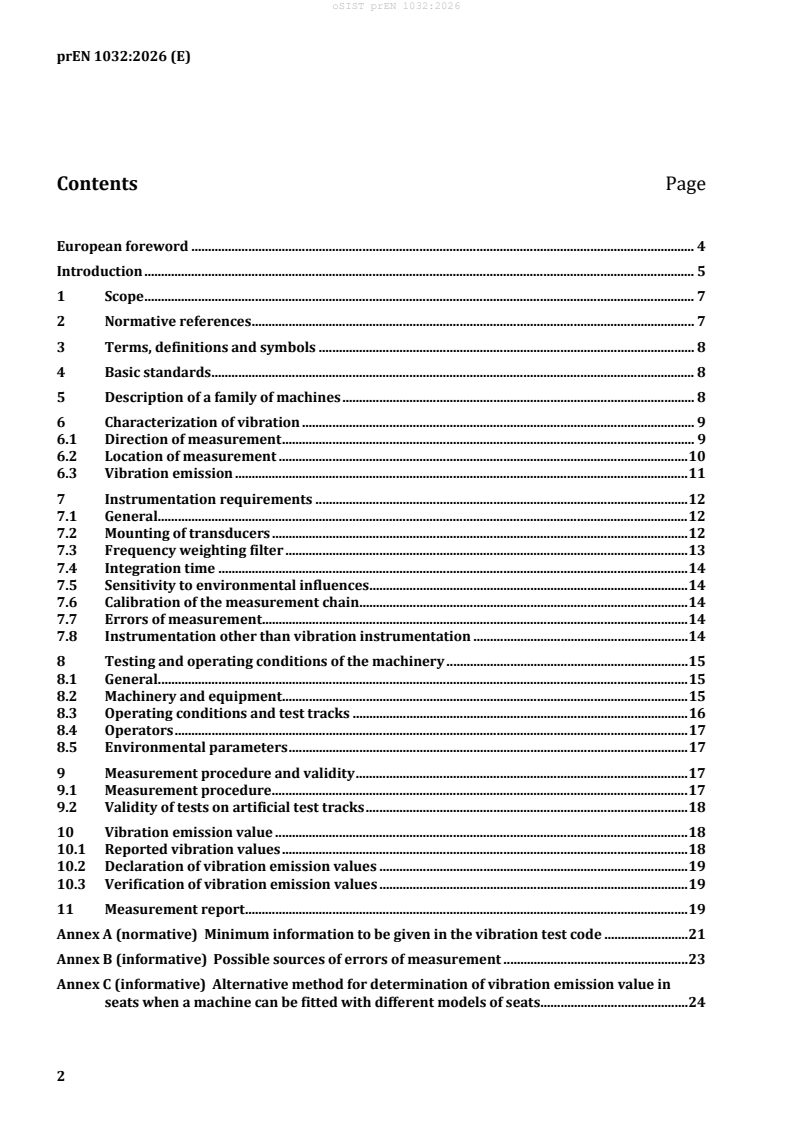
Contents
- Introduction
- 1 Scope
- 2 Normative references
- 3 Terms, definitions and symbols
- 3.1 vibration test code
- 3.2 mode of operation
- 3.3 operating conditions
- 4 Basic standards
- 5 Description of a family of machines
- 6 Characterization of vibration
- 6.1 Direction of measurement
- 6.2 Location of measurement
- 6.3 Vibration emission
- 7 Instrumentation requirements
- 7.1 General
- 7.2 Mounting of transducers
- 7.3 Frequency weighting filter
- 7.4 Integration time
- 7.5 Sensitivity to environmental influences
- 7.6 Calibration of the measurement chain
- 7.7 Errors of measurement
- 7.8 Instrumentation other than vibration instrumentation
- 8 Testing and operating conditions of the machinery
- 8.1 General
- 8.2 Machinery and equipment
- 8.3 Operating conditions and test tracks
- 8.4 Operators
- 8.5 Environmental parameters
- 9 Measurement procedure and validity
- 9.1 Measurement procedure
- 9.2 Validity of tests on artificial test tracks
- 10 Vibration emission value
- 10.1 Reported vibration values
- 10.2 Declaration of vibration emission values
- 10.3 Verification of vibration emission values
- 11 Measurement report
- Annex A
- Annex B
- Annex C
- Annex D
- Annex E
- 2 Emission points (seat, steering wheel)
- 3 Seat
- 4 Engine
- 5 Frame
- 6 Control point (wheel hub)
- 1 Weighted r.m.s value of acceleration in the emission point, m/s
- 2 Weighted r.m.s value of acceleration in the control point, m/s
- Annex F
- Annex ZA
- 1.1 General Remarks — not covered
- 2. SUPPLEMENTARY — Not applicable for this type of
- 3.4 Protection against — not covered
- 4. SUPPLEMENTARY — Not applicable for this type of
- 5. SUPPLEMENTARY — Not applicable for this type of
- 6. SUPPLEMENTARY — Not applicable for this type of
- Bibliography
Introduction
Exposure to mechanical vibration from mobile machinery can interfere with comfort, working efficiency and, in some circumstances, health and safety. The Machinery Regulation (EU) 2023/1230, supported by the basic safety standards EN ISO 12100, requires that machinery is designed and constructed so that the risks resulting from vibration emissions are minimized and that where risks remain, despite such measures, the machinery manufacturer supplies warnings. It also states that the information concerning vibrations generated by mobile machinery which are transmitted to the hand-arm system or to the whole body is given in the instructions for use. Knowledge of whole-body and hand-transmitted vibration emission values will aid the selection of low-vibration machinery. The vibration emission determined by a test code should be in proportion to the magnitude of the vibration hazard. In some cases (for example, where the vibration emission at the seat contains shocks) the r.m.s. values determined by the test code cannot adequately represent the vibration hazard. Test codes should provide guidance on how to warn of vibration risk (residual risk) in these cases. This document covers the vibration parameters required for declaration by the Machinery Regulation (EU) 2023/1230. Values of r.m.s. acceleration for both whole-body vibration and hand-transmitted vibration are given along with values representing the mean peak acceleration for repeated shock vibrations transmitted to the hand-arm system. This document also provides general requirements for testing and evaluating whole-body and hand-transmitted vibration emissions of mobile machinery as a basis for technical committees responsible for the preparation of vibration test codes. The purpose of this document is to assist technical standardization committees responsible for specific types of machinery in preparing vibration test codes to ensure that such vibration test codes - are as homogeneous as possible with each individual test code having the same basic structure, - are in full accordance with basic standards on measurement of vibration emission, - reflect the latest technical knowledge of methods of determining the vibration emission from the specific family of machinery under consideration, - provide a standardized method for the determination and declaration of the vibration emission value(s) of machinery, - to enable the vibration emission value(s) of different machines to be compared, and - to verify the vibration emission value(s) of machinery.
Standardized vibration test codes are required for many purposes, e.g. to fulfil legal requirements, as well as for trade agreements, aspects of work environment, vibration control, planning of process and work. In order to prepare a vibration test code for a specific family of machinery it is essential to establish additional requirements for that family, e.g. installation and mounting conditions, operating conditions, measurement positions, measurement directions, vibration declaration, information to be reported. It is essential when developing a test code for declaration of vibration emission to define a procedure to collect representative vibration values for the machine, to identify causes of variability, to validate the test method and to evaluate the reproducibility of results.
Guidance or recommendations for determination of human exposure to vibration at the workplace are not in the scope of this document. For such information, see ISO 5349-1 and ISO 2631-1. This document is a type-B standard as stated in EN ISO 12100.
This document is of relevance, in particular, for the following stakeholder groups representing the market players with regard to machinery safety:
oSIST prEN 1032:2026 prEN 1032:2026 (E) - machine manufacturers (small, medium and large enterprises); - health and safety bodies (regulators, accident prevention organizations, market surveillance etc.). When the above-mentioned stakeholder groups use this document, other groups can be affected by the level of machinery safety achieved, including:
- machine users/employers (small, medium and large enterprises);
- machine users/employees (e.g. trade unions, organizations for people with special needs);
- service providers, e.g. for maintenance (small, medium and large enterprises);
- consumers (in case of machinery intended for use by consumers). The above-mentioned stakeholder groups have been given the possibility to participate at the drafting process of this document.
In addition, this document is intended for standardization bodies elaborating type-C standards. The requirements of this document can be supplemented or modified by a type-C standard. For machines that are covered by the scope of a type-C standard and have been designed and built according to the requirements of that standard, the requirements of that type-C standard take precedence.
The obligations to control risks arising from exposures to vibration are specified in Europe by Directive 2002/44/EC which uses a daily vibration exposure value A(8), that is not to be confused with the vibration emission used in this document.
oSIST prEN 1032:2026 prEN 1032:2026 (E)
1 Scope
This document specifies the determination of whole-body and hand-transmitted vibration emissions at operator position(s) during testing of mobile machinery under regular operation, e.g. travelling, towing, lifting, excavating.
This document provides requirements for the preparation of vibration test codes (C-type standards), including guidelines and requirements for the conditions (e.g. operating conditions) for measurements. This document applies to sitting and standing positions. It is applicable to all mobile machinery producing periodic or random vibration with or without shocks.
This document contains sufficient guidance for designing an appropriate test for machinery for which no vibration test codes exist. It can also be used for the determination of vibration emission values of individual machines.
This document is not applicable to rotational vibration and backrest vibration. This document does not present limits or recommended vibration emission values.
2 Normative references
The following documents are referred to in the text in such a way that some or all of their content constitutes requirements of this document. For dated references, only the edition cited applies. For undated references, the latest edition of the referenced document (including any amendments) applies. EN 12096:2026, Mechanical vibration — Declaration and verification of vibration emission values EN ISO 5349-3:2025, Mechanical vibration - Measurement and evaluation of human exposure to handtransmitted vibration - Part 3: Isolated and repeated shocks using the frequency range of ISO 5349-1 (ISO 5349-3:2025) EN ISO 8041-1:2017, Human response to vibration - Measuring instrumentation - Part 1: General purpose vibration meters (ISO 8041-1:2017) EN ISO 10326-1:2016, Mechanical vibration - Laboratory method for evaluating vehicle seat vibration - Part 1: Basic requirements (ISO 10326-1:2016, Corrected version 2017-02) ISO 2041:2018, Mechanical vibration, shock and condition monitoring — Vocabulary ISO 5805:1997, Mechanical vibration and shock — Human exposure — Vocabulary
oSIST prEN 1032:2026 prEN 1032:2026 (E)
3 Terms, definitions and symbols
For the purposes of this document, the terms and definitions given in ISO 2041:2018 and ISO 5805:1997 and the following apply.
ISO and IEC maintain terminology databases for use in standardization at the following addresses:
- ISO Online browsing platform: available at https://www.iso.org/obp/
- IEC Electropedia: available at https://www.electropedia.org/
3.1 vibration test code
type-C standard relative to a specified family or sub-family or type of machinery, which gives all the information necessary to carry out efficiently the determination, declaration and verification of the vibration emission values, with the purpose of ensuring compatibility and allowing comparison of test results
3.2 mode of operation
task performed by a mobile machine, for which a vibration emission value is determined EXAMPLE travelling, towing, lifting, excavating
3.3 operating conditions
parameters which affect the vibration emission of a mobile machine for a particular mode of operation EXAMPLE travelling speed, travelling surface, weight of load, material being excavated
4 Basic standards
The preparation of vibration test codes for mobile machinery shall be based on the requirements of this document and, for declaration, also on the requirements of EN 12096:2026, Clause 4. As a minimum, a vibration test code shall cover the items listed in Annex A. Where no specific vibration test codes exist for a family of machines, this document shall be used as a test code. In such cases details of the measurement method and machine operation (see Clauses 6, 7 and 8) shall be fully reported.
NOTE EN 12096:2026, Clause 5 gives guidance on how to verify the vibration emission values of machinery.
5 Description of a family of machines
The family or type of machinery covered by the vibration test code shall be described unambiguously and in detail. In describing the configuration of the machinery, a vibration test code shall - identify any additional equipment, attachment or accessories, e.g. tools, used in the operation of the machine under test and which can have an influence on the vibration emission, - specify the selection of optional components, devices or sub-assemblies, e.g. tyres or seats, which can have an influence on the vibration emission, and which shall be used during the determination of vibration emission, - identify the range of applications for which the vibration test code is intended.
oSIST prEN 1032:2026 prEN 1032:2026 (E) It can be appropriate to divide a family of machinery into sub-families requiring different conditions of testing.
6 Characterization of vibration
6.1 Direction of measurement
6.1.1 Whole-body vibration
Translational whole-body vibration transmitted to the human body is related to the appropriate directions of an orthogonal coordinate system.
The terminology commonly used in biomechanics relates the coordinate systems to the human skeleton in a normal anatomical position. The directions are as follows:
- x-direction: back to chest;
- y-direction: right side to left side;
- z-direction: foot (or buttocks) to head.
These directions are illustrated in Figure 1.
Key 1 supporting surface x back to chest y right side to left side z foot (or buttocks) to head Figure 1 — Directions of the basicentric coordinate system for mechanical whole-body vibration influencing human beings
oSIST prEN 1032:2026 prEN 1032:2026 (E)
6.1.2 Hand-transmitted vibration
Translational hand-transmitted vibration from a steering wheel is related to the steering wheel as follows:
- x-direction: the radial direction;
- y-direction: the direction tangential to the rim of the steering wheel;
- z-direction: the direction orthogonal to both the x-direction and the y-direction. These directions are illustrated in Figure 2.
For some machines, a steering control is used instead of a steering wheel. In such cases the directions shall be specified in the vibration test code.
If measurements are to be made also in controls other than those for steering (e.g. levers), the vibration test code shall specify the directions.
Key x radial direction y direction tangential to the rim of the steering wheel z direction orthogonal to both the x-direction and the y-direction Figure 2 — Directions of measurement on steering wheels
6.2 Location of measurement
6.2.1 Whole-body vibration
For whole-body vibration measurements, vibration should be determined as close as possible to the point or area through which the vibration is transmitted to the body. This can encompass more than one measurement point.
a) In the case where the exposed persons are sitting, the transducer mounted in a semi-rigid disc (see 7.2) shall be placed on the surface of the seat such that the transducer is located midway between the ischial tuberosities of the seated person. For comfort reasons, it is acceptable if the centre of the disc is located slightly in front (up to 5 cm) of the ischial tuberosities. b) In the case where the exposed persons are standing or have their feet on a driving or a working platform, the transducer shall be located as in Figure 1 with the transducer midway between the arches of the feet.
NOTE There is no requirement for declaration of vibration at the backrest, so it is not covered in this document.
oSIST prEN 1032:2026 prEN 1032:2026 (E)
6.2.2 Hand-transmitted vibration
For hand-transmitted vibration measurements, vibration should be determined as close as possible to the point or area through which the vibration is transmitted to the hand. Measurements on the steering wheel shall be carried out adjacent to the normal position of a hand guiding the steering wheel. The position of the accelerometer shall be as near as possible to the hand without obstructing normal grip.
If the test code also requires measurements to be made on controls (e.g. levers), these measurements shall be made as close as possible to where the hand makes contact with the control during machine use, as specified in the instruction for use.
6.3 Vibration emission
6.3.1 Whole-body vibration
The quantity used to describe the magnitude of continuous whole-body vibration shall be the frequency-
weighted acceleration in m/s , expressed as a root-mean-square (r.m.s.) value a . w The frequency weightings for continuous whole-body vibration given in 7.3.1 shall be used. The frequency weighted acceleration a for whole-body vibration is defined as the r.m.s. value of the w frequency-weighted acceleration signal a (t):
w T
a = at dt (1)
ww
T Requirements for the integration time T are given in 7.4.
The measurements shall be made in three directions. The following values shall be determined. a ,,aa (2a) wx wy wz a =max1,4 a ;1,4 aa; (2b)
w max wx wy wz where a , a and a are the r.m.s. values for whole-body vibration of the frequency-weighted wx wy wz acceleration in the x-direction, y-direction and z-direction, respectively. A value for the associated uncertainty value K shall be determined, see 10.2 for declaration. a
6.3.2 Hand-transmitted vibration
6.3.2.1 Continuous vibration
The quantity used to describe the magnitude of continuous hand-transmitted vibration shall be the
frequency-weighted acceleration in m/s , expressed as a root-mean-square (r.m.s.) value a . hw The frequency weighting for continuous hand-transmitted vibration given in 7.3.2 shall be used. The frequency weighted acceleration a for continuous hand-transmitted vibration is defined as the hw r.m.s. value of the frequency-weighted acceleration signal a (t):
hw T
a = a t dt (3)
hw hw
T Requirements for the integration time T are given in 7.4.
oSIST prEN 1032:2026 prEN 1032:2026 (E) NOTE The measurement of hand-transmitted vibration can be inspected for the effects of operator-induced movements and either these effects removed from the signal or a period selected for analysis which is free of these artefacts.
The measurements shall be made in three directions. The following values shall be determined. a ,,aa (4a) hwx hwy hwz 2 22 a a++aa (4b) hv hwx hwy hwz where a , a and a are the r.m.s. values for hand-transmitted vibration of the frequency-weighted hwx hwy hwz acceleration in the x-direction, y-direction and z-direction, respectively. A value for the associated uncertainty value K shall be determined, see 10.2 for declaration. a
6.3.2.2 Repeated shock vibration
The quantity used to describe the magnitude of hand-transmitted repeated shock vibrations shall be the
vibration peak magnitude of the flat frequency weighted acceleration, p in m/s . h F The frequency weighting for repeated shock vibrations given in 7.3.2 shall be used.
The instantaneous tri-axial acceleration total value of the flat frequency weighted vibration (m/s ) used h to determine the p value is specified by F 2 2 2 at a t++at a t (5)
Fv Fx Fy Fz where a (t), a (t), a (t) are the instantaneous single-axis acceleration values of the flat frequency Fx Fy Fz h
weighted vibration in the axes denoted as x, y and z (m/s ).
The vibration peak magnitude of the flath acceleration total value shall be calculated in accordance with EN ISO 5349-3:2025, Clause 4.
Requirements for the integration time, T, are given in 7.4.
A value for the associated uncertainty value K shall be determined, see 10.2 for declaration. p
7 Instrumentation requirements
7.1 General
Unless otherwise specified by the relevant vibration test code the dynamic range, sensitivity, accuracy, linearity and overload capacity of the vibration measuring system shall be in accordance with EN ISO 8041-1:2017.
7.2 Mounting of transducers
7.2.1 General
A single tri-axial transducer or three orthogonally mounted transducers are used to measure the three axes of vibration at each location. Transducers oriented in different directions at a single measurement location shall be as close together as possible. As far as practicable, neither the mass of the measuring device and its fixture, nor any local resonances, should affect significantly the measured values. NOTE General information on the mounting of accelerometers can be found in ISO 5348:2021.
oSIST prEN 1032:2026 prEN 1032:2026 (E)
7.2.2 Whole-body vibration
The transducers used for the measurement on the seat surface shall be mounted in a semi-rigid disc, see Figure 3. The semi-rigid disc shall be in accordance with EN ISO 10326-1:2016, 5.2.3. Dimensions in millimetres
Key 1 thin metal disc for accelerometer mount and added centre rigidity 2 appropriate cavity for accelerometer(s) Figure 3 — Design of a semi-rigid mounting disc NOTE For practical reasons, it is often not possible to perfectly align the accelerometers in the disc with the directions of the basicentric coordinate system. In a tolerance range within ± 15° of the appropriate directions the accelerometers can be considered as aligned parallel to these directions. The transducers used for the measurement at the feet shall be rigidly fixed on the working platform. If the working platform is covered by a resilient material, the transducers may be mounted in the middle of a rigid metal plate (about 300 mm × 400 mm) with the operator standing on the plate.
7.2.3 Hand-transmitted vibration
The transducers used for hand-transmitted vibration measurements on the steering wheel shall be mounted firmly to the steering wheel, for more information see EN ISO 5349-2. NOTE There are several problems in making repeatable measurements on a steering wheel. In particular, the measurement can be strongly affected by steering movements made by the operator. Care is needed to minimize these, e.g. by making the measurements during travelling on a straight course. Alternative mounting conditions or specific formed mounting discs or adaptors may be specified in the specific vibration test code.
7.3 Frequency weighting filter
7.3.1 Whole-body vibration
The whole-body frequency weighting curves W and W in accordance with EN ISO 8041-1:2017, 5.6 shall d k be used.
7.3.2 Hand-transmitted vibration
For continuous hand-transmitted vibration the W frequency weighting in accordance with h EN ISO 8041-1:2017, 5.6 shall be used.
For hand-transmitted repeated shock vibrations the flat frequency weighting shall be used. The flat h h frequency weighting as defined in EN ISO 5349-3:2025, 3.7 is the band-limiting component of the W h frequency weighting as specified in EN ISO 8041-1:2017, 5.6.1 Table 3
oSIST prEN 1032:2026 prEN 1032:2026 (E)
...