


SIST-TS CLC/TS 50677:2022
(Main)Clothes washing machines and washer-dryers for household and similar use - Method for the determination of rinsing effectiveness by measurement of the surfactant content at textile materials
Clothes washing machines and washer-dryers for household and similar use - Method for the determination of rinsing effectiveness by measurement of the surfactant content at textile materials
This document provides a method for the evaluation of the rinsing effectiveness of household clothes washing machines, washer dryers and commercial washing machines. The amount of residual linear alkylbenzene sulfonate surfactant (LAS) extracted from the unstained test swatches of the strips used in the washing performance test is determined. This is accomplished by measuring the ultraviolet (UV) light absorbance at the wavelength particular to LAS, a key ingredient of the detergent.
Assuming a fixed linear relationship between LAS amount and quantity of detergent mixture and using a concentration versus absorbance curve developed as part of this procedure, the absorbance values are then converted into detergent concentrations, which together with the test solution mass data, yields detergent quantities. This assumption is done, because in the frame of this test it is not possible to determine the exact amount of LAS involved, even in the concentration curves, but only the amount of detergent used.
On the textiles, this linear relationship is not given, but it is nevertheless used to express the amount of LAS as determined by UV light absorbance measurements in terms of a detergent amount.
Waschmaschinen und Waschtrockner für den Hausgebrauch und ähnliche Zwecke - Verfahren zur Bestimmung der Spülwirkung durch Messung des Tensidgehalts an Textilien
Machines à laver le linge et machines à laver et à sécher pour usages domestiques et analogues - Méthode pour la détermination de l'efficacité de rinçage par la mesure de la teneur en tensioactifs des matières textiles
Pralni in pralno-sušilni stroji za gospodinjsko in podobno uporabo - Metoda za ugotavljanje učinkovitosti izpiranja z merjenjem tenzidov na tekstilu
Prva izdaja te tehnične specifikacije ponuja metodo za vrednotenje učinkovitosti izpiranja gospodinjskih pralnih strojev, pralno-sušilnih strojev in komercialnih pralnih strojev. Določi se količina ostankov detergenta, izluščenega iz nepobarvanih vzorcev trakov, uporabljenih pri preskusu učinkovitosti pranja. To se doseže z merjenjem vpijanja ultravijolične svetlobe pri valovni dolžini, značilni za linearni alkilbenzen sulfonatni tenzid, ki je ključna sestavina detergenta z znano linearno odvisnostjo od količine mešanice detergenta.
Če uporabimo krivuljo koncentracije v primerjavi z vpojnostjo, ki je pripravljena kot del tega postopka, se vrednosti vpojnosti nato pretvorijo v koncentracije detergenta, kar skupaj s podatki o masi preskusne raztopine zagotavlja podatke o količinah detergenta.
Prva izdaja se zdaj pogosto uporablja v številnih različnih laboratorijih, tako pri proizvajalcih kot v neodvisnih preskuševalnih laboratorijih. Skupina SWG01-08 je prejela povratne informacije, da je preskusno breme zelo veliko, kar povečuje stroške in zmanjšuje možnost vzporednega preskušanja več strojev. V drugi izdaji je načrtovana poenostavitev postopka z namenom izboljšati rezultate te metode in znižati stroške preskušanja.
General Information
- Status
- Withdrawn
- Publication Date
- 17-Aug-2022
- Withdrawal Date
- 08-Mar-2026
- Technical Committee
- FGA - Consumer information related to household electrical appliances
- Current Stage
- 9900 - Withdrawal (Adopted Project)
- Start Date
- 09-Mar-2026
- Due Date
- 01-Apr-2026
- Completion Date
- 09-Mar-2026
Relations
- Effective Date
- 01-Sep-2022
- Effective Date
- 03-Feb-2026
- Effective Date
- 03-Feb-2026



Frequently Asked Questions
SIST-TS CLC/TS 50677:2022 is a technical specification published by the Slovenian Institute for Standardization (SIST). Its full title is "Clothes washing machines and washer-dryers for household and similar use - Method for the determination of rinsing effectiveness by measurement of the surfactant content at textile materials". This standard covers: This document provides a method for the evaluation of the rinsing effectiveness of household clothes washing machines, washer dryers and commercial washing machines. The amount of residual linear alkylbenzene sulfonate surfactant (LAS) extracted from the unstained test swatches of the strips used in the washing performance test is determined. This is accomplished by measuring the ultraviolet (UV) light absorbance at the wavelength particular to LAS, a key ingredient of the detergent. Assuming a fixed linear relationship between LAS amount and quantity of detergent mixture and using a concentration versus absorbance curve developed as part of this procedure, the absorbance values are then converted into detergent concentrations, which together with the test solution mass data, yields detergent quantities. This assumption is done, because in the frame of this test it is not possible to determine the exact amount of LAS involved, even in the concentration curves, but only the amount of detergent used. On the textiles, this linear relationship is not given, but it is nevertheless used to express the amount of LAS as determined by UV light absorbance measurements in terms of a detergent amount.
This document provides a method for the evaluation of the rinsing effectiveness of household clothes washing machines, washer dryers and commercial washing machines. The amount of residual linear alkylbenzene sulfonate surfactant (LAS) extracted from the unstained test swatches of the strips used in the washing performance test is determined. This is accomplished by measuring the ultraviolet (UV) light absorbance at the wavelength particular to LAS, a key ingredient of the detergent. Assuming a fixed linear relationship between LAS amount and quantity of detergent mixture and using a concentration versus absorbance curve developed as part of this procedure, the absorbance values are then converted into detergent concentrations, which together with the test solution mass data, yields detergent quantities. This assumption is done, because in the frame of this test it is not possible to determine the exact amount of LAS involved, even in the concentration curves, but only the amount of detergent used. On the textiles, this linear relationship is not given, but it is nevertheless used to express the amount of LAS as determined by UV light absorbance measurements in terms of a detergent amount.
SIST-TS CLC/TS 50677:2022 is classified under the following ICS (International Classification for Standards) categories: 97.060 - Laundry appliances. The ICS classification helps identify the subject area and facilitates finding related standards.
SIST-TS CLC/TS 50677:2022 has the following relationships with other standards: It is inter standard links to SIST-TS CLC/TS 50677:2019, SIST EN IEC 62512:2021/A11:2021, SIST EN 60456:2016/A11:2021. Understanding these relationships helps ensure you are using the most current and applicable version of the standard.
SIST-TS CLC/TS 50677:2022 is associated with the following European legislation: EU Directives/Regulations: 2019/2014, 2019/2023; Standardization Mandates: M/566. When a standard is cited in the Official Journal of the European Union, products manufactured in conformity with it benefit from a presumption of conformity with the essential requirements of the corresponding EU directive or regulation.
SIST-TS CLC/TS 50677:2022 is available in PDF format for immediate download after purchase. The document can be added to your cart and obtained through the secure checkout process. Digital delivery ensures instant access to the complete standard document.
Standards Content (Sample)
SLOVENSKI STANDARD
01-september-2022
Nadomešča:
SIST-TS CLC/TS 50677:2019
Pralni in pralno-sušilni stroji za gospodinjsko in podobno uporabo - Metoda za
ugotavljanje učinkovitosti izpiranja z merjenjem tenzidov na tekstilu
Clothes washing machines and washer-dryers for household and similar use - Method
for the determination of rinsing effectiveness by measurement of the surfactant content
at textile materials
Waschmaschinen und Waschtrockner für den Hausgebrauch und ähnliche Zwecke -
Verfahren zur Bestimmung der Spülwirkung durch Messung des Tensidgehalts an
Textilien
Machines à laver le linge et machines à laver et à sécher pour usages domestiques et
analogues - Méthode pour la détermination de l'efficacité de rinçage par la mesure de la
teneur en tensioactifs des matières textiles
Ta slovenski standard je istoveten z: CLC/TS 50677:2022
ICS:
97.060 Aparati za nego perila Laundry appliances
2003-01.Slovenski inštitut za standardizacijo. Razmnoževanje celote ali delov tega standarda ni dovoljeno.
TECHNICAL SPECIFICATION CLC/TS 50677
SPÉCIFICATION TECHNIQUE
TECHNISCHE SPEZIFIKATION June 2022
ICS 97.060 Supersedes CLC/TS 50677:2019
English Version
Clothes washing machines and washer-dryers for household and
similar use - Method for the determination of rinsing
effectiveness by measurement of the surfactant content at textile
materials
Machines à laver le linge et machines à laver et à sécher Waschmaschinen und Waschtrockner für den
pour usages domestiques et analogues - Méthode pour la Hausgebrauch und ähnliche Zwecke - Verfahren zur
détermination de l'efficacité de rinçage par la mesure de la Bestimmung der Spülwirkung durch Messung des
teneur en tensioactifs des matières textiles Tensidgehalts an Textilien
This Technical Specification was approved by CENELEC on 2022-04-18.
CENELEC members are required to announce the existence of this TS in the same way as for an EN and to make the TS available promptly
at national level in an appropriate form. It is permissible to keep conflicting national standards in force.
CENELEC members are the national electrotechnical committees of Austria, Belgium, Bulgaria, Croatia, Cyprus, the Czech Republic,
Denmark, Estonia, Finland, France, Germany, Greece, Hungary, Iceland, Ireland, Italy, Latvia, Lithuania, Luxembourg, Malta, the
Netherlands, Norway, Poland, Portugal, Republic of North Macedonia, Romania, Serbia, Slovakia, Slovenia, Spain, Sweden, Switzerland,
Turkey and the United Kingdom.
European Committee for Electrotechnical Standardization
Comité Européen de Normalisation Electrotechnique
Europäisches Komitee für Elektrotechnische Normung
CEN-CENELEC Management Centre: Rue de la Science 23, B-1040 Brussels
© 2022 CENELEC All rights of exploitation in any form and by any means reserved worldwide for CENELEC Members.
Ref. No. CLC/TS 50677:2022 E
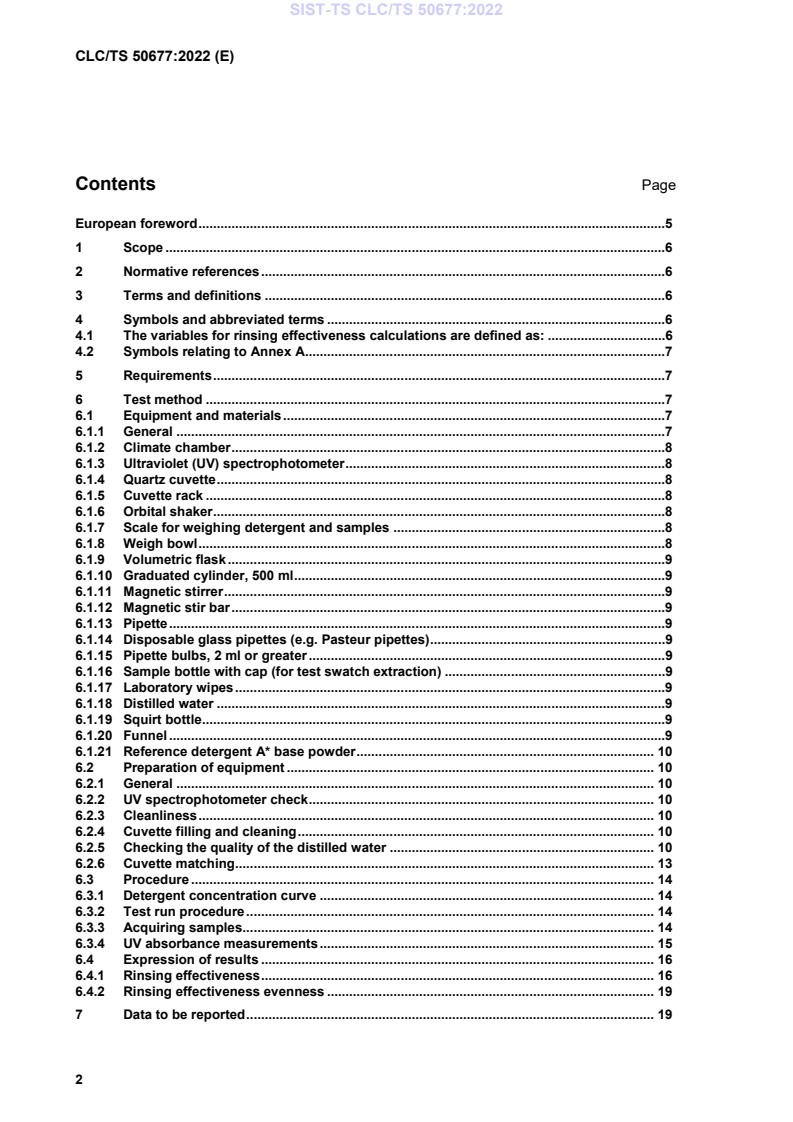
Contents Page
European foreword .5
1 Scope .6
2 Normative references .6
3 Terms and definitions .6
4 Symbols and abbreviated terms .6
4.1 The variables for rinsing effectiveness calculations are defined as: .6
4.2 Symbols relating to Annex A .7
5 Requirements .7
6 Test method .7
6.1 Equipment and materials .7
6.1.1 General .7
6.1.2 Climate chamber .8
6.1.3 Ultraviolet (UV) spectrophotometer .8
6.1.4 Quartz cuvette .8
6.1.5 Cuvette rack .8
6.1.6 Orbital shaker .8
6.1.7 Scale for weighing detergent and samples .8
6.1.8 Weigh bowl .8
6.1.9 Volumetric flask .9
6.1.10 Graduated cylinder, 500 ml .9
6.1.11 Magnetic stirrer .9
6.1.12 Magnetic stir bar .9
6.1.13 Pipette .9
6.1.14 Disposable glass pipettes (e.g. Pasteur pipettes) .9
6.1.15 Pipette bulbs, 2 ml or greater .9
6.1.16 Sample bottle with cap (for test swatch extraction) .9
6.1.17 Laboratory wipes .9
6.1.18 Distilled water .9
6.1.19 Squirt bottle .9
6.1.20 Funnel .9
6.1.21 Reference detergent A* base powder . 10
6.2 Preparation of equipment . 10
6.2.1 General . 10
6.2.2 UV spectrophotometer check . 10
6.2.3 Cleanliness . 10
6.2.4 Cuvette filling and cleaning . 10
6.2.5 Checking the quality of the distilled water . 10
6.2.6 Cuvette matching . 13
6.3 Procedure . 14
6.3.1 Detergent concentration curve . 14
6.3.2 Test run procedure . 14
6.3.3 Acquiring samples. 14
6.3.4 UV absorbance measurements . 15
6.4 Expression of results . 16
6.4.1 Rinsing effectiveness . 16
6.4.2 Rinsing effectiveness evenness . 19
7 Data to be reported . 19
Annex A (normative) Procedure for determining a detergent concentration curve . 20
A.1 General approach . 20
A.2 IEC-A* base detergent sampling . 20
A.3 Distilled water . 20
A.4 Preparation of Stock 1 solution (IEC-A* base powder detergent) . 20
A.4.1 Sample weighing . 20
A.4.2 Mix the sample . 20
A.4.3 Stock 1 calculation . 21
A.5 Preparation of Stock 2 . 21
A.5.1 Mix the sample . 21
A.5.2 Stock 2 calculation . 21
A.6 Preparation of working standards . 22
A.6.1 Mix the solutions . 22
A.6.2 Working standard calculations . 23
A.7 Measure the absorbance of the working standard solutions . 23
A.8 Calculations . 24
A.8.1 Initial treatment of the data . 24
A.8.2 Single sample data (per detergent sample) . 24
A.8.3 Combined sample data (all detergent samples) . 24
Annex B (normative) IEC-A* base powder detergent sampling . 26
B.1 Purpose . 26
B.2 Devices and materials . 26
B.3 Sampling procedure . 26
Annex C (informative) Acquiring samples using a dispenser . 30
C.1 General . 30
C.2 Calibration of the dispenser . 30
C.2.1 General . 30
C.2.2 Priming . 30
C.2.3 Setting the volume . 30
C.2.4 Calibration: . 30
C.2.5 Calculation: . 31
C.3 Acquiring samples (with dispenser) . 31
Annex D (informative) Quartz cuvette and glassware cleaning and handling . 32
D.1 Purpose . 32
D.2 Cuvettes . 32
D.3 General cleaning . 32
D.4 Periodic glass cleaning . 33
D.4.1 General . 33
D.4.2 Standard glassware cleaning solutions . 33
Annex E (informative) Uncertainty of the test method . 34
Annex F (informative) Extraction of single swatches . 35
F.1 General . 35
F.2 Additional materials . 35
F.2.1 Graduated cylinder, 100 ml . 35
F.2.2 Sample bottle with cap (for test swatch extraction) . 35
F.3 Single extraction . 35
Annex G (normative) Test report – Data to be reported . 37
G.1 General . 37
G.2 Data for test machine . 37
G.3 Data, parameters and results for the test series . 37
G.4 Example of calibration data collection (including calculation) . 39
G.5 Example of data collection for measurement . 41
Bibliography . 42
European foreword
This document (CLC/TS 50677:2022) has been prepared by CLC/TC 59X “Performance of household and
similar electrical appliances”.
This document supersedes CLC/TS 50677:2019 and all of its amendments and corrigenda (if any).
CLC/TS 50677:2021 includes the following significant technical changes with respect to
CLC/TS 50677:2019:
— Reduced requirements for UV spectrophotometer.
— Implemented simplified extraction procedure with reduced effort by extracting maximum 5 swatches of
each test run in one extraction bottle.
— Single swatch extraction was moved to Annex F.
Attention is drawn to the possibility that some of the elements of this document may be the subject of patent
rights. CENELEC shall not be held responsible for identifying any or all such patent rights.
This document has been prepared under a Standardization Request given to CENELEC by the European
Commission and the European Free Trade Association.
Any feedback and questions on this document should be directed to the users’ national committee. A
complete listing of these bodies can be found on the CENELEC website.
1 Scope
This document provides a method for the evaluation of the rinsing effectiveness of household clothes
washing machines, washer dryers and commercial washing machines. The amount of residual linear
alkylbenzene sulfonate surfactant (LAS) extracted from the unstained test swatches of the strips used in the
washing performance test is determined. This is accomplished by measuring the ultraviolet (UV) light
absorbance at the wavelength particular to LAS, a key ingredient of the detergent.
Assuming a fixed linear relationship between LAS amount and quantity of detergent mixture and using a
concentration versus absorbance curve developed as part of this procedure, the absorbance values are then
converted into detergent concentrations, which together with the test solution mass data, yields detergent
quantities. This assumption is done, because in the frame of this test it is not possible to determine the exact
amount of LAS involved, even in the concentration curves, but only the amount of detergent used.
On the textiles, this linear relationship is not given, but it is nevertheless used to express the amount of LAS
as determined by UV light absorbance measurements in terms of a detergent amount.
2 Normative references
The following documents are referred to in the text in such a way that some or all of their content constitutes
requirements of this document. For dated references, only the edition cited applies. For undated references,
the latest edition of the referenced document (including any amendments) applies.
EN 60456:2016/A11:2020, Clothes washing machines for household use - Methods for measuring the
performance
EN IEC 62512:2020/A11:2020, Electric clothes washer-dryers for household use - Methods for measuring
the performance
3 Terms and definitions
No terms and definitions are listed in this document.
ISO and IEC maintain terminological databases for use in standardization at the following addresses:
— IEC Electropedia: available at https://www.electropedia.org/
— ISO Online browsing platform: available at https://www.iso.org/obp
4 Symbols and abbreviated terms
4.1 The variables for rinsing effectiveness calculations are defined as:
Asp average absorbance
a
a
Asp
avg,j average net absorbance of the sample j
a
Asp
net absorbance for specimen i
i
a
Asp
i,223 absorbance reading at 223 nm for specimen i
a
Asp
i,330 absorbance reading at 330 nm for specimen i
a
Asp
peak absorbance at wavelength m
m
a
Asp
relative peak absorbance at wavelength m
r,m
a
Cs
concentration of detergent in sample j
j
a
Ds
mass of detergent recovered from sample j
j
Dsw average ratio of mass of detergent recovered per gram of
avg,l
test swatch from the test run l
a
Dsw
ratio of mass of detergent of test swatch k
k
DL ratio of mass of detergent of test run l
l
i, j, k and l index of specimens, samples, swatches and test run
m slope of the detergent concentration curve
n number of cuvettes, specimens, samples, swatches or
a
test runs
R rinsing effectiveness (average of all test runs)
Re Rinse Evenness Score
S standard deviation of the rinsing effectiveness
R
S standard deviation of the ratio of mass of detergent
r,l
recovered per gram of test swatch for test run l
a
Wsw
weight of test swatch k
k
a
Ws
weight of water in sample j
j
a
Care shall be taken in the calculations of Clause 6, as these variables are
depending on additional parameters, e.g. index of the sample, swatch or test
run.
4.2 Symbols relating to Annex A
b intercept of the detergent concentration curve
C detergent concentration of working standard solution
WSS
m mass of detergent
det
m slope of the detergent concentration curve
m mass of transferred Stock 1 solution
m mass of transferred Stock 2 solution
St concentration of Stock 1 solution
St concentration of Stock 2 solution
y absorbance value of the sample
x concentration of the detergent in the sample
5 Requirements
(Not available in this document.)
6 Test method
6.1 Equipment and materials
6.1.1 General
NOTE This materials list is additional to the materials list in EN 60456:2016, 5.4.
6.1.2 Climate chamber
The ambient temperature and relative humidity in the climate chamber shall be maintained at:
— temperature: (20 ± 2) °C
— relative humidity: (65 ± 5) %.
6.1.3 Ultraviolet (UV) spectrophotometer
The absorption of the ultraviolet light shall be measured with a ultraviolet spectrophotometer with the
following specifications:
— wavelength range: 190 nm to 350 nm
— spectral bandwidth: ≤ 2 nm
— wavelength accuracy (at D peak 656,1 nm): - 0,2 to 0,2 nm
— wavelength repeatability (10 measurements at 656,1 nm, slit width 1 nm): - 0,05 to 0,05 nm
— photometric range: - 0,1 to 3,0 A
— photometric accuracy (UV with K Cr O , Ph.Eur. at 1 A): - 0,02 to 0,02 A
2 2 7
— photometric repeatability (10 measurements with K Cr O , Ph.Eur. at 1 A): - 0,002 to 0,002 nm.
2 2 7
The spectrophotometer shall be calibrated regularly according to the manufacturer’s specification.
6.1.4 Quartz cuvette
The cuvettes to be used for the measurement of the ultraviolet absorption shall be rectangular with a path
length of 10 mm and be made from quartz.
6.1.5 Cuvette rack
(Not specified in this document.)
6.1.6 Orbital shaker
The device for the extraction of the linear alkylbenzene sulfonate shall be an orbital shaker. The orbital
shaker shall have a device for securing sample bottles on it.
Orbit: 4 mm to 20 mm
−1
Shaker speed: ≥ 350 min
NOTE The speed of the shaker can be checked by a tachometer, either optical by light beam reflection or
mechanical by a magnetic sensor. For details it is advised to refer to the manufacturer’s specification.
6.1.7 Scale for weighing detergent and samples
Minimum specification: 0 to 150 g range with
Minimum resolution: 0,001 g
Accuracy: ± 0,002 g
6.1.8 Weigh bowl
(Not specified in this document.)
6.1.9 Volumetric flask
For the preparation of the working standards for calibration volumetric flasks with a volume of 100 ml and
1000 ml shall be used.
6.1.10 Graduated cylinder, 500 ml
(Not specified in this document.)
6.1.11 Magnetic stirrer
(Not specified in this document.)
6.1.12 Magnetic stir bar
Small, medium and large stir bars shall be used.
6.1.13 Pipette
Pipette of volume 1, 2, 5, 10 and 25 ml shall be used.
6.1.14 Disposable glass pipettes (e.g. Pasteur pipettes)
Disposable glass pipettes without cotton stoppers, non-sterile and with a volume of 2 ml or greater shall be
used for transferring the extract to the cuvettes.
NOTE A transfer pipette with disposable plastic tips can be used in place of glass pipettes after correlation tests.
6.1.15 Pipette bulbs, 2 ml or greater
(Not specified in this document.)
6.1.16 Sample bottle with cap (for test swatch extraction)
For the extraction plastic bottles with cap made from high-density polyethylene with a volume of 500 ml and
a diameter of (73 ± 3) mm.
6.1.17 Laboratory wipes
(Not specified in this document.)
6.1.18 Distilled water
All water used for extractions, dilutions and the preparation of calibration standards shall meet the following
criteria:
Conductivity at 25 °C: ≤ 1 µS/cm.
Net absorbance (223 nm to 330 nm): - 0,002 to 0,002 A.
Absorbance curve spectrum 200 nm to 350 nm: no relative peak absorbance greater than ± 0,002 A in the
range between 223 nm to 330 nm.
The procedure for calculating these values is given in 6.2.4.
NOTE Water prepared by methods other than distillation having equivalent specifications can be used instead of
distilled water.
6.1.19 Squirt bottle
Material: high-density polyethylene
6.1.20 Funnel
(Not specified in this document.)
6.1.21 Reference detergent A* base powder
The detergent used for calibration is IEC-A* as described in EN 60456:2016/A11:2020. Only the base
powder IEC-A* shall be used for the determination of the calibration curve. The calibration shall be done with
the batch of detergent used for washing.
This document only refers to IEC-A* as detergent. It is possible to use other detergents than IEC-A*. For all
cases the calibration shall be done with the detergent used for washing.
6.2 Preparation of equipment
6.2.1 General
(Not specified in this document.)
6.2.2 UV spectrophotometer check
Turn on the UV spectrophotometer. It should be run approximately 30 min before measurements (refer to
the manufacturer’s specification).
If the instrument has a built-in self-check function, perform the self-check once a day before measuring data.
This may be included in the calibration report.
6.2.3 Cleanliness
All materials that come in contact with detergent, distilled water, Stock 1, Stock 2 or the working standard
solutions shall be cleaned and thoroughly rinsed with distilled water then dried before use. A professional
laboratory dishwasher may be used for this purpose.
6.2.4 Cuvette filling and cleaning
The cuvettes should be handled by the opaque sides only. Do not touch the clear sides of the cuvettes.
To avoid air bubbles, fill by running the solution down the side of the cuvette. Fill cuvettes without soiling or
wetting the exterior measuring surface. If air bubbles are present, eliminate them by holding the cuvette at a
slight angle and tapping the opaque side as many times as necessary to release the bubbles.
To prevent liquid from running down the cuvette surface after discharging, place the cuvette head first on a
clean position of a lint-free tissue for some seconds. Replace the tissue from time to time if no clean position
is left.
If a cuvette gets contaminated on the outside, clean the cuvette and re-check cuvette matching (6.2.5). Do
not only wipe/dry the cuvette surface with a tissue. Remaining residues in the UV-area are not visible.
NOTE See Annex D (informative), Quartz cuvette and glassware cleaning and handling.
6.2.5 Checking the quality of the distilled water
6.2.5.1 General
Take a spectrum (200 nm to 350 nm) of the distilled water used for testing as described in 6.2.4.2 f).
If
a) the calculated net absorbance value (223 nm to 330 nm) is greater than ± 0,002 A
or
b) any relative peak absorbance value in the range between 223 nm to 330 nm is greater than ± 0,002 A
Check the spectrum for abnormality and repeat this section with a different batch of distilled water. Such
water is likely to contain impurities which could interfere with this test method and lead to unreliable results.
6.2.5.2 Spectrum from 200 nm to 350 nm
a) Start Spectrophotometer and wait for warm up
b) Use only one cuvette
c) Place a clean, dry and empty cuvette into the position for zeroing the cuvette. The positioning of the
cuvette may vary according to the type of spectrophotometer used:
— for double beam devices, place the cuvette in the measuring position and leave the reference/blank
position empty;
— for single beam devices with a carrousel, place the cuvette in the reference/blank position.
d) Zero the device (baseline correction)
e) Fill the cuvette with distilled water (rinse twice, keep the third for measurement), place cuvette into the
measuring position, leave the reference/blank position empty if applicable.
f) Run a spectrum with the following settings (or the closest available on the spectrophotometer used):
— range: 200 nm to 350 nm
— bandwidth: 1 nm
— speed: 10 nm/s
— integration time: 0,1 s
— switch light source (UV to visual light): ≥ 360 nm
An example of a typical spectrum is given in Figure 1, Example spectrum of distilled water.
Figure 1 — Example spectrum of distilled water
6.2.5.3 Calculation of net absorbance (223 nm - 330 nm)
For each specimen i calculate the net absorbance Asp
i
Asp = Asp – Asp
i i,223 i,330
where
Asp is the absorbance reading at 223 nm for specimen i
i,223
Asp is the absorbance reading at 330 nm for specimen i
i,330
i is the index of the specimen.
6.2.5.4 Calculation of relative peak absorbance
Detect all peaks (minimum and maximum) in the range between 223 nm to 330 nm with a peak threshold
value ≥ 0,0002 A.
For each specimen i, calculate the average absorbance Asp
a
Asp = (Asp + Asp ) / 2
a i,223 i,330
where
Asp is the absorbance reading at 223 nm for specimen i
i,223
Asp is the absorbance reading at 330 nm for specimen i
i,330
i is the index of a specimen.
For all peaks with wavelength m, calculate the relative peak absorbance Asp
r,m
Asp = Asp – Asp
r,m m a
where
Asp is the peak absorbance at wavelength m
m
is the average absorbance.
Asp
a
Example for the calculation of the net absorbance of specimen i
Asp = - 0,0007 A
i,223
Asp = 0,0007 A
i,330
Calculate:
Asp = - 0,0007 A – 0,0007 A
i
Asp = - 0,0014 A
i
Example for the calculation of the relative peak absorbance of specimen i
Asp = - 0,0007 A
i,223
Asp = 0,0007 A
i,330
Asp = Asp = - 0,0013 A (highest peak at 240 nm)
m 240
Calculate:
Asp = (Asp + Asp ) / 2
a i,223 i,330
Asp = (- 0,0007 A + 0,0007 A) / 2
a
Asp = 0,000 A
a
Asp = Asp – Asp
r,240 240 a
Asp = - 0,0013 A – 0,0000 A
r,240
Asp = - 0,0013 A
r,240
6.2.6 Cuvette matching
Before measuring samples, cuvette matching is verified by filling all cuvettes with distilled water (rinse twice,
keep the third filling for measurement). Measure all cuvettes (including blank cuvette) against empty blank
position in spectrophotometer. Record absorbance values (223 nm, 330 nm). Repeat this step 3 times for
each of the cuvettes. Always place the clear sides of the cuvette in the same direction into the cuvette holder
(e.g. marking of the cuvette always to the beam side). Use this direction for all measurements.
Calculate the average net absorbance value (223 nm to 330 nm) for the three readings per cuvette. If the
absolute range of the averaged values of all cuvettes is greater than 0,002 A repeat this section with clean
or new cuvettes. Only use cuvettes with an absolute averaged net absorbance value smaller or equal to
0,002 A.
6.3 Procedure
6.3.1 Detergent concentration curve
6.3.1.1 General
The purpose of the detergent concentration curve is to provide an equation relating the amount of IEC-A*
detergent to the absorbance value obtained from a water sample containing IEC-A* base powder detergent.
This is accomplished by measuring the UV absorbance at the wavelength particular to LAS, a key ingredient
of the IEC-A* base powder detergent with an assumed fixed linear relationship to the quantity of the IEC-A*
detergent. This assumption is done, because in the frame of this test it is not possible to determine the exact
amount of LAS involved, even in the concentration curves, but only the amount of detergent used. On the
textiles, this linear relationship is not given, but it will nevertheless be used to express the amount of LAS as
determined by UV light absorbance measurements in terms of a detergent amount.
6.3.1.2 Frequency for determining detergent concentration curve
A detergent concentration curve should be determined for each new batch of IEC-A* base powder detergent
used. It should also be redone when any significant changes have been made in the system (new location,
new instrument, etc.) or when questions about data quality have arisen (new analyst, suspicious data, etc.).
6.3.1.3 Procedure for determining detergent concentration curve
See Annex A (normative), Procedure for determining detergent concentration curve.
6.3.2 Test run procedure
6.3.2.1 Prepare the load for performance test according to IEC / EN
See EN 60456:2016/A11:2020, Clause 6 for washing machines and EN IEC 62512:2020/A11:2020 for
washer-dryers.
For loads larger than 5 kg mark the first 5 soiled strips that will be put in the machine on any swatch except
the unsoiled swatch with a permanent marker, which is not washed out.
6.3.2.2 Perform the test run as specified in of EN 60456:2016/A11:2020, Clause 8 or
EN IEC 62512:2020/A11:2020, Clause 8 with the following changes
Do not iron the white unsoiled test swatch. Label the stain strips along the edge of the sebum stain. Do not
add markings to the white unsoiled test swatch.
6.3.3 Acquiring samples
Samples shall be read on the day of extraction.
Care shall be taken to avoid any contamination of the test swatches especially with detergent residues (e.g.
from hands, tools or surfaces) while removing the test swatches, while placing the test swatches in the
climate chamber and until the extraction process is complete. To prevent contamination of the test swatches,
tools like tweezers, gloves or others can be used. Check any tools to be used for the absence of detergent
residues and for the absence of any other material which absorbs around the wavelengths of 223 nm and
330 nm.
a) After completion of the test run, remove the white unsoiled test swatch from required stain strip by cutting
close to the sewn seam. Remove any loose threads.
For test runs up to 5 kg all swatches will be taken. If loads larger than 5 kg are used, the 5 marked stain
strips from 6.3.2.1 will be used. The remaining swatches shall not be used.
b) Place the test swatches in the climate chamber for minimum 16 h.
Ensure that each test swatch is completely exposed to the conditioned air. This can be done by hang
drying using marked clothes-pegs. Do not place the test swatch on a solid surface. Take care not to mix
test swatches from different test runs, the test swatches are not labelled.
c) After conditioning in the climate chamber weigh each of the selected test swatches. The swatches shall
stay in a conditioned state until they have been weighed.
NOTE If the weighing is not carried out under conditioned state, put the selected test swatches of a test run in a
separate labelled plastic bag or plastic bottles while in the climate chamber for protection from humidity.
d) For each extraction label a new sample bottle with the test run information and remove the cap from the
bottle.
e) Place the sample bottle on the scale and tare (“zero”) the scale.
f) Approximately 500 ml of distilled water will be needed for the extraction. Measure the required volume
of distilled water (23 ± 2) °C in a graduated cylinder.
g) Remove the sample bottle from the scale and add the water to the bottle. Put the sample bottle back on
the scale and record the mass Ws of the water to 3 decimals.
i
h) Put a plate on the scale and tare (“zero”) the scale.
i) Put the selected test swatches on the plate and record the mass Wsw of the test swatch for the
k
corresponding test run number to 3 decimals. Use tweezers to handle the test swatches.
j) Insert the test swatches into the corresponding sample bottles without folding, close the cap and put the
bottles on the shaker. Use tweezers to handle the test swatches.
k) Place the sample bottles on the shaker and secure it, utilizing a retention rack or similar means.
−1
l) Shake at 350 min for 60 min.
m) After shaking remove all test swatches with dry tweezers within 5 min and discard. Do not squeeze the
water out of the test swatches as they are removed. Close caps on sample bottles.
n) Take UV absorbance measurements of the water samples per 6.3.4.
6.3.4 UV absorbance measurements
6.3.4.1 Preparation of equipment
Prepare equipment used for UV measurement as described in 6.2.
Fill cuvettes with distilled water to the fill line. Zero cuvettes against the blank cuvette in the UV
spectrophotometer.
Select a new disposable glass pipette for each sample to be measured.
6.3.4.2 Preparation of blank
a) Rinse a glass pipette by drawing in 2 ml of distilled water and expel. Repeat this step one more time.
b) Refill the pipette.
c) Rinse a cuvette twice with distilled water and refill the pipette.
d) Dispense distilled water into the cuvette to the fill line and place in the spectrophotometer in the position
marked for a “blank”.
NOTE One blank can be used for all testing performed at one time (retain the blank in the spectrophotometer). It is
advised to check the blank periodically for air bubbles and discard it if bubbles are present.
6.3.4.3 Preparation and reading of specimens from extracted water samples
Recap the sample bottles by only placing the caps on the bottles. Place all sample bottles at the workplace
near to the measuring position/device in a way that the measured samples can be taken out without moving
the bottles.
Let the sample bottles rest for at least 30 min to allow sedimentation.
Take out the samples from the upper third of the liquid level in the sample bottles.
a) Select a sample bottle and do not shake or move the bottle.
b) Rinse a glass pipette by drawing in 2 ml of the sample and rinse a cuvette with the sample and refill the
pipette. Repeat this step one more time.
c) Dispense sample into the cuvette to the fill line.
d) Place the cuvette in the spectrophotometer, always positioning the same clear side facing the light beam.
e) Measure and record the UV absorbance Asp and Asp of the specimens at 223 nm and 330 nm
i,223 i,330
wavelengths to 4 decimals.
f) Repeat steps e) to f) for 3 cuvettes or steps e) to f) for 3 measurements if only one cuvette is used for
sample measurement.
g) Recap the sample bottle and save until readings are analysed.
NOTE If more than one cuvette is used, it is advised to keep the cuvettes in the same position and direction on the
spectrophotometer carousel throughout the test.
h) Repeat steps 6.3.4.2 and 6.3.4.3 for the remaining sample bottles.
NOTE If an absorbance reading exceeds the limit of the calibration curve data, it is essential that the sample is
diluted and measured again. The calculated concentration is then adjusted according to the dilution factor. For example,
if the calculated concentration of a 50 % diluted sample is 150 mg/l, the undiluted sample would have a concentration of
150 mg/l x 2 = 300 mg/l.
6.4 Expression of results
6.4.1 Rinsing effectiveness
Using the detergent concentration curve established in Annex A, calculate the rinsing effectiveness with the
following formulae. An explanatory calculation spreadsheet is shown in Annex G.
Calculations:
a) Net absorbance Asp for each specimen:
i
Asp = Asp – Asp
i i,223 i,330
where
Asp is the net absorbance reading at 223 nm for specimen i;
i,223
Asp is the net absorbance reading at 330 nm for specimen i.
i,330
b) Average net absorbance Asp for each sample:
avg,j
n
Asp = Asp
avg, j i
∑
n
i=1
where
Asp is the net absorbance for each specimen i, as calculated in a);
i
n is the number of cuvettes utilized or the number of measurements done for the sample;
j is the index of the sample.
c) Concentration of detergent Cs per sample, expressed in mg/l:
j
Asp − b
avg, j
Cs =
j
m
where
Asp is the average net absorbance for sample j, as calculated in b);
avg,j
b is the intercept of the detergent concentration curve, as calculated in A.8.3 c);
m is the slope of the detergent concentration curve, as calculated in A.8.3 c);
j is the index of the sample.
d) Mass of detergent recovered Ds per sample, expressed in mg:
j
1 l
Ds= Cs××Ws
j j j
1000 g
where
Cs is the concentration of the detergent in sample j in mg/l, as calculated in c);
j
Ws is the weight of water in sample j in g;
j
j is the index of the sample.
e) Ratio of mass of detergent recovered per gram Dsw per test swatch, expressed in mg/g:
k
Ds
j
Dsw =
k
Wsw
k
where
Ds is the mass of detergent recovered from sample j in mg, as calculated in d);
j
Wsw is the mass of test swatch k, in g;
k
k is the index of the test swatch.
f) Average ratio of mass of detergent recovered per gram of test swatch Dsw per test run, expressed
avg,l
in mg/g:
n
Dsw = Dsw
avg,l k
∑
n
k=1
where
Dsw is the ratio of mass of detergent recovered per gram of test swatch k in mg/g, as calculated in e);
k
n is the number of test swatches;
l is the index of the test run.
g) Ratio of mass of detergent per kg of load DL per test run, expressed in g/kg:
l
DL = Dsw
l avg,l
where
Dsw is the average ratio of mass of detergent recovered per gram of test swatch from the test run
avg,l
l, as calculated in f).
h) Rinsing effectiveness R (average ratio of mass of detergent per kg of load of all test runs), expressed in
g/kg:
n
R= DL
l
∑
n
l=1
where
DL is the ratio of mass of detergent per kg of load from test run l in g/kg, as calculated in g);
l
n is the number of test runs.
i) Standard deviation of the rinsing effectiveness S , expressed in g/kg:
R
n
S DL− R
( )
Rl
∑
n− 1
l=1
where
DL is the ratio of mass of detergent per kg of load of test run l expressed in g/kg, as calculated in g);
l
R is the Rinsing Effectiveness in g/kg, as calculated in h);
n is the number of test runs.
=
6.4.2 Rinsing effectiveness evenness
a) In some cases it might be useful to perform an extraction of the individual swatches to get an overview
about the evenness of the rinse effectiveness. In this case the extraction described in Annex F is
executed and the evenness is calculated as follows.
Evenness of the rinsing effectiveness S per test run i
...
Questions, Comments and Discussion
Ask us and Technical Secretary will try to provide an answer. You can facilitate discussion about the standard in here.
Loading comments...