

SIST EN 13748-2:2004
(Main)Terrazzo tiles - Part 2: Terrazzo tiles for external use
- Abstract
This European Standard specifies materials, properties and methods of testing for unreinforced cement-bound terrazzo tiles which are factory made and sold ready to be placed.
The tiles are intended for external use (including roofing applications) in pedestrian areas, e.g. walkways, terraces, commercial centres and swimming-pools.
NOTE This standard applies to ex-factory products and does not take into account the laying of the product.
- Status
- Published
- Publication Date
- 30-Sep-2004
- Technical Committee
- BBB - Concrete, reinforced concrete and prestressed concrete
- Current Stage
- 6060 - National Implementation/Publication (Adopted Project)
- Start Date
- 01-Oct-2004
- Due Date
- 01-Oct-2004
- Completion Date
- 01-Oct-2004
- Directive
- 305/2011 - Regulation (eu) No 305/2011 of the European Parliament and of the Council of 9 march 2011 laying down harmonised conditions for the marketing of construction products and repealing council directive 89/106/eecOJ Ref: C 259 OJ Date: 08-Aug-2014
89/106/EEC - Construction productsOJ Ref: C 263 OJ Date: 26-Oct-2004

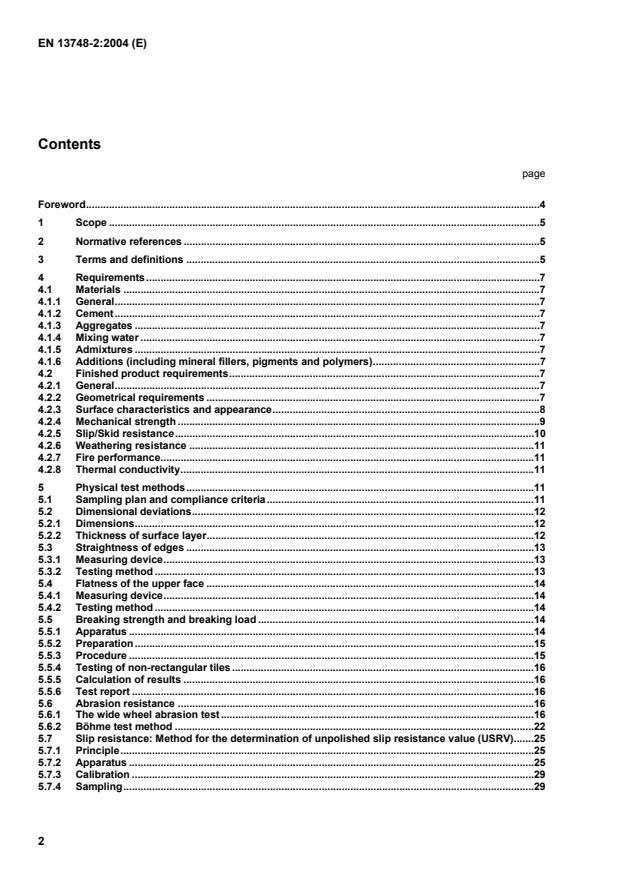
SIST EN 13748-2:2004 is the Slovene adoption of EN 13748-2:2004 from CEN. It specifies materials, properties, test methods, conformity evaluation and marking for unreinforced cement-bound terrazzo tiles made ready for external use, including roofing applications, in pedestrian areas. The standard is for manufacturers, test laboratories, specifiers and buyers who need to check whether the tiles meet the declared performance before they are placed on the market.
What does SIST EN 13748-2:2004 specify?
SIST EN 13748-2:2004 applies to factory-made terrazzo tiles sold ready to be placed. It covers tiles for external use where the decorative aspect is important, and it states that the product is assessed as delivered from the factory, not after laying.
The document is organized into:
- Clause 1 - Scope
- Clause 2 - Normative references
- Clause 3 - Terms and definitions
- Clause 4 - Requirements
- Clause 5 - Physical test methods
- Clause 6 - Evaluation of conformity and compliance criteria
- Clause 7 - Marking and labelling
- Annex ZA - clauses used for EU directive requirements and CE marking
Annex ZA links the standard to construction-product conformity and CE marking for external floorings and roofing applications.
What are the key requirements of SIST EN 13748-2:2004?
SIST EN 13748-2:2004 sets the main requirements on materials, geometry, appearance, mechanical performance and durability. In practice, this means the manufacturer has to control the raw materials, define the tile dimensions, test representative samples and declare the performance values that matter for the intended use.
Materials have to be suitable and traceable
Clause 4.1 says only materials with established suitability may be used, and the suitability has to be recorded in the manufacturer’s production control documentation. Cement, aggregates, admixtures and fly ash are tied to the named product standards, so the producer needs documented evidence that each constituent is fit for use.
Geometry and thickness are controlled
Clause 4.2.2 sets declared work dimensions and limits for dimensional deviations, straightness of edges and flatness of the upper face. Thickness class I and class II are defined for the facing layer, which matters because the tile may or may not be ground after laying. For a buyer or specifier, these clauses tell you what dimensional precision and usable surface quality to expect.
Appearance is checked visually
Clause 4.2.3 requires the surface to look sound in natural daylight from 2 m, without visible projections, depressions, flakes or crazes. Minor voids may be filled. This is the part that protects the decorative appearance that is central to terrazzo tiles.
Strength and abrasion are classed
Clause 4.2.4 covers breaking strength, breaking load and abrasion resistance. The standard gives strength and wear classes, so the tile can be selected for the level of traffic and mechanical loading expected in service.
Slip resistance and weathering are addressed
Clause 4.2.5 treats external terrazzo tiles as satisfactory for slip/skid resistance when the whole surface has not been ground or polished to a very smooth finish, and it allows USRV testing where a declared value is needed. Clause 4.2.6 classifies weathering resistance using water absorption or freeze/thaw resistance, which matters for exposure to rain, frost and de-icing salt.
Fire and thermal declarations are covered
Clause 4.2.7 states reaction to fire class A1fl and deemed satisfaction for external fire performance when used as roof covering. Clause 4.2.8 requires thermal conductivity to be declared only when the tile is intended to contribute to the thermal performance of a building element.
Conformity control is part of the standard
Clause 6 requires type testing and factory production control, with repeat testing after significant changes in raw materials, proportions, equipment or process. That is the basis for routine quality control and for third-party or customer acceptance testing.
What terms does SIST EN 13748-2:2004 define?
- Terrazzo tiles - compacted elements of uniform shape and thickness that conform to the standard, made as single-layered or dual-layered products.
- Single-layered terrazzo tiles - tiles made in one homogeneous layer of aggregate in a cement and water paste.
- Dual-layered terrazzo tiles - tiles with a facing or wear layer and a backing or base concrete layer that is not exposed in normal use.
- Work dimension - the manufacturing dimension that the actual dimension has to meet within the allowed tolerance.
- Actual dimension - the dimension measured on the finished tile.
- Declared value - the manufacturer’s stated value for a requirement, taking account of test accuracy and production variability.
- USRV - unpolished slip resistance value, measured by pendulum friction testing.
- Textured upper face - an upper face that is not flat and has a regular texture pattern.
Who uses SIST EN 13748-2:2004?
SIST EN 13748-2:2004 is used by terrazzo-tile manufacturers, factory production control staff, test laboratories, inspection bodies and purchasers who specify external pedestrian surfacing. It is also used when checking product conformity for decorative external floorings and roof coverings, including commercial centres, terraces, walkways and swimming-pool areas.
Which standards are used with SIST EN 13748-2:2004?
The document refers to these standards and documents:
- EN 197-1 - common cements
- EN 450 - fly ash for concrete
- EN 934-2 - concrete admixtures
- prEN 10083-2 - steel for the abrasion wheel
- EN 12620 - aggregates for concrete
- EN 13369 - common rules for precast concrete products, used for thermal conductivity data
- EN ISO 6506-1 - Brinell hardness for the Böhme apparatus steel track
- ISO 48, ISO 4662, ISO 7619 - rubber hardness and resilience for the slip-test slider
- ISO 8486-1 - grain size distribution for the abrasive used in wide-wheel abrasion testing
- EN 13748-1 - the internal-use part of the same terrazzo-tile series
- EN 1339 and EN 13198 - cited for comparison with other external concrete products
What does the SIST EN 13748-2:2004 document contain?
The document contains the requirements tables and the full test methods used for dimensional checks, edge straightness, flatness, breaking strength, breaking load, abrasion, slip resistance, water absorption and freeze/thaw resistance. It also gives the sampling plan for type testing, including the number of tiles used for each property and the related compliance criteria.
It includes detailed apparatus descriptions and procedures for the wide wheel abrasion test, the Böhme test method and the pendulum friction test for USRV. Annex ZA sets out the clauses relevant to EU directive requirements, the attestation of conformity route and the information needed for CE marking and labelling.
Relations
- Effective Date
- 28-Jan-2026
- Effective Date
- 28-Jan-2026
- Effective Date
- 28-Jan-2026
- Effective Date
- 28-Jan-2026
- Effective Date
- 28-Jan-2026
- Effective Date
- 28-Jan-2026
- Refers
SIST EN 596:1996 - Timber structures - Test methods - Soft body impact test of timber framed walls - Effective Date
- 28-Jan-2026
- Effective Date
- 28-Jan-2026
- Effective Date
- 28-Jan-2026
- Effective Date
- 28-Jan-2026
- Effective Date
- 28-Jan-2026
- Effective Date
- 28-Jan-2026
Get Certified
Connect with accredited certification bodies for this standard

DIBt (Deutsches Institut für Bautechnik)
German Institute for Building Technology.
DIN CERTCO
DIN Group product certification.

Aboma Certification B.V.
Specialized in construction, metal, and transport sectors.
Sponsored listings
Frequently Asked Questions
SIST EN 13748-2:2004 is a standard published by the Slovenian Institute for Standardization (SIST). Its full title is "Terrazzo tiles - Part 2: Terrazzo tiles for external use". This standard covers: This European Standard specifies materials, properties and methods of testing for unreinforced cement-bound terrazzo tiles which are factory made and sold ready to be placed. The tiles are intended for external use (including roofing applications) in pedestrian areas, e.g. walkways, terraces, commercial centres and swimming-pools. NOTE This standard applies to ex-factory products and does not take into account the laying of the product.
This European Standard specifies materials, properties and methods of testing for unreinforced cement-bound terrazzo tiles which are factory made and sold ready to be placed. The tiles are intended for external use (including roofing applications) in pedestrian areas, e.g. walkways, terraces, commercial centres and swimming-pools. NOTE This standard applies to ex-factory products and does not take into account the laying of the product.
SIST EN 13748-2:2004 is classified under the following ICS (International Classification for Standards) categories: 91.100.30 - Concrete and concrete products. The ICS classification helps identify the subject area and facilitates finding related standards.
SIST EN 13748-2:2004 has the following relationships with other standards: It is inter standard links to SIST EN 450-2:2005, SIST EN 197-1:2011, SIST EN 2086:2005, SIST EN ISO 6149-2:2007, SIST EN 12620:2002+A1:2008, SIST EN ISO 6506-1:2014, SIST EN 596:1996, SIST EN ISO 683-1:2018, SIST EN 450-1:2013, SIST EN 13369:2024, SIST EN 934-2:2009+A1:2012, SIST EN 12676-1:2002. Understanding these relationships helps ensure you are using the most current and applicable version of the standard.
SIST EN 13748-2:2004 is associated with the following European legislation: EU Directives/Regulations: 305/2011, 89/106/EEC; Standardization Mandates: M/119. When a standard is cited in the Official Journal of the European Union, products manufactured in conformity with it benefit from a presumption of conformity with the essential requirements of the corresponding EU directive or regulation.
SIST EN 13748-2:2004 is available in PDF format for immediate download after purchase. The document can be added to your cart and obtained through the secure checkout process. Digital delivery ensures instant access to the complete standard document.
Standards Content (Sample)
2003-01.Slovenski inštitut za standardizacijo. Razmnoževanje celote ali delov tega standarda ni dovoljeno.Terrazzo tiles - Part 2: Terrazzo tiles for external useCarreaux de mosaique - Partie 2: Carreaux de mosaique de marbre a usage extérieurTerrazzoplatten - Terrazzoplatten für die Anßenverwendung91.100.30Beton in betonski izdelkiConcrete and concrete productsICS:SIST EN 13748-2:2004en,fr,deTa slovenski standard je istoveten z:EN 13748-2:200401-oktober-2004SIST EN 13748-2:2004SLOVENSKI
STANDARD
EUROPEAN STANDARD NORME EUROPÉENNE EUROPÄISCHE NORM
EN 13748-2
June 2004 ICS 91.100.30
English version
Terrazzo tiles - Part 2: Terrazzo tiles for external use
Carreaux de mosaïque - Partie 2: Carreaux de mosaïque de marbre à usage extérieur
Terrazzoplatten – Teil 2: Terrazzoplatten für die Verwendung im Außenbereich This European Standard was approved by CEN on 1 April 2004.
CEN members are bound to comply with the CEN/CENELEC Internal Regulations which stipulate the conditions for giving this European Standard the status of a national standard without any alteration. Up-to-date lists and bibliographical references concerning such national standards may be obtained on application to the Central Secretariat or to any CEN member.
This European Standard exists in three official versions (English, French, German). A version in any other language made by translation under the responsibility of a CEN member into its own language and notified to the Central Secretariat has the same status as the official versions.
CEN members are the national standards bodies of Austria, Belgium, Cyprus, Czech Republic, Denmark, Estonia, Finland, France, Germany, Greece, Hungary, Iceland, Ireland, Italy, Latvia, Lithuania, Luxembourg, Malta, Netherlands, Norway, Poland, Portugal, Slovakia, Slovenia, Spain, Sweden, Switzerland and United Kingdom.
EUROPEAN COMMITTEE FOR STANDARDIZATION COMITÉ EUROPÉEN DE NORMALISATION EUROPÄISCHES KOMITEE FÜR NORMUNG
Management Centre: rue de Stassart, 36
B-1050 Brussels © 2004 CEN All rights of exploitation in any form and by any means reserved worldwide for CEN national Members. Ref. No. EN 13748-2:2004: E
Clauses of this European Standard addressing essential requirements or other provisions of EU Directives.39 ZA.1 Scope and relevant characteristics.39 ZA.2 Procedure for attestation of conformity.40 ZA.2.1 System of attestation of conformity.40 ZA.2.2 EC Declaration of conformity.40 ZA.3 CE marking and labelling.41 Bibliography.43
or alternatively ≤ 26 cm3/50 cm2 measured in accordance with test method described in 5.6.2. 3 H ≤ 23 mm measured in accordance with the test method described in 5.6.1 or alternatively ≤ 20 cm3/50 cm2 measured in accordance with test method described in 5.6.2. 4 I ≤ 20 mm measured in accordance with the test method described in 5.6.1
or alternatively ≤ 18 cm3/50 cm2 measured in accordance with test method described in 5.6.2. 4.2.5 Slip/Skid resistance 4.2.5.1 General Terrazzo tiles for external use have satisfactory slip/skid resistance, provided their whole upper surface has not been ground and/or polished to produce a very smooth surface. If in an exceptional case the unpolished slip/skid resistance value (USRV) is required, the product shall be tested according to 5.7 and the result declared. If the surface of the terrazzo tile contains ridges, grooves or other surface features which prevent testing by pendulum friction equipment, the product is deemed to satisfy the requirements without testing. NOTE The slip/skid resistance value relates to the tiles as manufactured. 4.2.5.2 Durability of slip/skid resistance Under normal conditions of use, terrazzo tiles provide satisfactory slip/skid resistance during the working life of the product, provided they are subjected to normal maintenance that does not modify their initial slipperiness.
Table 5 — Weathering resistance classes Class Marking Water absorption % by mass Mass loss after freeze/thaw test kg/m2 1 A No performance measured No performance measured 2 B ≤ 6 as a mean No performance measured 3 D No performance measured ≤ 1,0 as a mean with no individual value > 1,5 NOTE The National Annex of a country may state the class(es) of weathering resistance required to ensure durability for that country. 4.2.7 Fire performance 4.2.7.1 Reaction to fire Terrazzo tiles for external use are considered to be reaction to fire class A1fl without the need for testing according to EC Decision 96/603/EEC, as amended. 4.2.7.2 External fire performance Terrazzo tiles for external use used as roof covering are deemed to satisfy the requirements for external fire performance without the need for testing according to EC Decision 2000/553/EC. 4.2.8 Thermal conductivity If terrazzo tiles for external use are intended to contribute to the thermal performance of an element, the manufacturer shall declare the thermal conductivity using data given in Table L2 of EN 13369. 5 Physical test methods 5.1 Sampling plan and compliance criteria Table 6 details the sampling and compliance criteria for the testing of each requirement.
Table 6 — Sampling plan and compliance criteria for initial and further type testing Property Requirements Test method Number of tiles Compliance criteria 4.2.2 and 4.2.3 Appearance, dimensions and shape 4.2.2 and 4.2.3 5.2 and 5.3 and 5.4 8* Each tile shall meet the requirements Breaking strength 4.2.4.2 5.5 4 See 4.2.4.2 Breaking load 4.2.4.3 5.5 4 See 4.2.4.3 Abrasion resistance 4.2.4.4 5.6 3 See 4.2.4.4 Slip/skid resistance (only where tested) 4.2.5 5.7 5 The mean of the five tiles shall be declared Weathering resistance 4.2.6 5.8 respectively 5.9 3 See 4.2.6 * These tiles may be used for subsequent tests. 5.2 Dimensional deviations 5.2.1 Dimensions 5.2.1.1 Apparatus A steel rule with an accuracy of 0,5 mm. Callipers with an accuracy of 0,1 mm. 5.2.1.2 Procedure The dimensions shall be measured at 3 points. The maximum and minimum values shall be recorded. 5.2.2 Thickness of surface layer 5.2.2.1 Apparatus Measuring equipment capable of measuring with an accuracy of 0,5 mm. 5.2.2.2 Procedure Take a tile that has been broken. Measure the thickness of the surface layer on the split face at the point where, by visual inspection, the value will be a minimum. Record the measurement to the nearest millimetre. The thickness of the surface layer shall not be measured on the chamfer.
Dimensions in millimetres
Key 1 Depth of channels 5 Minimum thickness upper face 2 Minimum thickness upper face 6 Thickness upper face 3 Thickness upper face 7 Thickness 4 Thickness
Figure 1 — Examples of measurement of the thickness of non-flat surface flags 5.3 Straightness of edges 5.3.1 Measuring device A set of feeler gauges with an accuracy of 0,1 mm. 5.3.2 Testing method The ruler is placed along the edge and the maximum discrepancy i.e. between the edge and the ruler is noted (see Figure 2).
Figure 2 — Measurement of edge straightness 5.4 Flatness of the upper face 5.4.1 Measuring device Measuring equipment with an accuracy of 0,1 mm. 5.4.2 Testing method The maximum convex or concave deviations shall be determined along the two diagonal axes of the upper face (see Figure 3).
Figure 3 — Measurement of upper face flatness 5.5 Breaking strength and breaking load 5.5.1 Apparatus The transverse testing machine shall have a scale with an accuracy of ± 3 % over the range of the anticipated test loads and be capable of increasing the load at specified rates. It shall be constructed in such a way that it can induce 3 point bending into the sample without torsion. The load inducing bar shall be equidistant between the supports. The length of the supports and the load inducing bar shall be at least equal to the width of the sample to be tested (see Figure 4).
KEY F Load Figure 4 — Principle of testing The actual span between the bearers shall be within 0,5 % of the specified span rounded to the nearest millimetre. 5.5.2 Preparation Use whole tiles when their plan shape includes at least two parallel straight edges. In other cases, use sawn samples with the largest possible plan area which includes two parallel straight edges. If necessary, remove any burrs, high spots, etc. Immerse the tiles under water at (20 ± 5) °C for (24 ± 3) h, remove, wipe dry and test immediately. If a face is rough, textured or curved, prepare it by grinding or capping until fully flat. Other methods of preparation may be used for routine testing providing there is a correlation between the results of the two methods, e.g. using unground rough, textured or curved tiles instead of ground tiles. 5.5.3 Procedure The distance between the supports shall be 2/3 of the length of the tile, with an accuracy of ± 0,5 %. Place the sample with its upper face uppermost, symmetrically on the bearers of the testing machine and with its shorter side parallel to the supporting bearers. Depending on the surface profile of the tile any one of the following shall be used at the discretion of the manufacturer: no packing; packing; capping or grinding.
Key 1 Clamping trolley 8 Counterweight 2 Fixing screw 9 Slot 3 Specimen 10 Groove 4 Control valve 11 Abrasive material flow 5 Storage hopper 12 Abrasive collector 6 Flow guidance hopper 13 Wedge 7 Wide abrasion wheel
Figure 5 — Principle of wearing machine The wide abrasion wheel shall be made of steel E360 in accordance with prEN 10083-2. The hardness of the steel shall be between 203 HB and 245 HB. Its diameter shall be (200 ± 1) mm and its width shall be (70 ± 1) mm. It shall be driven to rotate 75 revolutions in (60 ± 3) s.
Key 1 Inclined side 2 Vertical side 6 Flow guidance hopper 9 Slot a, b, c > 10 Figure 6 — Position of slot in the base of the flow guidance hopper The distance of the fall between the slot and the axle of the wide abrasion wheel shall be (100 ± 5) mm and the flow of the abrasive shall be (1 to 5) mm behind the leading edge of the wheel (see Figure 7).
Side view
Plan view Key 3 Specimen 6 Flow guidance hopper 7 Wide abrasion wheel 9 Slot Figure 7 — Position of slot relative to wide abrasion wheel The flow of the abrasive material from the flow guidance hopper shall be at least at a minimum rate of
2,5 l/min onto the wide abrasion wheel. The flow of abrasive shall be constant and the minimum level of the abrasive in the flow guidance hopper shall be 25 mm (see Figure 7). Useful utensils for measuring the results are a magnifying glass, preferably equipped with a light, a steel ruler and a digital caliper.
1) The “Boulonnaise Marble reference is: Lunel demi-clair, thickness: 5 cm, c/passe 2 faces ground with a diamond grit size 100/120, rugotest class N7 (Ra = 1,6 µm) in accordance with EN ISO 4288:1997.
(l1 and l2) of the groove using a ruler (see Figure 8). Then draw a line (A B) in the middle of the groove perpendicular to the centreline of the groove. Position a digital calliper with square tips on the points A and B to the inside edge of the longitudinal limits
(l1 and l2) of the groove and measure and record the dimension to the nearest ± 0,1 mm. Repeat the measurement (10± 1) mm from the ends of the groove (C D) to give three readings. Dimensions in millimetres
Section A – A Face view Key 3 Specimen 10 Groove Figure 8 — Example of a tested specimen showing a groove
...