

SIST-TP CEN/TR 15172-2:2006
(Main)Whole-body vibration - Guidelines for vibration hazards reduction - Part 2: Management measures at the workplace
General Information
- Abstract
This Technical Report outlines practicable measures for the reduction and control of exposure to whole-body vibration at workplaces in order to provide a practical professional aid to workplace managers and health and safety officers. It covers identification and reduction of health risks from exposure to hazardous machinery vibration at the particular workplace, corresponding to Articles 4, 5 and 6 in the EU Directive 2002/44/EC, including
- identification of main sources of whole-body vibration at the workplace,
- formulation of a strategy for minimising and control of vibration exposure and
- implementation of the strategy.
NOTE Although the term vibration covers continuous vibration and transient vibration (shocks), in this Technical Report shocks are referred to in special cases where they require special attention.
This Technical Report is not concerned with hand-arm vibration which is covered by CR 1030-2.
- Status
- Published
- Publication Date
- 30-Jun-2006
- Technical Committee
- I13 - Imaginarni 13
- Current Stage
- 6060 - National Implementation/Publication (Adopted Project)
- Start Date
- 01-Jul-2006
- Due Date
- 01-Jul-2006
- Completion Date
- 01-Jul-2006


Overview
CEN/TR 15172-2:2005 - "Whole-body vibration: Guidelines for vibration hazards reduction - Part 2: Management measures at the workplace" (CEN) gives practical, workplace-focused guidance to identify, assess and control whole-body vibration (WBV) and shocks. It is written principally for workplace managers and health & safety officers to meet the requirements of the EU Directive 2002/44/EC on vibration exposure. The report describes how to formulate and implement a vibration risk‑control strategy rather than detailed engineering or design fixes (those are in CEN/TR 15172-1).
Key topics and requirements
- Scope and purpose: Outlines practicable measures to reduce and control operator exposure to WBV and transient shocks at workplaces. Not applicable to hand‑arm vibration.
- Identification of sources: Guidance on finding main WBV sources (mobile machinery over rough surfaces, machine tools, loading, compaction, road milling, etc.) and collecting representative exposure data.
- Risk assessment: Relationship between exposure and health risk (spinal disorders, effects of posture, shocks). Emphasises representative single‑day exposure assessment (do not average across days).
- Legal context: Alignment with EU Directive 2002/44/EC - exposure action values (EAV) and exposure limit values (ELV). Use declared emission values (Machinery Directive data) only as conservative comparators, not definitive health assessments.
- Control strategy elements: Task/process redesign, selection/modification of machinery, cab/seat selection, maintenance (tyres, road surfaces), limitation of exposure duration (job rotation), worker information and training.
- Special assessment methods: Notes the need for ISO 2631-1 and ISO 2631-5 approaches where shocks or high-magnitude segments occur, and EN 14253 for practical exposure measurement/calculation.
- Supporting material: Informative annexes with examples of high‑risk machines, assessment approaches, selection guidance, seating, supplier questions and health surveillance.
Practical applications and users
- Primary users: workplace managers, safety officers, occupational hygienists, fleet supervisors and procurement teams responsible for plant and machinery.
- Practical uses:
- Develop a workplace vibration policy and reduction strategy to comply with EU Directive 2002/44/EC.
- Identify which machines/processes need measurement or controls.
- Prioritise interventions: process redesign, lower‑vibration equipment, seat/cab options, maintenance schedules and rostering to reduce daily exposure.
- Prepare supplier queries and procurement specifications (compare declared emission values).
- Inform operator training and health surveillance programs.
Related standards (select)
- CEN/TR 15172-1 - engineering design methods to reduce WBV
- ISO 2631-1 and ISO 2631-5 - evaluation methods for WBV and shocks
- EN 14253 - measurement and calculation of occupational WBV exposure
Keywords: whole-body vibration, vibration hazards, workplace vibration, vibration exposure, EU Directive 2002/44/EC, management measures, vibration risk reduction.
Relations
- Effective Date
- 25-Aug-2026
- Effective Date
- 28-Jan-2026
- Effective Date
- 28-Jan-2026
- Effective Date
- 28-Jan-2026
- Effective Date
- 28-Jan-2026
- Effective Date
- 28-Jan-2026
- Effective Date
- 28-Jan-2026
- Effective Date
- 28-Jan-2026
- Effective Date
- 28-Jan-2026
- Effective Date
- 28-Jan-2026
- Effective Date
- 28-Jan-2026
- Effective Date
- 28-Jan-2026
- Effective Date
- 28-Jan-2026
- Effective Date
- 28-Jan-2026
- Effective Date
- 28-Jan-2026
Get Certified
Connect with accredited certification bodies for this standard

CIS Institut d.o.o.
Personal Protective Equipment (PPE) certification body. Notified Body NB-2890 for EU Regulation 2016/425 PPE.

Kiwa BDA Testing
Building and construction product certification.
Kmetijski inštitut Slovenije
Agricultural Institute of Slovenia. Soil testing, plant health, agricultural product analysis.
Sponsored listings
Frequently Asked Questions
SIST-TP CEN/TR 15172-2:2006 is a technical report published by the Slovenian Institute for Standardization (SIST). Its full title is "Whole-body vibration - Guidelines for vibration hazards reduction - Part 2: Management measures at the workplace". This standard covers: This Technical Report outlines practicable measures for the reduction and control of exposure to whole-body vibration at workplaces in order to provide a practical professional aid to workplace managers and health and safety officers. It covers identification and reduction of health risks from exposure to hazardous machinery vibration at the particular workplace, corresponding to Articles 4, 5 and 6 in the EU Directive 2002/44/EC, including - identification of main sources of whole-body vibration at the workplace, - formulation of a strategy for minimising and control of vibration exposure and - implementation of the strategy. NOTE Although the term vibration covers continuous vibration and transient vibration (shocks), in this Technical Report shocks are referred to in special cases where they require special attention. This Technical Report is not concerned with hand-arm vibration which is covered by CR 1030-2.
This Technical Report outlines practicable measures for the reduction and control of exposure to whole-body vibration at workplaces in order to provide a practical professional aid to workplace managers and health and safety officers. It covers identification and reduction of health risks from exposure to hazardous machinery vibration at the particular workplace, corresponding to Articles 4, 5 and 6 in the EU Directive 2002/44/EC, including - identification of main sources of whole-body vibration at the workplace, - formulation of a strategy for minimising and control of vibration exposure and - implementation of the strategy. NOTE Although the term vibration covers continuous vibration and transient vibration (shocks), in this Technical Report shocks are referred to in special cases where they require special attention. This Technical Report is not concerned with hand-arm vibration which is covered by CR 1030-2.
SIST-TP CEN/TR 15172-2:2006 is classified under the following ICS (International Classification for Standards) categories: 13.160 - Vibration and shock with respect to human beings. The ICS classification helps identify the subject area and facilitates finding related standards.
SIST-TP CEN/TR 15172-2:2006 has the following relationships with other standards: It is inter standard links to SIST ISO 2631-1:2022, SIST EN 14253:2004, SIST EN 643:2000, oSIST prEN 13381-1:2009, SIST EN ISO 11431:2004, SIST EN 15651-4:2013, SIST EN ISO 8340:2005, SIST EN 15651-3:2017, SIST EN 15651-3:2013, SIST EN ISO 9046:2005, SIST EN ISO 11432:2005, SIST EN 15651-1:2017, SIST EN ISO 7389:2004, SIST EN 15651-2:2013, SIST EN 15651-4:2017. Understanding these relationships helps ensure you are using the most current and applicable version of the standard.
SIST-TP CEN/TR 15172-2:2006 is available in PDF format for immediate download after purchase. The document can be added to your cart and obtained through the secure checkout process. Digital delivery ensures instant access to the complete standard document.
Standards Content (Sample)
SLOVENSKI STANDARD
01-julij-2006
Tresenje celotnega telesa – Smernice za zmanjšanje tveganja zaradi vibracij – 2.
del: Organizacijski ukrepi na delovnem mestu
Whole-body vibration - Guidelines for vibration hazards reduction - Part 2: Management
measures at the workplace
Ganzkörper-Schwingungen - Leitfaden zur Verringerung der Gefährdung durch
Schwingungen - Teil 2: Organisatorische Maßnahmen am Arbeitsplatz
Vibrations globales du corps - Guide pour la réduction des risques de vibrations - Partie
2: Mesures de prévention sur le lieu de travail
Ta slovenski standard je istoveten z: CEN/TR 15172-2:2005
ICS:
13.160 Vpliv vibracij in udarcev na Vibration and shock with
ljudi respect to human beings
2003-01.Slovenski inštitut za standardizacijo. Razmnoževanje celote ali delov tega standarda ni dovoljeno.
TECHNICAL REPORT
CEN/TR 15172-2
RAPPORT TECHNIQUE
TECHNISCHER BERICHT
November 2005
ICS 13.160; 17.160
English Version
Whole-body vibration - Guidelines for vibration hazards
reduction - Part 2: Management measures at the workplace
Vibrations globales du corps - Guide pour la réduction des Ganzkörper-Schwingungen - Leitfaden zur Verringerung der
risques de vibrations - Partie 2: Mesures de prévention sur Gefährdung durch Schwingungen - Teil 2: Organisatorische
le lieu de travail Maßnahmen am Arbeitsplatz
This Technical Report was approved by CEN on 25 July 2005. It has been drawn up by the Technical Committee CEN/TC 231.
CEN members are the national standards bodies of Austria, Belgium, Cyprus, Czech Republic, Denmark, Estonia, Finland, France,
Germany, Greece, Hungary, Iceland, Ireland, Italy, Latvia, Lithuania, Luxembourg, Malta, Netherlands, Norway, Poland, Portugal, Slovakia,
Slovenia, Spain, Sweden, Switzerland and United Kingdom.
EUROPEAN COMMITTEE FOR STANDARDIZATION
COMITÉ EUROPÉEN DE NORMALISATION
EUROPÄISCHES KOMITEE FÜR NORMUNG
Management Centre: rue de Stassart, 36 B-1050 Brussels
© 2005 CEN All rights of exploitation in any form and by any means reserved Ref. No. CEN/TR 15172-2:2005: E
worldwide for CEN national Members.
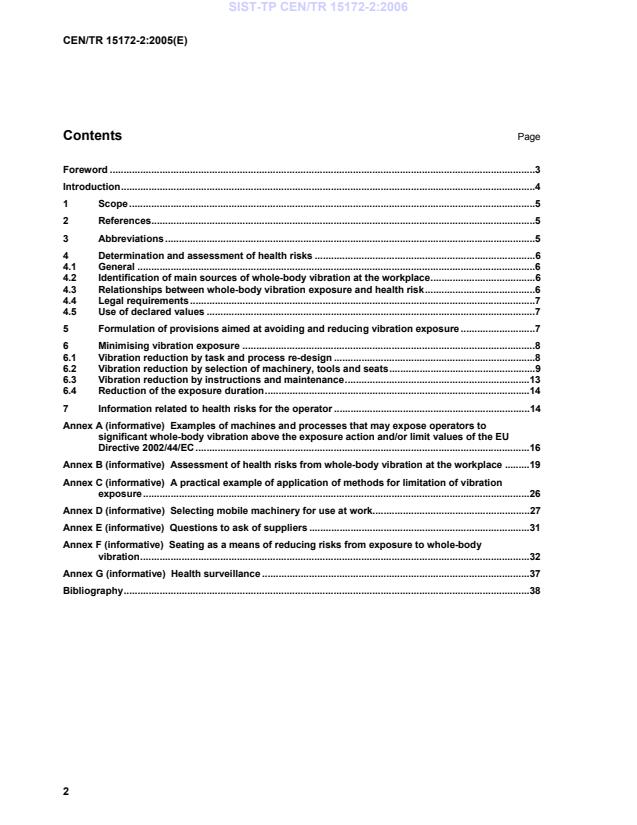
Contents Page
Foreword .3
Introduction.4
1 Scope .5
2 References.5
3 Abbreviations .5
4 Determination and assessment of health risks .6
4.1 General .6
4.2 Identification of main sources of whole-body vibration at the workplace.6
4.3 Relationships between whole-body vibration exposure and health risk.6
4.4 Legal requirements.7
4.5 Use of declared values .7
5 Formulation of provisions aimed at avoiding and reducing vibration exposure .7
6 Minimising vibration exposure .8
6.1 Vibration reduction by task and process re-design .8
6.2 Vibration reduction by selection of machinery, tools and seats.9
6.3 Vibration reduction by instructions and maintenance.13
6.4 Reduction of the exposure duration.14
7 Information related to health risks for the operator .14
Annex A (informative) Examples of machines and processes that may expose operators to
significant whole-body vibration above the exposure action and/or limit values of the EU
Directive 2002/44/EC.16
Annex B (informative) Assessment of health risks from whole-body vibration at the workplace .19
Annex C (informative) A practical example of application of methods for limitation of vibration
exposure.26
Annex D (informative) Selecting mobile machinery for use at work.27
Annex E (informative) Questions to ask of suppliers .31
Annex F (informative) Seating as a means of reducing risks from exposure to whole-body
vibration.32
Annex G (informative) Health surveillance .37
Bibliography.38
Foreword
This Technical Report (CEN/TR 15172-2:2005) has been prepared by Technical Committee CEN/TC 231
“Mechanical vibration and shock”, the secretariat of which is held by DIN.
CEN/TR 15172 consists of the following parts:
CEN/TR 15172-1, Whole-body vibration — Guidelines for vibration hazards reduction — Part 1: Engineering
methods by design of machinery
CEN/TR 15172-2, Whole-body vibration — Guidelines for vibration hazards reduction — Part 2: Management
measures at the workplace
Introduction
The EU Directive 2002/44/EC on the minimum health and safety requirements regarding the exposure of
workers to the risks arising from physical agents (vibration) requires those responsible for workplaces to
introduce measures protecting workers from the risks arising from vibration insofar as these affect the health
and safety of workers.
This Technical Report reviews measures of value in the efforts of workplace management to protect workers
from adverse health effects of whole-body vibration and shock. It is recognised that workplaces are very
different and that for a specific workplace only some of the measures are applicable.
Guidelines on engineering methods directed to designers and manufacturers of machinery transmitting
vibration to the human body are given in CEN/TR 15172-1.
1 Scope
This Technical Report outlines practicable measures for the reduction and control of exposure to whole-body
vibration at workplaces in order to provide a practical professional aid to workplace managers and health and
safety officers. It covers identification and reduction of health risks from exposure to hazardous machinery
vibration at the particular workplace, corresponding to Articles 4, 5 and 6 in the EU Directive 2002/44/EC,
including
— identification of main sources of whole-body vibration at the workplace,
— formulation of a strategy for minimising and control of vibration exposure and
— implementation of the strategy.
NOTE Although the term vibration covers continuous vibration and transient vibration (shocks), in this Technical
Report shocks are referred to in special cases where they require special attention.
This Technical Report is not concerned with hand-arm vibration which is covered by CR 1030-2.
2 Normative references
The following referenced documents are indispensable for the application of this Technical Report. For dated
references, only the edition cited applies. For undated references, the latest edition of the referenced
document (including any amendments) applies.
EN 14253:2003, Mechanical vibration — Measurement and calculation of occupational exposure to whole-
body vibration with reference to health — Practical guidance
ISO 2631-1:1997, Mechanical vibration and shock — Evaluation of human exposure to whole-body vibration
— Part 1: General requirements
ISO 2631-5, Mechanical vibration and shock — Evaluation of human exposure to whole-body vibration —
Part 5: Method for evaluation of vibration containing multiple shocks
3 Abbreviations
In this Technical Report the following abbreviations are used:
r.m.s. acceleration root-mean-square acceleration and
VDV fourth power vibration dose value, both of which are defined in ISO 2631-1.
S daily equivalent static compression dose, which is defined in ISO 2531-5.
ed
EAV daily exposure action value and
ELV daily exposure limit value, which both are defined in EU Directive 2002/44/EC.
4 Determination and assessment of health risks
4.1 General
General knowledge about whole-body vibration, its effects on man and its assessment and control, is
important as a basis for the determination of health risks at the workplace.
It is necessary to know
the main sources of whole-body vibration at the workplace,
the relationships between whole-body vibration exposure and health risk and
legal requirements including exposure action and limit values.
4.2 Identification of main sources of whole-body vibration at the workplace
The major sources of excessive vibration and shock are usually mobile machinery travelling over rough
surfaces and working with machine tools (loading, drilling, soil compaction, road milling, etc.). A list of the
more common machinery and processes that expose operators to whole-body vibration is given in Annex A.
Furthermore, it is necessary to know representative vibration values for each machine and process that create
the hazard and the corresponding patterns of vibration exposure in order that the exposure of operators can
be estimated.
Of special importance is to search for the following information about the machinery used:
What are the whole-body vibration exposure values for typical operations of the machine?
Which operational conditions can be expected to cause whole-body vibration exposures above the
exposure action value and/or above the exposure limit value?
Which modifications of the machine could cause changes of the declared values?
Which seats and tools can be considered as suited for the machine, i.e. without worsening the declared
values?
Which effect will an incorrect adjustment of the seat have on the whole-body vibration exposure?
If an operation handbook does not provide this information, the manufacturer should be asked to provide
additional information.
A thorough knowledge of how the machines are used in practical work is essential. This requires studies at
work sites and collection of information from operators of the machines.
4.3 Relationships between whole-body vibration exposure and health risk
Disorder of the spine and related structures is the main health problem which may be caused by whole-body
vibration. General information on health risks from exposure to whole-body vibration can be found in the
literature.
ISO 2631-1 and ISO 2631-5 provide guidance on health risks from whole-body vibration as well as limits at
which a health risk can be expected. Postures with bending and or twisting of the spine can significantly
increase the health risk at these exposures. Since the strength of the matured spine decreases with age, the
risk of injury due to a particular exposure can essentially increase with age.
There are indications of an exponential rise of the risk with an increasing intensity. Therefore, the integrated
values (e.g. r.m.s. values) will severely underestimate the health risk if daily exposures contain segments with
a high magnitude or transients with high peak acceleration (shocks, bumps). The more sophisticated
procedures described in ISO 2631-5 will be required for an adequate evaluation in such cases. For the same
reason, averaging of r.m.s. values for different days can lead to an underestimation of the health risk. This is
the case if days with significantly different daily exposure values are averaged.
EN 14253 describes how to measure and calculate the daily vibration exposure in various situations. Annex A
of EN 14253:2003 includes calculation of daily exposure for the cases where the daily work consists of long
uninterrupted operations and for the cases where the daily work consists of operations or work cycles with
different vibration magnitudes over short periods.
NOTE Research is continuously going on in various places and it is important for the management to follow the
development and be aware of revisions of the applicable standards.
4.4 Legal requirements
The EU Directive 2002/44/EC includes requirements on vibration exposure values that shall not be exceeded
(limit values) and exposure values above which actions for reduction of the vibration shall be taken (exposure
action values).
The vibration exposures should be determined for a workday that is representative for the most pronounced
vibration conditions. Averaging over workdays should not be made.
It should be noted that the limit values given by the EU Directive 2002/44/EC are not "safe" values. According
to ISO 2631-1:1997, Annex B, a significant health risk can be expected at levels below the limit values of the
EU Directive 2002/44/EC. Although exposures below the action value do not generally generate significant
health risks, there are cases where exposures below the action value can cause health problems. This is, for
example, the case when the exposure contains shocks or at unfavourable postures.
Guidance on strategies for assessment of a workplace is given in Annex B.
4.5 Use of declared values
The Machinery Directive 98/37/EC requires a declaration of the vibration emission value at operator’s position
in case this value is above 0,5 m/s . According to EN 1032, the declared value is representative of the
75-percentile of vibration values experienced in typical intended use of the machinery in the mode of operation
causing the highest vibration. It also states that the emission values should not be used for assessment of the
health risk. However, the declared emission values can be useful in comparison of machinery and in selection
of a machine for a certain task. If declared emission values are used, together with exposure duration, in order
to get a rough and conservative estimate of the daily exposure that can be expected, it should be kept in mind
that the declared value may be temporarily exceeded.
5 Formulation of provisions aimed at avoiding and reducing vibration exposure
In case the daily vibration exposure for an individual operator can exceed the action value of the EU Directive
2002/44/EC, a strategy for reduction and control of the vibration exposure should be formulated and
implemented. If the exposure action value is not exceeded but risk is demonstrated to exist (e.g. because of
exposure to high level of shocks), the strategy should include control of this risk. Elements of a strategy for the
control of vibration and shock exposure may include one or more of the following activities:
work task re-design, especially with regard to the main contributor to the vibration exposure;
machinery or process modification, e.g. use of low-vibration machinery;
modification of means for reduction of vibration transmission from source to operator, e.g. selection of
machine with cab suspension, appropriate seats, etc.;
limitation of individual exposure durations, especially with regard to the main contributor to the vibration
exposure (including job rotation);
control of that the tyre inflation pressure is maintained according to the manufacturer's manual;
selection of manufacturer’s options for wheels and tyres appropriate for the conditions of use;
maintenance of road surface.
Annex C provides a practical example of application of the various methods.
6 Minimising vibration exposure
6.1 Vibration reduction by task and process re-design
Detailed information should be gathered concerning the usage of the various machines, processes and tools
that have been identified as sources of whole-body vibration hazard.
In considering a particular process or task, the first step would be to define its purpose in broad terms, i.e.
what is to be achieved or done. The second step is to split up the process into its key elements, highlighting
those stages that are the principal contributors to the vibration exposure. Actions for limitation of the vibration
exposure may be concentrated to these contributors.
Work tasks should be designed so that
whole-body vibration exposures are as low as practicable,
the daily period of exposure to excessive vibration is as short as possible,
the exposure to severe shocks is avoided and
the working posture is one which imposes the least adverse health effects of the vibration.
In many cases, travelling over rough ground is the main contributor to the vibration exposure. This exposure
may be managed by the following activities:
Minimising the travelling distance by organisation of the work, including (if applicable) travelling to and
from breaks. This is also positive for the work efficiency.
Limitation of the travelling speed. Travelling speed has a very pronounced effect on the vibration value as
shown by the examples in Figure 1. Effective management of the work and information of the operator on
the health risks are prerequisites for getting speed limitation rules followed in practice.
Maintenance of the ground surface by removing obstacles, filling potholes, levelling of transport roads, etc.
Information to the operator of the health importance of correct adjustment of the seat and seat back (in
case this is adjustable) and of the driving posture.
For some machines, other operations than travelling can involve excessive vibration and shocks. An example
is tree harvesting, where the main effect of vibration exposure can be from shocks originating from felling
operation and movement of the stem in the harvesting head as delimbing occurs.
To reduce the risks the work should be organised in such a way that unnecessary climbing out from the cabin
in slippery conditions is reduced to a minimum. The management of the workplace should make sure that
sufficient support for feet and hands is provided and that footwear is provided with adequate anti-slipping
device (at least under heals). The operators should be trained for safe manners in choosing the place and
position of the machinery for climbing out.
Key
Y ratio between vibration values d soil compactor
a hauler (dumper with an articulated frame for steering) e agricultural transporter
b heavy wheel loader f agricultural tractor
c light wheel loader g small dumper
NOTE Figure 1 shows the ratio between the vibration values at the lowest speed, twice the lowest speed and three
times the lowest speed, and the vibration value at the lowest speed. The measurements were made in the z-direction in
the seat cushion, underneath the driver, at travelling over more or less rough surfaces. Similar measurements on industrial
trucks show that a doubling of speed increases the vibration value by a factor of two.
Figure 1 — Influence of driving speed on vibration value
6.2 Vibration reduction by selection of machinery, tools and seats
6.2.1 General
The management of a workplace should be careful in selection of machinery and working equipment and give
enough priority to freedom of excessive vibration and possibilities to operate the machine and working
equipment without attaining an undesirable posture.
6.2.2 Selection of machinery
The supplier should be asked to provide well-founded information on vibration emission and also an
assessment of exposure values during intended use of the machine.
In practice, some difficulty may be experienced in choosing low-vibration machine because of a lack of
appropriate test codes and the current inadequacy of available information on machine vibration emissions.
The declared vibration value provided in accordance with the requirements of the Machinery Directive
98/37/EC is useful for comparison of machines from different manufacturers.
Proper training and experience of use of the machinery are important factors for controlling vibration exposure
and avoid inappropriate postures. It is also important that the maintenance of the machinery is clear and easy.
More detailed guidance for selecting mobile machinery is provided in Annex D.
Annex E provides a list of the most important questions with regard to whole-body vibration that potential
buyers of machinery should ask suppliers.
6.2.3 Selection of working equipment or tools for the machine
When selecting working equipment or tools for the machine, soft movements of the working equipment and its
coupling to the machine should be aimed at. A check should be made to investigate to which extent the tool
influences the vibration level at the operator's position.
One important factor is to provide the right tool for the job. The machinery producer/manufacturer/supplier
should be asked for guidance on what tools to use and how to operate the tools in order to minimising the
vibration without loosing in efficiency. Also the tool maintenance instructions are important.
Machines that have suspensions of booms or buckets should have these suspensions in operation when
travelling.
A check should be made so that the control levers of the working equipment or tools are placed so that the
operator will maintain an upright posture and avoid unnecessary twisting of the body when using the
equipment or tools.
6.2.4 Selection of seats
The machine supplier should give detailed information on appropriate seat selection. It is important that there
is no conflict between the resonance frequencies of the tyre-machine system, chassis suspension system or
cab suspension system on one side and of the seat suspension system on the other side. It is further
important that there is enough room for the seat suspension to avoid topping and bottoming of the suspension
system. In order to avoid dangerous shocks when driving across an unexpected, severe obstacle, it is also
important that there is a protection from very hard topping and bottoming (reasonably soft end stops).
The manufacturer/supplier should be asked for proper mounting instructions. It is important to check and
assure that the seat mounting surface is rigid enough to avoid resonance problems. This is important also in
lateral directions where the vibration can be amplified and become dominant in certain mobile machinery with
current seats.
In selection of seats, it is also important that the seat suspension is easy to adjust according to the operator's
weight and body size. Height, forward-backward and backrest adjustments are especially important. The seat
cushions should be ergonomically well designed with width and height according to the needs of the operator.
The seat supplier should be asked to provide information on the life of the resilient materials included in the
seat suspension. This is especially important if the resilient material is organic (e.g. elastomers).
For more detailed guidance on selection of seats, see Annex F.
6.2.5 Selection of type of tyres
Tyres are usually selected according to their rolling resistance, grip, stability, cost, resistance to collision
damage, acceptability to the driver, etc.
Most all-terrain vehicles are fitted with pneumatic tyres because they filter out the small ground surface
irregularities. An exception to this are off-road machines fitted with caterpillar tracks and industrial trucks
which are often mounted on solid tyres for stability reasons and for puncture resistance. These tyres should
only be used on perfectly smooth ground.
Other parameters, such as damping and stiffness, have to be taken into account in order to absorb obstacle
impact. However, even large tyres cannot absorb vibration energy as well as a shock absorber. Therefore,
vibration builds up even on relatively smooth surfaces. Tyres are normally much stiffer than a suspension
system. Excessively soft tyres may induce low-frequency motions, including pitching. In general, changes in
tyre pressure do not result in a simple increase or decrease in vibration, but rather have an effect which is
dependent on other vehicle characteristics, such as load and dimension.
Figure 2 compares r.m.s. acceleration values measured for an unloaded 1,5 t counterbalance truck fitted with
solid or pneumatic tyres and running over an obstacle at different speeds. Acceleration variations resulted
from phase interference between the free vibration of the counterbalance truck after the front tyres had run
over the obstacle and the impact of the rear tyres when hitting the obstacle. In some cases, it may be
judicious to select solid tyres with a carefully selected internal filling, which would offer optimised damping of
the vibration induced by impact with an obstacle. However, research is required to develop a suitable design.
6.2.6 Widening track width or use of dual wheels
Measurements of vibration in agricultural tractors show that widening track width or use of dual wheels
reduces transverse vibration (in the y-direction) significantly. An example of the effects on the frequency-
weighted r.m.s. acceleration value in the seat of an agricultural tractor when using dual wheels is shown in
Figure 3.
Key
X speed, km/h solid tyres (measured)
Y r.m.s. acceleration, m/s pneumatic tyres (measured)
solid tyres (numerically calculated)
pneumatic tyres (numerically calculated)
Figure 2 — Comparison of acceleration values measured on an unloaded 1,5 t counterbalance truck
fitted with two tyre types and running over an obstacle at various speeds
Key
Y frequency-weighted r.m.s. acceleration, m/s
a single tyre
b dual tyre
Figure 3 — Example of effects of dual wheels on the frequency-weighted r.m.s. acceleration in the seat
of a small agricultural tractor, measured during harrowing in the x-, y- and z-direction
6.3 Vibration reduction by instructions and maintenance
6.3.1 Adjustment of tyre inflation pressure
The tyre inflation should be adjusted and kept within the range specified by the manufacturer. Tyre inflation
pressure has an influence on the vibration from the contact between ground and tyre. Lower inflation pressure
normally results in lower vibration levels. However, for less heavy machines the resonance frequency
produced by the tyre resilience may be higher than the resonance frequencies caused by the chassis, cab or
seat suspension system. In such case a lowering of the inflation pressure may increase the vibration at the
operator's position due to conflict with the resonance frequency of the suspension of the chassis, cab or seat.
The influence of inflation pressure on vibration is shown in the following example.
EXAMPLE For many categories of machinery, especially fork-lift trucks, the tyre pressure is very high (around 5 bar
to 10 bar) to provide good stability with high loads. However, for all-terrain machines, much lower tyre pressures may be
used according to the use of the machinery.
To assess the effects of changes in tyre pressure, measurements have been made on three all-terrain machines at two
tyre pressures: the machinery manufacturer's recommended tyre pressure and a reduced pressure. The effect of changes
in tyre pressure are shown for one all-terrain truck in Figure 4. A reduction of 12 % in tyre pressure caused a reduction of
around 8 % in the measured acceleration at the seat base. Similar results were found for the two other all-terrain trucks.
Key
Y acceleration on the seat base in the z-direction, m/s a on tarmac road
tyre pressure 3,2 bar b off-road
tyre pressure 2,8 bar c on test track without obstacles
d on test track with 30 mm high obstacles
Figure 4 — An example of the effects on the seat base acceleration in the z-direction when reducing
the tyre inflation pressure from 3,2 bar to 2,8 bar
6.3.2 Adjustment of suspension systems, seat, steering wheel and control levers
The proper adjustment of the seat and the seat suspension system (if adjustable) is very important. Detailed
instructions should be available from the seat supplier. Annex F provides guidance on seating as a means of
reducing the risks from exposure to whole-body vibration.
The posture of the operator has an influence on the adverse health effects of a given vibration. Normally, an
upright, relaxed, un-slouched, untwisted position, preferably in contact with the seat back, should be
maintained in all operation of the machine. This makes it often necessary to make use of adjustments to the
steering wheel and control levers to suit the individual operator.
6.3.3 Maintenance of machine and tools
A regular inspection and maintenance of tyres, tyre inflation pressure, suspension systems, flexible links
between machine and tools, etc. is essential for being able to sustain operating and travelling conditions that
do not cause excessive vibration. It should be noticed that a limited change due to hardening of elastic
elements or other ageing effects may result in very significant increase of vibration. Of special importance is
also to avoid plays in links between tools and machines, in the machine structure and in the suspension
systems.
Tools should be kept in good conditions so that the work can be performed efficiently without using more
contact force between tool and material than necessary.
6.3.4 Maintenance of the roadways and other driving surfaces
Maintenance of the roadways is a very important method for reducing the health risk from vibration and shock
exposure when travelling along the same route is repeated as part of the work cycle. In other cases, the
operator should be encouraged (or instructed) to take the track with the least rough surface if there is a choice,
even in cases where the travelling distance is somewhat longer.
6.3.5 Training of the operator
The workplace management should provide adequate training of the operator on how to operate the machine
and fulfil the task with a minimum of exposure to harmful vibration. This concerns factors mentioned above
(driving speed at travelling, use of tools, adjustment of seat, importance of posture, etc.).
6.4 Reduction of the exposure duration
While all practical available methods of vibration limitation and reduction have been applied at a certain
workplace, vibration and shocks may still remain unacceptably high. Then it may be necessary to reduce the
exposure duration of operators by job rotation or other management techniques. Other methods, e.g. a slow-
down of the work speed may need to be introduced and supervised.
7 Information related to health risks for the operator
Intense long-term whole-body vibration can adversely affect the spine and can increase the risk of low-back
pain. The latter may be a consequence of a degenerative change of the vertebrae and disks. The lumbar part
of the vertebral column is the most frequently affected region, followed by the thoracic region. Vibration is not
usually associated with impairments of the cervical spine, unless workers are required to wear helmets. In
these cases the helmets should be selected to be lightweight.
Specific diagnostic features are not known which would permit a reliable diagnosis of the back disorder as an
outcome of exposure to whole-body vibration. A considerable variability in individual susceptibility could be the
reason of different individual health risks related to the same vibration exposure.
Long-term whole-body vibration may also cause adverse effects on female reproductive organs, pregnancy,
the male urogenital system, the nervous system, vestibular organ and hearing.
Pre-placement health examinations and periodic medical examinations can help to prevent adverse health
effects of whole-body vibration. According to the EU Directive 2002/44/EC, workers exposed to mechanical
vibration at risk shall be entitled to appropriate health surveillance. It is strongly recommended for workers
exposed near to the limit value or to vibration exposures associated with unfavourable postural load, e.g.
prolonged bent forward or twisted back position. Exposed workers should be well informed about the health
risk and be encouraged to seek medical advice if symptoms appear, e.g. pain in the lumbosacral region
radiating down the leg and into the foot, numbness of certain areas of the leg or reduced muscular power of
the leg.
The ethical issues and the conditions of execution of the functions of occupational health professionals
recommended by the International Commission on Occupational Health shall be considered (in parts, see
Annex G).
All efforts to limit the health risk from vibration in mobile machinery by proper choice of machines, tools, work
processes, etc. are of little value if the operator is not careful in the handling of the machine. It is therefore of
vital importance that the management of the workplace provides an effective training program for themselves,
supervisors and operators. This should include
basic information on health effects of vibration and shocks, how it depends on the vibration and shock
levels and the posture,
information and training in how excessive vibration can be avoided by appropriate operation of the
machine and tools, information of the influence of speed, ground conditions, etc., on the vibration level
and
information and training of seat adjustment, adjustment of steering wheel and other preventive actions
that will limit the exposure and enable an appropriate posture in all faces of the work.
It is also important that there is a system for reporting from the operators on events and work conditions where
they experience excessive vibration and shocks. Also reporting of injuries, back pain, etc. should be
encouraged. Possible injuries can be found in CR 12349. The employers should be informed that vibration
below the limits given in the EU Directive 2002/44/EC does not mean a negligible health risk from vibration
exposure. The employers should also be informed about the increasing risk of back pain from confounding
factors, such as smoking, obesity and cold.
Annex A
(informative)
Examples of machines and processes that may expose operators to
significant whole-body vibration above the exposure action and/or limit
values of the EU Directive 2002/44/EC
A.1 General
The probability of the exposure action value (EAV) or the exposure limit value (ELV) of the EU Directive
2002/44/EC being exceeded depends on the type of machine, its suitability for the work and the daily duration
of exposure. Separate account should be taken of the risk presented by occasional shocks.
A.2 Exposure unlikely to exceed the EAV
Although the average vibration exposure for operators of some machinery and vehicles is likely to be below
the EAV there are no known classes of vehicle or machine for which it is possible to say there is no prospect
of the EAV being exceeded. However, exposures are likely to remain below the ELV in about half of many
vehicles such as passenger cars, vans and busses even if they are used for more than 8 h per day.
Exposures below the EAV in industrial trucks and off-road machinery are usually attributable to short durations
of exposure within a day.
A.3 Exposure likely to exceed the EAV but remain below the ELV
Drivers of road vehicles (cars, vans, busses, lorries, etc.) most likely to be exposed above the EAV will include
those who use vehicles with higher vibration emission and visit off-road sites or drive for most of an 8-h shift.
In extreme cases, drivers of cars, vans and busses can be exposed in excess of the EAV within about 4 h.
There are more types and applications of lorries and a wider range in vibration emission than for other road
vehicles. Although more than half of the lorries can be used for an 8-h shift without exposure exceeding the
EAV, in the extremes of the remainder, exposure can exceed the EAV within 2 h and exceed the ELV within
10 h.
Most industrial machinery is likely to be operated in such ways and for such durations that the EAV will be
exceeded on some if not most days. Industrial trucks and off-road vehicles (agricultural machinery, earth-
moving machinery, construction equipment, etc.) should all be expected to exceed the EAV unless the
duration of use is short. Many machines can be operated in such a style and for such duration that the ELV
may also be exceeded.
A.4 Exposure likely to exceed the ELV
Few industrial or agricultural machines will routinely be operated in such a way that the ELV is likely to be
exceeded.
Machinery operations that are known likely to involve exposure to whole-body vibration that may readily reach
the ELV within an 8-h shift include
agricultural tractors used for transport, tedding and cultivation (more vibration should be expected as
tractor power reduces),
earth-moving machinery such as excavators and bulldozers, especially when used for ripping,
construction machinery such as site dumpers used for transport of materials within a site.
It is possible to operate most industrial machinery in such ways that high vibration is generated and for such
durations that the ELV can be exceeded on some, if not most, days. However, most experienced operators
can and do choose a style of operation that results in only moderate vibration – though, nevertheless, above
the EAV.
A.5 Example of measured 8-h exposure values
Measurement of vibration exposure in a number of machines were made in 2002 in a Nordtest project. One
object was to throw some light upon the consequences of application of the EU Directive 2002/44/EC. This
was done by measurements in a few selected workplaces in Denmark, Norway and Sweden. Results for the
cases where the exposure action value was exceeded are shown below. In addition to the r.m.s. values A(8)
and the vibration dose values (VDV) referred to in the Directive, the daily equivalent static compression dose
S according to ISO 2631-5 has been evaluated.
ed
The machinery and conditions for which the exposure action value was exceeded were:
a) A forwarder (forestry machinery) collecting logs by loading and transporting them through the terrain to
the main road. The ground conditions were medium severe.
b) A rather modern agricultural tractor with a suspension seat:
ploughing with a four-furrow reversible plough (7,2 km/h),
harrowing with 12 m harrow (8 km/h).
Typical operations were identified by work day studies and interviews with the operators and the workplace
management.
For the forwarder, a full cycle included loading of logs, transportation through the forest and unloading. A work
day included eight full cycles plus 15 min of travelling to and from the worksite on a forest road.
For the agricultural tractor ploughing, a work day included 60 min travelling to and from the worksite on farm
road with the heavy plough mounted and 7 h ploughing.
For the agricultural tractor harrowing, a work day included 60 min travelling to and from the worksite on farm
road with the harrow mounted and 7 h harrowing.
The vibration was measured on the seat surface with accelerometers mounted in a semi-rigid disc as
described in EN 30326-1. A(8) values were calculated according to EN 14253. VDV values are the total dose
for the work day. The S (vector sum) values for the work day were calculated according to ISO 2631-5. The
ed
results are given in Table A.1.
Table A.1 — Results
Machine Measured vibration
Forwarder A(8) in x-direction: 0,5 m/s
A(8) in y-direction: 0,7 m/s
A(8) in z-direction: 0,5 m/s
1,75
VDV dose in x-direction: 14 m/s
1,75
VDV dose in y-direction: 15 m/s
1,75
VDV dose in z-direction: 12 m/s
S (vector): 1,4 MPa
ed
Agricultural tractor, plowing A(8) in x-direction: 0,6 m/s
A(8) in y-direction: 0,5 m/s
A(8) in z-direction: 0,6 m/s
1,75
VDV dose in x-direction: 10 m/s
1,75
VDV dose in y-direction: 7 m/s
1,75
VDV dose in z-direction: 15 m/s
S (vector): 0,5 MPa
ed
Agricultural tractor, harrowing A(8) in x-direction: 1,4 m/s
A(8) in y-direction: 0,6 m/s
A(8) in z-direction: 0,9 m/s
1,75
VDV dose in x-direction: 25 m/s
1,75
VDV dose in y-direction: 11 m/s
1,75
VDV dose in z-direction: 28 m/s
S (vector): 1,5 MPa
ed
Annex B
(informative)
Assessment of health risks from whole-body vibration at the workplace
B.1 General
This annex provides an extensive list of matters of relevance to assessment of health risks from exposure to
whole-body vibration. It should be useful for selecting the matters to be considered in an assessment of a
specific workplace. In the end of this annex an example is given on use of the annex in a specific case.
This annex includes material to assist making a judgement on whether or not there might be a whole-body
vibration risk at a specific workplace including identification of who is likely to be exposed above the exposure
action value of the EU Directive 2002/44/EC and who potentially may be exposed above the exposure limit
value of that EU Directive.
All employees who may be at risk from whole-body vibration need to be considered, including those working
away from the main site. Employees who may be at risk from whole-body vibration include those who, as part
of their job, are regularly exposed to whole-body vibration under the circumstances given below.
If it is obvious that the workplace does not subject workers to significant vibration exposure, it may be
suffic
...