


SIST EN 1709:2019
(Main)Safety requirements for cableway installations designed to transport persons - Precommissioning inspection and instructions for maintenance and operational inspection and checks
Safety requirements for cableway installations designed to transport persons - Precommissioning inspection and instructions for maintenance and operational inspection and checks
This document sets the safety requirements that need to be met in relation to pre-commissioning inspections and the instructions for maintenance and operational inspections and checks of cableway installations designed to transport persons. This document is applicable to the various types of cableway installation and takes into account their environment.
It also includes requirements relating to accident prevention and to the protection of workers irrespective of the application of national regulations.
National regulations regarding building laws or regulations or which afford protection to specific groups of people, as well as national regulations regarding testing, acceptance testing prior to starting passenger service, maintenance and operational inspection shall remain unaffected.
It does not apply to cableway installations for the transportation of goods or to lifts.
The provisions of Clause 5 apply to the measures to be taken prior to the commissioning of the installation, and those of Clauses 6 and 7 to the measures to be taken during operation.
This document does not apply to cableway installations designed to transport persons that were manufactured before the publication of this EN standard.
Sicherheitsanforderungen an Seilbahnen für die Personenbeförderung - Erprobung und Anleitungen für die Instandhaltung und die Betriebskontrollen
Dieses Dokument legt die Sicherheitsanforderungen an die Erprobung sowie an die Anleitungen für die Instandhaltung und die Betriebskontrollen von Seilbahnen für die Personenbeförderung fest. Dabei werden die verschiedenen Seilbahnsysteme und deren Umgebung berücksichtigt.
Es enthält Anforderungen über die Unfallverhütung und den Arbeitnehmerschutz unbeschadet der Anwendung nationaler Vorschriften.
Nationale Vorschriften mit bau- oder ordnungsrechtlichem Charakter oder die dem Schutz besonderer Personengruppen dienen sowie nationale Vorschriften für die Erprobung, die Abnahmeprüfung vor Aufnahme des Fahrgastbetriebes, die Instandhaltung und die Betriebskontrollen bleiben unberührt.
Es gilt weder für die Seilbahnen des Güterverkehrs noch für die Aufzüge.
Die Festlegungen des Abschnittes 5 beziehen sich auf Maßnahmen vor der Inbetriebnahme der Anlage, jene der Abschnitte 6 und 7 auf Maßnahmen während des Betriebes.
Dieses Dokument gilt nicht für Seilbahnen für die Personenbeförderung, die vor dem Datum der Veröffentlichung dieser Norm als EN hergestellt wurden.
Prescriptions de sécurité pour les installations à câbles transportant des personnes - Examen probatoire et instructions pour la maintenance et les contrôles en exploitation
Le présent document établit les prescriptions de sécurité s'appliquant à l'examen probatoire ainsi qu'aux instructions pour la maintenance et les contrôles en exploitation des installations à câbles transportant des personnes. Il s'applique aux différents systèmes et tient compte de leur environnement.
Il contient des exigences relatives à la prévention des accidents et à la protection des travailleurs sans affecter l'application des réglementations nationales.
Les réglementations nationales relatives au droit de la construction et aux conditions réglementaires ou liées à la protection de certains groupes de personnes ainsi que les réglementations nationales relatives à l'examen probatoire, l'essai de réception avant l'ouverture au public, la maintenance et les contrôles en exploitation ne sont pas affectées.
Il ne s'applique ni aux installations de transport à câbles destinées aux marchandises, ni aux ascenseurs.
Les dispositions de l'Article 5 s'appliquent aux mesures à prendre avant la mise en service de l’installation et les Articles 6 et 7 concernent celles à prendre pendant l'exploitation.
Le présent document ne s’applique pas aux installations à câbles transportant des personnes, construites avant sa date de publication par le CEN.
Varnostne zahteve za žičniške naprave za prevoz oseb – Prevzemni pregled, navodila za vzdrževanje, pregledi in kontrole obratovanja
Ta evropski standard določa varnostne zahteve, ki se uporabljajo za prevzemni pregled in navodila za vzdrževanje ter preglede in kontrole obratovanja žičniških naprav za prevoz oseb. Ta dokument se uporablja za različne vrste žičniških naprav, pri čemer se upoštevajo okolja njihove uporabe.
Vključuje tudi zahteve v zvezi s preprečevanjem nesreč in zaščito delavcev, brez poseganja v uporabo nacionalnih predpisov.
Standard ne vpliva na nacionalne predpise, ki se nanašajo na gradbeno zakonodajo ali predpise, ki zagotavljajo varnost določenih skupin ljudi, in na nacionalne predpise glede preizkušanja, prevzemnega preizkušanja pred začetkom potniškega prometa, vzdrževanja in pregledov obratovanja.
Ne uporablja se za žičniške naprave za prevoz blaga ali dvigala.
Določila točke 5 se nanašajo na ukrepe pred prevzemom naprave, določila točk 6 in 7 pa na ukrepe med obratovanjem.
General Information
- Status
- Published
- Public Enquiry End Date
- 10-Sep-2017
- Publication Date
- 05-Jun-2019
- Technical Committee
- DTN - Lift and transport appliances
- Current Stage
- 6100 - Translation of adopted SIST standards (Adopted Project)
- Start Date
- 01-Jul-2019
- Due Date
- 29-Jun-2020
- Completion Date
- 08-Oct-2019
Relations
- Effective Date
- 08-May-2019
Overview
EN 1709:2019 (CEN) defines safety requirements for cableway installations designed to transport persons, with a focus on precommissioning inspection, and the instructions for maintenance and operational inspections and checks. Approved in January 2019, this CEN standard supersedes EN 1709:2004 and aligns with Regulation (EU) 2016/424. It applies to all types of passenger cableway systems (taking account of their environment) but excludes goods-only cableways, lifts, and installations manufactured before publication.
Key Topics and Requirements
EN 1709:2019 organizes requirements across three main areas:
Precommissioning inspection (Clause 5)
- Verify conformity with technical documentation and supplied documents
- Check individual components, their interaction and site integration
- Perform operating tests and submit required documentation to the controller
- Produce a formal precommissioning inspection report
Instructions for maintenance (Clause 6)
- Requirements for documenting maintenance and servicing work
- Defined inspection regimes including: first inspections, monthly inspections, inspections for intermittent operation, annual inspections, multiannual inspections, and special inspections
- Guidance for repair work and record keeping
- Specific attention to civil engineering works, mechanical and electrical systems, carriers, safety devices and mobile evacuation equipment
Operational inspection and checks (Clause 7)
- Daily operational inspections and pre-service checks (installation stationary and during test runs)
- Ongoing inspections during normal operation and procedures after exceptional events
Other general clauses cover safety principles, hazard scenarios and protective measures for both passengers and workers. The standard preserves the applicability of relevant national regulations (building laws, acceptance testing, etc.).
Practical Applications and Who Uses This Standard
EN 1709:2019 is used to ensure safe commissioning, maintenance and operation of passenger cableway systems. Typical users include:
- Cableway manufacturers and suppliers (to prepare required documentation and maintenance instructions)
- System owners and operators (to implement inspection and maintenance regimes)
- Maintenance teams and site engineers (to follow servicing and inspection procedures)
- Independent inspectors, controllers and certification bodies (to verify conformity before passenger service)
- Regulators and safety managers (for compliance with EU and national safety requirements)
Using EN 1709 helps reduce accident risk, protect workers, ensure operational reliability and support regulatory compliance for passenger cableway installations.
Related Standards
EN 1709:2019 is part of a CEN series on cableway safety and links to:
- EN 1907 (Terminology)
- EN 1908 (Tensioning devices)
- EN 1909 (Recovery and evacuation)
- EN 12397 (Operation)
- EN 13107 (Civil engineering works)
…and other EN standards covering design, manufacture, erection, maintenance and operation of cableway installations.









Frequently Asked Questions
SIST EN 1709:2019 is a standard published by the Slovenian Institute for Standardization (SIST). Its full title is "Safety requirements for cableway installations designed to transport persons - Precommissioning inspection and instructions for maintenance and operational inspection and checks". This standard covers: This document sets the safety requirements that need to be met in relation to pre-commissioning inspections and the instructions for maintenance and operational inspections and checks of cableway installations designed to transport persons. This document is applicable to the various types of cableway installation and takes into account their environment. It also includes requirements relating to accident prevention and to the protection of workers irrespective of the application of national regulations. National regulations regarding building laws or regulations or which afford protection to specific groups of people, as well as national regulations regarding testing, acceptance testing prior to starting passenger service, maintenance and operational inspection shall remain unaffected. It does not apply to cableway installations for the transportation of goods or to lifts. The provisions of Clause 5 apply to the measures to be taken prior to the commissioning of the installation, and those of Clauses 6 and 7 to the measures to be taken during operation. This document does not apply to cableway installations designed to transport persons that were manufactured before the publication of this EN standard.
This document sets the safety requirements that need to be met in relation to pre-commissioning inspections and the instructions for maintenance and operational inspections and checks of cableway installations designed to transport persons. This document is applicable to the various types of cableway installation and takes into account their environment. It also includes requirements relating to accident prevention and to the protection of workers irrespective of the application of national regulations. National regulations regarding building laws or regulations or which afford protection to specific groups of people, as well as national regulations regarding testing, acceptance testing prior to starting passenger service, maintenance and operational inspection shall remain unaffected. It does not apply to cableway installations for the transportation of goods or to lifts. The provisions of Clause 5 apply to the measures to be taken prior to the commissioning of the installation, and those of Clauses 6 and 7 to the measures to be taken during operation. This document does not apply to cableway installations designed to transport persons that were manufactured before the publication of this EN standard.
SIST EN 1709:2019 is classified under the following ICS (International Classification for Standards) categories: 45.100 - Cableway equipment. The ICS classification helps identify the subject area and facilitates finding related standards.
SIST EN 1709:2019 has the following relationships with other standards: It is inter standard links to SIST EN 1709:2005. Understanding these relationships helps ensure you are using the most current and applicable version of the standard.
SIST EN 1709:2019 is associated with the following European legislation: EU Directives/Regulations: 2000/9/EC, 2016/424, TP068, TP079; Standardization Mandates: M/300. When a standard is cited in the Official Journal of the European Union, products manufactured in conformity with it benefit from a presumption of conformity with the essential requirements of the corresponding EU directive or regulation.
SIST EN 1709:2019 is available in PDF format for immediate download after purchase. The document can be added to your cart and obtained through the secure checkout process. Digital delivery ensures instant access to the complete standard document.
Standards Content (Sample)
SLOVENSKI STANDARD
01-julij-2019
Nadomešča:
SIST EN 1709:2005
Varnostne zahteve za žičniške naprave za prevoz oseb - Prevzemni pregled in
navodila za vzdrževanje in pregled obratovanja
Safety requirements for cableway installations designed to carry persons -
Precommissioning inspection and instructions for maintenance and operational
inspection
Sicherheitsanforderungen an Seilbahnen für den Personenverkehr - Erprobung und
Anleitungen für die Instandhaltung und die Betriebskontrollen
Prescriptions de sécurité pour les installations à câbles transportant des personnes -
Examen probatoire et instructions pour la maintenance et les contrôles en exploitation
Ta slovenski standard je istoveten z: EN 1709:2019
ICS:
45.100 Oprema za žičnice Cableway equipment
2003-01.Slovenski inštitut za standardizacijo. Razmnoževanje celote ali delov tega standarda ni dovoljeno.
EN 1709
EUROPEAN STANDARD
NORME EUROPÉENNE
May 2019
EUROPÄISCHE NORM
ICS 45.100 Supersedes EN 1709:2004
English Version
Safety requirements for cableway installations designed to
transport persons - Precommissioning inspection and
instructions for maintenance and operational inspection
and checks
Prescriptions de sécurité pour les installations à câbles Sicherheitsanforderungen an Seilbahnen für die
transportant des personnes - Examen probatoire et Personenbeförderung - Erprobung und Anleitungen für
instructions pour la maintenance et les contrôles en die Instandhaltung und die Betriebskontrollen
exploitation
This European Standard was approved by CEN on 15 January 2019.
CEN members are bound to comply with the CEN/CENELEC Internal Regulations which stipulate the conditions for giving this
European Standard the status of a national standard without any alteration. Up-to-date lists and bibliographical references
concerning such national standards may be obtained on application to the CEN-CENELEC Management Centre or to any CEN
member.
This European Standard exists in three official versions (English, French, German). A version in any other language made by
translation under the responsibility of a CEN member into its own language and notified to the CEN-CENELEC Management
Centre has the same status as the official versions.
CEN members are the national standards bodies of Austria, Belgium, Bulgaria, Croatia, Cyprus, Czech Republic, Denmark, Estonia,
Finland, Former Yugoslav Republic of Macedonia, France, Germany, Greece, Hungary, Iceland, Ireland, Italy, Latvia, Lithuania,
Luxembourg, Malta, Netherlands, Norway, Poland, Portugal, Romania, Serbia, Slovakia, Slovenia, Spain, Sweden, Switzerland,
Turkey and United Kingdom.
EUROPEAN COMMITTEE FOR STANDARDIZATION
COMITÉ EUROPÉEN DE NORMALISATION
EUROPÄISCHES KOMITEE FÜR NORMUNG
CEN-CENELEC Management Centre: Rue de la Science 23, B-1040 Brussels
© 2019 CEN All rights of exploitation in any form and by any means reserved Ref. No. EN 1709:2019 E
worldwide for CEN national Members.
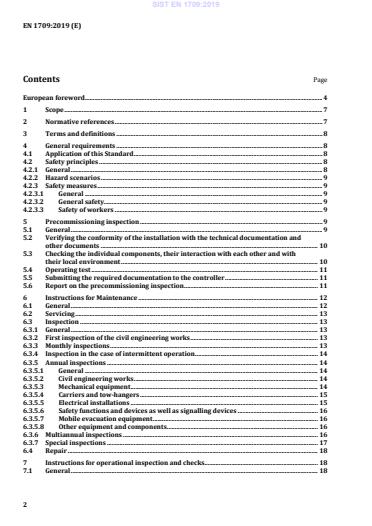
Contents Page
European foreword . 4
1 Scope . 7
2 Normative references . 7
3 Terms and definitions . 8
4 General requirements . 8
4.1 Application of this Standard . 8
4.2 Safety principles . 8
4.2.1 General . 8
4.2.2 Hazard scenarios . 9
4.2.3 Safety measures . 9
4.2.3.1 General . 9
4.2.3.2 General safety. 9
4.2.3.3 Safety of workers . 9
5 Precommissioning inspection . 9
5.1 General . 9
5.2 Verifying the conformity of the installation with the technical documentation and
other documents . 10
5.3 Checking the individual components, their interaction with each other and with
their local environment . 10
5.4 Operating test . 11
5.5 Submitting the required documentation to the controller . 11
5.6 Report on the precommissioning inspection . 11
6 Instructions for Maintenance . 12
6.1 General . 12
6.2 Servicing . 13
6.3 Inspection . 13
6.3.1 General . 13
6.3.2 First inspection of the civil engineering works . 13
6.3.3 Monthly inspections . 13
6.3.4 Inspection in the case of intermittent operation . 14
6.3.5 Annual inspections . 14
6.3.5.1 General . 14
6.3.5.2 Civil engineering works . 14
6.3.5.3 Mechanical equipment . 14
6.3.5.4 Carriers and tow-hangers . 15
6.3.5.5 Electrical installations . 15
6.3.5.6 Safety functions and devices as well as signalling devices . 16
6.3.5.7 Mobile evacuation equipment . 16
6.3.5.8 Other equipment and components . 16
6.3.6 Multiannual inspections . 16
6.3.7 Special inspections . 17
6.4 Repair . 18
7 Instructions for operational inspection and checks . 18
7.1 General . 18
7.2 Daily operational inspection and checks prior to passenger transportation . 18
7.2.1 Operational inspection and checks while the installation is stationary . 18
7.2.2 Operational inspection and checks during the test run . 19
7.3 Operational inspection and checks during operation . 20
7.4 Operational inspection and checks after exceptional events . 20
Annex ZA (informative) Relationship between this European Standard and the essential
requirements of Regulation (EU) 2016/424 . 21
European foreword
This document (EN 1709:2019) has been prepared by Technical Committee CEN/TC 242 “Safety
requirements for cableway installations designed to carry persons”, the secretariat of which is held by
AFNOR.
This European Standard shall be given the status of a national standard, either by publication of an
identical text or by endorsement, at the latest by November 2019, and conflicting national standards shall
be withdrawn at the latest by November 2019.
Attention is drawn to the possibility that some of the elements of this document may be the subject of
patent rights. CEN shall not be held responsible for identifying any or all such patent rights.
This document supersedes EN 1709:2004.
This document has been prepared under a mandate given to CEN by the European Commission and the
European Free Trade Association, and supports essential requirements of Regulation (EU) 2016/424.
For the relationship with Regulation (EU) 2016/424, see informative Annex ZA, which is an integral part
of this document.
The main changes with respect to the previous edition are listed below:
a) 4.2.2 h) was added due to the unsuitability of one procedure.
b) The classification of Clause 5 has been changed in order to implement the term “precommissioning
inspection” consistently with 3.1.
c) Clause 5 has been changed in order to clarify the differences between the two categories of
documents (documents by which the planned configuration of the installation is established, and
documents which the suppliers have to provide to the controller).
d) 5.2 has been deleted, as it is already included in the modified 5.1.
e) 5.3 g) was inserted.
f) The order of the list in 5.3 was adapted to the Regulation (EU) 2016/424 and to Section 6.
g) In the last paragraph of 5.3, the independent competent person has been deleted, as this is a matter
for the national members.
h) In 5.3 m) the pre-commissioning inspection has been deleted because it conflicts with the title and
the performance of recovery exercises as determined in national regulations and/or in EN 1909.
i) The final paragraph of 5.4 has been deleted as it is already covered in EN 12397.
j) In 6.1, the requirements for documenting maintenance work have been combined and extended in
one place.
k) 6.1.1 (new 6.1.2) has been changed, as, in accordance with 5.5, suppliers are required to provide
instructions for maintenance.
l) 6.1.4 was inserted, so that Annex ZA is still possible.
m) The definition of inspection in 6.3.1 has been supplemented with information concerning the time
requirements. This definition is now not the same as the term “inspection” in EN 1907.
n) The requirements in 6.3.1 for civil engineering works are generally applicable and have been
expanded to include all parts of the installation.
o) In 6.3.2 and 6.3.5, the visual inspection of screws and rivets for tightness has been changed to cover
loose and missing elements, and the visual inspection with regard to deformation has been extended
to include all components.
p) In 6.3.3, a), c), i), k) and parts of m) have been omitted and a stipulation of switching cabinet
cleanliness requirements included. The order of the list was adapted to Regulation (EU) 2016/424.
q) In 6.3.5, the order of the lists has been changed to comply with Regulation (EU) 2016/424 and a
clause concerning mobile evacuation equipment has been included.
r) 6.3.5.2 has been supplemented with detailed requirements for timber structures and for the terrain
in the vicinity of the civil engineering works.
s) Most of the requirements for funicular railways originally included in 6.3.6 are generally applicable
and have been extended to include all cableway systems. In order to create a comprehensible
qualitative difference with respect to the annual inspections in accordance with 6.3.5.2, inspection
by a competent person was introduced for the multiannual inspection of engineering structures
(tunnels, galleries, bridges) and ground anchors.
t) The intervals and the inspection methodology were changed in 6.3.7.
u) The requirements relating to the civil engineering works in 6.4 have been omitted, as they repeat
similar requirements in this Standard.
v) 6.5 has been deleted without replacement.
w) The terms and organization of Clause 7 have been revised. In addition, it was decided that the
supplier’s instructions in accordance with 5.5 shall include the stated operational inspections.
x) Clause 8 has been deleted, as it is already covered in other areas of the Standard.
y) The scope of the Standard was changed from “Maintenance and operational inspections” to
“Instructions for maintenance and operational inspections”.
This document forms part of a series of European Standards concerning safety requirements for cableway
installations designed to transport persons. This series of standards comprises the following documents:
— EN 1907 relating to Terminology;
— EN 12929 (all parts) relating to General requirements;
— EN 12930 relating to Calculations;
— EN 12927 relating to Cables;
— EN 1908 relating to Tensioning devices;
— EN 13223 relating to Drive systems and other mechanical equipment;
— EN 13796 (all parts) relating to Carriers;
— EN 13243 relating to Electrical equipment other than for drive systems;
— EN 13107 relating to Civil engineering works;
— EN 1709 relating to Pre-commissioning inspections and instructions for maintenance and
operational inspection and checks;
— EN 1909 relating to Recovery and evacuation;
— EN 12397 relating to Operation;
— EN 12408 relating to Quality control.
Together these form a series of standards regarding design, manufacture, erection, maintenance and
operation of all installations for cableway installations designed to transport persons.
In respect of ski-tows, the drafting of this document has been guided by the works of the International
Organization for Transportation by Rope (OITAF).
According to the CEN-CENELEC Internal Regulations, the national standards organizations of the
following countries are bound to implement this European Standard: Austria, Belgium, Bulgaria, Croatia,
Cyprus, Czech Republic, Denmark, Estonia, Finland, Former Yugoslav Republic of Macedonia, France,
Germany, Greece, Hungary, Iceland, Ireland, Italy, Latvia, Lithuania, Luxembourg, Malta, Netherlands,
Norway, Poland, Portugal, Romania, Serbia, Slovakia, Slovenia, Spain, Sweden, Switzerland, Turkey and
the United Kingdom.
1 Scope
This document sets the safety requirements that need to be met in relation to pre-commissioning
inspections and the instructions for maintenance and operational inspections and checks of cableway
installations designed to transport persons. This document is applicable to the various types of cableway
installation and takes into account their environment.
It also includes requirements relating to accident prevention and to the protection of workers
irrespective of the application of national regulations.
National regulations regarding building laws or regulations or which afford protection to specific groups
of people, as well as national regulations regarding testing, acceptance testing prior to starting passenger
service, maintenance and operational inspection shall remain unaffected.
It does not apply to cableway installations for the transportation of goods or to lifts.
The provisions of Clause 5 apply to the measures to be taken prior to the commissioning of the
installation, and those of Clauses 6 and 7 to the measures to be taken during operation.
This document does not apply to cableway installations designed to transport persons that were
manufactured before the publication of this EN standard.
2 Normative references
The following documents are referred to in the text in such a way that some or all of their content
constitutes requirements of this document. For dated references, only the edition cited applies. For
undated references, the latest edition of the referenced document (including any amendments) applies.
EN 1907, Safety requirements for cableway installations designed to transport persons — Terminology
EN 1908, Safety requirements for cableway installations designed to transport persons — Tensioning
devices
EN 1909, Safety requirements for cableway installations designed to transport persons — Recovery and
evacuation
EN 12397, Safety requirements for cableway installations designed to transport persons — Operation
EN 12408, Safety requirements for cableway installations designed to transport persons — Quality control
EN 12927, Safety requirements for cableway installations designed to carry persons — Ropes
EN 12929 (all parts), Safety requirements for cableway installations designed to transport persons —
General requirements
EN 12930, Safety requirements for cableway installations designed to transport persons — Calculations
EN 13107, Safety requirements for cableway installations designed to transport persons — Civil
engineering works
EN 13223, Safety requirements for cableway installations designed to transport persons — Drive systems
and other mechanical equipment
EN 13243, Safety requirements for cableway installations designed to transport persons — Electrical
equipment other than for drive systems
EN 13796 (all parts), Safety requirements for cableway installations designed to transport persons —
Carriers
3 Terms and definitions
For the purposes of this document, the terms and definitions given in EN 1907 and the following apply.
ISO and IEC maintain terminological databases for use in standardization at the following addresses:
— IEC Electropedia: go to http://www.electropedia.org/
— ISO Online Browsing Platform: go to http://www.iso.org/obp
3.1
Precommissioning inspection
all of the measures required to confirm the readiness of the installation for acceptance
3.2
Operational inspection and checks
operations intended for verifying the readiness for operation of the installation before and during
operation
3.3
Operating test
operation of a defined duration during which the working of the installation is tested
3.4
Readiness for acceptance
condition of the installation where the functional and technical safety conditions for acceptance have
been fulfilled
3.5
Readiness for operation
condition of the installation where the functional and technical safety conditions to allow passengers to
be transported have been fulfilled
4 General requirements
4.1 Application of this Standard
The requirements of this document, together with those of standards EN 1908, EN 1909, EN 12397,
EN 12408, EN 12927, EN 12929 (all parts), EN 12930, EN 13107, EN 13223, EN 13243, EN 13796 (all
parts) apply to all cableway installations.
4.2 Safety principles
4.2.1 General
The safety principles formulated in EN 12929-1 shall apply.
In addition, the scope of this document includes the following hazard scenarios and safety measures.
4.2.2 Hazard scenarios
The following events may lead to hazardous situations which may be avoided or limited by the safety
requirements of this document:
a) lack of compliance of the physical construction of the installation with the documents presented;
b) defective interaction of individual components with each other and with their local environment;
c) defects as a result of long-term operation, prolonged stoppages or repeated and sustained
unfavourable operating conditions;
d) use of insufficient suitably qualified personnel;
e) operation with the installation or its components in a defective condition;
f) lack of measures for maintaining or re-establishing the specified condition of the installation or its
components;
g) hazards stemming from the environment;
h) absence, unsuitability or non-compliance of a procedure.
4.2.3 Safety measures
4.2.3.1 General
The following safety measures shall be taken prior to acceptance and during operation in order to
eliminate the hazard scenarios listed in 4.2.2.
4.2.3.2 General safety
a) a precommissioning inspection of the installation prior to its acceptance, intended to verify the
correct interaction of the components with each other, and of the installation as a whole with its local
environment;
b) maintenance work intended to maintain and re-establish the specified condition of the installation
and its components;
c) operational inspection and checks intended to verify the readiness for operation of the installation
before and during operation.
4.2.3.3 Safety of workers
All work shall be carried out taking the necessary measures for protecting against risks to the safety and
health of workers.
5 Precommissioning inspection
5.1 General
The precommissioning inspection includes:
a) verifying the conformity of the installation with the technical documentation and other documents;
b) checking the individual components, their interaction with each other and within their local
environment;
c) performing the operating test;
d) submitting the required documentation to the controller;
e) drawing-up a report on the test.
5.2 Verifying the conformity of the installation with the technical documentation and
other documents
The technical documents are specified in this document and in EN 1908, EN 1909, EN 12397, EN 12408,
EN 12927, EN 12929 (all parts), EN 12930, EN 13107, EN 13223, EN 13243, EN 13796 (all parts).
Compliance of the installation with the technical documentation and other documents must be verified.
5.3 Checking the individual components, their interaction with each other and with their
local environment
These checks comprise, in particular:
a) the external condition of the station and line structures and their foundations;
b) the adequate clearance of the carriers, tow-hangers and ropes in relation to other components and
the local environment in the most unfavourable operating conditions;
c) the external condition of the ropes, their connections and end fixings;
d) the functioning of all drive systems including their control and adjustment devices, taking into
account all operating modes and the most unfavourable operational loading conditions. In the case
of ski-tows, this inspection shall be carried out on an unloaded installation;
e) the operation of all brakes for the drive systems including the maintenance of adequate friction
whilst taking into consideration the most unfavourable operational loading conditions. In the case of
ski-tows, this inspection shall be carried out on an unloaded installation;
f) the guidance of the rotes and the function of their supporting elements and tensioning devices,
including compliance with the required tensile forces;
g) the functioning of mechanical equipment for the loading and unloading of passengers;
h) the movement of the carriers or tow-hangers on the line and in the stations;
i) the functioning of the carriers’ fixings or tow-hangers to the cables and the attachment processes
under all operating conditions as well as the grips’ resistance to sliding;
j) the functioning of the electrical installations;
k) the functioning of the telecommunication and signalling installations;
l) the functioning of the safety devices (circuits) under circumstances of operational failure;
m) the functioning of the evacuation equipment.
Before commissioning and after major modifications which a
...
SLOVENSKI STANDARD
01-julij-2019
Nadomešča:
SIST EN 1709:2005
Varnostne zahteve za žičniške naprave za prevoz oseb – Prevzemni pregled,
navodila za vzdrževanje, pregledi in kontrole obratovanja
Safety requirements for cableway installations designed to transport persons -
Precommissioning inspection and instructions for maintenance and operational
inspection
and checks
Sicherheitsanforderungen an Seilbahnen für die Personenbeförderung - Erprobung und
Anleitungen für die Instandhaltung und die Betriebskontrollen
Prescriptions de sécurité pour les installations à câbles transportant des personnes -
Examen probatoire et instructions pour la maintenance et les contrôles en exploitation
Ta slovenski standard je istoveten z: EN 1709:2019
ICS:
45.100 Oprema za žičnice Cableway equipment
2003-01.Slovenski inštitut za standardizacijo. Razmnoževanje celote ali delov tega standarda ni dovoljeno.
EN 1709
EUROPEAN STANDARD
NORME EUROPÉENNE
May 2019
EUROPÄISCHE NORM
ICS 45.100 Supersedes EN 1709:2004
English Version
Safety requirements for cableway installations designed to
transport persons - Precommissioning inspection and
instructions for maintenance and operational inspection
and checks
Prescriptions de sécurité pour les installations à câbles Sicherheitsanforderungen an Seilbahnen für die
transportant des personnes - Examen probatoire et Personenbeförderung - Erprobung und Anleitungen für
instructions pour la maintenance et les contrôles en die Instandhaltung und die Betriebskontrollen
exploitation
This European Standard was approved by CEN on 15 January 2019.
CEN members are bound to comply with the CEN/CENELEC Internal Regulations which stipulate the conditions for giving this
European Standard the status of a national standard without any alteration. Up-to-date lists and bibliographical references
concerning such national standards may be obtained on application to the CEN-CENELEC Management Centre or to any CEN
member.
This European Standard exists in three official versions (English, French, German). A version in any other language made by
translation under the responsibility of a CEN member into its own language and notified to the CEN-CENELEC Management
Centre has the same status as the official versions.
CEN members are the national standards bodies of Austria, Belgium, Bulgaria, Croatia, Cyprus, Czech Republic, Denmark, Estonia,
Finland, Former Yugoslav Republic of Macedonia, France, Germany, Greece, Hungary, Iceland, Ireland, Italy, Latvia, Lithuania,
Luxembourg, Malta, Netherlands, Norway, Poland, Portugal, Romania, Serbia, Slovakia, Slovenia, Spain, Sweden, Switzerland,
Turkey and United Kingdom.
EUROPEAN COMMITTEE FOR STANDARDIZATION
COMITÉ EUROPÉEN DE NORMALISATION
EUROPÄISCHES KOMITEE FÜR NORMUNG
CEN-CENELEC Management Centre: Rue de la Science 23, B-1040 Brussels
© 2019 CEN All rights of exploitation in any form and by any means reserved Ref. No. EN 1709:2019 E
worldwide for CEN national Members.
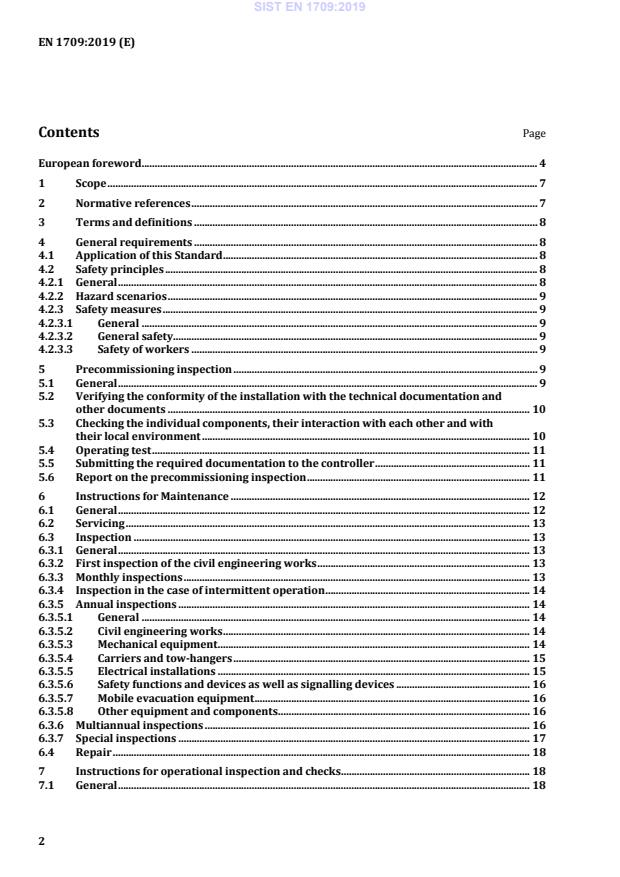
Contents Page
European foreword . 4
1 Scope . 7
2 Normative references . 7
3 Terms and definitions . 8
4 General requirements . 8
4.1 Application of this Standard . 8
4.2 Safety principles . 8
4.2.1 General . 8
4.2.2 Hazard scenarios . 9
4.2.3 Safety measures . 9
4.2.3.1 General . 9
4.2.3.2 General safety. 9
4.2.3.3 Safety of workers . 9
5 Precommissioning inspection . 9
5.1 General . 9
5.2 Verifying the conformity of the installation with the technical documentation and
other documents . 10
5.3 Checking the individual components, their interaction with each other and with
their local environment . 10
5.4 Operating test . 11
5.5 Submitting the required documentation to the controller . 11
5.6 Report on the precommissioning inspection . 11
6 Instructions for Maintenance . 12
6.1 General . 12
6.2 Servicing . 13
6.3 Inspection . 13
6.3.1 General . 13
6.3.2 First inspection of the civil engineering works . 13
6.3.3 Monthly inspections . 13
6.3.4 Inspection in the case of intermittent operation . 14
6.3.5 Annual inspections . 14
6.3.5.1 General . 14
6.3.5.2 Civil engineering works . 14
6.3.5.3 Mechanical equipment . 14
6.3.5.4 Carriers and tow-hangers . 15
6.3.5.5 Electrical installations . 15
6.3.5.6 Safety functions and devices as well as signalling devices . 16
6.3.5.7 Mobile evacuation equipment . 16
6.3.5.8 Other equipment and components . 16
6.3.6 Multiannual inspections . 16
6.3.7 Special inspections . 17
6.4 Repair . 18
7 Instructions for operational inspection and checks . 18
7.1 General . 18
7.2 Daily operational inspection and checks prior to passenger transportation . 18
7.2.1 Operational inspection and checks while the installation is stationary . 18
7.2.2 Operational inspection and checks during the test run . 19
7.3 Operational inspection and checks during operation . 20
7.4 Operational inspection and checks after exceptional events . 20
Annex ZA (informative) Relationship between this European Standard and the essential
requirements of Regulation (EU) 2016/424 . 21
European foreword
This document (EN 1709:2019) has been prepared by Technical Committee CEN/TC 242 “Safety
requirements for cableway installations designed to carry persons”, the secretariat of which is held by
AFNOR.
This European Standard shall be given the status of a national standard, either by publication of an
identical text or by endorsement, at the latest by November 2019, and conflicting national standards shall
be withdrawn at the latest by November 2019.
Attention is drawn to the possibility that some of the elements of this document may be the subject of
patent rights. CEN shall not be held responsible for identifying any or all such patent rights.
This document supersedes EN 1709:2004.
This document has been prepared under a mandate given to CEN by the European Commission and the
European Free Trade Association, and supports essential requirements of Regulation (EU) 2016/424.
For the relationship with Regulation (EU) 2016/424, see informative Annex ZA, which is an integral part
of this document.
The main changes with respect to the previous edition are listed below:
a) 4.2.2 h) was added due to the unsuitability of one procedure.
b) The classification of Clause 5 has been changed in order to implement the term “precommissioning
inspection” consistently with 3.1.
c) Clause 5 has been changed in order to clarify the differences between the two categories of
documents (documents by which the planned configuration of the installation is established, and
documents which the suppliers have to provide to the controller).
d) 5.2 has been deleted, as it is already included in the modified 5.1.
e) 5.3 g) was inserted.
f) The order of the list in 5.3 was adapted to the Regulation (EU) 2016/424 and to Section 6.
g) In the last paragraph of 5.3, the independent competent person has been deleted, as this is a matter
for the national members.
h) In 5.3 m) the pre-commissioning inspection has been deleted because it conflicts with the title and
the performance of recovery exercises as determined in national regulations and/or in EN 1909.
i) The final paragraph of 5.4 has been deleted as it is already covered in EN 12397.
j) In 6.1, the requirements for documenting maintenance work have been combined and extended in
one place.
k) 6.1.1 (new 6.1.2) has been changed, as, in accordance with 5.5, suppliers are required to provide
instructions for maintenance.
l) 6.1.4 was inserted, so that Annex ZA is still possible.
m) The definition of inspection in 6.3.1 has been supplemented with information concerning the time
requirements. This definition is now not the same as the term “inspection” in EN 1907.
n) The requirements in 6.3.1 for civil engineering works are generally applicable and have been
expanded to include all parts of the installation.
o) In 6.3.2 and 6.3.5, the visual inspection of screws and rivets for tightness has been changed to cover
loose and missing elements, and the visual inspection with regard to deformation has been extended
to include all components.
p) In 6.3.3, a), c), i), k) and parts of m) have been omitted and a stipulation of switching cabinet
cleanliness requirements included. The order of the list was adapted to Regulation (EU) 2016/424.
q) In 6.3.5, the order of the lists has been changed to comply with Regulation (EU) 2016/424 and a
clause concerning mobile evacuation equipment has been included.
r) 6.3.5.2 has been supplemented with detailed requirements for timber structures and for the terrain
in the vicinity of the civil engineering works.
s) Most of the requirements for funicular railways originally included in 6.3.6 are generally applicable
and have been extended to include all cableway systems. In order to create a comprehensible
qualitative difference with respect to the annual inspections in accordance with 6.3.5.2, inspection
by a competent person was introduced for the multiannual inspection of engineering structures
(tunnels, galleries, bridges) and ground anchors.
t) The intervals and the inspection methodology were changed in 6.3.7.
u) The requirements relating to the civil engineering works in 6.4 have been omitted, as they repeat
similar requirements in this Standard.
v) 6.5 has been deleted without replacement.
w) The terms and organization of Clause 7 have been revised. In addition, it was decided that the
supplier’s instructions in accordance with 5.5 shall include the stated operational inspections.
x) Clause 8 has been deleted, as it is already covered in other areas of the Standard.
y) The scope of the Standard was changed from “Maintenance and operational inspections” to
“Instructions for maintenance and operational inspections”.
This document forms part of a series of European Standards concerning safety requirements for cableway
installations designed to transport persons. This series of standards comprises the following documents:
— EN 1907 relating to Terminology;
— EN 12929 (all parts) relating to General requirements;
— EN 12930 relating to Calculations;
— EN 12927 relating to Cables;
— EN 1908 relating to Tensioning devices;
— EN 13223 relating to Drive systems and other mechanical equipment;
— EN 13796 (all parts) relating to Carriers;
— EN 13243 relating to Electrical equipment other than for drive systems;
— EN 13107 relating to Civil engineering works;
— EN 1709 relating to Pre-commissioning inspections and instructions for maintenance and
operational inspection and checks;
— EN 1909 relating to Recovery and evacuation;
— EN 12397 relating to Operation;
— EN 12408 relating to Quality control.
Together these form a series of standards regarding design, manufacture, erection, maintenance and
operation of all installations for cableway installations designed to transport persons.
In respect of ski-tows, the drafting of this document has been guided by the works of the International
Organization for Transportation by Rope (OITAF).
According to the CEN-CENELEC Internal Regulations, the national standards organizations of the
following countries are bound to implement this European Standard: Austria, Belgium, Bulgaria, Croatia,
Cyprus, Czech Republic, Denmark, Estonia, Finland, Former Yugoslav Republic of Macedonia, France,
Germany, Greece, Hungary, Iceland, Ireland, Italy, Latvia, Lithuania, Luxembourg, Malta, Netherlands,
Norway, Poland, Portugal, Romania, Serbia, Slovakia, Slovenia, Spain, Sweden, Switzerland, Turkey and
the United Kingdom.
1 Scope
This document sets the safety requirements that need to be met in relation to pre-commissioning
inspections and the instructions for maintenance and operational inspections and checks of cableway
installations designed to transport persons. This document is applicable to the various types of cableway
installation and takes into account their environment.
It also includes requirements relating to accident prevention and to the protection of workers
irrespective of the application of national regulations.
National regulations regarding building laws or regulations or which afford protection to specific groups
of people, as well as national regulations regarding testing, acceptance testing prior to starting passenger
service, maintenance and operational inspection shall remain unaffected.
It does not apply to cableway installations for the transportation of goods or to lifts.
The provisions of Clause 5 apply to the measures to be taken prior to the commissioning of the
installation, and those of Clauses 6 and 7 to the measures to be taken during operation.
This document does not apply to cableway installations designed to transport persons that were
manufactured before the publication of this EN standard.
2 Normative references
The following documents are referred to in the text in such a way that some or all of their content
constitutes requirements of this document. For dated references, only the edition cited applies. For
undated references, the latest edition of the referenced document (including any amendments) applies.
EN 1907, Safety requirements for cableway installations designed to transport persons — Terminology
EN 1908, Safety requirements for cableway installations designed to transport persons — Tensioning
devices
EN 1909, Safety requirements for cableway installations designed to transport persons — Recovery and
evacuation
EN 12397, Safety requirements for cableway installations designed to transport persons — Operation
EN 12408, Safety requirements for cableway installations designed to transport persons — Quality control
EN 12927, Safety requirements for cableway installations designed to carry persons — Ropes
EN 12929 (all parts), Safety requirements for cableway installations designed to transport persons —
General requirements
EN 12930, Safety requirements for cableway installations designed to transport persons — Calculations
EN 13107, Safety requirements for cableway installations designed to transport persons — Civil
engineering works
EN 13223, Safety requirements for cableway installations designed to transport persons — Drive systems
and other mechanical equipment
EN 13243, Safety requirements for cableway installations designed to transport persons — Electrical
equipment other than for drive systems
EN 13796 (all parts), Safety requirements for cableway installations designed to transport persons —
Carriers
3 Terms and definitions
For the purposes of this document, the terms and definitions given in EN 1907 and the following apply.
ISO and IEC maintain terminological databases for use in standardization at the following addresses:
— IEC Electropedia: go to http://www.electropedia.org/
— ISO Online Browsing Platform: go to http://www.iso.org/obp
3.1
Precommissioning inspection
all of the measures required to confirm the readiness of the installation for acceptance
3.2
Operational inspection and checks
operations intended for verifying the readiness for operation of the installation before and during
operation
3.3
Operating test
operation of a defined duration during which the working of the installation is tested
3.4
Readiness for acceptance
condition of the installation where the functional and technical safety conditions for acceptance have
been fulfilled
3.5
Readiness for operation
condition of the installation where the functional and technical safety conditions to allow passengers to
be transported have been fulfilled
4 General requirements
4.1 Application of this Standard
The requirements of this document, together with those of standards EN 1908, EN 1909, EN 12397,
EN 12408, EN 12927, EN 12929 (all parts), EN 12930, EN 13107, EN 13223, EN 13243, EN 13796 (all
parts) apply to all cableway installations.
4.2 Safety principles
4.2.1 General
The safety principles formulated in EN 12929-1 shall apply.
In addition, the scope of this document includes the following hazard scenarios and safety measures.
4.2.2 Hazard scenarios
The following events may lead to hazardous situations which may be avoided or limited by the safety
requirements of this document:
a) lack of compliance of the physical construction of the installation with the documents presented;
b) defective interaction of individual components with each other and with their local environment;
c) defects as a result of long-term operation, prolonged stoppages or repeated and sustained
unfavourable operating conditions;
d) use of insufficient suitably qualified personnel;
e) operation with the installation or its components in a defective condition;
f) lack of measures for maintaining or re-establishing the specified condition of the installation or its
components;
g) hazards stemming from the environment;
h) absence, unsuitability or non-compliance of a procedure.
4.2.3 Safety measures
4.2.3.1 General
The following safety measures shall be taken prior to acceptance and during operation in order to
eliminate the hazard scenarios listed in 4.2.2.
4.2.3.2 General safety
a) a precommissioning inspection of the installation prior to its acceptance, intended to verify the
correct interaction of the components with each other, and of the installation as a whole with its local
environment;
b) maintenance work intended to maintain and re-establish the specified condition of the installation
and its components;
c) operational inspection and checks intended to verify the readiness for operation of the installation
before and during operation.
4.2.3.3 Safety of workers
All work shall be carried out taking the necessary measures for protecting against risks to the safety and
health of workers.
5 Precommissioning inspection
5.1 General
The precommissioning inspection includes:
a) verifying the conformity of the installation with the technical documentation and other documents;
b) checking the individual components, their interaction with each other and within their local
environment;
c) performing the operating test;
d) submitting the required documentation to the controller;
e) drawing-up a report on the test.
5.2 Verifying the conformity of the installation with the technical documentation and
other documents
The technical documents are specified in this document and in EN 1908, EN 1909, EN 12397, EN 12408,
EN 12927, EN 12929 (all parts), EN 12930, EN 13107, EN 13223, EN 13243, EN 13796 (all parts).
Compliance of the installation with the technical documentation and other documents must be verified.
5.3 Checking the individual components, their interaction with each other and with their
local environment
These checks comprise, in particular:
a) the external condition of the station and line structures and their foundations;
b) the adequate clearance of the carriers, tow-hangers and ropes in relation to other components and
the local environment in the most unfavourable operating conditions;
c) the external condition of the ropes, their connections and end fixings;
d) the functioning of all drive systems including their control and adjustment devices, taking into
account all operating modes and the most unfavourable operational loading conditions. In the case
of ski-tows, this inspection shall be carried out on an unloaded installation;
e) the operation of all brakes for the drive systems including the maintenance of adequate friction
whilst taking into consideration the most unfavourable operational loading conditions. In the case of
ski-tows, this inspection shall be carried out on an unloaded installation;
f) the guidance of the rotes and the function of their supporting elements and tensioning devices,
including compliance with the required tensile forces;
g) the functioning of mechanical equipment for the loading and unloading of passengers;
h) the movement of the carriers or tow-hangers on the line and in the stations;
i) the functioning of the carriers’ fixings or tow-hangers to the cables and the attachment processes
under all operating conditions as well as the grips’ resistance to sliding;
j) the functioning of the electrical installations;
k) the functioning of the telecommunication and signalling installations;
l) the functioning of the safety devices (circuits) under circumstances of operational failure;
m) the functioning of the evacuation equipment.
Before commissioning and after major modif
...
ba
SLOVENSKI SIST EN 1709
STANDARD julij 2019
Varnostne zahteve za žičniške naprave za prevoz oseb – Prevzemni
pregled, navodila za vzdrževanje, pregledi in kontrole obratovanja
Safety requirements for cableway installations designed to transport persons –
Precommissioning inspection and instructions for maintenance and operational
inspection and checks
Sicherheitsanforderungen an Seilbahnen für die Personenbeförderung –
Erprobung und Anleitungen für die Instandhaltung und die Betriebskontrollen
Prescriptions de sécurité pour les installations à câbles transportant des
personnes – Examen probatoire et instructions pour la maintenance et les
contrôles en exploitation
Referenčna oznaka
ICS 45.100 SIST EN 1709:2019 (sl)
Nadaljevanje na straneh II in III ter od 1 do 18
© 2019-11. Slovenski inštitut za standardizacijo. Razmnoževanje ali kopiranje celote ali delov tega standarda ni dovoljeno.
SIST EN 1709 : 2019
NACIONALNI UVOD
Standard SIST EN 1709 (sl), Varnostne zahteve za žičniške naprave za prevoz oseb – Prevzemni
pregled, navodila za vzdrževanje, pregledi in kontrole obratovanja, 2019, ima status slovenskega
standarda in je istoveten evropskemu standardu EN 1709 (en), Safety requirements for cableway
installations designed to transport persons – Precommissioning inspection and instructions for
maintenance and operational inspection and checks, 2019.
Ta standard nadomešča SIST EN 1709:2005.
NACIONALNI PREDGOVOR
Evropski standard EN 1709:2019 je pripravil tehnični odbor Evropskega komiteja za standardizacijo
CEN/TC 242 Varnostne zahteve za prevoz oseb z žičniškimi napravami, katerega tajništvo je v
pristojnosti AFNOR.
Slovenski standard SIST EN 1709:2019 je prevod evropskega standarda EN 1709:2019. V primeru
spora glede besedila slovenskega prevoda v tem standardu je odločilen izvirni evropski standard v
angleškem jeziku. Slovensko izdajo standarda je pripravil tehnični odbor SIST/TC DTN Dvigalne in
transportne naprave.
Odločitev za izdajo tega standarda je dne 4. junija 2019 sprejel tehnični odbor SIST/TC DTN Dvigalne
in transportne naprave.
ZVEZE Z NACIONALNIMI STANDARDI
S privzemom tega evropskega standarda veljajo za omejeni namen referenčnih standardov vsi
standardi, navedeni v izvirniku, razen standardov, ki so že sprejeti v nacionalno standardizacijo:
SIST EN 1907 Varnostne zahteve za žičniške naprave za prevoz oseb – Izrazje
SIST EN 1908 Varnostne zahteve za žičniške naprave za prevoz oseb – Napenjalne
naprave
SIST EN 1909 Varnostne zahteve za žičniške naprave za prevoz oseb – Izpraznitev in
reševanje
SIST EN 12397 Varnostne zahteve za žičniške naprave za prevoz oseb – Obratovanje
SIST EN 12408 Varnostne zahteve za žičniške naprave za prevoz oseb – Zagotavljanje
kakovosti
SIST EN 12927 Varnostne zahteve za žičniške naprave za prevoz oseb – Vrvi
SIST EN 12929 (vsi deli) Varnostne zahteve za žičniške naprave za prevoz oseb – Splošne zahteve
SIST EN 12930 Varnostne zahteve za žičniške naprave za prevoz oseb – Izračuni
SIST EN 13107 Varnostne zahteve za žičniške naprave za prevoz oseb – Gradbena dela
in objekti
SIST EN 13223 Varnostne zahteve za žičniške naprave za prevoz oseb – Pogonski sistemi
in druga mehanska oprema
SIST EN 13243 Varnostne zahteve za žičniške naprave za prevoz oseb – Električna
oprema (razen za pogonske sisteme)
SIST EN 13796 (vsi deli) Varnostne zahteve za žičniške naprave za prevoz oseb – Vozila
OSNOVA ZA IZDAJO STANDARDA
– privzem evropskega standarda EN 1709:2019
II
SIST EN 1709 : 2019
PREDHODNA IZDAJA
– SIST EN 1709:2005
OPOMBE
– Povsod, kjer se v besedilu standarda uporablja izraz “evropski standard”, v SIST EN 1709:2019 to
pomeni “slovenski standard”.
– Nacionalni uvod in nacionalni predgovor nista sestavni del standarda.
– Ta nacionalni dokument je istoveten EN 1709:2019 in je objavljen z dovoljenjem
Upravni center
CEN/CENELEC
Rue de la Science 23
B-1040 Bruselj
This national document is identical with EN 1709:2019 and is published with the permission of
CEN/CENELEC
Management Centre
Rue de la Science 23
B-1040 Brussels
III
SIST EN 1709 : 2019
IV
EVROPSKI STANDARD EN 1709
EUROPEAN STANDARD
NORME EUROPÉENNE
maj 2019
EUROPÄISCHE NORM
ICS 45.100 Nadomešča EN 1709:2004
Slovenska izdaja
Varnostne zahteve za žičniške naprave za prevoz oseb – Prevzemni
pregled, navodila za vzdrževanje, pregledi in kontrole obratovanja
Safety requirements for Prescriptions de sécurité pour Sicherheitsanforderungen an
cableway installations designed les installations à câbles Seilbahnen für die
to transport persons – transportant des personnes – Personenbeförderung –
Precommissioning inspection Examen probatoire et Erprobung und Anleitungen für
and instructions for instructions pour la maintenance die Instandhaltung und die
maintenance and operational et les contrôles en exploitation Betriebskontrollen
inspection and checks
Ta evropski standard je CEN sprejel 15. januarja 2019.
Člani CEN morajo izpolnjevati notranje predpise CEN/CENELEC, ki določajo pogoje, pod katerimi
dobi ta evropski standard status nacionalnega standarda brez kakršnih koli sprememb. Seznami
najnovejših izdaj teh nacionalnih standardov in njihovi bibliografski podatki so na voljo na zahtevo pri
Upravnem centru CEN-CENELEC ali kateremkoli članu CEN.
Ta evropski standard obstaja v treh uradnih izdajah (angleški, francoski in nemški). Izdaje v drugih
jezikih, ki jih člani CEN na lastno odgovornost prevedejo in izdajo ter prijavijo pri Upravnem centru
CEN-CENELEC, veljajo kot uradne izdaje.
Člani CEN so nacionalni organi za standarde Avstrije, Belgije, Bolgarije, Cipra, Češke republike,
Danske, Estonije, Finske, Francije, Grčije, Hrvaške, Irske, Islandije, Italije, Latvije, Litve,
Luksemburga, Madžarske, Malte, Nekdanje jugoslovanske republike Makedonije, Nemčije,
Nizozemske, Norveške, Poljske, Portugalske, Romunije, Srbije, Slovaške, Slovenije, Španije,
Švedske, Švice, Turčije in Združenega kraljestva.
CEN
Evropski komite za standardizacijo
European committee for standardization
Comité européen de normalisation
Europäisches komitee für normung
Upravni center CEN-CENELEC: Rue de la Science 23, B-1040 Brussels
© 2019 CEN Lastnice avtorskih pravic so vse države članice CEN Ref. oznaka EN 1709:2019 E
SIST EN 1709 : 2019
VSEBINA Stran
Predgovor k evropskemu standardu . 4
1 Področje uporabe . 6
2 Zveze s standardi . 6
3 Izrazi in definicije . 6
4 Splošne zahteve . 7
4.1 Uporaba tega standarda . 7
4.2 Varnostna načela . 7
4.2.1 Splošno . 7
4.2.2 Možne nevarnosti . 7
4.2.3 Varnostni ukrepi . 8
4.2.3.1 Splošno . 8
4.2.3.2 Splošna varnost . 8
4.2.3.3 Varnost delavcev . 8
5 Prevzemni pregled . 8
5.1 Splošno . 8
5.2 Ugotavljanje skladnosti naprave s tehnično dokumentacijo in drugimi dokumenti . 8
5.3 Pregled posameznih delov, njihovega medsebojnega delovanja in delovanja v njihovem
lokalnem okolju . 8
5.4 Preskusno obratovanje . 9
5.5 Predložitev zahtevane dokumentacije upravljavcu . 9
5.6 Poročilo o prevzemnem pregledu . 10
6 Navodila za vzdrževanje . 10
6.1 Splošno . 10
6.2 Servisiranje . 11
6.3 Pregled . 11
6.3.1 Splošno . 11
6.3.2 Prvi pregled gradbenih inženirskih objektov . 11
6.3.3 Mesečni pregledi . 11
6.3.4 Pregled v primeru prekinjenega obratovanja . 12
6.3.5 Letni pregledi . 12
6.3.5.1 Splošno . 12
6.3.5.2 Gradbeni inženirski objekti . 12
6.3.5.3 Mehanska oprema . 12
6.3.5.4 Vozila in vlačila . 13
6.3.5.5 Električne naprave . 13
6.3.5.6 Varnostne funkcije in naprave ter naprave za opozarjanje . 13
6.3.5.7 Premične naprave za reševanje . 13
6.3.5.8 Ostala oprema in njeni deli . 13
6.3.6 Večletni pregledi . 14
SIST EN 1709 : 2019
6.3.7 Posebni pregledi . 14
6.4 Popravila . 15
7 Navodila za preglede in kontrole obratovanja . 15
7.1 Splošno . 15
7.2 Dnevni pregledi in kontrole obratovanja pred prevozom oseb . 16
7.2.1 Pregledi in kontrole obratovanja, ko je naprava v mirovanju . 16
7.2.2 Pregledi in kontrole obratovanja med preskusno vožnjo . 16
7.3 Pregledi in kontrole obratovanja med obratovanjem . 17
7.4 Pregledi in kontrole obratovanja po izrednih dogodkih . 17
Dodatek ZA (informativni): Povezava med tem evropskim standardom in bistvenimi
zahtevami Uredbe (EU) 2016/424 . 18
SIST EN 1709 : 2019
Predgovor k evropskemu standardu
Ta dokument (EN 1709:2019) je pripravil tehnični odbor CEN/TC 242 Varnostne zahteve za žičniške
naprave za prevoz oseb, katerega sekretariat vodi AFNOR.
Ta evropski standard mora dobiti status nacionalnega standarda bodisi z objavo istovetnega besedila
bodisi z razglasitvijo najpozneje do novembra 2019, nasprotujoče nacionalne standarde pa je treba
razveljaviti najpozneje do novembra 2019.
Opozoriti je treba na možnost, da je lahko nekaj elementov tega dokumenta predmet patentnih pravic.
CEN ne prevzema odgovornosti za identifikacijo nekaterih ali vseh takih patentnih pravic.
Ta dokument nadomešča standard EN 1709:2004.
Ta dokument je bil pripravljen v okviru mandata, ki sta ga Evropska komisija in Evropsko združenje za
prosto trgovino dodelila CEN, ter podpira bistvene zahteve Uredbe (EU) 2016/424.
Za povezavo tega standarda z Uredbo (EU) 2016/424 glej informativni dodatek ZA, ki je sestavni del
tega dokumenta.
Glavne spremembe v primerjavi s predhodno izdajo so naslednje:
a) točka 4.2.2 h) je dodana zaradi neustreznosti enega postopka;
b) klasifikacija točke 5 je spremenjena zaradi uvedbe izraza "prevzemni pregled" skladno s točko 3.1;
c) točka 5 je spremenjena, da se pojasnijo razlike med dvema kategorijama dokumentov (dokumenti,
ki določajo načrtovano konfiguracijo naprave, in dokumenti, ki jih morajo dobavitelji posredovati
upravljavcu);
d) točka 5.2 je izbrisana, saj je že vključena v spremenjeni točki 5.1;
e) točka 5.3 g) je dodana;
f) vrstni red seznama v točki 5.3 je povzet po Uredbi (EU) 2016/424 in točki 6;
g) v zadnjem odstavku točke 5.3 je izbrisano "neodvisna strokovna oseba", saj to ureja vsaka država
članica sama;
h) v točki 5.3 m) je izbrisan prevzemni pregled, saj je v nasprotju z naslovom in izvajanjem nalog na
področju odprave posledic, kot določajo nacionalni predpisi in/ali standard EN 1909;
i) zadnji odstavek točke 5.4 je izbrisan, saj je že zajet v standardu EN 12397;
j) v točki 6.1 so zahteve za dokumentiranje vzdrževalnih del združene na enem mestu in razširjene;
k) točka 6.1.1 (nova točka 6.1.2) je spremenjena, saj morajo dobavitelji zagotoviti navodila za
vzdrževanje v skladu s točko 5.5;
l) točka 6.1.4 je dodana, tako da je dodatek ZA še vedno mogoč;
m) definicija pregleda v točki 6.3.1 je dopolnjena z informacijami glede časovnih zahtev. Ta definicija
zdaj ni enaka izrazu "pregled" v standardu EN 1907;
n) zahteve v točki 6.3.1 za gradbene inženirske objekte so splošno veljavne in so razširjene, tako da
vključujejo vse dele naprave;
o) v točkah 6.3.2 in 6.3.5 je vizualni pregled pritrjenosti vijakov in zakovic spremenjen tako, da zajema
tudi razrahljane in manjkajoče elemente, vizualni pregled v zvezi z deformacijami pa je razširjen in
vključuje vse dele;
p) v točki 6.3.3 so izpuščene alineje a), c), i), k) in deli alineje m), vključeno pa je določilo za zahteve
glede čistosti stikalnih omar. Vrstni red je povzet po Uredbi (EU) 2016/424;
q) v točki 6.3.5 je vrstni red seznamov spremenjen, tako da je v skladu z Uredbo (EU) 2016/424,
SIST EN 1709 : 2019
vključena pa je točka v zvezi s premičnimi napravami za reševanje;
r) točka 6.3.5.2 je dopolnjena s podrobnimi zahtevami za lesene konstrukcije in teren v bližini
gradbenih inženirskih objektov;
s) večina zahtev za vzpenjače, ki so prvotno vključene v točki 6.3.6, je splošno veljavnih in so
razširjene, tako da vključujejo vse žičniške naprave. Da bi dosegli zadostno kvalitativno razliko pri
letnih pregledih v skladu s točko 6.3.5.2, je za večletni pregled inženirskih objektov (tunelov, galerij,
mostov) in sider uveden pregled, ki ga izvaja usposobljena oseba;
t) v točki 6.3.7 so spremenjeni intervali in metodologija pregledov;
u) v točki 6.4 so izpuščene zahteve v zvezi z gradbenimi inženirskimi objekti, saj se podobne zahteve
v tem standardu ponavljajo;
v) točka 6.5 je izbrisana in ni nadomeščena;
w) izrazi in organizacija točke 7 so revidirani. Poleg tega je bilo sklenjeno, da morajo navodila
dobavitelja v skladu s točko 5.5 vključevati navedene kontrole obratovanja;
x) točka 8 je izbrisana, saj je njena vsebina že zajeta v drugih delih standarda;
y) področje uporabe tega standarda je spremenjeno iz "vzdrževanje in kontrole obratovanja" v
"navodila za vzdrževanje in kontrole obratovanja".
Ta evropski standard je del skupine evropskih standardov, ki se nanašajo na varnostne zahteve za
žičniške naprave za prevoz oseb. To skupino standardov sestavljajo naslednji dokumenti:
– EN 1907, ki se nanaša na izrazje;
– EN 12929 (vsi deli), ki se nanaša na splošne zahteve;
– EN 12930, ki se nanaša na izračune;
– EN 12927, ki se nanaša na vrvi;
– EN 1908, ki se nanaša na napenjalne naprave;
– EN 13223, ki se nanaša na pogonske sisteme in drugo mehansko opremo;
– EN 13796 (vsi deli), ki se nanaša na vozila;
– EN 13243, ki se nanaša na električno opremo (razen za pogonske sisteme);
– EN 13107, ki se nanaša na gradbene inženirske objekte;
– EN 1709, ki se nanaša na prevzemne preglede in navodila za vzdrževanje ter preglede in kontrole
obratovanja;
– EN 1909, ki se nanaša na izpraznitev in reševanje;
– EN 12397, ki se nanaša na obratovanje;
– EN 12408, ki se nanaša na zagotavljanje kakovosti.
Skupaj tvorijo skupino standardov za konstruiranje, izdelavo, montažo, vzdrževanje in obratovanje
žičniških naprav za prevoz oseb.
V primeru vlečnic se priprava tega dokumenta navezuje na delo Mednarodne organizacije za prevoz z
žičniškimi napravami (International Organisation for Transportation by Rope – OITAF).
V skladu z notranjimi predpisi CEN-CENELEC morajo ta evropski standard obvezno uvesti nacionalne
organizacije za standardizacijo naslednjih držav: Avstrije, Belgije, Bolgarije, Cipra, Češke republike,
Danske, Estonije, Finske, Francije, Grčije, Hrvaške, Irske, Islandije, Italije, Latvije, Litve, Luksemburga,
Madžarske, Malte, Nekdanje jugoslovanske republike Makedonije, Nemčije, Nizozemske, Norveške,
Poljske, Portugalske, Romunije, Srbije, Slovaške, Slovenije, Španije, Švedske, Švice, Turčije in
Združenega kraljestva.
SIST EN 1709 : 2019
1 Področje uporabe
Ta dokument določa varnostne zahteve, ki jih je treba upoštevati v zvezi s prevzemnimi pregledi in
navodili za vzdrževanje ter pregledi in kontrolami obratovanja žičniških naprav za prevoz oseb. Pri
izpolnjevanju zahtev je treba upoštevati različne vrste žičniških naprav in njihovo okolje.
Vsebuje tudi zahteve za preprečevanje nesreč in zaščito delavcev ne glede na uporabo nacionalnih
predpisov.
Standard ne vpliva na nacionalne predpise, ki se nanašajo na gradbeno zakonodajo, ali predpise, ki
zagotavljajo varnost določenih skupin ljudi, in na nacionalne predpise v zvezi s preskusi glede
prevzemanja pred začetkom prevoza potnikov, vzdrževanjem in pregledi obratovanja.
Ne uporablja se za žičniške naprave za prevoz tovora ali za dvigala.
Določila točke 5 se nanašajo na ukrepe pred prevzemom naprave, določila točk 6 in 7 pa na ukrepe
med obratovanjem.
Ta dokument se ne uporablja za žičniške naprave za prevoz oseb, ki so bile izdelane pred objavo tega
standarda EN.
2 Zveze s standardi
Besedilo standarda se sklicuje na spodnje dokumente tako, da so nekateri deli ali njihova celotna
vsebina vključeni v zahteve tega dokumenta. Za datirana sklicevanja velja samo navedena izdaja. Pri
nedatiranih sklicevanjih se uporablja zadnja izdaja referenčnega dokumenta (vključno z vsemi dopolnili).
EN 1907 Varnostne zahteve za žičniške naprave za prevoz oseb – Izrazje
EN 1908 Varnostne zahteve za žičniške naprave za prevoz oseb – Napenjalne naprave
EN 1909 Varnostne zahteve za žičniške naprave za prevoz oseb – Izpraznitev in
reševanje
EN 12397 Varnostne zahteve za žičniške naprave za prevoz oseb – Obratovanje
EN 12408 Varnostne zahteve za žičniške naprave za prevoz oseb – Zagotavljanje
kakovosti
EN 12927 Varnostne zahteve za žičniške naprave za prevoz oseb – Vrvi
EN 12929 (vsi deli) Varnostne zahteve za žičniške naprave za prevoz oseb – Splošne zahteve
EN 12930 Varnostne zahteve za žičniške naprave za prevoz oseb – Izračuni
EN 13107 Varnostne zahteve za žičniške naprave za prevoz oseb – Gradbena dela in
objekti
EN 13223 Varnostne zahteve za žičniške naprave za prevoz oseb – Pogonski sistemi in
druga mehanska oprema
EN 13243 Varnostne zahteve za žičniške naprave za prevoz oseb – Električna oprema
(razen za pogonske sisteme)
EN 13796 (vsi deli) Varnostne zahteve za žičniške naprave za prevoz oseb – Vozila
3 Izrazi in definicije
V tem dokumentu se uporabljajo izrazi in definicije, podani v standardu EN 1907, ter naslednji izrazi in
definicije. ISO in IEC hranita terminološke zbirke podatkov za uporabo v standardizaciji na naslednjih
naslovih:
SIST EN 1709 : 2019
– IEC Electropedia: na http://www.electropedia.org/
– platforma za brskanje po spletu ISO: na http://www.iso.org/obp
3.1
prevzemni pregled
vsi ukrepi za potrditev pripravljenosti naprave za prevzem
3.2
pregledi in kontrole obratovanja
postopki za preverjanje pripravljenosti naprave za obratovanje (pred obratovanjem in med njim)
3.3
preskusno obratovanje
obratovanje z določenim trajanjem, med katerim se preskusi delovanje naprave
3.4
pripravljenost za prevzem
stanje naprave, v katerem so izpolnjeni funkcionalni in varnostno tehnični pogoji za prevzem
3.5
pripravljenost za obratovanje
stanje naprave, v katerem so izpolnjeni funkcionalni in varnostno-tehnični pogoji za prevoz potnikov
4 Splošne zahteve
4.1 Uporaba tega standarda
Zahteve tega dokumenta, skupaj s tistimi iz standardov EN 1908, EN 1909, EN 12397, EN 12408, EN
12927, EN 12929 (vsi deli), EN 12930, EN 13107, EN 13223, EN 13243, EN 13796 (vsi deli), veljajo za
vse žičniške naprave.
4.2 Varnostna načela
4.2.1 Splošno
Uporabljajo se varnostna načela iz standarda EN 12929-1.
Poleg tega področje uporabe tega standarda vključuje še naslednje možne nevarnosti in varnostne
ukrepe.
4.2.2 Možne nevarnosti
Naslednji dogodki lahko vodijo k nevarnim situacijam, ki se jim je z upoštevanjem zahtev tega
evropskega standarda mogoče izogniti ali jih omejiti:
a) neskladje med dejansko izvedbo naprave in predloženo dokumentacijo;
b) nepravilno medsebojno delovanje posameznih delov in delovanje v njihovem lokalnem okolju;
c) napake zaradi dolgotrajnega obratovanja, daljšega mirovanja ali ponavljajočih in dolgotrajnih
neugodnih obratovalnih pogojev;
d) neustrezno usposobljeno osebje;
e) obratovanje z napravo ali njenimi deli v okvarjenem stanju;
f) neizvajanje ukrepov za ohranjanje in ponovno vzpostavitev predpisanega stanja naprave ali njenih
delov;
g) nevarnosti iz okolja;
h) odsotnost, neustreznost ali neupoštevanje postopkov.
SIST EN 1709 : 2019
4.2.3 Varnostni ukrepi
4.2.3.1 Splošno
Za preprečevanje možnih nevarnosti, navedenih v točki 4.2.2, je treba pred prevzemom in med
obratovanjem izvesti naslednje varnostne ukrepe.
4.2.3.2 Splošna varnost
a) prevzemni pregled naprave pred prevzemom, da se potrdi ustrezno medsebojno delovanje
posameznih delov in delovanje celotne naprave v lokalnem okolju;
b) vzdrževalna dela za ohranitev in ponovno vzpostavitev predpisanega stanja naprave in njenih
delov;
c) pregledi in kontrole obratovanja z namenom, da se potrdi pripravljenost naprave za obratovanje
pred obratovanjem in med njim.
4.2.3.3 Varnost delavcev
Vsa dela je treba izvajati z vsemi potrebnimi ukrepi za zaščito pred tveganji za varnost in zdravje
delavcev.
5 Prevzemni pregled
5.1 Splošno
Prevzemni pregled vključuje:
a) ugotavljanje skladnosti naprave s tehnično dokumentacijo in drugimi dokumenti;
b) pregled posameznih delov, njihovega medsebojnega delovanja in delovanja v njihovem lokalnem
okolju;
c) izvajanje preskusnega obra
...
Questions, Comments and Discussion
Ask us and Technical Secretary will try to provide an answer. You can facilitate discussion about the standard in here.
Loading comments...