

SIST EN 15182-3:2019
(Main)Portable equipment for projecting extinguishing agents supplied by firefighting pumps - Hand-held branchpipes for fire service use - Part 3: Smooth bore jet and/or one fixed spray jet angle branchpipes PN 16
General Information
- Abstract
In addition to the requirements given in EN 15182-1:2019, this document applies to hand-held branchpipes with smooth bore jet and/or one fixed spray jet angle branchpipes with a nominal pressure of 16 bar (1,6 MPa) PN 16, with a maximum flow rate up to 1 000 l/min at a reference pressure of 6 bar (0,6 MPa). It deals with:
- safety requirements;
- performance requirements;
- test methods.
This document applies to branchpipes as defined in Annex A of EN 15182-1:2019.
WARNING 1 — These branchpipes offer no or inadequate protection for firefighters when the spray angle is less than 30 ° and therefore, are not be used in high risk firefighting situations such as internal attack.
WARNING 2 — These branchpipes should not be used when fighting fires in or near electrical installations when the spray angle is less than 30° without written authorization from the manufacturer in the manual. This authorization from the manufacturer includes safety distances.
- Status
- Published
- Public Enquiry End Date
- 19-Nov-2018
- Publication Date
- 03-Sep-2019
- Technical Committee
- POZ - Požarna varnost
- Current Stage
- 6060 - National Implementation/Publication (Adopted Project)
- Start Date
- 28-Aug-2019
- Due Date
- 02-Nov-2019
- Completion Date
- 04-Sep-2019

Overview
SIST EN 15182-3:2019 is a European standard developed by CEN that specifies the requirements for hand-held branchpipes used in fire service operations. These branchpipes are designed for projecting extinguishing agents supplied by firefighting pumps, specifically those with a smooth bore jet or a fixed spray jet angle under nominal pressure PN 16 (16 bar, 1.6 MPa). The standard applies to branchpipes with a maximum flow rate up to 1000 liters per minute at a reference pressure of 6 bar.
This document is an essential reference for manufacturers, testing bodies, and fire services, ensuring the safety, efficiency, and reliability of branchpipes used in firefighting. It complements the general requirements established in EN 15182-1:2019 and focuses on specific performance, safety, and testing criteria for these equipment types.
Key Topics
Safety Requirements
EN 15182-3 emphasizes critical safety warnings:- Branchpipes with spray angles less than 30° provide inadequate protection for firefighters and must not be used for high-risk operations such as internal fire attacks.
- Their use near or on electrical installations is restricted without explicit written authorization from the manufacturer, including safety distance guidelines.
Performance Requirements
The standard defines clear mechanical, hydraulic, and operational performance criteria, including:- Maximum dimensions and mass limits to ensure maneuverability.
- Torque limitations for operating elements such as levers and valve handles to allow safe, easy handling without excessive force.
- Spray jet characteristics, mandating a minimum spray angle of 15° for fixed spray jets, and specifying flow rate accuracy with permissible deviations.
- Minimum effective throw distance requirements, ensuring the branchpipe delivers water streams effectively at specified flow rates.
Test Methods
EN 15182-3 sets detailed testing protocols to verify compliance with requirements:- Leak-tightness tests under nominal and test pressures to confirm no leakage during operation.
- Hydrostatic pressure tests simulating water hammer effects up to burst pressure (60 bar) to validate structural integrity.
- Measurement of torque forces, spray angles, flow rates, and effective throw distances conducted under controlled conditions.
Mechanical Specifications
- Flow rates up to 1000 l/min and nominal pressure of 16 bar (PN 16).
- Branchpipes must adhere to dimension and mass limits for different flow rate capacities to optimize handling.
- Operating elements must maintain designated torque values and defined force ranges for components with detents to ensure durability and user safety.
Applications
SIST EN 15182-3:2019 branchpipes are critical equipment for firefighting teams engaging with portable devices connected to pumps. Their applications include:
- Outdoor firefighting operations where a fixed spray angle or smooth bore jet is sufficient for extinguishing flames at a safe distance.
- Use with fire trucks or fixed pump systems requiring reliable handheld spray tools capable of delivering extinguishing agents at high pressure.
- Environments where safety and ergonomic handling are mandatory to reduce firefighter fatigue and exposure risks.
- Situations necessitating consistent flow rates and effective water throw for efficient flame suppression without endangering personnel in proximity.
However, it is important to heed the standard’s warnings: these branchpipes are not suitable for high-risk internal firefighting attacks or operations near electrical hazards unless specifically authorized.
Related Standards
- EN 15182-1:2019 – Specifies common requirements for hand-held firefighting branchpipes and forms the foundational document for EN 15182-3.
- Other parts of the EN 15182 series address variations in branchpipe designs and pressures, offering comprehensive guidelines for firefighting equipment across different use cases.
- References to ISO and IEC terminological databases facilitate uniform definitions and understanding across firefighting and safety standards worldwide.
Keywords
Firefighting branchpipes, handheld branchpipes, smooth bore jet, fixed spray angle branchpipe, firefighting pumps, firefighting equipment standard, SIST EN 15182-3:2019, fire service use, extinguishing agents, fire safety equipment, PN16 branchpipes, fire hose nozzle standards, firefighting tool requirements, safety regulations for firefighting instruments.
Adhering to SIST EN 15182-3:2019 ensures fire services equipped with portable firefighting branchpipes meet stringent European safety, performance, and reliability criteria, advancing firefighting efficiency and firefighter protection in operational environments.
Relations
- Effective Date
- 01-Oct-2019
- Effective Date
- 28-Jan-2026
- Effective Date
- 28-Jan-2026
Get Certified
Connect with accredited certification bodies for this standard

CIS Institut d.o.o.
Personal Protective Equipment (PPE) certification body. Notified Body NB-2890 for EU Regulation 2016/425 PPE.

Kiwa BDA Testing
Building and construction product certification.
Kmetijski inštitut Slovenije
Agricultural Institute of Slovenia. Soil testing, plant health, agricultural product analysis.
Sponsored listings
Frequently Asked Questions
SIST EN 15182-3:2019 is a standard published by the Slovenian Institute for Standardization (SIST). Its full title is "Portable equipment for projecting extinguishing agents supplied by firefighting pumps - Hand-held branchpipes for fire service use - Part 3: Smooth bore jet and/or one fixed spray jet angle branchpipes PN 16". This standard covers: In addition to the requirements given in EN 15182-1:2019, this document applies to hand-held branchpipes with smooth bore jet and/or one fixed spray jet angle branchpipes with a nominal pressure of 16 bar (1,6 MPa) PN 16, with a maximum flow rate up to 1 000 l/min at a reference pressure of 6 bar (0,6 MPa). It deals with: - safety requirements; - performance requirements; - test methods. This document applies to branchpipes as defined in Annex A of EN 15182-1:2019. WARNING 1 — These branchpipes offer no or inadequate protection for firefighters when the spray angle is less than 30 ° and therefore, are not be used in high risk firefighting situations such as internal attack. WARNING 2 — These branchpipes should not be used when fighting fires in or near electrical installations when the spray angle is less than 30° without written authorization from the manufacturer in the manual. This authorization from the manufacturer includes safety distances.
In addition to the requirements given in EN 15182-1:2019, this document applies to hand-held branchpipes with smooth bore jet and/or one fixed spray jet angle branchpipes with a nominal pressure of 16 bar (1,6 MPa) PN 16, with a maximum flow rate up to 1 000 l/min at a reference pressure of 6 bar (0,6 MPa). It deals with: - safety requirements; - performance requirements; - test methods. This document applies to branchpipes as defined in Annex A of EN 15182-1:2019. WARNING 1 — These branchpipes offer no or inadequate protection for firefighters when the spray angle is less than 30 ° and therefore, are not be used in high risk firefighting situations such as internal attack. WARNING 2 — These branchpipes should not be used when fighting fires in or near electrical installations when the spray angle is less than 30° without written authorization from the manufacturer in the manual. This authorization from the manufacturer includes safety distances.
SIST EN 15182-3:2019 is classified under the following ICS (International Classification for Standards) categories: 13.220.10 - Fire-fighting. The ICS classification helps identify the subject area and facilitates finding related standards.
SIST EN 15182-3:2019 has the following relationships with other standards: It is inter standard links to SIST EN 15182-3:2007+A1:2010, SIST EN 15182-1:2019, SIST EN 15182-1:2007+A1:2010. Understanding these relationships helps ensure you are using the most current and applicable version of the standard.
SIST EN 15182-3:2019 is available in PDF format for immediate download after purchase. The document can be added to your cart and obtained through the secure checkout process. Digital delivery ensures instant access to the complete standard document.
Standards Content (Sample)
SLOVENSKI STANDARD
01-oktober-2019
Nadomešča:
SIST EN 15182-3:2007+A1:2010
Prenosna oprema za črpanje in uporabo gasilnega sredstva iz gasilskih črpalk -
Gasilski ročniki - 3. del: Ročniki PN 16 s polnim curkom in/ali z razpršenim curkom
pod določenim fiksnim kotom
Portable equipment for projecting extinguishing agents supplied by firefighting pumps -
Hand-held branchpipes for fire service use - Part 3: Smooth bore jet and/or one fixed
spray jet angle branchpipes PN 16
Tragbare Geräte zum Ausbringen von Löschmitteln, die mit Feuerlöschpumpen gefördert
werden - Strahlrohre für die Brandbekämpfung - Teil 3: Strahlrohre mit Vollstrahl
und/oder einem unveränderlichem Sprühstrahlwinkel PN 16
Equipement portable de projection d’agents d’extinction alimenté par des pompes à
usage incendie - Lances à main destinées aux services d'incendie et de secours - Partie
3: Lances à jet plein et/ou une diffusion à angle fixe PN 16
Ta slovenski standard je istoveten z: EN 15182-3:2019
ICS:
13.220.10 Gašenje požara Fire-fighting
2003-01.Slovenski inštitut za standardizacijo. Razmnoževanje celote ali delov tega standarda ni dovoljeno.
EN 15182-3
EUROPEAN STANDARD
NORME EUROPÉENNE
August 2019
EUROPÄISCHE NORM
ICS 13.220.10 Supersedes EN 15182-3:2007+A1:2009
English Version
Portable equipment for projecting extinguishing agents
supplied by firefighting pumps - Hand-held branchpipes
for fire service use - Part 3: Smooth bore jet and/or one
fixed spray jet angle branchpipes PN 16
Equipement portable de projection d'agents Tragbare Geräte zum Ausbringen von Löschmitteln, die
d'extinction alimenté par des pompes à usage incendie mit Feuerlöschpumpen gefördert werden - Strahlrohre
- Lances à main destinées aux services d'incendie et de für die Brandbekämpfung - Teil 3: Strahlrohre mit
secours - Partie 3 : Lances à jet plein et/ou une Vollstrahl und/oder einem unveränderlichen
diffusion à angle fixe PN 16 Sprühstrahlwinkel PN 16
This European Standard was approved by CEN on 10 June 2019.
CEN members are bound to comply with the CEN/CENELEC Internal Regulations which stipulate the conditions for giving this
European Standard the status of a national standard without any alteration. Up-to-date lists and bibliographical references
concerning such national standards may be obtained on application to the CEN-CENELEC Management Centre or to any CEN
member.
This European Standard exists in three official versions (English, French, German). A version in any other language made by
translation under the responsibility of a CEN member into its own language and notified to the CEN-CENELEC Management
Centre has the same status as the official versions.
CEN members are the national standards bodies of Austria, Belgium, Bulgaria, Croatia, Cyprus, Czech Republic, Denmark, Estonia,
Finland, France, Germany, Greece, Hungary, Iceland, Ireland, Italy, Latvia, Lithuania, Luxembourg, Malta, Netherlands, Norway,
Poland, Portugal, Republic of North Macedonia, Romania, Serbia, Slovakia, Slovenia, Spain, Sweden, Switzerland, Turkey and
United Kingdom.
EUROPEAN COMMITTEE FOR STANDARDIZATION
COMITÉ EUROPÉEN DE NORMALISATION
EUROPÄISCHES KOMITEE FÜR NORMUNG
CEN-CENELEC Management Centre: Rue de la Science 23, B-1040 Brussels
© 2019 CEN All rights of exploitation in any form and by any means reserved Ref. No. EN 15182-3:2019 E
worldwide for CEN national Members.
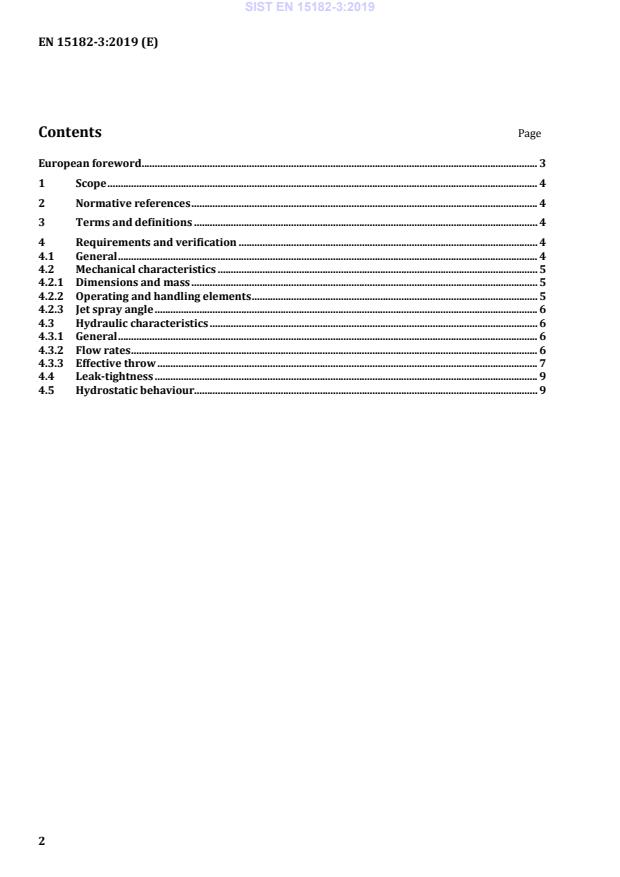
Contents Page
European foreword . 3
1 Scope . 4
2 Normative references . 4
3 Terms and definitions . 4
4 Requirements and verification . 4
4.1 General . 4
4.2 Mechanical characteristics . 5
4.2.1 Dimensions and mass . 5
4.2.2 Operating and handling elements . 5
4.2.3 Jet spray angle . 6
4.3 Hydraulic characteristics . 6
4.3.1 General . 6
4.3.2 Flow rates . 6
4.3.3 Effective throw . 7
4.4 Leak-tightness . 9
4.5 Hydrostatic behaviour. 9
European foreword
This document (EN 15182-3:2019) has been prepared by Technical Committee CEN/TC 192 “Fire and
rescue service equipment”, the secretariat of which is held by BSI.
This European Standard shall be given the status of a national standard, either by publication of an
identical text or by endorsement, at the latest by February 2020, and conflicting national standards
shall be withdrawn at the latest by February 2020.
Attention is drawn to the possibility that some of the elements of this document may be the subject of
patent rights. CEN shall not be held responsible for identifying any or all such patent rights.
This document supersedes EN 15182-3:2007+A1:2009.
Compared to EN 15182-3:2007+A1:2009 the following changes have been made:
— each verification has been placed under the corresponding requirement;
— a test to measure the forces needed to move the rotating elements which have detents (4.2.2) has
been added;
— the requirements for flowrates (4.3.2) have been updated;
— the verifications for leak-tightness (4.4) and hydrostatic behaviour (4.5) have been updated;
— improvement of the wording/editorial changes.
According to the CEN-CENELEC Internal Regulations, the national standards organisations of the
following countries are bound to implement this European Standard: Austria, Belgium, Bulgaria,
Croatia, Cyprus, Czech Republic, Denmark, Estonia, Finland, France, Germany, Greece, Hungary, Iceland,
Ireland, Italy, Latvia, Lithuania, Luxembourg, Malta, Netherlands, Norway, Poland, Portugal, Republic of
North Macedonia, Romania, Serbia, Slovakia, Slovenia, Spain, Sweden, Switzerland, Turkey and the
United K
...