

SIST EN 12697-7:2022
(Main)Bituminous mixtures - Test methods - Part 7: Determination of the bulk density of bituminous specimens by gamma rays
General Information
- Abstract
This document specifies a method for measuring the bulk density of pavement mixtures using a transmission-type gamma radiation test bench.
This method applies to cylindrical specimens or parallelepipedal blocks, prepared in a laboratory or cut from a pavement. The thickness and the mass absorption coefficient, which is a function of the chemical composition, are known. The thickness of the specimen body traversed by the radiation is between 30 mm and 300 mm.
The method cannot be applied to materials containing slags, with variable metal content or chemical composition.
NOTE Material containing metal or chemical compositions can affect the absorption of gamma rays.
- Status
- Published
- Public Enquiry End Date
- 19-Jan-2021
- Publication Date
- 14-Mar-2022
- Technical Committee
- CES - Roads
- Current Stage
- 6060 - National Implementation/Publication (Adopted Project)
- Start Date
- 03-Mar-2022
- Due Date
- 08-May-2022
- Completion Date
- 15-Mar-2022



Overview
SIST EN 12697-7:2022 is a European standard developed by CEN that specifies a test method for determining the bulk density of bituminous mixtures using gamma rays. This nondestructive technique applies to cylindrical or parallelepipedal specimens prepared in the laboratory or extracted from pavements. The method hinges on measuring gamma ray absorption as it passes through the specimen, enabling precise density calculations essential for quality control in road construction and asphalt pavement evaluation.
Key Topics
Scope and Applicability:
- The standard applies to bituminous specimens with thickness between 30 mm and 300 mm.
- Suitable for laboratory-prepared or pavement-cut specimens.
- Not applicable to materials containing slags or with variable metal content due to interference with gamma absorption characteristics.
Measurement Principle:
- Utilizes a transmission-type gamma radiation test bench with a radioactive source (commonly Cs-137).
- Gamma rays are emitted through a specimen; their absorption is measured to determine bulk density.
- The method follows an exponential absorption law based on material properties and specimen thickness.
Apparatus and Setup:
- Consists of an emitter-source unit and a receiving unit aligned at a fixed distance.
- Includes several collimators to control the beam diameter depending on specimen size and layer thickness.
- Requires calibration using specimens with known density to ensure measurement accuracy.
Specimen Preparation:
- Specimens must be dry or have a known water content; drying is typically done at ambient temperature until mass variation is minimal.
- Surfaces should be free from debris, and thickness must be measured precisely to 0.1 mm accuracy.
- Cylindrical specimens require marking for orientation during testing.
Measurement Procedure:
- Two measurement modes: continuous (moving specimen across beam) or localized/point measurements (stationary specimen with rotation if cylindrical).
- Requires prior adjustment and alignment of equipment and compensation for possible count rate variations during the test.
- Data collection includes count rates with and without the specimen to compute bulk density using standardized formulae.
Calculation and Results Expression:
- Bulk density calculation involves the mass absorption coefficient which depends on the chemical composition of the material.
- Calibration factor is applied to adjust results, traceable to density measurements per EN 12697-6.
- Final results are given in megagrams per cubic meter (Mg/m³), reflecting the combined density of aggregate and binder including moisture, if not dry.
Applications
Quality Control in Asphalt Production and Pavement Construction:
Ensures consistent density of bituminous layers which is critical for pavement durability and performance.Non-Destructive Testing in Pavement Evaluation:
Allows measurement without damaging specimens, enabling repeated tests on the same sample or in-situ cores.Research and Development in Road Materials:
Provides a reliable method for testing novel asphalt mixtures or additives by assessing density variations accurately.Layer Density Assessment:
Supports density gradient and homogeneity analysis within pavement layers, crucial for structural evaluation.
Related Standards
EN 12697-6: Bituminous mixtures - Test methods - Part 6: Determination of bulk density of bituminous specimens
Provides complementary bulk density measurement methods that can be used for calibration and verification.Other Parts of EN 12697 Series
The series covers various test methods for bituminous mixtures including stiffness, fatigue, and moisture susceptibility, all contributing to comprehensive asphalt testing protocols.ISO and IEC Terminology Databases
For standardized definitions and terms used in material testing and related procedures.
Keywords: SIST EN 12697-7:2022, bituminous mixtures, bulk density, gamma rays, pavement testing, nondestructive testing, asphalt density measurement, road construction materials, gamma radiation test bench, quality control asphalt, bulk density calculation.
Relations
- Effective Date
- 01-Apr-2022
- Effective Date
- 28-Jan-2026
- Effective Date
- 28-Jan-2026
- Referred By
SIST EN 13108-7:2016 - Bituminous mixtures - Material specifications - Part 7: Porous Asphalt - Effective Date
- 28-Jan-2026
- Effective Date
- 28-Jan-2026
- Effective Date
- 28-Jan-2026
- Referred By
SIST EN 13108-20:2006 - Bituminous mixtures - Material specifications - Part 20: Type Testing - Effective Date
- 28-Jan-2026
- Effective Date
- 28-Jan-2026
- Effective Date
- 28-Jan-2026
- Effective Date
- 28-Jan-2026
- Referred By
SIST EN 12697-24:2018 - Bituminous mixtures - Test methods - Part 24: Resistance to fatigue - Effective Date
- 28-Jan-2026
- Effective Date
- 28-Jan-2026
- Effective Date
- 28-Jan-2026
Get Certified
Connect with accredited certification bodies for this standard

Zavod za gradbeništvo Slovenije (ZAG) - Inšpekcija
ZAG inspection body for construction products, structures, and materials.
Sponsored listings
Frequently Asked Questions
SIST EN 12697-7:2022 is a standard published by the Slovenian Institute for Standardization (SIST). Its full title is "Bituminous mixtures - Test methods - Part 7: Determination of the bulk density of bituminous specimens by gamma rays". This standard covers: This document specifies a method for measuring the bulk density of pavement mixtures using a transmission-type gamma radiation test bench. This method applies to cylindrical specimens or parallelepipedal blocks, prepared in a laboratory or cut from a pavement. The thickness and the mass absorption coefficient, which is a function of the chemical composition, are known. The thickness of the specimen body traversed by the radiation is between 30 mm and 300 mm. The method cannot be applied to materials containing slags, with variable metal content or chemical composition. NOTE Material containing metal or chemical compositions can affect the absorption of gamma rays.
This document specifies a method for measuring the bulk density of pavement mixtures using a transmission-type gamma radiation test bench. This method applies to cylindrical specimens or parallelepipedal blocks, prepared in a laboratory or cut from a pavement. The thickness and the mass absorption coefficient, which is a function of the chemical composition, are known. The thickness of the specimen body traversed by the radiation is between 30 mm and 300 mm. The method cannot be applied to materials containing slags, with variable metal content or chemical composition. NOTE Material containing metal or chemical compositions can affect the absorption of gamma rays.
SIST EN 12697-7:2022 is classified under the following ICS (International Classification for Standards) categories: 93.080.20 - Road construction materials. The ICS classification helps identify the subject area and facilitates finding related standards.
SIST EN 12697-7:2022 has the following relationships with other standards: It is inter standard links to SIST EN 12697-7:2014, SIST EN 12697-6:2020, SIST EN 12697-22:2020, SIST EN 13108-7:2016, SIST EN 13108-9:2016, SIST EN 12697-12:2018, SIST EN 13108-20:2006, SIST EN 12697-8:2019, SIST EN 12697-43:2023, SIST EN 12697-26:2018, SIST EN 12697-24:2018, SIST EN 12697-26:2018+A1:2022, SIST EN 12697-22:2004+A1:2007. Understanding these relationships helps ensure you are using the most current and applicable version of the standard.
SIST EN 12697-7:2022 is available in PDF format for immediate download after purchase. The document can be added to your cart and obtained through the secure checkout process. Digital delivery ensures instant access to the complete standard document.
Standards Content (Sample)
SLOVENSKI STANDARD
01-april-2022
Nadomešča:
SIST EN 12697-7:2014
Bitumenske zmesi - Preskusne metode - 7. del: Ugotavljanje gostote bitumenskih
preskušancev z žarki gama
Bituminous mixtures - Test methods - Part 7: Determination of the bulk density of
bituminous specimens by gamma rays
Asphalt - Prüfverfahren - Teil 7: Bestimmung der Raumdichte von Asphalt-Probekörpern
mit Gammastrahlen
Mélanges bitumineux - Méthodes d’essai - Partie 7 : Détermination de la masse
volumique apparente des éprouvettes bitumineuses par les rayons gamma
Ta slovenski standard je istoveten z: EN 12697-7:2022
ICS:
93.080.20 Materiali za gradnjo cest Road construction materials
2003-01.Slovenski inštitut za standardizacijo. Razmnoževanje celote ali delov tega standarda ni dovoljeno.
EN 12697-7
EUROPEAN STANDARD
NORME EUROPÉENNE
February 2022
EUROPÄISCHE NORM
ICS 93.080.20 Supersedes EN 12697-7:2014
English Version
Bituminous mixtures - Test methods - Part 7:
Determination of the bulk density of bituminous
specimens by gamma rays
Mélanges bitumineux - Méthodes d'essai - Partie 7 : Asphalt - Prüfverfahren - Teil 7: Bestimmung der
Détermination de la masse volumique apparente des Raumdichte von Asphalt-Probekörpern mit Gamma-
éprouvettes bitumineuses par les rayons gamma Strahlen
This European Standard was approved by CEN on 26 December 2021.
CEN members are bound to comply with the CEN/CENELEC Internal Regulations which stipulate the conditions for giving this
European Standard the status of a national standard without any alteration. Up-to-date lists and bibliographical references
concerning such national standards may be obtained on application to the CEN-CENELEC Management Centre or to any CEN
member.
This European Standard exists in three official versions (English, French, German). A version in any other language made by
translation under the responsibility of a CEN member into its own language and notified to the CEN-CENELEC Management
Centre has the same status as the official versions.
CEN members are the national standards bodies of Austria, Belgium, Bulgaria, Croatia, Cyprus, Czech Republic, Denmark, Estonia,
Finland, France, Germany, Greece, Hungary, Iceland, Ireland, Italy, Latvia, Lithuania, Luxembourg, Malta, Netherlands, Norway,
Poland, Portugal, Republic of North Macedonia, Romania, Serbia, Slovakia, Slovenia, Spain, Sweden, Switzerland, Turkey and
United Kingdom.
EUROPEAN COMMITTEE FOR STANDARDIZATION
COMITÉ EUROPÉEN DE NORMALISATION
EUROPÄISCHES KOMITEE FÜR NORMUNG
CEN-CENELEC Management Centre: Rue de la Science 23, B-1040 Brussels
© 2022 CEN All rights of exploitation in any form and by any means reserved Ref. No. EN 12697-7:2022 E
worldwide for CEN national Members.
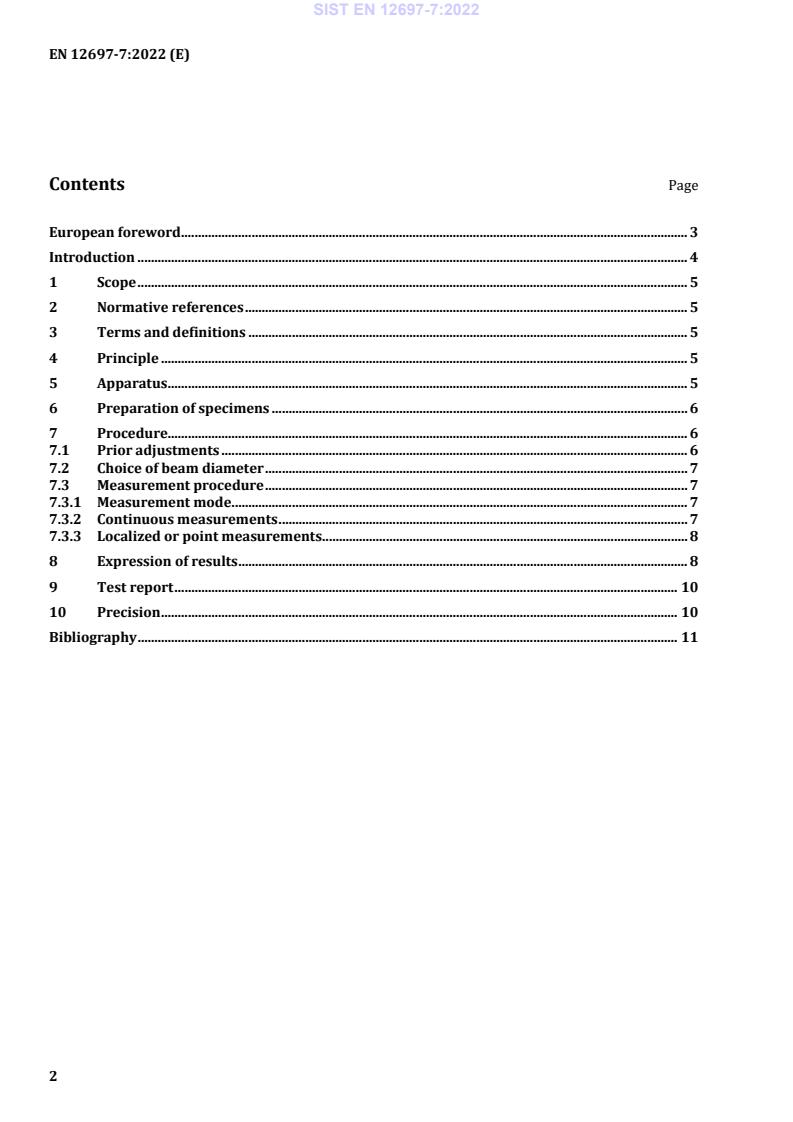
Contents Page
European foreword . 3
Introduction . 4
1 Scope . 5
2 Normative references . 5
3 Terms and definitions . 5
4 Principle . 5
5 Apparatus . 5
6 Preparation of specimens . 6
7 Procedure. 6
7.1 Prior adjustments . 6
7.2 Choice of beam diameter . 7
7.3 Measurement procedure . 7
7.3.1 Measurement mode . 7
7.3.2 Continuous measurements . 7
7.3.3 Localized or point measurements . 8
8 Expression of results . 8
9 Test report . 10
10 Precision . 10
Bibliography . 11
European foreword
This document (EN 12697-7:2022) has been prepared by Technical Committee CEN/TC 227 “Road
materials”, the secretariat of which is held by BSI.
This European Standard shall be given the status of a national standard, either by publication of an
identical text or by endorsement, at the latest by August 2022, and conflicting national standards shall be
withdrawn at the latest by August 2022.
Attention is drawn to the possibility that some of the elements of this document may be the subject of
patent rights. CEN shall not be held responsible for identifying any or all such patent rights.
This document supersedes EN 12697-7:2014.
The main changes compared to the previous edition are listed below:
— the title no longer refers to hot mix asphalt;
— [ge] editorial update according to current standard template;
— Clause 1, scope clarified according the CEN/CENELEC Internal Regulations Part 3:2019, 14.5;
— Clause 4, deletion of the exponential law including equation. Added reference to Clause 8;
1)
— (5.1), footnote amended to NOTE. Existing NOTE amended to normal text;
— Clause 6, NOTE 1: The period for when specimens are considered to be dry amended to 4 h in line
with other parts;
2)
— Clause 6, Footnote amended to NOTE 2. Existing NOTE amended to NOTE 1;
— Clause 6, measurement of the thickness of specimen replaced by “shall be known”;
— (7.3.3), formula for consistency test deleted and replaced with reference to Formula (1);
— Clause 8, editorial adjustments, renumbered formulas and addition of references to formulas;
— Clause 9, revision of data to be reported;
— Clause 10, completion of standard edition to read ISO 5725-2;
— [ge] bibliography added.
A list of all parts in the EN 12697 series can be found on the CEN website.
Any feedback and questions on this document should be directed to the users’ national standards body.
A complete listing of these bodies can be found on the CEN website.
According to the CEN-CENELEC Internal Regulations, the national standards organisations of the
following countries are bound to implement this European Standard: Austria, Belgium, Bulgaria, Croatia,
Cyprus, Czech Republic, Denmark, Estonia, Finland, France, Germany, Greece, Hungary, Iceland, Ireland,
Italy, Latvia, Lithuania, Luxembourg, Malta, Netherlands, Norway, Poland, Portugal, Republic of North
Macedonia, Romania, Serbia, Slovakia, Slovenia, Spain, Sweden, Switzerland, Turkey and the United
Kingdom.
Introduction
Bulk density measurement in the laboratory using gamma rays is a method which does not affect the
properties of the material. It can be included in a series of tests carried out on a given sample. It allows
the plotting of a density chart or gradient.
1 Scope
This document specifies a method for measuring the bulk density of pavement mixtures using a
transmission-type gamma radiation test bench.
This method applies to cylindrical specimens or parallelepipedal blocks, prepared in a laboratory or cut
from a pavement. The thickness and the mass absorption coefficient, which is a function of the chemical
composition, are known. The thickness of the specimen body traversed by the radiation is between
30 mm and 300 mm.
The method cannot be applied to materials containing slags, with variable metal content or chemical
composition.
NOTE Material containing metal or chemical compositions can affect the absorption of gamma rays.
2 Normative references
The following documents are referred to in the text in such a way that some or all of their content
constitutes requirements of this document. For dated references, only the edition cited applies. For
undated references, the latest edition of the referenced document (including any amendments) applies.
EN 12697-6, Bituminous mixtures - Test methods - Part 6: Determination of bulk density of bituminous
specimens
3 Terms and definitions
For the purposes of this document, the following terms and definitions apply.
ISO and IEC maintain terminological databases for use in standardization at the following addresses:
— IEC Electropedia: available at https://www.electropedia.org/
— ISO Online browsing platform: available at https://www.iso.org/obp
4 Principle
The method is based upon the absorption of gamma radiation by the material under the conditions of the
test described in this document and for materials such as bituminous mixtures. The method follows an
exponential law according to Clause 8, Formulae (2) and (3).
The specimen is placed in the path of a gamma ray b
...