

SIST EN 12590:2000
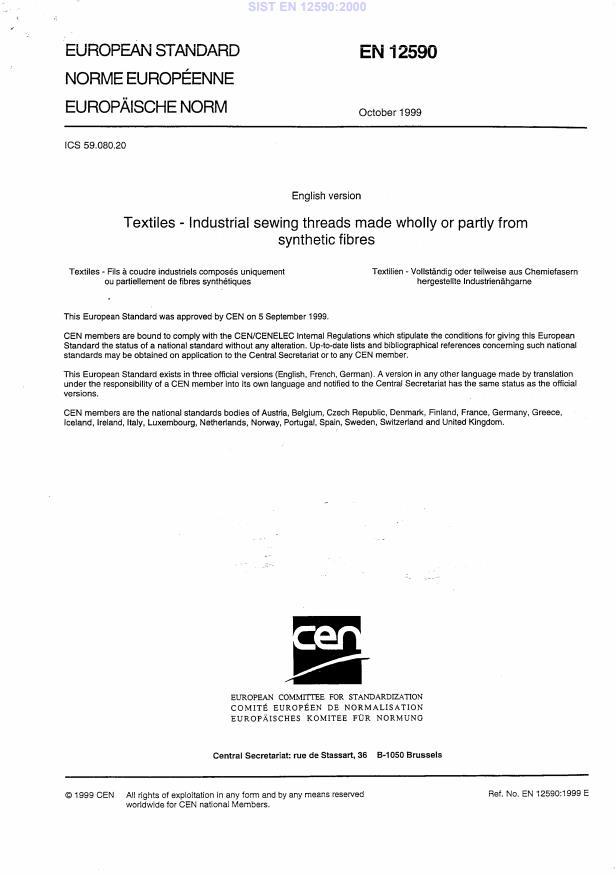
(Main)Textiles - Industrial sewing threads made wholly or partly from synthetic fibres
General Information
- Abstract
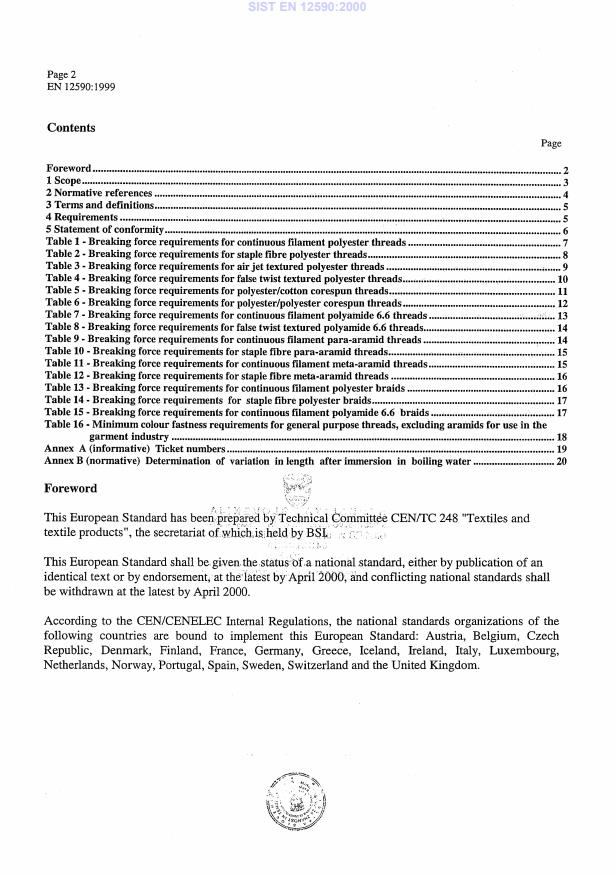
This European Standard specifies requirements for industrial sewing threads made wholly or partly from synthetic fibres. It specifies requirements for industrial sewing threads based on breaking force in relation to the thread size. For threads which are for use in the garment trade it also specifies colour fastness and boiling water shrinkage requirements. It deals with industrial sewing threads made from the following substrates and combinations of substrates: a) Continuous filament polyester; b) Staple fibre polyester; c) Air-Jet textured polyester (see 3.3); d) False twist textured polyester (see 3.4);...
- Status
- Published
- Publication Date
- 30-Jun-2000
- Technical Committee
- ITEK - Textile and textile products
- Current Stage
- 6060 - National Implementation/Publication (Adopted Project)
- Start Date
- 01-Jul-2000
- Due Date
- 01-Jul-2000
- Completion Date
- 01-Jul-2000

Overview
EN 12590:1999 is a European Standard (CEN) that specifies requirements for industrial sewing threads made wholly or partly from synthetic fibres. The standard defines performance criteria principally based on breaking force in relation to thread size, and - for threads intended for the garment trade - additional requirements for colour fastness and boiling water shrinkage. EN 12590 covers a range of polyester-based thread types used in industrial sewing applications.
Key Topics and Technical Requirements
- Scope and applicability
- Applies to industrial sewing threads composed wholly or partly of synthetic fibres, primarily polyester variants.
- Substrate types covered
- Examples include continuous filament polyester, staple-fibre polyester, air‑jet textured polyester, and false‑twist textured polyester, among other polyester combinations.
- Mechanical performance
- Requirements are defined by breaking force relative to thread size (i.e., minimum strength criteria linked to thread denier/tex).
- Garment-specific requirements
- For sewing threads intended for apparel use, the standard specifies colour fastness and boiling water shrinkage performance expectations.
- Quality and conformity
- Testable properties are identified so manufacturers and testing laboratories can demonstrate conformity to the standard; EN 12590 is used to set production and inspection criteria.
- National adoption
- EN 12590 has been adopted by CEN member bodies; examples include national versions such as SIST EN 12590:2000.
Applications and Who Uses This Standard
- Thread manufacturers use EN 12590 to design, produce, and certify industrial polyester sewing threads that meet European market requirements.
- Textile and apparel producers rely on the standard to select threads that provide required strength, colour fastness, and dimensional stability for garments and sewn products.
- Quality control & testing laboratories apply the standard’s specified criteria when performing strength, shrinkage, and colour fastness testing.
- Procurement and specification teams in automotive, upholstery, footwear, and industrial sewing sectors use EN 12590 to create supplier specifications and ensure product consistency.
- Standards bodies and regulators reference EN 12590 when harmonizing textile product requirements across Europe.
Related Standards
- EN 12590 should be used alongside other textile testing and sewing thread standards and national implementations (e.g., SIST EN versions). For complete conformity programs, pair EN 12590 with applicable ISO/CEN textile testing standards and industry-specific sewing thread specifications.
Keywords: EN 12590, industrial sewing threads, synthetic fibres, polyester sewing thread, thread breaking force, colour fastness, boiling water shrinkage, textile standards, CEN.
Relations
- Effective Date
- 28-Jan-2026
- Refers
SIST EN ISO 139:2005 - Textiles - Standard atmospheres for conditioning and testing (ISO 139:2005) - Effective Date
- 28-Jan-2026
- Effective Date
- 28-Jan-2026
- Effective Date
- 28-Jan-2026
- Effective Date
- 28-Jan-2026
- Effective Date
- 28-Jan-2026
- Effective Date
- 28-Jan-2026
- Effective Date
- 28-Jan-2026
- Effective Date
- 28-Jan-2026
- Effective Date
- 28-Jan-2026
- Effective Date
- 28-Jan-2026
Get Certified
Connect with accredited certification bodies for this standard

Control Union Certifications
Global certification for agriculture and sustainability.

Hohenstein Institut
Textile testing and certification.

Bureau Veritas Bangladesh
Bureau Veritas certification services in Bangladesh.
Sponsored listings
Frequently Asked Questions
SIST EN 12590:2000 is a standard published by the Slovenian Institute for Standardization (SIST). Its full title is "Textiles - Industrial sewing threads made wholly or partly from synthetic fibres". This standard covers: This European Standard specifies requirements for industrial sewing threads made wholly or partly from synthetic fibres. It specifies requirements for industrial sewing threads based on breaking force in relation to the thread size. For threads which are for use in the garment trade it also specifies colour fastness and boiling water shrinkage requirements. It deals with industrial sewing threads made from the following substrates and combinations of substrates: a) Continuous filament polyester; b) Staple fibre polyester; c) Air-Jet textured polyester (see 3.3); d) False twist textured polyester (see 3.4);...
This European Standard specifies requirements for industrial sewing threads made wholly or partly from synthetic fibres. It specifies requirements for industrial sewing threads based on breaking force in relation to the thread size. For threads which are for use in the garment trade it also specifies colour fastness and boiling water shrinkage requirements. It deals with industrial sewing threads made from the following substrates and combinations of substrates: a) Continuous filament polyester; b) Staple fibre polyester; c) Air-Jet textured polyester (see 3.3); d) False twist textured polyester (see 3.4);...
SIST EN 12590:2000 is classified under the following ICS (International Classification for Standards) categories: 59.080.20 - Yarns. The ICS classification helps identify the subject area and facilitates finding related standards.
SIST EN 12590:2000 has the following relationships with other standards: It is inter standard links to SIST EN ISO 105-D01:2013, SIST EN ISO 139:2005, SIST EN ISO 105-X12:2016, SIST EN ISO 2062:2010, SIST EN ISO 105-E01:2013, SIST EN ISO 105-B02:2014, SIST EN ISO 140-11:2005, SIST EN ISO 2060:1996, SIST EN ISO 105-C06:2012, SIST-TS CEN/TS 14237:2016, SIST ENV 14237:2002. Understanding these relationships helps ensure you are using the most current and applicable version of the standard.
SIST EN 12590:2000 is available in PDF format for immediate download after purchase. The document can be added to your cart and obtained through the secure checkout process. Digital delivery ensures instant access to the complete standard document.
Standards Content (Sample)
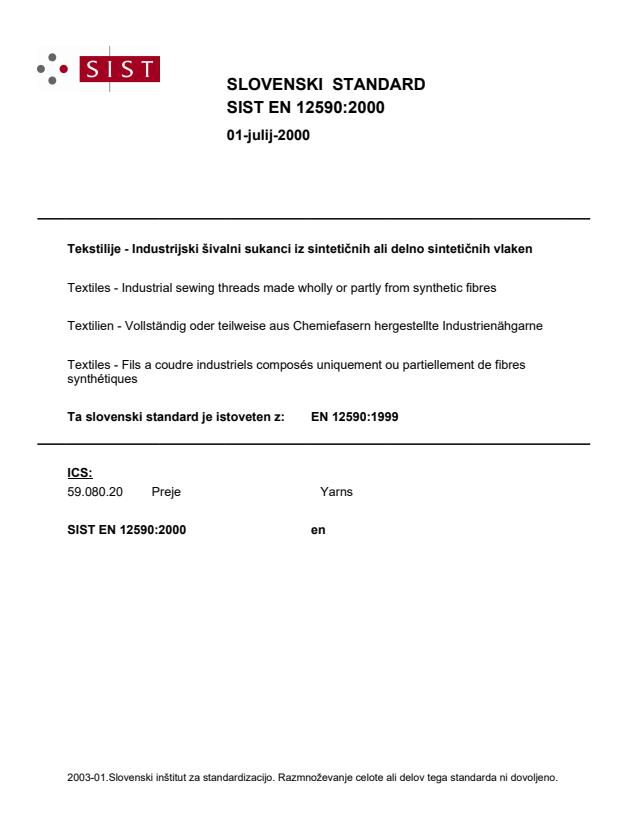
2003-01.Slovenski inštitut za standardizacijo. Razmnoževanje celote ali delov tega standarda ni dovoljeno.Textilien - Vollständig oder teilweise aus Chemiefasern hergestellte IndustrienähgarneTextiles - Fils a coudre industriels composés uniquement ou partiellement de fibres synthétiquesTextiles - Industrial sewing threads made wholly or partly from synthetic fibres59.080.20PrejeYarnsICS:Ta slovenski standard je istoveten z:EN 12590:1999SIST EN 12590:2000en01-julij-2000SIST EN 12590:2000SLOVENSKI
STANDARD
SIST
...