

oSIST prEN 14116:2026
(Main)Tanks for transport of dangerous goods - Digital interface for product recognition devices for liquid fuels
General Information
- Abstract
This document covers the digital interface at the product loading and/or discharge coupling which is used for the transfer of product related information and specifies the performance requirements, critical safety aspects and tests to provide compatibility of devices.
- Status
- Not Published
- Public Enquiry End Date
- 02-Jul-2026
- Technical Committee
- TLP - Pressure vessels
- Current Stage
- 4020 - Public enquire (PE) (Adopted Project)
- Start Date
- 28-Apr-2026
- Due Date
- 15-Sep-2026
- Completion Date
- 06-Aug-2026

Overview
oSIST prEN 14116:2026 defines the requirements and protocol for the digital interface used by product recognition devices (PRDs) on tanks for the transport of dangerous goods, specifically focusing on liquid fuels. Developed by CEN/TC 296, this draft standard aims to ensure seamless digital communication at product loading and discharge couplings, enhancing traceability, safety, and operational efficiency in the transport of hazardous materials.
By specifying the digital interface, performance criteria, safety aspects, and required interoperability tests, oSIST prEN 14116:2026 helps stakeholders - such as tank manufacturers, fuel terminal operators, and transporters - achieve reliable product identification and cross-system compatibility. The standard is set to replace EN 14116:2012+A2:2018.
Key Topics
- Digital Interface Specification: Establishes the electrical and communication protocol for transferring product-related data between loading/discharge infrastructure and the transport tank.
- Product Identification: Utilizes Product Identification Devices (PIDs) and Multiple Product Identification Devices (MultiPIDs) to ensure correct recognition of liquid fuels and prevention of product cross-contamination.
- Performance and Safety Requirements: Outlines necessary electrical and explosion-protection characteristics to ensure safe operation in hazardous environments (compliance with EN IEC 60079-0 and EN 60079-11).
- Testing and Compatibility: Mandates type and production testing to validate device performance, reliability, and compatibility between different manufacturers’ equipment.
- Protocol Structure: Defines the data coding, telegram/message format, and sequence for product and location information transfer.
- Installation and Maintenance: Provides guidance on correct implementation and ongoing equipment management for long-term reliability.
Applications
oSIST prEN 14116:2026 has practical applications across the logistics and petroleum industries:
- Automatic Product Identification: Enables automatic detection and confirmation of the type of fuel in each tank compartment, reducing manual errors at loading and unloading.
- Cross-Over Prevention: Prevents the mixing of different fuel types during transfer operations by verifying proper connections and product coding.
- Overfill Protection: Supports automated overfill prevention by linking data from PRDs to terminal automation systems, enhancing safety at depots and stations.
- Data Interchange: Facilitates bi-directional communication between stationary terminals and transport tanks, allowing for real-time updates on transferred quantities and tank status.
- Fleet and Asset Management: Enhances traceability and record-keeping of dangerous goods in transit by providing standardized digital records for product types, locations, and delivery chain.
Related Standards
Organizations working with oSIST prEN 14116:2026 should be aware of the following related standards to ensure overall compliance and compatibility:
- EN 13616: Overfill prevention devices for static tanks with liquid petroleum fuels.
- EN IEC 60079-0 & EN 60079-11: Standards for equipment intended for use in explosive atmospheres and intrinsic safety requirements.
- ISO 2859-1: Sampling procedures for inspection by attributes.
- ISO 8601: For representation of dates and times in data exchange.
- EN 15208: Reference for the operation of Multiple Product Identification Devices (MultiPIDs).
Summary
oSIST prEN 14116:2026 responds to the growing demand for enhanced safety and digitalization in the transport of dangerous goods. By providing a comprehensive framework for digital product recognition and safe, standardized data exchange, the standard strengthens industry-wide compatibility, regulatory compliance, and process automation across the liquid fuel supply chain. Stakeholders involved in the manufacture, operation, or maintenance of tanks for dangerous goods are strongly encouraged to align their systems with the requirements of oSIST prEN 14116:2026 for safe and efficient transport operations.
Relations
- Effective Date
- 01-Jun-2026
Get Certified
Connect with accredited certification bodies for this standard

BSI Group
BSI (British Standards Institution) is the business standards company that helps organizations make excellence a habit.

CIS Institut d.o.o.
Personal Protective Equipment (PPE) certification body. Notified Body NB-2890 for EU Regulation 2016/425 PPE.
Institut za varilstvo d.o.o. (Welding Institute)
Slovenia's leading welding institute since 1952. ISO 3834, EN 1090, pressure equipment certification, NDT personnel, welder qualification. Only IIW Au
Sponsored listings
Frequently Asked Questions
oSIST prEN 14116:2026 is a draft published by the Slovenian Institute for Standardization (SIST). Its full title is "Tanks for transport of dangerous goods - Digital interface for product recognition devices for liquid fuels". This standard covers: This document covers the digital interface at the product loading and/or discharge coupling which is used for the transfer of product related information and specifies the performance requirements, critical safety aspects and tests to provide compatibility of devices.
This document covers the digital interface at the product loading and/or discharge coupling which is used for the transfer of product related information and specifies the performance requirements, critical safety aspects and tests to provide compatibility of devices.
oSIST prEN 14116:2026 is classified under the following ICS (International Classification for Standards) categories: 13.300 - Protection against dangerous goods; 23.020.20 - Vessels and containers mounted on vehicles; 35.240.60 - IT applications in transport. The ICS classification helps identify the subject area and facilitates finding related standards.
oSIST prEN 14116:2026 has the following relationships with other standards: It is inter standard links to SIST EN 14116:2012+A2:2018. Understanding these relationships helps ensure you are using the most current and applicable version of the standard.
oSIST prEN 14116:2026 is available in PDF format for immediate download after purchase. The document can be added to your cart and obtained through the secure checkout process. Digital delivery ensures instant access to the complete standard document.
Standards Content (Sample)
SLOVENSKI STANDARD
01-junij-2026
Cisterne za prevoz nevarnega blaga - Digitalni vmesnik za napravo za
prepoznavanje proizvoda za tekoča goriva
Tanks for transport of dangerous goods - Digital interface for product recognition devices
for liquid fuels
Tanks für die Beförderung gefährlicher Güter - Digitale Schnittstelle für das
Produkterkennungssystem für flüssige Kraft‑ und Brennstoffe
Citernes destinées au transport de matières dangereuses - Interface numérique du
dispositif de reconnaissance de produits pétroliers
Ta slovenski standard je istoveten z: prEN 14116
ICS:
13.300 Varstvo pred nevarnimi Protection against dangerous
izdelki goods
23.020.20 Posode in vsebniki, montirani Vessels and containers
na vozila mounted on vehicles
35.240.60 Uporabniške rešitve IT v IT applications in transport
prometu
2003-01.Slovenski inštitut za standardizacijo. Razmnoževanje celote ali delov tega standarda ni dovoljeno.
DRAFT
EUROPEAN STANDARD
NORME EUROPÉENNE
EUROPÄISCHE NORM
April 2026
ICS 13.300 Will supersede EN 14116:2012+A2:2018
English Version
Tanks for transport of dangerous goods - Digital interface
for product recognition devices for liquid fuels
Citernes destinées au transport de matières Tanks für die Beförderung gefährlicher Güter - Digitale
dangereuses - Interface numérique du dispositif de Schnittstelle für das Produkterkennungssystem für
reconnaissance de produits pétroliers flüssige Kraft- und Brennstoffe
This draft European Standard is submitted to CEN members for enquiry. It has been drawn up by the Technical Committee
CEN/TC 296.
If this draft becomes a European Standard, CEN members are bound to comply with the CEN/CENELEC Internal Regulations
which stipulate the conditions for giving this European Standard the status of a national standard without any alteration.
This draft European Standard was established by CEN in three official versions (English, French, German). A version in any other
language made by translation under the responsibility of a CEN member into its own language and notified to the CEN-CENELEC
Management Centre has the same status as the official versions.
CEN members are the national standards bodies of Austria, Belgium, Bulgaria, Croatia, Cyprus, Czech Republic, Denmark, Estonia,
Finland, France, Germany, Greece, Hungary, Iceland, Ireland, Italy, Latvia, Lithuania, Luxembourg, Malta, Netherlands, Norway,
Poland, Portugal, Republic of North Macedonia, Romania, Serbia, Slovakia, Slovenia, Spain, Sweden, Switzerland, Türkiye and
United Kingdom.
Recipients of this draft are invited to submit, with their comments, notification of any relevant patent rights of which they are
aware and to provide supporting documentation.
Warning : This document is not a European Standard. It is distributed for review and comments. It is subject to change without
notice and shall not be referred to as a European Standard.
EUROPEAN COMMITTEE FOR STANDARDIZATION
COMITÉ EUROPÉEN DE NORMALISATION
EUROPÄISCHES KOMITEE FÜR NORMUNG
CEN-CENELEC Management Centre: Rue de la Science 23, B-1040 Brussels
© 2026 CEN All rights of exploitation in any form and by any means reserved Ref. No. prEN 14116:2026 E
worldwide for CEN national Members.
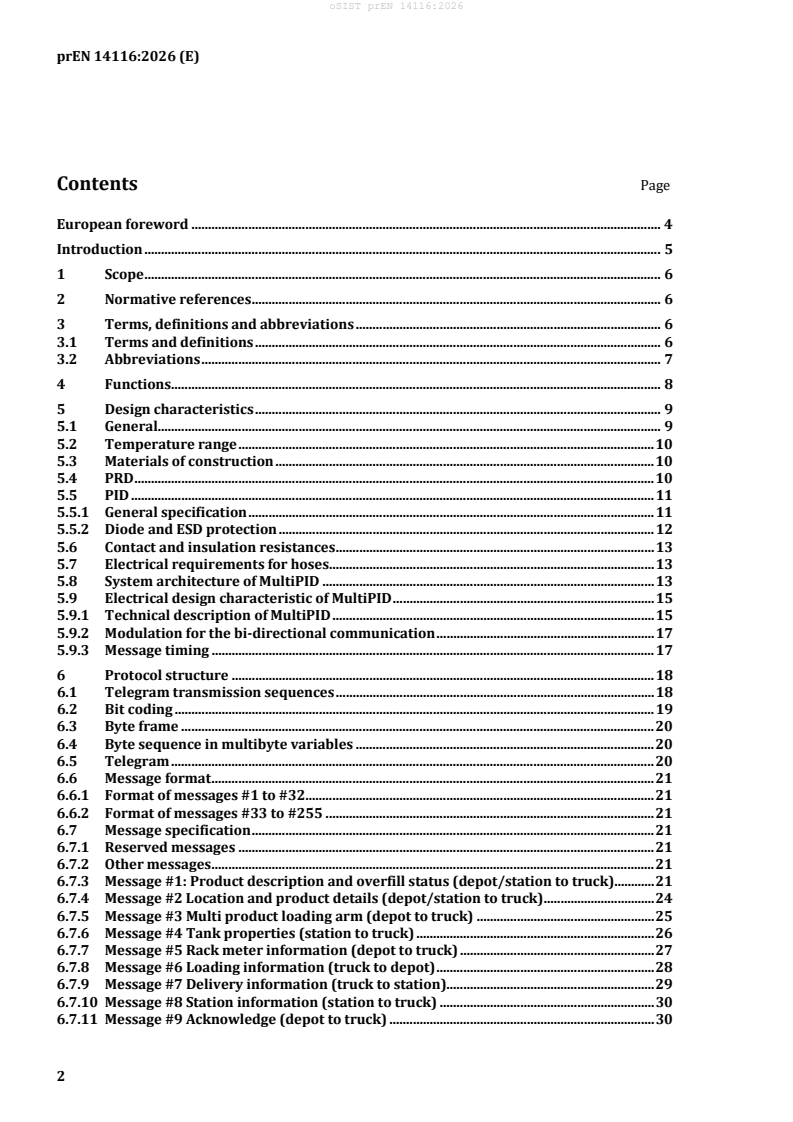
Contents Page
European foreword . 4
Introduction . 5
1 Scope . 6
2 Normative references . 6
3 Terms, definitions and abbreviations . 6
3.1 Terms and definitions . 6
3.2 Abbreviations . 7
4 Functions . 8
5 Design characteristics . 9
5.1 General. 9
5.2 Temperature range . 10
5.3 Materials of construction . 10
5.4 PRD . 10
5.5 PID . 11
5.5.1 General specification . 11
5.5.2 Diode and ESD protection . 12
5.6 Contact and insulation resistances . 13
5.7 Electrical requirements for hoses. 13
5.8 System architecture of MultiPID . 13
5.9 Electrical design characteristic of MultiPID . 15
5.9.1 Technical description of MultiPID . 15
5.9.2 Modulation for the bi-directional communication . 17
5.9.3 Message timing . 17
6 Protocol structure . 18
6.1 Telegram transmission sequences . 18
6.2 Bit coding . 19
6.3 Byte frame . 20
6.4 Byte sequence in multibyte variables . 20
6.5 Telegram . 20
6.6 Message format . 21
6.6.1 Format of messages #1 to #32. 21
6.6.2 Format of messages #33 to #255 . 21
6.7 Message specification . 21
6.7.1 Reserved messages . 21
6.7.2 Other messages . 21
6.7.3 Message #1: Product description and overfill status (depot/station to truck). 21
6.7.4 Message #2 Location and product details (depot/station to truck) . 24
6.7.5 Message #3 Multi product loading arm (depot to truck) . 25
6.7.6 Message #4 Tank properties (station to truck) . 26
6.7.7 Message #5 Rack meter information (depot to truck) . 27
6.7.8 Message #6 Loading information (truck to depot) . 28
6.7.9 Message #7 Delivery information (truck to station). 29
6.7.10 Message #8 Station information (station to truck) . 30
6.7.11 Message #9 Acknowledge (depot to truck) . 30
6.7.12 Message #10 Return product information (truck to return station) . 30
6.7.13 Message #32 CRC 16 . 31
7 Tests . 31
7.1 Type test . 31
7.1.1 General . 31
7.1.2 PID . 31
7.1.3 PRD function test . 34
7.1.4 Test results. 36
7.2 Production test . 36
7.2.1 General . 36
7.2.2 PID static test . 36
7.2.3 PID function test . 36
7.2.4 PRD function test . 36
7.2.5 Test results. 36
8 Marking . 37
9 Installation, operating and maintenance recommendations . 37
Annex A (informative) Manufacturer ID . 38
Annex B (normative) Calculation algorithm for CRC 16 . 39
Annex C (informative) A-deviations . 40
Annex D (normative) Company code . 41
D.1 Reason for the company code . 41
D.2 Host of the list . 41
D.3 Website . 41
D.4 Rules . 41
Bibliography . 42
European foreword
This document (prEN 14116:2026) has been prepared by Technical Committee CEN/TC 296 “Tanks for
the transport of dangerous goods”, the secretariat of which is held by AFNOR.
This document is currently submitted to the CEN Enquiry.
This document will supersede EN 14116:2012+A2:2018.
EN 14116:2012+A2:2018:
— Figure 9 in 5.9 has been revised to accurately reflect the description in the text.
Introduction
Product recognition, the subject of this document, is the digital interface that allows product data and/or
other information to be transferred between transport tanks and other installations.
1 Scope
This document covers the digital interface at the product loading and/or discharge coupling which is used
for the transfer of product related information and specifies the performance requirements, critical safety
aspects and tests to provide compatibility of devices.
2 Normative references
The following documents are referred to in the text in such a way that some or all of their content
constitutes requirements of this document. For dated references, only the edition cited applies. For
undated references, the latest edition of the referenced document (including any amendments) applies.
EN 13616:2004, Overfill prevention devices for static tanks for liquid petroleum fuels
EN IEC 60079-0, Explosive atmospheres — Part 0: Equipment — General requirements (IEC 60079-0)
EN 60079-11, Explosive atmospheres — Part 11: Equipment protection by intrinsic safety “i”
(IEC 60079-11)
ISO 2859-1, Sampling procedures for inspection by attributes — Part 1: Sampling schemes indexed by
acceptance quality limit (AQL) for lot-by-lot inspection
ISO 8601, Data elements and interchange formats — Information interchange — Representation of dates
and times
3 Terms, definitions and abbreviations
For the purposes of this document, the following terms and definitions apply.
ISO and IEC maintain terminology databases for use in standardization at the following addresses:
— ISO Online browsing platform: available at https://www.iso.org/obp/
— IEC Electropedia: available at https://www.electropedia.org/
3.1 Terms and definitions
3.1.1
message
defined data set
3.1.2
telegram
frame that contains at least one standardised message
3.1.3
maximum input voltage
Ui
according to EN 60079-11
3.1.4
maximum output voltage
U
according to EN 60079-11
3.1.5
maximum input current
I
i
according to EN 60079-11
3.1.6
maximum output current
I
according to EN 60079-11
3.1.7
maximum input power
P
i
according to EN 60079-11
3.1.8
maximum output power
P
according to EN 60079-11
3.1.9
maximum internal capacitance
Ci
according to EN 60079-11
3.1.10
maximum internal inductance
L
i
according to EN 60079-11
3.1.11
Multiple Product Identification Device
MultiPID
electronic device emulating at least one PID, extended by the ability of bi-directional communication
3.2 Abbreviations
ASCII American Standard Code for Information Interchange
CPDP Comité Professionnel Du Pétrole
ESD Electro-Static Discharge
LSB Least Significant Bit
MSB Most Significant Bit
PID Product Identification Device
PRD Product Recognition Device
RON Research Octane Number
4 Functions
Whenever a physical connection according to Figure 1 or Figure 2 is made, the digital interface enables
the transfer of product recognition data to the transport tank. The purpose of this digital interface is to
provide the data for the following types of applications:
a) automatic product identification for each compartment or tank;
b) cross over prevention;
c) overfill prevention (optional).
Bi-directionality may add the ability of communication between the stationary parts and the tank vehicle,
e.g. the transfer of data of measured quantities in both directions.
Key
1 pipework of loading arm with insulated coupling
2 pipework of transport tank with insulated coupling
3 vapour line
4 product line
5 PID, vapour
6 PID, product
7 PRD
a
required, if only one connection is established
Figure 1 — Loading
Key
1 pipework of transport tank with insulated coupling
b
2 conductive hoses and pipework of stationary tank with insulated couplings
3 vapour line
4 product line
5 PRD
6 PID, product
7 PID, vapour
a
required, if only one connection is established
b
if the discharge hoses are not conductive then the conductivity of these hoses shall be achieved by other
means
Figure 2 — Unloading
PRD supplies an intrinsically safe circuit.
5 Design characteristics
5.1 General
The PRD shall be located on the transport tank. The PID shall be connected in series to a current loop
with the PRD.
The PRD reads the PID by powering the PID through the hose or loading arm. The PID then sends its data
by modulating the supply current, which is sensed by the PRD; see Figure 3.
The PID sends its data, using messages, which are numbered from 1 to 255.
The PID always transmits “message #1”. By implementing more messages, it is possible to program the
PID with other types of information; see 6.6.
Since the PID modulates the supply current, PIDs shall not be connected in parallel.
Key
Components:
1 electronic circuit
ST modulating switch
IL supply current without modulation
ITD supply current amplitude
Figure 3 — Basic circuit diagram of PID
5.2 Temperature range
Unless otherwise specified, the operating temperature range shall be −20 °C to +50 °C.
Where the product recognition device is subjected to temperatures outside the specified temperature
range, all applicable temperature values shall be extended. All other requirements shall remain
unchanged.
5.3 Materials of construction
The manufacturer shall provide with the equipment a full material specification for those parts, which
may come into contact with the substances according to Clause 1.
5.4 PRD
The PRD shall provide an intrinsically safe power supply with the values according to Table 1 to the PID.
Table 1 — DC electrical characteristics of PRD
a
Parameter Unit Min Nom Max Ex-values
Open-circuit voltage V 11 12 15 U = 15
Short-circuit current mA - - 300 I = 300
Output power W - - 1,1 P = 1,1
a
Maximum value to ensure compliance with EN 60079-11.
Explosive protection shall be at least Ex ia IIA according to EN IEC 60079-0 and EN 60079-11.
5.5 PID
5.5.1 General specification
Explosion protection shall be at least Ex ia IIA according to EN IEC 60079-0 and EN 60079-11.
Table 2 — DC electrical characteristics of PID
a
Parameter Symbol Unit Min Nom Max Ex-values
Supply voltage U V 6 12 15 U = 15
i
Supply current without
I mA 0 5 10 I = 300
L i
modulation
Supply current at U < 3 V I mA - - 5 -
+ OFF
Maximum input power P W - - - = 1,1
i
Maximum internal capacitance Ci nF - - - = 600
Maximum internal inductance L µH - - - = 10
i
a
Maximum value to ensure compliance with EN 60079-11.
Table 3 — AC electrical characteristics of PID
Parameter Symbol Unit Min Nom Max
Supply current amplitude I mA 10 15 20
TD
Clock rate f Hz 4 800 4 880 4 960
TC
Duty cycle cd % 40 50 60
T
Rise time of output signal tTr µs 0 - 30
Fall time of output signal t µs 0 - 30
Tf
Transmission delay after power on t ms 0 - 0,9
Tds
The timing diagram of PID is shown in Figure 4.
Key
f = 2 × baud rate (f )
TC bit
I supply current with modulation
H
I supply current without modulation
L
t t at power ON
t , t t = t at i = I + 10 % I
1 4, 5 L TD
t , t = t at i = I + 90 % I
2 3 L TD
I supply current amplitude
TD
t transmission delay after power on
TdS
t fall time of output signal
Tf
t rise time of output signal
Tr
Figure 4 — Timing diagram of PID
5.5.2 Diode and ESD protection
To maintain ESD protection, a resistor has to be implemented into the PID; see Figure 5 and Table 4.
Key
Components:
1 electronic circuit
D diode
R ESD resistor
Figure 5 — PID schematic wiring diagram
Table 4 — Diode and ESD protection
Parameter Symbol Unit Min Max
Resistance of ESD resistor R kΩ 100 300
Diode D forward current I mA 300 -
D
Diode D forward voltage at
U V - 1
D
I < 50 mA
D
5.6 Contact and insulation resistances
The contact and insulation resistances shall be according to Table 5.
Table 5 — Contact and insulations resistances
Parameter Symbol Unit Min Max
a
Closed loop resistance R Ω - 10
L
b
Closed loop resistance for PRD design R Ω - 100
LD
c
Insulation resistance R kΩ 15 -
Ins
PRD ESD protection resistance R kΩ 100 500
ESD
a
All electrical contacts and wires. If hoses are used it includes also the hoses and couplings.
b
This equals the closed loop resistance R within a safety factor of 10.
L
c
Between different PID scan channels and between any PID scan channel and ground.
5.7 Electrical requirements for hoses
The electrical requirements for hoses used for loading and unloading shall be according to Table 6.
Hose design should minimize the built up of electrical charge during product flow.
Table 6 — Electrical requirements for hoses
Parameter Unit Minimum Maximum
a
Resistance between the couplings (end to end) Ω 0 5
Resistance between signal path and the external surface
Ω 1 500 —
c
of the hose
a
Inductance between the couplings (end to end) mH 0 0,4
a, b
Capacitance nF 0 200
a
These parameters are for single hoses and combinations of hoses, when the combination is used to make a
single hose. These parameters shall also include the signal return line.
b
Hose coupling to ground or signal return path.
c
Measurement surrounding/measurement condition: clamp DN 78, 20 mm wide, tighten, preferable full-
faced bearing. For other nominal diameters (DN) the clamp shall be coextensive, so appropriate smaller or
expanded.
5.8 System architecture of MultiPID
The system architecture shall be according to Figure 6.
Key
I depot
II truck
III station
IV station computer
V depot computer
a isolated vapour recovery
b isolated API-coupling
c isolated coupling discharge and vapour recovery
d Diesel (standard)
e RON 94
f RON 96
g Bio diesel
h RON 98
i vapour recovery
Figure 6 — Systematic of MultiPID
5.9 Electrical design characteristic of MultiPID
5.9.1 Technical description of MultiPID
The principle block diagram of MultiPID is given in Figure 7.
The electrical characteristics of MultiPID are according to Table 7.
The operational data of MultiPID is according to Figure 8.
Details of the operation of a MultiPID are described in EN 15208.
Key
1 modulator
2 reader
3 microprocessor
4 recommended host interface ia
Cn isolated coupling (product/vapour recovery)
Pn port
a
required, if only one connection is established
Figure 7 — Multi-PID principle block diagram
Table 7 — Electrical characteristics
Relevant for Functional block Parameter Symbol Unit min max
PID Current modulation Supply current without modulation IL mA - 10
Supply current amplitude I mA 10 20
TD
Clock rate fTC Hz 4 800 4 960
PRD Voltage modulation Voltage difference for modulation ΔU V ±0,5 ±1,5
M
PRD Supply via PRD Supply voltage U V 6 15
Common Ambient temperature Temperature T °C – 25 + 60
Key
1 bit stream sent by Multi-PID
2 current modulated by Multi-PID (Manchester code)
3 voltage modulated by PRD (level code)
4 sampling interval of Multi-PID retrieving bit stream from PRD
U voltage in volt
I current in ampere
t time in seconds
tTds see Figure 4
Il current for signal low
ITD see Figure 4
ΔUM voltage modulation
tTr see Figure 4
tTf see Figure 4
fTC see Figure 4
cdT duty cycle
Figure 8 — Operational data of Multi-PID
5.9.2 Modulation for the bi-directional communication
The communication between PRD and Multi-PID shall be of the type “full duplex” i.e. while MultiPID is
talking, PRD sends its message to MultiPID. Both shall be able to read the messages.
The current modulation by MultiPID shall result in a voltage modulation in PRD, due to its internal serial
resistor. MultiPID shall be able to differentiate this from the modulation of the supply voltage performed
by PRD. Therefore MultiPID shall measure the voltage changes caused by its own current modulation.
PRD shall start its transmission not before the end of the start bit of the MultiPID and synchronously to
the current modulation of MultiPID. MultiPID shall check the voltages synchronously to its own
transmission and shall subtract the voltage change before its own check, i.e. it shall recognize the bits
transmitted by the PRD.
5.9.3 Message timing
The scan period shall be the repetition time until a scan line is powered up again by PRD.
Power on time shall be the time a particular scan line is powered up by PRD.
During the entire power-on time, the telegram sent by MultiPID shall be repeated.
During each power-on time, not more than one telegram shall be transmitted by PRD. This telegram shall
contain only one message or two messages on condition that the second message is the CRC message #32.
Power-on time shall be sufficient to either recognize the existence of an electrical connection or:
a) recognize at least the content of the first received telegram; and
b) transmit the telegram from PRD to MultiPID, if necessary; and
c) if a telegram requires an acknowledgement from the MultiPID, until the acknowledgement has been
received.
For details see Figure 9.
Key
ACK acknowledgement of telegram from PRD
msg message
U voltage in volt
I current in ampere
t time
Figure 9 — Message timing
Whenever a connection of hose or loading arm is made, MultiPID shall send at least message #1 in a
telegram, as long as the MultiPID is powered via this connection. If the telegram contains an
acknowledged message, message #1 may not be included.
6 Protocol structure
6.1 Telegram transmission sequences
The PID shall start sending its telegram(s) after a power on delay until power is removed (see Figure 10
and Table 3). The telegram(s) shall be continuously transmitted without any gap.
Key
1 supply voltage
2 modulation by PID
t transmission delay after power on
Tds
U voltage in volt
I current in ampere
t time in seconds
Figure 10 — PID response
6.2 Bit coding
The PID shall transmit a serial data stream by modulating the supply current. The signal shall be a square
wave, in which each logical data bit is sent as two physical states where a logic 1 is sent as a transition
from high to low and a logic 0 is sent as a transition from low to high; see Figure 11.
Nominal values:
clock frequency = 4 880 Hz
baud rate = 2 440 Bits/s
duty cycle = 50 %
Key
1 logic 1
2 logic 0
3 1/baud rate
4 1/clock rate
Figure 11 — Bit coding
6.3 Byte frame
The LSB of each Byte shall be sent first. The MSB shall be followed by an even parity bit; see Table 8.
Table 8 — Byte frame
bit # of one Byte parity
0 (LSB) 1 2 3 4 5 6 7 (MSB) even
—————→ time
6.4 Byte sequence in multibyte variables
The most significant byte shall be sent first.
6.5 Telegram
A transmission shal
...