

SIST-TP CEN/TR 18296-1:2026
(Main)Ergonomics - Anthropometric and strength data of children in Europe - Part 1: Statistical summaries of the data
- Abstract
This document provides statistical summaries of anthropometric data (body dimensions and physical strength) of children in Europe considering different age groups. The age range covered by this report is up to 15 years.
This document also provides information about:
— date and origin of the data;
— geographic limitations of the data;
— size and sex of the population measured or scanned;
— description of the anthropometric and strength measures.
- Status
- Published
- Publication Date
- 12-Oct-2026
- Technical Committee
- VSN - Safety of machinery
- Current Stage
- 6060 - National Implementation/Publication (Adopted Project)
- Start Date
- 13-May-2026
- Due Date
- 18-Jul-2026
- Completion Date
- 13-Oct-2026

SIST-TP CEN/TR 18296-1:2026 is a CEN Technical Report on the anthropometric and strength data of children in Europe. It provides statistical summaries of body dimensions and physical strength for children up to 15 years of age. The report also records where the data came from, how the population was described, and how the percentile tables and measurement descriptions are coded.
What does SIST-TP CEN/TR 18296-1:2026 specify?
SIST-TP CEN/TR 18296-1:2026 specifies summarized anthropometric data for children in Europe, covering body dimensions and physical strength across different age groups. It is a data report for use in ergonomics, not a design rulebook, so the main value is the measured child data and the way it is presented.
Clause 1 states that the age range covered is up to 15 years and that the report also gives the date and origin of the data, the geographic limits, the size and sex of the measured population, and a description of the measures. The report is organized into Clauses 1 to 9 plus a bibliography.
Clause 4 explains the coding used in the percentile tables, Clause 5 covers strength measurements, Clause 6 covers anatomical landmarks, Clause 7 covers body postures, Clause 8 covers hand positions, and Clause 9 covers anthropometric measurements. In practice, this structure lets a reader move from the table codes to the measurement method and then to the body dimensions themselves.
What are the key requirements of SIST-TP CEN/TR 18296-1:2026?
SIST-TP CEN/TR 18296-1:2026 is mainly a structured summary of measured child data, so the key technical points are about how to read and interpret the tables and methods.
Clause 4 - percentile coding. The report uses percentile tables from the 1st to the 99th percentile, with age bands such as m03, m06, m09 and y01 through y15. It also uses F, M and U for sex, N for sample size based on valid measurements, and Pxx for the percentile values shown in the tables. This matters because users need to read each row in the right age and sex group before using the data in design or assessment.
Clause 5.1 - strength data are voluntary isometric strengths. The strength values are static force measurements, not dynamic efforts, and they come from a survey conducted in Spain in 2023 and 2024. The measurements were carried out for y02, y07, y11 and y13, although some y02 measurements were not performed because two-year-old children had difficulty following the protocol. This matters because it limits which age groups can be compared for each task.
Clauses 5.2 to 5.15 - each strength task has a fixed posture and test object. The report defines tasks such as Finger Push, Tip pinch, Three-jaw chuck pinch, Pinch-Pull, Hand Grip, Hand pushing, Hand Pulling, Twisting (With hand), Press with the foot, Pushing Forwards, Pushing downwards, Pulling, Lifting and Pushing with the shoulder. The setups specify details such as object diameter, handle size or body position. In practice, this is what makes the data comparable, because changing the contact surface or stance would change the force values.
Clause 5 - comfort and stability conditions are part of the method. Many strength methods require a standing position with feet hip-width apart, one foot forward and one back, and a stable upper-limb posture. Several tasks also require no slipping between the hand and the object. This matters because children’s measured force depends strongly on posture and grip stability.
Clause 6 - anatomical landmarks are defined for measurement consistency. The report defines landmarks across the head, face, neck, trunk, arm, hand, leg and foot, including points such as Tragion, Glabella, Sellion, Opisthocranion, Vertex, Acromion, Radial stylion and Ulnar stylion. Several of these landmarks are linked to EN ISO 7250-1:2017 or ISO 8559-1:2017. In practice, this keeps measurements repeatable across people and sites.
Clause 7 - body postures are standardized. The report defines A-POSE, B-ERECT, C-Functional, D-SITTING and E-HEAD, each with a specific body position and head orientation in the Frankfurt plane. This matters for scanning and measuring because posture changes body shape, heights and breadths.
Clause 8 - hand positions are standardized. The report defines two hand positions with the forearm horizontal and the hand stretched out flat: one with fingers 2 to 5 together and the thumb separated, and one with all fingers separated. This matters when hand dimensions or scans must be taken in a repeatable pose.
Clause 9.1 - anthropometric data are grouped by age because children cannot always be measured the same way. The report uses y0-1, y1-4 and y4-16 groups, and it notes that younger children have fewer measurements because long sessions and standing postures are harder for them. The anthropometric data come from surveys in Spain in 2023 and 2024 and in Netherlands in 2024 and 2025. That means a user should always check the age group before comparing dimensions.
What terms does SIST-TP CEN/TR 18296-1:2026 define?
- Isometric strength - Muscle force measured without the muscle changing length, so there is no body movement during the measurement period.
- LMS method - The Lambda-Median-Sigma method used in the report to calculate percentiles, with L, M and S changing smoothly with age.
- Frankfurt plane - The standard head plane used as the reference orientation for several landmark and posture descriptions.
- F - The sex code for females in the percentile tables.
- M - The sex code for males in the percentile tables.
- U - The sex code for unisex data, meaning males and females combined.
- N - The sample size, counting only valid measurements.
- Pxx - The percentile label used in the tables, such as 1, 5, 10, 25, 75, 90, 95 or 99.
Who uses SIST-TP CEN/TR 18296-1:2026?
SIST-TP CEN/TR 18296-1:2026 is used by ergonomists, anthropometrists, product designers and test engineers who need child body data for fit, reach, grip and force decisions. It is also relevant to quality managers and buyers working on products used for, by or with children, because the data support choices about dimensions, postures and user capability.
The report is especially useful when a product must match children’s body size or strength rather than adult assumptions. That includes design, evaluation and testing work where child ergonomics affects safety, comfort and usability.
Which standards are used with SIST-TP CEN/TR 18296-1:2026?
Clause 2 states that SIST-TP CEN/TR 18296-1:2026 has no normative references. The report is, however, linked with the following standards and companion part:
- CEN/TS 18296-2 - the companion part in the series, giving guidelines for the correct application of the anthropometric and strength data.
- EN ISO 7250-1:2017 - cited in several landmark definitions for body measurement reference points.
- ISO 8559-1:2017 - cited in several landmark definitions for body measurement reference points.
What does the SIST-TP CEN/TR 18296-1:2026 document contain?
SIST-TP CEN/TR 18296-1:2026 contains coded percentile tables, written test descriptions and illustrated measurement definitions. The strength section includes figure-based descriptions for each task and tables of percentiles, while the landmark section gives point-by-point definitions for measuring the body consistently.
It also includes the standard body postures A-POSE, B-ERECT, C-Functional, D-SITTING and E-HEAD, plus hand positions 1 and 2. The anthropometric section lists body, foot, hand, head, reach and sitting measurements, so the report can support scanning, measurement planning and data comparison.
The report is practical for anyone who needs to trace a number back to the measurement context behind it. It tells the reader what was measured, in which age group, with which posture or device, and how the percentile summaries are structured.
Get Certified
Connect with accredited certification bodies for this standard

CIS Institut d.o.o.
Personal Protective Equipment (PPE) certification body. Notified Body NB-2890 for EU Regulation 2016/425 PPE.

Kiwa BDA Testing
Building and construction product certification.
Kmetijski inštitut Slovenije
Agricultural Institute of Slovenia. Soil testing, plant health, agricultural product analysis.
Sponsored listings
Frequently Asked Questions
SIST-TP CEN/TR 18296-1:2026 is a technical report published by the Slovenian Institute for Standardization (SIST). Its full title is "Ergonomics - Anthropometric and strength data of children in Europe - Part 1: Statistical summaries of the data". This standard covers: This document provides statistical summaries of anthropometric data (body dimensions and physical strength) of children in Europe considering different age groups. The age range covered by this report is up to 15 years. This document also provides information about: — date and origin of the data; — geographic limitations of the data; — size and sex of the population measured or scanned; — description of the anthropometric and strength measures.
This document provides statistical summaries of anthropometric data (body dimensions and physical strength) of children in Europe considering different age groups. The age range covered by this report is up to 15 years. This document also provides information about: — date and origin of the data; — geographic limitations of the data; — size and sex of the population measured or scanned; — description of the anthropometric and strength measures.
SIST-TP CEN/TR 18296-1:2026 is classified under the following ICS (International Classification for Standards) categories: 13.180 - Ergonomics. The ICS classification helps identify the subject area and facilitates finding related standards.
SIST-TP CEN/TR 18296-1:2026 is available in PDF format for immediate download after purchase. The document can be added to your cart and obtained through the secure checkout process. Digital delivery ensures instant access to the complete standard document.
Standards Content (Sample)
SLOVENSKI STANDARD
01-november-2026
Ergonomija - Antropometrični in podatki o telesni moči otrok v Evropi - 1. del:
Statistični povzetki podatkov
Ergonomics - Anthropometric and strength data of children in Europe - Part 1: Statistical
summaries of the data
Ergonomie - Anthropometrische und Kraftdaten von Kindern in Europa - Teil 1:
Statistische Zusammenfassungen der Daten
Ergonomie - Données anthropométriques et de force des enfants en Europe - Partie 1 :
Synthèses statistiques des données
Ta slovenski standard je istoveten z: CEN/TR 18296-1:2026
ICS:
13.180 Ergonomija Ergonomics
2003-01.Slovenski inštitut za standardizacijo. Razmnoževanje celote ali delov tega standarda ni dovoljeno.
CEN/TR 18296-1
TECHNICAL REPORT
RAPPORT TECHNIQUE
May 2026
TECHNISCHER REPORT
ICS 13.180
English Version
Ergonomics - Anthropometric and strength data of
children in Europe - Part 1: Statistical summaries of the
data
Ergonomie - Données anthropométriques et de force Ergonomie - Anthropometrische und Kraftdaten von
des enfants en Europe - Partie 1 : Synthèses Kindern in Europa - Teil 1: Statistische
statistiques des données Zusammenfassungen der Daten
This Technical Report was approved by CEN on 13 April 2026. It has been drawn up by the Technical Committee CEN/TC 122.
CEN members are the national standards bodies of Austria, Belgium, Bulgaria, Croatia, Cyprus, Czech Republic, Denmark, Estonia,
Finland, France, Germany, Greece, Hungary, Iceland, Ireland, Italy, Latvia, Lithuania, Luxembourg, Malta, Netherlands, Norway,
Poland, Portugal, Republic of North Macedonia, Romania, Serbia, Slovakia, Slovenia, Spain, Sweden, Switzerland, Türkiye and
United Kingdom.
EUROPEAN COMMITTEE FOR STANDARDIZATION
COMITÉ EUROPÉEN DE NORMALISATION
EUROPÄISCHES KOMITEE FÜR NORMUNG
CEN-CENELEC Management Centre: Rue de la Science 23, B-1040 Brussels
© 2026 CEN All rights of exploitation in any form and by any means reserved Ref. No. CEN/TR 18296-1:2026 E
worldwide for CEN national Members.
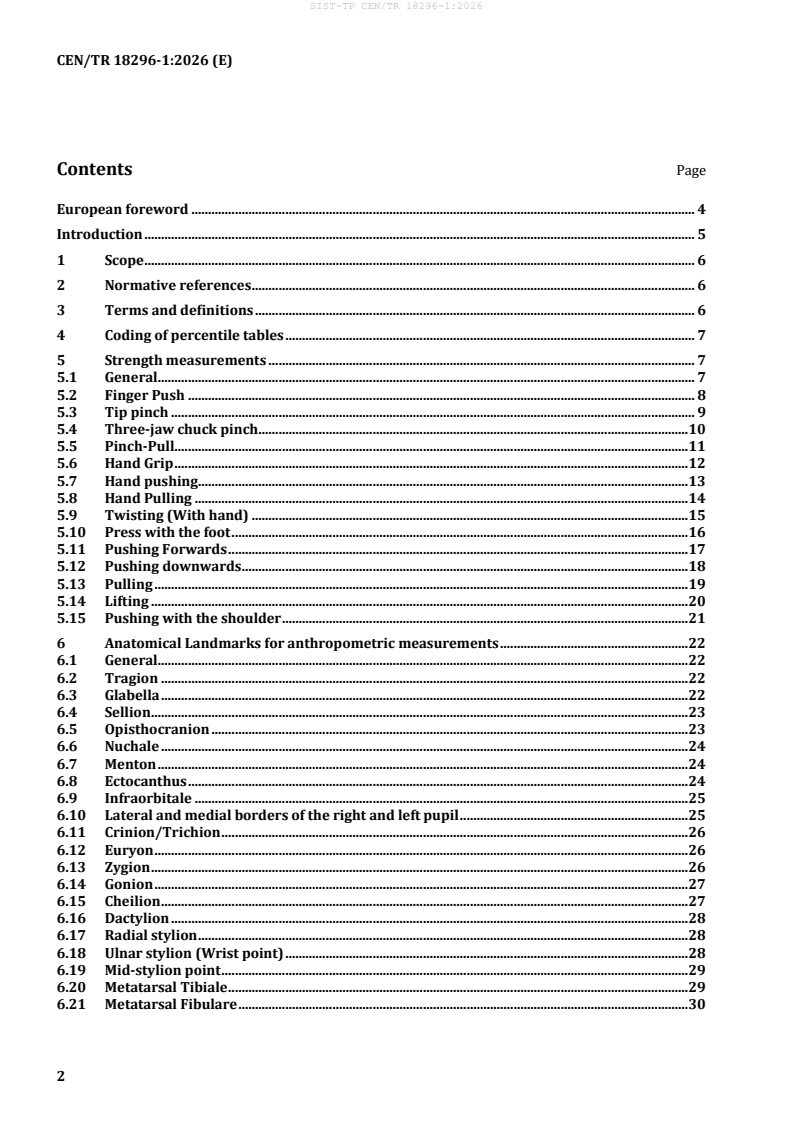
Contents Page
European foreword . 4
Introduction . 5
1 Scope . 6
2 Normative references . 6
3 Terms and definitions . 6
4 Coding of percentile tables . 7
5 Strength measurements . 7
5.1 General. 7
5.2 Finger Push . 8
5.3 Tip pinch . 9
5.4 Three-jaw chuck pinch . 10
5.5 Pinch-Pull . 11
5.6 Hand Grip . 12
5.7 Hand pushing. 13
5.8 Hand Pulling . 14
5.9 Twisting (With hand) . 15
5.10 Press with the foot . 16
5.11 Pushing Forwards . 17
5.12 Pushing downwards. 18
5.13 Pulling . 19
5.14 Lifting . 20
5.15 Pushing with the shoulder . 21
6 Anatomical Landmarks for anthropometric measurements . 22
6.1 General. 22
6.2 Tragion . 22
6.3 Glabella . 22
6.4 Sellion . 23
6.5 Opisthocranion . 23
6.6 Nuchale . 24
6.7 Menton . 24
6.8 Ectocanthus . 24
6.9 Infraorbitale . 25
6.10 Lateral and medial borders of the right and left pupil . 25
6.11 Crinion/Trichion . 26
6.12 Euryon . 26
6.13 Zygion . 26
6.14 Gonion . 27
6.15 Cheilion . 27
6.16 Dactylion . 28
6.17 Radial stylion . 28
6.18 Ulnar stylion (Wrist point) . 28
6.19 Mid-stylion point . 29
6.20 Metatarsal Tibiale . 29
6.21 Metatarsal Fibulare . 30
6.22 Toe 1 joint . 30
6.23 Toe 5 joint . 30
6.24 Medial malleolus . 31
6.25 Lateral malleolus . 31
6.26 Inside heel bone point . 31
6.27 Vertex . 32
6.28 Menton . 32
6.29 Cervicale (Back neck point) . 32
6.30 Front neck point . 33
6.31 Side neck point . 33
6.32 Acromion (shoulder point) . 34
6.33 Armpit front fold point . 34
6.34 Armpit back fold point . 35
6.35 Thelion (Bust point) . 35
6.36 Mesosternale . 36
6.37 Highest point of the hip bone . 36
6.38 Lowest rib point . 37
6.39 Iliospinale anterius . 37
6.40 Trochanter . 38
6.41 Elbow point . 38
6.42 Olecranon . 39
6.43 Tibiale . 39
6.44 Centre point of kneecap . 40
6.45 Infrapatella . 41
6.46 Suprapatella (sitting) . 41
7 Body postures . 42
8 Hand positions . 44
9 Anthropometric measurements . 45
9.1 General . 45
9.2 Body . 45
9.3 Foot . 227
9.4 Hand . 280
9.5 Head . 368
9.6 Reach . 421
9.7 Sitting . 447
Bibliography . 482
European foreword
This document (CEN/TR 18296-1:2026) has been prepared by Technical Committee CEN/TC 122
“Ergonomics”, the secretariat of which is held by DIN.
This document is currently submitted to the Vote on TR.
The series on Ergonomics — Anthropometric and strength data of children in Europe consists of the
following parts:
— Part 1: Statistical summaries of the data (CEN/TR 18296-1);
— Part 2: Guidelines for the correct application of anthropometric and strength data (CEN/TS 18296-2).
Introduction
CEN/TC 122 “Ergonomics” has carried out a project funded by the European Commission to acquire
anthropometric and strength data of children in Europe, initiated by the lack of up-to-date published data.
These data have to be current and reliable being the basis for the safety, comfort and usability of products
used for, by or with children.
Since there had been no sufficient knowledge neither on the existing anthropometric data and its
availability nor on the specific demand of data from the relevant stakeholders a first project phase had
been carried out in order to gather such knowledge as a basis for European anthropometric surveys. This
first phase of the project included an extensive research on the demands, necessity and existence of
Anthropometric and Strength data of European population under 18 years old. Results have been
published in CEN/TR 17698:2021 “Ergonomics — Demands and availability of anthropometric and
strength data of children in Europe”.
The second phase of the project included a measurement campaign to obtain updated anthropometric
and strength data for the European population under 16 years of age and resulted in the publication of
this technical report as well as CEN/TS xxx “…”.
1 Scope
This document provides statistical summaries of anthropometric data (body dimensions and physical
strength) of children in Europe considering different age groups. The age range covered by this report is
up to 15 years.
This document also provides information about:
— date and origin of the data;
— geographic limitations of the data;
— size and sex of the population measured or scanned;
— description of the anthropometric and strength measures.
2 Normative references
There are no normative references in this document.
3 Terms and definitions
For the purposes of this document, the following terms and definitions apply.
ISO and IEC maintain terminology databases for use in standardization at the following addresses:
— ISO Online browsing platform: available at https://www.iso.org/obp/
— IEC Electropedia: available at https://www.electropedia.org/
3.1
isometric strength
ability of muscles to generate force without changing their length during contraction
Note 1 to entry: No body movement occurs during the measurement period. The posture and joint angles remain
the same during the measurement.
3.2
LMS method
Lambda-Median-Sigma method
method applied in this report to calculate percentiles
Note 1 to entry: The LMS method is a statistical technique used to construct growth reference curves. It’s
particularly good at modelling data that changes with age and is not normally distributed, by accounting for
skewness and kurtosis.
Each letter corresponds to a parameter that changes smoothly with age:
— L (Lambda): Represents the Box-Cox transformation power to normalize the distribution (adjusts for
skewness).
— M (Median): The median of the measurement at each age (central tendency).
— S (Sigma): The coefficient of variation, or the generalized standard deviation (adjusts for spread or variability).
More information about the method can be found in [5].
3.3
Frankfurt plane
standard horizontal plane at the level of the left tragion and the left orbitale (infraorbitale) when the
midsagittal plane of the head is held vertically
4 Coding of percentile tables
st th
This report contains tables covering the 1 to 99 percentiles.
— Age (p01–p99): age group
m03: 3 ≤ months < 6
m06: 6 ≤ months < 9
m09: 9 ≤ months < 12
y01: 1 ≤ years < 2
y02: 2 ≤ years < 3
y03: 3 ≤ years < 4
y04: 4 ≤ years < 5
y05: 5 ≤ years < 6
y06: 6 ≤ years < 7
y07: 7 ≤ years < 8
y08: 8 ≤ years < 9
y09: 9 ≤ years < 10
y10: 10 ≤ years < 11
y11: 11 ≤ years < 12
y12: 12 ≤ years < 13
y13: 13 ≤ years < 14
y14: 14 ≤ years < 15
y15: 15 ≤ years < 16
— Sex:
F: females.
M: males
U: unisex (males and females)
— N: sample size considering only valid measurements.
— Pxx: percentile (1, 5, 10, 25, 75, 90 and 95, 99).
5 Strength measurements
5.1 General
The following subclauses describe the strengths measurements included in this report. All strengths
included in this report are voluntary isometric strengths.
Data source: survey conducted in Spain in 2023 and 2024.
Strength measurements were carried out with the age groups y02, y07, y11 and y13. However, some
measurements have not been performed with the age group y02 because two-year-old children have
difficulties in performing the measurement protocol correctly.
5.2 Finger Push
Description: The maximum static force that can be exerted in a forward direction with one index finger
against an object (round base button). See Figure 1.
Units: Newtons (N)
Figure 1 — Finger Push
Method: The finger push is performed from a standing position. The feet are be kept hip-width apart,
with one foot forward and the other back from the starting position, to ensure a self-stable position and
to perform the gesture with maximum effort. The starting position of the upper limb is defined by the
shoulder slightly abducted, the arm along the side of the body, neutrally rotated, and the elbow flexed at
90°. The forearm is pronated and functional extension of the wrist (15° to 20°) is allowed, with the
metacarpal joint at approximately 90° and extension of the interphalangeal joints required.
Table 1 — Percentiles: Finger Push
Age Sex N P01 P05 P10 P25 P50 P75 P90 P95 P99
y07 U 147 10 13 15 20 25 31 37 41 49
y07 F 73 10 13 16 20 25 31 37 41 48
y07 M 74 10 13 15 19 24 30 37 41 51
y11 U 143 14 20 23 30 37 45 52 57 66
y11 F 71 13 19 22 28 35 43 51 57 67
y11 M 72 14 21 25 31 39 46 53 57 65
y13 U 146 21 27 31 38 46 56 65 71 84
y13 F 74 22 27 31 37 45 54 63 69 81
y13 M 72 20 27 31 38 47 57 67 74 87
5.3 Tip pinch
Description: The maximum static force that can be exerted on an object placed in the hand by squeezing
together the pad of the thumb as opposed to the pad of the index finger. See Figure 2.
Units: Newtons (N)
Figure 2 — Tip pinch
Method: The finger pinch is performed from a standing position. No slipping between the fingers and the
object during measurement. For stability and comfort, feet are placed hip-width apart, and with one foot
forward and the other foot backward from the starting position. The upper limb is positioned with the
shoulder slightly abducted and neutrally rotated, the elbow flexed at approximately at 90°, and the
forearm and wrist in neutral position.
Diameter of the object: 20 mm
Table 2 — Percentiles: Tip pinch
Age Sex N P01 P05 P10 P25 P50 P75 P90 P95 P99
y07 U 146 15 17 19 22 26 32 39 44 57
y07 F 73 14 17 18 21 26 32 40 46 62
y07 M 73 15 18 20 23 27 32 38 42 52
y11 U 143 22 26 29 34 41 48 55 59 69
y11 F 71 24 28 30 34 40 47 54 60 71
y11 M 72 20 25 28 34 41 48 55 60 69
y13 U 146 31 35 37 42 49 57 65 71 84
y13 F 74 31 35 37 42 48 56 65 71 84
y13 M 72 30 35 38 43 49 57 66 71 84
5.4 Three-jaw chuck pinch
Description: The maximum static force that can be exerted on an object placed in the hand by squeezing
together the pad of the thumb in opposition to the pads of the index and middle fingers. See Figure 3.
Units: Newtons (N)
Figure 3 — Three-jaw chuck pinch
Method: The finger pinch is performed from standing position. No slipping between the fingers and the
object during measurement. For greater stability and comfort, the feet are kept hip-width apart and move
one foot can be moved forward and the other backward from the starting position. The upper limb is
positioned with the shoulder slightly abducted and neutrally rotated, the elbow flexed approximately at
90°, and the forearm and wrist in neutral position.
Diameter of the object: 20 mm
Table 3 — Percentiles: Three-jaw chuck pinch
Age Sex N P01 P05 P10 P25 P50 P75 P90 P95 P99
y07 U 146 21 24 26 29 33 38 43 46 53
y07 F 73 22 24 26 29 33 38 44 48 57
y07 M 73 21 24 26 29 33 38 42 45 50
y11 U 143 30 35 38 44 52 61 70 76 88
y11 F 71 28 34 38 44 53 63 73 80 94
y11 M 72 31 36 39 44 51 59 66 72 82
y13 U 145 36 43 48 55 64 74 84 90 102
y13 F 74 39 44 48 54 62 70 79 85 97
y13 M 71 34 43 48 57 67 78 88 94 105
5.5 Pinch-Pull
Description: The maximum static force that can be exerted by pulling the fingers towards the body
against various objects. This pulling force is exerted when performing a lateral pinch. The thumb pulp
against the lateral side of the middle phalanx of the index finger. See Figure 4.
Units: Newtons (N)
Figure 4 — Pinch-Pull
Method: The pinch pull is performed from a standing position. No slipping between the fingers and the
object during measurement. For greater stability and comfort, feet can be hip-width apart and one foot
can be moved forward and the other backward from the starting position. The upper limb position
shoulder is placed slightly adducted and neutrally rotated, the elbow flexed at 90° and the forearm and
wrist in neutral position.
Height of the object: 8 mm
Table 4 — Percentiles: Pinch-Pull
Age Sex N P01 P05 P10 P25 P50 P75 P90 P95 P99
y07 U 146 16 19 21 25 29 34 40 43 50
y07 F 73 15 19 21 24 29 33 37 40 45
y07 M 73 16 19 21 25 30 36 42 46 56
y11 U 142 25 29 32 37 44 53 62 68 82
y11 F 70 26 30 32 36 42 49 57 63 75
y11 M 72 24 30 33 39 47 56 66 73 88
y13 U 146 29 34 38 44 53 63 74 81 95
y13 F 74 28 32 35 41 49 57 67 73 87
y13 M 72 31 38 42 49 58 68 78 85 99
5.6 Hand Grip
Description The maximum force that can be exerted by the forearm with all fingers flexed around an
object. See Figure 5.
Units: Newtons (N)
Figure 5 — Hand grip
Method: The hand grip is performed is performed from a standing position. To provide a better stability
and comfort to perform the feet are be kept hip width apart; and move one foot forward and move the
other foot back from the starting position to ensure a self-stable position to make the gesture with the
maximal effort. Regarding upper limb, shoulder is placed slightly abducted and neutrally rotated; elbow
flexed approximately at 90°; and the forearm and wrist in neutral position.
The hand grip measurement device is available in two sizes (Figure 6) to ensure an ergonomically
comfortable grasp, characterized by the middle phalanx of the other fingers being approximately parallel
to the thumb during use.
— Small: A: 40 mm, B: 30 mm
— Large: A: 46 mm, B: 34 mm
Figure 6 — Hand grip device
Table 5 — Percentiles: Hand grip
Age Sex N P01 P05 P10 P25 P50 P75 P90 P95 P99
y02 U 127 3 8 11 16 22 28 35 39 47
y02 F 62 4 8 11 16 22 28 34 38 45
y02 M 65 3 7 10 15 22 29 35 40 48
y07 U 146 40 51 57 67 81 95 109 118 135
y07 F 73 38 47 52 63 76 91 107 117 138
Age Sex N P01 P05 P10 P25 P50 P75 P90 P95 P99
y07 M 73 47 57 63 73 85 98 110 118 134
y11 U 143 72 88 98 116 138 163 187 203 234
y11 F 71 67 83 93 111 134 162 190 209 249
y11 M 72 74 93 104 122 142 163 183 194 216
y13 U 146 99 121 134 159 191 229 267 293 346
y13 F 74 93 113 126 148 177 209 242 263 306
y13 M 72 113 135 149 174 207 247 288 316 375
5.7 Hand pushing
Description The maximum static force that can be exerted forward with the upper limb and palm of the
hand against an object (hemisphere with a round base). See Figure 7.
Units: Newtons (N)
Figure 7 — Hand pushing
Method: The hand push is performed from a standing position. To ensure greater stability and comfort,
the feet are positioned hip-width apart. The subject moves one foot forward and the other backward from
the initial stance until reaching a posture perceived as most comfortable. The position of the upper limb
is defined by slight shoulder abduction, neutral arm rotation along the side of the body, and 90° elbow
flexion. The forearm is pronated and the wrist extended to allow supportive contact of the palm against
the object. The posture remains unchanged throughout the measurement.
The pushing surface area is available in two sizes to ensure comfortable support for the palm, such that
the surface remains approximately within the hand’s width and half its length.
— Small: 60 mm × 47 mm
— Large: 80 mm × 57 mm
Table 6 — Percentiles: Hand pushing
Age Sex N P01 P05 P10 P25 P50 P75 P90 P95 P99
y07 U 147 13 20 25 33 45 59 74 84 106
y07 F 73 10 17 22 31 43 56 68 76 93
y07 M 74 20 25 28 36 46 61 80 94 130
y11 U 142 27 35 40 50 64 82 104 119 156
y11 F 70 25 33 38 48 61 77 93 105 128
y11 M 72 29 37 42 52 68 88 113 131 174
Age Sex N P01 P05 P10 P25 P50 P75 P90 P95 P99
y13 U 145 38 48 54 67 85 109 138 159 210
y13 F 73 35 45 51 63 79 100 122 138 173
y13 M 72 43 53 59 73 92 119 152 177 241
5.8 Hand Pulling
Description The maximum static force that can be exerted by pulling towards the body with the upper
limb and palm of the hand, and with the fingers flexed (hand grip), on an object (hand hold). See Figure 8.
Units: Newtons (N)
Figure 8 — Hand Pulling
Method: The hand pull is performed from a standing position. To ensure greater stability and comfort,
the feet are positioned hip-width apart. The subject moves one foot forward and the other backward from
the initial stance until reaching a posture perceived as most comfortable. For the upper limb, the shoulder
is slightly adducted and neutrally rotated, the elbow is flexed at 90°, and the forearm and wrist are in a
neutral position. The posture remains unchanged throughout the measurement. No slipping between the
fingers and the object during measurement.
The handle is available in two diameters to facilitate appropriate contact between the pad of the thumb
and either the pad or dorsal surface of the distal phalanx of the middle finger. This design aims to prevent
excessive gripping force and promote a more ergonomic hand posture during use.
— Small: 25 mm
— Large: 28 mm
Table 7 — Percentiles: Hand Pulling
Age Sex N P01 P05 P10 P25 P50 P75 P90 P95 P99
y07 U 146 21 28 32 41 53 67 82 92 113
y07 F 73 16 25 30 40 51 64 76 84 99
y07 M 73 25 31 35 43 55 70 88 101 134
y11 U 143 33 45 52 65 83 103 124 138 166
y11 F 71 29 40 47 60 77 98 120 135 165
y11 M 72 43 53 59 71 87 106 127 141 172
y13 U 146 42 56 65 82 106 134 164 184 228
y13 F 74 44 54 61 75 95 122 155 180 243
Age Sex N P01 P05 P10 P25 P50 P75 P90 P95 P99
y13 M 72 42 60 71 92 117 144 171 188 221
5.9 Twisting (With hand)
Description: The maximum static force that can be exerted on an object by turning it (circular knob)
with one hand in any direction. It is usually measured as the force with which a circular knob can be
turned. See Figure 9.
Units: Newtons per meter (Nm)
Figure 9 — Twisting (With hand)
Method: The twist is performed from a standing position with the shoulder slightly adducted and
neutrally rotated, the elbow flexed at 90°, the forearm in a neutral position and the wrist with functionally
extended. The subject performs the twist in the opening direction. No slipping between the fingers and
the object during measurement.
The knob is available in two diameters to ensure a comfortable and secure grip. Its dimensions are
designed to remain within, and closely match, the subject’s hand breadth and approximately half the
length of the dorsum of the hand plus the proximal phalanx of the middle finger.
— Small: 50 mm
— Large: 65 mm
Table 8 — Twisting (With hand)
Age Sex N P01 P05 P10 P25 P50 P75 P90 P95 P99
y02 U 80 0.06 0.14 0.18 0.28 0.40 0.53 0.65 0.74 0.89
y02 F 41 0.05 0.13 0.18 0.28 0.40 0.52 0.64 0.72 0.87
y02 M 39 0.06 0.14 0.18 0.28 0.40 0.53 0.67 0.75 0.93
y07 U 146 0.67 0.88 1.00 1.23 1.52 1.86 2.19 2.41 2.86
y07 F 73 0.69 0.87 0.98 1.18 1.46 1.79 2.14 2.38 2.88
y07 M 73 0.65 0.89 1.03 1.28 1.59 1.92 2.24 2.43 2.82
y11 U 142 1.21 1.59 1.82 2.24 2.76 3.35 3.94 4.32 5.09
y11 F 70 1.18 1.59 1.84 2.29 2.84 3.45 4.04 4.42 5.18
y11 M 72 1.21 1.57 1.78 2.19 2.70 3.27 3.85 4.22 4.98
y13 U 146 1.63 2.14 2.45 3.02 3.75 4.57 5.39 5.92 7.00
y13 F 74 1.52 1.97 2.24 2.75 3.39 4.13 4.87 5.35 6.33
y13 M 72 1.92 2.47 2.80 3.40 4.13 4.95 5.76 6.28 7.31
5.10 Press with the foot
Description: The maximum static force that a foot can exert in a downward direction against a pedal or
similar object. The action is performed while the subject is seated with the back supported. See Figure 10.
Units: Newtons (N)
Figure 10 — Press with the foot
Method: The sitting position is defined by 90° hip flexion, 120° knee flexion and neutral ankle position.
The other foot is placed on the floor, hip-width apart, with the ankle in a neutral position and the knee
bent at 90°. The force is applied by engaging the entire lower extremity.
Table 9 — Press with the foot
Age Sex N P01 P05 P10 P25 P50 P75 P90 P95 P99
y02 U 82 4 9 12 21 34 51 72 86 118
y02 F 42 3 7 10 18 31 50 71 87 123
y02 M 40 5 11 15 23 36 53 73 86 116
y07 U 147 55 77 91 120 160 211 266 304 388
y07 F 73 45 71 87 118 156 200 243 271 327
y07 M 74 61 81 95 124 165 221 287 335 448
y11 U 141 85 129 156 209 278 358 439 492 600
y11 F 71 83 124 149 197 259 331 404 452 549
y11 M 70 86 135 166 224 299 384 469 525 636
y13 U 145 127 184 219 287 373 473 574 640 774
y13 F 74 117 167 198 258 336 427 521 582 709
y13 M 71 150 214 253 325 415 515 615 679 808
5.11 Pushing Forwards
Description: The maximum static force that can be exerted forward with both hands against an object
(handlebars). See Figure 11.
Units: Newtons (N)
Figure 11 — Pushing Forwards
Method: The push is performed from a standing position. To ensure greater stability and comfort, the
feet are positioned hip-width apart. The subject moves one foot forward and the other backward from
the initial stance until reaching a posture perceived as most comfortable. The upper limb position is
defined by a slight abduction of the shoulders, with the arms rotated neutrally to the side of the body and
the elbows flexed 90°. The forearms are pronated and the wrists are extended to grip the handlebars. The
posture remains unchanged throughout the measurement. No slipping between the fingers and the
handlebar during measurement.
Handlebar diameter: 30 mm.
Table 10 — Pushing Forwards
Age Sex N P01 P05 P10 P25 P50 P75 P90 P95 P99
y02 U 75 6 9 12 17 24 33 43 50 64
y02 F 39 6 9 11 16 23 32 42 49 64
y02 M 36 5 9 12 18 26 35 44 50 63
y07 U 147 28 34 38 47 59 75 96 112 153
y07 F 73 27 34 38 46 56 68 81 89 107
y07 M 74 27 34 39 49 64 84 110 130 182
y11 U 143 37 48 54 68 86 110 137 155 198
y11 F 71 31 43 49 63 80 101 123 138 169
y11 M 72 46 55 61 74 92 117 147 171 229
Age Sex N P01 P05 P10 P25 P50 P75 P90 P95 P99
y13 U 146 45 58 66 82 105 134 166 188 238
y13 F 74 43 56 64 79 99 123 148 164 200
y13 M 72 43 59 69 88 115 147 182 206 257
5.12 Pushing downwards
Description: The maximum static force that can be exerted downwards with both hands against an
object (handlebars). See Figure 12.
Units: Newtons (N)
Figure 12 — Pushing downwards
Method: The push is performed from a standing position. To ensure greater stability and comfort, the
feet are positioned hip-width apart. The subject moves one foot forward and the other backward from
the initial stance until reaching a posture perceived as most comfortable. The upper limb position is
defined by a slight abduction of the shoulders, with the arms rotated neutrally to the side of the body and
the elbows flexed 90°. The forearms are pronated and the wrists are extended to grip the handlebars. The
posture remains unchanged throughout the measurement. No slipping between the fingers and the
handlebar during measurement
Handlebar diameter: 30 mm.
Table 11 — Pushing downwards
Age Sex N P01 P05 P10 P25 P50 P75 P90 P95 P99
y07 U 147 43 53 60 73 91 113 138 156 195
y07 F 73 38 51 58 73 91 113 136 150 181
y07 M 74 47 56 62 74 91 114 141 161 211
Age Sex N P01 P05 P10 P25 P50 P75 P90 P95 P99
y11 U 142 74 89 98 115 135 159 182 197 228
y11 F 71 68 84 93 110 130 153 175 189 217
y11 M 71 84 97 105 120 140 163 188 206 243
y13 U 145 84 107 121 148 183 226 271 302 368
y13 F 74 89 106 118 140 172 213 262 298 385
y13 M 71 76 108 126 158 197 238 277 301 349
5.13 Pulling
Description: The maximum static force that can be exerted in one direction of pull with both hands
against an object (handlebars). See Figure 13.
Units: Newtons (N)
Figure 13 — Pulling
Method: The pull is performed from a standing position. For greater stability and comfort, the feet are
placed hip-width apart with one foot forward and the other backward from the starting position. The
upper limb position is defined by a slight abduction of the shoulders, with the arms rotated neutrally to
the side of the body and the elbows flexed 90°. The forearms are pronated and the wrists are extended to
grip the handlebars. The posture remains unchanged throughout the measurement. No slipping between
the fingers and the handlebar during measurement.
Handlebar diameter: 30 mm.
Table 12 — Pulling
Age Sex N P01 P05 P10 P25 P50 P75 P90 P95 P99
y02 U 79 8 12 15 21 29 40 52 60 79
y02 F 41 9 12 14 19 26 34 44 51 66
y02 M 38 7 12 16 24 34 46 59 68 85
y07 U 147 26 33 38 48 61 78 97 111 141
y07 F 73 23 32 38 48 60 73 86 94 109
Age Sex N P01 P05 P10 P25 P50 P75 P90 P95 P99
y07 M 74 26 34 38 48 63 83 107 126 172
y11 U 142 40 50 56 69 88 113 142 164 217
y11 F 70 41 50 56 68 84 105 129 147 187
y11 M 72 39 50 57 71 92 120 153 178 237
y13 U 146 55 69 77 94 118 148 183 208 266
y13 F 74 54 67 74 90 111 137 167 188 236
y13 M 72 56 71 81 100 126 159 197 223 283
5.14 Lifting
Description: The maximum static force that can be exerted in one direction of pull with both hands
against an object (handlebars). See Figure 14.
Units: Newtons (N)
Figure 14 — Lifting
Method: The lift is performed from a standing position. To ensure greater stability and comfort, the feet
are positioned hip-width apart. The subject moves one foot forward and the other backward from the
initial stance until reaching a posture perceived as most comfortable. The upper limb position is defined
by a slight abduction of the shoulders, with the arms rotated neutrally to the side of the body and the
elbows flexed 90°. The forearms are supinated and the wrists are extended to grip the handlebars. The
posture remains unchanged throughout the measurement. No slipping between the fingers and the
handlebar during measurement
Handlebar diameter: 30 mm.
Table 13 — Lifting
Age Sex N P01 P05 P10 P25 P50 P75 P90 P95 P99
y07 U 146 44 55 62 76 96 119 146 164 205
y07 F 73 39 53 63 79 101 125 150 165 197
y07 M 73 48 57 63 74 91 113 140 161 213
Age Sex N P01 P05 P10 P25 P50 P75 P90 P95 P99
y11 U 143 83 100 110 128 152 180 208 227 266
y11 F 71 79 95 104 123 148 178 210 232 280
y11 M 72 88 106 116 134 156 181 206 222 254
y13 U 146 98 123 139 168 205 248 292 321 381
y13 F 74 112 130 141 161 187 217 249 271 317
y13 M 72 83 121 142 181 227 277 325 354 412
5.15 Pushing with the shoulder
Description: The maximum static force that can be exerted in the lateral direction with the body by
contact of the shoulder against an object. See Figure 15.
Units: Newtons (N)
Figure 15 — Pushing with the shoulder
Method: The push is performed from a standing position, with the shoulder in contact with the wall. The
subject stands laterally to the wall, with both feet positioned apart to ensure good stability and fully in
contact with the floor. The arms are crossed over the chest. The posture remains unchanged throughout
the measurement.
Table 14 — Pushing with the shoulder
Age Sex N P01 P05 P10 P25 P50 P75 P90 P95 P99
y07 U 147 45 54 59 69 83 99 118 132 163
y07 F 73 42 52 57 68 82 98 114 124 146
y07 M 74 48 55 60 70 83 101 123 139 180
y11 U 143 61 77 87 107 132 163 195 217 263
y11 F 71 58 73 82 99 121 145 171 187 222
y11 M 72 63 83 95 118 147 180 213 234 278
y13 U 146 68 92 106 132 164 199 234 256 300
y13 F 74 78 94 105 124 150 181 214 236 284
y13 M 72 60 93 111 142 178 216 251 272 313
6 Anatomical Landmarks for anthropometric measurements
6.1 General
This section describes the anatomical landmarks used in the description of the measurements.
6.2 Tragion
Description: Notch just above the tragus (the small cartilaginous flap in front of the ear hole). See
Figure 16.
Reference:
EN ISO 7250-1:2017, 5.20
ISO 8559-1:2017, 3.1.3
Figure 16 — Tragion
6.3 Glabella
Description: Most anterior point of the forehead between the brow ridges in the midsagittal plane while
the head is held in the Frankfurt plane. See Figure 17.
Reference:
EN ISO 7250-1:2017, 5.6
ISO 8559-1:2017, 3.1.2
Figure 17 — Glabella
6.4 Sellion
Description: Point of greatest indentation of the nasal root depression, in the midsagittal plane, while
the head is held in the Frankfurt plane. See Figure 18.
Reference: EN ISO 7250-1:2017, 5.15
Figure 18 — Sellion
6.5 Opisthocranion
Description: Most distant point from glabella in the midsagittal plane while the head is held in the
Frankfurt plane. See Figure 19.
Reference: EN ISO 7250-1:2017, 5.14
Figure 19 — Opisthocranion
6.6 Nuchale
Description: Lowest point in the midsagittal plane of the occiput that can be palpated amid the nuchal
muscles, projected posteriorly while the head is held in the Frankfurt plane. See Figure 20.
Reference: EN ISO 7250-1:2017, 5.11
Figure 20 — Nuchale
6.7 Menton
Description: Lowest point of the tip of the chin in the midsagittal plane, projected inferiorly while the
head is held in the Frankfurt plane. See Figure 21.
Reference: EN ISO 7250-1:2017, 5.11
Figure 21 — Menton
6.8 Ectocanthus
Description: The lateral corner of the eye formed by the meeting of the upper and lower eyelids. See
Figure 23.
Reference: EN ISO 7250-1:2017, 5.5
Figure 22 — Ectocanthus
6.9 Infraorbitale
Description: Lowest point of the lower border of the orbital margin (lower edge of the eye socket). See
Figure 23.
Reference: EN ISO 7250-1:2017, 5.11
Figure 23 — Infraorbitale
6.10 Lateral and medial borders of the right and left pupil
Description: Lateral border of right pupil and medial border of left pupil while the subject is looking
straight ahead to the infinite (m
...