

SIST-TS CEN/TS 18296-2:2026
(Main)Ergonomics - Anthropometric and strength data of children in Europe - Part 2: Guidelines for the correct application of anthropometric and strength data
- Abstract
This document provides guidelines for the correct application of anthropometric and strength data of children, in particular for all anthropometric data (body dimensions and physical strength) provided in CEN/TR 18296-1. To improve the user-friendliness, the document combines ergonomically relevant information with a summary of the updated anthropometric data (based on CEN/TR 18296-1 but with combined age groups and fewer statistical parameters).
- Status
- Published
- Publication Date
- 12-Oct-2026
- Technical Committee
- VSN - Safety of machinery
- Current Stage
- 6060 - National Implementation/Publication (Adopted Project)
- Start Date
- 26-Aug-2026
- Due Date
- 31-Oct-2026
- Completion Date
- 13-Oct-2026

SIST-TS CEN/TS 18296-2:2026 is the Slovenian version of CEN/TS 18296-2:2026, a CEN Technical Specification in ergonomics. It gives guidance on how to apply anthropometric and strength data of children in Europe, especially the data published in CEN/TR 18296-1. It is written for people who design, assess, or standardize products and processes for or with children, and for situations where child body dimensions or physical strength affect safety, comfort, or usability.
What does SIST-TS CEN/TS 18296-2:2026 specify?
SIST-TS CEN/TS 18296-2:2026 specifies guidelines for the correct use of children's anthropometric and strength data, with a strong focus on the body dimensions and physical strength data provided in CEN/TR 18296-1. It also combines ergonomically relevant guidance with a summary of updated anthropometric data, using combined age groups and fewer statistical parameters to make the tables easier to use in practice.
The document is organized into clauses on scope, normative references, terms and definitions, coding of percentile tables, stakeholder needs, didactic guidance for using anthropometric databases, the macrostructure of the guidelines, and the presentation of icons. It ends with two informative annexes and a bibliography.
| Annex | What it covers |
|---|---|
| Annex A | Application notes and icons assigned to children's body measurements |
| Annex B | Application instructions and icons assigned to physical strength data of children |
What are the key requirements of SIST-TS CEN/TS 18296-2:2026?
SIST-TS CEN/TS 18296-2:2026 does not present itself as a product test standard. Instead, its core value is in the way it tells users to read, interpret, and apply child data so that design or assessment decisions are not made from percentile tables alone.
Use the data together with the transfer information
The standard separates core data from Bio transfer data and Interface transfer data. Core data are the body measurements and strength values themselves, while the transfer data explain when the table value may shift in real use because of body posture, body mechanics, clothing, equipment, contact with the environment, or other influences. In practice, this means the user should not assume that the measured value is the same as the value needed in the final product situation.
Read the percentile tables with the coding rules
Clause 4 gives the coding used for age groups, sex, sample size, and percentiles. The age labels identify ranges, sex is coded as F, M, or U, N indicates the sample size for valid measurements, and Pxx marks the percentile values used in the tables. This matters because the tables are not plain lists of numbers - users need to read the codes correctly before comparing or selecting dimensions.
Clause 4 also explains why some age groups and measures are treated differently. For very young children, the practical measuring position and the ability to hold posture affect which values can be published. That is important for anyone using the tables for detailed design work, because it shows that the data set is shaped by measurement conditions, not just by statistical convenience.
Match the database to the design task
Clause 6 explains that the choice of database depends on what is being designed or standardized. The document presents a flowchart for deciding how to select and apply an anthropometric database, and it points users toward the main questions that prevent misuse. In practice, this is the step that helps a designer decide whether a value is suitable for furniture, vehicles, protective products, medical products, or another child-related application.
Check whether the guidance can be transferred to another population or dataset
Clause 6.3 states that the guidelines accompany the updated child data in Part 1, but they can also be used with other anthropometric databases if the methodology is comparable. The text asks users to verify the anatomical and biomechanical definition of the body part or strength measure and to compare the measurement specifications. For a buyer, test engineer, or standards writer, this means the guidance should only be reused when the underlying measurement method is genuinely comparable.
Apply the macrostructure: core data, transfer data, and icons
Clause 7 organizes the guidelines into a core-data layer and a transfer-data layer, supported by a toolbox of icons. The core data include the standardized name of each measurement, its description, and a pictorial representation of the measurement distance. The transfer data and icons explain when and how the table value may need to be interpreted differently in a real application.
This structure matters because it turns the tables into a working tool rather than a static list. A user can identify the measurement, understand its method, and then check whether posture, soft tissue, clothing, or interface contact affects the applied value.
Account for biomechanical and physiological effects
Clause 7.2 describes Bio transfer data such as differences between measuring posture and application posture, body joint chains, soft tissue, muscle tone, breathing, and nutritional or digestive state. Clause 7.4 adds interface effects such as clothing, helmets, headphones, gloves, footwear, protective equipment, pressure from the environment, and posture changes caused by contact. In practice, these are the reasons why a table value may need an allowance, a deduction, or a more careful engineering judgment.
Use the icon system to flag statistical and methodological issues
Clause 8 presents a triangular icon system for bio transfer, interface transfer, and statistical aspects. The icons highlight cases such as differences between sex groups, whether a body measurement can be combined safely with other measures, and the special methodological conditions for strength measurements in children. This is useful when the user needs a quick visual warning that a value should not be copied into a design without interpretation.
What terms does SIST-TS CEN/TS 18296-2:2026 define?
Core data - Data on children's body measurements and strengths, including the population, subpopulations, measurement definitions, descriptions, statistical details, and percentile tables.
Bio transfer data - Data describing influences that make a measurement change, or need to be reinterpreted, because of anatomical, biomechanical, or physiological conditions.
Interface transfer data - Data describing influences caused by contact or interaction with the technical environment, where safety or comfort at the interface can change the effective body dimension.
Age group - The coded age range used in the percentile tables, so users can read which age band a measurement refers to.
Pxx - The percentile designation used in the tables, such as 1, 5, 50, 95, and 99, to show the statistical position of a value.
N - The sample size, counted from valid measurements only, which tells the user how many usable observations support a table entry.
U - Unisex, meaning that the table value applies to both males and females together.
Who uses SIST-TS CEN/TS 18296-2:2026?
SIST-TS CEN/TS 18296-2:2026 is used by designers, production planners, inspectors, and members of standardization committees who work with child-related products or environments. The document names application areas such as children's toys, children's vehicles, furniture, bedding, pushchairs, child seats in motor vehicles, building regulations, architectural aspects, footwear, technical medical products, and computer-aided design systems and computer manikins.
In practice, it supports product development, comparative product testing, ergonomic assessment, and the planning of spaces or interfaces where children interact with equipment. It is also relevant where adult users must design around children's variability, such as shared products or child-accessible interfaces.
Which standards are used with SIST-TS CEN/TS 18296-2:2026?
The normative reference named in the document is:
- CEN/TR 18296-1:2025 - Provides the statistical summaries of the children's anthropometric and strength data, and supplies the terms and definitions used here. It is the companion part that this Technical Specification builds on.
The foreword also identifies the series structure as:
- Part 1: CEN/TR 18296-1
- Part 2: CEN/TS 18296-2
What does the SIST-TS CEN/TS 18296-2:2026 document contain?
The document contains a flowchart for choosing and applying an anthropometric database, explanatory text on stakeholder needs, and didactic guidance for reading child measurement data in ergonomic work. It also contains the macrostructure of the guideline system, including core data, transfer data, and the icon-based toolbox that supports interpretation.
Annex A assigns application notes and icons to children's body measurements, while Annex B does the same for physical strength data. The body of the document also includes tables that explain bio transfer influences, interface transfer influences, and statistical or methodological icons, so the user can see when a table value needs context before it is used in design, testing, or evaluation.
Get Certified
Connect with accredited certification bodies for this standard

CIS Institut d.o.o.
Personal Protective Equipment (PPE) certification body. Notified Body NB-2890 for EU Regulation 2016/425 PPE.

Kiwa BDA Testing
Building and construction product certification.
Kmetijski inštitut Slovenije
Agricultural Institute of Slovenia. Soil testing, plant health, agricultural product analysis.
Sponsored listings
Frequently Asked Questions
SIST-TS CEN/TS 18296-2:2026 is a technical specification published by the Slovenian Institute for Standardization (SIST). Its full title is "Ergonomics - Anthropometric and strength data of children in Europe - Part 2: Guidelines for the correct application of anthropometric and strength data". This standard covers: This document provides guidelines for the correct application of anthropometric and strength data of children, in particular for all anthropometric data (body dimensions and physical strength) provided in CEN/TR 18296-1. To improve the user-friendliness, the document combines ergonomically relevant information with a summary of the updated anthropometric data (based on CEN/TR 18296-1 but with combined age groups and fewer statistical parameters).
This document provides guidelines for the correct application of anthropometric and strength data of children, in particular for all anthropometric data (body dimensions and physical strength) provided in CEN/TR 18296-1. To improve the user-friendliness, the document combines ergonomically relevant information with a summary of the updated anthropometric data (based on CEN/TR 18296-1 but with combined age groups and fewer statistical parameters).
SIST-TS CEN/TS 18296-2:2026 is classified under the following ICS (International Classification for Standards) categories: 13.180 - Ergonomics. The ICS classification helps identify the subject area and facilitates finding related standards.
SIST-TS CEN/TS 18296-2:2026 is available in PDF format for immediate download after purchase. The document can be added to your cart and obtained through the secure checkout process. Digital delivery ensures instant access to the complete standard document.
Standards Content (Sample)
SLOVENSKI STANDARD
01-november-2026
Ergonomija - Antropometrični podatki in podatki o telesni moči otrok v Evropi - 2.
del: Smernice za pravilno uporabo antropometričnih podatkov in podatkov o
telesni moči
Ergonomics - Anthropometric and strength data of children in Europe - Part 2: Guidelines
for the correct application of anthropometric and strength data
Ergonomie - Anthropometrische und Kraftdaten von Kindern in Europa - Teil 2: Leitlinien
für die korrekte Anwendung von anthropometrischen und Kraftdaten
Ergonomie - Données anthropométriques et de force des enfants en Europe - Partie 2 :
Lignes directrices pour l'application correcte des données anthropométriques et de force
Ta slovenski standard je istoveten z: CEN/TS 18296-2:2026
ICS:
13.180 Ergonomija Ergonomics
2003-01.Slovenski inštitut za standardizacijo. Razmnoževanje celote ali delov tega standarda ni dovoljeno.
CEN/TS 18296-2
TECHNICAL SPECIFICATION
SPÉCIFICATION TECHNIQUE
August 2026
TECHNISCHE SPEZIFIKATION
ICS 13.180
English Version
Ergonomics - Anthropometric and strength data of
children in Europe - Part 2: Guidelines for the correct
application of anthropometric and strength data
Ergonomie - Données anthropométriques et de force Ergonomie - Anthropometrische und Kraftdaten von
des enfants en Europe - Partie 2 : Lignes directrices Kindern in Europa - Teil 2: Leitlinien für die korrekte
pour l'application correcte des données Anwendung von anthropometrischen und Kraftdaten
anthropométriques et de force
This Technical Specification (CEN/TS) was approved by CEN on 8 June 2026 for provisional application.
The period of validity of this CEN/TS is limited initially to three years. After two years the members of CEN will be requested to
submit their comments, particularly on the question whether the CEN/TS can be converted into a European Standard.
CEN members are required to announce the existence of this CEN/TS in the same way as for an EN and to make the CEN/TS
available promptly at national level in an appropriate form. It is permissible to keep conflicting national standards in force (in
parallel to the CEN/TS) until the final decision about the possible conversion of the CEN/TS into an EN is reached.
CEN members are the national standards bodies of Austria, Belgium, Bulgaria, Croatia, Cyprus, Czech Republic, Denmark, Estonia,
Finland, France, Germany, Greece, Hungary, Iceland, Ireland, Italy, Latvia, Lithuania, Luxembourg, Malta, Netherlands, Norway,
Poland, Portugal, Republic of North Macedonia, Romania, Serbia, Slovakia, Slovenia, Spain, Sweden, Switzerland, Türkiye and
United Kingdom.
EUROPEAN COMMITTEE FOR STANDARDIZATION
COMITÉ EUROPÉEN DE NORMALISATION
EUROPÄISCHES KOMITEE FÜR NORMUNG
CEN-CENELEC Management Centre: Rue de la Science 23, B-1040 Brussels
© 2026 CEN All rights of exploitation in any form and by any means reserved Ref. No. CEN/TS 18296-2:2026 E
worldwide for CEN national Members.
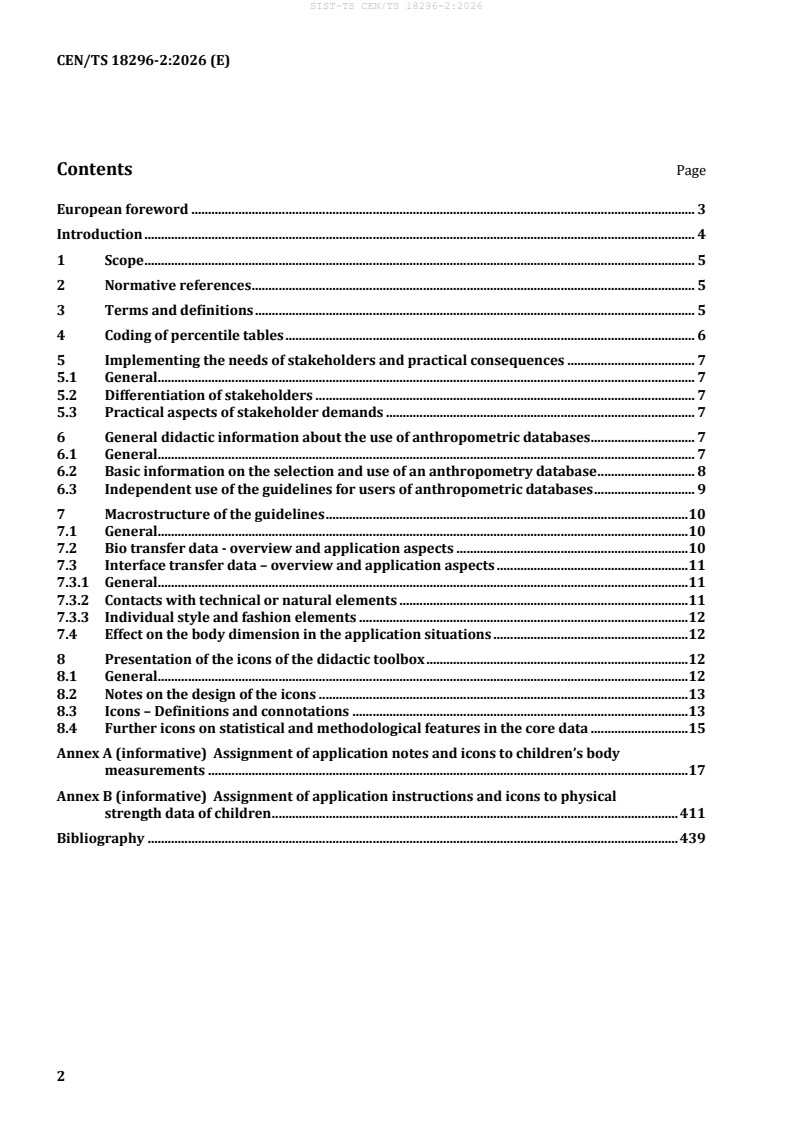
Contents Page
European foreword . 3
Introduction . 4
1 Scope . 5
2 Normative references . 5
3 Terms and definitions . 5
4 Coding of percentile tables . 6
5 Implementing the needs of stakeholders and practical consequences . 7
5.1 General. 7
5.2 Differentiation of stakeholders . 7
5.3 Practical aspects of stakeholder demands . 7
6 General didactic information about the use of anthropometric databases . 7
6.1 General. 7
6.2 Basic information on the selection and use of an anthropometry database . 8
6.3 Independent use of the guidelines for users of anthropometric databases . 9
7 Macrostructure of the guidelines . 10
7.1 General. 10
7.2 Bio transfer data - overview and application aspects . 10
7.3 Interface transfer data – overview and application aspects . 11
7.3.1 General. 11
7.3.2 Contacts with technical or natural elements . 11
7.3.3 Individual style and fashion elements . 12
7.4 Effect on the body dimension in the application situations . 12
8 Presentation of the icons of the didactic toolbox . 12
8.1 General. 12
8.2 Notes on the design of the icons . 13
8.3 Icons – Definitions and connotations . 13
8.4 Further icons on statistical and methodological features in the core data . 15
Annex A (informative) Assignment of application notes and icons to children’s body
measurements . 17
Annex B (informative) Assignment of application instructions and icons to physical
strength data of children . 411
Bibliography . 439
European foreword
This document (CEN/TS 18296-2:2026) has been prepared by Technical Committee CEN/TC 122
“Ergonomics”, the secretariat of which is held by DIN.
Attention is drawn to the possibility that some of the elements of this document may be the subject of
patent rights. CEN shall not be held responsible for identifying any or all such patent rights.
The series on Ergonomics — Anthropometric and strength data of children in Europe consists of the
following parts:
— Part 1: Statistical summaries of the data (CEN/TR 18296-1);
— Part 2: Guidelines for the correct application of anthropometric and strength data (CEN/TS 18296-2).
Any feedback and questions on this document should be directed to the users’ national standards body.
A complete listing of these bodies can be found on the CEN website.
According to the CEN/CENELEC Internal Regulations, the national standards organisations of the
following countries are bound to announce this Technical Specification: Austria, Belgium, Bulgaria,
Croatia, Cyprus, Czech Republic, Denmark, Estonia, Finland, France, Germany, Greece, Hungary, Iceland,
Ireland, Italy, Latvia, Lithuania, Luxembourg, Malta, Netherlands, Norway, Poland, Portugal, Republic of
North Macedonia, Romania, Serbia, Slovakia, Slovenia, Spain, Sweden, Switzerland, Türkiye and the
United Kingdom.
Introduction
These guidelines are the result of monitoring empirical work to update anthropometric and strength data
of children in Europe. The European Committee for Standardization (CEN) has carried out, within
CEN/TC 122 “Ergonomics” a project funded by the European Commission to acquire anthropometric and
strength data of children in Europe, initiated by the lack of up-to-date published data. These data need to
be current and reliable being the basis for the safety, comfort and usability of products used for, by or
with children. From the economic point of view, they are the prerequisite for a successful position of
European stakeholders on the international market.
The metric updating of the database was supported by an accompanying project that can assist users in
utilising the new data in the context of ergonomic work on products and on processes in which the
physical characteristics of children play a role, so that the above-mentioned objective leads to optimal
results in practice. This assistance is particularly useful because in many cases an anthropometric
database needs to be used to support application expertise in the increasingly complex manufacturing
and assessment processes. With the development of a simplified toolbox, in which important implications
for application situations are presented graphically, the guidelines pursue a user-driven approach.
Standards in the field of anthropometry fulfil a special task in overcoming the virtual distance between
manufacturers of products and processes and their users. Databases with physical characteristics in a
user population play a key role in this. They form the basis for planning and manufacturing products and
processes that are safe and convenient to use. The physical characteristics as a whole are differentiated
into anthropometric measurements, biomechanical and physiological correlations. Anthropometric data
is generated when it is collected or updated in relation to a population through the application of
measurement methods and visualisations defined in scientific discourse. If anthropometric data are then
published in compressed form in standards, misinterpretation can occur in many situations due to the
complex underlying anatomical, biomechanical and physiological relationships in a practical application
situation. It is therefore very sensible and expedient to increase the quality of use and reliability of
standardised anthropometric data by providing accompanying information and advice. Therefore, the
publication of updated child data in Europe (published as part 1 of this series) is accompanied by these
guidelines for the correct use of the anthropometric values. They will minimise the distance between
manufacturers and users and thus raise the overall product and process level from an ergonomic
perspective.
Furthermore, the guidelines also pursue an economic objective: by increasing safety in the correct
application of anthropometric data in the area of comparative product testing, there is an indirect
increase in the ergonomic quality of use overall, i.e. within a product group.
These transfer functions of the guidelines play a special role for children and products intended for them
as well as consumer products children come in contact or interact with: these products and procedures
not only focus on the anthropometric data of the children themselves, their diversity also has an impact
on the ergonomic conditions for the adults appearing at the various interfaces with the products. It can
therefore be very important to consider the variability of children’s measurements from the perspective
of adults and to include them in the design, shaping and dimensioning of shared products and procedures.
1 Scope
This document provides guidelines for the correct application of anthropometric and strength data of
children, in particular for all anthropometric data (body dimensions and physical strength) provided in
CEN/TR 18296-1. To improve the user-friendliness, the document combines ergonomically relevant
information with a summary of the updated anthropometric data (based on CEN/TR 18296-1 but with
combined age groups and fewer statistical parameters).
2 Normative references
The following documents are referred to in the text in such a way that some or all of their content
constitutes requirements of this document. For dated references, only the edition cited applies. For
undated references, the latest edition of the referenced document (including any amendments) applies.
CEN/TR 18296-1:2025, Ergonomics - Anthropometric and strength data of children in Europe - Part 1:
Statistical summaries of the data
3 Terms and definitions
For the purposes of this document, terms and definitions given in CEN/TR 18296-1 and the following
apply.
ISO and IEC maintain terminology databases for use in standardization at the following addresses:
— ISO Online browsing platform: available at https://www.iso.org/obp/
— IEC Electropedia: available at https://www.electropedia.org/
3.1 Data types
NOTE Following the stakeholders’ requirements for updating anthropometric data for children, it quickly
becomes clear that an isolated publication of percentile tables does not fulfil expectations. These guidelines respond
to this by means of a new macrostructure for data presentation. Three different data types are defined below:
— anthropometric core data
— transfer data:
— bio transfer data
— interface transfer data
The differentiation between these three types of data is based on the following experience: The use of data on body
measurements and body forces in standards and other forms of publication poses major challenges for the
publishing institutions or persons with regard to human biological reliability in the following anonymous
application situations. The origin of the data is originally based on scientific rules. In this respect, the input into the
databases is controlled and based on scientific ethics and professional expertise. Once the database has been
published, the practical use of the figures is not subject to this control. In many cases, the use of anthropometric
data is then in the hands of people from other specialised fields. There is a certain risk here that certain biological
aspects are not recognisable to users or are ignored. For this reason, the core data is accompanied by transfer data
in these guidelines.
3.1.1
core data
data on body measurements and strengths in children which include information about the population
and subpopulations, definition of the measures, description of the measurements and statistical details
and percentile tables
3.1.2
Bio transfer data
data which describe those influences, through which the measurement determined in a normalised
standard position of the body show ergonomically significant changes due to anatomical, biomechanical
and physiological states or processes
3.1.3
Interface transfer data
data which describe those influences due to contact and/or interaction of the body or parts of the body
with the technical environment with ergonomic relevant consequences for the safety and the comfort at
the interface
4 Coding of percentile tables
Age: age group
y02: 2 ≤ years < 3
y07: 7 ≤ years < 8
y11: 11 ≤ years < 12
y13: 13 ≤ years < 14
y1-3: 1 ≤ years < 4
y4-6: 4 ≤ years < 7
y7-9: 7 ≤ years < 10
y10-12: 10 ≤ years < 13
y13-15: 13 ≤ years < 16
NOTE 1 Practical anthropometric work with and on children is subject to particularly careful scrutiny with
regard to the ethical aspects of the examinations and tests. Therefore, the percentile tables in the annex cannot be
completely uniform and complete.
NOTE 2 The reasons for the differences in the age groups for which percentile values can be given in this
document are as follows:
— Only children of age groups y<4 years are able to maintain the right posture during the measuring procedure.
— All the body measurements for y<1 and y1-3 are manual and the values are presented based on the number of
children capable to maintain the right position during this measuring procedure.
Sex:
F: females.
M: males
U: unisex (males and females)
N: sample size considering only valid measurements.
Pxx: percentile (1, 5, 50, 95 and 99).
5 Implementing the needs of stakeholders and practical consequences
5.1 General
Stakeholder requirements were communicated across a very broad range of topics and areas of expertise.
As anthropometric data play a role in the development and evaluation of a large number of products and
processes, these guidelines provide a thematically independent overview of their correct application. The
requirements for the guidelines have been developed from the following fields of work and areas of
expertise:
5.2 Differentiation of stakeholders
The following areas contributed to the most comprehensive picture possible of needs:
— Standardisation of body measurements
— Design of products for active use by children (children’s toys, children’s vehicles, etc.)
— Design of products for use in children’s physical environment (children’s furniture, bedding)
— Transport and safety equipment for children (pushchairs, child seats in motor vehicles)
— Components for protecting health and life involving children (building regulations, architectural
aspects)
5.3 Practical aspects of stakeholder demands
The interests of stakeholders with regard to future anthropometric standardisation work can be
summarised as follows:
— The actualization of anthropometric database for children is welcomed across the board in the face
of ever faster and larger markets.
— The practical situations for the application of anthropometric data (children and adults as a whole)
in design and assessment tasks are becoming increasingly complex due to industrial planning tools.
At the same time, there is no evidence that the comprehensive constructive and human biological
expertise of standard users is growing. Consequently, the publication of the updated anthropometric
data are accompanied by special information on their correct use with the aim of finding ergonomic
solutions.
— Stakeholders pointed out that the speed of the development or evaluation of child-friendly industrial
products shall not be reduced by overly extensive accompanying information. In the sense of a user-
driven design for the document, these requirements have been incorporated into the macrostructure
of the guidelines and have determined the content and form of the information on children’s body
measurements and forces.
6 General didactic information about the use of anthropometric databases
6.1 General
An optimal, ergonomically comfortable and safe design of products with the human – technical
environment interface can only be achieved on the basis of a good adaptation of the designed
environment to the metric and physiological diversity of the human body. An essential aspect of this is
the values of measurements of the human body anthropometric data, in this case of children.
In all areas of life in industrial societies, people interact with products or in technical environments that
are very rarely customised to the individual user. In practice, body measurements and measurements
derived from them are used in a wide range of areas such as the design of production areas and other
workspaces, public spaces (e.g. children’s furniture, transport interiors, school equipment), footwear,
technical medical products and many other areas. In addition, these measurements also form the basis
for the development of computer-aided simulation systems (CAD systems, computer manikins). To
ensure that the technical environment of children in Europe can be designed to be safe and comfortable,
these guidelines are intended to show designers, production planners, inspectors, designers of technical
environments and employees in standardisation committees how the correct application of
measurements and forces of the human body can be achieved and how foreseeable misapplications can
be minimised.
6.2 Basic information on the selection and use of an anthropometry database
The consideration of what is to be designed or standardised determines the extent to which body
measurements of potential users shall be taken as a basis. The flow chart in the following figure shows
the basic and general procedure that leads to the best possible application of anthropometric databases.
At the same time, the diagram enables the reader to quickly access the system of influencing factors when
a specific question arises in order to prevent possible misapplications.
Figure 1 — Flowchart for decisions on the correct selection and application of an
anthropometric database
Having chosen a suitable database, the next practical steps follow applicating single data. The focus of
these guidelines is primarily on solving and answering questions that can arise when using body
measures and strengths at the interface between the child and the technical environment.
6.3 Independent use of the guidelines for users of anthropometric databases
These guidelines for the correct use of anthropometric data of children in Europe accompany the update
of the corresponding database in part 1 of this series. In terms of content, they also retain their
significance for other databases. However, before transferring them to anthropometric conditions in
other populations or to databases that refer to studies from other time periods, it shall be checked for
certainty whether exactly the same methodology was used when collecting the data for other databases.
In individual cases, the examination shall include in particular the anatomical and biomechanical
definition of the measured body part or body strength as well as a comparison of the measurement
specifications.
After clarification of these requirements, the guidelines are in principle transferable to other applications
of anthropometric databases.
7 Macrostructure of the guidelines
7.1 General
The Guidelines include the following elements to support users in the use of anthropometric data in all
application situations:
— Core data
— Standardised designation of the individual body measurement from the series measurement for
updating the anthropometric database for children in Europe
— Description of the body measurement
— Pictorial representation of the measurement distance for the body measurement
— Transfer data
— Definition of transfer data that support the user’s understanding of table values in the
application situation
— Toolbox with icons that indicate the effective influence of transfer data when using table values
— Assignment of icons from the didactic toolbox to the individual body and force measures at a
glance.
7.2 Bio transfer data - overview and application aspects
The following overview of bio transfer data is based on a compilation of empirical values from interviews
with stakeholders and practical experience in the project participant’s consortium on the use of body
measurements in the field of ergonomic issues and tests. The following bio transfer data have been
derived from this area of practical experiences. They have been arranged in Table 1 according to the type
of the body dimension (e.g., length point to point, circumference).
Table 1
Effect on the body dimension in the
Biomechanical and/or physiological cause
application situation
Type of Measurements: point to point
difference between measuring posture and This rather general note is more or less relevant
application posture in most application situations, many differences
are ergonomically relevant.
body joint(s) within the measuring section The body measure is a segment of a chain which
can change due to joint positions in such a way
that a simple recalculation would not be correct.
EXAMPLE Addition of forearm and upper arm
lengths in different positions of the segments in
relation to each other)
Effect on the body dimension in the
Biomechanical and/or physiological cause
application situation
body joint chain effective The body angle chain, in which the body
dimension is involved as a segment, does not
allow certain angular changes without restriction.
The positions of the segments have a
considerable influence on each other.
EXAMPLE Curvature of a finger through movement
of individual phalanges, no isolated movement of the
single segment possible)
Measurements for circumferences/depths
soft tissues within the measuring section A circumference measurement (for example the
abdominal circumference) changes depending on
the position of the soft tissues involved and the
body posture.
muscles within the measuring section A circumference measurement (for example the
abdominal circumference) changes due to the
tension (tone) of the muscles involved and
depending on the body posture.
Measurements for circumferences/depths on the trunk
Breathing movements Depth and circumference measurements on the
trunk in the chest and abdominal area are
strongly influenced by breathing. Depending on
the application situation, it can be necessary to
reduce or increase the original measurement.
Nutritive and digestive states Depth and circumference measurements on the
trunk in the abdominal area can be influenced by
the circadian nutritional status. Depending on the
application situation, it can be necessary to
reduce or increase the original value or provide
for dynamic developments at the interface.
7.3 Interface transfer data – overview and application aspects
7.3.1 General
Interface transfer data provide users with information that can arise in the specific application situation
about possible metric changes in the anthropometrically and methodically determined measurement due
to constraints and influences from the environment close to the body.
7.3.2 Contacts with technical or natural elements
All contacts on the entire body surface with other technical or natural elements act as influencing factors.
In the majority of applications for children, these are:
— clothing
— toys
— vehicles (also for transport, e.g. prams)
— body protecting equipment
— body-supporting systems (furniture, seats and loungers)
— systems that secure the body and movement (belts, bars)
7.3.3 Individual style and fashion elements
In addition - as a supplement to the bio transfer data - all fashion elements with direct contact to the
body surface, e.g.
— hairstyles
— fingernails
— jewellery
7.4 Effect on the body dimension in the application situations
In general, the following types of change in the anthropometric dimension can be expected in the
application situation:
— Increase in body measure due to clothing (for babies also hygiene products such as nappies)
— Increase in body measure due to protective equipment (e.g. helmets)
— Increase in body measure due to functional elements close to the body (e.g. headphones)
— Reduction in body measure due to pressure exerted on the body surface at the interface with the
environment
— Reduction in body measure due to pressure exerted on the body surface by the environment at the
interface
— Increase in body measure due to displacement of muscle parts and soft tissue caused by pressure
(effect of muscle activity or gravity)
— Effect on posture and/or body angle chain due to contact with the interface
In some postures or positions, there can also be a simultaneous increase in one measure and a reduction
in another:
— Hip area in a lying person: Decrease in abdominal depth and increase in hip width due to the
displacement of soft tissue by gravity
— Measure at the thigh: when sitting with hanging legs, reduce the height of the thigh and increase the
width by compressing muscles and soft tissue
Users are informed of the "danger" posed by these biomechanical and physiological influences for the
correct application of the table values for the core data, ideally via the didactic icons developed for this
purpose (see Clause 8). The quantitative impact will be decided on a case-by-case basis. This decision will
be based on the method description for the body dimension and then the possible cause of the effect will
be identified, especially when ergonomically relevant for the interface.
8 Presentation of the icons of the didactic toolbox
8.1 General
In this clause, graphic elements from the didactic toolbox for creating awareness of the correct use of core
data are presented. According to the feedback from the stakeholders, it is assumed that all users have
very different levels of ergonomic competence. The didactic toolbox with its icons is intended to provide
relief in the correct use of anthropometric values and at the same time strengthening the effect of the
information path and thus increasing expertise.
8.2 Notes on the design of the icons
The icons used in these guidelines have the external shape of a triangle. The triangular frame shape
supports the didactically orientated technical information in the inner area through its appealing and
warning character. Three frame shapes are used, each of which determines the affiliation of the icon to
the defined type of transfer data:
Icon frame for bio transfer
Icon frame for interface transfer
(the double line indicates the two elements for the interaction between
body part and technical elements at the interface)
Icon frame for statistical aspects
Figure 2 — Introduction of icon types for anthropometric data use (two transfer types, one for
statistical purposes)
8.3 Icons – Definitions and connotations
The content of the individual icons is defined in Table 2 and Table 3. The presentation is organised
according to the types introduced. For each icon, the function and effect of influences that can arise or are
highly likely to arise in an application situation of the respective body dimension are resolved. The
influence principally described in the icon that arises from the application situation for the body
dimension in a design or assessment task shall be transferred to the relevant body segment (torso, head)
or body part (legs, arms, fingers) in each individual case.
Table 2 — Bio transfer data
Icon Causes and significance for the application
Reduction of core data value due to the difference between
measuring posture and application posture.
Body joint chain effective: The biomechanical interaction of segment
dimensions shall be taken into account during use. The position of
the segment joint chain can be arbitrary (torso and legs at an angle to
each other when standing up) or forced (phalanges when bending a
finger).
Icon Causes and significance for the application
When using core data labelled with this icon, changes can occur due
to the composition of the body measurement with proportions of soft
tissue and muscle mass: Reduction of the table value due to
compression or breathing activity (exhalation), increase due to
muscle tension or relaxation as well as breathing activity
(inhalation).
Table 3 — Interface transfer data
Icon Causes and significance for the application
If the body surface comes into contact with the technical
environment at an interface or surface, a relevant deformation is
expected if soft tissue and muscle mass are present in this area. In
addition, skeletal changes in the body angle chain may have to be
taken into account. Depending on the type and intensity of the
pressure, appropriate deductions shall be made from the core data.
For the body measurement labelled in this way, surcharges for
clothing (trunk, arms, legs) shall be added to the core data
(measurement in an almost undressed state). The amount of the
respective add on value depends on the seasonal and weather-
dependent choice of garments. Furthermore, the amount of the
metric surcharge should not be assumed to be absolute, but rather
relative to lower and higher percentile values.
For the body measurement labelled in this way, surcharges for
clothing (all hand measures) shall be added to the core data
(measurement in an almost undressed state). The amount of the
respective add on value depends on the seasonal and weather-
dependent choice of gloves.
For the body measurement labelled in this way, surcharges for
clothing (all foot measures) shall be added to the core data
(measurement in an almost undressed state). The amount of the
respective add on value depends on the seasonal and weather-
dependent choice of foot-ware.
For the body measurement labelled in this way, surcharges for
personal protective equipment shall be added to the core data
(measurement in an almost undressed state). The amount of the
respective add on value depends on the type, material and size of the
equipment.
Icon Causes and significance for the application
For the body measurement labelled by this icon core data shall be
adjusted when they are influenced by all kinds of fashion elements
with direct contact to the body surface, e.g. hairstyles, fingernails,
jewellery.
8.4 Further icons on statistical and methodological features in the core data
In addition to the icons presented in 8.3 for the two transfer areas, there are also some that relate to
statistical peculiarities. These always appear in the tables for the core data when - more or less
unexpectedly - quantitative differences occur in the comparison of age and gender groupings. These are
caused, for example, by:
— different times of onset of growth phases between boys and girls;
— different growth rates within the respective group;
— suitability of the body measure as summand in addition for the purpose of forming a total
measurement;
— a difference between the ethically correct methodology in the recording of physical forces in children,
in which empirical data can only be collected in such a way that health risks and the occurrence of
pain are excluded during measurement, and possible situations in the reality (individual maximum
strength values, impact forces).
Table 4 — Statistical and methodological aspects
General Transfer Causes and significance for the
Icon
data application
Differences This icon is used to display
between ergonomically relevant percentile
percentile values differences between the sex groups
within an age range when the P50
value for girls is higher than P50 for
boys (F>M). In all other cases the M-
P50 values are higher than the F-P50
values or the F>M-difference is
regarded as not ergonomically
relevant.
General Transfer Causes and significance for the
Icon
data application
Suitability of the Not all sub-segments of the human
body measure as body are readily suitable for addition
summand for processes with the aim of creating an
additions overall segment. For example, the arm
length (shoulder-fingertip) cannot be
determined without error by adding
the upper arm length and the forearm
length (deviations arise from joint
function in the elbow). This icon is
shown, if the body measure is suitable
in this sense, indicating the
anatomically and bio- mechanically
correct use of the body measure as a
summand.
Quantitative Empirical studies of physical strength
differences in children are subject to special
between strength protection for the young test subjects.
measure types Without exception, health and
freedom from pain take centre stage.
(method)
This icon provides users with an
indication of these methodological
framework conditions (isometric
force measurement) and their
consequences for the dimensions of
the core data. It is also useful for all
considerations (e.g. in the product
design of safety features) to note that.
In some applications, it is conceivable
that maximum forces can also be used
by the child, e.g. in exceptional
emotional situations or emergencies.
In such cases, the impact from the
application of force can be
considerably higher. The magnitude of
the difference can be considerable and
can only be determined in a
measurement customised to the
individual application case.
Annex A
(informative)
Assignment of application notes and icons to children’s body
measurements
NOTE The statistical summaries given in this annex are based on the data provided in CEN/TR 18296-1. The
technical report also contains a description of the measurement method of the different body dimensions.
A.1 Body
A.1.1 Body mass (Weight)
Units: kg
Description for age ≥ 1 year: Total mass (weight) of the body. Subject stands on a weighing scale.
Description for age < 1 year: Total mass (weight) of the body. Subject lies on a weighing scale.
Table A.1 — Table of percentiles 1 to 99: Body mass (Weight)(kg)
Age Sex N P01 P05 P50 P95 P99
y1-3 U 760 8 9 12 18 21
y1-3 F 364 8 9 12 18 21
y1-3 M 396 9 10 13 18 20
y4-6 U 588 13 15 20 27 32
y4-6 F 292 13 14 20 27 30
y4-6 M 296 14 15 20 28 34
y7-9 U 604 19 21 29 44 55
y7-9 F 300 19 21 29 44 55
y7-9 M 304 19 21 29 43 54
y10-12 U 766 26 29 40 58 69
y10-12 F 384 26 29 40 58 69
y10-12 M 382 26 29 40 59 70
y13-15 U 690 35 40 55 78 91
Age Sex N P01 P05 P50 P95 P99
y13-15 F 342 37 41 53 72 82
y13-15 M 348 33 38 56 82 96
A.1.2 Stature
Units: mm
Description for age ≥ 1 year: Vertical distance from the floor to the highest point of the head (vertex).
Description for age < 1 year: Horizontal distance from the vertical plate to which the soles touch to the
vertex of the head in the median line.
Figure A.1 — Stature
Table A.2 — Table of percentiles 1 to 99: Stature(mm)
Age Sex N P01 P05 P50 P95 P99
y1-3 U 756 690 733 857 1,026 1,116
y1-3 F 360 675 721 853 1,022 1,107
y1-3 M 396 707 745 859 1,033 1,136
y4-6 U 510 959 1,009 1,132 1,259 1,313
y4-6 F 256 950 1,000 1,123 1,250 1,303
y4-6 M 254 971 1,019 1,140 1,267 1,321
y7-9 U 568 1,148 1,200 1,331 1,467 1,526
Age Sex N P01 P05 P50 P95 P99
y7-9 F 284 1,146 1,198 1,327 1,461 1,518
y7-9 M 284 1,150 1,202 1,334 1,474 1,533
y10-12 U 714 1,309 1,364 1,501 1,641 1,699
y10-12 F 348 1,300 1,363 1,508 1,645 1,700
y10-12 M 366 1,318 1,367 1,494 1,637 1,701
y13-15 U 664 1,461 1,517 1,657 1,805 1,869
y13-15 F 330 1,467 1,515 1,628 1,740 1,787
y13-15 M 334 1,442 1,525 1,694 1,835 1,888
Statistical
Bio transfer data Interface transfer data
aspects
The following influencing factors shall be taken into account when using this body measure in an
ergonomic context or when using it in standards:
— The measured body part or body segment is a link in a joint chain, i.e. its value changes if the posture
in which the standardised measurement was taken is changed during use.
— Allowances for clothing worn close to the body shall be applied to the measured body part or body
segment.
— Allowances for items of personal protective equipment worn close to the body shall be applied to
the measured body part or body segment.
— When using this body measure, it can be necessary to take into account the metric influences due
to the individual hairstyle (allowances), especially if there are deviations from the described
measurement method in the specific situation.
Comparing M/F in age group y10-12 P50-values are higher for F what can be of ergonomic relevance
in application cases.
A.1.3 Eye height (from floor)
Units: mm
Description for age ≥ 1 year: Vertical distance from the floor to the outer corner of the eye
(ectocanthus).
Figure A.2 — Eye height (from floor)
Table A.3 — Table of percentiles 1 to 99: Eye height (from floor)(mm)
Age Sex N P01 P05 P50 P95 P99
y4-6 U 482 850 900 1,022 1,149 1,203
y4-6 F 236 837 889 1,015 1,140 1,192
y4-6 M 246 866 912 1,029 1,157 1,214
y7-9 U 540 1,041 1,090 1,214 1,346 1,403
y7-9 F 270 1,042 1,090 1,212 1,346 1,405
y7-9 M 270 1,039 1,090 1,217 1,347 1,401
y10-12 U 664 1,198 1,252 1,385 1,523 1,582
y10-12 F 332 1,189 1,250 1,392 1,526 1,580
y10-12 M 332 1,207 1,254 1,378 1,521 1,586
y13-15 U 662 1,345 1,400 1,537 1,682 1,745
y13-15 F 330 1,353 1,399 1,511 1,620 1,665
y13-15 M 332 1,323 1,404 1,571 1,713 1,766
Bio transfer data Interface transfer data Statistical aspects
The following influencing factors shall be taken into account when applying this body measure in an
ergonomic context or when using it in standards:
— The measured body part or body segment is part of a joint chain, i.e. its value changes if the body
posture in which the standardised measurement was taken is abandoned during use.
— Allowances for clothing worn close to the body shall be added to the measured body part or body
segment.
The values for this body measure can be used as a metric component for the mathematical
determination of another body measure if the biomechanical and anatomical conditions are correctly
taken into account.
Comparing M/F in age group y10-12 P50-values are higher for F what can be of ergonomic relevance
in application cases.
A.1.4 Chin height
Units: mm
Description for age ≥ 1 year: Vertical distance from the lowest point of the chin (menton) to the ground.
Figure A.3 — Chin height
...