

SIST EN 50395:2005
(Main)Electrical test methods for low voltage energy cables
- Abstract
EN 50395 contains electrical test methods required for the testing of harmonized low voltage energy cables, especially those rated at up to and including 450/750 V. NOTE 1 A description of the origin of these test methods and the background to this European Standard is given in the Introduction and in Annex B. The particular cable standard dictates the tests which need to be performed on the relevant cable type. It also specifies whether the specific test is a type test (T), a sample test (S) or a routine test (R) for the particular cable type. NOTE 2 T, S and R are defined in the relevant cable standard. The requirements to be met during or after the test are specified for the particular cable type in the relevant cable standard. However, some test requirements are obvious and universal, such as the fact that no breakdown shall occur during voltage tests, and these are stated in the particular test method. Test methods for use specifically in utility power cables are not covered by this European Standard. They can be found in HD 605. Test methods for use specifically in communications cables are the responsibility of the Technical Committee CENELEC TC 46X, Communication cables. At present such test methods are given in EN 50289 series.
- Status
- Published
- Publication Date
- 30-Nov-2005
- Technical Committee
- IEKA - Electric cables
- Current Stage
- 6060 - National Implementation/Publication (Adopted Project)
- Start Date
- 01-Dec-2005
- Due Date
- 01-Dec-2005
- Completion Date
- 01-Dec-2005
- Directive
- 2006/95/EC - Directive 2006/95/EC of the European Parliament and of the Council of 12 December 2006 on the harmonisation of the laws of Member States relating to electrical equipment designed for use within certain voltage limits (codified version)OJ Ref: C 348/03 OJ Date: 28-Nov-2013
2014/35/EU - Directive 2014/35/EU of the European Parliament and of the Council of 26 February 2014 on the harmonisation of the laws of the Member States relating to the making available on the market of electrical equipment designed for use within certain voltage limitsOJ Ref: C 249/03, UMIK 13.6.2025 OJ Date: 08-Jul-2016



SIST EN 50395:2005 is the Slovenian adoption of EN 50395, published by SIST/CENELEC for electrical test methods for low voltage energy cables. It specifies the test methods used for harmonized low voltage energy cables, especially those rated up to and including 450/750 V. The relevant cable standard decides which tests apply and whether each one is a type test (T), sample test (S) or routine test (R).
What does SIST EN 50395:2005 specify?
SIST EN 50395:2005 specifies electrical test methods, not product-specific acceptance limits. It gives the procedures for testing harmonized low voltage energy cables and leaves the exact test selection, test conditions and pass values to the relevant cable standard.
The scope also makes the boundaries clear in practice. Test methods for utility power cables are outside this European Standard and are found in HD 605, while communications cable methods are handled in the EN 50289 series.
The document is organized into:
- Clause 3, general requirements
- Clause 4, definitions
- Clauses 5 to 12, individual test methods
- Annex A, calculation of minimum insulation resistance
- Annex B, source of electrical test methods in EN 50395
- Bibliography
| Annex | What it covers |
|---|---|
| Annex A | Calculation of minimum insulation resistance, including the basic formula and rounding |
| Annex B | The origin of each test method and where it came from in HD 21.2 S3 and HD 22.2 S3 |
What are the key requirements of SIST EN 50395:2005?
SIST EN 50395:2005 sets a common test framework before any individual method is run. Tests are carried out at least 16 h after extrusion or cross-linking, unless otherwise specified, at an ambient temperature of (20 ± 15) °C, and with an a.c. test voltage of approximately sine-wave form at 49 Hz to 61 Hz unless the clause or product standard says otherwise. In practice, the cable standard must supply the real test temperatures, durations and acceptance values.
General electrical checks
Clause 5 requires electrical d.c. resistance of the conductor to be tested according to Annex A of EN 60228. That means conductor resistance is verified by the conductor standard, not redefined here.
Clause 6 covers the voltage test on completed cable. For cables without a metallic layer, the sample is immersed in water and tested between conductors and water; for cables with a metallic layer, the test is between conductors and the earthed metallic layer. The practical point is simple: no breakdown of insulation is allowed.
Clause 7 applies a voltage test on cores in water for sheathed cables, braided cables and flat unsheathed cords. The sample is prepared by removing the covering without damaging the cores, then immersed and tested between the conductors and water. Again, the requirement is no breakdown.
Insulation and ageing-related tests
Clause 8 covers insulation resistance in two cases: cables with maximum conductor temperatures not exceeding 90 °C, and cables above 90 °C. In both cases the resistance is measured after d.c. voltage application and converted to a 1 km value. The relevant cable standard sets the minimum acceptable value, and Annex A gives the calculation method for that minimum.
Clause 9 checks long term resistance of insulation to d.c. on a 5 m sample in sodium chloride solution. The test requires no insulation breakdown and no visible damage to the outside of the insulation after the test. This helps assess behaviour under wet d.c. stress.
Final inspection and sheath properties
Clause 10 checks for the absence of faults in insulation on cable in its final stage of manufacture. Single-core cables are tested by the spark test in EN 50356, while other cables are tested by a voltage test. The practical aim is production screening before delivery lengths are released.
Clause 11 measures surface resistance of sheath on three completed samples. The samples are conditioned at controlled temperature and humidity, then tested with d.c. voltage and the median of the three results is compared with the cable standard value.
Clause 12 covers transfer impedance in accordance with EN 50289-1-6, clause 6. This is the test used when screening performance matters.
What terms does SIST EN 50395:2005 define?
- Median value - the middle result in an ordered set, or the average of the two middle results when there is an even number of values.
- Type test (T) - the test category assigned by the relevant cable standard for qualification of a cable type.
- Sample test (S) - the test category used for testing selected samples of a cable type.
- Routine test (R) - the test category used for regular production checks on manufactured cable.
- Metallic layer - a conductive layer on the cable that is used as part of the test circuit in the voltage test on completed cable.
- Transfer impedance - the electrical test parameter covered in Clause 12 for cable screening performance.
Who uses SIST EN 50395:2005?
SIST EN 50395:2005 is used by cable manufacturers, test laboratories, certification bodies and quality managers working with harmonized low voltage energy cables. Buyers and specifiers use it to understand which electrical tests a given cable standard may require, while laboratory staff use it to prepare samples, apply the correct test voltage and record results. It is also relevant to engineers responsible for design verification, factory routine testing and final inspection.
What changed in SIST EN 50395:2005 from the previous edition?
SIST EN 50395:2005, together with EN 50396:2005, supersedes HD 21.2 S3:1997 + A1:2002 and HD 22.2 S3:1997 + A1:2002. The introduction says the document brings together electrical test methods previously contained in HD 21 and HD 22, and Annex B maps each test method to its former location.
Which standards are used with SIST EN 50395:2005?
- EN 60228 - used for the conductor d.c. resistance test in Clause 5 and for conductor dimensions in Annex A.
- EN 50356 - used for the spark test in Clause 10.2.
- EN 50289-1-6 - used for the transfer impedance test in Clause 12.
- EN 50396:2005 - named in the foreword as the companion standard that, together with EN 50395:2005, supersedes the earlier HD 21.2 S3 and HD 22.2 S3.
- HD 605 - named in the scope as the place to find test methods for utility power cables.
- EN 50289 series - named in the scope as the source for communications cable test methods.
What does the SIST EN 50395:2005 document contain?
The document contains the test methods themselves, plus the general test conditions that apply across them. It includes procedures for voltage tests, insulation resistance, long term resistance of insulation to d.c., surface resistance of sheath and transfer impedance, together with one figure showing electrode positioning for the insulation resistance test above 90 °C.
Annex A gives the formula, rounding rule and worked examples for minimum insulation resistance. Annex B gives a source table that traces each method back to its earlier place in HD 21.2 S3 or HD 22.2 S3. The bibliography points readers to the related cable and materials standards used alongside this document.
Relations
- Effective Date
- 28-Jan-2023
- Effective Date
- 01-Jul-2008
- Effective Date
- 01-Jul-2008
- Effective Date
- 01-Jul-2008
- Official Journal Project Relation
SIST HD 22.2 S3:1998/A1:2003 - Cables of rated voltages up to and including 450/750 V and having cross-linked insulation -- Part 2: Test methods - Effective Date
- 05-Mar-2010
- Official Journal Project Relation
SIST HD 21.2 S3:1998/A1:2003 - Cables of rated voltages up to and including 450/750 V and having thermoplastic insulation -- Part 2: Test methods - Effective Date
- 05-Mar-2010
- Effective Date
- 10-Feb-2026
- Effective Date
- 03-Feb-2026
- Effective Date
- 03-Feb-2026
- Effective Date
- 03-Feb-2026
- Effective Date
- 03-Feb-2026
- Referred By
SIST EN 50214:2024 - Flat flexible cables - Effective Date
- 03-Feb-2026
- Effective Date
- 03-Feb-2026
- Effective Date
- 03-Feb-2026
- Effective Date
- 03-Feb-2026
Get Certified
Connect with accredited certification bodies for this standard

IMQ S.p.A. (Certification)
Italian electrical product certification.

SLG Prüf- und Zertifizierungs GmbH
German testing and certification body.

UL Solutions
Global safety science company with testing, inspection and certification.
Sponsored listings
Frequently Asked Questions
SIST EN 50395:2005 is a standard published by the Slovenian Institute for Standardization (SIST). Its full title is "Electrical test methods for low voltage energy cables". This standard covers: EN 50395 contains electrical test methods required for the testing of harmonized low voltage energy cables, especially those rated at up to and including 450/750 V. NOTE 1 A description of the origin of these test methods and the background to this European Standard is given in the Introduction and in Annex B. The particular cable standard dictates the tests which need to be performed on the relevant cable type. It also specifies whether the specific test is a type test (T), a sample test (S) or a routine test (R) for the particular cable type. NOTE 2 T, S and R are defined in the relevant cable standard. The requirements to be met during or after the test are specified for the particular cable type in the relevant cable standard. However, some test requirements are obvious and universal, such as the fact that no breakdown shall occur during voltage tests, and these are stated in the particular test method. Test methods for use specifically in utility power cables are not covered by this European Standard. They can be found in HD 605. Test methods for use specifically in communications cables are the responsibility of the Technical Committee CENELEC TC 46X, Communication cables. At present such test methods are given in EN 50289 series.
EN 50395 contains electrical test methods required for the testing of harmonized low voltage energy cables, especially those rated at up to and including 450/750 V. NOTE 1 A description of the origin of these test methods and the background to this European Standard is given in the Introduction and in Annex B. The particular cable standard dictates the tests which need to be performed on the relevant cable type. It also specifies whether the specific test is a type test (T), a sample test (S) or a routine test (R) for the particular cable type. NOTE 2 T, S and R are defined in the relevant cable standard. The requirements to be met during or after the test are specified for the particular cable type in the relevant cable standard. However, some test requirements are obvious and universal, such as the fact that no breakdown shall occur during voltage tests, and these are stated in the particular test method. Test methods for use specifically in utility power cables are not covered by this European Standard. They can be found in HD 605. Test methods for use specifically in communications cables are the responsibility of the Technical Committee CENELEC TC 46X, Communication cables. At present such test methods are given in EN 50289 series.
SIST EN 50395:2005 is classified under the following ICS (International Classification for Standards) categories: 29.060.20 - Cables. The ICS classification helps identify the subject area and facilitates finding related standards.
SIST EN 50395:2005 has the following relationships with other standards: It is inter standard links to SIST HD 21.2 S3:1998, SIST HD 22.2 S3:1998/A1:2003, SIST HD 22.2 S3:1998, SIST HD 21.2 S3:1998/A1:2003, SIST HD 22.2 S3:1998/A1:2003, SIST HD 21.2 S3:1998/A1:2003, SIST EN 10245-1:2012, SIST HD 22.16 S2:2007, SIST HD 22.14 S3:2007, SIST HD 22.13 S2:2007, SIST EN 50143:2009, SIST EN 50214:2024, SIST EN 50618:2015, SIST EN 50382-2:2008, SIST EN 50214:2007. Understanding these relationships helps ensure you are using the most current and applicable version of the standard.
SIST EN 50395:2005 is associated with the following European legislation: EU Directives/Regulations: 2006/95/EC, 2010-01-3290, 2014/35/EU, 73/23/EEC. When a standard is cited in the Official Journal of the European Union, products manufactured in conformity with it benefit from a presumption of conformity with the essential requirements of the corresponding EU directive or regulation.
SIST EN 50395:2005 is available in PDF format for immediate download after purchase. The document can be added to your cart and obtained through the secure checkout process. Digital delivery ensures instant access to the complete standard document.
Standards Content (Sample)
SLOVENSKI SIST EN 50395:2005
STANDARD
december 2005
Metode za preskušanje električnih lastnosti nizkonapetostnih energetskih
kablov
Electrical test methods for low voltage energy cables
ICS 29.060.20 Referenčna številka
© Standard je založil in izdal Slovenski inštitut za standardizacijo. Razmnoževanje ali kopiranje celote ali delov tega dokumenta ni dovoljeno
EUROPEAN STANDARD EN 50395
NORME EUROPÉENNE
EUROPÄISCHE NORM August 2005
ICS 29.060.20 Partly supersedes HD 21.2 S3:1997 + A1:2002 &
HD 22.2 S3:1997 + A1:2002
English version
Electrical test methods for low voltage energy cables
Méthodes d'essais électriques Elektrische Prüfverfahren
pour les câbles d'énergie basse tension für Niederspannungskabel und -leitungen
This European Standard was approved by CENELEC on 2005-07-01. CENELEC members are bound to
comply with the CEN/CENELEC Internal Regulations which stipulate the conditions for giving this European
Standard the status of a national standard without any alteration.
Up-to-date lists and bibliographical references concerning such national standards may be obtained on
application to the Central Secretariat or to any CENELEC member.
This European Standard exists in three official versions (English, French, German). A version in any other
language made by translation under the responsibility of a CENELEC member into its own language and
notified to the Central Secretariat has the same status as the official versions.
CENELEC members are the national electrotechnical committees of Austria, Belgium, Cyprus, Czech
Republic, Denmark, Estonia, Finland, France, Germany, Greece, Hungary, Iceland, Ireland, Italy, Latvia,
Lithuania, Luxembourg, Malta, Netherlands, Norway, Poland, Portugal, Slovakia, Slovenia, Spain, Sweden,
Switzerland and United Kingdom.
CENELEC
European Committee for Electrotechnical Standardization
Comité Européen de Normalisation Electrotechnique
Europäisches Komitee für Elektrotechnische Normung
Central Secretariat: rue de Stassart 35, B - 1050 Brussels
© 2005 CENELEC - All rights of exploitation in any form and by any means reserved worldwide for CENELEC members.
Ref. No. EN 50395:2005 E
Foreword
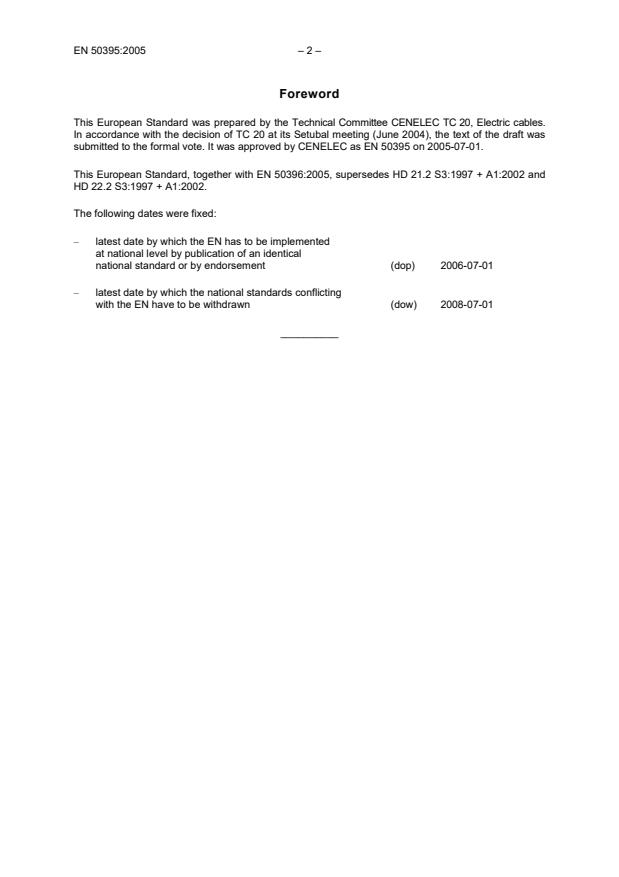
This European Standard was prepared by the Technical Committee CENELEC TC 20, Electric cables.
In accordance with the decision of TC 20 at its Setubal meeting (June 2004), the text of the draft was
submitted to the formal vote. It was approved by CENELEC as EN 50395 on 2005-07-01.
This European Standard, together with EN 50396:2005, supersedes HD 21.2 S3:1997 + A1:2002 and
HD 22.2 S3:1997 + A1:2002.
The following dates were fixed:
– latest date by which the EN has to be implemented
at national level by publication of an identical
national standard or by endorsement (dop) 2006-07-01
– latest date by which the national standards conflicting
with the EN have to be withdrawn (dow) 2008-07-01
__________
– 3 – EN 50395:2005
Contents
Page
Introduction.5
1 Scope.5
2 Normative references.5
3 General requirements .6
3.1 Pre-conditioning.6
3.2 Test temperature .6
3.3 Test voltage .6
3.4 Test values .6
4 Definitions.6
5 Electrical d.c. resistance of conductor .6
6 Voltage test on completed cable .6
7 Voltage test on cores in water .7
7.1 Test sample .7
7.2 Procedure .7
7.3 Requirement .7
8 Insulation resistance test .7
8.1 Insulation resistance for cables having maximum conductor temperatures
not exceeding 90 °C .7
8.1.1 Test sample .7
8.1.2 Procedure .8
8.1.3 Requirement .8
8.2 Insulation resistance for cables with maximum conductor temperatures
exceeding 90 °C .8
8.2.1 Test sample .8
8.2.2 Procedure .8
8.2.3 Requirement .8
9 Long term resistance of insulation to d.c.9
9.1 Test sample .9
9.2 Procedure .9
9.3 Requirement .10
10 Check for the absence of faults in insulation .10
10.1 General.10
10.2 Spark test.10
10.2.1 Procedure .10
10.2.2 Requirement .10
10.3 Voltage test.10
10.3.1 Procedure .10
10.3.2 Requirement .10
11 Surface resistance of sheath .11
11.1 Test samples .11
11.2 Procedure .11
11.3 Requirement .11
12 Transfer impedance .11
Annex A .12
A.1 Basic formula.12
A.2 Rounding .12
A.3 Examples of calculation.12
Annex B (informative) Source of electrical test methods in EN 50395.13
Bibliography.14
Figure 1 – Positioning of electrodes .9
– 5 – EN 50395:2005
Introduction
EN 50395 contains the electrical test methods that are used for harmonized low voltage energy
cables. These electrical test methods include all those previously contained in HD 21 and HD 22.
Annex B gives a comparison between the original location of each test method and its place in this
new European Standard.
The content of EN 50395 is not, and will not be, restricted only to test methods for cables to HD 21
and HD 22. Other test methods for harmonized LV cables may be included. Furthermore, the use of
test methods in EN 50395 for cables outside HD 21 and HD 22 is not prohibited, but it is strongly
recommended that expert advice be taken before such use, or before any proposal for incorporation
into another standard.
1 Scope
EN 50395 contains electrical test methods required for the testing of harmonized low voltage energy
cables, especially those rated at up to and including 450/750 V.
NOTE 1 A description of the origin of these test methods and the background to this European Standard is given in the
Introduction and in Annex B.
The particular cable standard dictates the tests which need to be performed on the relevant cable
type. It also specifies whether the specific test is a type test (T), a sample test (S) or a routine test (R)
for the particular cable type.
NOTE 2 T, S and R are defined in the relevant cable standard.
The requirements to be met during or after the test are specified for the particular cable type in the
relevant cable standard. However, some test requirements are obvious and universal, such as the fact
that no breakdown shall occur during voltage tests, and these are stated in the particular test method.
Test methods for use specifically in utility power cables are not covered by this European Standard.
They can be found in HD 605.
Test methods for use specifically in communications cables are the responsibility of the Technical
Committee CENELEC TC 46X, Communication cables. At present such test methods are given in
EN 50289 series.
2 Normative references
The following referenced documents are indispensable for the application of this document. For dated
references, only the edition cited applies. For undated references, the latest edition of the referenced
document (including any amendments) applies.
EN 50289-1-6 2002 Communication cables – Specifications for test methods -
Part 1-6: Electrical test methods – Electromagnetic performance
EN 50356 2002 Method for spark testing of cables
EN 60228 2005 Conductors of insulated cables
3 General requirements
3.1 Pre-conditioning
All the tests shall be carried out not less than 16 h after the extrusion or cross-linking, if any, of the
insulating or sheathing compounds.
3.2 Test temperature
Unless otherwise specified, tests shall be made at an ambient temperature of (20 ± 15) °C.
3.3 Test voltage
Unless otherwise specified in the individual clause of this European Standard or in the product
standard, the test voltage shall be a.c. of approxi
...