


SIST EN 17106-1:2021
(Main)Road operation machinery - Safety - Part 1: General requirements
Road operation machinery - Safety - Part 1: General requirements
This document specifies the common safety requirements for road operation machinery.
This document deals with the significant hazards common to road operation machinery, when they are used as intended and under the conditions of misuse which are reasonably foreseeable by the manufacturer associated with the whole life time of the machine (transport, assembly, dismantling, equipment in service and out of service, maintenance, moving on site, storage, disabling and scrapping).
NOTE The requirements specified in this part of the standard are common to two or more families of road operation machinery.
This document gives safety requirements for all types of road operation machinery and shall be used in conjunction with one of parts x to xx.
These machine specific parts do not repeat the requirements from part 1 but supplement or modify the requirements for the type of road operation machinery in question.
This European Standard applies to:
a) Road surface cleaning machines (as currently defined in EN 15429-1);
b) Winter service machines (as defined in group 1 and 2 of EN 15144);
c) Road service area maintenance machines for:
grass cutting (see Clause 3.1.1.1 of EN 15436-1:2008);
brush/hedge cutting (see Clause 3.1.1.2 of EN 15436-1:2008);
mechanical plant/branch cutting (see Clauses 3.1.2 and 3.2.3 of EN 15436-1:2008).
This standard deals with:
a) equipment permanently mounted on carrier vehicles;
b) interchangeable equipment;
c) self-propelled machinery with an integrated specially designed chassis;
d) trailed machines;
e) interfaces.
For multipurpose machinery the parts of the standard that cover the specific functions and applications have to be used, e.g. sweeper used for spreading thawing material or snow removing machines with brooms and ploughs shall use the relevant requirements of prEN xxx parts x, x, x.
Road operation machinery within the scope of prEN xxx parts x to x may include interchangeable auxiliary equipment within the scope of prEN xxx part x either as an integral part of its construction or as interchangeably fitted equipment.
Maschinen für den Straßenbetriebsdienst - Sicherheit - Teil 1 Grundlegende Sicherheitsanforderungen
Dieses Dokument legt die allgemeinen Sicherheitsanforderungen für Maschinen für den Straßenbetriebsdienst fest.
Dieses Dokument behandelt die signifikanten Gefährdungen (siehe Anhang A), die bei Maschinen für den Straßenbetriebsdienst über die gesamte Lebensdauer der Maschine hinweg (Transport, Überführungs- und Arbeitsmodi, An- und Abbau von Einrichtungen/Vorrichtungen im Betrieb, routinemäßige Wartung und Lagerung) üblich sind, wenn diese wie vom Hersteller beabsichtigt sowie unter missbräuchlichen Bedingungen in einem Rahmen, wie dieser vom Hersteller vernünftigerweise vorhergesehen werden kann, verwendet werden, mit Ausnahme der Demontage, Stilllegung und Verschrottung.
ANMERKUNG 1 Die in diesem Teil des Dokuments festgelegten Anforderungen gelten für zwei oder mehr Familien von Maschinen für den Straßenbetriebsdienst.
Dieses Dokument enthält allgemeine Sicherheitsanforderungen für alle Typen von Maschinen für den Straßenbetriebsdienst und muss in Verbindung mit Teil 2 bis Teil 4 verwendet werden. Diese maschinenspezifischen Teile wiederholen die Anforderungen nach Teil 1 nicht, sondern erweitern, ersetzen oder modifizieren die Anforderungen in Bezug auf den jeweiligen Typ Maschine für den Straßenbetriebsdienst.
Dieses Dokument gilt für:
[...]
Machines d'exploitation des routes - Sécurité - Partie 1 : Exigences générales
Obratovanje cestnih strojev - Varnost - 1. del: Splošne zahteve
General Information
- Status
- Published
- Public Enquiry End Date
- 31-May-2017
- Publication Date
- 08-Nov-2021
- Technical Committee
- I13 - Imaginarni 13
- Current Stage
- 6060 - National Implementation/Publication (Adopted Project)
- Start Date
- 28-Oct-2021
- Due Date
- 02-Jan-2022
- Completion Date
- 09-Nov-2021
Relations
- Effective Date
- 27-Oct-2021
- Effective Date
- 27-Oct-2021
- Effective Date
- 27-Oct-2021
- Effective Date
- 11-Feb-2015
- Effective Date
- 11-Feb-2015
- Effective Date
- 11-Feb-2015
Overview
EN 17106-1:2021 - published by CEN - is the Type‑C European standard that defines general safety requirements for road operation machinery. It establishes common safety principles for machines used in road maintenance and service, including road surface cleaning machines, winter service machines and road service area maintenance machines (grass, brush, mechanical branch cutting). Part 1 contains the cross‑family requirements that apply to permanently mounted equipment, interchangeable attachments, self‑propelled chassis and trailed machines. It is intended to be used together with machine‑specific parts (Parts 2–4).
Key topics and requirements
- Scope and applicability: Covers significant hazards common to road operation machinery during intended use and foreseeable misuse across the machine’s lifecycle (transport, assembly, travel/work modes, maintenance, storage). Note: certain clauses exclude dismantling, disabling and scrapping and national road/vehicle construction regulations take precedence.
- Risk assessment and reduction: Conforms to EN ISO 12100 principles - identify hazards (see informative Annex A) and apply protective measures.
- Machine control and safety systems: Requirements reference safety‑related control design (EN ISO 13849‑1), emergency stop design (EN ISO 13850) and prevention of unexpected start‑up (EN ISO 14118).
- Ergonomics and operator space: Layout, access and operator envelope considerations (EN ISO 3411, ISO 2867).
- Electrical and hydraulic safety: Electrical equipment and interfaces (EN 60204‑1), hydraulic/pneumatic system safety (EN ISO 4413 / EN ISO 4414).
- Noise: Noise emission test methods and declaration (Annex B and EN ISO 11201 / EN ISO 3744).
- Marking, information and documentation: Requirements for warning signs, instruction handbook and machine markings (including relationship to Directive 2006/42/EC in Annex ZA).
- Exclusions and limits: Not applicable to carrier vehicles, pedestrian‑controlled or hand‑held tools, EMI/EMC and vibration hazards, among others listed in the standard.
Practical applications and users
EN 17106-1:2021 is used by:
- Manufacturers and OEMs - to design and certify road operation machinery that meets European safety requirements.
- Design engineers - for system safety integration of attachments, interfaces and control systems.
- Compliance and market surveillance bodies - to assess conformity with machinery directives.
- Maintenance and service providers - to apply safe servicing procedures and documentation.
- Procurement and fleet managers - to specify safe features for road cleaning, winter maintenance and verge‑maintenance equipment.
Keywords: EN 17106-1:2021, road operation machinery safety, CEN standard, general requirements, winter service machines, road surface cleaning machines, risk assessment.
Related standards
EN 17106‑1 references and complements other standards, notably:
- EN ISO 12100 (risk assessment)
- EN ISO 13849‑1 (safety‑related control systems)
- EN 60204‑1 (electrical equipment of machines)
- EN ISO 11201 / EN ISO 3744 (noise measurement) See the standard’s normative references and Annex ZA for regulatory alignment with Directive 2006/42/EC.


Frequently Asked Questions
SIST EN 17106-1:2021 is a standard published by the Slovenian Institute for Standardization (SIST). Its full title is "Road operation machinery - Safety - Part 1: General requirements". This standard covers: This document specifies the common safety requirements for road operation machinery. This document deals with the significant hazards common to road operation machinery, when they are used as intended and under the conditions of misuse which are reasonably foreseeable by the manufacturer associated with the whole life time of the machine (transport, assembly, dismantling, equipment in service and out of service, maintenance, moving on site, storage, disabling and scrapping). NOTE The requirements specified in this part of the standard are common to two or more families of road operation machinery. This document gives safety requirements for all types of road operation machinery and shall be used in conjunction with one of parts x to xx. These machine specific parts do not repeat the requirements from part 1 but supplement or modify the requirements for the type of road operation machinery in question. This European Standard applies to: a) Road surface cleaning machines (as currently defined in EN 15429-1); b) Winter service machines (as defined in group 1 and 2 of EN 15144); c) Road service area maintenance machines for: grass cutting (see Clause 3.1.1.1 of EN 15436-1:2008); brush/hedge cutting (see Clause 3.1.1.2 of EN 15436-1:2008); mechanical plant/branch cutting (see Clauses 3.1.2 and 3.2.3 of EN 15436-1:2008). This standard deals with: a) equipment permanently mounted on carrier vehicles; b) interchangeable equipment; c) self-propelled machinery with an integrated specially designed chassis; d) trailed machines; e) interfaces. For multipurpose machinery the parts of the standard that cover the specific functions and applications have to be used, e.g. sweeper used for spreading thawing material or snow removing machines with brooms and ploughs shall use the relevant requirements of prEN xxx parts x, x, x. Road operation machinery within the scope of prEN xxx parts x to x may include interchangeable auxiliary equipment within the scope of prEN xxx part x either as an integral part of its construction or as interchangeably fitted equipment.
This document specifies the common safety requirements for road operation machinery. This document deals with the significant hazards common to road operation machinery, when they are used as intended and under the conditions of misuse which are reasonably foreseeable by the manufacturer associated with the whole life time of the machine (transport, assembly, dismantling, equipment in service and out of service, maintenance, moving on site, storage, disabling and scrapping). NOTE The requirements specified in this part of the standard are common to two or more families of road operation machinery. This document gives safety requirements for all types of road operation machinery and shall be used in conjunction with one of parts x to xx. These machine specific parts do not repeat the requirements from part 1 but supplement or modify the requirements for the type of road operation machinery in question. This European Standard applies to: a) Road surface cleaning machines (as currently defined in EN 15429-1); b) Winter service machines (as defined in group 1 and 2 of EN 15144); c) Road service area maintenance machines for: grass cutting (see Clause 3.1.1.1 of EN 15436-1:2008); brush/hedge cutting (see Clause 3.1.1.2 of EN 15436-1:2008); mechanical plant/branch cutting (see Clauses 3.1.2 and 3.2.3 of EN 15436-1:2008). This standard deals with: a) equipment permanently mounted on carrier vehicles; b) interchangeable equipment; c) self-propelled machinery with an integrated specially designed chassis; d) trailed machines; e) interfaces. For multipurpose machinery the parts of the standard that cover the specific functions and applications have to be used, e.g. sweeper used for spreading thawing material or snow removing machines with brooms and ploughs shall use the relevant requirements of prEN xxx parts x, x, x. Road operation machinery within the scope of prEN xxx parts x to x may include interchangeable auxiliary equipment within the scope of prEN xxx part x either as an integral part of its construction or as interchangeably fitted equipment.
SIST EN 17106-1:2021 is classified under the following ICS (International Classification for Standards) categories: 43.160 - Special purpose vehicles. The ICS classification helps identify the subject area and facilitates finding related standards.
SIST EN 17106-1:2021 has the following relationships with other standards: It is inter standard links to SIST EN 13524:2004+A2:2014, SIST EN 13021:2004+A1:2009, SIST EN 13019:2002+A1:2009, SIST EN 13019:2002+A1:2009, SIST EN 13021:2004+A1:2009, SIST EN 13524:2004+A2:2014. Understanding these relationships helps ensure you are using the most current and applicable version of the standard.
SIST EN 17106-1:2021 is associated with the following European legislation: EU Directives/Regulations: 2006/42/EC; Standardization Mandates: M/396. When a standard is cited in the Official Journal of the European Union, products manufactured in conformity with it benefit from a presumption of conformity with the essential requirements of the corresponding EU directive or regulation.
SIST EN 17106-1:2021 is available in PDF format for immediate download after purchase. The document can be added to your cart and obtained through the secure checkout process. Digital delivery ensures instant access to the complete standard document.
Standards Content (Sample)
SLOVENSKI STANDARD
01-december-2021
Nadomešča:
SIST EN 13019:2002+A1:2009
SIST EN 13021:2004+A1:2009
SIST EN 13524:2004+A2:2014
Obratovanje cestnih strojev - Varnost - 1. del: Splošne zahteve
Road operation machinery - Safety - Part 1: General requirements
Maschinen für den Straßenbetriebsdienst - Sicherheit - Teil 1 Grundlegende
Sicherheitsanforderungen
Machines d'exploitation des routes - Sécurité - Partie 1 : Exigences générales
Ta slovenski standard je istoveten z: EN 17106-1:2021
ICS:
43.160 Vozila za posebne namene Special purpose vehicles
2003-01.Slovenski inštitut za standardizacijo. Razmnoževanje celote ali delov tega standarda ni dovoljeno.
EN 17106-1
EUROPEAN STANDARD
NORME EUROPÉENNE
October 2021
EUROPÄISCHE NORM
ICS 43.160; 93.080.99; C Supersedes EN 13019:2001+A1:2008, EN
13021:2003+A1:2008, EN 13524:2003+A2:2014
English Version
Road operation machinery - Safety - Part 1: General
requirements
Machines d'exploitation des routes - Sécurité - Partie 1 Maschinen für den Straßenbetriebsdienst - Sicherheit -
: Prescriptions générales Teil 1 Grundlegende Sicherheitsanforderungen
This European Standard was approved by CEN on 16 August 2021.
CEN members are bound to comply with the CEN/CENELEC Internal Regulations which stipulate the conditions for giving this
European Standard the status of a national standard without any alteration. Up-to-date lists and bibliographical references
concerning such national standards may be obtained on application to the CEN-CENELEC Management Centre or to any CEN
member.
This European Standard exists in three official versions (English, French, German). A version in any other language made by
translation under the responsibility of a CEN member into its own language and notified to the CEN-CENELEC Management
Centre has the same status as the official versions.
CEN members are the national standards bodies of Austria, Belgium, Bulgaria, Croatia, Cyprus, Czech Republic, Denmark, Estonia,
Finland, France, Germany, Greece, Hungary, Iceland, Ireland, Italy, Latvia, Lithuania, Luxembourg, Malta, Netherlands, Norway,
Poland, Portugal, Republic of North Macedonia, Romania, Serbia, Slovakia, Slovenia, Spain, Sweden, Switzerland, Turkey and
United Kingdom.
EUROPEAN COMMITTEE FOR STANDARDIZATION
COMITÉ EUROPÉEN DE NORMALISATION
EUROPÄISCHES KOMITEE FÜR NORMUNG
CEN-CENELEC Management Centre: Rue de la Science 23, B-1040 Brussels
© 2021 CEN All rights of exploitation in any form and by any means reserved Ref. No. EN 17106-1:2021 E
worldwide for CEN national Members.
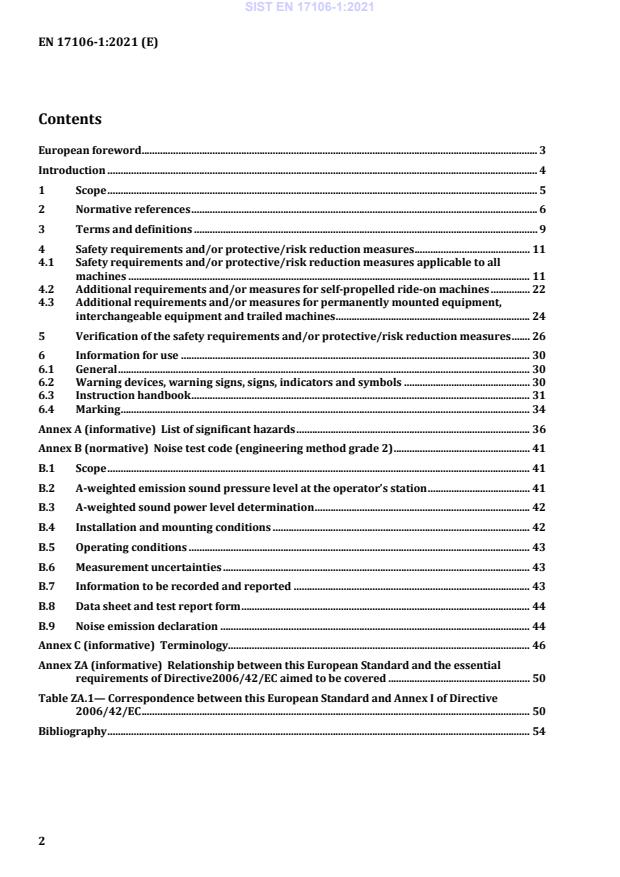
Contents
European foreword . 3
Introduction . 4
1 Scope . 5
2 Normative references . 6
3 Terms and definitions . 9
4 Safety requirements and/or protective/risk reduction measures . 11
4.1 Safety requirements and/or protective/risk reduction measures applicable to all
machines . 11
4.2 Additional requirements and/or measures for self-propelled ride-on machines . 22
4.3 Additional requirements and/or measures for permanently mounted equipment,
interchangeable equipment and trailed machines . 24
5 Verification of the safety requirements and/or protective/risk reduction measures . 26
6 Information for use . 30
6.1 General . 30
6.2 Warning devices, warning signs, signs, indicators and symbols . 30
6.3 Instruction handbook . 31
6.4 Marking . 34
Annex A (informative) List of significant hazards . 36
Annex B (normative) Noise test code (engineering method grade 2) . 41
B.1 Scope . 41
B.2 A-weighted emission sound pressure level at the operator’s station . 41
B.3 A-weighted sound power level determination . 42
B.4 Installation and mounting conditions . 42
B.5 Operating conditions . 43
B.6 Measurement uncertainties . 43
B.7 Information to be recorded and reported . 43
B.8 Data sheet and test report form . 44
B.9 Noise emission declaration . 44
Annex C (informative) Terminology . 46
Annex ZA (informative) Relationship between this European Standard and the essential
requirements of Directive2006/42/EC aimed to be covered . 50
Table ZA.1— Correspondence between this European Standard and Annex I of Directive
2006/42/EC . 50
Bibliography . 54
European foreword
This document (EN 17106-1:2021) has been prepared by Technical Committee CEN/TC 151
“Construction equipment and building material machines - Safety”, the secretariat of which is held by
DIN.
This European Standard shall be given the status of a national standard, either by publication of an
identical text or by endorsement, at the latest by April 2022, and conflicting national standards shall be
withdrawn at the latest by April 2022.
Attention is drawn to the possibility that some of the elements of this document may be the subject of
patent rights. CEN shall not be held responsible for identifying any or all such patent rights.
This document supersedes EN 13019:2001+A1:2008, EN 13021:2003+A1:2008,
EN 13524:2003+A2:2014.
This document has been prepared under a standardization request given to CEN by the European
Commission and the European Free Trade Association, and supports essential requirements of
EU Directive(s).
For relationship with EU Directive(s), see informative Annex ZA, which is an integral part of this
document.
EN 17106:2021 consists of the following parts under the general title “Road operation machinery –
Safety”:
— Part 1: General requirements
— Part 2: Specific requirements for road surface cleaning machines
— Part 3-1: Winter service machines - Specific requirements for snow clearing machines with rotating
tools and snow ploughs
— Part 3-2: Winter service machines - Specific requirements for spreading machines
— Part 4: Road service area maintenance machines - Specific requirements for grass and brush cutting
machines
Any feedback and questions on this document should be directed to the users’ national standards body.
A complete listing of these bodies can be found on the CEN website.
According to the CEN-CENELEC Internal Regulations, the national standards organisations of the
following countries are bound to implement this European Standard: Austria, Belgium, Bulgaria, Croatia,
Cyprus, Czech Republic, Denmark, Estonia, Finland, France, Germany, Greece, Hungary, Iceland, Ireland,
Italy, Latvia, Lithuania, Luxembourg, Malta, Netherlands, Norway, Poland, Portugal, Republic of North
Macedonia, Romania, Serbia, Slovakia, Slovenia, Spain, Sweden, Switzerland, Turkey and the United
Kingdom.
Introduction
This document is a type-C standard as stated in EN ISO 12100:2010.
This document is of relevance, in particular, for the following stakeholder groups representing the market
players with regard to machinery safety:
— machine manufacturers (small, medium and large enterprises);
— health and safety bodies (regulators, accident prevention organizations, market surveillance etc.).
Others can be affected by the level of machinery safety achieved with the means of the document by the
above-mentioned stakeholder groups:
— machine users/employers (small, medium and large enterprises);
— machine users/employees (e.g. trade unions, organizations for people with special needs);
— service providers, e.g. for maintenance (small, medium and large enterprises);
— consumers (in case of machinery intended for use by consumers).
The above-mentioned stakeholder groups have been given the possibility to participate at the drafting
process of this document.
The machinery concerned and the extent to which hazards, hazardous situations or hazardous events are
covered are indicated in the Scope of this document.
When requirements of this type-C standard are different from those which are stated in type-A or type-B
standards, the requirements of this type-C standard take precedence over the requirements of the other
standards for machines that have been designed and built according to the requirements of this type-C
standard.
1 Scope
This document specifies the general safety requirements for road operation machinery.
This document deals with the significant hazards (see Annex A) common to road operation machinery,
when they are used as intended and under the conditions of misuse which are reasonably foreseeable by
the manufacturer associated with the whole lifetime of the machine (transportation, travel and work
mode mounting and dismounting of equipment/attachments in service, routine maintenance, and
storage), excluding dismantling, disabling and scrapping.
NOTE 1 The requirements specified in this document are common to two or more families of road operation
machinery.
This document gives general safety requirements for all types of road operation machinery and shall be
used in conjunction with parts 2 to 4. These machine specific parts do not repeat the requirements from
part 1 but supplement, supersede or modify the requirements for the type of road operation machinery
in question.
This document applies to:
a) road surface cleaning machines (as defined in 3.7 and EN 15429-1:2007);
b) winter maintenance equipment (as defined in groups 1 and 2 of EN 15144:2007);
c) road service area maintenance machines for grass and/or brush cutting (as defined in
EN 15436-1:2008).
This document deals with:
— equipment permanently mounted on carrier vehicles;
— interchangeable equipment;
— self-propelled machinery with an integrated specially designed chassis;
— trailed machines;
— interfaces.
This document does not deal with:
— carrier vehicles, e.g. trucks, tractors, construction machinery, mobile industrial handling equipment;
NOTE 2 These requirements are covered in directives related to the construction of vehicles.
— demountable bodyworks on carrier vehicles (e.g. load platforms, boxes);
— risks associated with the operation of machines in potentially explosive atmospheres;
— pedestrian controlled and hand-held machines;
— remote controlled machines, except for the risks related to the working equipment only;
— lawn and garden equipment;
— machines for the maintenance of sports grounds;
— machines for agriculture, horticulture and forestry;
— earth-moving and mobile road construction machinery according to EN 474-1:2006+A6:2019 and
EN 500-1:2006+A1:2009;
— road surface treatment machines according to EN 13020:2015;
— snow-grooming equipment according to EN 15059:2009+A1:2015;
— machines or components which are solely designed for clearing rails such as rail/tram-line sweepers
or blowers;
— sweeping/cleaning equipment according to EN 60335-2-72;
— pit and sewer cleaning vehicles/-machines;
— refuse-collecting vehicles;
— airport machines and equipment;
— snow throwers according to ISO 8437-1.
This document does not include requirements which are covered in directives related to the construction
of vehicles or national road regulations. Requirements of road safety regulations take precedence over
the requirements of this document.
NOTE 3 For specific directives and/or road regulations, see the bibliography.
The use in public road traffic is governed by the national regulations.
This document does not deal with significant hazards associated with electromagnetic compatibility
(EMC).
This document does not deal with significant hazards associated with vibration.
This document is not applicable to road operation machinery manufactured before the date of its
publication.
2 Normative references
The following documents are referred to in the text in such a way that some or all of their content
constitutes requirements of this document. For dated references, only the edition cited applies. For
undated references, the latest edition of the referenced document (including any amendments) applies.
EN 15431:2008, Winter and road service area maintenance equipments - Power system and related controls
- Interchangeability and performance requirements
EN 15432-1:2011, Winter and road service area maintenance equipments - Front-mounted equipments -
Part 1: Fixed front mounting plates
EN 15432-2:2013, Winter and road service area maintenance equipments - Front-mounted equipments -
Part 2: Interchangeability on lifting systems
EN 16330:2013, Winter and road service area equipment - Power system and related controls - Power
hydraulic system and electric interfaces
EN 60204-1:2018, Safety of machinery - Electrical equipment of machines - Part 1: General requirements
EN 60529:1991, Degrees of protection provided by enclosures (IP Code)
EN ISO 2867:2011, Earth-moving machinery - Access systems (ISO 2867:2011)
EN ISO 3411:2007, Earth-moving machinery - Physical dimensions of operators and minimum operator
space envelope (ISO 3411:2007)
EN ISO 3744:2010, Acoustics - Determination of sound power levels and sound energy levels of noise sources
using sound pressure - Engineering methods for an essentially free field over a reflecting plane (ISO
3744:2010)
EN ISO 4254-1:2015, Agricultural machinery - Safety - Part 1: General requirements (ISO 4254-1:2013)
EN ISO 4413:2010, Hydraulic fluid power - General rules and safety requirements for systems and their
components (ISO 4413:2010)
EN ISO 4414:2010, Pneumatic fluid power - General rules and safety requirements for systems and their
components (ISO 4414:2010)
EN ISO 4871:2009, Acoustics - Declaration and verification of noise emission values of machinery and
equipment (ISO 4871:1996)
EN ISO 5010:2019, Earth-moving machinery - Wheeled machines - Steering requirements (ISO 5010:2019)
EN ISO 6682:2008, Earth-moving machinery - Zones of comfort and reach for controls (ISO 6682:1986,
including Amd 1:1989)
EN ISO 7010:2020, Graphical symbols - Safety colours and safety signs - Registered safety signs (ISO
7010:2019, Corrected version 2020-06)
EN ISO 11201:2010, Acoustics - Noise emitted by machinery and equipment - Determination of emission
sound pressure levels at a work station and at other specified positions in an essentially free field over a
reflecting plane with negligible environmental corrections (ISO 11201:2010)
EN ISO 11202:2010, Acoustics - Noise emitted by machinery and equipment - Determination of emission
sound pressure levels at a work station and at other specified positions applying approximate environmental
corrections (ISO 11202:2010)
EN ISO 11204:2010, Acoustics - Noise emitted by machinery and equipment - Determination of emission
sound pressure levels at a work station and at other specified positions applying accurate environmental
corrections (ISO 11204:2010)
EN ISO 12100:2010, Safety of machinery - General principles for design - Risk assessment and risk reduction
(ISO 12100:2010)
EN ISO 13732-1:2008, Ergonomics of the thermal environment - Methods for the assessment of human
responses to contact with surfaces - Part 1: Hot surfaces (ISO 13732-1:2006)
EN ISO 13849-1:2015, Safety of machinery - Safety-related parts of control systems - Part 1: General
principles for design (ISO 13849-1:2015)
EN ISO 13850:2015, Safety of machinery - Emergency stop function - Principles for design (ISO 13850:2015)
EN ISO 13857:2019, Safety of machinery — Safety distances to prevent hazard zones being reached by
upper and lower limbs (ISO 13857:2019)
EN ISO 14118:2018, Safety of machinery - Prevention of unexpected start-up (ISO 14118:2017)
EN ISO 14119:2013, Safety of machinery - Interlocking devices associated with guards - Principles for
design and selection (ISO 14119:2013)
EN ISO 14120:2015, Safety of machinery - Guards - General requirements for the design and construction
of fixed and movable guards (ISO 14120:2015)
ISO 730:2009, Agricultural wheeled tractors — Rear-mounted three-point linkage - Categories 1N, 1, 2N,
2, 3N, 3, 4N and 4
ISO 3600:2015, Tractors, machinery for agriculture and forestry, powered lawn and garden equipment -
Operator's manuals - Content and format
ISO 3767 (all parts), Tractors, machinery for agriculture and forestry, powered lawn and garden equipment
- Symbols for operator controls and other displays
ISO 3795:1989, Road vehicles, and tractors and machinery for agriculture and forestry - Determination of
burning behaviour of interior materials
ISO 3864-1:2011, Graphical symbols - Safety colours and safety signs - Part 1: Design principles for safety
signs and safety markings
ISO 4253:1993, Agricultural tractors - Operator's seating accommodation - Dimensions
ISO 5006:2017, Earth-moving machinery - Operator's field of view - Test method and performance criteria
ISO 6405-1:2017, Earth-moving machinery - Symbols for operator controls and other displays - Part 1:
Common symbols
ISO 7000:2019, Graphical symbols for use on equipment - Registered symbols
ISO 8759-1:2018, Agricultural tractors - Front-mounted equipment - Part 1: Power take-off: Safety
requirements and clearance zone around PTO
ISO 9533:2010, Earth-moving machinery - Machine-mounted audible travel alarms and forward horns -
Test methods and performance criteria
ISO 10968:2020, Earth-moving machinery - Operator’s controls
ISO 10998:2008, Agricultural tractors - Requirements for steering
ISO 11684:1995, Tractors, machinery for agriculture and forestry, powered lawn and garden equipment -
Safety signs and hazard pictorials - General principles
ISO 12508:1994, Earth-moving machinery - Operator station and maintenance areas - Bluntness of edges
ISO 15077:2020, Tractors and self-propelled machinery for agriculture - Operator controls - Actuating
forces, displacement, location and method of operation
ISO 15818:2017, Earth-moving machinery - Lifting and tying-down attachment points - Performance
requirements
ISO 25119-1:2018, Tractors and machinery for agriculture and forestry - Safety-related parts of control
systems - Part 1: General principles for design and development
ISO 26262-2:2018, Road vehicles - Functional safety - Part 2: Management of functional safety
3 Terms and definitions
For the purposes of this document, the terms and definitions given in EN ISO 12100:2010 and the
following apply.
ISO and IEC maintain terminological databases for use in standardization at the following addresses:
— ISO Online browsing platform: available at https://www.iso.org/obp
— IEC Electropedia: available at https://www.electropedia.org/
NOTE Additional illustrations are provided in Annex C.
3.1
interface
device mounted on a machine to allow the installation of attachments and/or equipment
Note 1 to entry: This can be mechanical, pneumatic, hydraulic or electric couplings.
3.2
interchangeable equipment
attachment which is intended by design is assembled or dismounted with a carrier vehicle (e.g. machine,
tractor, truck) by the operator himself in order to change its function or attribute a new function, in so
far as this equipment is not a tool
3.3
self-propelled machine
specially designed machine, where the working attachments are integrated and propelled by its own
power source
Note 1 to entry: The self-propelled machine can be a ride-on machine, operator-assisted machine, pedestrian
controlled machine fitted with a seat or a sulky or a remote-controlled machine.
3.4
trailed machine
vehicle which is designed to be towed by a self-propelled vehicle or tractor, permanently incorporates an
implement or is designed to process materials
Note 1 to entry: This vehicle may include a load platform designed and constructed to receive any tools and
appliances needed for those purposes and to store temporarily any materials.
3.5
equipment permanently mounted
device which is fixed assembled with the machine and which cannot be changed by the operator
3.6
demountable bodywork
specially designed frame with superstructure that can be easily mounted on, removed from and
transported by a suitable vehicle, e.g. flexible swap bodies, trailers and container chassis for combined
transport by road, rail or ship
3.7
road surface cleaning machine
machine for removal of spoil on traffic areas, where the machine is permanently fixed or demountable
from a carrier vehicle or specially designed chassis
3.8
winter maintenance equipment
3.8.1
snow plough
machine to remove snow from the traffic area by pushing aside
3.8.2
snow clearing machine with rotating tool
self-propelled and attached machine with which snow can be removed from traffic areas by rotating
means, accelerated and ejected, e.g. snow cutter, snow blower, snow cutter-blower and snow sweeper
3.8.2.1
snow cutter
machine for snow clearing with the rotary tools set at a right angle to the longitudinal axis of the vehicle
3.8.2.2
snow blower
machine for snow clearing with the rotary tools set parallel to the longitudinal axis of vehicle
3.8.2.3
snow cutter blower
combination of a snow cutter and snow blower; snow is collected by the cutter and expelled by the blower
3.8.2.4
snow sweeper
machine for snow clearing with rotating brushes
3.8.3
spreading machine
machine for distribution of de-icing material
Note 1 to entry: This can be for example a spreader or a sprayer.
3.8.3.1
spreader
machine for defined application of substances to traffic areas to maintain or to improve the skid
resistance of the traffic area
3.8.3.2
sprayer
machine able to spray liquid de-icing material on the traffic area
3.9
traffic area
paved area on which there is vehicular and/or pedestrian traffic; not included are rail tracks which are
solely for rail-mounted traffic, as well as traffic areas inside buildings and underground
3.10
demountable equipment
equipment that is able to be demounted from and remounted to the carrier vehicle
3.11
lashing point
point or device (e.g. ring device) at the machine or at the demountable equipment which allows its lifting
by an appropriate lifting device
3.12
operator
person controlling the equipment while operating and/or driving the machine
3.13
operator's station
area from which an operator controls the travel and/or work functions of the machine
3.14
normal operation
use of the machine for the purpose intended by the manufacturer by an operator familiar with the
machine characteristics
3.15
routine maintenance
maintenance that is specified in the periodic maintenance schedule of the operator’s manual for
performing scheduled daily/weekly/monthly maintenance on the machine
3.16
positive engagement (form locked engagement)
engagement system which retains the attachment in the normal working position by a system of at least
two components that engage each other perpendicular to the working forces such that the working forces
do not tend to cause disengagement (e.g. pin in shear)
3.17
lifting point
device fitted on, or incorporated into, a road operation machine, used for lifting the machine or
disassembled unit
4 Safety requirements and/or protective/risk reduction measures
4.1 Safety requirements and/or protective/risk reduction measures applicable to all
machines
4.1.1 General
Road operation shall comply with the safety requirements and/or protective/risk reduction measures of
this clause, unless modified by requirements of the relevant specific part of the standard series. In
addition, the machine shall be designed according to the principles of EN ISO 12100:2010 for relevant
but not significant hazards which are not dealt with by this document.
4.1.2 Noise
4.1.2.1 Noise reduction by design
4.1.2.1.1 Noise reduction at source
Machines shall be so designed and constructed that risks resulting from the emission of airborne noise
are reduced to the lowest possible level, taking account of technical progress and the availability of means
of reducing noise, in particularly, at source.
The available information and technical measures for reducing noise at source (see for example
EN ISO 11688-1:2009) shall be taken into account in the design.
NOTE 1 EN ISO 11688-2 provides useful information on noise generation mechanisms in machinery.
NOTE 2 Noise generation may vary considerably between machinery types. Noise reduction measures are
therefore dealt with in product specific standards.
4.1.2.1.2 Noise reduction by protective measures
The following measures - if practicable - are among those that are suitable:
— a cab;
— encapsulation of the engine(s);
— exhaust silencer.
NOTE Guidelines for the design of enclosures can be found in EN ISO 15667.
4.1.2.2 Noise reduction by information
The operating instructions shall contain information on residual risks associated with noise (see 6.3.2).
4.1.2.3 Noise measurement and declaration
In order to quantify the residual risk for noise, the measurement of the sound power and the emission
sound pressure level at the operator's position shall be carried out in accordance with Annex B and the
results shall be stated in the operator’s manual.
4.1.3 Visibility
4.1.3.1 General
Visibility from the operating positions shall be such that the operator can operate the machine safely
when used in its foreseen conditions and its intended use with regard to themselves and other persons
and operating positions adjacent to the machine.
When it is necessary to aid visibility of the working area and equipment, additional visual aids shall be
provided.
Appropriate illumination of the working area shall be provided, either by integrated lighting system or
by lighting system installed on the carrier vehicle.
4.1.3.2 Closed circuit television system
If a closed-circuit television system (CCTV) is fitted, it shall meet the following requirements:
The minimum size of the monitor screen sector for the rear view shall be 12,7 cm (approx. 5 inches)
diagonal (for example 4:3 or 16:9 format). The screen sector can be used for other purposes, but in the
case of driving backwards the screen sector shall show only the view to the back.
NOTE 1 Requirements for the installation of the monitor are given in the road safety regulations and truck cabin
manufacturer guidelines.
NOTE 2 The described CCTV systems are not related to road safety requirements.
4.1.3.3 Visibility measurement
The field of vision shall be verified according to the measurement procedure of ISO 5006:2017.
For visibility measurements according to ISO 5006:2017, the travel mode as defined by the manufacturer
shall be used.
It is sufficient to measure the machine with the most challenging standard attachment within the limits
of the intended use.
Specific testing conditions and acceptance criteria are provided in parts 2 to 4 of this series.
4.1.4 Controls and displays
4.1.4.1 General
Controls shall comply with EN ISO 6682:2008 and ISO 10968:2020, except the following clauses:
— 5.1.5;
— 5.1.8 last sentence.
NOTE ISO 15077 contains equivalent requirements to ISO 10968:2020 (e.g. minimum forces for actuating
controls).
The minimum distance between finger, hand- and foot-operated controls, or between these types of
control and other machine parts, shall be as in Table 1:
Table 1 — Minimum distance between centre line of two adjacent controls
Type of control Minimum distance
Hand operated controls 40 mm
Finger operated controls 19 mm without divider
Finger operated controls 15 mm with divider
For keys located on a touch screen or buttons on a lever 14 mm
Foot operated controls 50 mm
The location of controls and displays shall comply with the visibility requirements in relevant specific
parts of this document.
The location of controls and displays shall not obstruct or impair the access to the operator’s station, to
emergency exits or to emergency controls such as extinguishers, window breakers, PTO emergency stop
or other protective devices.
The controls and displays shall not impair the operation of airbags and restrain systems.
The design of controls shall not generate injury, harm or burns.
The manual controls and displays shall be located in such a way that they do not interfere with each other
regarding position and operation.
Controls shall be positioned outside of the hazard zone. Hazardous conditions (e.g. emptying of a sweeper
hopper) that are not protected shall be observable by the operator during the operation of the controls.
The controls and their different function positions shall be identified and shall be explained in the
operator's manual.
4.1.4.2 Protection against actuation of controls by unauthorized person
Controls shall be lockable by the operator when leaving the workplace by the use of:
— guards; or,
— mechanical locking means; or,
— locking through key-operated switches.
NOTE The ignition key of the carrier vehicle is considered to be an equivalent mean to fulfil the requirement.
4.1.4.3 Safety and reliability of control systems
Control systems shall comply with the standards listed in Table 2.
Table 2 — Applicable standards for control systems
Equipment Driving functions Working functions
Electrical/electronic control Other control All control systems
systems systems
Self-propelled EN ISO 13849-1:2015 EN ISO 13849-1:2015
equipment
a
Equipment EN ISO 13849-1:2015
ISO 26262-2:2018
mounted on
trucks truck
chassis
a a
Equipment EN ISO 13849-1:2015
ISO 25119-1:2018 or EN ISO 13849-1:2015
a
mounted on
EN ISO 13849-1:2015
tractors and
machinery for
agriculture and
forestry
a
Verification of functional safety is done by the vehicle manufacturer.
The performance level (PL) for safety functions shall meet the minimum required performance level
(PLr) according to EN ISO 13849-1:2015 as specified in the relevant part(s) of this document.
4.1.4.4 Starting
To avoid unauthorized activation of the engine starting, at least one of the following means shall be
provided:
— key-operated ignition or starting switch;
— lockable cab;
— lockable cover for the ignition or starting switch;
— security ignition or starting lock;
— lockable battery disconnecting switch.
Information to avoid unauthorized starting shall be provided in the operator’s manual.
Provisions shall be made to prevent the engine starter, if provided, from engaging unless:
— the traction transmission(s) is (are) in the neutral or parked position; or
— the traction clutch is disengaged;
and
— the master implement clutch (PTO) is disengaged;
or
— any work mode is deactivated.
4.1.4.5 Stopping
4.1.4.5.1 Normal stop
The machines shall be fitted with a stopping device by which the machine is brought to a complete stop.
4.1.4.5.2 Operational stop
Where, for operational reasons, a stop control that does not cut off the energy supply to the actuators is
required, the stop condition shall be monitored and maintained.
4.1.4.5.3 Emergency stop
In order that an actual or impending danger is averted quickly, emergency stops shall be provided. They
shall stop all relevant movements or functions as quickly as possible to prevent a dangerous situation
developing without creating an additional hazard. The emergency stop shall be in accordance with
EN ISO 13850:2015.
If an emergency stop function is not needed because the normal engine stop device provides the
emergency stop function, it shall be placed within easy reach according to EN ISO 6682:2008.
Additional specific requirements for emergency stops are given in separate parts of the document.
4.1.4.6 Starting and stopping the engine
Starting the engine shall not be possible with the engine's power transmission drive system and/or
working functions engaged if they may cause a hazardous situation.
Stopping the engine shall be achieved by a device constructed so that:
— the engine's stop device does not require sustained manual operation;
and
— when the device is set at the “off” or “stop” position the engine cannot be re-started, unless the device
has been reset.
Where an electric starter is used, unauthorized activation of the starter shall be avoided, by use of means
such as:
— key operated ignition or starting switch;
— lockable cab;
— lockable cover for the ignition or starting switch;
— security ignition or starting lock;
— lockable battery disconnecting switch.
4.1.5 Guards
Access to the danger zone, during any dangerous movement shall be prevented by guards. Guards shall
comply with EN ISO 14120:2015.
The technical principles for guards are described in EN ISO 12100:2010.
Interlocking devices associated with guards shall comply to EN ISO 14119:2013.
For determination of safety distances through openings in guards EN ISO 13857:2019, Table 4 shall be
applied.
4.1.6 Shearing and pinching points in the operator’s workplace
In the operator's workplace, there shall be no shearing or pinching points within hand or foot reach of
the operator when seated in the seat provided.
Safety distances from guards and protective devices to moving parts shall comply with
EN ISO 13857:2019.
4.1.7 Sharp edges and acute angles
Sharp edges and acute angles shall meet the requirements defined in ISO 12508:1994 in the areas which
can be accessed during operation and daily maintenance, except for the area of the attachment and tools.
4.1.8 Hot surfaces
Temperatures of surfaces of machinery with which the operator may come into contact shall conform to
EN ISO 13732-1:2008. This shall be achieved by the use of guards (e.g. perforated plates placed in front
of or around the hot surfaces) or be positioned to avoid risk of unintended contact. Where guarding is
impractical, e.g. engine radiator caps, adequate warning signs shall be employed advising on the nature
of the risk and avoidance measures described in information for use.
This requirement also applies to hot surfaces which are near steps, handrails, handholds and integral
machine parts used as boarding means and which can be inadvertently touched.
4.1.9 Fumes, gases and dust particles
The outlet of the exhaust pipe shall be located and directed in such a way that the driver or any other
operator obliged to stand on the machine will not normally be exposed to harmful concentrations of
noxious gases or fumes.
EXAMPLE Location of the outlet away from the head level of the operator or the intake of the cab.
At the same time the flow of exhaust gas shall be directed away from the operating and personnel
transport positions.
Dust pollution from the working process, e.g. sweeping brushes, etc. shall be minimized in the operating
and personnel transport positions, where no suppression means are employed, this can be achieved by
means of a cabin, e.g. filter or ventilation system.
4.1.10 Access systems
Access systems shall be in accordance with EN ISO 2867:2011.
4.1.11 Electrical equipment
4.1.11.1 General
Electrical equipment shall be in accordance with EN 60204-1:2018.
4.1.11.2 Degree of protection
Depending on the location/installation of electrical and electronic components, the following degrees of
protection are required:
— for all safety related components installed exterior to the machine or directly exposed to their
environment shall have a minimum degree of protection which corresponds to IP 54 according to
EN 60529:1991;
— for all safety related components installed in the operator's cab or protected against the
environment, the protection shall be designed and executed to safeguard a correct function under
expected and intended conditions.
4.1.11.3 Batteries
Starter and traction batteries shall be located so they can be properly maintained and exchanged, from
the ground or a platform, and shall be secured to remain in position and located or constructed and sealed
so as to prevent the possibility of spillage to the operator in the event of a machine overturn. Pollution
due to the accumulation of vapours in places occupied by operators shall be prevented.
Batteries shall be firmly attached in a ventilated space. The batteries shall be provided with measures for
safe handling.
Live parts (not connected to the frame) and/or connectors shall be covered with insulation material.
The electrical, non-earth terminals of batteries shall be protected to prevent unintentional contact and
shorting.
It shall be possible to disconnect the battery electrical circuit by any easily accessible device provided for
this purpose.
Information on service and replacement of the battery shall be provided in the operator's manual.
It shall be possible to disconnect batteries easily e.g. by a quick coupling or an accessible isolator switch.
The symbol 9.16 (battery disconnects/battery shut-off) according to ISO 6405-1:2017 shall be used for
identification.
The disconnection system shall be capable of being locked (e.g. padlock) if reconnection could endanger
persons.
4.1.12 Fire resistance
The interior, upholstery and insulation of the cab and other parts of the machine where insulation
materials are used, shall be made of flame retardant materials.
The burning rate shall not exceed the maximum rate of 150 mm/min when tested in accordance with
ISO 3795:1989.
4.1.13 Fire extinguisher
Road operation machinery shall have a defined space for installation of fire extinguisher easily accessible
to the operator.
4.1.14 Hydraulic systems and their components
Hydraulic systems shall comply with the safety requirements of EN ISO 4413:2010.
Pressurized hoses, pipes and components shall be located or shielded so that in the event of rupture, the
fluid cannot be discharged directly onto the operator when in the operating position.
Hydraulic lines containing fluid with a pressure of more than 5000 kPa or having a temperature over
60 °C passing near the operator’s station (within a distance of 1,0 m from the operator) shall be guarded.
4.1.15 Pneumatic systems and their components
Pneumatic systems shall comply with the safety requirements of EN ISO 4414:2010.
4.1.16 Failure of power supply
If the energy supply fails, it shall be possible to:
a) bring the attachment into a safe position (e.g. ground or support frame);
b) see the attachment moving into the safe position from the operator actuating position of the related
control;
c) release the residual pressure in the hydraulic and pneumatic circuits.
The means to move the attachment to a safe position and the device to release the residual pressure can
be located outside the operator's station.
4.1.17 Uncontrolled motion
Machine and equipment or attachment movement from the holding position, other than by actuation of
the controls by the operator, due to drift or creep (e.g. by leaking) or when power supply stops, shall be
limited to the extent that it cannot create a risk to exposed persons.
4.1.18 Fuel tank
Fuel tanks shall be corrosion-resistant and shall satisfy leakage tests at a pressure equal to double the
working pressure, but in any event not less than 30 kPa.
The design of the fuel cap shall be such that no apparent leakage occurs whilst the engine is at the normal
operating temperature and in all machine working positions. Seepage from any fuel tank ventilation
system shall not be considered as leakage.
Information on filling of the fuel tank shall be provided in the operator's manual.
Fuel tanks shall have easily accessible filling ports which permit the filling by normal filling facilities or
by cans with removable spouts.
Filling ports shall not be located in the operator's cabin environment.
Level indication means shall be provided for all tanks.
Labels shall be affixed near the filling port to indicate the correct fluid media.
A static discharge for plastic tank for CNG, LPG or petrol shall be provided.
4.1.19 Manual operation of individual assemblies
If special tools are required for the manual operation of individual assemblies, these shall be supplied
with the machine and their use explained in the operator's manual.
4.1.20
...
Questions, Comments and Discussion
Ask us and Technical Secretary will try to provide an answer. You can facilitate discussion about the standard in here.
Loading comments...