

SIST EN 13258:2003
(Main)Materials and articles in contact with foodstuffs - Test methods for crazing resistance of ceramic articles
- Abstract
This European Standard specifies two test methods (methods A and B) for the determination of crazing resistance of glazed ceramic tableware articles in contact with food with water absorption higher than 0,5 % (determined according to method C of EN 1217:1997). Method A is a test for resistance to crazing due to moisture expansion. Method B is a test for resistance to crazing due to thermal shock and is similar in most respects to EN 1183: 1997.
- Status
- Published
- Publication Date
- 30-Jun-2003
- Technical Committee
- EPO - Packaging - sales and grouped
- Current Stage
- 6060 - National Implementation/Publication (Adopted Project)
- Start Date
- 01-Jul-2003
- Due Date
- 01-Jul-2003
- Completion Date
- 01-Jul-2003



SIST EN 13258:2003 is published by SIST as the Slovenian identical adoption of EN 13258:2003. It specifies two test methods for crazing resistance of glazed ceramic tableware articles in contact with food with water absorption higher than 0.5 %. Laboratories, manufacturers, and quality control teams use it to assess resistance to moisture expansion and thermal shock.
What does SIST EN 13258:2003 specify?
SIST EN 13258:2003 sets out test methods for glazed ceramic tableware articles in contact with food, limited to articles with water absorption higher than 0.5 % measured by method C of EN 1217:1997. The document focuses on how to test crazing resistance and how to report the outcome in a consistent way.
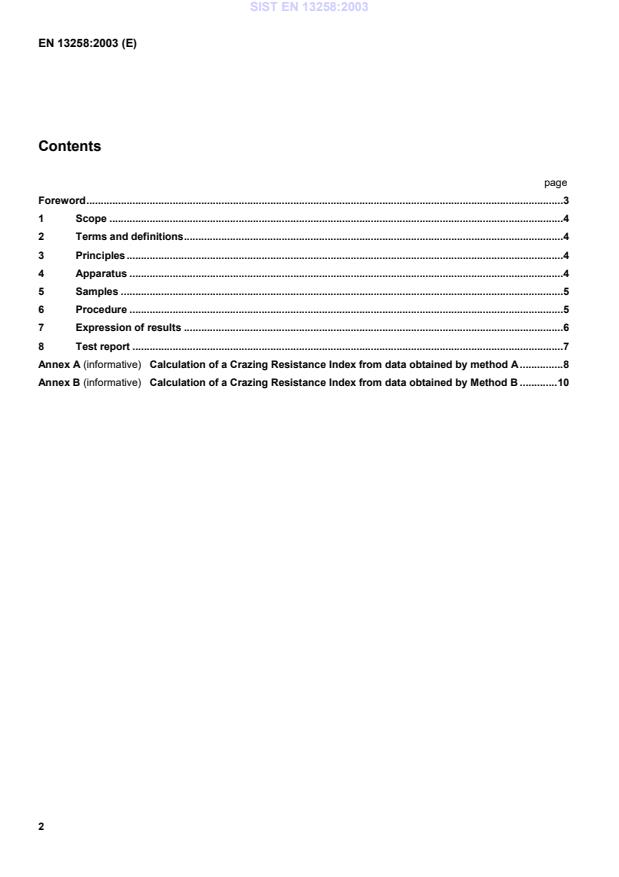
The standard is organized into eight clauses:
- Scope
- Terms and definitions
- Principles
- Apparatus
- Samples
- Procedure
- Expression of results
- Test report
It also includes two informative annexes for calculating a Crazing Resistance Index.
| Annex | What it covers |
|---|---|
| Annex A | Calculation of a Crazing Resistance Index from data obtained by method A |
| Annex B | Calculation of a Crazing Resistance Index from data obtained by method B |
What are the key requirements of SIST EN 13258:2003?
SIST EN 13258:2003 requires testing on not less than 7 whole unused samples. In practice, that means the result is based on a small set of intact articles, not fragments or repaired items, and the standard notes that both holloware and flatware are worth testing because manufacturing routes can differ.
Method A - moisture expansion
Method A subjects the samples to saturated steam in an autoclave at 340 kPa, with pressure raised gradually and held for 2 hours. After each cycle, the samples are cooled, stained, wiped, and inspected for crazing. This matters because it simulates damage driven by moisture expansion rather than mechanical handling.
The autoclave must allow safe pressure control and opening, and the staining solution uses eosine and domestic washing up liquid. The stain helps reveal fine cracks that are hard to see on a clean glazed surface.
Method B - thermal shock
Method B heats the samples in a test oven and then cools them rapidly in a cold water bath. The bath temperature is controlled within a narrow range, and the transfer from oven to bath must be fast and controlled. This matters because the method is designed to expose glaze cracking caused by sudden temperature change.
Testing starts at a temperature difference of 100 °C, then increases in 20 °C steps until all samples fail or the maximum stated difference is reached. The bath contains stain so that crazing cracks can be seen immediately after immersion.
Apparatus and handling
Clause 4 specifies the main equipment for each method. For Method A it includes the autoclave, staining solution, and soft cotton cloth. For Method B it includes the cold water bath, oven, basket, tongs, and heat-resistant gloves. The detailed equipment list matters because the result depends on controlled pressure, temperature, timing, and safe handling.
Results and Crazing Resistance Index
Clause 7 requires recording failures after each cycle or temperature increment, plus any samples that survive the full sequence. Annex A and Annex B show how to calculate a Crazing Resistance Index from those results. In practice, the index gives a single summary value that helps compare articles or batches tested by the same method.
Test report
Clause 8 requires the report to identify the standard used, the samples tested, the number of samples and sampling method, the method chosen, the cumulative time or temperature difference for each sample, the number of failures at each step, and the calculated Crazing Resistance Index. That gives buyers, labs, and suppliers a clear record of how the article behaved under test.
What terms does SIST EN 13258:2003 define?
Crazing is the formation of very fine cracks in the glaze caused by moisture expansion of the body or by thermal stress.
Moisture expansion is the expansion of ceramic bodies with high water absorption when water vapour penetrates through imperfections in the glaze.
Thermal shock is a sudden change in temperature that can create stress in the glaze.
Method A is the steam-based test for resistance to crazing due to moisture expansion.
Method B is the heat-and-quench test for resistance to crazing due to thermal shock.
Crazing Resistance Index is the calculated summary value derived from the failure data recorded during testing.
Who uses SIST EN 13258:2003?
SIST EN 13258:2003 is used by ceramic tableware manufacturers, test laboratories, and quality control teams working with glazed articles in contact with food. It is also useful for buyers, specifiers, and inspection teams who need a common way to check resistance to crazing before acceptance or supply.
What changed in SIST EN 13258:2003 from the previous edition?
SIST EN 13258:2003 supersedes ENV 13258:1998.
Which standards are used with SIST EN 13258:2003?
- EN 1217:1997 - provides method C for measuring the water absorption used to decide whether the article falls within scope.
- EN 1183:1997 - provides a comparison point for Method B, which is similar in most respects to that thermal shock test.
What does the SIST EN 13258:2003 document contain?
The document contains the test principles, equipment specifications, sample requirements, step-by-step procedures, result recording rules, and reporting content. Clause 4 gives the apparatus needed for both methods, including the pressure and temperature-controlled devices and the staining materials used to reveal crazing.
Clause 6 gives the operating sequence for both methods, including timing, temperature control, and inspection after each cycle or thermal shock. Clause 7 explains how to record failures and surviving samples, and how to derive the Crazing Resistance Index.
Annex A and Annex B provide worked calculation examples for Method A and Method B. These annexes are useful for labs when they need to turn raw pass-fail data into a reported index for comparison, specification checks, or product evaluation.
Relations
- Effective Date
- 01-Jul-2003
Get Certified
Connect with accredited certification bodies for this standard

BSI Group
BSI (British Standards Institution) is the business standards company that helps organizations make excellence a habit.

Bureau Veritas
Bureau Veritas is a world leader in laboratory testing, inspection and certification services.

DNV
DNV is an independent assurance and risk management provider.
Sponsored listings
Frequently Asked Questions
SIST EN 13258:2003 is a standard published by the Slovenian Institute for Standardization (SIST). Its full title is "Materials and articles in contact with foodstuffs - Test methods for crazing resistance of ceramic articles". This standard covers: This European Standard specifies two test methods (methods A and B) for the determination of crazing resistance of glazed ceramic tableware articles in contact with food with water absorption higher than 0,5 % (determined according to method C of EN 1217:1997). Method A is a test for resistance to crazing due to moisture expansion. Method B is a test for resistance to crazing due to thermal shock and is similar in most respects to EN 1183: 1997.
This European Standard specifies two test methods (methods A and B) for the determination of crazing resistance of glazed ceramic tableware articles in contact with food with water absorption higher than 0,5 % (determined according to method C of EN 1217:1997). Method A is a test for resistance to crazing due to moisture expansion. Method B is a test for resistance to crazing due to thermal shock and is similar in most respects to EN 1183: 1997.
SIST EN 13258:2003 is classified under the following ICS (International Classification for Standards) categories: 67.250 - Materials and articles in contact with foodstuffs. The ICS classification helps identify the subject area and facilitates finding related standards.
SIST EN 13258:2003 has the following relationships with other standards: It is inter standard links to SIST ENV 13258:2000. Understanding these relationships helps ensure you are using the most current and applicable version of the standard.
SIST EN 13258:2003 is available in PDF format for immediate download after purchase. The document can be added to your cart and obtained through the secure checkout process. Digital delivery ensures instant access to the complete standard document.
Standards Content (Sample)
2003-01.Slovenski inštitut za standardizacijo. Razmnoževanje celote ali delov tega standarda ni dovoljeno.Werkstoffe und Gegenstände in Kontakt mit Lebensmitteln - Prüfverfahren für die Haarrissbeständigkeit keramischer GegenständeMatériaux et articles en contact avec les denrées alimentaires - Méthodes d'essai de la résistance au tressaillage des articles en céramiqueMaterials and articles in contact with foodstuffs - Test methods for crazing resistance of ceramic articles67.250Materiali in predmeti v stiku z živiliMaterials and articles in contact with foodstuffsICS:Ta slovenski standard je istoveten z:EN 13258:2003SIST EN 13258:2003en01-julij-2003SIST EN 13258:2003SLOVENSKI
STANDARDSIST ENV 13258:20001DGRPHãþD
EUROPEAN STANDARDNORME EUROPÉENNEEUROPÄISCHE NORMEN 13258March 2003ICS 67.250; 97.040.60English versionMaterials and articles in contact with foodstuffs - Test methodsfor crazing resistance of ceramic articlesMatériaux et articles en contact avec les denréesalimentaires - Méthodes d'essai de la résistance autressaillage des articles en céramiqueWerkstoffe und Gegenstände in Kontakt mit Lebensmitteln- Prüfverfahren für die Haarrissbeständigkeit keramischerGegenständeThis European Standard was approved by CEN on 21 November 2002.CEN members are bound to comply with the CEN/CENELEC Internal Regulations which stipulate the conditions for giving this EuropeanStandard the status of a national standard without any alteration. Up-to-date lists and bibliographical references concerning such nationalstandards may be obtained on application to the Management Centre or to any CEN member.This European Standard exists in three official versions (English, French, German). A version in any other language made by translationunder the responsibility of a CEN member into its own language and notified to the Management Centre has the same status as the officialversions.CEN members are the national standards bodies of Austria, Belgium, Czech Republic, Denmark, Finland, France, Germany, Greece,Hungary, Iceland, Ireland, Italy, Luxembourg, Malta, Netherlands, Norway, Portugal, Slovak Republic, Spain, Sweden, Switzerland andUnited Kingdom.EUROPEAN COMMITTEE FOR STANDARDIZATIONCOMITÉ EUROPÉEN DE NORMALISATIONEUROPÄISCHES KOMITEE FÜR NORMUNGManagement Centre: rue de Stassart, 36
B-1050 Brussels© 2003 CENAll rights of exploitation in any form and by any means reservedworldwide for CEN national Members.Ref. No. EN 13258:2003 ESIST EN 13258:2003
Calculation of a Crazing Resistance Index from data obtained by method A.8Annex B (informative)
Calculation of a Crazing Resistance Index from data obtained by Method B.10SIST EN 13258:2003
...