

SIST EN 300 422-1 V1.4.2:2011
(Main)Electromagnetic compatibility and Radio spectrum Matters (ERM) - Wireless microphones in the 25 MHz to 3 GHz frequency range - Part 1: Technical characteristics and methods of measurement
General Information
- Abstract
The present document covers the minimum characteristics considered necessary in order to make the best use of the available frequency spectrum for wireless microphones and Aids for the hearing impaired.
The present document specifies the minimum performance requirements and the methods of measurement of Assistive Listening Devices, radio microphones and in-ear monitoring systems. It does not necessarily include all the characteristics that may be required by a user, nor does it necessarily represent the optimum performance achievable.
The present document applies to equipment operating on radio frequencies between 25 MHz and 3 GHz (as shown in table 1) using analogue, digital and hybrid (using both analogue and digital) modulation.
The maximum power recommended for equipment covered by the present document is 250 mW for radio microphones and 10 mW for ALDs.
An exception to this are the Public Hearing Aids defined in the CEPT Report 004 [i.10] and subsequent ECC [i.12] and EC Decisions [i.11] on the ex ERMES band [169,4 MHz to 169,8125 MHz] where 500 mW is defined.
The present document also covers radio microphones used in the 863 MHz to 865 MHz band, with a maximum power of 10 mW.
Electromagnetic Compatibility (EMC) requirements are covered by EN 301 489-9 [i.5].
National regulations on:
1) maximum power output;
2) licensing status.
will apply or those detailed in the latest version of:
• EC Decision 2005/928/EC [i.12];
• ECC/DEC/(05)02 [i.13];
• the EC SRD Decision [i.11]; or
• CEPT/ERC/REC 70-03 [i.9], annex 10 (see http://www.erodocdb.dk/).
Unless otherwise stated in the EC SRD Decision, ECC Decision or National Interfaces, Radio Microphones can be subject to individual licence.
The types of equipment covered by the present document are as follows:
• Professional Wireless Microphone Systems (PWMS) [i.1];
• in ear monitoring systems;
• consumer radio microphones;
• tour guide systems; and
• Assistive Listening Devices (Aids for the handicapped) comprising personal and public hearing aid systems.
- Status
- Published
- Public Enquiry End Date
- 31-Mar-2011
- Publication Date
- 19-Sep-2011
- Technical Committee
- MOC - Mobile Communications
- Current Stage
- 6060 - National Implementation/Publication (Adopted Project)
- Start Date
- 05-Sep-2011
- Due Date
- 10-Nov-2011
- Completion Date
- 20-Sep-2011
Buy Documents
en_30042201v010402c - Electromagnetic compatibility and Radio spectrum Matters (ERM); Wireless microphones in the 25 MHz to 3 GHz frequency range; Part 1: Technical characteristics and methods of measurement
en_30042201v010402p - Electromagnetic compatibility and Radio spectrum Matters (ERM); Wireless microphones in the 25 MHz to 3 GHz frequency range; Part 1: Technical characteristics and methods of measurement
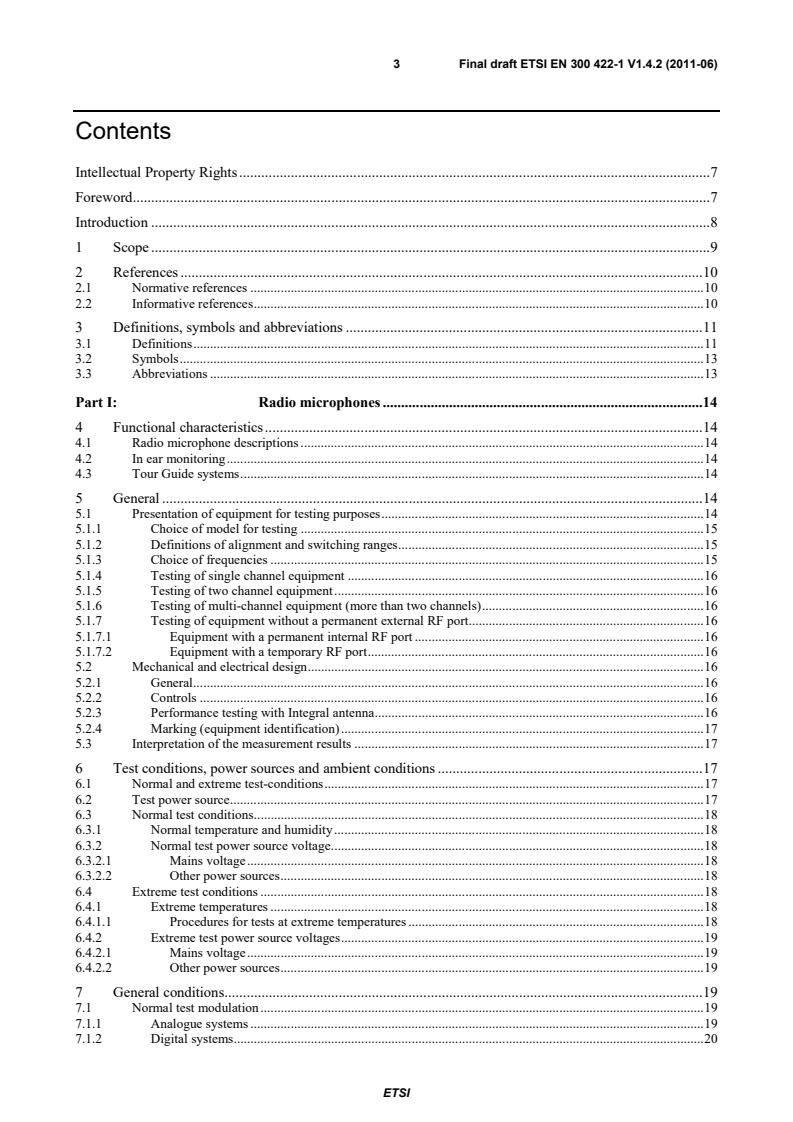
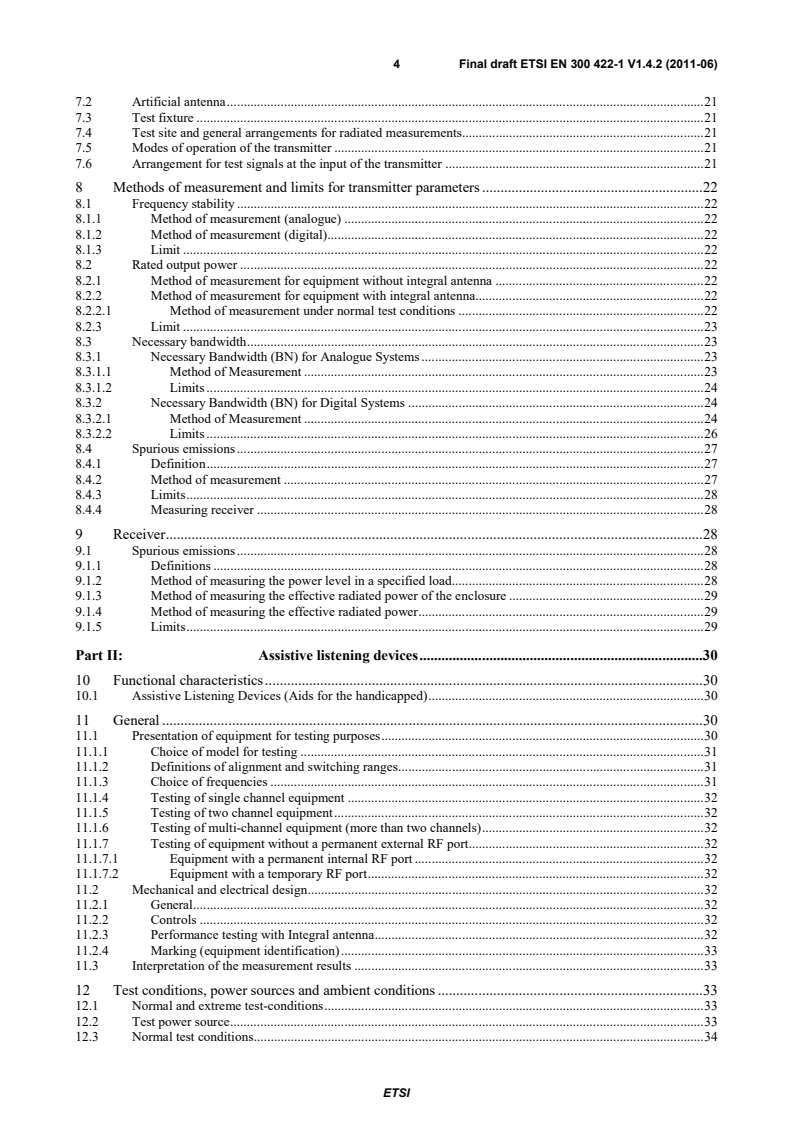
en_30042201v010402v - Electromagnetic compatibility and Radio spectrum Matters (ERM); Wireless microphones in the 25 MHz to 3 GHz frequency range; Part 1: Technical characteristics and methods of measurement

Overview
SIST EN 300 422-1 V1.4.2:2011 sets out the essential technical characteristics and measurement methods for wireless microphones and assistive listening devices (ALDs) operating between 25 MHz and 3 GHz. This European standard, published by SIST and harmonized with ETSI EN 300 422-1, aims to ensure efficient spectrum utilization and minimize radio interference across a wide array of wireless audio equipment including professional and consumer systems.
This standard is vital for manufacturers, integrators, and users of wireless microphones, in-ear monitoring systems, tour guide solutions, and hearing aid transmitters. It covers not only technical performance and measurement techniques, but also references relevant electromagnetic compatibility (EMC) and power output requirements. By adhering to SIST EN 300 422-1, manufacturers meet the regulatory baseline for product access to European and international markets.
Key Topics
- Frequency Range: Applies to equipment operating from 25 MHz up to 3 GHz, covering a wide variety of wireless audio devices.
- Equipment Types:
- Professional Wireless Microphone Systems (PWMS)
- Consumer Radio Microphones
- In-ear Monitoring Systems
- Tour Guide Systems
- Assistive Listening Devices (ALDs) including both personal and public hearing aid transmitters
- Technical and Performance Requirements:
- Minimum technical characteristics for robust, interference-free operation
- Maximum output power: 250 mW for radio microphones, 10 mW for most ALDs, with certain exceptions (up to 500 mW for public hearing aids in defined bands)
- Compatible with analogue, digital, and hybrid modulation systems
- Measurement Methods:
- Defines test conditions (normal and extreme temperatures, power sources, voltages)
- Procedures for measuring frequency stability, output power, necessary bandwidth, and spurious emissions
- Regulatory Compliance:
- References key European Commission Decisions and CEPT/ECC Agreements for power limits and license requirements
- EMC requirements referred through EN 301 489-9
Applications
SIST EN 300 422-1 V1.4.2:2011 is broadly applicable across sectors relying on wireless audio transmission, including:
- Live Events and Broadcasting: Ensures professional wireless microphones and in-ear monitors deliver clear, interference-resistant audio for concerts, theatre, film, and TV production.
- Education and Guided Tours: Standardizes performance for tour guide systems and classroom ALDs, supporting clear audio in challenging environments.
- Accessibility Technologies: Sets technical guidelines for assistive listening devices, improving the usability and compliance of wireless hearing aids in public venues.
- Consumer Electronics: Applies to consumer radio microphones and wireless audio products, ensuring they meet regulatory and operational requirements for safety and spectrum efficiency.
By complying with this standard, device manufacturers and integrators guarantee reliable performance, regulatory approval, and interoperability in multi-user wireless environments.
Related Standards
Manufacturers, integrators, and other stakeholders should also reference these related standards and regulations:
- EN 301 489-9: Electromagnetic compatibility requirements for wireless microphones and ALDs.
- EN 301 357-1: Additional specifications for certain low-power or consumer audio equipment.
- CEPT/ERC/REC 70-03: European recommendations on spectrum use for Short Range Devices.
- EC Decisions & ECC Decisions: Legal framework for frequency allocation and licensing (e.g., EC Decision 2005/928/EC, ECC/DEC/(05)02).
- National Regulations: May impose additional requirements on power output and licensing based on local spectrum management.
Adherence to these standards ensures consistency, safety, and the optimal use of wireless audio technology across a spectrum-rich environment.
Keywords: wireless microphones standard, SIST EN 300 422-1, technical characteristics, radio spectrum, assistive listening devices, EMC, frequency range, measurement methods, wireless audio compliance, Europe radio standards
Buy Documents
en_30042201v010402c - Electromagnetic compatibility and Radio spectrum Matters (ERM); Wireless microphones in the 25 MHz to 3 GHz frequency range; Part 1: Technical characteristics and methods of measurement
en_30042201v010402p - Electromagnetic compatibility and Radio spectrum Matters (ERM); Wireless microphones in the 25 MHz to 3 GHz frequency range; Part 1: Technical characteristics and methods of measurement
en_30042201v010402v - Electromagnetic compatibility and Radio spectrum Matters (ERM); Wireless microphones in the 25 MHz to 3 GHz frequency range; Part 1: Technical characteristics and methods of measurement
Get Certified
Connect with accredited certification bodies for this standard

ANCE
Mexican certification and testing association.

Intertek Slovenia
Intertek testing, inspection, and certification services in Slovenia.

LNE (Laboratoire National de Métrologie et d'Essais)
French national laboratory for metrology and testing.
Sponsored listings
Frequently Asked Questions
SIST EN 300 422-1 V1.4.2:2011 is a standard published by the Slovenian Institute for Standardization (SIST). Its full title is "Electromagnetic compatibility and Radio spectrum Matters (ERM) - Wireless microphones in the 25 MHz to 3 GHz frequency range - Part 1: Technical characteristics and methods of measurement". This standard covers: The present document covers the minimum characteristics considered necessary in order to make the best use of the available frequency spectrum for wireless microphones and Aids for the hearing impaired. The present document specifies the minimum performance requirements and the methods of measurement of Assistive Listening Devices, radio microphones and in-ear monitoring systems. It does not necessarily include all the characteristics that may be required by a user, nor does it necessarily represent the optimum performance achievable. The present document applies to equipment operating on radio frequencies between 25 MHz and 3 GHz (as shown in table 1) using analogue, digital and hybrid (using both analogue and digital) modulation. The maximum power recommended for equipment covered by the present document is 250 mW for radio microphones and 10 mW for ALDs. An exception to this are the Public Hearing Aids defined in the CEPT Report 004 [i.10] and subsequent ECC [i.12] and EC Decisions [i.11] on the ex ERMES band [169,4 MHz to 169,8125 MHz] where 500 mW is defined. The present document also covers radio microphones used in the 863 MHz to 865 MHz band, with a maximum power of 10 mW. Electromagnetic Compatibility (EMC) requirements are covered by EN 301 489-9 [i.5]. National regulations on: 1) maximum power output; 2) licensing status. will apply or those detailed in the latest version of: • EC Decision 2005/928/EC [i.12]; • ECC/DEC/(05)02 [i.13]; • the EC SRD Decision [i.11]; or • CEPT/ERC/REC 70-03 [i.9], annex 10 (see http://www.erodocdb.dk/). Unless otherwise stated in the EC SRD Decision, ECC Decision or National Interfaces, Radio Microphones can be subject to individual licence. The types of equipment covered by the present document are as follows: • Professional Wireless Microphone Systems (PWMS) [i.1]; • in ear monitoring systems; • consumer radio microphones; • tour guide systems; and • Assistive Listening Devices (Aids for the handicapped) comprising personal and public hearing aid systems.
The present document covers the minimum characteristics considered necessary in order to make the best use of the available frequency spectrum for wireless microphones and Aids for the hearing impaired. The present document specifies the minimum performance requirements and the methods of measurement of Assistive Listening Devices, radio microphones and in-ear monitoring systems. It does not necessarily include all the characteristics that may be required by a user, nor does it necessarily represent the optimum performance achievable. The present document applies to equipment operating on radio frequencies between 25 MHz and 3 GHz (as shown in table 1) using analogue, digital and hybrid (using both analogue and digital) modulation. The maximum power recommended for equipment covered by the present document is 250 mW for radio microphones and 10 mW for ALDs. An exception to this are the Public Hearing Aids defined in the CEPT Report 004 [i.10] and subsequent ECC [i.12] and EC Decisions [i.11] on the ex ERMES band [169,4 MHz to 169,8125 MHz] where 500 mW is defined. The present document also covers radio microphones used in the 863 MHz to 865 MHz band, with a maximum power of 10 mW. Electromagnetic Compatibility (EMC) requirements are covered by EN 301 489-9 [i.5]. National regulations on: 1) maximum power output; 2) licensing status. will apply or those detailed in the latest version of: • EC Decision 2005/928/EC [i.12]; • ECC/DEC/(05)02 [i.13]; • the EC SRD Decision [i.11]; or • CEPT/ERC/REC 70-03 [i.9], annex 10 (see http://www.erodocdb.dk/). Unless otherwise stated in the EC SRD Decision, ECC Decision or National Interfaces, Radio Microphones can be subject to individual licence. The types of equipment covered by the present document are as follows: • Professional Wireless Microphone Systems (PWMS) [i.1]; • in ear monitoring systems; • consumer radio microphones; • tour guide systems; and • Assistive Listening Devices (Aids for the handicapped) comprising personal and public hearing aid systems.
SIST EN 300 422-1 V1.4.2:2011 is classified under the following ICS (International Classification for Standards) categories: 33.060.99 - Other equipment for radiocommunications; 33.100.01 - Electromagnetic compatibility in general; 33.160.50 - Accessories. The ICS classification helps identify the subject area and facilitates finding related standards.
SIST EN 300 422-1 V1.4.2:2011 is available in PDF format for immediate download after purchase. The document can be added to your cart and obtained through the secure checkout process. Digital delivery ensures instant access to the complete standard document.
Standards Content (Sample)
Draft ETSI EN 300 422-1 V1.4.2 (2011-01)
European Standard (EN)
Electromagnetic compatibility
and Radio spectrum Matters (ERM);
Wireless microphones
in the 25 MHz to 3 GHz frequency range;
Part 1: Technical characteristics and
methods of measurement
2 Draft ETSI EN 300 422-1 V1.4.2 (2011-01)
Reference
REN/ERM-TG17WG3-014-1
Keywords
audio, radio, radio MIC, testing
ETSI
650 Route des Lucioles
F-06921 Sophia Antipolis Cedex - FRANCE
Tel.: +33 4 92 94 42 00 Fax: +33 4 93 65 47 16
Siret N° 348 623 562 00017 - NAF 742 C
Association à but non lucratif enregistrée à la
Sous-Préfecture de Grasse (06) N° 7803/88
Important notice
Individual copies of the present document can be downloaded from:
http://www.etsi.org
The present document may be made available in more than one electronic version or in print. In any case of existing or
perceived difference in contents between such versions, the reference version is the Portable Document Format (PDF).
In case of dispute, the reference shall be the printing on ETSI printers of the PDF version kept on a specific network drive
within ETSI Secretariat.
Users of the present document should be aware that the document may be subject to revision or change of status.
Information on the current status of this and other ETSI documents is available at
http://portal.etsi.org/tb/status/status.asp
If you find errors in the present document, please send your comment to one of the following services:
http://portal.etsi.org/chaircor/ETSI_support.asp
Copyright Notification
No part may be reproduced except as authorized by written permission.
The copyright and the foregoing restriction extend to reproduction in all media.
© European Telecommunications Standards Institute 2011.
All rights reserved.
TM TM TM TM
DECT , PLUGTESTS , UMTS , TIPHON , the TIPHON logo and the ETSI logo are Trade Marks of ETSI registered
for the benefit of its Members.
TM
3GPP is a Trade Mark of ETSI registered for the benefit of its Members and of the 3GPP Organizational Partners.
LTE™ is a Trade Mark of ETSI currently being registered
for the benefit of its Members and of the 3GPP Organizational Partners.
GSM® and the GSM logo are Trade Marks registered and owned by the GSM Association.
ETSI
3 Draft ETSI EN 300 422-1 V1.4.2 (2011-01)
Contents
Intellectual Property Rights . 7
Foreword . 7
Introduction . 8
1 Scope . 9
2 References . 10
2.1 Normative references . 10
2.2 Informative references . 10
3 Definitions, symbols and abbreviations . 11
3.1 Definitions . 11
3.2 Symbols . 13
3.3 Abbreviations . 13
Part I: Radio microphones . 14
4 Functional characteristics . 14
4.1 Radio microphone descriptions . 14
4.2 In ear monitoring . 14
4.3 Tour Guide systems . 14
5 General . 14
5.1 Presentation of equipment for testing purposes . 14
5.1.1 Choice of model for testing . 15
5.1.2 Definitions of alignment and switching ranges . 15
5.1.3 Choice of frequencies . 15
5.1.4 Testing of single channel equipment . 16
5.1.5 Testing of two channel equipment . 16
5.1.6 Testing of multi-channel equipment (more than two channels) . 16
5.1.7 Testing of equipment without a permanent external RF port . 16
5.1.7.1 Equipment with a permanent internal RF port . 16
5.1.7.2 Equipment with a temporary RF port . 16
5.2 Mechanical and electrical design . 16
5.2.1 General . 16
5.2.2 Controls . 16
5.2.3 Performance testing with Integral antenna . 16
5.2.4 Marking (equipment identification) . 17
5.3 Interpretation of the measurement results . 17
6 Test conditions, power sources and ambient conditions . 17
6.1 Normal and extreme test-conditions . 17
6.2 Test power source . 17
6.3 Normal test conditions . 18
6.3.1 Normal temperature and humidity . 18
6.3.2 Normal test power source voltage . 18
6.3.2.1 Mains voltage . 18
6.3.2.2 Other power sources . 18
6.4 Extreme test conditions . 18
6.4.1 Extreme temperatures . 18
6.4.1.1 Procedures for tests at extreme temperatures . 18
6.4.2 Extreme test power source voltages . 19
6.4.2.1 Mains voltage . 19
6.4.2.2 Other power sources . 19
7 General conditions . 19
7.1 Normal test modulation . 19
7.1.1 Analogue systems . 19
7.1.2 Digital systems . 20
ETSI
4 Draft ETSI EN 300 422-1 V1.4.2 (2011-01)
7.2 Artificial antenna . 21
7.3 Test fixture . 21
7.4 Test site and general arrangements for radiated measurements. 21
7.5 Modes of operation of the transmitter . 21
7.6 Arrangement for test signals at the input of the transmitter . 21
8 Methods of measurement and limits for transmitter parameters . 22
8.1 Frequency stability . 22
8.1.1 Method of measurement (analogue) . 22
8.1.2 Method of measurement (digital) . 22
8.1.3 Limit . 22
8.2 Rated output power . 22
8.2.1 Method of measurement for equipment without integral antenna . 22
8.2.2 Method of measurement for equipment with integral antenna. 22
8.2.2.1 Method of measurement under normal test conditions . 22
8.2.3 Limit . 23
8.3 Necessary bandwidth . 23
8.3.1 Necessary Bandwidth (BN) for Analogue Systems . 23
8.3.1.1 Method of Measurement . 23
8.3.1.2 Limits . 24
8.3.2 Necessary Bandwidth (BN) for Digital Systems . 24
8.3.2.1 Method of Measurement . 24
8.3.2.2 Limits . 26
8.4 Spurious emissions . 27
8.4.1 Definition . 27
8.4.2 Method of measurement . 27
8.4.3 Limits . 28
8.4.4 Measuring receiver . 28
9 Receiver . . 28
9.1 Spurious emissions . 28
9.1.1 Definitions . 28
9.1.2 Method of measuring the power level in a specified load. 28
9.1.3 Method of measuring the effective radiated power of the enclosure . 29
9.1.4 Method of measuring the effective radiated power . 29
9.1.5 Limits . 29
Part II: Assistive listening devices . 30
10 Functional characteristics . 30
10.1 Assistive Listening Devices (Aids for the handicapped) . 30
11 General . 30
11.1 Presentation of equipment for testing purposes . 30
11.1.1 Choice of model for testing . 31
11.1.2 Definitions of alignment and switching ranges . 31
11.1.3 Choice of frequencies . 31
11.1.4 Testing of single channel equipment . 32
11.1.5 Testing of two channel equipment . 32
11.1.6 Testing of multi-channel equipment (more than two channels) . 32
11.1.7 Testing of equipment without a permanent external RF port . 32
11.1.7.1 Equipment with a permanent internal RF port . 32
11.1.7.2 Equipment with a temporary RF port . 32
11.2 Mechanical and electrical design . 32
11.2.1 General . 32
11.2.2 Controls . 32
11.2.3 Performance testing with Integral antenna . 32
11.2.4 Marking (equipment identification) . 33
11.3 Interpretation of the measurement results . 33
12 Test conditions, power sources and ambient conditions . 33
12.1 Normal and extreme test-conditions . 33
12.2 Test power source . 33
12.3 Normal test conditions . 34
ETSI
5 Draft ETSI EN 300 422-1 V1.4.2 (2011-01)
12.3.1 Normal temperature and humidity . 34
12.3.2 Normal test power source voltage . 34
12.3.2.1 Mains voltage . 34
12.3.2.2 Other power sources . 34
12.4 Extreme test conditions . 34
12.4.1 Extreme temperatures . 34
12.4.1.1 Procedures for tests at extreme temperatures . 34
12.4.2 Extreme test power source voltages . 35
12.4.2.1 Mains voltage . 35
12.4.2.2 Other power sources . 35
13 General conditions . 35
13.1 Normal test modulation . 35
13.1.1 Analogue systems . 35
13.1.2 Digital systems . 35
13.2 Artificial antenna . 36
13.3 Test fixture . 36
13.4 Test site and general arrangements for radiated measurements. 36
13.5 Modes of operation of the transmitter . 36
13.6 Arrangement for test signals at the input of the transmitter . 36
14 Methods of measurement and limits for transmitter parameters . 37
14.1 Frequency stability . 37
14.1.1 Method of measurement (analogue) . 37
14.1.2 Method of measurement (digital) . 37
14.1.3 Limit . 37
14.2 Rated output power . 37
14.2.1 Method of measurement for equipment without integral antenna . 37
14.2.2 Method of measurement for equipment with integral antenna. 37
14.2.2.1 Method of measurement under normal test conditions . 37
14.2.3 Limit . 38
14.3 Necessary bandwidth . 38
14.3.1 Necessary Bandwidth (BN) for Analogue Systems . 38
14.3.1.1 Method of Measurement . 38
14.3.1.2 Limits . 39
14.3.2 Necessary Bandwidth (BN) for Digital Systems . 40
14.3.2.1 Method of Measurement . 40
14.3.2.2 Limits . 41
14.4 Spurious emissions . 41
14.4.1 Definition . 41
14.4.2 Method of measurement . 41
14.4.3 Limits . 41
14.4.4 Measuring receiver . 42
15 Receiver . . 42
15.1 Spurious emissions . 42
15.1.1 Definitions . 42
15.1.2 Method of measuring the power level in a specified load. 42
15.1.3 Method of measuring the effective radiated power of the enclosure . 42
15.1.4 Method of measuring the effective radiated power . 43
15.1.5 Limits . 43
16 Measurement uncertainty . 43
Annex A (normative): Radiated measurement . 45
A.1 Test sites and general arrangements for measurements involving the use of radiated fields . 45
A.1.1 Anechoic Chamber . 45
A.1.2 Anechoic Chamber with a conductive ground plane . 46
A.1.3 Open Area Test Site (OATS) . 47
A.1.4 Test antenna . 48
A.1.5 Substitution antenna . 48
A.1.6 Measuring antenna . 49
A.1.7 Stripline arrangement . 49
ETSI
6 Draft ETSI EN 300 422-1 V1.4.2 (2011-01)
A.1.7.1 General . 49
A.1.7.2 Description . 49
A.1.7.3 Calibration . 49
A.1.7.4 Mode of use . 49
A.2 Guidance on the use of radiation test sites . 49
A.2.1 Verification of the test site . 49
A.2.2 Preparation of the EUT . 49
A.2.3 Power supplies to the EUT . 50
A.2.4 Volume control setting for analogue speech tests . 50
A.2.5 Range length . 50
A.2.6 Site preparation . 51
A.3 Coupling of signals . 51
A.3.1 General . 51
A.3.2 Data Signals. 51
A.3.3 Speech and analogue signals . 51
A.3.3.1 Acoustic coupler description. 52
A.3.3.2 Calibration . 52
A.4 Standard test position . 52
A.5 Test fixture . 53
A.5.1 Description . 53
A.5.2 Calibration . 53
A.5.3 Mode of use . 54
Annex B (normative): Measurement of Necessary Bandwidth (BN) for analogue systems . 55
Annex C (informative): Bibliography . 56
History . 57
ETSI
7 Draft ETSI EN 300 422-1 V1.4.2 (2011-01)
Intellectual Property Rights
IPRs essential or potentially essential to the present document may have been declared to ETSI. The information
pertaining to these essential IPRs, if any, is publicly available for ETSI members and non-members, and can be found
in ETSI SR 000 314: "Intellectual Property Rights (IPRs); Essential, or potentially Essential, IPRs notified to ETSI in
respect of ETSI standards", which is available from the ETSI Secretariat. Latest updates are available on the ETSI Web
server (http://webapp.etsi.org/IPR/home.asp).
Pursuant to the ETSI IPR Policy, no investigation, including IPR searches, has been carried out by ETSI. No guarantee
can be given as to the existence of other IPRs not referenced in ETSI SR 000 314 (or the updates on the ETSI Web
server) which are, or may be, or may become, essential to the present document.
Foreword
This European Standard (EN) has been produced by ETSI Technical Committee Electromagnetic compatibility and
Radio spectrum Matters (ERM), and is now submitted for the Public Enquiry phase of the ETSI standards Two-step
Approval Procedure.
The present document has been updated in line with the advances in radio microphone technology in the digital field
and the increased use of wireless applications for Assistive listening Devices, also with changes generated within CEPT
and the EC in the former ERMES band for aids for the handicapped.
The present document is part 1 of a multi-part deliverable covering the Electromagnetic compatibility and Radio
spectrum Matters (ERM); Wireless microphones in the 25 MHz to 3 GHz frequency range, as identified below:
Part 1: "Technical characteristics and methods of measurement";
Part 2: "Harmonized EN covering the essential requirements of article 3.2 of the R&TTE Directive".
Proposed national transposition dates
Date of latest announcement of this EN (doa): 3 months after ETSI publication
Date of latest publication of new National Standard
or endorsement of this EN (dop/e): 6 months after doa
Date of withdrawal of any conflicting National Standard (dow): 6 months after doa
ETSI
8 Draft ETSI EN 300 422-1 V1.4.2 (2011-01)
Introduction
EN 300 422 was originated in 1991 when Assistive Listening Devices (ALD) where a very small part of the Radio
Microphone Industry, in recent years major advances in both the volume and functionality of ALDs has caused a
rethink in how to best present the testing regime in a clear and concise manor. After a number of discussions the present
document has been split into Part I for Radio Microphone and Part II for ALDs.
The present document is a testing standard based on spectrum utilization parameters and does not include performance
characteristics that may be required by the user nor requirements for interfacing equipment.
Systems including assistive listening devices (Aids for the handicapped) with digital modulations and operating in the
range 863 MHz to 865 MHz may be tested to either the present document (< 600 kHz maximum occupied bandwidth)
or to EN 301 357-1 [i.1] (< 300 kHz maximum occupied bandwidth) with due consideration of power and operating
frequency.
Ear worn hearing assistance devices may in some cases require stereo transmission to present both left and right audio
information to the wearer. For that reason, devices that transmit information to the hearing impaired may require two
channel operation. It is expected that two or more channels will be tested separately when determining bandwidth and
associated measurements. Channels maybe two separate frequencies or wider bandwidth.
Since the initial adoption of I-ETS 300 422 [i.2] there has been the introduction of further types of equipment into the
market - cordless headphones/loudspeakers, Low power Band II and consumer in-ear monitoring. These are low power
wideband systems that have some characteristics in common with radio microphones but are not compatible with
multichannel radio microphones. This equipment is covered by EN 301 357-1 [i.1] and Annex 13 of
CEPT/ERC/REC 70-03 [i.8].
Additional standards or specifications may be required for equipment intended to interface to the Public Switched
Telephone Network (PSTN). This facility may be subjected to regulatory conditions.
ETSI
9 Draft ETSI EN 300 422-1 V1.4.2 (2011-01)
1 Scope
The present document covers the minimum characteristics considered necessary in order to make the best use of the
available frequency spectrum for wireless microphones and Aids for the hearing impaired.
The present document specifies the minimum performance requirements and the methods of measurement of Assistive
Listening Devices, radio microphones and in-ear monitoring systems. It does not necessarily include all the
characteristics that may be required by a user, nor does it necessarily represent the optimum performance achievable.
The present document applies to equipment operating on radio frequencies between 25 MHz and 3 GHz (as shown in
table 1) using analogue, digital and hybrid (using both analogue and digital) modulation.
The maximum power recommended for equipment covered by the present document is 250 mW for radio microphones
and 10 mW for ALDs.
An exception to this are the Public Hearing Aids defined in the CEPT Report 004 [i.9] and subsequent ECC [i.11] and
EC Decisions [i.10] on the ex ERMES band [169,4 MHz to 169,8125 MHz] where 500 mW is defined.
The present document also covers radio microphones used in the 863 MHz to 865 MHz band, with a maximum power
of 10 mW.
Electromagnetic Compatibility (EMC) requirements are covered by EN 301 489-9 [i.4].
National regulations on:
1) maximum power output;
2) licensing status.
will apply or those detailed in the latest version of:
• EC Decision 2005/928/EC [i.11];
• ECC/DEC/(05)02 [i.12];
• the EC SRD Decision [i.10]; or
• CEPT/ERC/REC 70-03 [i.8], annex 10 (see http://www.erodocdb.dk/).
Unless otherwise stated in the EC SRD Decision, ECC Decision or National Interfaces, Radio Microphones can be
subject to individual licence.
The types of equipment covered by the present document are as follows:
• Professional Wireless Microphone Systems (PWMS) [i.13];
• in ear monitoring systems;
• consumer radio microphones;
• tour guide systems; and
• Assistive Listening Devices (Aids for the handicapped) comprising personal and public hearing aid systems.
Table 1: Radiocommunications service frequency bands
Radiocommunications service frequency bands
Transmit 25 MHz to 3 000 MHz
Receive 25 MHz to 3 000 MHz
ETSI
10 Draft ETSI EN 300 422-1 V1.4.2 (2011-01)
2 References
References are either specific (identified by date of publication and/or edition number or version number) or
non-specific. For specific references, only the cited version applies. For non-specific references, the latest version of the
reference document (including any amendments) applies.
Referenced documents which are not found to be publicly available in the expected location might be found at
http://docbox.etsi.org/Reference.
NOTE: While any hyperlinks included in this clause were valid at the time of publication ETSI cannot guarantee
their long term validity.
2.1 Normative references
The following referenced documents are necessary for the application of the present document.
[1] ITU-R Recommendation BS.559-2: "Objective measurement of radio-frequency protection ratios
in LF, MF and HF broadcasting".
[2] IEC 60244-13: "Methods of measurement for radio transmitters; Part 13: Performance
characteristics for FM sound broadcasting".
[3] ETSI TR 100 028 (all parts): "Electromagnetic compatibility and Radio spectrum Matters (ERM)
Uncertainties in the measurement of mobile radio equipment characteristics".
2.2 Informative references
The following referenced documents are not necessary for the application of the present document but they assist the
user with regard to a particular subject area.
[i.1] ETSI EN 301 357-1: "Electromagnetic compatibility and Radio spectrum Matters (ERM);
Cordless audio devices in the range 25 MHz to 2 000 MHz; Part 1: Technical characteristics and
test methods".
[i.2] ETSI I-ETS 300 422: "Radio Equipment and Systems (RES); Technical characteristics and test
methods for wireless microphones in the 25 MHz to 3 GHz frequency range".
[i.3] ETSI EN 300 454-1: "Electromagnetic compatibility and Radio spectrum Matters (ERM); Wide
band audio links; Part 1: Technical characteristics and test methods".
[i.4] ETSI EN 301 489-9: "Electromagnetic compatibility and Radio spectrum Matters (ERM);
Electromagnetic Compatibility (EMC) standard for radio equipment and services; Part 9: Specific
conditions for wireless microphones, similar Radio Frequency (RF) audio link equipment, cordless
audio and in-ear monitoring devices".
[i.5] Directive 1999/5/EC of the European Parliament and of the Council of 9 March 1999 on radio
equipment and telecommunications terminal equipment and the mutual recognition of their
conformity (R&TTE Directive).
[i.6] ETSI TR 102 273: "Electromagnetic compatibility and Radio spectrum Matters (ERM);
Improvement on Radiated Methods of Measurement (using test site) and evaluation of the
corresponding measurement uncertainties".
[i.7] ANSI C63.5: "American National Standard for Calibration of Antennas Used for Radiated
Emission Measurements in Electro Magnetic Interference".
[i.8] CEPT/ERC/REC 70-03: "Relating to the use of Short Range Devices (SRD)".
[i.9] CEPT Report 004: "Report from CEPT to the European Commission in response to the Mandate
to: REVIEW THE FREQUENCY BAND 169.4 - 169.8 MHz".
ETSI
11 Draft ETSI EN 300 422-1 V1.4.2 (2011-01)
[i.10] Commission Decision 2006/771/EC of 9 November 2006 on harmonisation of the radio spectrum
for use by short-range devices.
[i.11] EC Decision 2005/928/EC: "Commission Decision of 20 December 2005 on the harmonisation of
the 169,4-169,8125 MHz frequency band in the Community", OJ L 344, 27.12.2005, p. 47-51.
[i.12] ECC/DEC/(05)02: "ECC Decision of 18 March 2005 on the use of the Frequency Band
169.4-169.8125 MHz".
[i.13] ETSI TR 102 546: "Electromagnetic compatibility and Radio spectrum Matters (ERM); Technical
characteristics for professional wireless microphone systems (PWMS); System reference
document".
[i.14] CENELEC EN 62209-1: "Human exposure to radio frequency fields from hand-held and
body-mounted wireless communication devices - Human models, instrumentation, and procedures
- Part 1: Procedure to determine the specific absorption rate (SAR) for hand-held devices used in
close proximity to the ear (frequency range of 300 MHz to 3 GHz)".
[i.15] CENELEC EN 62209-2: "Human exposure to radio frequency fields from hand-held and
body-mounted wireless communication devices - Human models, instrumentation, and procedures
- Part 2: Procedure to determine the specific absorption rate (SAR) for wireless communication
devices used in close proximity to the human body (frequency range of 30 MHz to 6 GHz)".
3 Definitions, symbols and abbreviations
3.1 Definitions
For the purposes of the present document, the following terms and definitions apply:
aids for hearing impaired: all types of hearing aids and their accessories as well as all types of assistive listening
systems for hearing impaired people
alignment range: See clause 5.1.2.
antenna port: port, where a radio frequency antenna is connected to equipment
Assistive Listening System (ALS) for hearing impaired: systems utilizing electromagnetic, radio or light waves, or a
combination of these, to tra
...
European Standard
Electromagnetic compatibility
and Radio spectrum Matters (ERM);
Wireless microphones
in the 25 MHz to 3 GHz frequency range;
Part 1: Technical characteristics and
methods of measurement
2 ETSI EN 300 422-1 V1.4.2 (2011-08)
Reference
REN/ERM-TG17WG3-014-1
Keywords
audio, radio, radio MIC, testing
ETSI
650 Route des Lucioles
F-06921 Sophia Antipolis Cedex - FRANCE
Tel.: +33 4 92 94 42 00 Fax: +33 4 93 65 47 16
Siret N° 348 623 562 00017 - NAF 742 C
Association à but non lucratif enregistrée à la
Sous-Préfecture de Grasse (06) N° 7803/88
Important notice
Individual copies of the present document can be downloaded from:
http://www.etsi.org
The present document may be made available in more than one electronic version or in print. In any case of existing or
perceived difference in contents between such versions, the reference version is the Portable Document Format (PDF).
In case of dispute, the reference shall be the printing on ETSI printers of the PDF version kept on a specific network drive
within ETSI Secretariat.
Users of the present document should be aware that the document may be subject to revision or change of status.
Information on the current status of this and other ETSI documents is available at
http://portal.etsi.org/tb/status/status.asp
If you find errors in the present document, please send your comment to one of the following services:
http://portal.etsi.org/chaircor/ETSI_support.asp
Copyright Notification
No part may be reproduced except as authorized by written permission.
The copyright and the foregoing restriction extend to reproduction in all media.
© European Telecommunications Standards Institute 2011.
All rights reserved.
TM TM TM
DECT , PLUGTESTS , UMTS and the ETSI logo are Trade Marks of ETSI registered for the benefit of its Members.
TM
3GPP and LTE™ are Trade Marks of ETSI registered for the benefit of its Members and
of the 3GPP Organizational Partners.
GSM® and the GSM logo are Trade Marks registered and owned by the GSM Association.
ETSI
3 ETSI EN 300 422-1 V1.4.2 (2011-08)
Contents
Intellectual Property Rights . 7
Foreword . 7
Introduction . 8
1 Scope . 9
2 References . 10
2.1 Normative references . 10
2.2 Informative references . 10
3 Definitions, symbols and abbreviations . 11
3.1 Definitions . 11
3.2 Symbols . 13
3.3 Abbreviations . 13
Part I: Radio microphones . 14
4 Functional characteristics . 14
4.1 Radio microphone descriptions . 14
4.2 In ear monitoring . 14
4.3 Tour Guide systems . 14
5 General . 14
5.1 Presentation of equipment for testing purposes . 14
5.1.1 Choice of model for testing . 15
5.1.2 Definitions of alignment and switching ranges . 15
5.1.3 Choice of frequencies . 15
5.1.4 Testing of single channel equipment . 16
5.1.5 Testing of two channel equipment . 16
5.1.6 Testing of multi-channel equipment (more than two channels) . 16
5.1.7 Testing of equipment without a permanent external RF port . 16
5.1.7.1 Equipment with a permanent internal RF port . 16
5.1.7.2 Equipment with a temporary RF port . 16
5.2 Mechanical and electrical design . 16
5.2.1 General . 16
5.2.2 Controls . 16
5.2.3 Performance testing with Integral antenna . 16
5.2.4 Marking (equipment identification) . 17
5.3 Interpretation of the measurement results . 17
6 Test conditions, power sources and ambient conditions . 17
6.1 Normal and extreme test-conditions . 17
6.2 Test power source . 17
6.3 Normal test conditions . 18
6.3.1 Normal temperature and humidity . 18
6.3.2 Normal test power source voltage . 18
6.3.2.1 Mains voltage . 18
6.3.2.2 Other power sources . 18
6.4 Extreme test conditions . 18
6.4.1 Extreme temperatures . 18
6.4.1.1 Procedures for tests at extreme temperatures . 18
6.4.2 Extreme test power source voltages . 19
6.4.2.1 Mains voltage . 19
6.4.2.2 Other power sources . 19
7 General conditions . 19
7.1 Normal test modulation . 19
7.1.1 Analogue systems . 19
7.1.2 Digital systems . 20
ETSI
4 ETSI EN 300 422-1 V1.4.2 (2011-08)
7.2 Artificial antenna . 21
7.3 Test fixture . 21
7.4 Test site and general arrangements for radiated measurements. 21
7.5 Modes of operation of the transmitter . 21
7.6 Arrangement for test signals at the input of the transmitter . 21
8 Methods of measurement and limits for transmitter parameters . 22
8.1 Frequency stability . 22
8.1.1 Method of measurement (analogue) . 22
8.1.2 Method of measurement (digital) . 22
8.1.3 Limit . 22
8.2 Rated output power . 22
8.2.1 Method of measurement for equipment without integral antenna . 22
8.2.2 Method of measurement for equipment with integral antenna. 22
8.2.2.1 Method of measurement under normal test conditions . 22
8.2.3 Limit . 23
8.3 Necessary bandwidth . 23
8.3.1 Necessary Bandwidth (BN) for Analogue Systems . 23
8.3.1.1 Method of Measurement . 23
8.3.1.2 Limits . 24
8.3.2 Necessary Bandwidth (BN) for Digital Systems . 24
8.3.2.1 Method of Measurement . 24
8.3.2.2 Limits . 26
8.4 Spurious emissions . 27
8.4.1 Definition . 27
8.4.2 Method of measurement . 27
8.4.3 Limits . 28
8.4.4 Measuring receiver . 28
9 Receiver . . 28
9.1 Spurious emissions . 28
9.1.1 Definitions . 28
9.1.2 Method of measuring the power level in a specified load. 28
9.1.3 Method of measuring the effective radiated power of the enclosure . 29
9.1.4 Method of measuring the effective radiated power . 29
9.1.5 Limits . 29
Part II: Assistive listening devices . 30
10 Functional characteristics . 30
10.1 Assistive Listening Devices (Aids for the handicapped) . 30
11 General . 30
11.1 Presentation of equipment for testing purposes . 30
11.1.1 Choice of model for testing . 31
11.1.2 Definitions of alignment and switching ranges . 31
11.1.3 Choice of frequencies . 31
11.1.4 Testing of single channel equipment . 32
11.1.5 Testing of two channel equipment . 32
11.1.6 Testing of multi-channel equipment (more than two channels) . 32
11.1.7 Testing of equipment without a permanent external RF port . 32
11.1.7.1 Equipment with a permanent internal RF port . 32
11.1.7.2 Equipment with a temporary RF port . 32
11.2 Mechanical and electrical design . 32
11.2.1 General . 32
11.2.2 Controls . 32
11.2.3 Performance testing with Integral antenna . 32
11.2.4 Marking (equipment identification) . 33
11.3 Interpretation of the measurement results . 33
12 Test conditions, power sources and ambient conditions . 33
12.1 Normal and extreme test-conditions . 33
12.2 Test power source . 33
12.3 Normal test conditions . 34
ETSI
5 ETSI EN 300 422-1 V1.4.2 (2011-08)
12.3.1 Normal temperature and humidity . 34
12.3.2 Normal test power source voltage . 34
12.3.2.1 Mains voltage . 34
12.3.2.2 Other power sources . 34
12.4 Extreme test conditions . 34
12.4.1 Extreme temperatures . 34
12.4.1.1 Procedures for tests at extreme temperatures . 34
12.4.2 Extreme test power source voltages . 35
12.4.2.1 Mains voltage . 35
12.4.2.2 Other power sources . 35
13 General conditions . 35
13.1 Normal test modulation . 35
13.1.1 Analogue systems . 35
13.1.2 Digital systems . 35
13.2 Artificial antenna . 36
13.3 Test fixture . 36
13.4 Test site and general arrangements for radiated measurements. 36
13.5 Modes of operation of the transmitter . 36
13.6 Arrangement for test signals at the input of the transmitter . 36
14 Methods of measurement and limits for transmitter parameters . 37
14.1 Frequency stability . 37
14.1.1 Method of measurement (analogue) . 37
14.1.2 Method of measurement (digital) . 37
14.1.3 Limit . 37
14.2 Rated output power . 37
14.2.1 Method of measurement for equipment without integral antenna . 37
14.2.2 Method of measurement for equipment with integral antenna. 37
14.2.2.1 Method of measurement under normal test conditions . 37
14.2.3 Limit . 38
14.3 Necessary bandwidth . 38
14.3.1 Necessary Bandwidth (BN) for Analogue Systems . 38
14.3.1.1 Method of Measurement . 38
14.3.1.2 Limits . 39
14.3.2 Necessary Bandwidth (BN) for Digital Systems . 40
14.3.2.1 Method of Measurement . 40
14.3.2.2 Limits . 41
14.4 Spurious emissions . 41
14.4.1 Definition . 41
14.4.2 Method of measurement . 41
14.4.3 Limits . 41
14.4.4 Measuring receiver . 42
15 Receiver . . 42
15.1 Spurious emissions . 42
15.1.1 Definitions . 42
15.1.2 Method of measuring the power level in a specified load. 42
15.1.3 Method of measuring the effective radiated power of the enclosure . 43
15.1.4 Method of measuring the effective radiated power . 43
15.1.5 Limits . 43
16 Measurement uncertainty . 44
Annex A (normative): Radiated measurement . 45
A.1 Test sites and general arrangements for measurements involving the use of radiated fields . 45
A.1.1 Anechoic Chamber . 45
A.1.2 Anechoic Chamber with a conductive ground plane . 46
A.1.3 Open Area Test Site (OATS) . 47
A.1.4 Test antenna . 48
A.1.5 Substitution antenna . 48
A.1.6 Measuring antenna . 49
A.1.7 Stripline arrangement . 49
ETSI
6 ETSI EN 300 422-1 V1.4.2 (2011-08)
A.1.7.1 General . 49
A.1.7.2 Description . 49
A.1.7.3 Calibration . 49
A.1.7.4 Mode of use . 49
A.2 Guidance on the use of radiation test sites . 49
A.2.1 Verification of the test site . 49
A.2.2 Preparation of the EUT . 49
A.2.3 Power supplies to the EUT . 50
A.2.4 Volume control setting for analogue speech tests . 50
A.2.5 Range length . 50
A.2.6 Site preparation . 51
A.3 Coupling of signals . 51
A.3.1 General . 51
A.3.2 Data Signals. 51
A.3.3 Speech and analogue signals . 51
A.3.3.1 Acoustic coupler description. 52
A.3.3.2 Calibration . 52
A.4 Standard test position . 52
A.5 Test fixture . 53
A.5.1 Description . 53
A.5.2 Calibration . 53
A.5.3 Mode of use . 54
Annex B (normative): Measurement of Necessary Bandwidth (BN) for analogue systems . 55
Annex C (informative): Bibliography . 56
History . 57
ETSI
7 ETSI EN 300 422-1 V1.4.2 (2011-08)
Intellectual Property Rights
IPRs essential or potentially essential to the present document may have been declared to ETSI. The information
pertaining to these essential IPRs, if any, is publicly available for ETSI members and non-members, and can be found
in ETSI SR 000 314: "Intellectual Property Rights (IPRs); Essential, or potentially Essential, IPRs notified to ETSI in
respect of ETSI standards", which is available from the ETSI Secretariat. Latest updates are available on the ETSI Web
server (http://ipr.etsi.org).
Pursuant to the ETSI IPR Policy, no investigation, including IPR searches, has been carried out by ETSI. No guarantee
can be given as to the existence of other IPRs not referenced in ETSI SR 000 314 (or the updates on the ETSI Web
server) which are, or may be, or may become, essential to the present document.
Foreword
This European Standard (EN) has been produced by ETSI Technical Committee Electromagnetic compatibility and
Radio spectrum Matters (ERM).
The present document has been updated in line with the advances in radio microphone technology in the digital field
and the increased use of wireless applications for Assistive listening Devices, also with changes generated within CEPT
and the EC in the former ERMES band for aids for the handicapped.
The present document is part 1 of a multi-part deliverable covering the Electromagnetic compatibility and Radio
spectrum Matters (ERM); Wireless microphones in the 25 MHz to 3 GHz frequency range, as identified below:
Part 1: "Technical characteristics and methods of measurement";
Part 2: "Harmonized EN covering the essential requirements of article 3.2 of the R&TTE Directive".
National transposition dates
Date of adoption of this EN: 8 August 2011
Date of latest announcement of this EN (doa): 30 November 2011
Date of latest publication of new National Standard
or endorsement of this EN (dop/e): 31 May 2012
Date of withdrawal of any conflicting National Standard (dow): 31 May 2012
ETSI
8 ETSI EN 300 422-1 V1.4.2 (2011-08)
Introduction
EN 300 422 was originated in 1991 when Assistive Listening Devices (ALD) where a very small part of the Radio
Microphone Industry, in recent years major advances in both the volume and functionality of ALDs has caused a
rethink in how to best present the testing regime in a clear and concise manor. After a number of discussions the present
document has been split into Part I for Radio Microphone and Part II for ALDs.
The present document is a testing standard based on spectrum utilization parameters and does not include performance
characteristics that may be required by the user nor requirements for interfacing equipment.
Systems including assistive listening devices (Aids for the handicapped) with digital modulations and operating in the
range 863 MHz to 865 MHz may be tested to either the present document (< 600 kHz maximum occupied bandwidth)
or to EN 301 357-1 [i.2] (< 300 kHz maximum occupied bandwidth) with due consideration of power and operating
frequency.
Ear worn hearing assistance devices may in some cases require stereo transmission to present both left and right audio
information to the wearer. For that reason, devices that transmit information to the hearing impaired may require two
channel operation. It is expected that two or more channels will be tested separately when determining bandwidth and
associated measurements. Channels maybe two separate frequencies or wider bandwidth.
Since the initial adoption of I-ETS 300 422 [i.3] there has been the introduction of further types of equipment into the
market - cordless headphones/loudspeakers, Low power Band II and consumer in-ear monitoring. These are low power
wideband systems that have some characteristics in common with radio microphones but are not compatible with
multichannel radio microphones. This equipment is covered by EN 301 357-1 [i.2] and Annex 13 of
CEPT/ERC/REC 70-03 [i.9].
Additional standards or specifications may be required for equipment intended to interface to the Public Switched
Telephone Network (PSTN). This facility may be subjected to regulatory conditions.
ETSI
9 ETSI EN 300 422-1 V1.4.2 (2011-08)
1 Scope
The present document covers the minimum characteristics considered necessary in order to make the best use of the
available frequency spectrum for wireless microphones and Aids for the hearing impaired.
The present document specifies the minimum performance requirements and the methods of measurement of Assistive
Listening Devices, radio microphones and in-ear monitoring systems. It does not necessarily include all the
characteristics that may be required by a user, nor does it necessarily represent the optimum performance achievable.
The present document applies to equipment operating on radio frequencies between 25 MHz and 3 GHz (as shown in
table 1) using analogue, digital and hybrid (using both analogue and digital) modulation.
The maximum power recommended for equipment covered by the present document is 250 mW for radio microphones
and 10 mW for ALDs.
An exception to this are the Public Hearing Aids defined in the CEPT Report 004 [i.10] and subsequent ECC [i.12] and
EC Decisions [i.11] on the ex ERMES band [169,4 MHz to 169,8125 MHz] where 500 mW is defined.
The present document also covers radio microphones used in the 863 MHz to 865 MHz band, with a maximum power
of 10 mW.
Electromagnetic Compatibility (EMC) requirements are covered by EN 301 489-9 [i.5].
National regulations on:
1) maximum power output;
2) licensing status.
will apply or those detailed in the latest version of:
• EC Decision 2005/928/EC [i.12];
• ECC/DEC/(05)02 [i.13];
• the EC SRD Decision [i.11]; or
• CEPT/ERC/REC 70-03 [i.9], annex 10 (see http://www.erodocdb.dk/).
Unless otherwise stated in the EC SRD Decision, ECC Decision or National Interfaces, Radio Microphones can be
subject to individual licence.
The types of equipment covered by the present document are as follows:
• Professional Wireless Microphone Systems (PWMS) [i.1];
• in ear monitoring systems;
• consumer radio microphones;
• tour guide systems; and
• Assistive Listening Devices (Aids for the handicapped) comprising personal and public hearing aid systems.
Table 1: Radiocommunications service frequency bands
Radiocommunications service frequency bands
Transmit 25 MHz to 3 000 MHz
Receive 25 MHz to 3 000 MHz
ETSI
10 ETSI EN 300 422-1 V1.4.2 (2011-08)
2 References
References are either specific (identified by date of publication and/or edition number or version number) or
non-specific. For specific references, only the cited version applies. For non-specific references, the latest version of the
reference document (including any amendments) applies.
Referenced documents which are not found to be publicly available in the expected location might be found at
http://docbox.etsi.org/Reference.
NOTE: While any hyperlinks included in this clause were valid at the time of publication ETSI cannot guarantee
their long term validity.
2.1 Normative references
The following referenced documents are necessary for the application of the present document.
[1] ITU-R Recommendation BS.559-2: "Objective measurement of radio-frequency protection ratios
in LF, MF and HF broadcasting".
[2] IEC 60244-13: "Methods of measurement for radio transmitters; Part 13: Performance
characteristics for FM sound broadcasting".
[3] ETSI TR 100 028 (all parts): "Electromagnetic compatibility and Radio spectrum Matters (ERM);
Uncertainties in the measurement of mobile radio equipment characteristics".
2.2 Informative references
The following referenced documents are not necessary for the application of the present document but they assist the
user with regard to a particular subject area.
[i.2] ETSI EN 301 357-1: "Electromagnetic compatibility and Radio spectrum Matters (ERM);
Cordless audio devices in the range 25 MHz to 2 000 MHz; Part 1: Technical characteristics and
test methods".
[i.3] ETSI I-ETS 300 422: "Radio Equipment and Systems (RES); Technical characteristics and test
methods for wireless microphones in the 25 MHz to 3 GHz frequency range".
[i.4] ETSI EN 300 454-1: "Electromagnetic compatibility and Radio spectrum Matters (ERM); Wide
band audio links; Part 1: Technical characteristics and test methods".
[i.5] ETSI EN 301 489-9: "Electromagnetic compatibility and Radio spectrum Matters (ERM);
Electromagnetic Compatibility (EMC) standard for radio equipment and services; Part 9: Specific
conditions for wireless microphones, similar Radio Frequency (RF) audio link equipment, cordless
audio and in-ear monitoring devices".
[i.6] Directive 1999/5/EC of the European Parliament and of the Council of 9 March 1999 on radio
equipment and telecommunications terminal equipment and the mutual recognition of their
conformity (R&TTE Directive).
[i.7] ETSI TR 102 273: "Electromagnetic compatibility and Radio spectrum Matters (ERM);
Improvement on Radiated Methods of Measurement (using test site) and evaluation of the
corresponding measurement uncertainties".
[i.8] ANSI C63.5: "American National Standard for Calibration of Antennas Used for Radiated
Emission Measurements in Electro Magnetic Interference".
[i.9] CEPT/ERC/REC 70-03: "Relating to the use of Short Range Devices (SRD)".
[i.10] CEPT Report 004: "Report from CEPT to the European Commission in response to the Mandate
to: REVIEW THE FREQUENCY BAND 169.4 - 169.8 MHz".
ETSI
11 ETSI EN 300 422-1 V1.4.2 (2011-08)
[i.11] Commission Decision 2006/771/EC of 9 November 2006 on harmonisation of the radio spectrum
for use by short-range devices.
[i.12] EC Decision 2005/928/EC: "Commission Decision of 20 December 2005 on the harmonisation of
the 169,4-169,8125 MHz frequency band in the Community", OJ L 344, 27.12.2005, p. 47-51.
[i.13] ECC/DEC/(05)02: "ECC Decision of 18 March 2005 on the use of the Frequency Band
169.4-169.8125 MHz".
[i.14] ETSI TR 102 546: "Electromagnetic compatibility and Radio spectrum Matters (ERM); Technical
characteristics for professional wireless microphone systems (PWMS); System reference
document".
[i.15] CENELEC EN 62209-1: "Human exposure to radio frequency fields from hand-held and
body-mounted wireless communication devices - Human models, instrumentation, and
procedures - Part 1: Procedure to determine the specific absorption rate (SAR) for hand-held
devices used in close proximity to the ear (frequency range of 300 MHz to 3 GHz)".
[i.16] CENELEC EN 62209-2: "Human exposure to radio frequency fields from hand-held and
body-mounted wireless communication devices - Human models, instrumentation, and
procedures - Part 2: Procedure to determine the specific absorption rate (SAR) for wireless
communication devices used in close proximity to the human body (frequency range of 30 MHz
to 6 GHz)".
3 Definitions, symbols and abbreviations
3.1 Definitions
For the purposes of the present document, the following terms and definitions apply:
aids for hearing impaired: all types of hearing aids and their accessories as well as all types of assistive listening
systems for hearing impaired people
alignment range: See clause 5.1.2.
antenna port: port, where a radio frequency antenna is connected to equipment
Assistive Listening System (ALS) for hearing impaired: systems utilizing electromagnetic, radio or light waves, or a
combination of these, to transmit the acoustic signal from the source (e.g. a loudspeaker or a person talking) directly to
the hearing impaired person
NOTE: Both aids for the hearing impaired and Assistive Listening devices would normally be prescribed by a
he
...
Final draft ETSI EN 300 422-1 V1.4.2 (2011-06)
European Standard
Electromagnetic compatibility
and Radio spectrum Matters (ERM);
Wireless microphones
in the 25 MHz to 3 GHz frequency range;
Part 1: Technical characteristics and
methods of measurement
2 Final draft ETSI EN 300 422-1 V1.4.2 (2011-06)
Reference
REN/ERM-TG17WG3-014-1
Keywords
audio, radio, radio MIC, testing
ETSI
650 Route des Lucioles
F-06921 Sophia Antipolis Cedex - FRANCE
Tel.: +33 4 92 94 42 00 Fax: +33 4 93 65 47 16
Siret N° 348 623 562 00017 - NAF 742 C
Association à but non lucratif enregistrée à la
Sous-Préfecture de Grasse (06) N° 7803/88
Important notice
Individual copies of the present document can be downloaded from:
http://www.etsi.org
The present document may be made available in more than one electronic version or in print. In any case of existing or
perceived difference in contents between such versions, the reference version is the Portable Document Format (PDF).
In case of dispute, the reference shall be the printing on ETSI printers of the PDF version kept on a specific network drive
within ETSI Secretariat.
Users of the present document should be aware that the document may be subject to revision or change of status.
Information on the current status of this and other ETSI documents is available at
http://portal.etsi.org/tb/status/status.asp
If you find errors in the present document, please send your comment to one of the following services:
http://portal.etsi.org/chaircor/ETSI_support.asp
Copyright Notification
No part may be reproduced except as authorized by written permission.
The copyright and the foregoing restriction extend to reproduction in all media.
© European Telecommunications Standards Institute 2011.
All rights reserved.
TM TM TM TM
DECT , PLUGTESTS , UMTS , TIPHON , the TIPHON logo and the ETSI logo are Trade Marks of ETSI registered
for the benefit of its Members.
TM
3GPP is a Trade Mark of ETSI registered for the benefit of its Members and of the 3GPP Organizational Partners.
LTE™ is a Trade Mark of ETSI currently being registered
for the benefit of its Members and of the 3GPP Organizational Partners.
GSM® and the GSM logo are Trade Marks registered and owned by the GSM Association.
ETSI
3 Final draft ETSI EN 300 422-1 V1.4.2 (2011-06)
Contents
Intellectual Property Rights . 7
Foreword . 7
Introduction . 8
1 Scope . 9
2 References . 10
2.1 Normative references . 10
2.2 Informative references . 10
3 Definitions, symbols and abbreviations . 11
3.1 Definitions . 11
3.2 Symbols . 13
3.3 Abbreviations . 13
Part I: Radio microphones . 14
4 Functional characteristics . 14
4.1 Radio microphone descriptions . 14
4.2 In ear monitoring . 14
4.3 Tour Guide systems . 14
5 General . 14
5.1 Presentation of equipment for testing purposes . 14
5.1.1 Choice of model for testing . 15
5.1.2 Definitions of alignment and switching ranges . 15
5.1.3 Choice of frequencies . 15
5.1.4 Testing of single channel equipment . 16
5.1.5 Testing of two channel equipment . 16
5.1.6 Testing of multi-channel equipment (more than two channels) . 16
5.1.7 Testing of equipment without a permanent external RF port . 16
5.1.7.1 Equipment with a permanent internal RF port . 16
5.1.7.2 Equipment with a temporary RF port . 16
5.2 Mechanical and electrical design . 16
5.2.1 General . 16
5.2.2 Controls . 16
5.2.3 Performance testing with Integral antenna . 16
5.2.4 Marking (equipment identification) . 17
5.3 Interpretation of the measurement results . 17
6 Test conditions, power sources and ambient conditions . 17
6.1 Normal and extreme test-conditions . 17
6.2 Test power source . 17
6.3 Normal test conditions . 18
6.3.1 Normal temperature and humidity . 18
6.3.2 Normal test power source voltage . 18
6.3.2.1 Mains voltage . 18
6.3.2.2 Other power sources . 18
6.4 Extreme test conditions . 18
6.4.1 Extreme temperatures . 18
6.4.1.1 Procedures for tests at extreme temperatures . 18
6.4.2 Extreme test power source voltages . 19
6.4.2.1 Mains voltage . 19
6.4.2.2 Other power sources . 19
7 General conditions . 19
7.1 Normal test modulation . 19
7.1.1 Analogue systems . 19
7.1.2 Digital systems . 20
ETSI
4 Final draft ETSI EN 300 422-1 V1.4.2 (2011-06)
7.2 Artificial antenna . 21
7.3 Test fixture . 21
7.4 Test site and general arrangements for radiated measurements. 21
7.5 Modes of operation of the transmitter . 21
7.6 Arrangement for test signals at the input of the transmitter . 21
8 Methods of measurement and limits for transmitter parameters . 22
8.1 Frequency stability . 22
8.1.1 Method of measurement (analogue) . 22
8.1.2 Method of measurement (digital) . 22
8.1.3 Limit . 22
8.2 Rated output power . 22
8.2.1 Method of measurement for equipment without integral antenna . 22
8.2.2 Method of measurement for equipment with integral antenna. 22
8.2.2.1 Method of measurement under normal test conditions . 22
8.2.3 Limit . 23
8.3 Necessary bandwidth . 23
8.3.1 Necessary Bandwidth (BN) for Analogue Systems . 23
8.3.1.1 Method of Measurement . 23
8.3.1.2 Limits . 24
8.3.2 Necessary Bandwidth (BN) for Digital Systems . 24
8.3.2.1 Method of Measurement . 24
8.3.2.2 Limits . 26
8.4 Spurious emissions . 27
8.4.1 Definition . 27
8.4.2 Method of measurement . 27
8.4.3 Limits . 28
8.4.4 Measuring receiver . 28
9 Receiver . . 28
9.1 Spurious emissions . 28
9.1.1 Definitions . 28
9.1.2 Method of measuring the power level in a specified load. 28
9.1.3 Method of measuring the effective radiated power of the enclosure . 29
9.1.4 Method of measuring the effective radiated power . 29
9.1.5 Limits . 29
Part II: Assistive listening devices . 30
10 Functional characteristics . 30
10.1 Assistive Listening Devices (Aids for the handicapped) . 30
11 General . 30
11.1 Presentation of equipment for testing purposes . 30
11.1.1 Choice of model for testing . 31
11.1.2 Definitions of alignment and switching ranges . 31
11.1.3 Choice of frequencies . 31
11.1.4 Testing of single channel equipment . 32
11.1.5 Testing of two channel equipment . 32
11.1.6 Testing of multi-channel equipment (more than two channels) . 32
11.1.7 Testing of equipment without a permanent external RF port . 32
11.1.7.1 Equipment with a permanent internal RF port . 32
11.1.7.2 Equipment with a temporary RF port . 32
11.2 Mechanical and electrical design . 32
11.2.1 General . 32
11.2.2 Controls . 32
11.2.3 Performance testing with Integral antenna . 32
11.2.4 Marking (equipment identification) . 33
11.3 Interpretation of the measurement results . 33
12 Test conditions, power sources and ambient conditions . 33
12.1 Normal and extreme test-conditions . 33
12.2 Test power source . 33
12.3 Normal test conditions . 34
ETSI
5 Final draft ETSI EN 300 422-1 V1.4.2 (2011-06)
12.3.1 Normal temperature and humidity . 34
12.3.2 Normal test power source voltage . 34
12.3.2.1 Mains voltage . 34
12.3.2.2 Other power sources . 34
12.4 Extreme test conditions . 34
12.4.1 Extreme temperatures . 34
12.4.1.1 Procedures for tests at extreme temperatures . 34
12.4.2 Extreme test power source voltages . 35
12.4.2.1 Mains voltage . 35
12.4.2.2 Other power sources . 35
13 General conditions . 35
13.1 Normal test modulation . 35
13.1.1 Analogue systems . 35
13.1.2 Digital systems . 35
13.2 Artificial antenna . 36
13.3 Test fixture . 36
13.4 Test site and general arrangements for radiated measurements. 36
13.5 Modes of operation of the transmitter . 36
13.6 Arrangement for test signals at the input of the transmitter . 36
14 Methods of measurement and limits for transmitter parameters . 37
14.1 Frequency stability . 37
14.1.1 Method of measurement (analogue) . 37
14.1.2 Method of measurement (digital) . 37
14.1.3 Limit . 37
14.2 Rated output power . 37
14.2.1 Method of measurement for equipment without integral antenna . 37
14.2.2 Method of measurement for equipment with integral antenna. 37
14.2.2.1 Method of measurement under normal test conditions . 37
14.2.3 Limit . 38
14.3 Necessary bandwidth . 38
14.3.1 Necessary Bandwidth (BN) for Analogue Systems . 38
14.3.1.1 Method of Measurement . 38
14.3.1.2 Limits . 39
14.3.2 Necessary Bandwidth (BN) for Digital Systems . 40
14.3.2.1 Method of Measurement . 40
14.3.2.2 Limits . 41
14.4 Spurious emissions . 41
14.4.1 Definition . 41
14.4.2 Method of measurement . 41
14.4.3 Limits . 41
14.4.4 Measuring receiver . 42
15 Receiver . . 42
15.1 Spurious emissions . 42
15.1.1 Definitions . 42
15.1.2 Method of measuring the power level in a specified load. 42
15.1.3 Method of measuring the effective radiated power of the enclosure . 43
15.1.4 Method of measuring the effective radiated power . 43
15.1.5 Limits . 43
16 Measurement uncertainty . 44
Annex A (normative): Radiated measurement . 45
A.1 Test sites and general arrangements for measurements involving the use of radiated fields . 45
A.1.1 Anechoic Chamber . 45
A.1.2 Anechoic Chamber with a conductive ground plane . 46
A.1.3 Open Area Test Site (OATS) . 47
A.1.4 Test antenna . 48
A.1.5 Substitution antenna . 48
A.1.6 Measuring antenna . 49
A.1.7 Stripline arrangement . 49
ETSI
6 Final draft ETSI EN 300 422-1 V1.4.2 (2011-06)
A.1.7.1 General . 49
A.1.7.2 Description . 49
A.1.7.3 Calibration . 49
A.1.7.4 Mode of use . 49
A.2 Guidance on the use of radiation test sites . 49
A.2.1 Verification of the test site . 49
A.2.2 Preparation of the EUT . 49
A.2.3 Power supplies to the EUT . 50
A.2.4 Volume control setting for analogue speech tests . 50
A.2.5 Range length . 50
A.2.6 Site preparation . 51
A.3 Coupling of signals . 51
A.3.1 General . 51
A.3.2 Data Signals. 51
A.3.3 Speech and analogue signals . 51
A.3.3.1 Acoustic coupler description. 52
A.3.3.2 Calibration . 52
A.4 Standard test position . 52
A.5 Test fixture . 53
A.5.1 Description . 53
A.5.2 Calibration . 53
A.5.3 Mode of use . 54
Annex B (normative): Measurement of Necessary Bandwidth (BN) for analogue systems . 55
Annex C (informative): Bibliography . 56
History . 57
ETSI
7 Final draft ETSI EN 300 422-1 V1.4.2 (2011-06)
Intellectual Property Rights
IPRs essential or potentially essential to the present document may have been declared to ETSI. The information
pertaining to these essential IPRs, if any, is publicly available for ETSI members and non-members, and can be found
in ETSI SR 000 314: "Intellectual Property Rights (IPRs); Essential, or potentially Essential, IPRs notified to ETSI in
respect of ETSI standards", which is available from the ETSI Secretariat. Latest updates are available on the ETSI Web
server (http://webapp.etsi.org/IPR/home.asp).
Pursuant to the ETSI IPR Policy, no investigation, including IPR searches, has been carried out by ETSI. No guarantee
can be given as to the existence of other IPRs not referenced in ETSI SR 000 314 (or the updates on the ETSI Web
server) which are, or may be, or may become, essential to the present document.
Foreword
This final draft European Standard (EN) has been produced by ETSI Technical Committee Electromagnetic
compatibility and Radio spectrum Matters (ERM), and is now submitted for the Vote phase of the ETSI standards
Two-step Approval Procedure.
The present document has been updated in line with the advances in radio microphone technology in the digital field
and the increased use of wireless applications for Assistive listening Devices, also with changes generated within CEPT
and the EC in the former ERMES band for aids for the handicapped.
The present document is part 1 of a multi-part deliverable covering the Electromagnetic compatibility and Radio
spectrum Matters (ERM); Wireless microphones in the 25 MHz to 3 GHz frequency range, as identified below:
Part 1: "Technical characteristics and methods of measurement";
Part 2: "Harmonized EN covering the essential requirements of article 3.2 of the R&TTE Directive".
Proposed national transposition dates
Date of latest announcement of this EN (doa): 3 months after ETSI publication
Date of latest publication of new National Standard
or endorsement of this EN (dop/e): 6 months after doa
Date of withdrawal of any conflicting National Standard (dow): 6 months after doa
ETSI
8 Final draft ETSI EN 300 422-1 V1.4.2 (2011-06)
Introduction
EN 300 422 was originated in 1991 when Assistive Listening Devices (ALD) where a very small part of the Radio
Microphone Industry, in recent years major advances in both the volume and functionality of ALDs has caused a
rethink in how to best present the testing regime in a clear and concise manor. After a number of discussions the present
document has been split into Part I for Radio Microphone and Part II for ALDs.
The present document is a testing standard based on spectrum utilization parameters and does not include performance
characteristics that may be required by the user nor requirements for interfacing equipment.
Systems including assistive listening devices (Aids for the handicapped) with digital modulations and operating in the
range 863 MHz to 865 MHz may be tested to either the present document (< 600 kHz maximum occupied bandwidth)
or to EN 301 357-1 [i.2] (< 300 kHz maximum occupied bandwidth) with due consideration of power and operating
frequency.
Ear worn hearing assistance devices may in some cases require stereo transmission to present both left and right audio
information to the wearer. For that reason, devices that transmit information to the hearing impaired may require two
channel operation. It is expected that two or more channels will be tested separately when determining bandwidth and
associated measurements. Channels maybe two separate frequencies or wider bandwidth.
Since the initial adoption of I-ETS 300 422 [i.3] there has been the introduction of further types of equipment into the
market - cordless headphones/loudspeakers, Low power Band II and consumer in-ear monitoring. These are low power
wideband systems that have some characteristics in common with radio microphones but are not compatible with
multichannel radio microphones. This equipment is covered by EN 301 357-1 [i.2] and Annex 13 of
CEPT/ERC/REC 70-03 [i.9].
Additional standards or specifications may be required for equipment intended to interface to the Public Switched
Telephone Network (PSTN). This facility may be subjected to regulatory conditions.
ETSI
9 Final draft ETSI EN 300 422-1 V1.4.2 (2011-06)
1 Scope
The present document covers the minimum characteristics considered necessary in order to make the best use of the
available frequency spectrum for wireless microphones and Aids for the hearing impaired.
The present document specifies the minimum performance requirements and the methods of measurement of Assistive
Listening Devices, radio microphones and in-ear monitoring systems. It does not necessarily include all the
characteristics that may be required by a user, nor does it necessarily represent the optimum performance achievable.
The present document applies to equipment operating on radio frequencies between 25 MHz and 3 GHz (as shown in
table 1) using analogue, digital and hybrid (using both analogue and digital) modulation.
The maximum power recommended for equipment covered by the present document is 250 mW for radio microphones
and 10 mW for ALDs.
An exception to this are the Public Hearing Aids defined in the CEPT Report 004 [i.10] and subsequent ECC [i.12] and
EC Decisions [i.11] on the ex ERMES band [169,4 MHz to 169,8125 MHz] where 500 mW is defined.
The present document also covers radio microphones used in the 863 MHz to 865 MHz band, with a maximum power
of 10 mW.
Electromagnetic Compatibility (EMC) requirements are covered by EN 301 489-9 [i.5].
National regulations on:
1) maximum power output;
2) licensing status.
will apply or those detailed in the latest version of:
• EC Decision 2005/928/EC [i.12];
• ECC/DEC/(05)02 [i.13];
• the EC SRD Decision [i.11]; or
• CEPT/ERC/REC 70-03 [i.9], annex 10 (see http://www.erodocdb.dk/).
Unless otherwise stated in the EC SRD Decision, ECC Decision or National Interfaces, Radio Microphones can be
subject to individual licence.
The types of equipment covered by the present document are as follows:
• Professional Wireless Microphone Systems (PWMS) [i.1];
• in ear monitoring systems;
• consumer radio microphones;
• tour guide systems; and
• Assistive Listening Devices (Aids for the handicapped) comprising personal and public hearing aid systems.
Table 1: Radiocommunications service frequency bands
Radiocommunications service frequency bands
Transmit 25 MHz to 3 000 MHz
Receive 25 MHz to 3 000 MHz
ETSI
10 Final draft ETSI EN 300 422-1 V1.4.2 (2011-06)
2 References
References are either specific (identified by date of publication and/or edition number or version number) or
non-specific. For specific references, only the cited version applies. For non-specific references, the latest version of the
reference document (including any amendments) applies.
Referenced documents which are not found to be publicly available in the expected location might be found at
http://docbox.etsi.org/Reference.
NOTE: While any hyperlinks included in this clause were valid at the time of publication ETSI cannot guarantee
their long term validity.
2.1 Normative references
The following referenced documents are necessary for the application of the present document.
[1] ITU-R Recommendation BS.559-2: "Objective measurement of radio-frequency protection ratios
in LF, MF and HF broadcasting".
[2] IEC 60244-13: "Methods of measurement for radio transmitters; Part 13: Performance
characteristics for FM sound broadcasting".
[3] ETSI TR 100 028 (all parts): "Electromagnetic compatibility and Radio spectrum Matters (ERM);
Uncertainties in the measurement of mobile radio equipment characteristics".
2.2 Informative references
The following referenced documents are not necessary for the application of the present document but they assist the
user with regard to a particular subject area.
[i.2] ETSI EN 301 357-1: "Electromagnetic compatibility and Radio spectrum Matters (ERM);
Cordless audio devices in the range 25 MHz to 2 000 MHz; Part 1: Technical characteristics and
test methods".
[i.3] ETSI I-ETS 300 422: "Radio Equipment and Systems (RES); Technical characteristics and test
methods for wireless microphones in the 25 MHz to 3 GHz frequency range".
[i.4] ETSI EN 300 454-1: "Electromagnetic compatibility and Radio spectrum Matters (ERM); Wide
band audio links; Part 1: Technical characteristics and test methods".
[i.5] ETSI EN 301 489-9: "Electromagnetic compatibility and Radio spectrum Matters (ERM);
Electromagnetic Compatibility (EMC) standard for radio equipment and services; Part 9: Specific
conditions for wireless microphones, similar Radio Frequency (RF) audio link equipment, cordless
audio and in-ear monitoring devices".
[i.6] Directive 1999/5/EC of the European Parliament and of the Council of 9 March 1999 on radio
equipment and telecommunications terminal equipment and the mutual recognition of their
conformity (R&TTE Directive).
[i.7] ETSI TR 102 273: "Electromagnetic compatibility and Radio spectrum Matters (ERM);
Improvement on Radiated Methods of Measurement (using test site) and evaluation of the
corresponding measurement uncertainties".
[i.8] ANSI C63.5: "American National Standard for Calibration of Antennas Used for Radiated
Emission Measurements in Electro Magnetic Interference".
[i.9] CEPT/ERC/REC 70-03: "Relating to the use of Short Range Devices (SRD)".
[i.10] CEPT Report 004: "Report from CEPT to the European Commission in response to the Mandate
to: REVIEW THE FREQUENCY BAND 169.4 - 169.8 MHz".
ETSI
11 Final draft ETSI EN 300 422-1 V1.4.2 (2011-06)
[i.11] Commission Decision 2006/771/EC of 9 November 2006 on harmonisation of the radio spectrum
for use by short-range devices.
[i.12] EC Decision 2005/928/EC: "Commission Decision of 20 December 2005 on the harmonisation of
the 169,4-169,8125 MHz frequency band in the Community", OJ L 344, 27.12.2005, p. 47-51.
[i.13] ECC/DEC/(05)02: "ECC Decision of 18 March 2005 on the use of the Frequency Band
169.4-169.8125 MHz".
[i.14] ETSI TR 102 546: "Electromagnetic compatibility and Radio spectrum Matters (ERM); Technical
characteristics for professional wireless microphone systems (PWMS); System reference
document".
[i.15] CENELEC EN 62209-1: "Human exposure to radio frequency fields from hand-held and
body-mounted wireless communication devices - Human models, instrumentation, and
procedures - Part 1: Procedure to determine the specific absorption rate (SAR) for hand-held
devices used in close proximity to the ear (frequency range of 300 MHz to 3 GHz)".
[i.16] CENELEC EN 62209-2: "Human exposure to radio frequency fields from hand-held and
body-mounted wireless communication devices - Human models, instrumentation, and
procedures - Part 2: Procedure to determine the specific absorption rate (SAR) for wireless
communication devices used in close proximity to the human body (frequency range of 30 MHz
to 6 GHz)".
3 Definitions, symbols and abbreviations
3.1 Definitions
For the purposes of the present document, the following terms and definitions apply:
aids for hearing impaired: all types of hearing aids and their accessories as well as all types of assistive listening
systems for hearing impaired people
alignment range: See clause 5.1.2.
antenna port: port, where a radio frequency antenna is connected to equipment
Assistive Listening System (ALS) for hearing impaired: systems utilizi
...
2003-01.Slovenski inštitut za standardizacijo. Razmnoževanje celote ali delov tega standarda ni dovoljeno.Electromagnetic compatibility and Radio spectrum Matters (ERM) - Wireless microphones in the 25 MHz to 3 GHz frequency range - Part 1: Technical characteristics and methods of measurement33.160.50PriborAccessories33.100.01Elektromagnetna združljivost na splošnoElectromagnetic compatibility in general33.060.99Druga oprema za radijske komunikacijeOther equipment for radiocommunicationsICS:Ta slovenski standard je istoveten z:EN 300 422-1 Version 1.4.2SIST EN 300 422-1 V1.4.2:2011en01-oktober-2011SIST EN 300 422-1 V1.4.2:2011SLOVENSKI
STANDARD
in the 25 MHz to 3 GHz frequency range; Part 1: Technical characteristics and methods of measurement
European Standard SIST EN 300 422-1 V1.4.2:2011
ETSI ETSI EN 300 422-1 V1.4.2 (2011-08) 2
Reference REN/ERM-TG17WG3-014-1 Keywords audio, radio, radio MIC, testing ETSI 650 Route des Lucioles F-06921 Sophia Antipolis Cedex - FRANCE
Tel.: +33 4 92 94 42 00
Fax: +33 4 93 65 47 16
Siret N° 348 623 562 00017 - NAF 742 C Association à but non lucratif enregistrée à la Sous-Préfecture de Grasse (06) N° 7803/88
Important notice Individual copies of the present document can be downloaded from: http://www.etsi.org The present document may be made available in more than one electronic version or in print. In any case of existing or perceived difference in contents between such versions, the reference version is the Portable Document Format (PDF). In case of dispute, the reference shall be the printing on ETSI printers of the PDF version kept on a specific network drive within ETSI Secretariat. Users of the present document should be aware that the document may be subject to revision or change of status. Information on the current status of this and other ETSI documents is available at http://portal.etsi.org/tb/status/status.asp If you find errors in the present document, please send your comment to one of the following services: http://portal.etsi.org/chaircor/ETSI_support.asp Copyright Notification No part may be reproduced except as authorized by written permission. The copyright and the foregoing restriction extend to reproduction in all media.
© European Telecommunications Standards Institute 2011. All rights reserved.
DECTTM, PLUGTESTSTM, UMTSTM and the ETSI logo are Trade Marks of ETSI registered for the benefit of its Members. 3GPPTM and LTE™ are Trade Marks of ETSI registered for the benefit of its Members and of the 3GPP Organizational Partners. GSM® and the GSM logo are Trade Marks registered and owned by the GSM Association. SIST EN 300 422-1 V1.4.2:2011
ETSI ETSI EN 300 422-1 V1.4.2 (2011-08) 3 Contents Intellectual Property Rights . 7 Foreword . 7 Introduction . 8 1 Scope . 9 2 References . 10 2.1 Normative references . 10 2.2 Informative references . 10 3 Definitions, symbols and abbreviations . 11 3.1 Definitions . 11 3.2 Symbols . 13 3.3 Abbreviations . 13 Part I: Radio microphones
......................................................................................................................... 14 4 Functional characteristics ....................................................................................................................... 14 4.1 Radio microphone descriptions ........................................................................................................................ 14 4.2 In ear monitoring .............................................................................................................................................. 14 4.3 Tour Guide systems .......................................................................................................................................... 14 5 General ................................................................................................................................................... 14 5.1 Presentation of equipment for testing purposes ................................................................................................ 14 5.1.1 Choice of model for testing ........................................................................................................................ 15 5.1.2 Definitions of alignment and switching ranges ........................................................................................... 15 5.1.3 Choice of frequencies ................................................................................................................................. 15 5.1.4 Testing of single channel equipment .......................................................................................................... 16 5.1.5 Testing of two channel equipment .............................................................................................................. 16 5.1.6 Testing of multi-channel equipment (more than two channels) .................................................................. 16 5.1.7 Testing of equipment without a permanent external RF port ...................................................................... 16 5.1.7.1 Equipment with a permanent internal RF port ...................................................................................... 16 5.1.7.2 Equipment with a temporary RF port .................................................................................................... 16 5.2 Mechanical and electrical design ...................................................................................................................... 16 5.2.1 General ........................................................................................................................................................ 16 5.2.2 Controls ...................................................................................................................................................... 16 5.2.3 Performance testing with Integral antenna .................................................................................................. 16 5.2.4 Marking (equipment identification) ............................................................................................................ 17 5.3 Interpretation of the measurement results ........................................................................................................ 17 6 Test conditions, power sources and ambient conditions ........................................................................ 17 6.1 Normal and extreme test-conditions ................................................................................................................. 17 6.2 Test power source ............................................................................................................................................. 17 6.3 Normal test conditions ...................................................................................................................................... 18 6.3.1 Normal temperature and humidity .............................................................................................................. 18 6.3.2 Normal test power source voltage ............................................................................................................... 18 6.3.2.1 Mains voltage ........................................................................................................................................ 18 6.3.2.2 Other power sources .............................................................................................................................. 18 6.4 Extreme test conditions .................................................................................................................................... 18 6.4.1 Extreme temperatures ................................................................................................................................. 18 6.4.1.1 Procedures for tests at extreme temperatures ........................................................................................ 18 6.4.2 Extreme test power source voltages ............................................................................................................ 19 6.4.2.1 Mains voltage ........................................................................................................................................ 19 6.4.2.2 Other power sources .............................................................................................................................. 19 7 General conditions .................................................................................................................................. 19 7.1 Normal test modulation .................................................................................................................................... 19 7.1.1 Analogue systems ....................................................................................................................................... 19 7.1.2 Digital systems ............................................................................................................................................ 20 SIST EN 300 422-1 V1.4.2:2011
ETSI ETSI EN 300 422-1 V1.4.2 (2011-08) 4 7.2 Artificial antenna . 21 7.3 Test fixture . 21 7.4 Test site and general arrangements for radiated measurements. 21 7.5 Modes of operation of the transmitter . 21 7.6 Arrangement for test signals at the input of the transmitter . 21 8 Methods of measurement and limits for transmitter parameters . 22 8.1 Frequency stability . 22 8.1.1 Method of measurement (analogue) . 22 8.1.2 Method of measurement (digital) . 22 8.1.3 Limit . 22 8.2 Rated output power . 22 8.2.1 Method of measurement for equipment without integral antenna . 22 8.2.2 Method of measurement for equipment with integral antenna. 22 8.2.2.1 Method of measurement under normal test conditions . 22 8.2.3 Limit . 23 8.3 Necessary bandwidth . 23 8.3.1 Necessary Bandwidth (BN) for Analogue Systems . 23 8.3.1.1 Method of Measurement . 23 8.3.1.2 Limits . 24 8.3.2 Necessary Bandwidth (BN) for Digital Systems . 24 8.3.2.1 Method of Measurement . 24 8.3.2.2 Limits . 26 8.4 Spurious emissions . 27 8.4.1 Definition . 27 8.4.2 Method of measurement . 27 8.4.3 Limits . 28 8.4.4 Measuring receiver . 28 9 Receiver . 28 9.1 Spurious emissions . 28 9.1.1 Definitions . 28 9.1.2 Method of measuring the power level in a specified load. 28 9.1.3 Method of measuring the effective radiated power of the enclosure . 29 9.1.4 Method of measuring the effective radiated power . 29 9.1.5 Limits . 29 Part II: Assistive listening devices . 30 10 Functional characteristics . 30 10.1 Assistive Listening Devices (Aids for the handicapped) . 30 11 General . 30 11.1 Presentation of equipment for testing purposes . 30 11.1.1 Choice of model for testing . 31 11.1.2 Definitions of alignment and switching ranges . 31 11.1.3 Choice of frequencies . 31 11.1.4 Testing of single channel equipment . 32 11.1.5 Testing of two channel equipment . 32 11.1.6 Testing of multi-channel equipment (more than two channels) . 32 11.1.7 Testing of equipment without a permanent external RF port . 32 11.1.7.1 Equipment with a permanent internal RF port . 32 11.1.7.2 Equipment with a temporary RF port . 32 11.2 Mechanical and electrical design . 32 11.2.1 General . 32 11.2.2 Controls . 32 11.2.3 Performance testing with Integral antenna . 32 11.2.4 Marking (equipment identification) . 33 11.3 Interpretation of the measurement results . 33 12 Test conditions, power sources and ambient conditions . 33 12.1 Normal and extreme test-conditions . 33 12.2 Test power source . 33 12.3 Normal test conditions . 34 SIST EN 300 422-1 V1.4.2:2011
ETSI ETSI EN 300 422-1 V1.4.2 (2011-08) 5 12.3.1 Normal temperature and humidity . 34 12.3.2 Normal test power source voltage . 34 12.3.2.1 Mains voltage . 34 12.3.2.2 Other power sources . 34 12.4 Extreme test conditions . 34 12.4.1 Extreme temperatures . 34 12.4.1.1 Procedures for tests at extreme temperatures . 34 12.4.2 Extreme test power source voltages . 35 12.4.2.1 Mains voltage . 35 12.4.2.2 Other power sources . 35 13 General conditions . 35 13.1 Normal test modulation . 35 13.1.1 Analogue systems . 35 13.1.2 Digital systems . 35 13.2 Artificial antenna . 36 13.3 Test fixture . 36 13.4 Test site and general arrangements for radiated measurements. 36 13.5 Modes of operation of the transmitter . 36 13.6 Arrangement for test signals at the input of the transmitter . 36 14 Methods of measurement and limits for transmitter parameters . 37 14.1 Frequency stability . 37 14.1.1 Method of measurement (analogue) . 37 14.1.2 Method of measurement (digital) . 37 14.1.3 Limit . 37 14.2 Rated output power . 37 14.2.1 Method of measurement for equipment without integral antenna . 37 14.2.2 Method of measurement for equipment with integral antenna. 37 14.2.2.1 Method of measurement under normal test conditions . 37 14.2.3 Limit . 38 14.3 Necessary bandwidth . 38 14.3.1 Necessary Bandwidth (BN) for Analogue Systems . 38 14.3.1.1 Method of Measurement . 38 14.3.1.2 Limits . 39 14.3.2 Necessary Bandwidth (BN) for Digital Systems . 40 14.3.2.1 Method of Measurement . 40 14.3.2.2 Limits . 41 14.4 Spurious emissions . 41 14.4.1 Definition . 41 14.4.2 Method of measurement . 41 14.4.3 Limits . 41 14.4.4 Measuring receiver . 42 15 Receiver . 42 15.1 Spurious emissions . 42 15.1.1 Definitions . 42 15.1.2 Method of measuring the power level in a specified load. 42 15.1.3 Method of measuring the effective radiated power of the enclosure . 43 15.1.4 Method of measuring the effective radiated power . 43 15.1.5 Limits . 43 16 Measurement uncertainty . 44 Annex A (normative): Radiated measurement . 45 A.1 Test sites and general arrangements for measurements involving the use of radiated fields . 45 A.1.1 Anechoic Chamber . 45 A.1.2 Anechoic Chamber with a conductive ground plane . 46 A.1.3 Open Area Test Site (OATS) . 47 A.1.4 Test antenna . 48 A.1.5 Substitution antenna . 48 A.1.6 Measuring antenna . 49 A.1.7 Stripline arrangement . 49 SIST EN 300 422-1 V1.4.2:2011
ETSI ETSI EN 300 422-1 V1.4.2 (2011-08) 6 A.1.7.1 General . 49 A.1.7.2 Description . 49 A.1.7.3 Calibration . 49 A.1.7.4 Mode of use . 49 A.2 Guidance on the use of radiation test sites . 49 A.2.1 Verification of the test site . 49 A.2.2 Preparation of the EUT . 49 A.2.3 Power supplies to the EUT . 50 A.2.4 Volume control setting for analogue speech tests . 50 A.2.5 Range length . 50 A.2.6 Site preparation . 51 A.3 Coupling of signals . 51 A.3.1 General . 51 A.3.2 Data Signals. 51 A.3.3 Speech and analogue signals . 51 A.3.3.1 Acoustic coupler description. 52 A.3.3.2 Calibration . 52 A.4 Standard test position . 52 A.5 Test fixture . 53 A.5.1 Description . 53 A.5.2 Calibration . 53 A.5.3 Mode of use . 54 Annex B (normative): Measurement of Necessary Bandwidth (BN) for analogue systems . 55 Annex C (informative): Bibliography . 56 History . 57
ETSI ETSI EN 300 422-1 V1.4.2 (2011-08) 7 Intellectual Property Rights IPRs essential or potentially essential to the present document may have been declared to ETSI. The information pertaining to these essential IPRs, if any, is publicly available for ETSI members and non-members, and can be found in ETSI SR 000 314: "Intellectual Property Rights (IPRs); Essential, or potentially Essential, IPRs notified to ETSI in respect of ETSI standards", which is available from the ETSI Secretariat. Latest updates are available on the ETSI Web server (http://ipr.etsi.org). Pursuant to the ETSI IPR Policy, no investigation, including IPR searches, has been carried out by ETSI. No guarantee can be given as to the existence of other IPRs not referenced in ETSI SR 000 314 (or the updates on the ETSI Web server) which are, or may be, or may become, essential to the present document. Foreword This European Standard (EN) has been produced by ETSI Technical Committee Electromagnetic compatibility and Radio spectrum Matters (ERM). The present document has been updated in line with the advances in radio microphone technology in the digital field and the increased use of wireless applications for Assistive listening Devices, also with changes generated within CEPT and the EC in the former ERMES band for aids for the handicapped. The present document is part 1 of a multi-part deliverable covering the Electromagnetic compatibility and Radio spectrum Matters (ERM); Wireless microphones in the 25 MHz to 3 GHz frequency range, as identified below: Part 1: "Technical characteristics and methods of measurement"; Part 2: "Harmonized EN covering the essential requirements of article 3.2 of the R&TTE Directive".
National transposition dates Date of adoption of this EN: 8 August 2011 Date of latest announcement of this EN (doa): 30 November 2011 Date of latest publication of new National Standard or endorsement of this EN (dop/e):
31 May 2012 Date of withdrawal of any conflicting National Standard (dow): 31 May 2012
ETSI ETSI EN 300 422-1 V1.4.2 (2011-08) 8 Introduction EN 300 422 was originated in 1991 when Assistive Listening Devices (ALD) where a very small part of the Radio Microphone Industry, in recent years major advances in both the volume and functionality of ALDs has caused a rethink in how to best present the testing regime in a clear and concise manor. After a number of discussions the present document has been split into Part I for Radio Microphone and Part II for ALDs. The present document is a testing standard based on spectrum utilization parameters and does not include performance characteristics that may be required by the user nor requirements for interfacing equipment. Systems including assistive listening devices (Aids for the handicapped) with digital modulations and operating in the range 863 MHz to 865 MHz may be tested to either the present document (< 600 kHz maximum occupied bandwidth) or to EN 301 357-1 [i.2] (< 300 kHz maximum occupied bandwidth) with due consideration of power and operating frequency. Ear worn hearing assistance devices may in some cases require stereo transmission to present both left and right audio information to the wearer. For that reason, devices that transmit information to the hearing impaired may require two channel operation. It is expected that two or more channels will be tested separately when determining bandwidth and associated measurements. Channels maybe two separate frequencies or wider bandwidth. Since the initial adoption of I-ETS 300 422 [i.3] there has been the introduction of further types of equipment into the market - cordless headphones/loudspeakers, Low power Band II and consumer in-ear monitoring. These are low power wideband systems that have some characteristics in common with radio microphones but are not compatible with multichannel radio microphones. This equipment is covered by EN 301 357-1 [i.2] and Annex 13 of
CEPT/ERC/REC 70-03 [i.9]. Additional standards or specifications may be required for equipment intended to interface to the Public Switched Telephone Network (PSTN). This facility may be subjected to regulatory conditions. SIST EN 300 422-1 V1.4.2:2011
ETSI ETSI EN 300 422-1 V1.4.2 (2011-08) 9 1 Scope The present document covers the minimum characteristics considered necessary in order to make the best use of the available frequency spectrum for wireless microphones and Aids for the hearing impaired.
The present document specifies the minimum performance requirements and the methods of measurement of Assistive Listening Devices, radio microphones and in-ear monitoring systems. It does not necessarily include all the characteristics that may be required by a user, nor does it necessarily represent the optimum performance achievable. The present document applies to equipment operating on radio frequencies between 25 MHz and 3 GHz (as shown in table 1) using analogue, digital and hybrid (using both analogue and digital) modulation. The maximum power recommended for equipment covered by the present document is 250 mW for radio microphones and 10 mW for ALDs. An exception to this are the Public Hearing Aids defined in the CEPT Report 004 [i.10] and subsequent ECC [i.12] and EC Decisions [i.11] on the ex ERMES band [169,4 MHz to 169,8125 MHz] where 500 mW is defined. The present document also covers radio microphones used in the 863 MHz to 865 MHz band, with a maximum power of 10 mW. Electromagnetic Compatibility (EMC) requirements are covered by EN 301 489-9 [i.5]. National regulations on: 1) maximum power output; 2) licensing status. will apply or those detailed in the latest version of: • EC Decision 2005/928/EC [i.12]; • ECC/DEC/(05)02 [i.13]; • the EC SRD Decision [i.11]; or
• CEPT/ERC/REC 70-03 [i.9], annex 10 (see http://www.erodocdb.dk/). Unless otherwise stated in the EC SRD Decision, ECC Decision or National Interfaces, Radio Microphones can be subject to individual licence.
The types of equipment covered by the present document are as follows: • Professional Wireless Microphone Systems (PWMS) [i.1]; • in ear monitoring systems; • consumer radio microphones; • tour guide systems; and • Assistive Listening Devices (Aids for the handicapped) comprising personal and public hearing aid systems.
Table 1: Radiocommunications service frequency bands
Radiocommunications service frequency bands Transmit
25 MHz to 3 000 MHz Receive
25 MHz to 3 000 MHz
ETSI ETSI EN 300 422-1 V1.4.2 (2011-08) 10 2 References References are either specific (identified by date of publication and/or edition number or version number) or non-specific. For specific references, only the cited version applies. For non-specific references, the latest version of the reference document (including any amendments) applies. Referenced documents which are not found to be publicly available in the expected location might be found at http://docbox.etsi.org/Reference. NOTE: While any hyperlinks included in this clause were valid at the time of publication ETSI cannot guarantee their long term validity. 2.1 Normative references The following referenced documents are necessary for the application of the present document. [1] ITU-R Recommendation BS.559-2: "Objective measurement of radio-frequency protection ratios in LF, MF and HF broadcasting". [2] IEC 60244-13: "Methods of measurement for radio transmitters; Part 13: Performance characteristics for FM sound broadcasting". [3] ETSI TR 100 028 (all parts): "Electromagnetic compatibility and Radio spectrum Matters (ERM); Uncertainties in the measurement of mobile radio equipment characteristics". 2.2 Informative references The following referenced documents are not necessary for the application of the present document but they assist the user with regard to a particular subject area. [i.2] ETSI EN 301 357-1: "Electromagnetic compatibility and Radio spectrum Matters (ERM); Cordless audio devices in the range 25 MHz to 2 000 MHz; Part 1: Technical characteristics and test methods". [i.3] ETSI I-ETS 300 422: "Radio Equipment and Systems (RES); Technical characteristics and test methods for wireless microphones in the 25 MHz to 3 GHz frequency range". [i.4] ETSI EN 300 454-1: "Electromagnetic compatibility and Radio spectrum Matters (ERM); Wide band audio links; Part 1: Technical characteristics and test methods". [i.5] ETSI EN 301 489-9: "Electromagnetic compatibility and Radio spectrum Matters (ERM); Electromagnetic Compatibility (EMC) standard for radio equipment and services; Part 9: Specific conditions for wireless microphones, similar Radio Frequency (RF) audio link equipment, cordless audio and in-ear monitoring devices". [i.6] Directive 1999/5/EC of the European Parliament and of the Council of 9 March 1999 on radio equipment and telecommunications terminal equipment and the mutual recognition of their conformity (R&TTE Directive). [i.7] ETSI TR 102 273: "Electromagnetic compatibility and Radio spectrum Matters (ERM); Improvement on Radiated Methods of Measurement (using test site) and evaluation of the corresponding measurement uncertainties". [i.8] ANSI C63.5: "American National Standard for Calibration of Antennas Used for Radiated Emission Measurements in Electro Magnetic Interference". [i.9] CEPT/ERC/REC 70-03: "Relating to the use of Short Range Devices (SRD)". [i.10] CEPT Report 004: "Report from CEPT to the European Commission in response to the Mandate to: REVIEW THE FREQUENCY BAND 169.4 - 169.8 MHz". SIST EN 300 422-1 V1.4.2:2011
ETSI ETSI EN 300 422-1 V1.4.2 (2011-08) 11 [i.11] Commission Decision 2006/771/EC of 9 November 2006 on harmonisation of the radio spectrum for use by short-range devices. [i.12] EC Decision 2005/928/EC: "Commission Decision of 20 December 2005 on the harmonisation of the 169,4-169,8125 MHz frequency band in the Community", OJ L 344, 27.12.2005, p. 47-51. [i.13] ECC/DEC/(05)02: "ECC Decision of 18 March 2005 on the use of the Frequency Band
169.4-169.8125 MHz". [i.14] ETSI TR 102 546: "Electromagnetic compatibility and Radio spectrum Matters (ERM); Technical characteristics for professional wireless microphone systems (PWMS); System reference document". [i.15] CENELEC EN 62209-1: "Human exposure to radio frequency fields from hand-held and
body-mounted wireless communication devices - Human models, instrumentation, and procedures - Part 1: Procedure to determine the specific absorption rate (SAR) for hand-held devices used in close proximity to the ear (frequency range of 300 MHz to 3 GHz)". [i.16] CENELEC EN 62209-2: "Human exposure to radio frequency fields from hand-held and
body-mounted wireless communication devices - Human models, instrumentation, and procedures - Part 2: Procedure to determine the specific absorption rate (SAR) for wireless communication devices used in close proximity to the human body (frequency range of 30 MHz to 6 GHz)". 3 Definitions, symbols and abbreviations 3.1 Definitions For the purposes of the present document, the following terms and definitions apply: aids for hearing impaired: all types of hearing aids and their accessories as well as all types of assistive listening systems for hearing impaired people alignment range: See clause 5.1.2. antenna port: port, where a radio frequency antenna is connected to equipment Assistive Listening System (ALS) for hearing impaired: systems utilizing electromagnetic, radio or light waves, or a combination of these, to transmit the acoustic signal from the source (e.g. a loudspeaker or a person talking) directly to the hearing impaired person NOTE: Both aids for the hearing impaired and Assistive Listening devices would normally be prescribed by a hearing professi
...