


SIST IEC 60050-901:2015
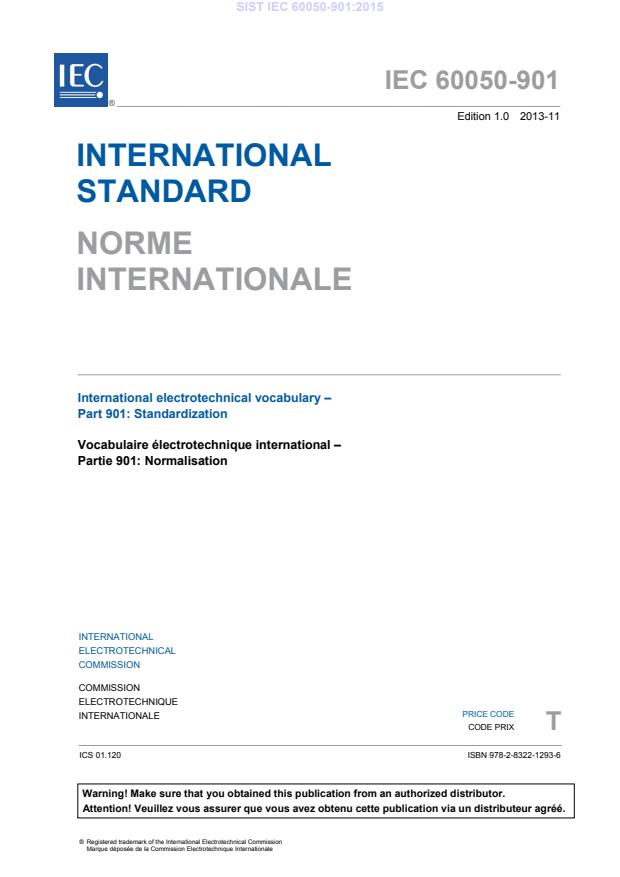
International Electrotechnical Vocabulary - Part 901: Standardization
International Electrotechnical Vocabulary - Part 901: Standardization
IEC 60050-901:2013 gives the general terminology used in the field of standardization, as well as general terms pertaining to specific applications and associated technologies. It has the status of a horizontal standard in accordance with IEC Guide 108:2006.
Vocabulaire Electrotechnique International - Partie 901: Normalisation
L'IEC 60050-901:2013 donne la terminologie générale utilisée dans le domaine de la normalisation, ainsi que les termes généraux relatifs à des applications particulières et technologies associées. Elle a le statut de norme horizontale conformément au Guide IEC 108:2006.
Mednarodni elektrotehniški slovar - poglavje 901 Standardizacija
IEC 60050-901:2013 vsebuje splošno terminologijo, ki se uporablja na področju standardizacije, kakor tudi splošne pogoje, ki se nanašajo na posamezne aplikacije in z njimi povezane tehnologije.
General Information
- Status
- Published In Translation
- Publication Date
- 09-Apr-2015
- Technical Committee
- TRM - Terminology
- Current Stage
- 6100 - Translation of adopted SIST standards (Adopted Project)
- Start Date
- 19-Nov-2014
- Due Date
- 18-Nov-2015
Overview
SIST IEC 60050-901:2015, titled International Electrotechnical Vocabulary - Part 901: Standardization, is a key international standard published by the International Electrotechnical Commission (IEC). This standard provides the general terminology used in the field of standardization, especially related to electrotechnology, electronics, and telecommunications. As a horizontal standard according to IEC Guide 108:2006, it supports uniform language and definitions across various technical committees and industries.
The standard was first released in 2013 and compiles terminology formerly published in IEC Guides and ISO/IEC standards, updated and structured for comprehensive reference. It is essential for professionals involved in the preparation, implementation, and management of technical standards and normative documentation within the electrotechnical domain.
Key Topics
SIST IEC 60050-901:2015 covers a broad range of foundational terms and definitions critical for understanding and applying standardization principles:
- General terminology and principles: Concepts and aims of standardization that form the basis for developing consistent international standards.
- Types of normative documents: Clarification of different forms of standards, technical reports, specifications, and guides.
- Standardization bodies: Definitions relating to national, regional, and international organizations responsible for producing and enforcing standards.
- Preparation and drafting: Terms related to the processes and methodologies for creating normative documents.
- Content and structure: Guidelines on how normative documents should be formatted and organized for clarity and usability.
- Harmonization and implementation: Language around the alignment of standards across borders and industries to facilitate global interoperability.
- Environmental aspects: Inclusion of terms associated with the integration of environmental considerations into standardization processes.
The vocabulary entries include preferred terms, synonyms, definitions, and, where applicable, notes, examples, and cross-referenced sources. The multilingual approach covers English, French, Russian, and additional IEC languages, enabling global accessibility.
Applications
SIST IEC 60050-901:2015 is a valuable resource for a broad spectrum of professionals and organizations involved in standardization and technical documentation, including:
- Standards development organizations (SDOs): Enhancing clarity and consistency in creating and updating electrotechnical standards.
- Technical committees and industry experts: Providing a common language to facilitate international collaboration and consensus.
- Regulatory bodies: Supporting regulatory harmonization and compliance monitoring with standardized terminology.
- Manufacturers and suppliers in electrical and electronic sectors: Ensuring precise understanding of standards for product development and quality assurance.
- Academia and training institutions: Serving as a definitive reference for education in electrotechnical standardization concepts.
- Environmental compliance professionals: Applying the standard’s vocabulary for integrating environmental considerations into product and process standards.
By promoting uniform terminology, SIST IEC 60050-901:2015 helps reduce ambiguity, improve communication, and support the global adoption of coherent standards, leading to increased interoperability, safety, and innovation across electrotechnical fields.
Related Standards
SIST IEC 60050-901:2015 is part of the larger IEC 60050 series, known as the International Electrotechnical Vocabulary (IEV), which encompasses around 80 parts, each covering specific areas such as:
- IEC 60050-161: Electromagnetic compatibility terminology
- IEC 60050-411: Rotating machines vocabulary
The standard also aligns and collaborates closely with:
- IEC Guide 108:2006: Horizontal standard guidelines
- ISO/IEC Directives: Procedures for developing and managing international standards
- ISO/IEC Guide 2: Standardization and related activities - General vocabulary
For access to the full IEC 60050 vocabulary and related parts, official resources such as IEC Electropedia provide searchable, multilingual terminology databases essential for international electrotechnical standardization.
Keywords: SIST IEC 60050-901:2015, International Electrotechnical Vocabulary, standardization terminology, electrotechnical standards, IEC standard, normative documents, technical standardization, electrotechnical vocabulary, IEC, international standards, technical committees, environmental aspects in standards


Frequently Asked Questions
SIST IEC 60050-901:2015 is a standard published by the Slovenian Institute for Standardization (SIST). Its full title is "International Electrotechnical Vocabulary - Part 901: Standardization". This standard covers: IEC 60050-901:2013 gives the general terminology used in the field of standardization, as well as general terms pertaining to specific applications and associated technologies. It has the status of a horizontal standard in accordance with <a href='http://webstore.iec.ch/webstore/webstore.nsf/Artnum_PK/36435?opendocument'>IEC Guide 108:2006</a>.
IEC 60050-901:2013 gives the general terminology used in the field of standardization, as well as general terms pertaining to specific applications and associated technologies. It has the status of a horizontal standard in accordance with <a href='http://webstore.iec.ch/webstore/webstore.nsf/Artnum_PK/36435?opendocument'>IEC Guide 108:2006</a>.
SIST IEC 60050-901:2015 is classified under the following ICS (International Classification for Standards) categories: 01.040.01 - Generalities. Terminology. Standardization. Documentation (Vocabularies); 01.120 - Standardization. General rules; 29.020 - Electrical engineering in general. The ICS classification helps identify the subject area and facilitates finding related standards.
SIST IEC 60050-901:2015 is available in PDF format for immediate download after purchase. The document can be added to your cart and obtained through the secure checkout process. Digital delivery ensures instant access to the complete standard document.
Standards Content (Sample)
SLOVENSKI STANDARD
01-maj-2015
Mednarodni elektrotehniški slovar - poglavje 901 Standardizacija
International Electrotechnical Vocabulary - Part 901: Standardization
Vocabulaire Electrotechnique International - Partie 901: Normalisation
Ta slovenski standard je istoveten z: IEC 60050-901
ICS:
01.040.01 Splošno. Terminologija. Generalities. Terminology.
Standardizacija. Standardization.
Dokumentacija (Slovarji) Documentation
(Vocabularies)
01.120 Standardizacija. Splošna Standardization. General
pravila rules
29.020 Elektrotehnika na splošno Electrical engineering in
general
2003-01.Slovenski inštitut za standardizacijo. Razmnoževanje celote ali delov tega standarda ni dovoljeno.
®
Edition 1.0 2013-11
INTERNATIONAL
STANDARD
NORME
INTERNATIONALE
International electrotechnical vocabulary –
Part 901: Standardization
Vocabulaire électrotechnique international –
Partie 901: Normalisation
INTERNATIONAL
ELECTROTECHNICAL
COMMISSION
COMMISSION
ELECTROTECHNIQUE
PRICE CODE
INTERNATIONALE
CODE PRIX T
ICS 01.120 ISBN 978-2-8322-1293-6
– II – 60050-901 © IEC:2013
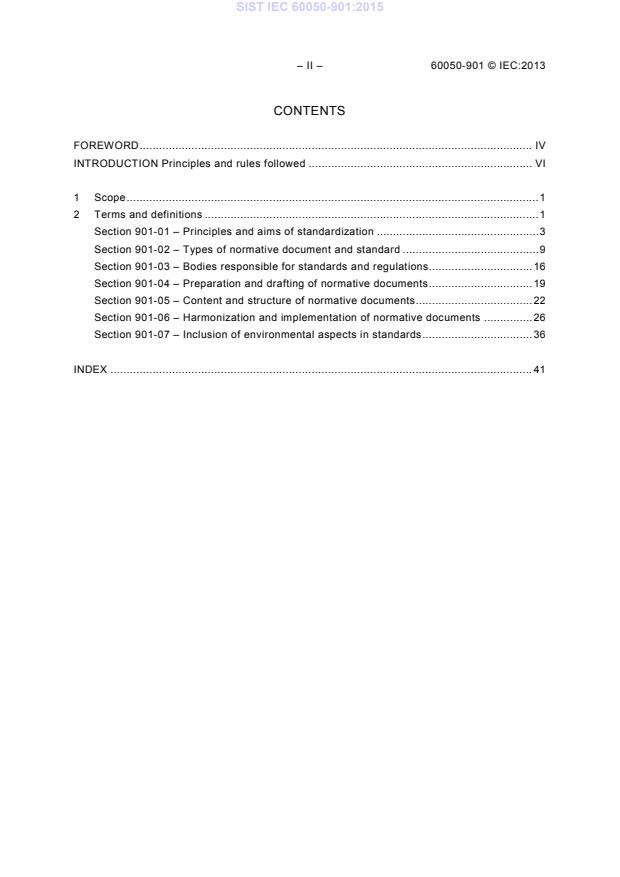
CONTENTS
FOREWORD . IV
INTRODUCTION Principles and rules followed . VI
1 Scope . 1
2 Terms and definitions . 1
Section 901-01 – Principles and aims of standardization . 3
Section 901-02 – Types of normative document and standard . 9
Section 901-03 – Bodies responsible for standards and regulations. 16
Section 901-04 – Preparation and drafting of normative documents . 19
Section 901-05 – Content and structure of normative documents . 22
Section 901-06 – Harmonization and implementation of normative documents . 26
Section 901-07 – Inclusion of environmental aspects in standards . 36
INDEX . 41
60050-901 © IEC:2013 – III –
SOMMAIRE
AVANT-PROPOS . V
INTRODUCTION Principes d’établissement et règles suivies . IX
1 Domaine d’application . 2
2 Termes et définitions . 2
Section 901-01 – Principes et objectifs de la normalisation . 3
Section 901-02 – Types de documents normatifs et de normes . 9
Section 901-03 – Organismes responsables des normes et des règlements . 16
Section 901-04 – Préparation et rédaction des documents normatifs . 19
Section 901-05 – Contenu et structure des documents normatifs . 22
Section 901-06 – Harmonisation et mise en œuvre des documents normatifs . 26
Section 901-07 – Prise en compte des aspects liés à l'environnement dans les
normes . 36
INDEX . 44
– IV – 60050-901 © IEC:2013
INTERNATIONAL ELECTROTECHNICAL COMMISSION
_______________
INTERNATIONAL ELECTROTECHNICAL VOCABULARY –
Part 901: Standardization
FOREWORD
1) The International Electrotechnical Commission (IEC) is a worldwide organization for standardization comprising
all national electrotechnical committees (IEC National Committees). The object of IEC is to promote
international co-operation on all questions concerning standardization in the electrical and electronic fields. To
this end and in addition to other activities, IEC publishes International Standards, Technical Specifications,
Technical Reports, Publicly Available Specifications (PAS) and Guides (hereafter referred to as “IEC
Publication(s)”). Their preparation is entrusted to technical committees; any IEC National Committee interested
in the subject dealt with may participate in this preparatory work. International, governmental and non-
governmental organizations liaising with the IEC also participate in this preparation. IEC collaborates closely
with the International Organization for Standardization (ISO) in accordance with conditions determined by
agreement between the two organizations.
2) The formal decisions or agreements of IEC on technical matters express, as nearly as possible, an international
consensus of opinion on the relevant subjects since each technical committee has representation from all
interested IEC National Committees.
3) IEC Publications have the form of recommendations for international use and are accepted by IEC National
Committees in that sense. While all reasonable efforts are made to ensure that the technical content of IEC
Publications is accurate, IEC cannot be held responsible for the way in which they are used or for any
misinterpretation by any end user.
4) In order to promote international uniformity, IEC National Committees undertake to apply IEC Publications
transparently to the maximum extent possible in their national and regional publications. Any divergence
between any IEC Publication and the corresponding national or regional publication shall be clearly indicated in
the latter.
5) IEC itself does not provide any attestation of conformity. Independent certification bodies provide conformity
assessment services and, in some areas, access to IEC marks of conformity. IEC is not responsible for any
services carried out by independent certification bodies.
6) All users should ensure that they have the latest edition of this publication.
7) No liability shall attach to IEC or its directors, employees, servants or agents including individual experts and
members of its technical committees and IEC National Committees for any personal injury, property damage or
other damage of any nature whatsoever, whether direct or indirect, or for costs (including legal fees) and
expenses arising out of the publication, use of, or reliance upon, this IEC Publication or any other IEC
Publications.
8) Attention is drawn to the Normative references cited in this publication. Use of the referenced publications is
indispensable for the correct application of this publication.
9) Attention is drawn to the possibility that some of the elements of this IEC Publication may be the subject of
patent rights. IEC shall not be held responsible for identifying any or all such patent rights.
International Standard IEC 60050-901 has been prepared by IEC technical committee 1:
Terminology.
This first edition comprises terminology formerly published in ISO/IEC Guide 2, IEC Guide 108
and IEC Guide 109, and reviewed as change request C00003 for inclusion in the International
Electrotechnical Vocabulary.
This publication was developed in accordance with the ISO/IEC Directives, Part 1, IEC
Supplement, Annexes SK and SL, and was approved by the validation team of IEC technical
committee 1: Terminology, under the normal database procedure.
A list of all parts of the IEC 60050 series, published under the general title International
Electrotechnical Vocabulary can be found on the IEC website and is available at
www.electropedia.org.
All parts of the IEC 60050 series have the status of a horizontal standard in accordance with
IEC Guide 108.
60050-901 © IEC:2013 – V –
COMMISSION ÉLECTROTECHNIQUE INTERNATIONALE
________________
VOCABULAIRE ÉLECTROTECHNIQUE INTERNATIONAL –
Partie 901: Normalisation
AVANT-PROPOS
1) La Commission Electrotechnique Internationale (IEC) est une organisation mondiale de normalisation
composée de l'ensemble des comités électrotechniques nationaux (Comités nationaux de l'IEC). L'IEC a pour
objet de favoriser la coopération internationale pour toutes les questions de normalisation dans les domaines
de l'électricité et de l'électronique. A cet effet, l'IEC – entre autres activités – publie des Normes
internationales, des Spécifications techniques, des Rapports techniques, des Spécifications accessibles au
public (PAS) et des Guides (ci-après dénommés "Publication(s) de l'IEC"). Leur élaboration est confiée à des
comités d'études, aux travaux desquels tout Comité national intéressé par le sujet traité peut participer. Les
organisations internationales, gouvernementales et non gouvernementales, en liaison avec l'IEC, participent
également aux travaux. L'IEC collabore étroitement avec l'Organisation Internationale de Normalisation (ISO),
selon des conditions fixées par accord entre les deux organisations.
2) Les décisions ou accords officiels de l'IEC concernant les questions techniques représentent, dans la mesure
du possible, un accord international sur les sujets étudiés, étant donné que les Comités nationaux de l'IEC
intéressés sont représentés dans chaque comité d’études.
3) Les Publications de l'IEC se présentent sous la forme de recommandations internationales et sont agréées
comme telles par les Comités nationaux de l'IEC. Tous les efforts raisonnables sont entrepris afin que l'IEC
s'assure de l'exactitude du contenu technique de ses publications; l'IEC ne peut pas être tenue responsable de
l'éventuelle mauvaise utilisation ou interprétation qui en est faite par un quelconque utilisateur final.
4) Dans le but d'encourager l'uniformité internationale, les Comités nationaux de l'IEC s'engagent, dans toute la
mesure possible, à appliquer de façon transparente les Publications de l'IEC dans leurs publications nationales
et régionales. Toutes divergences entre toutes Publications de l'IEC et toutes publications nationales ou
régionales correspondantes doivent être indiquées en termes clairs dans ces dernières.
5) L'IEC elle-même ne fournit aucune attestation de conformité. Des organismes de certification indépendants
fournissent des services d'évaluation de conformité et, dans certains secteurs, accèdent aux marques de
conformité de l'IEC. L'IEC n'est responsable d'aucun des services effectués par les organismes de certification
indépendants.
6) Tous les utilisateurs doivent s'assurer qu'ils sont en possession de la dernière édition de cette publication.
7) Aucune responsabilité ne doit être imputée à l'IEC, à ses administrateurs, employés, auxiliaires ou
mandataires, y compris ses experts particuliers et les membres de ses comités d'études et des Comités
nationaux de l'IEC, pour tout préjudice causé en cas de dommages corporels et matériels, ou de tout autre
dommage de quelque nature que ce soit, directe ou indirecte, ou pour supporter les coûts (y compris les frais
de justice) et les dépenses découlant de la publication ou de l'utilisation de cette Publication de l'IEC ou de
toute autre Publication de l'IEC, ou au crédit qui lui est accordé.
8) L'attention est attirée sur les références normatives citées dans cette publication. L'utilisation de publications
référencées est obligatoire pour une application correcte de la présente publication.
9) L’attention est attirée sur le fait que certains des éléments de la présente Publication de l'IEC peuvent faire
l’objet de droits de propriété intellectuelle ou de droits analogues. L'IEC ne saurait être tenue pour responsable
de ne pas avoir identifié de tels droits de propriété et de ne pas avoir signalé leur existence.
La Norme internationale IEC 60050-901 a été établie par le comité d'études 1 de l'IEC:
Terminologie.
Cette première édition comprend la terminologie publiée auparavant dans le Guide ISO/IEC 2,
et les Guides IEC 108 et 109, et passée en revue en tant que «change request» C00003 pour
inclusion dans le Vocabulaire Electrotechnique International.
Cette publication a été développée en conformité avec les Annexes SK et SL du Supplément
IEC aux Directives ISO/IEC, Partie 1, et a été approuvée par l’équipe de validation du comité
d'études 1 de l'IEC: Terminologie, selon la procédure base de données «normale».
Une liste de toutes les parties de la série IEC 60050, publiée sous le titre général Vocabulaire
Electrotechnique International, peut être consultée sur le site web de l'IEC et est disponible à
l’adresse www.electropedia.org.
Toutes les parties de la série IEC 60050 ont le statut d'une norme horizontale conformément
au Guide IEC 108.
– VI – 60050-901 © IEC:2013
INTRODUCTION
Principles and rules followed
General
The IEV (IEC 60050 series) is a general purpose multilingual vocabulary covering the field of
electrotechnology, electronics and telecommunication (available at www.electropedia.org). It
comprises about 20 000 terminological entries, each corresponding to a concept. These
entries are distributed among about 80 parts, each part corresponding to a given field.
EXAMPLE
Part 161 (IEC 60050-161): Electromagnetic compatibility
Part 411 (IEC 60050-411): Rotating machines
The entries follow a hierarchical classification scheme Part/Section/Concept; within the
sections, the concepts are organized in a systematic order.
The terms and definitions (and possibly non-verbal representations, examples, notes and
sources) in the entries are given in two or more of the three IEC languages, that is French,
English and Russian (principal IEV languages).
In each entry, the terms alone are also given in several of the additional IEV languages
(Arabic, Chinese, Finnish, German, Italian, Japanese, Norwegian, Polish, Portuguese,
Serbian, Slovenian, Spanish and Swedish).
Organization of a terminological entry
Each of the entries corresponds to a concept, and comprises:
- an entry number,
- possibly a letter symbol for the quantity or unit,
then, for the principal IEV languages present in the part:
- the term designating the concept, called “preferred term”, possibly accompanied by
synonyms and abbreviations,
- the definition of the concept,
- possibly non-verbal representations, examples and notes to entry,
- possibly the source,
and finally, for the additional IEV languages, the terms alone.
Entry number
The entry number is comprised of three elements, separated by hyphens:
Part number: 3 digits,
Section number: 2 digits,
Concept number: 2 digits (01 to 99).
EXAMPLE 131-13-22
Letter symbols for quantities and units
These symbols, which are language independent, are given on a separate line following the
entry number.
60050-901 © IEC:2013 – VII –
EXAMPLE
131-12-04
R
resistance
Preferred term and synonyms
The preferred term is the term that heads a terminological entry in a given language; it may
be followed by synonyms. It is printed in boldface.
Synonyms:
The synonyms are printed on separate lines under the preferred term: preferred synonyms are
printed in boldface, and deprecated synonyms are printed in lightface. Deprecated synonyms
are prefixed by the text “DEPRECATED:”.
Absence of an appropriate term:
When no appropriate term exists in a given language, the preferred term is replaced by five
dots, as follows:
.....
“ ” (and there are of course no synonyms).
Attributes
Each term (or synonym) may be followed by attributes giving additional information, and
printed in lightface on the same line as the corresponding term, following this term.
EXAMPLE
specific use of the term:
transmission line,
national variant:
lift, GB
grammatical information:
quantize, verb
transient, noun
AC, adj
Source
In some cases, it has been necessary to include in an IEV part a concept taken from another
IEV part, or from another authoritative terminology document (ISO/IEC Guide 99,
ISO/IEC 2382, etc.), either with or without modification to the definition (and possibly to the
term).
This is indicated by the mention of this source, printed in lightface, and placed at the end of
the entry in each of the principal IEV languages present.
EXAMPLE SOURCE: IEC 60050-131:2002, 131-03-13, modified
Terms in additional IEV languages
– VIII – 60050-901 © IEC:2013
These terms are placed following the entries in the principal IEV languages, on separate lines
(a single line for each language), preceded by the alpha-2 code for the language defined in
ISO 639-1, and in the alphabetic order of this code.
60050-901 © IEC:2013 – IX –
INTRODUCTION
Principes d’établissement et règles suivies
Généralités
Le VEI (série de normes IEC 60050) est un vocabulaire multilingue à usage général couvrant
le champ de l’électrotechnique, de l’électronique et des télécommunications (disponible à
www.electropedia.org). Il comprend environ 20 000 articles terminologiques correspondant
chacun à un concept (une notion). Ces articles sont répartis dans environ 80 parties, chacune
correspondant à un domaine donné.
EXEMPLE
Partie 161 (IEC 60050-161): Compatibilité électromagnétique
Partie 411 (IEC 60050-411): Machines tournantes
Les articles suivent un schéma de classification hiérarchique Partie/Section/Concept, les
concepts étant, au sein des sections, classés par ordre systématique.
Les termes et définitions (et éventuellement les représentations non verbales, exemples,
notes et sources) sont donnés dans deux ou plus des trois langues de l'IEC, c’est-à-dire
français, anglais et russe (langues principales du VEI).
Dans chaque article, les termes seuls sont également donnés dans plusieurs des langues
additionnelles du VEI (allemand, arabe, chinois, espagnol, finnois, italien, japonais,
norvégien, polonais, portugais, serbe, slovène et suédois).
Constitution d’un article terminologique
Chacun des articles correspond à un concept, et comprend:
- un numéro d’article,
- éventuellement un symbole littéral de grandeur ou d’unité,
puis, pour chaque langue principale du VEI présente dans la partie:
- le terme désignant le concept, appelé « terme privilégié », éventuellement
accompagné de synonymes et d’abréviations,
- la définition du concept,
- éventuellement des représentations non verbales, des exemples et des notes à
l’article,
- éventuellement la source,
et enfin, pour les langues additionnelles du VEI, les termes seuls.
Numéro d’article
Le numéro d’article comprend trois éléments, séparés par des traits d’union:
Numéro de partie: 3 chiffres,
Numéro de section: 2 chiffres,
Numéro du concept: 2 chiffres (01 à 99).
EXEMPLE 131-13-22
– X – 60050-901 © IEC:2013
Symboles littéraux de grandeurs et d’unités
Ces symboles, indépendants de la langue, sont donnés sur une ligne séparée suivant le
numéro d’article.
EXEMPLE
131-12-04
R
résistance, f
Terme privilégié et synonymes
Le terme privilégié est le terme qui figure en tête d’un article dans une langue donnée; il peut
être suivi par des synonymes. Il est imprimé en gras.
Synonymes:
Les synonymes sont imprimés sur des lignes séparées sous le terme privilégié: les
synonymes privilégiés sont imprimés en gras, et les synonymes déconseillés sont imprimés
en maigre. Les synonymes déconseillés sont précédés par le texte « DÉCONSEILLÉ: ».
Absence de terme approprié:
Lorsqu’il n’existe pas de terme approprié dans une langue, le terme privilégié est remplacé
par cinq points, comme ceci:
.....
« » (et il n’y a alors bien entendu pas de synonymes).
Attributs
Chaque terme (ou synonyme) peut être suivi d’attributs donnant des informations
supplémentaires; ces attributs sont imprimés en maigre, à la suite de ce terme, et sur la
même ligne.
EXEMPLE
spécificité d’utilisation du terme:
rang,
variante nationale:
unité de traitement, CA
catégorie grammaticale:
quantifier, verbe
électronique, f
électronique, adj
Source
Dans certains cas, il a été nécessaire d’inclure dans une partie du VEI un concept pris dans
une autre partie du VEI, ou dans un autre document de terminologie faisant autorité
(Guide ISO/IEC 99, ISO/IEC 2382, etc.), avec ou sans modification de la définition (ou
éventuellement du terme).
Ceci est indiqué par la mention de cette source, imprimée en maigre et placée à la fin de
l’article dans chacune des langues principales du VEI présentes.
60050-901 © IEC:2013 – XI –
EXEMPLE SOURCE: IEC 60050-131:2002, 131-03-13, modifié
Termes dans les langues additionnelles du VEI
Ces termes sont placés à la fin des articles dans les langues principales du VEI, sur des
lignes séparées (une ligne par langue), précédés par le code alpha-2 de la langue, défini
dans l'ISO 639-1, et dans l'ordre alphabétique de ce code.
– 1 – 60050-901 © IEC:2013
INTERNATIONAL ELECTROTECHNICAL VOCABULARY –
Part 901: Standardization
1 Scope
This part of IEC 60050 gives the general terminology used in the field of standardization, as
well as general terms pertaining to specific applications and associated technologies. It has
the status of a horizontal standard in accordance with IEC Guide 108, Guidelines for ensuring
the coherency of IEC publications – Application of horizontal standards.
This terminology is consistent with the terminology developed in the other specialized parts of
the IEV.
This horizontal standard is primarily intended for use by technical committees in the
preparation of standards in accordance with the principles laid down in IEC Guide 108.
One of the responsibilities of a technical committee is, wherever applicable, to make use of
horizontal standards in the preparation of its publications. The content of this horizontal
standard will not apply unless specifically referred to or included in the relevant publications.
2 Terms and definitions
The terms and definitions contained in this part of IEC 60050 were extracted from the
Electropedia (www.electropedia.org) (also known as the "IEV Online") – the world's most
comprehensive online terminology database covering the field of electrotechnology,
electronics and telecommunication.
60050-901 © IEC:2013 – 2 –
VOCABULAIRE ÉLECTROTECHNIQUE INTERNATIONAL –
Partie 901: Normalisation
1 Domaine d’application
Cette partie de l'IEC 60050 donne la terminologie générale utilisée dans le domaine de la
normalisation, ainsi que les termes généraux relatifs à des applications particulières et
technologies associées. Elle a le statut de norme horizontale conformément au
Guide IEC 108, Lignes directrices pour assurer la cohérence des publications de l'IEC –
Application des normes horizontales.
Cette terminologie est en accord avec la terminologie figurant dans les autres parties
spécialisées du VEI.
Cette norme horizontale est essentiellement destinée à l'usage des comités d'études dans la
préparation des normes, conformément aux principes établis dans le Guide IEC 108.
Une des responsabilités d'un comité d'études est, partout où cela est possible, de se servir
des normes horizontales lors de la préparation de ses publications. Le contenu de cette
norme horizontale ne s'appliquera pas, à moins qu'il ne soit spécifiquement désigné ou inclus,
dans les publications concernées.
2 Termes et définitions
Les termes et définitions contenus dans la présente partie de l’IEC 60050 ont été extraits de
l’Electropedia (www.electropedia.org) (également connu sous le nom "IEV Online") – la base
de données terminologique en ligne la plus complète couvrant le champ de l’électrotechnique,
de l’électronique et des télécommunications.
– 3 – 60050-901 © IEC:2013
SECTION 901-01 – PRINCIPLES AND AIMS OF STANDARDIZATION
SECTION 901-01 – PRINCIPES ET OBJECTIFS DE LA NORMALISATION
901-01-01
standardization
activity of establishing, with regard to actual or potential problems, provisions for common and
repeated use, aimed at the achievement of the optimum degree of order in a given context
Note 1 to entry: In particular, the activity consists of the processes of formulating, issuing and
implementing standards.
Note 2 to entry: Important benefits of standardization are improvement of the suitability of products,
processes and services for their intended purposes, prevention of barriers to trade and facilitation of
technological cooperation.
SOURCE: ISO/IEC Guide 2:2004, 1.1
normalisation, f
activité propre à établir, face à des problèmes réels ou potentiels, des dispositions destinées à un
usage commun et répété, visant à l'obtention du degré optimal d'ordre dans un contexte donné
Note 1 à l'article: Cette activité concerne, en particulier, la formulation, la diffusion et la mise en
application de normes.
Note 2 à l'article: La normalisation offre d'importants avantages, notamment par une meilleure
adaptation des produits, des processus et des services aux fins qui leur sont assignées, par la
prévention des obstacles au commerce et en facilitant la coopération technologique.
SOURCE: Guide ISO/CEI 2:2004, 1.1
901-01-02
subject of standardization
topic to be standardized
Note 1 to entry: The term "topic", i.e. product, process or service, has been adopted to encompass the
subject of standardization in a broad sense, and should be understood equally to cover, for example,
any material, component, equipment, system, interface, protocol, procedure, function, method or
activity.
Note 2 to entry: Standardization may be limited to particular aspects of any subject. For example, in
the case of shoes, criteria could be standardized separately for sizes and durability.
SOURCE: ISO/IEC Guide 2:2004, 1.2, modified – An explanation of the use of the term "topic" has
been added to Note 1 to entry, and the text "throughout ISO/IEC Guide 2" has been deleted.
sujet de normalisation, m
matière à normaliser
Note 1 à l'article: Le terme «matière», c'est-à-dire produit, processus ou service, a été adopté pour
que les sujets de normalisation soient considérés dans un sens large; elle doit être interprétée comme
pouvant recouvrir sans distinction tout matériau, composant, équipement, système, interface,
protocole, procédure, fonction, méthode ou activité.
Note 2 à l'article: Le champ de la normalisation peut être limité à certains aspects particuliers d'un
sujet quelconque. Dans le cas des chaussures par exemple, la pointure et les critères de durabilité
peuvent être normalisés séparément.
SOURCE: Guide ISO/CEI 2:2004, 1.2, modifiée – Une explication de l'utilisation du terme «matière» a
été ajoutée à la Note 1 à l'article, et le texte «tout au long du Guide ISO/CEI 2» a été supprimé.
60050-901 © IEC:2013 – 4 –
901-01-03
field of standardization
DEPRECATED: domain of standardization
group of related subjects of standardization
Note 1 to entry: Engineering, transport, agriculture, and quantities and units, for example, could be
regarded as fields of standardization.
SOURCE: ISO/IEC Guide 2:2004, 1.3
domaine de normalisation, m
groupe de sujets de normalisation reliés entre eux
Note 1 à l'article: On peut ainsi considérer l'ingénierie, les transports, l'agriculture ou les grandeurs et
unités, par exemple, comme des domaines de normalisation.
SOURCE: Guide ISO/CEI 2:2004, 1.3
901-01-04
state of the art
developed stage of technical capability at a given time as regards products, processes and services,
based on the relevant consolidated findings of science, technology and experience
SOURCE: ISO/IEC Guide 2:2004, 1.4
état de la technique, m
état de l'art, m
état d'avancement d'une capacité technique à un moment donné, en ce qui concerne un produit, un
processus ou un service, fondé sur des découvertes scientifiques, techniques et expérimentales
pertinentes
SOURCE: Guide ISO/CEI 2:2004, 1.4, modifié – Les guillemets entourant le synonyme ont été
supprimés.
901-01-05
acknowledged rule of technology
technical provision acknowledged by a majority of representative experts as reflecting the state of the
art
Note 1 to entry: A normative document on a technical subject, if prepared with the cooperation of
concerned interests by consultation and consensus procedures, is presumed to constitute an
acknowledged rule of technology at the time of its approval.
SOURCE: ISO/IEC Guide 2:2004, 1.5
règle technique reconnue, f
règle de l'art, f
disposition technique reconnue par une majorité d'experts représentatifs comme reflétant l'état de la
technique
Note 1 à l'article: Si un document normatif sur un sujet technique est préparé avec la coopération des
parties intéressées par le biais de consultations et de procédures de réalisation d'un consensus, il est
censé constituer une règle technique reconnue au moment de son approbation.
SOURCE: Guide ISO/CEI 2:2004, 1.5, modifié – Les guillemets entourant le synonyme ont été
supprimés.
– 5 – 60050-901 © IEC:2013
901-01-06
level of standardization
geographical, political or economic extent of involvement in standardization
SOURCE: ISO/IEC Guide 2:2004, 1.6
niveau de normalisation, m
portée géographique, politique ou économique de la normalisation
SOURCE: Guide ISO/CEI 2:2004, 1.6
901-01-07
international standardization
standardization in which involvement is open to relevant bodies from all countries
SOURCE: ISO/IEC Guide 2:2004, 1.6.1
normalisation internationale, f
normalisation dans laquelle peuvent s'engager les organismes concernés de tous les pays
SOURCE: Guide ISO/CEI 2:2004, 1.6.1
901-01-08
regional standardization
standardization in which involvement is open to relevant bodies from countries from only one
geographical, political or economic area of the world
SOURCE: ISO/IEC Guide 2:2004, 1.6.2
normalisation régionale, f
normalisation dans laquelle peuvent s'engager les organismes concernés d'un seul et même secteur
géographique, politique ou économique du monde
SOURCE: Guide ISO/CEI 2:2004, 1.6.2
901-01-09
national standardization
standardization that takes place at the level of one specific country
Note 1 to entry: Within a country or a territorial division of a country, standardization may also take
place on a branch or sectoral basis (e.g. ministries), at local levels, at association and company levels
in industry and in individual factories, workshops and offices.
SOURCE: ISO/IEC Guide 2:2004, 1.6.3
normalisation nationale, f
normalisation qui se situe au niveau d'un pays déterminé
Note 1 à l'article: Dans un pays ou une division territoriale d'un pays, la normalisation peut également
se faire sur une base sectorielle (par exemple ministères), au niveau local, au niveau des associations
et des entreprises dans l'industrie et les usines, ateliers et bureaux individuels.
SOURCE: Guide ISO/CEI 2:2004, 1.6.3
60050-901 © IEC:2013 – 6 –
901-01-10
provincial standardization
standardization that takes place at the level of a territorial division of a country
Note 1 to entry: Within a country or a territorial division of a country, standardization may also take
place on a branch or sectoral basis (e.g. ministries), at local levels, at association and company levels
in industry and in individual factories, workshops and offices.
SOURCE: ISO/IEC Guide 2:2004, 1.6.4
normalisation territoriale, f
normalisation qui se situe au niveau d'une division territoriale d'un pays
Note 1 à l'article: Dans un pays ou une division territoriale d'un pays, la normalisation peut également
se faire sur une base sectorielle (par exemple ministères), au niveau local, au niveau des associations
et des entreprises dans l'industrie et les usines, ateliers et bureaux individuels.
SOURCE: Guide ISO/CEI 2:2004, 1.6.4
901-01-11
consensus
general agreement, characterized by the absence of sustained opposition to substantial issues by any
important part of the concerned interests and by a process that involves seeking to take into account
the views of all parties concerned and to reconcile any conflicting arguments
Note 1 to entry: Consensus need not imply unanimity.
SOURCE: ISO/IEC Guide 2:2004, 1.7
consensus, m
accord général caractérisé par l'absence d'opposition ferme à l'encontre de l'essentiel du sujet
émanant d'une partie importante des intérêts en jeu et par un processus de recherche de prise en
considération des vues de toutes les parties concernées et de rapprochement des positions
divergentes éventuelles
Note 1 à l'article: Le consensus n'implique pas nécessairement l'unanimité.
SOURCE: Guide ISO/CEI 2:2004, 1.7
901-01-12
fitness for purpose
ability of a product, process or service to serve a defined purpose under specific conditions
SOURCE: ISO/IEC Guide 2:2004, 2.1
aptitude à l'emploi, f
aptitude d'un produit, d'un processus ou d'un service à remplir un emploi défini dans des conditions
spécifiées
SOURCE: Guide ISO/CEI 2:2004, 2.1
– 7 – 60050-901 © IEC:2013
901-01-13
compatibility
suitability of products, processes or services for use together under specific conditions to fulfil relevant
requirements without causing unacceptable interactions
SOURCE: ISO/IEC Guide 2:2004, 2.2
compatibilité, f
aptitude de produits, processus ou services à être utilisés conjointement dans des conditions
spécifiées pour satisfaire aux exigences en cause sans interaction inacceptable
SOURCE: Guide ISO/CEI 2:2004, 2.2
901-01-14
interchangeability
ability of one product, process or service to be used in place of another to fulfil the same requirements
Note 1 to entry: The functional aspect of interchangeability is called “functional interchangeability”, and
the dimensional aspect “dimensional interchangeability”.
SOURCE: ISO/IEC Guide 2:2004, 2.3
interchangeabilité, f
faculté d'utiliser un produit, processus ou service à la place d'un autre pour satisfaire aux mêmes
exigences
Note 1 à l'article: L'aspect fonctionnel de l'interchangeabilité est appelé «interchangeabilité
fonctionnnelle» et l'aspect dimensionnel «interchangeabilité dimensionnelle».
SOURCE: Guide ISO/CEI 2:2004, 2.3
901-01-15
variety control
selection of the optimum number of sizes or types of products, processes or services to meet
prevailing needs
Note 1 to entry: Variety control is usually concerned with variety reduction.
SOURCE: ISO/IEC Guide 2:2004, 2.4
gestion de la diversité, f
limitation de la variété, f
choix du nombre optimal de dimensions ou de types d'un produit, d'un processus ou d'un service pour
répondre aux besoins prédominants
Note 1 à l'article: La gestion de la diversité vise généralement à la réduction de la diversité (parfois
dénommée «réduction de la variété»).
SOURCE: Guide ISO/CEI 2:2004, 2.4, modifié – Les guillemets entourant le synonyme ont été
supprimés.
60050-901 © IEC:2013 – 8 –
901-01-16
protection of the environment
preservation of the environment from unacceptable damage from the effects and operations of
products, processes and services
SOURCE: ISO/IEC Guide 2:2004, 2.6
protection de l'environnement, f
préservation de l'environnement de dommages inacceptables dus aux effets et à l'exploitation de
produits, processus ou services
SOURCE: Guide ISO/CEI 2:2004, 2.6
901-01-17
product protection
DEPRECATED: environmental protection
protection of a product against climatic or other adverse conditions during its use, transport or storage
SOURCE: ISO/IEC Guide 2:2004, 2.7
protection d'un produit, f
protection d'un produit contre des conditions climatiques ou d'autre nature pendant son utilisation, son
transport ou son stockage
SOURCE: Guide ISO/CEI 2:2004, 2.7
– 9 – 60050-901 © IEC:2013
SECTION 901-02 – TYPES OF NORMATIVE DOCUMENT AND STANDARD
SECTION 901-02 – TYPES DE DOCUMENTS NORMATIFS ET DE NORMES
901-02-01
normative document
document that provides rules, guidelines or characteristics for activities or their results
Note 1 to entry: The term “normative document” is a generic term that covers such documents as
standards, technical specifications, codes of practice and regulations.
Note 2 to entry: A “document” is to be understood as any medium with information recorded on or in it.
Note 3 to entry: The terms for different kinds of normative documents are defined considering the
document and its content as a single entity.
SOURCE: ISO/IEC Guide 2:2004, 3.1
document normatif, m
document qui donne des règles, des lignes directrices ou des caractéristiques pour des activités ou
leurs résultats
Note 1 à l'article: L'expression «document normatif» est un terme générique qui recouvre les
documents tels que les normes, les spécifications techniques, les codes de bonne pratique et les
règlements.
Note 2 à l'article: On considère comme «document» tout support d'information avec l'information qu'il
porte.
Note 3 à l'article: Les termes relatifs aux différents types de documents normatifs sont définis comme
comprenant le document et son contenu considérés comme un tout.
SOURCE: Guide ISO/CEI 2:2004, 3.1
901-02-02
standard
document, established by consensus and approved by a recognized body, that provides, for common
and repeated use, rules, guidelines or characteristics for activities or their results, aimed at the
achievement of the optimum degree of order in a given context
Note 1 to entry: Standards should be based on the consolidated results of science, technology and
experience, and aimed at the promotion of optimum community benefits.
SOURCE: ISO/IEC Guide 2:2004, 3.2
norme, f
document, établi par consensus et approuvé par un organisme reconnu, qui fournit, pour des usages
communs et répétés, des règles, des lignes directrices ou des caractéristiques, pour des activités ou
leurs résultats, garantissant un niveau d'ordre optimal dans un contexte donné
Note 1 à l'article: Il convient que les normes soient fondées sur les acquis conjugués de la science, de
la technique et de l'expérience et visent à l'avantage optimal de la communauté.
SOURCE: Guide ISO/CEI 2:2004, 3.2
60050-901 © IEC:2013 – 10 –
901-02-03
international standard
standard that is adopted by an international standardizing/standards organization and made available
to the public
SOURCE: ISO/IEC Guide 2:2004, 3.2.1.1
norme internationale, f
norme qui est adoptée par une organisation internationale à activités normatives/de normalisation et
qui est mise à la disposition du public
SOURCE: Guide ISO/CEI 2:2004, 3.2.1.1
901-02-04
regional standard
standard that is adopted by a regional standardizing/standards organization and made available to the
public
SOURCE: ISO/IEC Guide 2:2004, 3.2.1.2
norme régionale, f
norme qui est adoptée par une organisation régionale à activités normatives/de normalisation et qui
est mise à la disposition du public
SOURCE: Guide ISO/CEI 2:2004, 3.2.1.2
901-02-05
national standard
standard that is adopted by a national standards body and made available to the public
SOURCE: ISO/IEC Guide 2:2004, 3.2.1.3
norme nationale, f
norme qui est adoptée par un organisme national de normalisation et qui est mise à la disposition du
public
SOURCE: Guide ISO/CEI 2:2004, 3.2.1.3
901-02-06
provincial standard
standard that is adopted at the level of a territorial division of a country and made available to the
public
SOURCE: ISO/IEC Guide 2:2004, 3.2.1.4
norme territoriale, f
norme qui est adoptée au niveau d'une division territoriale d'un pays et qui est mise à la disposition du
public
SOURCE: Guide ISO/CEI 2:2004, 3.2.1.4
– 11 – 60050-901 © IEC:2013
901-02-07
prestandard
document that is adopted provisionally by a standardizing body and made available to the public in
order that the necessary experience may be gained from its application on which to base a standard
SOURCE: ISO/IEC Guide 2:2004, 3.3
prénorme, f
document qui est adopté provisoirement par un organisme à activités normatives et qui est mis à la
disposition du public pour que l'on puisse bénéficier de l'expérience nécessaire de son application, à
partir de laquelle on élaborera une norme
SOURCE: Guide ISO/CEI 2:2004, 3.3
901-02-08
technical specification
document that prescribes technical requirements to be fulfilled by a product, process or service
Note 1 to entry: A technical specification should indicate, whenever appropriate, the procedure(s) by
means of which it may be determined whether the requirements given are fulfilled.
Note 2 to entry: A technical specification may be a standard, a part of a standard or independent of a
standard.
SOURCE: ISO/IEC Guide 2:2004, 3.4, modified – Note 3 to entry has been deleted.
spécification technique, f
document qui spécifie les exigences techniques que doit satisfaire un produit, un processus ou un
service
Note 1 à l'article: Il convient qu'une spécification technique indique, le cas échéant, le(s) mode(s)
opératoire(s) permettant de déterminer si les exigences données sont satisfaites.
Note 2 à l'article: Une spécification technique peut être une norme, une partie de norme ou être
indépendante d'une norme.
SOURCE: Guide ISO/CEI 2:2004, 3.4, modifiée – Note 3 à l'article a été supprimé.
901-02-09
code of practice
document that recommends practices or procedures for the design, manufacture, installation,
maintenance or utilization of equipment, structures or products
Note 1 to entry: A code of practice may be a standard, a part of a standard or independent of a
standard.
SOURCE: ISO/IEC Guide 2:2004, 3.5
code de bonne pratique, m
document qui recommande des pratiques ou des procédures en matière de conception, de fabrication,
d'installation, d'entretien ou d'utilisation d'équipements, de structures ou de produits
Note 1 à l'article: Un code de b
...
Questions, Comments and Discussion
Ask us and Technical Secretary will try to provide an answer. You can facilitate discussion about the standard in here.
Loading comments...