

SIST EN 12309-3:2025
(Main)Gas-fired sorption appliances for heating and/or cooling with a net heat input not exceeding 70 kW - Part 3: Requirements, test conditions and test methods
General Information
- Abstract
1.1 Scope of EN 12309 series
Appliances covered by this document include one or a combination of the following:
- gas-fired sorption chiller;
- gas-fired sorption chiller/heater;
- gas-fired sorption heat pump;
- hybrids based on gas sorption appliances.
This document applies to appliances designed to be used for space heating or cooling or refrigeration with or without heat recovery.
This document applies to appliances having flue gas systems of Type B and Type C (according to EN 1749:2020) and to appliances designed for outdoor installations, including Type A.
EN 12309 does not apply to air conditioners, it only applies to appliances having:
- integral burners under the control of fully automatic burner control systems;
- closed system refrigerant circuits in which the refrigerant does not come into direct contact with the water or air to be cooled or heated;
- mechanical means to assist transportation of the combustion air and/or the flue gas.
The above appliances can have one or more primary or secondary functions (i.e. heat recovery - see definitions in EN 12309-1:2023).
In the case of packaged units (consisting of several parts), this document applies only to those designed and supplied as a complete package.
The appliances having their condenser cooled by air and by the evaporation of external additional water are not covered by EN 12309.
Installations used for heating and/or cooling of industrial processes are not within the scope of EN 12309. All the symbols given in this text are to be used regardless of the language used.
1.2 Scope of this Part 3 of EN 12309
This part of EN 12309 specifies the requirements, test methods and conditions for gas-fired sorption appliances for heating and/or cooling with a net heat input not exceeding 70 kW.
This part of EN 12309 deals particularly with test protocols and tools to calculate the capacity, the gas utilization efficiency and the electrical power input of the appliance. This data can be used in particular to calculate the seasonal efficiency of the appliance.
- Status
- Published
- Public Enquiry End Date
- 02-May-2022
- Publication Date
- 13-Feb-2025
- Technical Committee
- PLN - Gas appliances for domestic use
- Current Stage
- 6060 - National Implementation/Publication (Adopted Project)
- Start Date
- 12-Feb-2025
- Due Date
- 19-Apr-2025
- Completion Date
- 14-Feb-2025

Overview
SIST EN 12309-3:2025 (EN 12309-3:2024) specifies requirements, test conditions and test methods for gas-fired sorption appliances for heating and/or cooling with a net heat input not exceeding 70 kW. Part 3 of the EN 12309 series focuses on laboratory and field test protocols used to determine capacity, gas utilization efficiency (GUE) and electrical power input - data that feed into seasonal efficiency and primary energy calculations. This European standard was approved by CEN in April 2024 and is adopted as SIST EN 12309-3:2025.
What the standard covers
- Appliance types: gas-fired sorption chiller, sorption chiller/heater, sorption heat pump, and hybrid systems based on gas sorption technology.
- Installation types: appliances with flue gas systems Type A, B and C (per EN 1749:2020) and appliances designed for outdoor installation.
- Functional scope: space heating, space cooling or refrigeration, with or without heat recovery.
- Exclusions: conventional air conditioners, appliances whose condensers are cooled by air plus external water evaporation, and industrial process heating/cooling installations.
- Packaged units: applies only to units supplied and designed as complete packages.
- Relationship to other parts: definitions and classifications are in EN 12309-1:2023.
Key technical topics and requirements
- Test conditions and environmental requirements for repeatable measurements (electrical supply, ambient conditions).
- Measurement methods for heat input, measured and effective cooling/heating capacities, and heat recovery.
- Electrical power input measurement and correction procedures (fans, liquid pumps, standby/off modes).
- Procedures for reduced-capacity and ON/OFF cycling tests, steady-state and transient testing.
- Capacity corrections for integrated and non-integrated pumps and circulators.
- Uncertainties of measurement, test apparatus arrangement, marking and documentation requirements.
- Normative annexes on pump efficiency and corrections, and informative annexes on primary energy ratio, test flows and reporting.
Practical applications
- Provides standardized test methods to quantify performance metrics used for product certification, regulatory compliance, lab testing, and energy labelling.
- Enables manufacturers to substantiate declared capacities and gas utilization efficiency for gas-fired sorption appliances up to 70 kW.
- Helps test laboratories and third-party certifiers produce reproducible, comparable performance data for product selection and specification.
- Supports energy assessors and system designers in evaluating seasonal performance and primary energy impact of sorption heating and cooling systems.
Who should use this standard
- Manufacturers and R&D teams of gas-fired sorption chillers/heat pumps
- Accredited test laboratories and certification bodies
- HVAC system specifiers, consultants and energy assessors
- Regulators and standards bodies aligning product compliance and labelling schemes
Related standards
- EN 12309-1:2023 (definitions and general requirements)
- EN 1749:2020 (flue gas system classification)
Keywords: gas-fired sorption appliances, sorption chiller, sorption heat pump, gas utilization efficiency, EN 12309-3:2025, test methods, heating and cooling, 70 kW.
Relations
- Effective Date
- 01-Mar-2025
- Effective Date
- 01-Mar-2025
- Effective Date
- 01-Mar-2025
- Effective Date
- 28-Jan-2026
- Effective Date
- 28-Jan-2026
- Effective Date
- 28-Jan-2026
- Effective Date
- 28-Jan-2026
- Effective Date
- 28-Jan-2026
- Effective Date
- 28-Jan-2026
- Effective Date
- 28-Jan-2026
- Effective Date
- 28-Jan-2026
Get Certified
Connect with accredited certification bodies for this standard

DNV
DNV is an independent assurance and risk management provider.

Lloyd's Register
Lloyd's Register is a global professional services organisation specialising in engineering and technology.

DIBt (Deutsches Institut für Bautechnik)
German Institute for Building Technology.
Sponsored listings
Frequently Asked Questions
SIST EN 12309-3:2025 is a standard published by the Slovenian Institute for Standardization (SIST). Its full title is "Gas-fired sorption appliances for heating and/or cooling with a net heat input not exceeding 70 kW - Part 3: Requirements, test conditions and test methods". This standard covers: 1.1 Scope of EN 12309 series Appliances covered by this document include one or a combination of the following: - gas-fired sorption chiller; - gas-fired sorption chiller/heater; - gas-fired sorption heat pump; - hybrids based on gas sorption appliances. This document applies to appliances designed to be used for space heating or cooling or refrigeration with or without heat recovery. This document applies to appliances having flue gas systems of Type B and Type C (according to EN 1749:2020) and to appliances designed for outdoor installations, including Type A. EN 12309 does not apply to air conditioners, it only applies to appliances having: - integral burners under the control of fully automatic burner control systems; - closed system refrigerant circuits in which the refrigerant does not come into direct contact with the water or air to be cooled or heated; - mechanical means to assist transportation of the combustion air and/or the flue gas. The above appliances can have one or more primary or secondary functions (i.e. heat recovery - see definitions in EN 12309-1:2023). In the case of packaged units (consisting of several parts), this document applies only to those designed and supplied as a complete package. The appliances having their condenser cooled by air and by the evaporation of external additional water are not covered by EN 12309. Installations used for heating and/or cooling of industrial processes are not within the scope of EN 12309. All the symbols given in this text are to be used regardless of the language used. 1.2 Scope of this Part 3 of EN 12309 This part of EN 12309 specifies the requirements, test methods and conditions for gas-fired sorption appliances for heating and/or cooling with a net heat input not exceeding 70 kW. This part of EN 12309 deals particularly with test protocols and tools to calculate the capacity, the gas utilization efficiency and the electrical power input of the appliance. This data can be used in particular to calculate the seasonal efficiency of the appliance.
1.1 Scope of EN 12309 series Appliances covered by this document include one or a combination of the following: - gas-fired sorption chiller; - gas-fired sorption chiller/heater; - gas-fired sorption heat pump; - hybrids based on gas sorption appliances. This document applies to appliances designed to be used for space heating or cooling or refrigeration with or without heat recovery. This document applies to appliances having flue gas systems of Type B and Type C (according to EN 1749:2020) and to appliances designed for outdoor installations, including Type A. EN 12309 does not apply to air conditioners, it only applies to appliances having: - integral burners under the control of fully automatic burner control systems; - closed system refrigerant circuits in which the refrigerant does not come into direct contact with the water or air to be cooled or heated; - mechanical means to assist transportation of the combustion air and/or the flue gas. The above appliances can have one or more primary or secondary functions (i.e. heat recovery - see definitions in EN 12309-1:2023). In the case of packaged units (consisting of several parts), this document applies only to those designed and supplied as a complete package. The appliances having their condenser cooled by air and by the evaporation of external additional water are not covered by EN 12309. Installations used for heating and/or cooling of industrial processes are not within the scope of EN 12309. All the symbols given in this text are to be used regardless of the language used. 1.2 Scope of this Part 3 of EN 12309 This part of EN 12309 specifies the requirements, test methods and conditions for gas-fired sorption appliances for heating and/or cooling with a net heat input not exceeding 70 kW. This part of EN 12309 deals particularly with test protocols and tools to calculate the capacity, the gas utilization efficiency and the electrical power input of the appliance. This data can be used in particular to calculate the seasonal efficiency of the appliance.
SIST EN 12309-3:2025 is classified under the following ICS (International Classification for Standards) categories: 27.080 - Heat pumps; 91.140.30 - Ventilation and air-conditioning systems. The ICS classification helps identify the subject area and facilitates finding related standards.
SIST EN 12309-3:2025 has the following relationships with other standards: It is inter standard links to SIST EN 12309-3:2015, SIST EN 12309-5:2015, SIST EN 12309-4:2015, SIST EN 12309-1:2023, SIST EN 12309-2:2015, SIST EN 12102-1:2022, SIST EN 12309-6:2025, SIST EN 1749:2020, SIST EN 12309-7:2015, SIST EN 437:2021, SIST EN 15316-4-2:2018. Understanding these relationships helps ensure you are using the most current and applicable version of the standard.
SIST EN 12309-3:2025 is associated with the following European legislation: EU Directives/Regulations: 2016/2281, 811/2013, 813/2013; Standardization Mandates: M/535, M/560. When a standard is cited in the Official Journal of the European Union, products manufactured in conformity with it benefit from a presumption of conformity with the essential requirements of the corresponding EU directive or regulation.
SIST EN 12309-3:2025 is available in PDF format for immediate download after purchase. The document can be added to your cart and obtained through the secure checkout process. Digital delivery ensures instant access to the complete standard document.
Standards Content (Sample)
SLOVENSKI STANDARD
01-marec-2025
Absorpcijske in adsorpcijske plinske naprave za gretje in/ali hlajenje z grelno
močjo do vključno 70 kW - 3. del: Zahteve, preskusni pogoji in preskusne metode
Gas-fired sorption appliances for heating and/or cooling with a net heat input not
exceeding 70 kW - Part 3: Requirements, test conditions and test methods
Gasbefeuerte Sorptions-Geräte für Heizung und/oder Kühlung mit einer
Nennwärmebelastung nicht über 70 kW - Teil 3: Anforderungen und Prüfbedingungen
Appareils à sorption fonctionnant au gaz pour le chauffage et/ou le refroidissement de
débit calorifique sur PCI inférieur ou égal à 70 kW - Partie 3 : Exigences, conditions
d’essai et méthodes d’essai
Ta slovenski standard je istoveten z: EN 12309-3:2024
ICS:
27.080 Toplotne črpalke Heat pumps
91.140.30 Prezračevalni in klimatski Ventilation and air-
sistemi conditioning systems
2003-01.Slovenski inštitut za standardizacijo. Razmnoževanje celote ali delov tega standarda ni dovoljeno.
EN 12309-3
EUROPEAN STANDARD
NORME EUROPÉENNE
May 2024
EUROPÄISCHE NORM
ICS 27.080; 91.140.30 Supersedes EN 12309-3:2014, EN 12309-4:2014, EN
12309-5:2014
English Version
Gas-fired sorption appliances for heating and/or cooling
with a net heat input not exceeding 70 kW - Part 3:
Requirements, test conditions and test methods
Appareils à sorption fonctionnant au gaz pour le Gasbefeuerte Sorptions-Geräte für Heizung und/oder
chauffage et/ou le refroidissement de débit calorifique Kühlung mit einer Nennwärmebelastung nicht über 70
sur PCI inférieur ou égal à 70 kW - Partie 3 : Exigences, kW - Teil 3: Anforderungen und Prüfbedingungen
conditions d'essai et méthodes d'essai
This European Standard was approved by CEN on 8 April 2024.
CEN members are bound to comply with the CEN/CENELEC Internal Regulations which stipulate the conditions for giving this
European Standard the status of a national standard without any alteration. Up-to-date lists and bibliographical references
concerning such national standards may be obtained on application to the CEN-CENELEC Management Centre or to any CEN
member.
This European Standard exists in three official versions (English, French, German). A version in any other language made by
translation under the responsibility of a CEN member into its own language and notified to the CEN-CENELEC Management
Centre has the same status as the official versions.
CEN members are the national standards bodies of Austria, Belgium, Bulgaria, Croatia, Cyprus, Czech Republic, Denmark, Estonia,
Finland, France, Germany, Greece, Hungary, Iceland, Ireland, Italy, Latvia, Lithuania, Luxembourg, Malta, Netherlands, Norway,
Poland, Portugal, Republic of North Macedonia, Romania, Serbia, Slovakia, Slovenia, Spain, Sweden, Switzerland, Türkiye and
United Kingdom.
EUROPEAN COMMITTEE FOR STANDARDIZATION
COMITÉ EUROPÉEN DE NORMALISATION
EUROPÄISCHES KOMITEE FÜR NORMUNG
CEN-CENELEC Management Centre: Rue de la Science 23, B-1040 Brussels
© 2024 CEN All rights of exploitation in any form and by any means reserved Ref. No. EN 12309-3:2024 E
worldwide for CEN national Members.
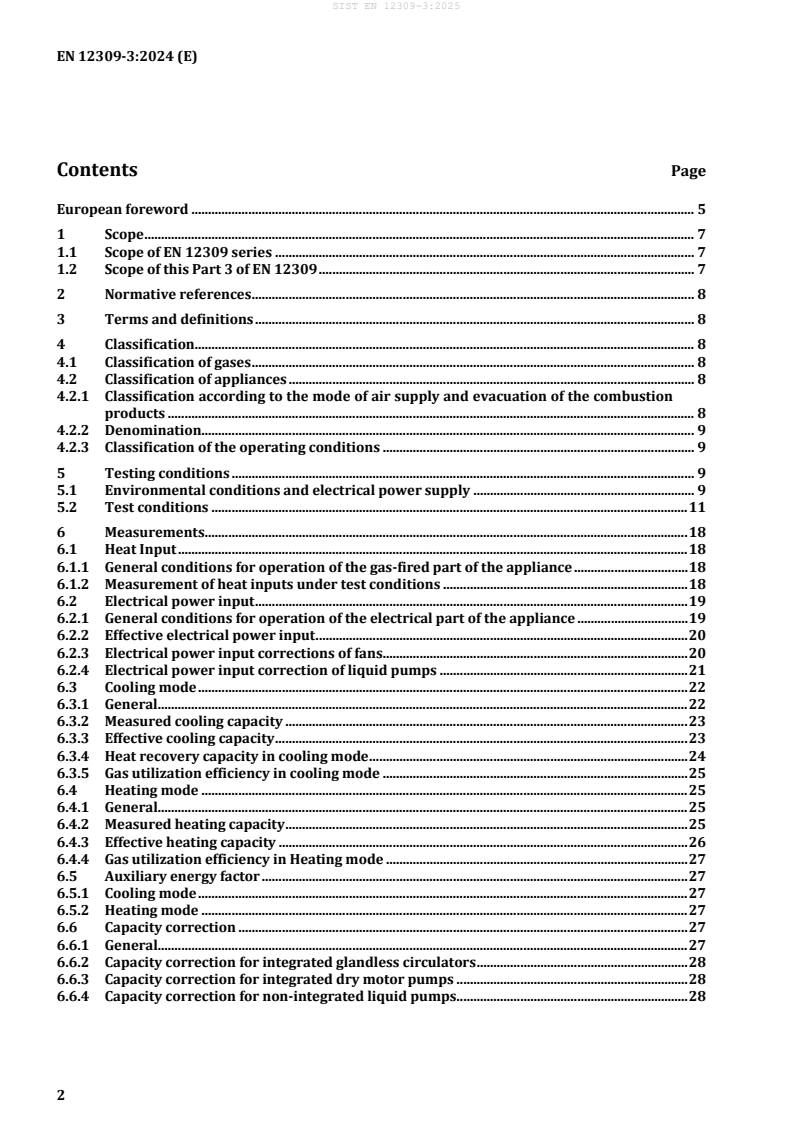
Contents Page
European foreword . 5
1 Scope . 7
1.1 Scope of EN 12309 series . 7
1.2 Scope of this Part 3 of EN 12309 . 7
2 Normative references . 8
3 Terms and definitions . 8
4 Classification. 8
4.1 Classification of gases . 8
4.2 Classification of appliances . 8
4.2.1 Classification according to the mode of air supply and evacuation of the combustion
products . 8
4.2.2 Denomination. 9
4.2.3 Classification of the operating conditions . 9
5 Testing conditions . 9
5.1 Environmental conditions and electrical power supply . 9
5.2 Test conditions . 11
6 Measurements . 18
6.1 Heat Input . 18
6.1.1 General conditions for operation of the gas-fired part of the appliance . 18
6.1.2 Measurement of heat inputs under test conditions . 18
6.2 Electrical power input . 19
6.2.1 General conditions for operation of the electrical part of the appliance . 19
6.2.2 Effective electrical power input . 20
6.2.3 Electrical power input corrections of fans . 20
6.2.4 Electrical power input correction of liquid pumps . 21
6.3 Cooling mode . 22
6.3.1 General. 22
6.3.2 Measured cooling capacity . 23
6.3.3 Effective cooling capacity . 23
6.3.4 Heat recovery capacity in cooling mode . 24
6.3.5 Gas utilization efficiency in cooling mode . 25
6.4 Heating mode . 25
6.4.1 General. 25
6.4.2 Measured heating capacity . 25
6.4.3 Effective heating capacity . 26
6.4.4 Gas utilization efficiency in Heating mode . 27
6.5 Auxiliary energy factor . 27
6.5.1 Cooling mode . 27
6.5.2 Heating mode . 27
6.6 Capacity correction . 27
6.6.1 General. 27
6.6.2 Capacity correction for integrated glandless circulators . 28
6.6.3 Capacity correction for integrated dry motor pumps . 28
6.6.4 Capacity correction for non-integrated liquid pumps . 28
7 Test methods . 29
7.1 General . 29
7.1.1 Introduction . 29
7.1.2 All appliances . 29
7.1.3 Alternating appliances . 30
7.1.4 Non ducted appliances . 30
7.1.5 Ducted appliances . 30
7.1.6 Air to water(brine) and water(brine) to water(brine) appliances . 31
7.1.7 Sound measurements . 31
7.2 Measurement for water(brine) to water(brine) appliances . 31
7.2.1 Steady-state operation conditions . 31
7.2.2 Measurement of heating capacity, cooling capacity, heat recovery capacity, gas input
and electrical power input . 31
7.2.3 Measurement of GUE . 31
7.3 Measurement in cooling mode for air-to-water(brine) appliances . 32
7.3.1 Steady-state operation conditions . 32
7.3.2 Measurement of cooling capacity, heat recovery capacity, gas input and electrical
power input . 32
7.3.3 Measurement of GUE . 32
7.4 Measurement in heating mode for air-to-water appliances . 32
7.4.1 General . 32
7.4.2 Preconditioning period . 33
7.4.3 Equilibrium period . 33
7.4.4 Data collection period . 33
7.4.5 Test procedure when a defrost cycle ends the preconditioning period . 34
7.4.6 Test procedure when a defrost cycle does not end the preconditioning period . 34
7.5 Reduced capacity tests . 35
7.5.1 General . 35
7.5.2 Cycling interval (ON-OFF) tests . 36
7.6 Permissible deviations . 37
7.7 Test methods for electric power consumption during thermostat off mode, standby
mode and off mode . 42
7.7.1 Measurement of electrical power consumption during thermostat off mode . 42
7.7.2 Measurement of the electrical power consumption during standby mode . 42
7.7.3 Measurement of the electric power consumption during off mode . 42
7.8 Test results. 42
7.9 Test apparatus . 45
7.9.1 Arrangement of the test apparatus . 45
7.9.2 Installation and connection of the appliance . 46
7.10 Uncertainties of measurement . 46
8 Marking and documentation . 48
Annex A (normative) Determination of the liquid pump efficiency . 49
A.1 General . 49
A.2 Hydraulic power of the liquid pump . 49
A.3 Efficiency of integrated pumps . 50
A.4 Efficiency of non-integrated pumps . 53
Annex B (normative) Electrical and capacity corrections to include in the electrical power
input and in the measured heating, cooling and heat recovery capacities . 54
Annex C (informative) Primary energy efficiency - Calculation at a single operating point . 56
C.1 Primary energy ratio in heating mode . 56
C.2 Primary energy ratio in cooling mode . 56
Annex D (informative) Heating capacity tests - Flow chart and examples of different test
sequences. 57
D.1 Flow chart . 57
D.2 Examples of test profiles . 58
Annex E (informative) Direct method for air-to-water (brine) and water (brine) to water
(brine) appliances . 64
E.1 General. 64
E.2 Compensation system air to water appliances . 64
E.3 Compensation system for water/brine to water appliances . 65
Annex F (normative) Measurement in ON/OFF mode . 66
F.1 General. 66
F.2 Test procedure for measurement in ON/OFF mode . 66
Annex G (informative) Test report . 69
G.1 General information . 69
G.2 Additional information . 69
G.3 Test results . 70
Annex ZA (informative) Relationship between this European Standard and the ecodesign
requirements of Commission Regulation (EU) No 813/2013 L 239/136 aimed to be
covered . 71
Annex ZB (informative) Relationship between this European Standard and the energy
labelling requirements of Commission Delegated Regulation (EU) No 811/2013 L
239/1 aimed to be covered . 72
Annex ZC (informative) Relationship between this European Standard and the ecodesign
requirements of Commission Regulation (EU) No 2016/2281 L 346/1 aimed to be
covered . 74
Bibliography . 75
European foreword
This document (EN 12309-3:2024) has been prepared by Technical Committee CEN/TC 299 “Gas-fired
sorption appliances, indirect fired sorption appliances, gas-fired endothermic engine heat pumps and
domestic gas-fired washing and drying appliances”, the secretariat of which is held by UNI.
This European Standard shall be given the status of a national standard, either by publication of an
identical text or by endorsement, at the latest by November 2024, and conflicting national standards
shall be withdrawn at the latest by November 2024.
Attention is drawn to the possibility that some of the elements of this document may be the subject of
patent rights. CEN shall not be held responsible for identifying any or all such patent rights.
This document supersedes EN 12309-3:2014, EN 12309-4:2014 and EN 12309-5:2014.
In comparison with the previous edition, the following technical modifications have been made:
— the content of previous standards EN 12309-3:2014, EN 12309-4:2014 and EN 12309-5:2014 has
been merged;
— nomenclature has been updated to be aligned with Commission Regulation (EU) No 813/2013 of 2
August 2013, Commission Delegated Regulation (EU) No 811/2013 of 18 February 2013,
Commission Regulation (EU) No 2016/2281 of 30 November 2016;
— test conditions have been rationalized;
— c definition and application has been better detailed;
pump
— test methods have been simplified;
— permissible deviations have been revised;
— informative Annex F (Measurement control criteria for water(brine) to water(brine) appliances)
has been deleted.
This document has been prepared under a standardization request addressed to CEN by the European
Commission. The Standing Committee of the EFTA States subsequently approves these requests for its
Member States.
For the relationship with EU Legislation, see informative Annex ZA, ZB or ZC, which is an integral part of
this document.
This standard comprises parts under the general title, Gas-fired sorption appliances for heating and/or
cooling with a net heat input not exceeding 70 kW. A list of all parts in a series can be found on the CEN
website.
These documents will be reviewed whenever new mandates could apply.
Any feedback and questions on this document should be directed to the users’ national standards body.
A complete listing of these bodies can be found on the CEN website. According to the CEN-CENELEC
Internal Regulations, the national standards organisations of the following countries are bound to
implement this European Standard: Austria, Belgium, Bulgaria, Croatia, Cyprus, Czech Republic,
Denmark, Estonia, Finland, France, Germany, Greece, Hungary, Iceland, Ireland, Italy, Latvia, Lithuania,
Luxembourg, Malta, Netherlands, Norway, Poland, Portugal, Republic of North Macedonia, Romania,
Serbia, Slovakia, Slovenia, Spain, Sweden, Switzerland, Türkiye and the United Kingdom.
1 Scope
1.1 Scope of EN 12309 series
Appliances covered by this document include one or a combination of the following:
— gas-fired sorption chiller;
— gas-fired sorption chiller/heater;
— gas-fired sorption heat pump;
— hybrids based on gas sorption appliances.
This document applies to appliances designed to be used for space heating or cooling or refrigeration
with or without heat recovery.
This document applies to appliances having flue gas systems of Type B and Type C (according to
EN 1749:2020) and to appliances designed for outdoor installations, including Type A.
EN 12309 does not apply to air conditioners, it only applies to appliances having:
— integral burners under the control of fully automatic burner control systems;
— closed system refrigerant circuits in which the refrigerant does not come into direct contact with
the water or air to be cooled or heated;
— mechanical means to assist transportation of the combustion air and/or the flue gas.
The above appliances can have one or more primary or secondary functions (i.e. heat recovery - see
definitions in EN 12309-1:2023).
In the case of packaged units (consisting of several parts), this document applies only to those designed
and supplied as a complete package.
The appliances having their condenser cooled by air and by the evaporation of external additional
water are not covered by EN 12309.
Installations used for heating and/or cooling of industrial processes are not within the scope of
EN 12309. All the symbols given in this text are to be used regardless of the language used.
1.2 Scope of this Part 3 of EN 12309
This part of EN 12309 specifies the requirements, test methods and conditions for gas-fired sorption
appliances for heating and/or cooling with a net heat input not exceeding 70 kW.
This part of EN 12309 deals particularly with test protocols and tools to calculate the capacity, the gas
utilization efficiency and the electrical power input of the appliance. This data can be used in particular
to calculate the seasonal efficiency of the appliance.
2 Normative references
The following documents are referred to in the text in such a way that some or all of their content
constitutes requirements of this document. For dated references, only the edition cited applies. For
undated references, the latest edition of the referenced document (including any amendments) applies.
EN 437:2021, Test gases — Test pressures — Appliance categories
EN 1749:2020, Classification of gas appliances according to the method of supplying combustion air and
of evacuation of the combustion products (types)
EN 12102-1:2022, Air conditioners, liquid chilling packages, heat pumps, process chillers and
dehumidifiers with electrically driven compressors — Determination of the sound power level — Part 1:
Air conditioners, liquid chilling packages, heat pumps for space heating and cooling, dehumidifiers and
process chillers
EN 12309-1:2023, Gas-fired sorption appliances for heating and/or cooling with a net heat input not
exceeding 70 kW — Part 1: Terms and definitions
EN 12309-2:2015, Gas-fired sorption appliances for heating and/or cooling with a net heat input not
exceeding 70 kW — Part 2: Safety
FprEN 12309-6:2023, Gas-fired sorption appliances for heating and/or cooling with a net heat input not
exceeding 70 kW — Part 6: Calculation of seasonal performances
EN 12309-7:2014, Gas-fired sorption appliances for heating and/or cooling with a net heat input not
exceeding 70 kW — Part 7: Specific provisions for hybrid appliances
3 Terms and definitions
For the purposes of this document, the terms and definitions given in EN 12309-1:2023 apply.
ISO and IEC maintain terminology databases for use in standardization at the following addresses:
— ISO Online browsing platform: available at https://www.iso.org/obp/
— IEC Electropedia: available at https://www.electropedia.org/
4 Classification
4.1 Classification of gases
Gases are classified into three families, divided into groups according to the value of the Wobbe index.
Families and groups of gas used in this document are in accordance with those of the EN 437:2021.
4.2 Classification of appliances
4.2.1 Classification according to the mode of air supply and evacuation of the combustion
products
The types of appliances as defined in EN 1749:2020 apply.
Currently in preparation.
4.2.2 Denomination
Appliances are denominated in such a way that the heat transfer medium for the outdoor heat
exchanger is indicated first, followed by the heat transfer medium for the indoor heat exchanger.
Examples of such appliances are given in Table 1.
Table 1 — Examples of denomination of appliances
Heat transfer medium Denomination
Outdoor heat exchanger Indoor heat exchanger
Air a Air Cooled Liquid Chiller
Water
Air Cooled Liquid Chiller/Heater
Air/Water Heat pump
a a Water Cooled Liquid Chiller
Water Water
Water Cooled Liquid Chiller/Heater
Water/Water Heat pump
Brine a Brine Cooled Liquid Chiller
Water
Brine Cooled Liquid Chiller/Heater
Brine/Water Heat pump
a
This description also applies where the water contains additives to prevent corrosion as specified in the
appliances instructions.
4.2.3 Classification of the operating conditions
The classification according to the temperatures of the heat transfer media is formed in such a way that
the heat transfer media are indicated together with their temperatures (in °C). A short classification is
formed in such a way that a characteristic letter is used for the heat transfer medium: A for air, W for
water and B for brine.
Both for heating and for cooling appliances, the value indicated in the first place refer to the outdoor
heat exchanger temperature and the value in the second place to the indoor heat exchanger
temperature.
Temperatures for the outdoor heat exchanger are inlet temperatures. Temperatures for the indoor heat
exchanger are outlet temperatures.
EXAMPLE 1 In cooling mode, A27W7 means an inlet temperature of air for the outdoor heat exchanger of 27 °C
and an outlet temperature of water for the indoor heat exchanger of 7 °C.
EXAMPLE 2 In heating mode, B0W50 means an inlet temperature of brine for the outdoor heat exchanger of
0 °C and an outlet temperature of water for the indoor heat exchanger of 50 °C.
5 Testing conditions
5.1 Environmental conditions and electrical power supply
The tests to check the requirements shall be carried out under the environmental conditions and
electrical power supply requirements specified in Tables 2 and 3 depending on the location of the
appliance.
Table 2 — Environmental conditions and electrical power supply requirements for appliances
designed for indoor installations
Type Measured quantities Test conditions
Water-to-water and brine-to- Ambient temperature (Dry bulb 20 °C ± 5 °C
a temperature)
water appliances
Air-to-water appliances with Ambient temperature (Dry bulb 20 °C ± 5 °C
duct connection on the air inlet temperature)
and outlet side
Air-to-water appliances without Air inlet temperature (Dry/Wet According to Tables 4, 5, 8, 9, 10
duct connection on the air inlet bulb temperature)
side
All appliances Voltage Nominal voltage
All appliances Frequency Nominal frequency
a
Test conditions for water to water or brine to water appliances can be extended to water to brine and brine
to brine appliances respectively (e.g. for reversible applications).
Table 3 — Environmental conditions and electrical power supply requirements for appliances
designed for outdoor installation
Type Measured quantities Test conditions
Water-to-water and brine-to- Ambient temperature (Dry bulb 25 °C to 35 °C
water appliances in cooling temperature)
a
mode
Water-to-water and brine-to- Ambient temperature (Dry bulb 0 °C to 7 °C
water appliances in heating temperature)
mode
Air-to-water appliances Air inlet temperature (Dry/Wet According to Tables 4, 5, 8, 9, 10
bulb temperature)
All appliances Voltage Nominal voltage
All appliances Frequency Nominal frequency
a
Test conditions for water to water or brine to water appliances can be extended to water to brine and brine
to brine appliances respectively (e.g. for reversible applications).
For all appliances, electrical power voltage and frequency shall be stated in the appliance’s technical
documentation.
5.2 Test conditions
The appropriate test conditions shall be applied in accordance with:
— Table 4 for water-to-water, water-to-brine, air-to-water and air-to-brine appliances in cooling
mode, when the scope of testing is establishing standard GUE, rated cooling capacity and sound
power level (L );
WA
— Table 5 for air-to-water and air-to-brine appliances in cooling mode with heat recovery, when the
scope of testing is establishing standard GUE, rated cooling capacity and sound power level (L );
WA
— Table 6 for water-to-water and brine-to-water appliances in heating mode, when the scope of
testing is establishing rated GUE (GUE ), rated PER (PER ) and rated heat capacity
rated rated
(P );
rated,h
— Table 7 for water-to-water and brine-to-water appliances in heating mode, when the scope of
testing is establishing establishing sound power level (L );
WA
— Table 8 for air-to-water appliances in heating mode, when the scope of testing is establishing rated
GUE (GUE ), rated PER (PER ) and typical heat capacity (P ; P );
rated rated typ(35) typ(55)
— Table 9 for air-to-water appliances in heating mode, when the scope of testing is establishing rated
heat capacity (P );
rated,h
— Table 10 for air-to-water appliances in heating mode, when the scope of testing is establishing
sound power level (L );
WA
The prescribed test conditions shall be applied at full load of tested appliances, unless differently
specified in the above listed tables.
For appliances with brine, the test shall be carried out with the brine specified in the technical
documentation, see 7.1.6.
Table 4 — Standard rating conditions or reference design conditions for establishing standard
GUE, rated cooling capacity and sound power level (L ) for water-to-water, water-to-brine,
WA
air-to-water and air-to-brine appliances in cooling mode
Outdoor heat exchanger Indoor heat exchanger
Type of appliance /
Inlet Outlet Inlet Outlet
NOTES
Application
temperature temperature temperature temperature
°C °C °C °C
a d
30 12 7 W30W7
Water-to-water 35
a d
30 0 −5 W30B-5
Water-to-brine 35
b
Air-to-water /
c
/ 12 7 A35W7
Low temperature
b
Air-to-water /
c
/ 23 18 A35W18
Medium temperature
b c
/ 0 −5 A35B-5
Air-to-brine 35
NOTE The supplementary heater of a reversible unit (chiller/heater unit) is not operated during the test. In
addition, for an appliance with a recovery heat exchanger, no heat recovery medium is circulated during the test.
a
Test conditions for water-to-water or water-to-brine appliances can be extended to brine-to-water and brine-to-
brine appliances respectively (e.g. for reversible applications).
b
The water shall contain any additive specified in technical documentation, but the test conditions remain the
same as for water.
c
Dry bulb temperature.
d
Flow rate shall remain inside the range given by the manufacturer; in the opposite case keep the inlet
temperature.
Table 5 — Standard rating conditions or reference design conditions for establishing standard
GUE, rated cooling capacity and sound power level (L ) for air-to-water and air-to-brine
WA
appliances in cooling mode with heat recovery
Outdoor heat exchanger Indoor heat exchanger Recovery heat exchanger
Type of appliance
Inlet Outlet Inlet Outlet Inlet Outlet
/
temperatur temperatur temperatur temperatur
temperatur temperatur
Application
e e e e e e
°C °C °C °C °C °C
b
Air-to-water /
c
/ a 7 40 50
Low temperature
b
Air-to-water /
c
a
/ 18 40 50
Medium
temperature
b c
/ a −5 40 50
Air-to-brine 35
a
With the flow rate as determined during the test with no circulation of heat recovery medium (see Table 4).
b
If the air cooled condenser is ducted, then the test shall be carried out at the minimum flow rate specified in technical
documentation.
c
Dry bulb temperature.
Table 6 — Standard rating conditions for establishing rated GUE (GUE ), rated PER
rated
(PER ) and rated heat capacity (P ) for water-to-water and brine-to-water appliances
rated rated,h
in heating mode
Outdoor heat exchanger Indoor heat exchanger
Inlet Outlet Inlet Outlet
Application NOTES
temperature temperature temperature temperature
°C °C °C °C
a
Water-to-water
Low temperature 10 7 30 35 W10W35
Medium temperature 10 7 47 55 W10W55
a
Brine-to-water
Low temperature 0 −3 30 35 B0W35
Medium temperature 0 −3 47 55 B0W55
a
Test conditions for water-to-water or brine-to-water appliances can be extended to water-to-brine and brine-to-brine
appliances respectively (e.g. for reversible applications).
Table 7 — Standard rating conditions for establishing sound power level (L ) for water-to-
WA
water and brine-to-water appliances in heating mode
Outdoor heat exchanger Indoor heat exchanger
Heat
Inlet Outlet Inlet Outlet
Application NOTES
capacity
temperature temperature temperature temperature
°C °C °C °C
a
Water-to-water , fixed capacity appliances
Full
Low temperature 10 7 30 35
W10W35
capacity
Medium Full
10 7 47 55 W10W55
temperature capacity
a
Water-to-water , variable capacity appliances
b
35 % of
d
Low temperature 10 7 35 W10W35
P
rated,h
c
Medium 35 % of
d
10 7 55 W10W55
temperature P
rated,h
a
Brine-to-water , fixed capacity appliances
Full
Low temperature 0 −3 30 35 B0W35
capacity
Medium Full
0 −3 47 55 B0W55
temperature capacity
a
Brine-to-water , variable capacity appliances
b
35 % of
d
Low temperature 0 −3 35 B0W35
P
rated,h
c
Medium 35 % of
d
0 −3 55 B0W55
temperature P
rated,h
a
Test conditions for water-to-water or brine-to-water appliances can be extended to water-to-brine and brine-to-brine
appliances respectively (e.g. for reversible applications).
b
With the target capacity of point C, Average climate conditions, in Table 8 of FprEN 12309-6:2023 with a maximum deviation
of ± 5 %. If the settings are such that this is not possible, then the operating conditions and/or settings of the unit within its
boundary limits shall be such that at least the capacity and the leaving water temperature requirements are fulfilled.
c
With the target capacity of point C, Average climate conditions, in Table 9 of FprEN 12309-6:2023 with a maximum deviation
of ± 5 %. If the settings are such that this is not possible, then the operating conditions and/or settings of the unit within its
boundary limits shall be such that at least the capacity and the leaving water temperature requirements are fulfilled.
d
If requested heat capacity is not matched within a maximum deviation of ± 5 %, this value is adjusted.
Table 8 — Standard rating conditions for establishing rated GUE (GUE ), rated PER
rated
(PER ) and Typical Heat Capacity (P ; P ) for air-to-water appliances in
rated typ(35) typ(55)
heating mode
Outdoor heat exchanger Indoor heat exchanger
Inlet dry bulb Inlet wet bulb Inlet Outlet
Application NOTES
temperature temperature temperature temperature
°C °C °C °C
Outdoor air
Low temperature 7 6 30 35 A7W35
Medium temperature 7 6 47 55 A7W55
Exhaust air
Low temperature 20 12 30 35 A20W35
Medium temperature 20 12 47 55 A20W55
Table 9 — Standard rating conditions or reference design conditions for establishing rated heat
capacity (P ) for air-to-water appliances in heating mode
rated,h
Outdoor heat exchanger Indoor heat exchanger
Inlet dry bulb Inlet wet bulb Inlet Outlet
Application NOTES
temperature temperature temperature temperature
°C °C °C °C
Outdoor air
Warmer climate conditions
a
2 1 35 A2W35
Average climate conditions
Low temperature
−10 −11 a 35 A-10W35
Colder climate conditions
−22 −23 a 35 A-22W35
Warmer climate conditions
2 1 a 55 A2W55
Average climate conditions
Medium
temperature
a
−10 −11 55 A-10W55
Colder climate conditions
−22 −23 a 55 A-22W55
Exhaust air (all climate conditions)
Low temperature 20 12 a 35 A20W35
Outdoor heat exchanger Indoor heat exchanger
Inlet dry bulb Inlet wet bulb Inlet Outlet
Application NOTES
temperature temperature temperature temperature
°C °C °C °C
Medium
20 12 a 55 A20W55
temperature
a
All tests shall be carried out with nominal flow rates indicated in the technical documentation, provided that the
difference between the inlet and outlet temperatures at the indoor heat exchanger is lower than a maximum
temperature difference (ΔT ) calculated using the following formula:
max
ΔT = 4 * (T / 9) – 6
max out
In case this condition is not respected, the flow rate shall be increased until ΔT is equal to ΔT .
max
If only a range of flow rates is given, tests shall be carried out at the minimum value of the range, provided that ΔT
is lower than ΔT .
max
If a nominal flow rate or a range of flow rates are not indicated in the technical documentation, tests shall be
carried out with ΔT = ΔT .
max
Table 10 — Standard rating conditions for establishing sound power level (L ) for air-to-
WA
water appliances in heating mode
Outdoor heat exchanger Indoor heat exchanger
Heat
Application
NOTES
Inlet dry bulb Inlet wet bulb Inlet Outlet
capacity
temperature temperature temperature temperature
°C °C °C °C
Outdoor air, Average climate, fixed capacity appliances
Full
Low temperature 7 6 30 35 A7W35
capacity
Medium Full
7 6 47 55 A7W55
temperature capacity
Outdoor air, Average climate, variable capacity appliances
a
35 % of
g
Low temperature 7 6 35 A7W35
P
rated,h
b
Medium 35 % of
g
7 6 55 A7W55
temperature P
rated,h
Outdoor air, Colder climate, fixed capacity appliances
Full
Low temperature 2 1 30 35 A2W35
capacity
Medium Full
2 1 47 55 A2W55
temperature capacity
Outdoor air, Colder climate, variable capacity appliances
c
37 % of
g
Low temperature 2 1 35 A2W35
P
rated,h
Outdoor heat exchanger Indoor heat exchanger
Heat
Application NOTES
Inlet dry bulb Inlet wet bulb Inlet Outlet
capacity
temperature temperature temperature temperature
°C °C °C °C
d
Medium 37 % of
g
2 1 55 A2W55
temperature P
rated,h
Outdoor air, Warmer climate, fixed capacity appliances
Full
Low temperature 14 13 30 35 A14W35
capacity
Medium Full
14 13 47 55 A14W55
temperature capacity
Outdoor air, Warmer climate, variable capacity appliances
e
14 % of
g
Low temperature 14 13 35 A14W35
P
rated,h
f
Medium 14 % of
g
14 13 55 A14W55
temperature P
rated,h
Exhaust air, fixed capacity appliances
Full
Low temperature 20 12 30 35 A20W35
capacity
Medium Full
20 12 47 55 A20W55
temperature capacity
Exhaust air, variable capacity appliances
35 % of
g
Low temperature 20 12 35 A20W35
P
rated,h
35 % of
Medium
g
20 12 55 A20W55
P
temperature
rated,h
a
With the target capacity of point C, Average climate conditions, in Table 5 of FprEN 12309-6:2023 with a maximum deviation
of ±5 %. If the settings are such that this is not possible, then the operating conditions and/or settings of the unit within its
boundary limits shall be s
...