

SIST EN 1537:2013
(Main)Execution of special geotechnical work - Ground anchors
General Information
- Abstract
1.1 This European Standard covers ground anchors grouted into the ground which are stressed and tested. They can be used for permanent or temporary applications.
NOTE For the purpose of this standard the term ‘anchor(s)’ refers to ‘ground anchor(s)’.
1.2 The anchors are designed in accordance with EN 1997-1 and are tested in accordance with prEN ISO 22477 5.
1.3 Typical bond and compression type anchors are shown in Figure 1 and Figure 2.
1.4 The term "ground" is taken to encompass soil, rock and fill already in place or existing prior to the execution of the construction work.
1.5 The planning and design of ground anchors calls for experience and knowledge in this specialised field.
1.6 The installation and testing phases require skilled, qualified labour and supervision.
1.7 This standard cannot replace the knowledge of specialist personnel and the expertise of experienced contractors required to apply this standard.
1.8 This standard does not address systems such as tension piles, screw anchors, mechanical anchors, soil nails, dead-man anchors or expander anchors as these do not fulfil the requirements of this standard.
- Status
- Published
- Public Enquiry End Date
- 30-Mar-2010
- Publication Date
- 11-Nov-2013
- Technical Committee
- KON.007 - Geotechnics
- Current Stage
- 6060 - National Implementation/Publication (Adopted Project)
- Start Date
- 19-Jul-2013
- Due Date
- 23-Sep-2013
- Completion Date
- 12-Nov-2013

Overview
EN 1537:2013 - Execution of special geotechnical works - Ground anchors is the CEN standard that specifies requirements for grouted ground anchors that are stressed and tested for permanent or temporary use. The standard covers execution aspects: drilling, grouting, stressing, corrosion protection, testing, supervision and record-keeping. It applies to anchors bonded into the ground (soil, rock or existing fill) and defines two typical anchor types: bond and compression anchors. EN 1537:2013 complements design rules in EN 1997-1 (Eurocode 7) and aligns testing with prEN ISO 22477-5.
Key topics and technical requirements
- Scope and definitions: Clarifies terms (anchor = ground anchor) and excludes systems that do not meet the standard (e.g., tension piles, screw anchors, mechanical anchors, soil nails, dead‑man and expander anchors).
- Design interface: Anchors must be designed per EN 1997-1; EN 1537 addresses execution-stage considerations necessary to achieve the design intent.
- Materials and corrosion protection: Requirements for tendon, anchor head, couplers, grout and protective barriers; guidance for temporary vs permanent corrosion protection systems.
- Drilling and tolerances: Execution requirements for boreholes and drilling methods used for anchor installation.
- Grouting procedures: Pre‑grouting, anchor grouting, post‑grouting and grout quality considerations for load transfer and protection.
- Stressing and locking-off: Procedures, equipment and sequencing for stressing anchors and securing them in service.
- Testing, supervision and monitoring: Investigation, suitability and acceptance tests (aligned with prEN ISO 22477-5), measurement requirements, datum loads, supervision and ongoing monitoring.
- Documentation: Record keeping and example record sheets (informative annexes) to demonstrate compliance and traceability.
- Informative annexes: Practical guidance on corrosion testing, acceptance criteria, typical corrosion protection systems and sample record sheets.
Applications
EN 1537:2013 is used where grouted, stressed and tested anchors are specified for geotechnical support works, typically including:
- Support of excavation and retaining structures
- Slope stabilisation and landslide mitigation
- Tiebacks for walls and abutments
- Temporary works requiring tested anchors
Who should use this standard
- Geotechnical and structural engineers specifying ground anchor systems
- Specialist contractors executing drilling, grouting and stressing works
- Site supervisors, testing laboratories and quality assurance teams
- Procurement/specifiers and project owners seeking compliance with Eurocode-based execution practices
Related standards
- EN 1997-1 (Eurocode 7) - Geotechnical design - Part 1: General rules
- prEN ISO 22477-5 - Testing of geotechnical structures (anchor testing)
- Related Execution standards: EN 1536 (Bored piles), EN 1538 (Diaphragm walls)
EN 1537:2013 provides practical, execution-focused requirements to ensure that grouted ground anchors perform as designed and are installed, tested and documented by competent personnel.
Relations
- Effective Date
- 01-Dec-2013
- Effective Date
- 01-Dec-2013
- Effective Date
- 11-Mar-2026
- Effective Date
- 28-Jan-2026
- Effective Date
- 28-Jan-2026
- Effective Date
- 28-Jan-2026
- Effective Date
- 28-Jan-2026
- Effective Date
- 28-Jan-2026
- Effective Date
- 28-Jan-2026
- Effective Date
- 28-Jan-2026
- Effective Date
- 28-Jan-2026
- Effective Date
- 28-Jan-2026
- Refers
SIST EN 10080:2005 - Steel for the reinforcement of concrete - Weldable reinforcing steel - General - Effective Date
- 28-Jan-2026
- Effective Date
- 28-Jan-2026
- Effective Date
- 28-Jan-2026
Get Certified
Connect with accredited certification bodies for this standard

Zavod za gradbeništvo Slovenije (ZAG) - Inšpekcija
ZAG inspection body for construction products, structures, and materials.
Sponsored listings
Frequently Asked Questions
SIST EN 1537:2013 is a standard published by the Slovenian Institute for Standardization (SIST). Its full title is "Execution of special geotechnical work - Ground anchors". This standard covers: 1.1 This European Standard covers ground anchors grouted into the ground which are stressed and tested. They can be used for permanent or temporary applications. NOTE For the purpose of this standard the term ‘anchor(s)’ refers to ‘ground anchor(s)’. 1.2 The anchors are designed in accordance with EN 1997-1 and are tested in accordance with prEN ISO 22477 5. 1.3 Typical bond and compression type anchors are shown in Figure 1 and Figure 2. 1.4 The term "ground" is taken to encompass soil, rock and fill already in place or existing prior to the execution of the construction work. 1.5 The planning and design of ground anchors calls for experience and knowledge in this specialised field. 1.6 The installation and testing phases require skilled, qualified labour and supervision. 1.7 This standard cannot replace the knowledge of specialist personnel and the expertise of experienced contractors required to apply this standard. 1.8 This standard does not address systems such as tension piles, screw anchors, mechanical anchors, soil nails, dead-man anchors or expander anchors as these do not fulfil the requirements of this standard.
1.1 This European Standard covers ground anchors grouted into the ground which are stressed and tested. They can be used for permanent or temporary applications. NOTE For the purpose of this standard the term ‘anchor(s)’ refers to ‘ground anchor(s)’. 1.2 The anchors are designed in accordance with EN 1997-1 and are tested in accordance with prEN ISO 22477 5. 1.3 Typical bond and compression type anchors are shown in Figure 1 and Figure 2. 1.4 The term "ground" is taken to encompass soil, rock and fill already in place or existing prior to the execution of the construction work. 1.5 The planning and design of ground anchors calls for experience and knowledge in this specialised field. 1.6 The installation and testing phases require skilled, qualified labour and supervision. 1.7 This standard cannot replace the knowledge of specialist personnel and the expertise of experienced contractors required to apply this standard. 1.8 This standard does not address systems such as tension piles, screw anchors, mechanical anchors, soil nails, dead-man anchors or expander anchors as these do not fulfil the requirements of this standard.
SIST EN 1537:2013 is classified under the following ICS (International Classification for Standards) categories: 93.020 - Earthworks. Excavations. Foundation construction. Underground works. The ICS classification helps identify the subject area and facilitates finding related standards.
SIST EN 1537:2013 has the following relationships with other standards: It is inter standard links to SIST EN 1537:2002/AC:2004, SIST EN 1537:2002, SIST EN 206-2:2026, SIST EN ISO 12944-5:2020, SIST EN 10025-1:2004, kSIST FprEN 1992-1-1:2023, SIST EN 447:2008, SIST EN 10025-4:2019+A1:2023, SIST EN 10025-2:2019, SIST EN 10219-2:2019, SIST EN 1997-1:2005, SIST EN 10025-3:2019, SIST EN 10080:2005, SIST EN 10219-1:2006, SIST EN 10025-6:2019+A1:2023. Understanding these relationships helps ensure you are using the most current and applicable version of the standard.
SIST EN 1537:2013 is available in PDF format for immediate download after purchase. The document can be added to your cart and obtained through the secure checkout process. Digital delivery ensures instant access to the complete standard document.
Standards Content (Sample)
2003-01.Slovenski inštitut za standardizacijo. Razmnoževanje celote ali delov tega standarda ni dovoljeno.Ausführung von besonderen geotechnischen Arbeiten (Spezialtiefbau) - VerpreßankerExécution des travaux géotechniques spéciaux - Tirant d'ancrageExecution of special geotechnical work - Ground anchors93.020Zemeljska dela. Izkopavanja. Gradnja temeljev. Dela pod zemljoEarthworks. Excavations. Foundation construction. Underground worksICS:Ta slovenski standard je istoveten z:EN 1537:2013SIST EN 1537:2013en,fr,de01-december-2013SIST EN 1537:2013SLOVENSKI
STANDARDSIST EN 1537:2002/AC:2004SIST EN 1537:20021DGRPHãþD
EUROPEAN STANDARD NORME EUROPÉENNE EUROPÄISCHE NORM
EN 1537
July 2013 ICS 93.020 Supersedes EN 1537:1999English Version
Execution of special geotechnical works - Ground anchors
Exécution des travaux géotechniques spéciaux - Tirants d'ancrage
Ausführung von Arbeiten im Spezialtiefbau - VerpressankerThis European Standard was approved by CEN on 8 May 2013.
CEN members are bound to comply with the CEN/CENELEC Internal Regulations which stipulate the conditions for giving this European Standard the status of a national standard without any alteration. Up-to-date lists and bibliographical references concerning such national standards may be obtained on application to the CEN-CENELEC Management Centre or to any CEN member.
This European Standard exists in three official versions (English, French, German). A version in any other language made by translation under the responsibility of a CEN member into its own language and notified to the CEN-CENELEC Management Centre has the same status as the official versions.
CEN members are the national standards bodies of Austria, Belgium, Bulgaria, Croatia, Cyprus, Czech Republic, Denmark, Estonia, Finland, Former Yugoslav Republic of Macedonia, France, Germany, Greece, Hungary, Iceland, Ireland, Italy, Latvia, Lithuania, Luxembourg, Malta, Netherlands, Norway, Poland, Portugal, Romania, Slovakia, Slovenia, Spain, Sweden, Switzerland, Turkey and United Kingdom.
EUROPEAN COMMITTEE FOR STANDARDIZATION
COMITÉ EUROPÉEN DE NORMALISATION EUROPÄISCHES KOMITEE FÜR NORMUNG
Management Centre:
Avenue Marnix 17,
B-1000 Brussels © 2013 CEN All rights of exploitation in any form and by any means reserved worldwide for CEN national Members. Ref. No. EN 1537:2013: ESIST EN 1537:2013
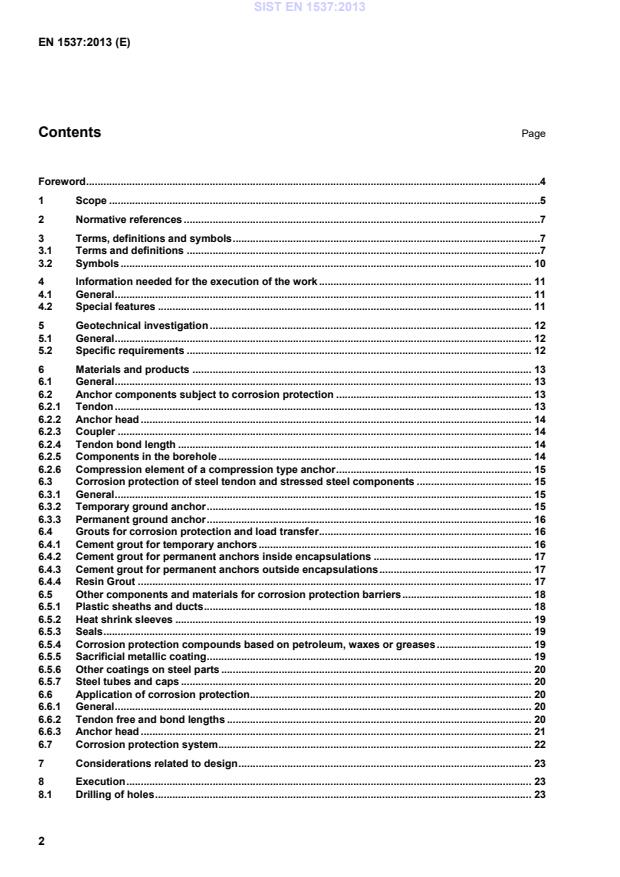
Foreword .4 1 Scope .5 2 Normative references .7 3 Terms, definitions and symbols .7 3.1 Terms and definitions .7 3.2 Symbols . 10 4 Information needed for the execution of the work . 11 4.1 General . 11 4.2 Special features . 11 5 Geotechnical investigation . 12 5.1 General . 12 5.2 Specific requirements . 12 6 Materials and products . 13 6.1 General . 13 6.2 Anchor components subject to corrosion protection . 13 6.2.1 Tendon . 13 6.2.2 Anchor head . 14 6.2.3 Coupler . 14 6.2.4 Tendon bond length . 14 6.2.5 Components in the borehole . 14 6.2.6 Compression element of a compression type anchor . 15 6.3 Corrosion protection of steel tendon and stressed steel components . 15 6.3.1 General . 15 6.3.2 Temporary ground anchor . 15 6.3.3 Permanent ground anchor . 16 6.4 Grouts for corrosion protection and load transfer . 16 6.4.1 Cement grout for temporary anchors . 16 6.4.2 Cement grout for permanent anchors inside encapsulations . 17 6.4.3 Cement grout for permanent anchors outside encapsulations . 17 6.4.4 Resin Grout . 17 6.5 Other components and materials for corrosion protection barriers . 18 6.5.1 Plastic sheaths and ducts . 18 6.5.2 Heat shrink sleeves . 19 6.5.3 Seals . 19 6.5.4 Corrosion protection compounds based on petroleum, waxes or greases . 19 6.5.5 Sacrificial metallic coating . 19 6.5.6 Other coatings on steel parts . 20 6.5.7 Steel tubes and caps . 20 6.6 Application of corrosion protection . 20 6.6.1 General . 20 6.6.2 Tendon free and bond lengths . 20 6.6.3 Anchor head . 21 6.7 Corrosion protection system . 22 7 Considerations related to design . 23 8 Execution . 23 8.1 Drilling of holes . 23 SIST EN 1537:2013
Examples of testing corrosion protection . 36 Annex B (informative)
Guidelines for acceptance criteria for viscous corrosion protection compounds and examples of standards for the testing of material properties . 38 Annex C (informative)
Corrosion protection systems for temporary and permanent anchors and typical details for permanent anchor heads . 39 Annex D (informative)
Example of record sheet . 45 Annex E (informative)
Obligation of the provisions . 47 Bibliography . 52
— structural revisions to match the structure of this standard with that of other standards for special geotechnical works, e.g. EN 1536, Execution of special geotechnical work — Bored piles and EN 1538, Execution of special geotechnical work — Diaphragm walls; — general revision in accordance with comments received during the CEN Enquiry, 2010; — update of references. As long as EN ISO 22477-5 is not available, national solutions should be implemented for the testing of anchors. According to the CEN-CENELEC Internal Regulations, the national standards organisations of the following countries are bound to implement this European Standard: Austria, Belgium, Bulgaria, Croatia, Cyprus, Czech Republic, Denmark, Estonia, Finland, Former Yugoslav Republic of Macedonia, France, Germany, Greece, Hungary, Iceland, Ireland, Italy, Latvia, Lithuania, Luxembourg, Malta, Netherlands, Norway, Poland, Portugal, Romania, Slovakia, Slovenia, Spain, Sweden, Switzerland, Turkey and the United Kingdom. SIST EN 1537:2013
1.6 The installation and testing phases require skilled, qualified labour and supervision.
1.7 This standard cannot replace the knowledge of specialist personnel and the expertise of experienced contractors required to apply this standard. 1.8 This standard does not address systems such as tension piles, screw anchors, mechanical anchors, soil nails, dead-man anchors or expander anchors as these do not fulfil the requirements of this standard.
Key 1 anchorage point at jack during stressing 8 O-Ring 2 anchorage point at anchor head in service 9 soil/rock 3 tensioning element at anchor head 10 borehole 4 bearing plate 11 debonding sleeve 5 load transfer block 12 tendon 6 structural element 13 fixed length grout body 7 trumpet or anchor head tube 14 free length filling where appropriate Figure 1 — Sketch of a bond type ground anchor — Details of anchor head and head protection omitted SIST EN 1537:2013
Key 1 anchorage point at jack during stressing 2 anchorage point at anchor head in service 3 tensioning element at anchor head 4 bearing plate 5 load transfer block 6 structural element 7 trumpet or anchor head tube 8 O - Ring 9 soil/rock 10 borehole 11 debonding sleeve 12 tendon 13 fixed length grout body 14 free length filling where appropriate
15 compression element Figure 2 — Sketch of a compression type ground anchor — Details of anchor head and head protection omitted SIST EN 1537:2013
ETAG 013, Post-tensioning kits for prestressing of structures 3 Terms, definitions and symbols 3.1 Terms and definitions For the purposes of this document, the following terms and definitions apply. 3.1.1 anchor head fr: tête d'ancrage de: Ankerkopf element of a ground anchor which transmits the tensile load from the tendon to the bearing plate or the structure
1) In preparation. SIST EN 1537:2013
anchor system fr: système d’ancrage de: Ankersystem system comprising specific components and materials which collectively form the ground anchor
3.1.3
acceptance test fr: essai de réception
de: Abnahmeprüfung load test to confirm that each anchor conforms with the acceptance criteria 3.1.4
apparent tendon free length fr: longueur libre équivalente de l’armature de: Rechnerische freie Stahllänge length of tendon which is estimated to be fully decoupled from the surrounding grout and is calculated from the load-elastic displacement data following testing 3.1.5
borehole diameter
fr: diamètre de forage de: Bohrlochdurchmesser diameter of a borehole as defined by the drill bit or casing diameter, excluding any enlargements 3.1.6
compression type anchor fr: tirant à élément de compression de: Druckrohranker ground anchor, the load of which is transferred via a decoupled steel tendon down to the bottom of the borehole, and from there via a compression element and the borehole grout into the ground 3.1.7
compression element length fr: longeur d’élément de compression de: Druckrohrlänge length of the compression element for load transfer of a compression type anchor 3.1.8
coupler fr: coupleur de: Koppelelement device for joining the lengths of bar or strand which comprise an anchor tendon 3.1.9
critical creep load fr: traction critique de fluage de: Kritische Kriechkraft anchor load corresponding to the end of the first linear part of a plot of anchor load against creep rate 3.1.10
datum load fr: traction de référence de: Vorbelastung level of anchor load from which the anchor head displacement is measured during a stress test SIST EN 1537:2013
encapsulation fr: protection de: Korrosionsschutzumhüllung corrosion protection barrier which is typically a plastic or metallic tube applied to the tendon 3.1.12
fixed anchor length fr: longueur de scellement du tirant de: Krafteintragungslänge designed length of an anchor over which the load is transmitted to the surrounding ground, through a grout body 3.1.13 free anchor length fr: longueur libre du tirant de: Freie Ankerlänge distance between the proximal end of the fixed anchor length and the tendon anchorage point at the anchor head 3.1.14 ground anchor fr: tirant d'ancrage de: Verpressanker structural element capable of transmitting an applied tensile load to a load-bearing stratum; it consists of an anchor head, a free anchor length and a fixed anchor length 3.1.15 grout fr: coulis de: Verpressgut fluid mixture of a binding and/or setting agent (usually cement) and water that hardens after being placed in position 3.1.16 investigation test fr: essai préalable de: Untersuchungsprüfung load test to establish the ultimate load resistance of an anchor at the ground/grout interface and to determine the characteristics of the anchor in the working load range 3.1.17 lock-off load fr: traction de blocage de: Festlegekraft load transferred to an anchor head immediately on completion of a stressing operation 3.1.18 permanent anchor fr: tirant d'ancrage permanent de: Daueranker anchor with a design life in excess of two years SIST EN 1537:2013
proof load fr: traction d'épreuve de: Prüfkraft maximum test load to which an anchor is subjected 3.1.20 suitability test fr: essai de contrôle de: Eignungsprüfung load test to confirm that a particular anchor design will be adequate in particular ground conditions 3.1.21 temporary anchor fr: tirant d'ancrage provisoire de: Kurzzeitanker anchor with a design life of two years or less 3.1.22
tendon fr: armature de: Zugglied part of a ground anchor that is capable of transmitting the tensile load from the fixed anchor length to the anchor head 3.1.23
tendon bond length fr: longueur de scellement de l'armature de: Verankerungslänge des Zuggliedes length of the tendon that is bonded directly to the grout and capable of transmitting the applied tensile load 3.1.24
tendon free length fr: longueur libre de l'armature de: Freie Stahllänge length of tendon between the anchorage point at the anchor head and the proximal end of the tendon bond length 3.2 Symbols At Cross sectional area of anchor tendon Et Elastic modulus of anchor tendon ftk Characteristic tensile strength of a tendon LA Anchor length Lapp Apparent tendon free length Le External length of tendon measured from the tendon anchorage in the anchor head to the anchorage point in the stressing jack Lce Length of compression element Lfixed Fixed anchor length SIST EN 1537:2013
The evaluation of the anchor system investigation is undertaken by a suitably qualified and experienced anchor specialist or authority and may be defined in a national document. 6.1.4 All materials used shall be mutually compatible. NOTE
This applies in particular to adjacent materials with a common interface. 6.1.5 Material properties shall not change during the designed service life of the ground anchor in such a way that the anchor loses its serviceability. NOTE An exception is corrosion inhibiting compound on restressable anchors that can require replenishment in service. 6.2 Anchor components subject to corrosion protection 6.2.1 Tendon 6.2.1.1 All steel tendons shall comply with the following European Standards, where appropriate: — EN 10210-1, Hot finished structural hollow sections of non-alloy and fine grain steels — Part 1: Technical delivery conditions; — EN 10219-1, Cold formed welded structural hollow sections of non-alloy and fine grain steels: Technical delivery requirements; SIST EN 1537:2013
...