

SIST ISO/IEC 15459-6:2025
(Main)Information technology - Automatic identification and data capture techniques - Unique identification - Part 6: Groupings
General Information
- Abstract
ISO/IEC 15459-6:2014 specifies a unique string of characters for the identification of groupings of products, product packages, transport units and items. The character string is intended to be represented in a linear bar code symbol and two-dimensional symbol or other automatic identification and data capture (AIDC) media attached to the entity to meet management needs and/or regulatory needs (e.g. customs clearance). To address these needs, different types of identifiers are recognized in the various parts of ISO/IEC 15459, which allows different requirements to be met by the unique identifiers associated within the context of the specific parts of ISO/IEC 15459.
The unique identifiers for grouping of products, product packages, transport units and items enables grouping by type, characteristics, order, manufacturing, quality, location, movement, etc. to be uniquely identified. It is possible to use with other unique individual identifiers defined in other parts of ISO/IEC 15459. Encoding these unique identifiers in a data carrier enables information about the item processing to be clearly identified.
- Status
- Published
- Publication Date
- 15-May-2025
- Technical Committee
- ITC - Information technology
- Current Stage
- 6060 - National Implementation/Publication (Adopted Project)
- Start Date
- 06-May-2025
- Due Date
- 11-Jul-2025
- Completion Date
- 16-May-2025



Overview
SIST ISO/IEC 15459-6:2025 is an international standard developed by ISO and IEC that specifies requirements for unique identification of groupings of products, product packages, transport units, and items using automatic identification and data capture (AIDC) techniques. The standard defines a unique string of characters for each grouping, designed to be encoded in linear bar code symbols, two-dimensional symbols, or other AIDC media. This unique identifier system supports both management and regulatory needs, such as supply chain traceability and customs clearance, by enabling reliable, standardized identification and grouping of entities.
Unique identification of groupings according to this standard streamlines processing across diverse sectors and organizations by supporting efficient data exchange, electronic reading, and error reduction. The identifiers are constructed in accordance with rules set by authorized issuing agencies, ensuring global unambiguity and consistency.
Key Topics
- Groupings Identification: The standard distinguishes between identities for individual items and those for groupings. Grouping identifiers are used to represent collections of products or items based on type, batch, transport unit, order, quality, or location.
- Character String and Encoding: Grouping identities consist of a string with up to 50 characters, using alphabetic, numeric, and special characters from the ISO/IEC 646 character set. For ease of use in data carriers such as bar codes, strings are recommended to be kept as short as practical (ideally no more than 20 characters in a single-line barcode).
- AIDC Media: Identifiers must be encoded in machine-readable forms, including linear barcodes, 2D symbols, or other AIDC technologies, to ensure accurate electronic data capture and minimize errors through automatic processing.
- Issuing Agencies and Format: The assignment of grouping identities must follow rules from authorized issuing agencies (e.g., GS1, JIPDEC/CII), using predefined qualifiers and structures to assure global uniqueness and compatibility with existing standards.
- Interoperability: Grouping identifiers can be used alongside other unique identifiers defined in other parts of ISO/IEC 15459, supporting holistic tracking throughout product and logistics lifecycles.
Applications
- Supply Chain Management: Enables streamlined tracking and management of product batches, shipments, and transport units, improving logistics, inventory control, and traceability throughout the supply chain.
- Regulatory Compliance: Supports regulatory processes such as customs clearance and quality assurance by providing reliable and uniform identification for groups of items.
- Traceability: Facilitates both backward and forward traceability in scenarios such as product recalls, quality control investigations, or ensuring safe disposal and recycling of goods.
- Data Integration: Enhances integration with enterprise resource planning (ERP) and warehouse management systems (WMS) through globally unique and machine-readable identifiers, improving data interoperability between organizations.
- Error Reduction: By using AIDC media for identification, manual data entry errors are minimized, and operational efficiency is increased for tasks such as goods receiving, sorting, and order fulfillment.
Related Standards
- ISO/IEC 15459-1: Unique identification for individual transport units.
- ISO/IEC 15459-2: Registration procedures for issuing agencies and identities.
- ISO/IEC 15459-3: Common rules for the ISO/IEC 15459 family of standards.
- ISO/IEC 15459-4: Unique identification for individual products and product packages.
- ISO/IEC 15459-5: Unique identification for individual returnable transport items.
- ISO/IEC 15418: GS1 Application Identifiers and ASC MH10 Data Identifiers and maintenance.
- ISO/IEC 19762-1: Harmonized vocabulary for AIDC techniques.
SIST ISO/IEC 15459-6:2025 is a key standard for organizations looking to implement reliable, globally recognized group identification using automatic identification and data capture, supporting full traceability and regulatory compliance within modern supply chains.
Relations
- Effective Date
- 17-Jun-2026
- Effective Date
- 20-Feb-2026
- Effective Date
- 09-Feb-2026
- Effective Date
- 09-Feb-2026
- Effective Date
- 09-Feb-2026
Get Certified
Connect with accredited certification bodies for this standard

BSI Group
BSI (British Standards Institution) is the business standards company that helps organizations make excellence a habit.

NYCE
Mexican standards and certification body.
Sponsored listings
Frequently Asked Questions
SIST ISO/IEC 15459-6:2025 is a standard published by the Slovenian Institute for Standardization (SIST). Its full title is "Information technology - Automatic identification and data capture techniques - Unique identification - Part 6: Groupings". This standard covers: ISO/IEC 15459-6:2014 specifies a unique string of characters for the identification of groupings of products, product packages, transport units and items. The character string is intended to be represented in a linear bar code symbol and two-dimensional symbol or other automatic identification and data capture (AIDC) media attached to the entity to meet management needs and/or regulatory needs (e.g. customs clearance). To address these needs, different types of identifiers are recognized in the various parts of ISO/IEC 15459, which allows different requirements to be met by the unique identifiers associated within the context of the specific parts of ISO/IEC 15459. The unique identifiers for grouping of products, product packages, transport units and items enables grouping by type, characteristics, order, manufacturing, quality, location, movement, etc. to be uniquely identified. It is possible to use with other unique individual identifiers defined in other parts of ISO/IEC 15459. Encoding these unique identifiers in a data carrier enables information about the item processing to be clearly identified.
ISO/IEC 15459-6:2014 specifies a unique string of characters for the identification of groupings of products, product packages, transport units and items. The character string is intended to be represented in a linear bar code symbol and two-dimensional symbol or other automatic identification and data capture (AIDC) media attached to the entity to meet management needs and/or regulatory needs (e.g. customs clearance). To address these needs, different types of identifiers are recognized in the various parts of ISO/IEC 15459, which allows different requirements to be met by the unique identifiers associated within the context of the specific parts of ISO/IEC 15459. The unique identifiers for grouping of products, product packages, transport units and items enables grouping by type, characteristics, order, manufacturing, quality, location, movement, etc. to be uniquely identified. It is possible to use with other unique individual identifiers defined in other parts of ISO/IEC 15459. Encoding these unique identifiers in a data carrier enables information about the item processing to be clearly identified.
SIST ISO/IEC 15459-6:2025 is classified under the following ICS (International Classification for Standards) categories: 35.040 - Information coding; 35.040.50 - Automatic identification and data capture techniques. The ICS classification helps identify the subject area and facilitates finding related standards.
SIST ISO/IEC 15459-6:2025 has the following relationships with other standards: It is inter standard links to SIST EN 18219:2026, SIST EN 62090:2018, SIST-TP CEN/TR 17536:2021, SIST-TP CEN/TR 17535:2021, SIST EN 17230:2021. Understanding these relationships helps ensure you are using the most current and applicable version of the standard.
SIST ISO/IEC 15459-6:2025 is available in PDF format for immediate download after purchase. The document can be added to your cart and obtained through the secure checkout process. Digital delivery ensures instant access to the complete standard document.
Standards Content (Sample)
SLOVENSKI STANDARD
01-junij-2025
Informacijska tehnologija - Tehnike za samodejno razpoznavanje in zajem
podatkov- Enotna identifikacija - 6. del: Razvrščanje v skupine
Information technology — Automatic identification and data capture techniques —
Unique identification — Part 6: Groupings
Technologies de l'information — Identification automatique et techniques de capture de
données — Identification unique — Partie 6: Regroupements
Ta slovenski standard je istoveten z: ISO/IEC 15459-6:2014
ICS:
35.040.50 Tehnike za samodejno Automatic identification and
razpoznavanje in zajem data capture techniques
podatkov
2003-01.Slovenski inštitut za standardizacijo. Razmnoževanje celote ali delov tega standarda ni dovoljeno.
INTERNATIONAL ISO/IEC
STANDARD 15459-6
Second edition
2014-11-15
Corrected version
2016-09-01
Information technology — Automatic
identification and data capture
techniques — Unique identification —
Part 6:
Groupings
Technologies de l’information — Identification automatique et
techniques de capture de données — Identification unique —
Partie 6: Regroupements
Reference number
©
ISO/IEC 2014
© ISO/IEC 2014, Published in Switzerland
All rights reserved. Unless otherwise specified, no part of this publication may be reproduced or utilized otherwise in any form
or by any means, electronic or mechanical, including photocopying, or posting on the internet or an intranet, without prior
written permission. Permission can be requested from either ISO at the address below or ISO’s member body in the country of
the requester.
ISO copyright office
Ch. de Blandonnet 8 • CP 401
CH-1214 Vernier, Geneva, Switzerland
Tel. +41 22 749 01 11
Fax +41 22 749 09 47
copyright@iso.org
www.iso.org
ii © ISO/IEC 2014 – All rights reserved
Contents Page
Foreword .iv
Introduction .v
1 Scope . 1
2 Normative references . 1
3 Terms and definitions . 2
4 Identities for individual entities . 2
5 Identities for grouping of entities . 2
6 Identity for grouping of products, units and items . 2
6.1 General . 2
6.2 Maximum number of characters permissible in a unique identity. 3
6.3 Permissible character sets in an identity . 3
7 Implementation of coding using AIDC media . 3
Annex A (informative) Groupings . 4
Annex B (informative) Identities for groupings . 6
Annex C (informative) Use case for identities for groupings. 8
Bibliography .10
© ISO/IEC 2014 – All rights reserved iii
Foreword
ISO (the International Organization for Standardization) and IEC (the International Electrotechnical
Commission) form the specialized system for worldwide standardization. National bodies that are
members of ISO or IEC participate in the development of International Standards through technical
committees established by the respective organization to deal with particular fields of technical
activity. ISO and IEC technical committees collaborate in fields of mutual interest. Other international
organizations, governmental and non-governmental, in liaison with ISO and IEC, also take part in the
work. In the field of information technology, ISO and IEC have established a joint technical committee,
ISO/IEC JTC 1.
The procedures used to develop this document and those intended for its further maintenance are
described in the ISO/IEC Directives, Part 1. In particular the different approval criteria needed for
the different types of document should be noted. This document was drafted in accordance with the
editorial rules of the ISO/IEC Directives, Part 2 (see www.iso.org/directives).
Attention is drawn to the possibility that some of the elements of this document may be the subject
of patent rights. ISO and IEC shall not be held responsible for identifying any or all such patent
rights. Details of any patent rights identified during the development of the document will be in the
Introduction and/or on the ISO list of patent declarations received (see www.iso.org/patents).
Any trade name used in this document is information given for the convenience of users and does not
constitute an endorsement.
For an explanation on the meaning of ISO specific terms and expressions related to conformity
assessment, as well as information about ISO’s adherence to the WTO principles in the Technical
Barriers to Trade (TBT) see the following URL: Foreword - Supplementary information
The committee responsible for this document is ISO/IEC JTC 1, Information technology; Subcommittee
SC 31, Automatic identification and data capture techniques.
This second edition cancels and replaces the first edition (ISO/IEC 15459-6:2007), which has been
technically revised.
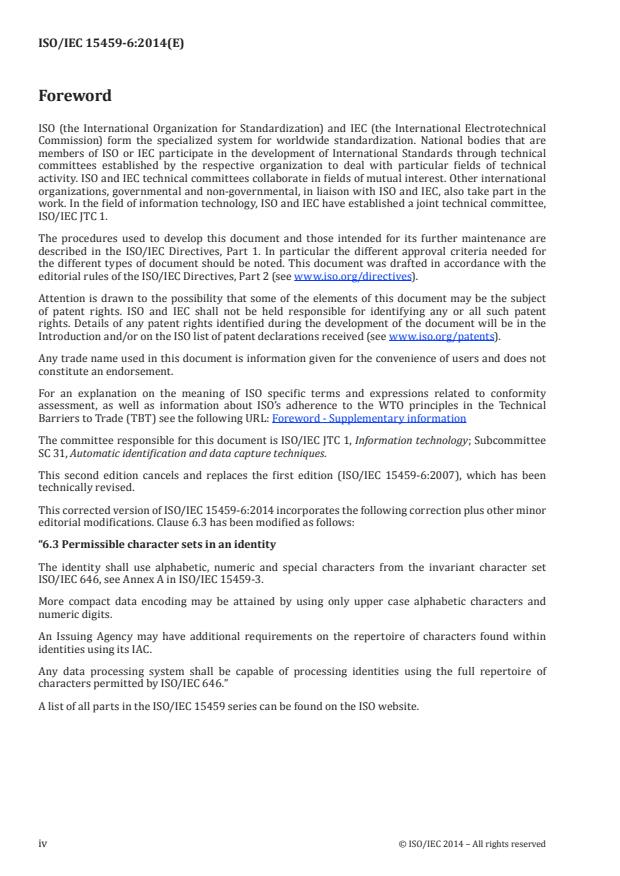
This corrected version of ISO/IEC 15459-6:2014 incorporates the following correction plus other minor
editorial modifications. Clause 6.3 has been modified as follows:
“6.3 Permissible character sets in an identity
The identity shall use alphabetic, numeric and special characters from the invariant character set
ISO/IEC 646, see Annex A in ISO/IEC 15459-3.
More compact data encoding may be attained by using only upper case alphabetic characters and
numeric digits.
An Issuing Agency may have additional requirements on the repertoire of characters found within
identities using its IAC.
Any data processing system shall be capable of processing identities using the full repertoire of
characters permitted by ISO/IEC 646.”
A list of all parts in the ISO/IEC 15459 series can be found on the ISO website.
iv © ISO/IEC 2014 – All rights reserved
Introduction
Unique identities can occur at many different levels, at item level, on the transport unit, on the
returnable transport item, at grouping levels, and elsewhere. Such entities are often handled by several
parties, both public and private, throughout their lifecycle. Each of these parties must be able to identify
and trace such distinct entities so that reference can be made to associated information such as quality
inspection data, the chemical substance contained, the batch or lot number of parts, components or raw
materials, etc.
The associated information is typically held in some kind of database. The information can be accessed
using EDI exchange or another appropriate access protocol, e.g. a directory access protocol.
There are considerable benefits if the identity of the entity is represented as a bar code or other AIDC
(Automatic Identification and Data Capture) media and attached to or made a constituent part of that
which is being uniquely identified so that
— it can be read electronically, thus minimizing errors;
— one identity can be used by all parties;
— each party can use the identity to look up its computer files to find the data associated with the entity.
All AIDC technologies have the potential to encode an identity. It is expected that application standards,
using various automatic identification technologies, will be developed based upon the identity as a prime
key. These application standards, which can include additional rules for which level of identification
should be used, are often made available from the Issuing Agency.
The identity for groupings of products, product packages, transport units and items defined in this
part of ISO/IEC 15459, and represented in AIDC media attached to the entities (e.g. raw material,
parts, transport units, finished goods, consumer products, assets, etc.), meets the needs defined in
ISO/IEC 15459-3, Common Rules.
© ISO/IEC 2014 – All rights reserved v
INTERNATIONAL STANDARD ISO/IEC 15459-6:2014(E)
Information technology — Automatic identification and
data capture techniques — Unique identification —
Part 6:
Groupings
1 Scope
This part of ISO/IEC 15459 specifies a unique string of characters for the identification of groupings
of products, product packages, transport units and items. The character string is intended to be
represented in a linear bar code symbol and two-dimensional symbol or other AIDC media attached
to the entity to meet management needs and/or regulatory needs (e.g. customs clearance). To address
these needs different types of identifiers are recognized in the various parts of ISO/IEC 15459, which
allows different requirements to be met by the unique identifiers associated within the context of the
specific parts of ISO/IEC 15459.
The unique identifiers for grouping or products, product packages, transport units and items enables
grouping by e.g. type, characteristics, order, manufacturing, quality, location, movement, etc. to be
uniquely identified. It is possible to use with other unique individual identifiers defined in other parts
of ISO/IEC 15459. Encoding these unique identifiers in a data carrier enables information about the
item processing to be clearly identified.
The identity for groupings is intended for “look-up” purposes, and cannot be directly used as an entity
identity in the strictest sense of the definition as used, for example, in ISO/IEC 15459-1, ISO/IEC 15459-
4, and ISO/IEC 15459-5.
2 Normative references
The following documents, in whole or in part, are normatively referenced in this document and are
indispensable for its application. For dated references, only the edition cited applies. For undated
references, the latest edition of the referenced document (including any amendments) applies.
ISO/IEC 646, Information technology — ISO 7-bit coded character set for information interchange
ISO/IEC 15459-1, Information technology — Automatic identification and data capture techniques —
Unique identification — Part 1: Individual transport units
ISO/IEC 15459-2, Information technology — Automatic identification and data capture techniques —
Unique identification — Part 2: Registration procedures
ISO/IEC 15459-3, Information technology — Automatic identification and data capture techniques —
Unique identification — Part 3: Common rules
ISO/IEC 15459-4, Information technology — Automatic identification and data capture techniques —
Unique identification — Part 4: Individual products and product packages
ISO/IEC 15459-5, Information technology — Automatic identification and data capture techniques —
Unique identification — Part 5: Individual returnable transport items (RTIs)
ISO/IEC 19762-1, Information technology — Automatic identification and data capture (AIDC)
techniques — Harmonized vocabulary — Part 1: General terms relating to AIDC
GS1 General Specifications
© ISO/IEC 2014 – All rights reserved 1
3 Terms and definitions
For the purposes of this document, the terms and definitions given in ISO/IEC 19762-1 and
ISO/IEC 15459-3 apply.
ISO and IEC maintain terminological databases for use in standardization at the following addresses:
— IEC Electropedia: available at http://www.electropedia.org/
— ISO Online browsing platform: available at http://www.iso.org/obp
4 Identities for individual entities
An individual instance of an entity is aptly identified by an identity that is different from any other
identity. The description of such a form of unique identification is described in ISO/IEC 15459-
1, ISO/IEC 15459-4 and ISO/IEC 15459-5. The provisions in ISO/IEC 15459-1, ISO/IEC 15459-4 or
ISO/IEC 15459-5 shall be used for individual entities.
Where unique identi
...
INTERNATIONAL ISO/IEC
STANDARD 15459-6
Second edition
2014-11-15
Corrected version
2016-09-01
Information technology — Automatic
identification and data capture
techniques — Unique identification —
Part 6:
Groupings
Technologies de l’information — Identification automatique et
techniques de capture de données — Identification unique —
Partie 6: Regroupements
Reference number
©
ISO/IEC 2014
© ISO/IEC 2014, Published in Switzerland
All rights reserved. Unless otherwise specified, no part of this publication may be reproduced or utilized otherwise in any form
or by any means, electronic or mechanical, including photocopying, or posting on the internet or an intranet, without prior
written permission. Permission can be requested from either ISO at the address below or ISO’s member body in the country of
the requester.
ISO copyright office
Ch. de Blandonnet 8 • CP 401
CH-1214 Vernier, Geneva, Switzerland
Tel. +41 22 749 01 11
Fax +41 22 749 09 47
copyright@iso.org
www.iso.org
ii © ISO/IEC 2014 – All rights reserved
Contents Page
Foreword .iv
Introduction .v
1 Scope . 1
2 Normative references . 1
3 Terms and definitions . 2
4 Identities for individual entities . 2
5 Identities for grouping of entities . 2
6 Identity for grouping of products, units and items . 2
6.1 General . 2
6.2 Maximum number of characters permissible in a unique identity. 3
6.3 Permissible character sets in an identity . 3
7 Implementation of coding using AIDC media . 3
Annex A (informative) Groupings . 4
Annex B (informative) Identities for groupings . 6
Annex C (informative) Use case for identities for groupings. 8
Bibliography .10
© ISO/IEC 2014 – All rights reserved iii
Foreword
ISO (the International Organization for Standardization) and IEC (the International Electrotechnical
Commission) form the specialized system for worldwide standardization. National bodies that are
members of ISO or IEC participate in the development of International Standards through technical
committees established by the respective organization to deal with particular fields of technical
activity. ISO and IEC technical committees collaborate in fields of mutual interest. Other international
organizations, governmental and non-governmental, in liaison with ISO and IEC, also take part in the
work. In the field of information technology, ISO and IEC have established a joint technical committee,
ISO/IEC JTC 1.
The procedures used to develop this document and those intended for its further maintenance are
described in the ISO/IEC Directives, Part 1. In particular the different approval criteria needed for
the different types of document should be noted. This document was drafted in accordance with the
editorial rules of the ISO/IEC Directives, Part 2 (see www.iso.org/directives).
Attention is drawn to the possibility that some of the elements of this document may be the subject
of patent rights. ISO and IEC shall not be held responsible for identifying any or all such patent
rights. Details of any patent rights identified during the development of the document will be in the
Introduction and/or on the ISO list of patent declarations received (see www.iso.org/patents).
Any trade name used in this document is information given for the convenience of users and does not
constitute an endorsement.
For an explanation on the meaning of ISO specific terms and expressions related to conformity
assessment, as well as information about ISO’s adherence to the WTO principles in the Technical
Barriers to Trade (TBT) see the following URL: Foreword - Supplementary information
The committee responsible for this document is ISO/IEC JTC 1, Information technology; Subcommittee
SC 31, Automatic identification and data capture techniques.
This second edition cancels and replaces the first edition (ISO/IEC 15459-6:2007), which has been
technically revised.
This corrected version of ISO/IEC 15459-6:2014 incorporates the following correction plus other minor
editorial modifications. Clause 6.3 has been modified as follows:
“6.3 Permissible character sets in an identity
The identity shall use alphabetic, numeric and special characters from the invariant character set
ISO/IEC 646, see Annex A in ISO/IEC 15459-3.
More compact data encoding may be attained by using only upper case alphabetic characters and
numeric digits.
An Issuing Agency may have additional requirements on the repertoire of characters found within
identities using its IAC.
Any data processing system shall be capable of processing identities using the full repertoire of
characters permitted by ISO/IEC 646.”
A list of all parts in the ISO/IEC 15459 series can be found on the ISO website.
iv © ISO/IEC 2014 – All rights reserved
Introduction
Unique identities can occur at many different levels, at item level, on the transport unit, on the
returnable transport item, at grouping levels, and elsewhere. Such entities are often handled by several
parties, both public and private, throughout their lifecycle. Each of these parties must be able to identify
and trace such distinct entities so that reference can be made to associated information such as quality
inspection data, the chemical substance contained, the batch or lot number of parts, components or raw
materials, etc.
The associated information is typically held in some kind of database. The information can be accessed
using EDI exchange or another appropriate access protocol, e.g. a directory access protocol.
There are considerable benefits if the identity of the entity is represented as a bar code or other AIDC
(Automatic Identification and Data Capture) media and attached to or made a constituent part of that
which is being uniquely identified so that
— it can be read electronically, thus minimizing errors;
— one identity can be used by all parties;
— each party can use the identity to look up its computer files to find the data associated with the entity.
All AIDC technologies have the potential to encode an identity. It is expected that application standards,
using various automatic identification technologies, will be developed based upon the identity as a prime
key. These application standards, which can include additional rules for which level of identification
should be used, are often made available from the Issuing Agency.
The identity for groupings of products, product packages, transport units and items defined in this
part of ISO/IEC 15459, and represented in AIDC media attached to the entities (e.g. raw material,
parts, transport units, finished goods, consumer products, assets, etc.), meets the needs defined in
ISO/IEC 15459-3, Common Rules.
© ISO/IEC 2014 – All rights reserved v
INTERNATIONAL STANDARD ISO/IEC 15459-6:2014(E)
Information technology — Automatic identification and
data capture techniques — Unique identification —
Part 6:
Groupings
1 Scope
This part of ISO/IEC 15459 specifies a unique string of characters for the identification of groupings
of products, product packages, transport units and items. The character string is intended to be
represented in a linear bar code symbol and two-dimensional symbol or other AIDC media attached
to the entity to meet management needs and/or regulatory needs (e.g. customs clearance). To address
these needs different types of identifiers are recognized in the various parts of ISO/IEC 15459, which
allows different requirements to be met by the unique identifiers associated within the context of the
specific parts of ISO/IEC 15459.
The unique identifiers for grouping or products, product packages, transport units and items enables
grouping by e.g. type, characteristics, order, manufacturing, quality, location, movement, etc. to be
uniquely identified. It is possible to use with other unique individual identifiers defined in other parts
of ISO/IEC 15459. Encoding these unique identifiers in a data carrier enables information about the
item processing to be clearly identified.
The identity for groupings is intended for “look-up” purposes, and cannot be directly used as an entity
identity in the strictest sense of the definition as used, for example, in ISO/IEC 15459-1, ISO/IEC 15459-
4, and ISO/IEC 15459-5.
2 Normative references
The following documents, in whole or in part, are normatively referenced in this document and are
indispensable for its application. For dated references, only the edition cited applies. For undated
references, the latest edition of the referenced document (including any amendments) applies.
ISO/IEC 646, Information technology — ISO 7-bit coded character set for information interchange
ISO/IEC 15459-1, Information technology — Automatic identification and data capture techniques —
Unique identification — Part 1: Individual transport units
ISO/IEC 15459-2, Information technology — Automatic identification and data capture techniques —
Unique identification — Part 2: Registration procedures
ISO/IEC 15459-3, Information technology — Automatic identification and data capture techniques —
Unique identification — Part 3: Common rules
ISO/IEC 15459-4, Information technology — Automatic identification and data capture techniques —
Unique identification — Part 4: Individual products and product packages
ISO/IEC 15459-5, Information technology — Automatic identification and data capture techniques —
Unique identification — Part 5: Individual returnable transport items (RTIs)
ISO/IEC 19762-1, Information technology — Automatic identification and data capture (AIDC)
techniques — Harmonized vocabulary — Part 1: General terms relating to AIDC
GS1 General Specifications
© ISO/IEC 2014 – All rights reserved 1
3 Terms and definitions
For the purposes of this document, the terms and definitions given in ISO/IEC 19762-1 and
ISO/IEC 15459-3 apply.
ISO and IEC maintain terminological databases for use in standardization at the following addresses:
— IEC Electropedia: available at http://www.electropedia.org/
— ISO Online browsing platform: available at http://www.iso.org/obp
4 Identities for individual entities
An individual instance of an entity is aptly identified by an identity that is different from any other
identity. The description of such a form of unique identification is described in ISO/IEC 15459-
1, ISO/IEC 15459-4 and ISO/IEC 15459-5. The provisions in ISO/IEC 15459-1, ISO/IEC 15459-4 or
ISO/IEC 15459-5 shall be used for individual entities.
Where unique identification for grouping of entities, which are not necessarily of the same type, is
required the provisions of Clause 5 and Clause 6 of this part of ISO/IEC 15459 shall be used.
5 Identities for grouping of entities
The grouping of entities for which the type, usage, quality, or delivery, etc. is considered the same could
be determined to be uniquely and distinctly identified and such a grouping should be unambiguously
identified by a qualifier and string as defined in Clause 6 so that groupings can be distinguished from
entities using other qualifiers.
The qualif
...