

SIST ISO/IEC 15459-2:2025
(Main)Information technology - Automatic identification and data capture techniques - Unique identification - Part 2: Registration procedures
General Information
- Abstract
ISO/IEC 15459-2:2015 specifies the procedural requirements to maintain identities and outlines the obligations of the Registration Authority and Issuing Agencies.
ISO/IEC 15459-2:2015 excludes those entities where ISO has designated Maintenance Agencies or Registration Authorities to provide identity and/or identifier schemes. It does not apply to:
freight containers, because their unique coding is specified in ISO 6346, Freight containers - Coding, identification and marking;
vehicles, because their unique identification is specified in ISO 3779, Road vehicles - Vehicle identification number (VIN) - Content and structure;
car radios, because their unique identification is specified in ISO 10486, Passenger cars - Car radio identification number (CRIN).
The exclusion also applies to ISO 2108, Information and documentation - International standard book number (ISBN), and ISO 3297, Information and documentation - International standard serial number (ISSN).
- Status
- Published
- Publication Date
- 14-May-2025
- Technical Committee
- ITC - Information technology
- Current Stage
- 6060 - National Implementation/Publication (Adopted Project)
- Start Date
- 06-May-2025
- Due Date
- 11-Jul-2025
- Completion Date
- 15-May-2025




Overview
ISO/IEC 15459-2:2015 - "Information technology - Automatic identification and data capture techniques - Unique identification - Part 2: Registration procedures" defines the procedural requirements for issuing and maintaining globally unique identities used with AIDC (automatic identification and data capture) technologies. The standard sets out the roles and obligations of the Registration Authority and Issuing Agencies, how Issuing Agency Codes (IACs) are requested and published, and the administrative processes that ensure consistent, interoperable unique identification across systems and organizations.
Key topics and requirements
- Scope and exclusions: Specifies registration procedures for unique identification but excludes schemes already governed by designated Maintenance Agencies or Registration Authorities. Explicit exclusions include freight containers (ISO 6346), vehicles (ISO 3779), car radios (ISO 10486), ISBN (ISO 2108) and ISSN (ISO 3297).
- Issuing Agency application process: Organizations must apply to the Registration Authority using the prescribed application form and comply with Registration Authority procedures to obtain an IAC.
- Registration Authority duties: Receive and process applications, maintain and publish a freely available IAC register (alphabetical in English), notify successful applicants, and maintain the Issuing Agency database.
- Issuing Agency Code (IAC) allocation rules:
- Characters allowed: upper-case A–Z and digits 0–9.
- IACs A–J: reserved for single-character allocations to multinational, not-for-profit organizations with broad issuer relationships.
- K: reserved for national public administrations and completed with ISO 3166-1 alpha-2 country code (applications require national endorsement).
- L–U: reserved for two-character IACs for organizations represented in multiple member countries.
- V–Z: reserved for three-character IACs for organizations with more limited representation.
- GS1: allocated the numeric block 0–9 exclusively.
- Normative references: Related technical vocabulary and common rules are referenced (e.g., ISO/IEC 15459-3 and ISO/IEC 19762-1).
Applications and who uses it
- Supply chain and logistics: Ensures entities (transport units, products, RTIs, groupings) have persistent unique identities for tracking, traceability and EDI integrations.
- Manufacturers and brand owners: Register Issuing Agency identities for serialized items and packaging.
- Standards bodies and registration authorities: Operate and publish the IAC register and oversee allocation procedures.
- Software and AIDC vendors: Implement identity schemes within barcode, RFID and database systems to support lookup and interoperability.
- Regulators and large enterprises: Adopt consistent identity governance for quality, safety and recall management.
Related standards
- ISO/IEC 15459 series (Parts 1, 3, 4, 5, 6)
- ISO/IEC 15459-3 (Common rules)
- ISO/IEC 19762-1 (AIDC vocabulary)
- ISO 6346, ISO 3779, ISO 10486, ISO 2108, ISO 3297 (noted exclusions)
- ISO 3166-1 (country codes)
- ISO/IEC 15418, GS1 General Specifications
Keywords: ISO/IEC 15459-2:2015, unique identification, registration procedures, Issuing Agency Code (IAC), Registration Authority, AIDC, automatic identification, data capture, supply chain traceability.
Relations
- Effective Date
- 17-Jun-2026
- Effective Date
- 20-Feb-2026
- Effective Date
- 09-Feb-2026
- Effective Date
- 09-Feb-2026
- Effective Date
- 09-Feb-2026
Get Certified
Connect with accredited certification bodies for this standard

BSI Group
BSI (British Standards Institution) is the business standards company that helps organizations make excellence a habit.

NYCE
Mexican standards and certification body.
Sponsored listings
Frequently Asked Questions
SIST ISO/IEC 15459-2:2025 is a standard published by the Slovenian Institute for Standardization (SIST). Its full title is "Information technology - Automatic identification and data capture techniques - Unique identification - Part 2: Registration procedures". This standard covers: ISO/IEC 15459-2:2015 specifies the procedural requirements to maintain identities and outlines the obligations of the Registration Authority and Issuing Agencies. ISO/IEC 15459-2:2015 excludes those entities where ISO has designated Maintenance Agencies or Registration Authorities to provide identity and/or identifier schemes. It does not apply to: freight containers, because their unique coding is specified in ISO 6346, Freight containers - Coding, identification and marking; vehicles, because their unique identification is specified in ISO 3779, Road vehicles - Vehicle identification number (VIN) - Content and structure; car radios, because their unique identification is specified in ISO 10486, Passenger cars - Car radio identification number (CRIN). The exclusion also applies to ISO 2108, Information and documentation - International standard book number (ISBN), and ISO 3297, Information and documentation - International standard serial number (ISSN).
ISO/IEC 15459-2:2015 specifies the procedural requirements to maintain identities and outlines the obligations of the Registration Authority and Issuing Agencies. ISO/IEC 15459-2:2015 excludes those entities where ISO has designated Maintenance Agencies or Registration Authorities to provide identity and/or identifier schemes. It does not apply to: freight containers, because their unique coding is specified in ISO 6346, Freight containers - Coding, identification and marking; vehicles, because their unique identification is specified in ISO 3779, Road vehicles - Vehicle identification number (VIN) - Content and structure; car radios, because their unique identification is specified in ISO 10486, Passenger cars - Car radio identification number (CRIN). The exclusion also applies to ISO 2108, Information and documentation - International standard book number (ISBN), and ISO 3297, Information and documentation - International standard serial number (ISSN).
SIST ISO/IEC 15459-2:2025 is classified under the following ICS (International Classification for Standards) categories: 35.040 - Information coding; 35.040.50 - Automatic identification and data capture techniques. The ICS classification helps identify the subject area and facilitates finding related standards.
SIST ISO/IEC 15459-2:2025 has the following relationships with other standards: It is inter standard links to SIST EN 18219:2026, SIST EN 62090:2018, SIST EN 17071:2019, SIST EN 17099:2020, SIST EN 17230:2021. Understanding these relationships helps ensure you are using the most current and applicable version of the standard.
SIST ISO/IEC 15459-2:2025 is available in PDF format for immediate download after purchase. The document can be added to your cart and obtained through the secure checkout process. Digital delivery ensures instant access to the complete standard document.
Standards Content (Sample)
SLOVENSKI STANDARD
01-junij-2025
Informacijska tehnologija - Tehnike za samodejno razpoznavanje in zajem
podatkov - Enotna identifikacija - 2. del: Postopki vpisa
Information technology — Automatic identification and data capture techniques —
Unique identification — Part 2: Registration procedures
Technologies de l'information — Identification automatique et techniques de capture de
données — Identification unique — Partie 2: Procédures d'enregistrement
Ta slovenski standard je istoveten z: ISO/IEC 15459-2:2015
ICS:
35.040.50 Tehnike za samodejno Automatic identification and
razpoznavanje in zajem data capture techniques
podatkov
2003-01.Slovenski inštitut za standardizacijo. Razmnoževanje celote ali delov tega standarda ni dovoljeno.
INTERNATIONAL ISO/IEC
STANDARD 15459-2
Third edition
2015-03-01
Information technology — Automatic
identification and data capture
techniques — Unique identification —
Part 2:
Registration procedures
Technologies de l’information — Identification automatique et
techniques de capture de données — Identification unique —
Partie 2: Procédures d’enregistrement
Reference number
©
ISO/IEC 2015
© ISO/IEC 2015
All rights reserved. Unless otherwise specified, no part of this publication may be reproduced or utilized otherwise in any form
or by any means, electronic or mechanical, including photocopying, or posting on the internet or an intranet, without prior
written permission. Permission can be requested from either ISO at the address below or ISO’s member body in the country of
the requester.
ISO copyright office
Case postale 56 • CH-1211 Geneva 20
Tel. + 41 22 749 01 11
Fax + 41 22 749 09 47
E-mail copyright@iso.org
Web www.iso.org
Published in Switzerland
ii © ISO/IEC 2015 – All rights reserved
Foreword .iv
Introduction .v
1 Scope . 1
2 Normative references . 1
3 Terms and definitions . 1
4 Issuing Agency . 2
5 Registration Authority . 2
6 Issuing Agency Code (IAC) allocation . 2
Bibliography . 4
© ISO/IEC 2015 – All rights reserved iii
Foreword
ISO (the International Organization for Standardization) and IEC (the International Electrotechnical
Commission) form the specialized system for worldwide standardization. National bodies that are
members of ISO or IEC participate in the development of International Standards through technical
committees established by the respective organization to deal with particular fields of technical
activity. ISO and IEC technical committees collaborate in fields of mutual interest. Other international
organizations, governmental and non-governmental, in liaison with ISO and IEC, also take part in the
work. In the field of information technology, ISO and IEC have established a joint technical committee,
ISO/IEC JTC 1.
The procedures used to develop this document and those intended for its further maintenance are
described in the ISO/IEC Directives, Part 1. In particular the different approval criteria needed for
the different types of document should be noted. This document was drafted in accordance with the
editorial rules of the ISO/IEC Directives, Part 2 (see www.iso.org/directives).
Attention is drawn to the possibility that some of the elements of this document may be the subject
of patent rights. ISO and IEC shall not be held responsible for identifying any or all such patent rights.
Details of any patent rights identified during the development of the document will be in the Introduction
and/or on the ISO list of patent declarations received (see www.iso.org/patents).
Any trade name used in this document is information given for the convenience of users and does not
constitute an endorsement.
For an explanation on the meaning of ISO specific terms and expressions related to conformity
assessment, as well as information about ISO’s adherence to the WTO principles in the Technical Barriers
to Trade (TBT) see the following URL: Foreword - Supplementary information
The committee responsible for this document is ISO/IEC JTC 1, Information technology, Subcommittee
SC 31, Automatic identification and data capture techniques.
This third edition cancels and replaces the second edition (ISO/IEC 15459-2:2006), which has been
technically revised.
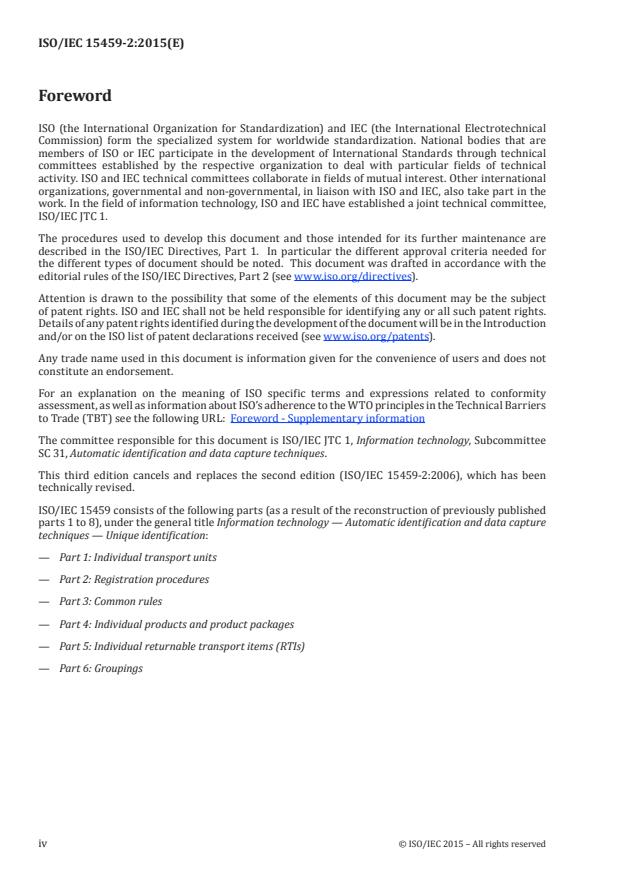
ISO/IEC 15459 consists of the following parts (as a result of the reconstruction of previously published
parts 1 to 8), under the general title Information technology — Automatic identification and data capture
techniques — Unique identification:
— Part 1: Individual transport units
— Part 2: Registration procedures
— Part 3: Common rules
— Part 4: Individual products and product packages
— Part 5: Individual returnable transport items (RTIs)
— Part 6: Groupings
iv © ISO/IEC 2015 – All rights reserved
Introduction
Unique identification can occur at many different levels, at item level, on the transport unit, on the
returnable transport item, at grouping levels, and elsewhere. Such entities are often handled by several
parties, both public and private, throughout their lifecycle. Each of these parties must be able to identify
and trace such distinct entities so that reference can be made to associated information such as quality
inspection data, the chemical substance contained, the batch or lot number of parts, components or raw
materials, etc.
The associated information is typically held in some kind of database. The information can be accessed
using EDI exchange or another appropriate access protocol, e.g. a directory access protocol.
There are considerable benefits if the identity of the entity is represented as a bar code or other AIDC
(Automatic Identification and Data Capture) media and attached to, or made a constituent part of, that
which is being uniquely identified so that:
— it can be read electronically, thus minimizing errors;
— one identity can be used by all parties;
— each party can use the identity to look up its computer files to find the data associated with the entity.
All AIDC technologies have the potential to encode an identity. It is expected that application standards,
using various automatic identification technologies, will be developed based upon the identity as a prime
key. These application standards, which can include additional rules for which level of identification
should be used, are often
...
INTERNATIONAL ISO/IEC
STANDARD 15459-2
Third edition
2015-03-01
Information technology — Automatic
identification and data capture
techniques — Unique identification —
Part 2:
Registration procedures
Technologies de l’information — Identification automatique et
techniques de capture de données — Identification unique —
Partie 2: Procédures d’enregistrement
Reference number
©
ISO/IEC 2015
© ISO/IEC 2015
All rights reserved. Unless otherwise specified, no part of this publication may be reproduced or utilized otherwise in any form
or by any means, electronic or mechanical, including photocopying, or posting on the internet or an intranet, without prior
written permission. Permission can be requested from either ISO at the address below or ISO’s member body in the country of
the requester.
ISO copyright office
Case postale 56 • CH-1211 Geneva 20
Tel. + 41 22 749 01 11
Fax + 41 22 749 09 47
E-mail copyright@iso.org
Web www.iso.org
Published in Switzerland
ii © ISO/IEC 2015 – All rights reserved
Foreword .iv
Introduction .v
1 Scope . 1
2 Normative references . 1
3 Terms and definitions . 1
4 Issuing Agency . 2
5 Registration Authority . 2
6 Issuing Agency Code (IAC) allocation . 2
Bibliography . 4
© ISO/IEC 2015 – All rights reserved iii
Foreword
ISO (the International Organization for Standardization) and IEC (the International Electrotechnical
Commission) form the specialized system for worldwide standardization. National bodies that are
members of ISO or IEC participate in the development of International Standards through technical
committees established by the respective organization to deal with particular fields of technical
activity. ISO and IEC technical committees collaborate in fields of mutual interest. Other international
organizations, governmental and non-governmental, in liaison with ISO and IEC, also take part in the
work. In the field of information technology, ISO and IEC have established a joint technical committee,
ISO/IEC JTC 1.
The procedures used to develop this document and those intended for its further maintenance are
described in the ISO/IEC Directives, Part 1. In particular the different approval criteria needed for
the different types of document should be noted. This document was drafted in accordance with the
editorial rules of the ISO/IEC Directives, Part 2 (see www.iso.org/directives).
Attention is drawn to the possibility that some of the elements of this document may be the subject
of patent rights. ISO and IEC shall not be held responsible for identifying any or all such patent rights.
Details of any patent rights identified during the development of the document will be in the Introduction
and/or on the ISO list of patent declarations received (see www.iso.org/patents).
Any trade name used in this document is information given for the convenience of users and does not
constitute an endorsement.
For an explanation on the meaning of ISO specific terms and expressions related to conformity
assessment, as well as information about ISO’s adherence to the WTO principles in the Technical Barriers
to Trade (TBT) see the following URL: Foreword - Supplementary information
The committee responsible for this document is ISO/IEC JTC 1, Information technology, Subcommittee
SC 31, Automatic identification and data capture techniques.
This third edition cancels and replaces the second edition (ISO/IEC 15459-2:2006), which has been
technically revised.
ISO/IEC 15459 consists of the following parts (as a result of the reconstruction of previously published
parts 1 to 8), under the general title Information technology — Automatic identification and data capture
techniques — Unique identification:
— Part 1: Individual transport units
— Part 2: Registration procedures
— Part 3: Common rules
— Part 4: Individual products and product packages
— Part 5: Individual returnable transport items (RTIs)
— Part 6: Groupings
iv © ISO/IEC 2015 – All rights reserved
Introduction
Unique identification can occur at many different levels, at item level, on the transport unit, on the
returnable transport item, at grouping levels, and elsewhere. Such entities are often handled by several
parties, both public and private, throughout their lifecycle. Each of these parties must be able to identify
and trace such distinct entities so that reference can be made to associated information such as quality
inspection data, the chemical substance contained, the batch or lot number of parts, components or raw
materials, etc.
The associated information is typically held in some kind of database. The information can be accessed
using EDI exchange or another appropriate access protocol, e.g. a directory access protocol.
There are considerable benefits if the identity of the entity is represented as a bar code or other AIDC
(Automatic Identification and Data Capture) media and attached to, or made a constituent part of, that
which is being uniquely identified so that:
— it can be read electronically, thus minimizing errors;
— one identity can be used by all parties;
— each party can use the identity to look up its computer files to find the data associated with the entity.
All AIDC technologies have the potential to encode an identity. It is expected that application standards,
using various automatic identification technologies, will be developed based upon the identity as a prime
key. These application standards, which can include additional rules for which level of identification
should be used, are often made available from the Issuing Agency.
The procedures and obligations needed to construct an identity to achieve unique identification of an
entity are defined in this part of ISO/IEC 15459.
© ISO/IEC 2015 – All rights reserved v
INTERNATIONAL STANDARD ISO/IEC 15459-2:2015(E)
Information technology — Automatic identification and
data capture techniques — Unique identification —
Part 2:
Registration procedures
1 Scope
This part of ISO/IEC 15459 specifies the
...