


SIST EN 115-2:2021
(Main)Safety of escalators and moving walks - Part 2: Rules for the improvement of safety of existing escalators and moving walks
Safety of escalators and moving walks - Part 2: Rules for the improvement of safety of existing escalators and moving walks
This document gives rules for improving the safety of existing escalators and moving walks with the aim of reaching an equivalent level of safety to that of a newly installed escalator and moving walk by the application of today’s state of the art for safety.
NOTE Due to situations such as the existing machine or building designs, it might not be possible in all cases to reach today’s state of the art for safety. Nevertheless, the objective is to improve the level of safety wherever possible.
This document includes the improvement of safety of existing escalators and moving walks for:
a) users;
b) maintenance and inspection personnel;
c) persons outside the escalator or moving walk (but in its immediate vicinity);
d) authorized persons.
This document is not applicable to:
1) safety during transport, installation, repairs and dismantling of escalators and moving walks;
2) spiral escalators;
3) accelerating moving walks.
However, this document can usefully be taken as a reference basis.
Sicherheit von Fahrtreppen und Fahrsteigen - Teil 2: Regeln für die Erhöhung der Sicherheit bestehender Fahrtreppen und Fahrsteige
Dieses Dokument enthält Regeln für die Verbesserung der Sicherheit bestehender Fahrtreppen und Fahrsteige mit dem Ziel, durch die Anwendung des heutigen Stands der Sicherheitstechnik eine zu neu errichteten Fahrtreppen und Fahrsteigen gleichwertige Sicherheit zu erreichen.
ANMERKUNG Aufgrund besonderer Situationen, wie z. B. einer bestehenden Anlage oder der Gebäudeausführung usw. kann es möglich sein, dass nicht immer der heutige Stand der Sicherheitstechnik erreicht wird. Das Ziel bleibt jedoch, das Sicherheitsniveau so weit wie möglich zu erhöhen.
Dieses Dokument beinhaltet die Verbesserung der Sicherheit von bestehenden Fahrtreppen und Fahrsteigen für:
a) Benutzer;
b) Instandhaltungs- und Überwachungspersonal;
c) Personen außerhalb der Fahrtreppe oder des Fahrsteigs (aber in deren unmittelbarer Umgebung);
d) befugte Personen.
Dieses Dokument ist nicht anwendbar auf:
1) die Sicherheit beim Transport, Einbau, Reparatur und Rückbau von Fahrtreppen und Fahrsteigen;
2) Bogenfahrtreppen;
3) Beschleunigungsfahrsteige.
Hierfür kann jedoch sachdienlich von diesem Dokument ausgegangen werden.
Sécurité des escaliers mécaniques et trottoirs roulants - Partie 2 : Règles pour l’amélioration de la sécurité des escaliers mécaniques et des trottoirs roulants existants
Le présent document fournit des règles pour améliorer la sécurité des escaliers mécaniques et trottoirs roulants existants dans le but d’atteindre un niveau de sécurité équivalent à celui des escaliers mécaniques et trottoirs roulants installés récemment, en fonction de l’état de l’art actuel en matière de sécurité.
NOTE En raison des situations dues à la conception des équipements ou des bâtiments existants, il peut ne pas être possible d’atteindre dans tous les cas l’état de l’art actuel en matière de sécurité. L’objectif est néanmoins d’améliorer le niveau de sécurité dans la mesure du possible.
Le présent document traite de l’amélioration de la sécurité des escaliers mécaniques et trottoirs roulants existants pour :
a) les usagers ;
b) le personnel de maintenance et d’inspection ;
c) les personnes non présentes sur l’escalier mécanique ou le trottoir roulant (mais se trouvant à proximité immédiate) ;
d) les personnes autorisées.
Le présent document ne s’applique pas :
1) à la sécurité lors du transport, de l’installation, de la réparation et du démontage des escaliers mécaniques et des trottoirs roulants ;
2) aux escaliers mécaniques en spirale ;
3) aux trottoirs roulants accélérés.
Le présent document peut toutefois servir de référence.
Varnost tekočih stopnic in trakov (stez) za osebe - 2. del: Pravila za izboljšanje varnosti obstoječih tekočih stopnic in trakov za osebe
General Information
- Status
- Published
- Public Enquiry End Date
- 30-Mar-2020
- Publication Date
- 17-Aug-2021
- Technical Committee
- DTN - Lift and transport appliances
- Current Stage
- 6060 - National Implementation/Publication (Adopted Project)
- Start Date
- 07-May-2021
- Due Date
- 12-Jul-2021
- Completion Date
- 18-Aug-2021
Relations
- Effective Date
- 05-May-2021
Overview
EN 115-2:2021 (CEN) - "Safety of escalators and moving walks - Part 2" provides rules for improving the safety of existing escalators and moving walks. Its objective is to progressively raise older installations to an equivalent level of safety as a newly installed unit by applying today’s state of the art for safety. The standard acknowledges practical constraints (building layout, machine age) and promotes risk‑based, stepwise upgrades where full compliance may not be possible.
Key topics and requirements
- Scope and exclusions: Applies to safety upgrades for users, maintenance and inspection personnel, bystanders and authorized staff. Not applicable to transport/installation/repairs/dismantling, spiral escalators or accelerating moving walks.
- Hazard identification and classification: Lists significant hazards and provides a risk‑based approach to prioritise improvements.
- Principal technical areas covered for improvement:
- Balustrade and skirting dimensions and protections
- Handrail system: profile, position and speed monitoring
- Steps, pallets and belts: integrity and guarding
- Drive units and braking systems
- Machinery spaces, driving/return stations and building interfaces
- Electrical installations and control systems: safety and protective functions
- Fire protection and signage for users
- Verification and implementation: Includes methods for national implementation (Annex A), a practical safety checklist for audits (Annex B) and guidance on prioritising high, medium and low risks.
- Documentation and use: Guidance for information for use, maintenance regimes and follow‑up risk assessments (ISO 14798 referenced for additional risk assessment methods).
Practical applications
- Use EN 115-2:2021 to:
- Audit existing escalators/moving walks and identify corrective actions.
- Plan phased safety upgrade programmes based on risk severity and frequency.
- Inform procurement decisions (retrofit vs replacement) and asset management strategies.
- Prepare technical specifications for modernization works (handrail improvements, braking upgrades, electrical safety).
- Typical users:
- Building owners and facility managers
- Lift/escalator maintenance companies and installers
- Inspection bodies and safety auditors
- Regulatory and municipal authorities setting retrofit programmes
Related standards
- EN 115-1:2017 (construction and installation) - core reference for state‑of‑the‑art requirements.
- EN 115 series (Parts 1, 2, 3, 4) and ISO 14798 (risk assessment guidance) are relevant for comprehensive compliance and risk evaluation.
EN 115-2:2021 is a practical, risk‑based roadmap for improving escalator and moving walk safety across older assets - essential for anyone responsible for safe operation, inspection or upgrade planning.

Frequently Asked Questions
SIST EN 115-2:2021 is a standard published by the Slovenian Institute for Standardization (SIST). Its full title is "Safety of escalators and moving walks - Part 2: Rules for the improvement of safety of existing escalators and moving walks". This standard covers: This document gives rules for improving the safety of existing escalators and moving walks with the aim of reaching an equivalent level of safety to that of a newly installed escalator and moving walk by the application of today’s state of the art for safety. NOTE Due to situations such as the existing machine or building designs, it might not be possible in all cases to reach today’s state of the art for safety. Nevertheless, the objective is to improve the level of safety wherever possible. This document includes the improvement of safety of existing escalators and moving walks for: a) users; b) maintenance and inspection personnel; c) persons outside the escalator or moving walk (but in its immediate vicinity); d) authorized persons. This document is not applicable to: 1) safety during transport, installation, repairs and dismantling of escalators and moving walks; 2) spiral escalators; 3) accelerating moving walks. However, this document can usefully be taken as a reference basis.
This document gives rules for improving the safety of existing escalators and moving walks with the aim of reaching an equivalent level of safety to that of a newly installed escalator and moving walk by the application of today’s state of the art for safety. NOTE Due to situations such as the existing machine or building designs, it might not be possible in all cases to reach today’s state of the art for safety. Nevertheless, the objective is to improve the level of safety wherever possible. This document includes the improvement of safety of existing escalators and moving walks for: a) users; b) maintenance and inspection personnel; c) persons outside the escalator or moving walk (but in its immediate vicinity); d) authorized persons. This document is not applicable to: 1) safety during transport, installation, repairs and dismantling of escalators and moving walks; 2) spiral escalators; 3) accelerating moving walks. However, this document can usefully be taken as a reference basis.
SIST EN 115-2:2021 is classified under the following ICS (International Classification for Standards) categories: 91.140.90 - Lifts. Escalators. The ICS classification helps identify the subject area and facilitates finding related standards.
SIST EN 115-2:2021 has the following relationships with other standards: It is inter standard links to SIST EN 115-2:2010. Understanding these relationships helps ensure you are using the most current and applicable version of the standard.
SIST EN 115-2:2021 is associated with the following European legislation: EU Directives/Regulations: 2006/42/EC; Standardization Mandates: M/396. When a standard is cited in the Official Journal of the European Union, products manufactured in conformity with it benefit from a presumption of conformity with the essential requirements of the corresponding EU directive or regulation.
SIST EN 115-2:2021 is available in PDF format for immediate download after purchase. The document can be added to your cart and obtained through the secure checkout process. Digital delivery ensures instant access to the complete standard document.
Standards Content (Sample)
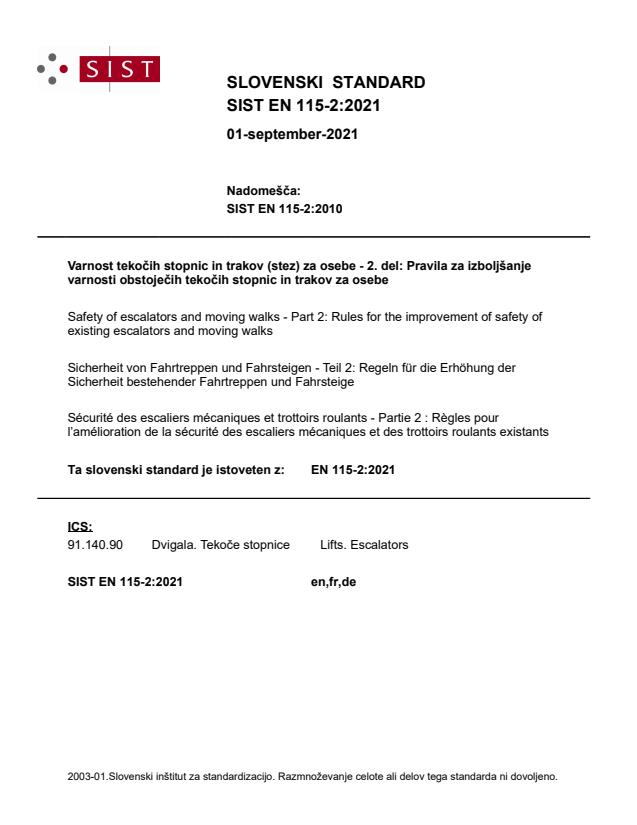
SLOVENSKI STANDARD
01-september-2021
Nadomešča:
SIST EN 115-2:2010
Varnost tekočih stopnic in trakov (stez) za osebe - 2. del: Pravila za izboljšanje
varnosti obstoječih tekočih stopnic in trakov za osebe
Safety of escalators and moving walks - Part 2: Rules for the improvement of safety of
existing escalators and moving walks
Sicherheit von Fahrtreppen und Fahrsteigen - Teil 2: Regeln für die Erhöhung der
Sicherheit bestehender Fahrtreppen und Fahrsteige
Sécurité des escaliers mécaniques et trottoirs roulants - Partie 2 : Règles pour
l’amélioration de la sécurité des escaliers mécaniques et des trottoirs roulants existants
Ta slovenski standard je istoveten z: EN 115-2:2021
ICS:
91.140.90 Dvigala. Tekoče stopnice Lifts. Escalators
2003-01.Slovenski inštitut za standardizacijo. Razmnoževanje celote ali delov tega standarda ni dovoljeno.
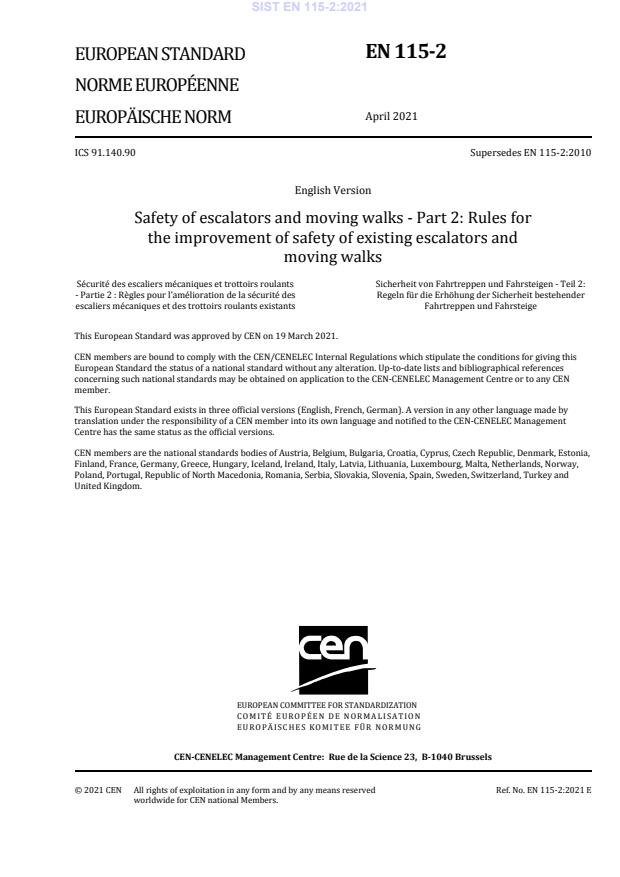
EN 115-2
EUROPEAN STANDARD
NORME EUROPÉENNE
April 2021
EUROPÄISCHE NORM
ICS 91.140.90 Supersedes EN 115-2:2010
English Version
Safety of escalators and moving walks - Part 2: Rules for
the improvement of safety of existing escalators and
moving walks
Sécurité des escaliers mécaniques et trottoirs roulants Sicherheit von Fahrtreppen und Fahrsteigen - Teil 2:
- Partie 2 : Règles pour l'amélioration de la sécurité des Regeln für die Erhöhung der Sicherheit bestehender
escaliers mécaniques et des trottoirs roulants existants Fahrtreppen und Fahrsteige
This European Standard was approved by CEN on 19 March 2021.
CEN members are bound to comply with the CEN/CENELEC Internal Regulations which stipulate the conditions for giving this
European Standard the status of a national standard without any alteration. Up-to-date lists and bibliographical references
concerning such national standards may be obtained on application to the CEN-CENELEC Management Centre or to any CEN
member.
This European Standard exists in three official versions (English, French, German). A version in any other language made by
translation under the responsibility of a CEN member into its own language and notified to the CEN-CENELEC Management
Centre has the same status as the official versions.
CEN members are the national standards bodies of Austria, Belgium, Bulgaria, Croatia, Cyprus, Czech Republic, Denmark, Estonia,
Finland, France, Germany, Greece, Hungary, Iceland, Ireland, Italy, Latvia, Lithuania, Luxembourg, Malta, Netherlands, Norway,
Poland, Portugal, Republic of North Macedonia, Romania, Serbia, Slovakia, Slovenia, Spain, Sweden, Switzerland, Turkey and
United Kingdom.
EUROPEAN COMMITTEE FOR STANDARDIZATION
COMITÉ EUROPÉEN DE NORMALISATION
EUROPÄISCHES KOMITEE FÜR NORMUNG
CEN-CENELEC Management Centre: Rue de la Science 23, B-1040 Brussels
© 2021 CEN All rights of exploitation in any form and by any means reserved Ref. No. EN 115-2:2021 E
worldwide for CEN national Members.
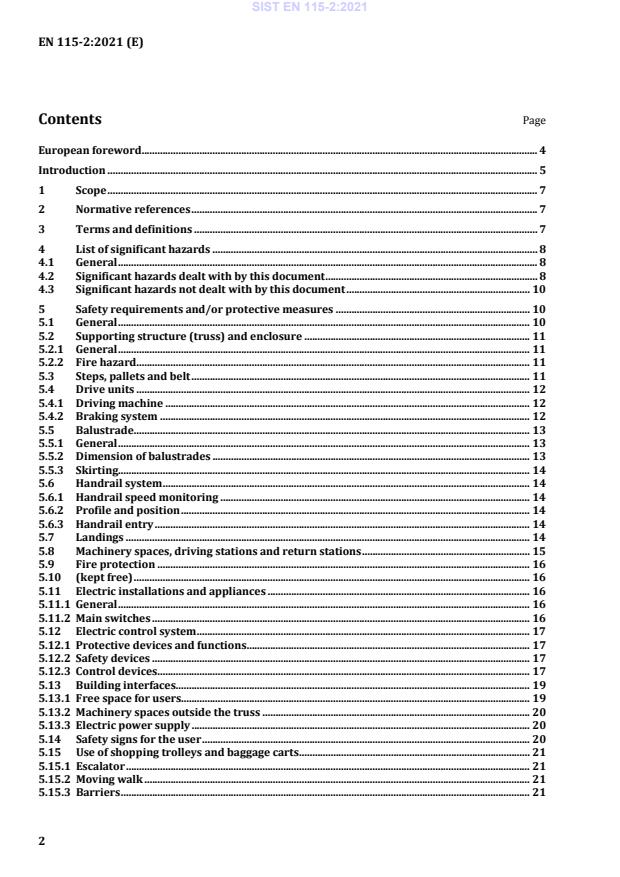
Contents Page
European foreword . 4
Introduction . 5
1 Scope . 7
2 Normative references . 7
3 Terms and definitions . 7
4 List of significant hazards . 8
4.1 General . 8
4.2 Significant hazards dealt with by this document . 8
4.3 Significant hazards not dealt with by this document . 10
5 Safety requirements and/or protective measures . 10
5.1 General . 10
5.2 Supporting structure (truss) and enclosure . 11
5.2.1 General . 11
5.2.2 Fire hazard . 11
5.3 Steps, pallets and belt . 11
5.4 Drive units . 12
5.4.1 Driving machine . 12
5.4.2 Braking system . 12
5.5 Balustrade . 13
5.5.1 General . 13
5.5.2 Dimension of balustrades . 13
5.5.3 Skirting. 14
5.6 Handrail system . 14
5.6.1 Handrail speed monitoring . 14
5.6.2 Profile and position . 14
5.6.3 Handrail entry . 14
5.7 Landings . 14
5.8 Machinery spaces, driving stations and return stations . 15
5.9 Fire protection . 16
5.10 (kept free) . 16
5.11 Electric installations and appliances . 16
5.11.1 General . 16
5.11.2 Main switches . 16
5.12 Electric control system . 17
5.12.1 Protective devices and functions . 17
5.12.2 Safety devices . 17
5.12.3 Control devices . 17
5.13 Building interfaces. 19
5.13.1 Free space for users. 19
5.13.2 Machinery spaces outside the truss . 20
5.13.3 Electric power supply . 20
5.14 Safety signs for the user . 20
5.15 Use of shopping trolleys and baggage carts . 21
5.15.1 Escalator . 21
5.15.2 Moving walk . 21
5.15.3 Barriers . 21
6 Verification and improvement measures . 21
7 Information for use . 21
Annex A (informative) Method for national implementation of EN 115-2 . 22
A.1 General . 22
A.2 Identification of hazardous situations . 22
A.3 Evaluation of hazardous situations . 22
A.4 Classification of priority levels . 24
Annex B (informative) Safety check list for existing escalators and moving walks . 26
Bibliography . 34
European foreword
This document (EN 115-2:2021) has been prepared by Technical Committee CEN/TC 10 “Lifts, escalators
and moving walks”, the secretariat of which is held by AFNOR.
This European Standard shall be given the status of a national standard, either by publication of an
identical text or by endorsement, at the latest by October 2021, and conflicting national standards shall
be withdrawn at the latest by April 2023.
Attention is drawn to the possibility that some of the elements of this document may be the subject of
patent rights. CEN shall not be held responsible for identifying any or all such patent rights.
This document supersedes EN 115-2:2010.
The need for replacement was based on the following points:
a) EN 115-2:2010 was referring to EN 115-1:2008, which is superseded by EN 115-1:2017;
b) additional requirements based on EN 115-1:2017;
c) new structure for electric requirements with clauses for protective, safety and control devices and
functions.
The EN 115 series of standards consists of the following parts, under the general title Safety of escalators
and moving walks:
— Part 1: Construction and installation;
— Part 2: Rules for the improvement of safety of existing escalators and moving walks;
— Part 3: Correlation between EN 115-1:2008+A1:2010 and EN 115-1:2017;
— Part 4: Interpretations related to EN 115 family of standards.
According to the CEN-CENELEC Internal Regulations, the national standards organisations of the
following countries are bound to implement this European Standard: Austria, Belgium, Bulgaria, Croatia,
Cyprus, Czech Republic, Denmark, Estonia, Finland, France, Germany, Greece, Hungary, Iceland, Ireland,
Italy, Latvia, Lithuania, Luxembourg, Malta, Netherlands, Norway, Poland, Portugal, Republic of North
Macedonia, Romania, Serbia, Slovakia, Slovenia, Spain, Sweden, Switzerland, Turkey and the United
Kingdom.
Introduction
Background of this document
More than 136 500 escalators and moving walks are in use today in the European Union (EU) and
European free Trade Association (EFTA) and almost 50 % were installed more than 20 years ago.
However, this document compares the safety level of escalators and moving walks installed after 1970
with those within EN 115-1:2017. This recognizes that the first attempt to have a common standard for
escalators and moving walks was the CIRA Recommendation 28 [1]. Escalators and moving walks were
installed to the safety level appropriate at that time. This level is less than today’s state of the art for
safety.
New technologies and social expectations have led to today's state of the art for safety. This has led to the
situation today of different levels of safety across Europe causing accidents. However, users and
authorized persons expect a common acceptable level of safety.
Furthermore, the life cycle of escalators and moving walks is longer than most other transportation
systems and building equipment, which therefore means that the design, performance and safety can fall
behind modern technologies. If all existing escalators and moving walks are not upgraded to today's state
of the art of safety the number of injuries will increase (especially in areas which can be accessed by the
general public, recognizing the change of behaviour and changing attitudes towards safety in general). If
escalators or moving walks were installed before 1970 on the base of manufacturer's and national
standards or were installed after 1970 but not in accordance with CIRA Recommendation 28, then they
should be the subject of a separate risk assessment in addition to the recommendations of this document
to determine whether a safety upgrade or a full replacement is appropriate.
Approach of this document
This document:
— categorizes various hazards and hazardous situations, each of which has been analysed by a risk
assessment (see in particular Annex A);
— is intended to provide corrective actions to progressively and selectively improve, step by step, the
safety of all existing escalators and moving walks towards today’s state of the art for safety (see
Clause 5);
— enables each escalator and moving walk to be audited and safety measures to be identified and
implemented in a step by step and selective fashion according to the frequency and severity of any
single risk (see Table B.2);
— lists the high, medium and low risks and corrective actions which can be applied in separate steps in
order to mitigate the risks (see Table B.2).
Use of this document
This document can be used as a guideline for:
a) national authorities to determine its own programme of implementation in a step by step process via
a filtering process (see Annex A) in a reasonable and practicable way based on the level of risk (e.g.
high, medium, low) and social and economic considerations;
b) owners to follow their responsibilities according to existing regulations (e.g. use of Work Equipment
Directive);
c) maintenance companies and/or inspection bodies to inform the owners on the safety level of their
installations;
d) owners to upgrade the existing escalator or moving walk on a voluntary basis in accordance with c)
if no regulations exist.
In making an audit of an existing escalator or moving walk installation Annex B can be used to identify
the hazards and corrective actions in this document. However, where a hazardous situation is identified
which is not covered in this document a separate risk assessment should be made. This risk assessment
should be based on ISO 14798 [4].
The need for replacement was based on the revision of EN 115-1, which was published in 2017.
“Reasonable and practicable” is defined as follows: “In deciding what is reasonably practicable the seriousness
of a risk to injury should be weighted against the difficulty and cost of removing or reducing that risk. Where
the difficulty and costs are high, and a careful assessment of the risk shows it to be comparatively unimportant,
action may not need to be taken. On the other hand where the risk is high, action should be taken at whatever
cost.”.
1 Scope
This document gives rules for improving the safety of existing escalators and moving walks with the aim
of reaching an equivalent level of safety to that of a newly installed escalator and moving walk by the
application of today’s state of the art for safety.
NOTE Due to situations such as the existing machine or building designs, it might not be possible in all cases to
reach today’s state of the art for safety. Nevertheless, the objective is to improve the level of safety wherever
possible.
This document includes the improvement of safety of existing escalators and moving walks for:
a) users;
b) maintenance and inspection personnel;
c) persons outside the escalator or moving walk (but in its immediate vicinity);
d) authorized persons.
This document is not applicable to:
1) safety during transport, installation, repairs and dismantling of escalators and moving walks;
2) spiral escalators;
3) accelerating moving walks.
However, this document can usefully be taken as a reference basis.
2 Normative references
The following documents are referred to in the text in such a way that some or all of their content
constitutes requirements of this document. For dated references, only the edition cited applies. For
undated references, the latest edition of the referenced document (including any amendments) applies.
EN 115-1:2017, Safety of escalators and moving walks — Part 1: Construction and installation
EN 13015:2001+A1:2008, Maintenance for lifts and escalators — Rules for maintenance instructions
EN 60204-1:2018, Safety of machinery — Electrical equipment of machines — Part 1: General
requirements
EN ISO 12100:2010, Safety of machinery — general principles for design — Risk assessment and risk
reduction (ISO 12100:2010)
3 Terms and definitions
For the purposes of this document, the terms and definitions given in EN ISO 12100:2010, EN 115-1:2017
and the following apply.
ISO and IEC maintain terminological databases for use in standardization at the following addresses:
— IEC Electropedia: available at https://www.electropedia.org/
— ISO Online browsing platform: available at https://www.iso.org/obp
3.1
authorized person
suitably trained person with authorization to access restricted areas of escalators and moving walks (e.g.
machinery spaces, separate machine rooms) and to work there, for the purpose of inspection, testing and
maintenance
3.2
existing escalator or moving walk
escalator or moving walk which is in service at the disposal of its owner
3.3
owner of the installation
natural or legal person who has the power of disposal of the installation and takes the responsibility for
its operation and use
4 List of significant hazards
4.1 General
This clause contains all the significant hazards, hazardous situations and events, as far as they are dealt
with in this document, identified by risk assessments as significant for existing escalators and moving
walks and which require action to eliminate or reduce the risk.
4.2 Significant hazards dealt with by this document
Table 1 below contains a list of significant hazards including their priority levels and relevant clauses of
the present document.
Table 1 — List of significant hazards
Nr. Hazard/hazardous situation Priority Relevant clause
level of EN 115-2
1 Effect of harmful materials (e.g. asbestos) H 5.1
2 Contact with moving machinery parts (e.g. driving unit, M 5.2.1, 5.4.1, 5.12.2,
handrail drive, step or pallet) normally not accessible to the 5.13.2.1, 5.12.3.2
public
3 Fire inside the supporting structure and machinery spaces M 5.2.2, 5.9
4 Slipping on steps/pallets/belt and landing areas H 5.3.1, 5.7.1
5 Falling due to insufficient step demarcation M 5.3.2
6 Trapping between skirting and steps H 5.3.3, 5.5.3
7 Trapping between step and step or pallet and pallet H 5.3.4
8 Missing steps or pallets H 5.3.5
9 Collision between fixed and moving parts of the M 5.3.6
step/pallet/belt system
10 Uncontrolled movement or a failure to stop of the machine H 5.4.1, 5.4.2.1
resulting from missing second independent main contactor
11 Excessive speed and unintended reversal of direction M 5.4.2.1.1, 5.4.2.1.2,
5.4.2.2
12 Effect of excessive stopping distance L 5.4.2.1.4
Nr. Hazard/hazardous situation Priority Relevant clause
level of EN 115-2
13 Falling due to reduced stopping distance H 5.4.2.1.4
14 Falling over the balustrade M 5.5.2.1, 5.5.2.2
15 Falling resulting from sliding on the outside of the balustrade L 5.5.2.3
16 Climbing on the outside of the balustrade or falling from the H 5.5.2.3, 5.13.1.6
landing
17 Falling due to handrail speed deviation M 5.6.1
18 Crushing of fingers between handrail and balustrade H 5.6.2
19 Drawing-in at handrail entry into the balustrade H/M 5.6.3.1
20 Trapping at handrail entry (between handrail and floor) M 5.6.3.2
21 Trapping between comb and step/pallet H 5.7.2, 5.7.3
22 Trapping of users resulting from sagging of the step/pallet H 5.7.4
23 Miscellaneous equipment in workers' area not related to the M 5.8.1
installation
24 Insufficient space in workers' area H 5.8.2, 5.13.2.4,
5.13.2.5, 5.13.2.6
25 Injuries due to missing lifting equipment for heavy loads M 5.8.3
26.1 Missing lighting in the workers' area and access to it H 5.8.4
26.2 Inadequate lighting in the workers' area and access to it M 5.8.4, 5.13.2.2,
5.13.2.3
27.1 Missing stop device (working area) H 5.8.5
27.2 Inadequate stop device (working area) L 5.8.5
28 Contact of persons with live parts – Insufficient isolation H 5.11.1.2, 5.13.3
29 Contact of persons with live parts – Isolation failure H 5.11.1.3, 5.11.1.4,
5.13.3
30.1 Unsafe working conditions due to missing main switch H 5.11.2
30.2 Unsafe working conditions due to or inadequate main switch M 5.11.2
31 Electrostatic discharge from moving components L 5.12.1.3
32.1 Injuries due to missing stop devices for emergency situation H 5.12.3.1
32.2 Injuries due to inadequate stop devices for emergency M 5.12.3.1
situation
32.3 Injuries due to being unable to locate the stop devices for H 5.12.3.1
emergency situation
33 Impact on bodies caused by collision with building structures H 5.13.1.1, 5.13.1.2,
(wall, roof, criss-cross arrangement) 5.13.1.3
34 Crushing due to restricted circulation areas M 5.13.1.4
35 Crushing of persons resulting from traffic congestion on L 5.13.1.5
succeeding escalators or moving walks
36 Falling due to inadequate lighting at the landings M 5.13.1.7
Nr. Hazard/hazardous situation Priority Relevant clause
level of EN 115-2
37 Missing safety signs M 5.14
38.1 Missing devices resulting in misuse of escalators by H 5.15.1
transporting other items than persons (e.g. shopping trolleys
or baggage carts)
38.2 Inadequate devices to prevent use of trolleys or baggage carts M 5.15.1
on escalators
39 Crushing due to incompatible trolleys on moving walks L 5.15.2
Key
H high, M medium, L low
4.3 Significant hazards not dealt with by this document
— Environmental conditions including e.g. earthquake and flooding;
— electromagnetic interferences;
— shearing due to sharp edges on machinery;
— non-conformance with national building codes;
— fire in the building.
5 Safety requirements and/or protective measures
5.1 General
The following requirements and/or protective measures shall not be considered as the only possible
solution. Alternatives are permitted, provided they lead to an equivalent safety level.
A risk assessment shall be made on a case by case basis to identify hazards or hazardous situations not
covered in this document.
Where the requirements of this document cannot be met technically and a residual risk remains, or
cannot be avoided, the level of risk shall be reduced as far as it is practicable. When residual risk remains
the use of appropriate procedures such as signs, instructions and training should be considered.
Harmful materials such as asbestos in brake linings, contactor shields, cladding including machinery
spaces and separate machine rooms or control cabinet locations, etc. shall be replaced by materials which
ensure the same performance level.
These should be considered in relation to national requirements.
For specific requirements such as accessibility, the conditions in the building shall be assessed to
determine what is practical to be applied for escalators and moving walks.
If an escalator or moving walk has been upgraded by one of the measures described in this document, the
consequences to other parts of the escalator or moving walk shall be considered with special regard to
EN 115-1:2017.
5.2 Supporting structure (truss) and enclosure
5.2.1 General
All mechanically moving parts of the escalator or moving walk shall be completely enclosed within panels
or walls. Exempt from this are the accessible steps, the accessible pallets, the accessible belt and that part
of the handrail available for the user. Ventilation apertures in compliance with EN ISO 13857:2019,
Table 5 are permitted.
Exterior panels which are designed to be opened (e.g. for cleaning purposes), inspection covers and floor
plates shall be provided with an electric safety device according to EN 115-1:2017, Table 8 M). For
inspection covers and floor plates it shall only be possible to open them by a key or a tool suited for that
purpose.
If rooms behind inspection covers and floor plates can be entered, it shall be possible to open them from
the inside without a key or a tool even when locked.
It is permissible to omit an enclosure of the mechanically moving parts if other measures (such as rooms
with locked doors accessible to authorized personnel only) make a hazard to the public impossible.
5.2.2 Fire hazard
5.2.2.1 Accumulation of combustible material inside the truss due to the daily environmental
pollution can generate a fire hazard. Therefore, the inner part of the escalator/moving walk shall be
cleaned regularly.
5.2.2.2 Depending on the maintenance conditions, e.g. access, fire protection systems shall be
installed.
5.3 Steps, pallets and belt
5.3.1 Tread surfaces for escalators and moving walks shall provide a secure foothold taking into
consideration the operational and environmental conditions.
5.3.2 Demarcation (e.g. groove in the step tread) shall be provided to highlight at the landings the rear
edge of the steps.
5.3.3 The lateral displacement of the steps or pallets out of their guiding system shall not exceed 4 mm
at either side and 7 mm for the sum of clearances measured at both sides.
The vertical displacement shall not exceed 4 mm for steps and pallets and 6 mm for belts.
5.3.4 Clearances for steps with cleated risers and pallets with meshing front and rear edges shall not
exceed 6 mm between two consecutive steps or pallets in any usable position measured at the tread
surface.
Clearances for steps with plain risers and pallets without meshing shall not exceed 5 mm between two
consecutive steps or pallets in any usable position measured at the tread surface.
In the area of the transition curves of moving walks with meshed front edges and rear edges of the pallets,
this clearance is permitted to be increased to 8 mm.
5.3.5 A missing step/pallet shall be detected and the escalator/moving walk stopped before the gap
(resulting from the missing step/pallet) emerges from the comb. This shall be ensured by a device
according to EN 115-1:2017, Table 8 J), provided at each driving and return station.
5.3.6 The step/pallet chains and the belt shall be tensioned continuously. The escalator/moving walk
shall be stopped automatically before the tensioning device moves excessively (see EN 115-1:2017,
5.4.3.3 and Table 8 D) and E)). Springs working in tension are not permitted for the tensioning device.
When weights are used for tensioning they shall be safely retained should their suspension break.
5.4 Drive units
5.4.1 Driving machine
Stopping the escalator or moving walk by means of the electric safety devices shall be effected as follows:
The supply to the motor(s) shall be interrupted by at least two independent contactors, the contacts of
which shall be in series in the supply circuit of the motor(s). If, when the escalator or moving walk is
stopped, one of the main contacts of one of the contactors has not opened, restarting shall be prevented.
If a hand winding device is provided it shall be easily accessible and safe to operate. If the hand winding
device is removable an electric safety device (EN 115-1:2017, Table 8 O)) shall be actuated when or
before the hand winding device is put on the machine. Crank handles or perforate hand wheels are not
permitted.
5.4.2 Braking system
5.4.2.1 Operational brake
The interruption of the electricity supply to the operational brake shall be effected by at least two
independent electric devices. They can be those which break the supply to the motor(s). If after the stop
of the escalator or moving walk one of these electric devices has not opened, restarting shall be prevented.
5.4.2.1.1 If the design does not prevent excessive speed, escalators and moving walks shall be equipped
in such a way that they stop automatically before the speed exceeds a value of 1,2 times the nominal
speed. Where speed control devices are used for this purpose they shall have switched off the escalator
or moving walk before the speed exceeds a value of 1,2 times the nominal speed and shall be provided
with an electrical safety device in accordance with EN 115-1:2017, Table 8 A).
5.4.2.1.2 Escalators and inclined (α ≥ 6°) moving walks shall be equipped with an electrical safety
device in accordance with EN 115-1:2017, Table 8 B) in such a way that they stop automatically by the
time the steps and pallets or the belt change from the pre-set direction of travel.
5.4.2.1.3 A device shall be provided to monitor the lifting of the operational brake after starting the
escalator/moving walk (EN 115-1:2017, Table 8 K)).
5.4.2.1.4 Stopping distances for the escalator and moving walk
The stopping distances for unloaded upwards, unloaded downwards and loaded downwards escalators
shall be as indicated in Table 2.
Table 2 — Stopping distances for escalators
Nominal speed v Stopping distance between
0,50 m/s 0,20 m and 1,00 m
0,65 m/s 0,30 m and 1,30 m
0,75 m/s 0,40 m and 1,50 m
The stopping distances for unloaded upwards, unloaded downwards and loaded downward moving
inclined moving walks shall be as given in Table 3. This applies also for unloaded and loaded horizontal
moving walks in both directions.
Table 3 — Stopping distances for moving walks
Nominal speed v Stopping distance between
0,50 m/s 0,20 m and 1,00 m
0,65 m/s 0,30 m and 1,30 m
0,75 m/s 0,40 m and 1,50 m
0,90 m/s 0,55 m and 1,70 m
For intermediate and lower nominal speeds the stopping distances shall be interpolated.
The stopping distances shall be measured from the time the electric device for stopping is actuated.
5.4.2.2 Auxiliary brake
Escalators and inclined moving walks shall be equipped with auxiliary brake(s) if
a) the connection between the operational brake and the driving sprockets of the steps/pallets or the
drum of the belt is not accomplished by shafts, gear wheels, multiplex chains, or more than one single
chain, or
b) the operational brake is not an electro-mechanical brake, or
c) the rise exceeds 6 m.
The connection between the auxiliary brake and the driving sprockets of the steps/ pallets or the drum
of the belt shall be accomplished by shafts, gear wheels, multiplex chains or more than one single chain.
It is not permissible for the connection to comprise friction drives, i.e. clutches.
The auxiliary braking system shall be dimensioned in such a way that escalators and moving walks
travelling with brake load downward are brought to rest and maintained stationary. Upon operation of
auxiliary brakes it is not necessary to keep the stopping distances defined for the operational brake.
A device shall be provided to monitor the lifting of the auxiliary brake after starting the escalator/moving
walk in accordance with EN 115-1:2017, Table 8 C).
5.5 Balustrade
5.5.1 General
Balustrades shall be installed on each side of the escalator or moving walk.
5.5.2 Dimension of balustrades
5.5.2.1 In the inclined section the vertical height from step nose or pallet surface or belt surface to
top of the handrail shall be not less than 0,90 m and not exceed 1,10 m.
5.5.2.2 The lower inner decking and the interior panel shall have an angle of inclination of at least
25° to the horizontal. This does not apply to the horizontal part of the lower inner decking that directly
joins the interior panel.
5.5.2.3 Appropriate measures shall be taken to discourage people from climbing on the outsides of
the balustrade if there is a danger of people falling from them.
On escalators and moving walks devices shall be provided on the outer decking at a point
(1 000 ± 50) mm above the floor level where the bottom of the device intersects with the balustrade
decking and shall extend to a length of at least 1 000 mm parallel with the balustrade decking where no
stepping is possible. The device shall extend to at least a height in line with the top of the handrail.
Where handrail level balustrade deckings are provided between escalators/inclined moving walks and
adjacent walls, anti-slide devices shall be provided on the balustrade decking when the distance between
the structure of the building (wall) and the centreline of the handrail is greater than 300 mm, or, on
adjacent escalators/inclined moving walks when the distance between the centrelines of the handrails is
greater than 400 mm. These devices shall consist of objects fastened to the balustrade decking, no closer
than 100 mm to the handrail and spaced no greater than 1 800 mm apart. The height shall be not less
than 20 mm. The devices shall have no sharp corners or edges.
NOTE All dimensions detailed in 5.5.2.3 are illustrated in EN 115-1:2017, Figure 7.
5.5.3 Skirting
On escalators, the possibility of trapping between skirting and steps shall be minimized by the installation
of skirt deflectors in accordance with EN 115-1:2017, 5.5.3.4 c).
Where it is not practical to achieve the required distances between the underside of the rigid part of the
deflector device and the step nose line, then the maximum dimension shall be achieved without
protruding above the existing inner decking profile. The minimum dimension permissible is 8 mm
between the underside of the rigid part of the deflector device and the step nose line.
5.6 Handrail system
5.6.1 Handrail speed monitoring
A handrail speed monitoring device shall be provided in accordance with EN 115-1:2017, Table 8 L).
If this is not reasonably practicable, a movement detection device shall be installed and shall stop the
escalator or moving walk in the event of no hand rail movement within a time frame of 5 s to 15 s while
the step/pallet/belt is running.
5.6.2 Profile and position
The handrail profiles and their guides on the balustrades shall be formed or enclosed in such a way that
the possibility of pinching or trapping of fingers or hands is reduced.
The distance between the handrail profile and guide or cover profiles shall under no circumstances be
wider than 8 mm.
5.6.3 Handrail entry
5.6.3.1 At the point of entry of the handrail into the newel a guard shall be installed to protect against
pinching of fingers and hands.
An electric safety device in accordance with EN 115-1:2017, Table 8 H) shall be provided.
5.6.3.2 If extended newels are fitted they shall be of the correct profile in accordance with
EN 115-1:2017, 5.6.4.2 or appropriate guarding shall be fitted to prevent trapping.
5.7 Landings
5.7.1 The landing area of escalators and moving walks (i.e. comb plate and floor plate) shall have a
surface that provides a secure foothold for a minimum distance of 0,85 m measured from the root of the
comb teeth.
Exempt from this are the combs.
5.7.2 The combs shall have such a design that upon trapping of foreign bodies either their teeth deflect
and remain in mesh with the grooves of the steps, pallets or belt, or they break.
5.7.3 In the case of objects being trapped which are not dealt with by the means described in 5.7.2 and
in the case of comb/step/pallet impact the escalator or moving walk shall be stopped automatically.
5.7.4 If any part of the step or pallet is sagging so that meshing of the combs is no longer ensured a
safety device shall be provided to stop the escalator or moving walk. This safety device shall be arranged
before each transition curve at a sufficient distance before the comb intersection line to ensure that the
step or pallet which has sagged does not reach the comb intersection line. The safety device may be
applied at any point on the step or pallet and shall be in accordance with EN 115-1:2017, Table 8 I).
5.8 Machinery spaces, driving stations and return stations
5.8.1 These rooms/spaces shall be used only for accommodating the equipment necessary for the
operation and maintenance and inspection of the escalator or moving walk. Effective protection and
guards shall be provided for moving and rotating parts if they are accessible.
5.8.2 In all machinery spaces, especially in driving and return stations inside the truss, space with a
sufficiently large standing area shall be kept free from fixed parts of any kind. The size of the standing
area shall be at least 0,30 m and the smaller side shall be at least 0,50 m long.
It is permitted to occupy this standing area by permanently installed parts, provided that the
permanently installed parts are placed behind rounded corners of max. 0,25 m radius and at a height of
at least 0,12 m above the free standing area.
Where these minimum dimensions are not achievable and in order to minimize the risk, devices to detect
persons in a machinery space shall be provided (e.g. light beam). If a person is detected both normal and
inspection modes of operation shall be blocked. If no persons are detected along with an open floor plate
condition, operation only in the inspection mode shall be possible.
5.8.3 If the controller cabinet has to be moved or lifted for maintenance purposes, then suitable
attachments for lifting shall be provided.
5.8.4 Provisions for electric lighting in driving and return stations and machinery spaces inside the
truss shall be provided by one or more socket outlets in each of these places.
The light intensity shall be at least 200 Lux in working areas.
5.8.5 There shall be a stop device in the driving and return station.
Escalators and moving walks with the driving unit arranged between the user side of the step, pallet or
belt and the return line, or outside the return stations, shall have additional stop devices in the area of
the driving unit.
The operation of these stop devices shall cause the disconnection of the power supply from the driving
machine and allow the initiation of the braking sequence (acc. EN 115-1:2017, 5.12.3.5) to stop the
escalator or moving walk.
The stop devices shall be in accordance with EN 115-1:2017, Table 8 P).
When activated it shall prevent the escalator or moving walk from starting.
Specific case: A stop device need not be provided in a machinery space if a main switch according to
EN 115-1:2017, 5.11.3 is located therein.
5.9 Fire protection
Fire protection and building requirements differ from country to country and so far neither have been
harmonized. Therefore, this document cannot include specific requirements for fire protection and
building requirements.
5.10 (kept free)
5.11 Electric installations and appliances
5.11.1 General
5.11.1.1 Introduction
The following items address the common hazardous situations regarding the electrical installation.
However, there may be other specific hazardous situations, e.g. the existing wiring and connections; any
risks of electrical shock or bridging of a safety circuit. These shall be checked on a case by case basis using
a risk assessment when carrying out an audit to Annex B taking into account the regulations/standards
which existed at the time of the installation of the escalator or moving walk.
Escalators and moving walks shall comply with EN 60204-1 or the requirements of the national rules of
the country where they are installed.
5.11.1.2 Protection against direct contact
5.11.1.2.1 For protection against direct contact the requirements of EN 60204-1:2018, 6.2 shall apply.
5.11.1.2.2 If, after the opening of the main switch or switches of the escalator or moving walk, some
connection terminals remain live, they shall be clearly separated from terminals which are not live. If the
voltage exceeds 50 V, they shall be suitably marked.
In these instances the requirements of EN 60204-1:2018, 5.3.5 and 16.2 apply.
5.11.1.3 Voltage limit for control and safety circuits
For control and safety circuits, the value in direct current or the r.m.s. value in alternating current
between conductors or between conductors and earth shall not exceed 250 V.
5.11.1.4 Conductor for neutral and earth-continuity
The conductor for neutral and earth continuity shall be in accordance with EN 6020
...
Questions, Comments and Discussion
Ask us and Technical Secretary will try to provide an answer. You can facilitate discussion about the standard in here.
Loading comments...