


SIST EN 12457-2:2004
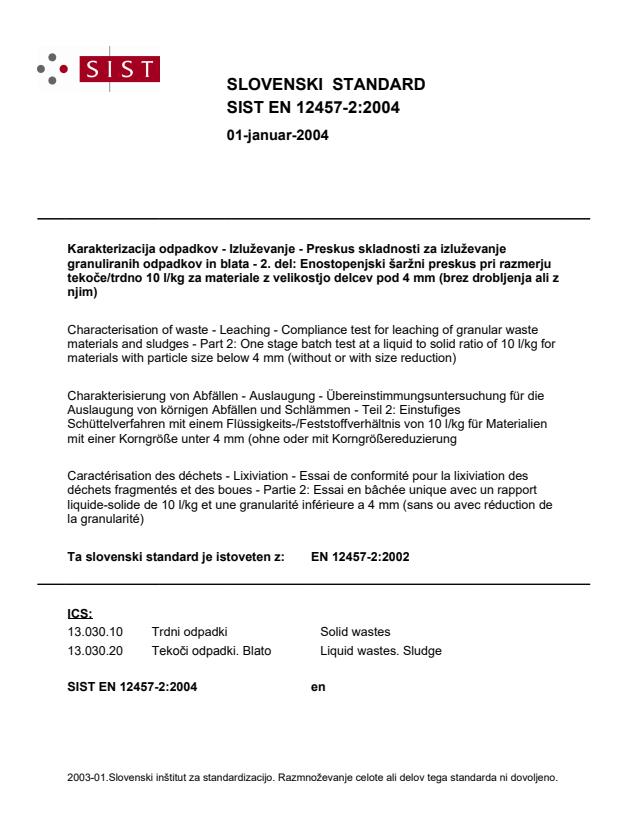
(Main)Characterisation of waste - Leaching - Compliance test for leaching of granular waste materials and sludges - Part 2: One stage batch test at a liquid to solid ratio of 10 l/kg for materials with particle size below 4 mm (without or with size reduction)
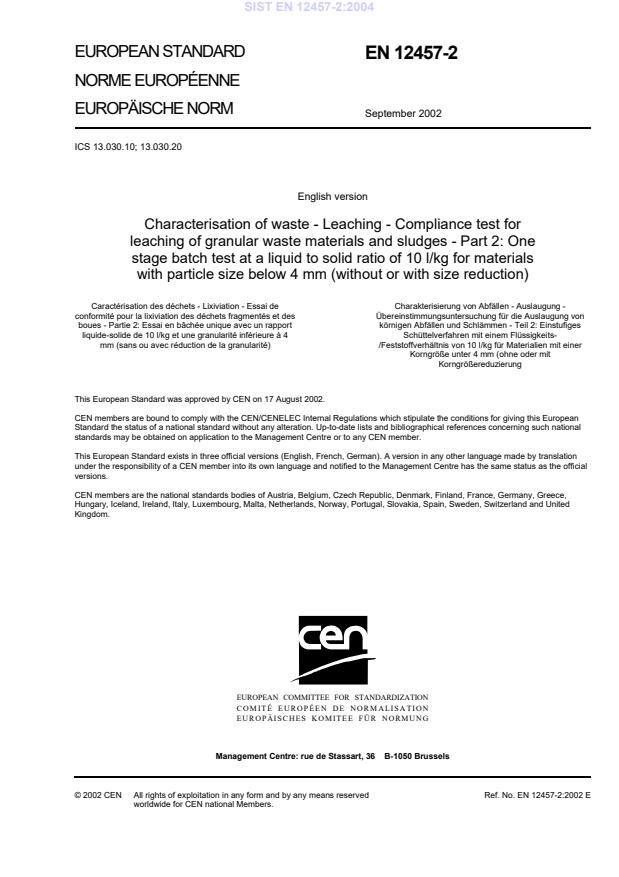
Characterisation of waste - Leaching - Compliance test for leaching of granular waste materials and sludges - Part 2: One stage batch test at a liquid to solid ratio of 10 l/kg for materials with particle size below 4 mm (without or with size reduction)
This part of the European Standard specifies a compliance test providing information on leaching of granular wastes and sludges under the experimental conditions specified hereafter, and particularly a liquid to solid ratio of 10 l/kg dry matter. It applies to waste which has a particle size below 4 mm without or with size reduction. The test procedure specified in this Standard produces an eluate which shall subsequently be characterised physically and chemically according to appropriate standard methods.
Charakterisierung von Abfällen - Auslaugung - Übereinstimmungsuntersuchung für die Auslaugung von körnigen Abfällen und Schlämmen - Teil 2: Einstufiges Schüttelverfahren mit einem Flüssigkeits-/Feststoffverhältnis von 10 l/kg für Materialien mit einer Korngröße unter 4 mm (ohne oder mit Korngrößereduzierung
Dieser Teil der Europäischen Norm legt eine Übereinstimmungsuntersuchung fest, die Informationen zur Auslaugung von körnigen Abfällen und Schlämmen unter den im Weiteren genannten experimentellen Bedingungen und insbesondere bei einem Flüssigkeits-/Feststoffverhältnis von 10 l/kg Trockenmasse liefert. Er gilt für Abfälle mit einer Korngröße unter 4 mm ohne oder mit Korngrößenreduzierung (wie in 4.3.2 angegeben).
Diese Europäische Norm wurde erstellt, um vorwiegend anorganische Bestandteile von Abfällen zu untersuchen. Sie berücksichtigt weder die besonderen Eigenschaften von nichtpolaren organischen Bestandteilen noch die Folgen von mikrobiologischen Prozessen in organischen abbaubaren Abfällen.
Durch das in der vorliegenden Norm beschriebene Prüfverfahren wird ein Eluat hergestellt, das anschließend physikalisch und chemisch nach den entsprechenden Standardmethoden charakterisiert wird.
ANMERKUNG 1 Dieses Verfahren kann nicht für Materialien mit einem Wassergehalt oder Wasseraufnahmevermögen angewendet werden, die eine gute Durchmischung des Feststoffes mit der vorher bestimmten Menge der Flüssigkeit nicht ermöglichen.
ANMERKUNG 2 Dieses Verfahren kann nicht für Materialien angewendet werden, die mit dem Auslaugungsmittel reagieren, was z. B. zu starken Gasemissionen, einer Verfestigungswirkung oder einer übermäßigen Wärmefreisetzung führen kann.
ANMERKUNG 3 Durch das Zerkleinern von Abfall werden neue Oberflächen freigesetzt, was zu einer Veränderung der Auslaugungseigenschaften führen kann.
Dieses Prüfverfahren ist allein nicht ausreichend, um für die Bestimmung des Auslaugungsverhaltens von Abfall, wie in ENV 12920:1998 festgelegt, verwendet zu werden.
Diese Europäische Norm befasst sich nicht mit sicherheitstechnischen und gesundheitlichen Belangen.
Caractérisation des déchets - Lixiviation - Essai de conformité pour la lixiviation des déchets fragmentés et des boues - Partie 2: Essai en bâchée unique avec un rapport liquide-solide de 10 l/kg et une granularité inférieure a 4 mm (sans ou avec réduction de la granularité)
La présente partie de la Norme européenne spécifie un essai de conformité fournissant des informations sur la lixiviation des déchets fragmentés et des boues dans les conditions expérimentales spécifiées ci après, et en particulier un rapport liquide solide de 10 l/kg de matière sèche. Cet essai s'applique aux déchets ayant une granularité inférieure à 4 mm sans ou avec réduction de la granularité (comme spécifié en 4.3.2).La présente Norme européenne a principalement été conçue pour étudier les constituants inorganiques des déchets. Elle ne tient pas compte des caractéristiques particulières des constituants organiques non polaires ni des conséquences de l'évolution microbiologique des déchets organiques dégradables.Le mode opératoire d'essai spécifié dans la présente Norme européenne permet d'obtenir un éluat qui doit ensuite être caractérisé du point de vue physique et chimique selon des méthodes normalisées appropriées.
NOTE 1 Ce mode opératoire ne peut pas être appliqué aux matières ayant une teneur en eau ou une affinité avec l'eau telle qu'il est impossible de bien mélanger le solide avec la quantité prédéterminée de liquide.
NOTE 2 Ce mode opératoire ne peut pas être appliqué aux matériaux réagissant avec le lixiviant, ce qui donnerait, par exemple, une émission gazeuse excessive, un effet de solidification ou à un dégagement de chaleur trop élevé.
NOTE 3 En fragmentant le matériau, de nouvelles surfaces sont exposées, ce qui peut conduire à un changement des propriétés de lixiviation.
Cet essai ne peut pas, à lui seul, être utilisé pour déterminer le comportement à la lixiviation d'un déchet, comme spécifié par l'ENV 12920.La présente Norme européenne ne traite pas des questions liées à la santé et à la sécurité.
Karakterizacija odpadkov - Izluževanje - Preskus skladnosti za izluževanje granuliranih odpadkov in blata - 2. del: Enostopenjski šaržni preskus pri razmerju tekoče/trdno 10 l/kg za materiale z velikostjo delcev pod 4 mm (brez drobljenja ali z njim)
General Information
- Status
- Published
- Publication Date
- 31-Dec-2003
- Technical Committee
- KAT - Soil quality
- Current Stage
- 6060 - National Implementation/Publication (Adopted Project)
- Start Date
- 01-Jan-2004
- Due Date
- 01-Jan-2004
- Completion Date
- 01-Jan-2004
- Directive
- 99/31/EC - Landfill of waste
Overview
EN 12457-2:2002 (CEN) is a European compliance standard for the characterisation of waste by leaching. It defines a one‑stage batch leaching test for granular waste materials and sludges using a liquid-to-solid (L/S) ratio of 10 l/kg (dry matter) for materials with particle size below 4 mm (with or without size reduction). The procedure produces an eluate that is then characterised by established physical and chemical analytical methods to assess leaching behaviour under the specified test conditions.
Key topics and technical requirements
- Test principle: single‑step batch contact of waste with water (leachant) under controlled conditions to reach equilibrium or near‑equilibrium between solid and liquid phases.
- L/S ratio: fixed at 10 l/kg (dry matter) for this part.
- Particle size: applicable to wastes with particles < 4 mm, either as sampled or after defined size reduction.
- Sample preparation: sampling strategy, laboratory and test sample definitions, and pre-treatment are specified to ensure representativity.
- Separation and analysis: solid and liquid phases are separated (filtration); the eluate is analysed physically and chemically using referenced analytical methods (e.g., ENV 12506, ENV 13370, EN 12880, ISO 11465).
- Quality assurance: blank tests, documentation, calculations, and performance characteristics (validation and precision) are covered.
- Scope & limitations:
- Primarily developed for inorganic constituents.
- Not designed for non‑polar organic compounds or to account for microbiological degradation processes.
- Not suitable for materials that are liquid by definition, react violently with the leachant, solidify, emit excessive gas, or generate excessive heat.
- Crushing/size reduction may expose fresh surfaces and change leaching behaviour; this is noted in the standard.
Practical applications
- Regulatory compliance: assessing whether waste meets leaching-based acceptance criteria for disposal or reuse.
- Waste classification: supporting decisions on landfill acceptance, recovery or reuse routes.
- Environmental monitoring & risk assessment: providing eluate data for contaminant mobility evaluations.
- Quality control: checking consistency of treated wastes or residues from industrial processes and waste treatment plants.
Who uses this standard
- Environmental testing laboratories and accredited analytical facilities
- Waste management companies and landfill operators
- Environmental consultants and engineers
- Regulatory authorities and compliance auditors
- Research organisations studying contaminant release from wastes
Related standards
- EN 12457 series: Part 1, Part 3, Part 4 (other L/S ratios and particle sizes)
- ENV 12920 (basic characterisation methodology)
- ENV 12506, ENV 13370 (eluate analysis methods)
- EN 12880, ISO 11465 (water/dry matter determination)
Keywords: EN 12457-2:2002, characterisation of waste, leaching test, compliance test, one stage batch test, L/S 10 l/kg, granular waste, sludges, eluate analysis, CEN.

Frequently Asked Questions
SIST EN 12457-2:2004 is a standard published by the Slovenian Institute for Standardization (SIST). Its full title is "Characterisation of waste - Leaching - Compliance test for leaching of granular waste materials and sludges - Part 2: One stage batch test at a liquid to solid ratio of 10 l/kg for materials with particle size below 4 mm (without or with size reduction)". This standard covers: This part of the European Standard specifies a compliance test providing information on leaching of granular wastes and sludges under the experimental conditions specified hereafter, and particularly a liquid to solid ratio of 10 l/kg dry matter. It applies to waste which has a particle size below 4 mm without or with size reduction. The test procedure specified in this Standard produces an eluate which shall subsequently be characterised physically and chemically according to appropriate standard methods.
This part of the European Standard specifies a compliance test providing information on leaching of granular wastes and sludges under the experimental conditions specified hereafter, and particularly a liquid to solid ratio of 10 l/kg dry matter. It applies to waste which has a particle size below 4 mm without or with size reduction. The test procedure specified in this Standard produces an eluate which shall subsequently be characterised physically and chemically according to appropriate standard methods.
SIST EN 12457-2:2004 is classified under the following ICS (International Classification for Standards) categories: 13.030.10 - Solid wastes; 13.030.20 - Liquid wastes. Sludge. The ICS classification helps identify the subject area and facilitates finding related standards.
SIST EN 12457-2:2004 is associated with the following European legislation: EU Directives/Regulations: 99/31/EC; Standardization Mandates: M/326. When a standard is cited in the Official Journal of the European Union, products manufactured in conformity with it benefit from a presumption of conformity with the essential requirements of the corresponding EU directive or regulation.
You can purchase SIST EN 12457-2:2004 directly from iTeh Standards. The document is available in PDF format and is delivered instantly after payment. Add the standard to your cart and complete the secure checkout process. iTeh Standards is an authorized distributor of SIST standards.
Standards Content (Sample)
2003-01.Slovenski inštitut za standardizacijo. Razmnoževanje celote ali delov tega standarda ni dovoljeno.OXåHYDQMHQMLPCharakterisierung von Abfällen - Auslaugung - Übereinstimmungsuntersuchung für die Auslaugung von körnigen Abfällen und Schlämmen - Teil 2: Einstufiges Schüttelverfahren mit einem Flüssigkeits-/Feststoffverhältnis von 10 l/kg für Materialien mit einer Korngröße unter 4 mm (ohne oder mit KorngrößereduzierungCaractérisation des déchets - Lixiviation - Essai de conformité pour la lixiviation des déchets fragmentés et des boues - Partie 2: Essai en bâchée unique avec un rapport liquide-solide de 10 l/kg et une granularité inférieure a 4 mm (sans ou avec réduction de la granularité)Characterisation of waste - Leaching - Compliance test for leaching of granular waste materials and sludges - Part 2: One stage batch test at a liquid to solid ratio of 10 l/kg for materials with particle size below 4 mm (without or with size reduction)13.030.20Liquid wastes. Sludge13.030.10Trdni odpadkiSolid wastesICS:Ta slovenski standard je istoveten z:EN 12457-2:2002SIST EN 12457-2:2004en01-januar-2004SIST EN 12457-2:2004SLOVENSKI
STANDARD
EUROPEAN STANDARDNORME EUROPÉENNEEUROPÄISCHE NORMEN 12457-2September 2002ICS 13.030.10; 13.030.20English versionCharacterisation of waste - Leaching - Compliance test forleaching of granular waste materials and sludges - Part 2: Onestage batch test at a liquid to solid ratio of 10 l/kg for materialswith particle size below 4 mm (without or with size reduction)Caractérisation des déchets - Lixiviation - Essai deconformité pour la lixiviation des déchets fragmentés et desboues - Partie 2: Essai en bâchée unique avec un rapportliquide-solide de 10 l/kg et une granularité inférieure à 4mm (sans ou avec réduction de la granularité)Charakterisierung von Abfällen - Auslaugung -Übereinstimmungsuntersuchung für die Auslaugung vonkörnigen Abfällen und Schlämmen - Teil 2: EinstufigesSchüttelverfahren mit einem Flüssigkeits-/Feststoffverhältnis von 10 l/kg für Materialien mit einerKorngröße unter 4 mm (ohne oder mitKorngrößereduzierungThis European Standard was approved by CEN on 17 August 2002.CEN members are bound to comply with the CEN/CENELEC Internal Regulations which stipulate the conditions for giving this EuropeanStandard the status of a national standard without any alteration. Up-to-date lists and bibliographical references concerning such nationalstandards may be obtained on application to the Management Centre or to any CEN member.This European Standard exists in three official versions (English, French, German). A version in any other language made by translationunder the responsibility of a CEN member into its own language and notified to the Management Centre has the same status as the officialversions.CEN members are the national standards bodies of Austria, Belgium, Czech Republic, Denmark, Finland, France, Germany, Greece,Hungary, Iceland, Ireland, Italy, Luxembourg, Malta, Netherlands, Norway, Portugal, Slovakia, Spain, Sweden, Switzerland and UnitedKingdom.EUROPEAN COMMITTEE FOR STANDARDIZATIONCOMITÉ EUROPÉEN DE NORMALISATIONEUROPÄISCHES KOMITEE FÜR NORMUNGManagement Centre: rue de Stassart, 36
B-1050 Brussels© 2002 CENAll rights of exploitation in any form and by any means reservedworldwide for CEN national Members.Ref. No. EN 12457-2:2002 ESIST EN 12457-2:2004
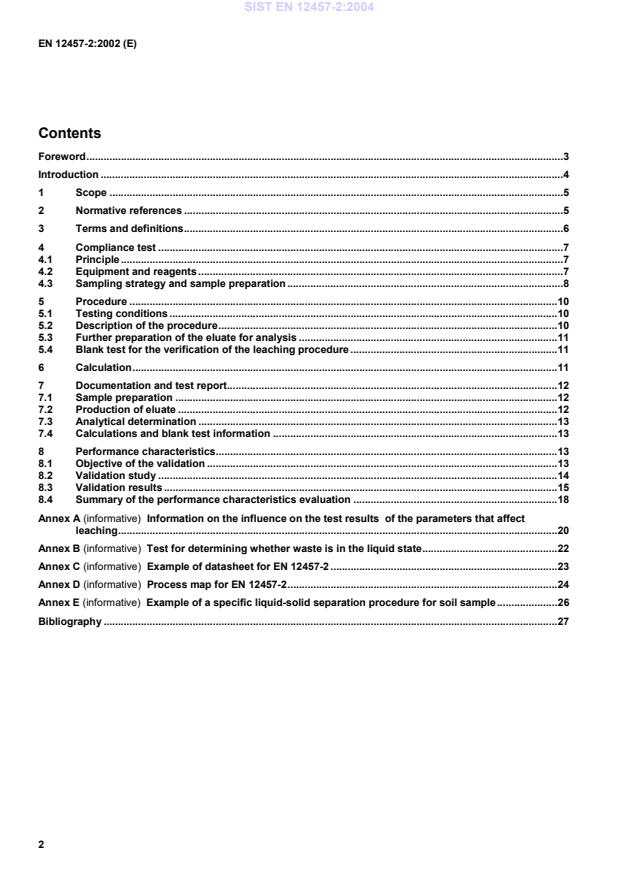
Information on the influence on the test results
of the parameters that affectleaching.20Annex B (informative)
Test for determining whether waste is in the liquid state.22Annex C (informative)
Example of datasheet for EN 12457-2.23Annex D (informative)
Process map for EN 12457-2.24Annex E (informative)
Example of a specific liquid-solid separation procedure for soil sample.26Bibliography.27SIST EN 12457-2:2004
The laboratorysample is the final sample from the point of view of sample collection but it is the initial sample from the point of view of thelaboratory.NOTE 2Several laboratory samples can be prepared and sent to different laboratories or to the same laboratory for differentpurposes.
When sent to the same laboratory, the set is generally considered as a single laboratory sample and is documentedas a single sample.3.14 test samplesample, prepared from the laboratory sample, from which test portions are removed for testing or for analysis( IUPAC definition )3.15 test portionamount or volume of the test sample taken for analysis, usually of known weight or volume ( IUPAC definition )4 Compliance test4.1 PrincipleThe sample material, which originally or after pre-treatment has a particle size below 4 mm as defined in 4.3.2, isbrought into contact with water (4.2.15) under defined conditions. This European Standard is based on theassumption that equilibrium or near-equilibrium is achieved between the liquid and solid phases during the testduration (see 5.2.1). The solid residue is separated by filtration. The properties of the eluate are measured usingmethods developed for water analysis adapted to meet criteria for analysis of eluates (ENV 12506, ENV 13370 andothers under development).After the test the leaching conditions in terms of pH, conductivity and optionally redox potential dictated by thewaste are recorded.NOTEThese parameters often control the leaching behaviour of wastes and are therefore important for checking theleaching test.4.2 Equipment and reagents4.2.1Glass or high density polyethylene(HDPE)/polypropylene(PP) bottles in accordance with EN ISO 5667-3,with a nominal volume of 1 litre, glass bottles having caps of inert material, for example PTFE(polytetrafluoroethylene). Rinsing is compulsory.NOTE 1For inorganic constituents HDPE/PP bottles are preferred, except for samples analysed for mercury.NOTE 2The volume of 1 litre is selected in combination with the mass MD of 90 gram as specified in 4.3.4 in order tominimise head space. In case of material with low density, deviation from this requirement can be necessary while stillattempting to minimise headspace. This deviation should be documented in the test report.4.2.2An end-over-end tumbler (5 rpm - 10 rpm) or roller-table inducing rotation of the bottle at about 10 rpm.SIST EN 12457-2:2004
5 °C according to ISO 11465 or for sludges according to EN 12880. Thisdetermination shall be made in parallel on a test portion different from the test portion for leaching. The dry mattercontent ratio is calculated as follows :DR = 100
MD/MW(1)whereDRis the dry matter content ratio (%) ;MDis the mass of the dried test portion (kg) ;Mwis the mass of undried test portion (kg).The moisture content ratio (MC in %) is calculated as follows :MC = 100
(MW - MD)/MD(2)NOTE 1The basis for the calculation of the moisture content is the mass of the dry residue in this European Standard, asspecified in ISO 11465 (for the determination of the water content of soil). It is to be noted that in EN 12880 (for thedetermination of water content of sludges), the water content is calculated on the basis of the raw mass.NOTE 2The above moisture content determination could be not accurate enough in some cases (e.g. large amount ofvolatile or unstable compounds). In such cases a direct determination of the true water content should be performed and themoisture content calculated accordingly.4.3.4 Preparation of test portionPrepare from the test sample a test portion with a total mass MW (measured with an accuracy of 0,1 g) containing0,090 kg
0,005 kg of dry mass (MD). Use a sample splitter (4.2.14) or apply coning and quartering to split thesample.MW = 100
MD/DR(3)SIST EN 12457-2:2004
5) °C.5.2 Description of the procedure5.2.1 Leaching step Place the test portion with the total mass Mw corresponding to 0,090 kg
0,005 kg of dry mass MD in a bottle(4.2.1). Add an amount of leachant (L) establishing a liquid to solid ratio (L/S) = 10 l/kg
2 % during the extraction.Care should be taken to obtain good mixing of solid and liquid.L = (10 – MC/100 )
MD(4)WhereLis the volume of leachant used (in l) ;MDis the dry mass of the test portion (in kg) ;MCis the moisture content ratio (in %). Place the capped bottle in an agitation device (4.2.2). Agitate for 24 h
0,5 h. During the extraction care should be taken to prevent settlement of solids in the bottle. Excessive abrasion leading to significant particle size reduction shall be avoided.NOTESome wastes generate gas when they are wetted. Examples are waste incineration fly ash and sand blasting wastewhich may contain metallic particles. If gas emission occurs, careful opening of the bottle a few times during the leaching canprevent too high pressure. Such opening should be documented in the test report.5.2.2 Liquid-solid separation step Allow the suspended solids to settle for 15 min
5 min. Filter the eluate almost completely over a 0,45 µm membrane filter using a vacuum or pressure filtration device(4.2.3). Rinsing of the filter with water or another solvent is not allowed after filtration.SIST EN 12457-2:2004
75 mS/cm) are leached, acidification of the eluatescan lead to precipitation of salts. This can be avoided by diluting such samples 5 to 10 times prior to acidification. This additionaldilution should be taken into account in the calculations. A quantity of the undiluted sample should be acidified and retained incase the 5 to 10 dilution takes the sample below the detection limit for some determinands. Such procedure should bedocumented in the test report.5.4 Blank test for the verification of the leaching procedureBlank tests shall be carried out. A 0,95 litre volume of leachant is submitted to the whole procedure (except thesieving step, the fragmentation step and the splitting step but including the eluate analysis step).The eluate of this blank test shall fulfill the following minimum requirements : in the eluate of the blank test, theconcentration of each considered element shall be less than 20 % of the concentration determined in the eluate ofthe tested waste or less than 20 % of the concentration in the eluate of a limit value to which the measurementresult is to be compared. The elements to be considered are all the elements which are to be determined in theeluate of the tested waste.If the above requirements are not fulfilled, it is necessary to reduce the contamination.The blank test results shall not be substracted from the results of the waste leaching test.NOTEThe above provisions for the blank test do not take into account the sieving step, the fragmentation step and thesplitting step. In order to minimise the possible contamination during these three steps, it is recommended to process a portionof the laboratory sample through the sieving device, the fragmentation device and through the splitting device before thepreparation of the test sample and to discard such material thereafter. This provision does not cover the situation described inthe notes under 4.2.5 and 4.2.6.6 CalculationThe analysis of the eluate(s) produced by the leaching test provides the concentrations of the constituents in theeluate(s), expressed in mg/l. The final results are expressed as the amount of constituent leached relative to thetotal mass of the sample, in mg/kg of dry matter.SIST EN 12457-2:2004
[(L/MD) + (MC/100)](5)WhereAis the release of a constituent at a L/S = 10 (in mg/kg of dry matter) ;Cis the concentration of a particular constituent in the eluate (in mg/l) (5.3.2) ;Lis the volume of leachant used (in l) ;MCis the moisture content ratio as defined in 3.12, expressed as a percentage of the drymass (4.3.2) andcalculated as in 4.3.3 ;MDis the dry mass of the test portion (in kg) (4.3.4).7 Documentation and test reportIn order to comply with this European Standard, the following information shall be documented in such a way thatthey are immediately available on request. In the following list, at least, the items marked with an asterisk (*) shallbe included in the test report. All the deviation from the minimum requirements of this European Standard shall alsobe documented in the test report7.1 Sample preparation reference to this European Standard* ; nature of the waste (e.g. granular waste, sludge)* ; reference of the laboratory sample* and of the accompanying documents* stipulated in the sampling standard ; date of reception in the laboratory of the laboratory sample* ; address of the laboratory and name(s) of the responsible person(s)* ; mass of the laboratory sample* ; date of the preparation of the test portion for the determination of the dry matter content ratio ; date of the preparation of the test portion for the leaching test ; storage conditions between the three above dates ; description of the preparation of the test portion with references to the paragraphs of this European Standardespecially : method of size reduction*, including the eventual drying, when required, fraction above 4 mm*,fraction of non-crushable material*, mode of splitting ; storage conditions between preparation of the test portion and the implementation of the leaching test.7.2 Production of eluate raw mass MW (kg) of the test portion* ; moisture content ratio MC (%) of the waste material* ; address of the laboratory and name(s) of the responsible person(s)* ;SIST EN 12457-2:2004
preparation of the testportion from the laboratory sample
before the leaching test); the leaching test itself and the experimental parameter variations as allowed by the tolerances;SIST EN 12457-2:2004
In the validation work of parts 1 and 3, only a selection from these 7 wastes were tested (detailedinformation can be found in the final report on the Validation study mentioned in the Bibliography).In the validation study the following starting points were used: The laboratory samples were all taken from one large batch of the different wastes according to the normalpractice. The normal size reduction and the normal repeated mixing were carried out as needed to obtainrepresentative laboratory samples from the large batch sample. However in the case of metallurgical slag, aseparate laboratory sample was provided to assess the difference between size reduction down to 4 mmperformed in the laboratory and size reduction down to 4 mm performed in the course of the preparation of thelaboratory samples. The experimental plan was designed by CEN/TC 292 WG 2 on the basis of each laboratory being given twolaboratory samples of each waste to be tested. This is in accordance with ISO 5725-5:1998, clause 5 dedicatedto heterogeneous material (e.g. sand or aggregate samples etc.). However, in order to verify the contribution ofthe analysis of the eluate to the overall variability of the leaching test, the participating laboratories were askedto perform a single complete leaching test on each laboratory sample and to analyse the eluates in duplicate. The wastes examined cover all the grain size classes to which the compliance leaching test applies: powderedwastes and sludges (0 µm to about 125 µm), fine-grained materials (0 mm to 4 mm) and coarse-grainedmaterials (0 mm to greater than 4 mm) after the required size reduction. Not only was testing carried out on familiar waste/component combinations (where considerable experiencewith the testing procedure has already been reported in the technical literature) but also on less familiar andpotentially difficult waste-component combinations. Wastes were chosen in this latter category where it wasexpected that one or more of the requirements would not be easily fulfilled (for example heterogeneity inmetallurgical slag, biological instability of sewage sludge). These combinations were applied in the validationtrial to give insight into the level of uncertainty that might arise for these matrices.Table 1 provides a list of the waste types chosen for testing and the selected components.SIST EN 12457-2:2004
EWC 19 01 05Sewage sludge (SEW)
EWC 19 08 05Contaminated soil (COS)
EWC 17 05 03Chemical sludge (CHS)
EWC 06 05 02Sand blasting waste (SBW)
EWC 12 01 16Incinerator bottom ash (MBA)
EWC 19 01 11Metallurgical slag (MES)
EWC 10 04 01 F, Cl, NO2*, Ba, Cr VICo, Ni, NH4*, TOC, SO4As, Pb, Co, Cd, NiCr VI, Cr, F*, Cl, Cd*Ba, Cu*, Mo F, ZnBa, Cu, Mo, Sb, SO4 2-Sb, Ba, B, As* , PbaThe components marked with * were analysed but were not included in the determination of the test performancecharacteristics for reasons justified in Table 2.8.3 Validation resultsThe statistical evaluation was conducted according to ISO 5725-5:1998, clause6 providing "robust methods fordata analysis": The average values, the repeatability standard deviation (sr test) and the reproducibility standarddeviation (sR) were obtained (Table 2). In order to compare and contrast the contribution of the analysis of theeluate to the overall uncertainty in the leaching test, Table 2 lists the repeatability standard deviation for the eluateanalysis sr,anal as obtained in the validation study.The repeatability is determined as an interval around a measurement result (i.e. "repeatability limit"). This intervalcorresponds to the maximum difference that can be expected
(with a 95% statistical confidence) between one testresult and another, both test results being obtained under the following conditions : The tests are performed inaccordance with all the requirements of the present standard by the same laboratory using its own facilities andtesting laboratory samples obtained from the same primary field sample and prepared under identical procedures.The repeatability limit was calculated using the relationship
:
r test = f
s r,test with the critical range factor f = 2.For instance, for the first line of Table 2, the repeatability limit around a measurement result of4,69 mg As/kg is ± 0,49 mg As/kg (i.e. ± 10,4 % of 4,69)NOTE 1The above relationship refers to the difference that may be found between two measurement results performed eachon two laboratory samples obtained under the same conditions. The value
f = 2 used in the factor f
2 corresponds to thetheoretical factor of 1,96 for a pure normal distribution at 95 % statistical confidence. Also, this value f = 2 corresponds to theusual value k = 2 of the coverage factor recommended in the Guide to the expression of Uncertainty in Measurement (GUM).However it can be necessary to use a larger value for f in situation as described below in 8.3 and 8.4.The reproducibility, like repeatibility is also determined as an interval around a measurement result (i.e."reproducibility limit"). This interval corresponds to the maximum difference that can be expected
(with a 95%statistical confidence) between one test result and another test result obtained by another laboratory, both testresults being obtained under the following conditions : The tests are performed in accordance with all therequirements of the present standard by two different laboratories using their own facilities and testing laboratorysamples obtained from the same primary field sample and prepared under identical procedures.The reproducibility limit was calculated using the relationship :
R = f
sR with the critical range factor f = 2.SIST EN 12457-2:2004
is ± 3,85 mg As/kg (i.e. ± 82,0 % of 4,69)NOTE 2The above relation
...
The SIST EN 12457-2:2004 standard plays a crucial role in the characterization of waste, specifically focusing on the leaching properties of granular waste materials and sludges. This standard outlines a compliance test that is vital for assessing the potential environmental impact of these materials when subjected to leaching processes. The scope of this standard is precise and effective; it specifically applies to granular wastes and sludges with a maximum particle size of 4 mm, which includes both untreated materials and those that have undergone size reduction. By establishing a standardized liquid to solid ratio of 10 l/kg dry matter, it provides consistency and reliability in testing methods across various waste types. One of the strengths of the SIST EN 12457-2:2004 standard is its comprehensive testing procedure, which leads to the generation of an eluate that can be further characterized physically and chemically. This dual focus on the generation of leachate as well as the subsequent analysis aligns with best practices in environmental science, ensuring that the evaluation of waste materials is both thorough and rigorous. Moreover, the relevance of this standard is underscored by its alignment with broader environmental regulations and sustainable waste management practices. As waste issues continue to gain prominence in environmental policies across Europe, the methods prescribed in this standard facilitate compliance with legal requirements and aid in the decision-making processes related to waste disposal and management. Overall, the SIST EN 12457-2:2004 standard provides a robust framework for the assessment of the leaching behavior of granular wastes, thereby contributing to better environmental protection and informed waste management strategies. Its clarity in scope, strengths in methodology, and significant relevance to current environmental challenges make it an indispensable document for professionals engaged in waste management and environmental protection.
Die SIST EN 12457-2:2004 ist ein bedeutendes Dokument, das sich mit der Charakterisierung von Abfällen befasst, insbesondere mit der Auslaugung von granularen Abfallmaterialien und Schlämmen. Der Standard bietet einen Compliance-Test, der wertvolle Informationen über die Auslaugungseigenschaften von Abfällen unter spezifischen experimentellen Bedingungen liefert. Der Fokus liegt dabei auf einem Verhältnis von Flüssigkeit zu Feststoff von 10 l/kg für Materialien mit einer Partikelgröße von weniger als 4 mm, unabhängig davon, ob eine Größenreduktion vorgenommen wurde oder nicht. Ein wesentliches Merkmal der SIST EN 12457-2:2004 ist die detaillierte Beschreibung des Prüfverfahrens, das zur Erzeugung eines Eluats führt. Dieses Eluat wird anschließend physikalisch und chemisch charakterisiert, was die Relevanz des Standards in Bezug auf die Qualitätssicherung und die Einhaltung von Umweltschutzrichtlinien unterstreicht. Durch die klare Definition der Testbedingungen ermöglicht der Standard eine konsistente und vergleichbare Charakterisierung der Auslaugungseigenschaften von verschiedenen Abfalltypen. Die Stärken der SIST EN 12457-2:2004 liegen nicht nur in der Standardisierung des Testverfahrens, sondern auch in der Sicherstellung, dass die durchgeführten Tests relevante Daten für die Bewertung der potenziellen Umweltauswirkungen von Abfallstoffen liefern. Dies ist besonders wichtig für die Entsorgungsindustrie, die zunehmend auf präzise Daten angewiesen ist, um die Umweltauswirkungen ihrer Tätigkeiten zu minimieren und gesetzliche Vorschriften einzuhalten. Zusammenfassend lässt sich sagen, dass die SIST EN 12457-2:2004 ein exzellentes Instrument zur Bewertung der Auslaugungsverhalten von Abfällen darstellt. Die in diesem Standard festgelegten Verfahren sind von großer Bedeutung für die wissenschaftliche Community sowie für die Industrie, die sich mit der Abfallbehandlung und -entsorgung auseinandersetzt.
La norme SIST EN 12457-2:2004 se concentre sur la caractérisation des déchets, en particulier en ce qui concerne le lixiviation des matériaux granulaires et des boues. Le champ d'application de cette norme est clairement défini, spécifiant un test de conformité qui évalue les propriétés de lixiviation des déchets granulaires et des boues dans des conditions expérimentales précises, notamment un rapport liquide sur solide de 10 l/kg de matière sèche. Ce ratio est crucial pour garantir la pertinence des résultats obtenus lors de l'analyse. Une des forces majeures de cette norme réside dans son approche systématique du test de lixiviation. En intégrant des matériaux ayant une taille de particule inférieure à 4 mm, qu'ils soient traités ou non par réduction de taille, la norme permet une évaluation exhaustive et précise des déchets. De plus, le fait que l'eluat résultant soit soumis à des caractérisations physiques et chimiques selon des méthodes standard appropriées renforce la fiabilité des résultats. Cela permet également d'harmoniser les procédés d'analyse, offrant ainsi une base solide pour les décideurs et les gestionnaires de déchets. La pertinence de la norme SIST EN 12457-2:2004 est indéniable dans le contexte actuel de gestion des déchets, où les exigences environnementales et réglementaires sont de plus en plus strictes. En fournissant un cadre normatif pour le test de conformité de lixiviation, elle aide les organisations à s'assurer que leurs déchets sont gérés de manière responsable et conforme aux normes en matière de protection de l'environnement. La norme s'inscrit ainsi dans une quête plus large pour minimiser l'impact environnemental des déchets tout en assurant la sécurité et la qualité des ressources naturelles.
SIST EN 12457-2:2004 표준은 고형 폐기물 및 슬러지의 침출 특성을 평가하기 위한 시험 방법을 제시하며, 특히 물질의 입자 크기가 4mm 미만인 경우를 대상으로 합니다. 이 표준의 주요 목적은 고형 폐기물의 환경적 안전성을 높이기 위한 침출 테스트를 통해 관련 정보를 제공하는 것입니다. 이 표준의 강점은 첫째, 고형 폐기물과 슬러지의 침출 시험에 대한 명확한 절차를 제공함으로써, 폐기물의 적정 처리를 위한 기초 데이터를 제공합니다. 또한, 시험에서 사용되는 액체 대 고체 비율 10 l/kg는 비교적 일반화된 조건으로 설정되어 있어, 다양한 유형의 고형 폐기물에 적용하기 용이합니다. 둘째, 시험을 통해 생성된 엘루에이트는 적절한 표준 방법에 따라 물리적 및 화학적으로 특성화되어야 하며, 이 과정은 폐기물 관리 및 규제 준수에 있어 필수적인 정보를 제공합니다. 이러한 특성화는 환경적인 리스크를 관리하고, 안전한 처리를 위한 의사 결정을 지원하는 데 필수적입니다. SIST EN 12457-2:2004 표준은 환경 보호와 지속 가능성을 위한 필수 기준으로 자리 잡고 있으며, 폐기물 관리 분야에 있어 그 중요성이 더욱 커지고 있습니다. 이 표준은 유럽 전역에서 인식되는 폐기물 특성과 처리의 일관성을 강화하며, 다양한 산업에서의 적용 가능성 덕분에 재활용 및 자원 회수 노력에도 기여합니다.
SIST EN 12457-2:2004 は、廃棄物の特性評価に関する重要な標準であり、特に粒状廃棄物およびスラッジの浸出試験に焦点を当てています。この標準には、粒子サイズが4mm未満の材料に対して、液体と固体の比率が10 l/kgである一段試験の手順が明記されています。これにより、廃棄物の浸出性に関する貴重な情報が得られ、環境への影響評価が可能になります。 この規格の大きな強みは、実験条件が明確に定義されている点です。廃棄物の水質や土壌への影響を評価する際に、信頼性の高いデータを提供することができるため、廃棄物管理や環境保護の分野での応用が期待されます。また、この標準による試験手順は、試験後の溶出液の物理的および化学的特性を適切な標準方法に従って特定することが求められるため、結果の再現性も保障されます。 さらに、SIST EN 12457-2:2004 は、グローバルな廃棄物管理のためのコンプライアンス試験としての役割を果たしており、EU政策や規制に完全に整合している点でもその重要性が際立っています。このように、浸出試験における具体的なガイドラインを提供することで、廃棄物の適切な処分方法や再利用方法を導き出すための基礎となります。
Questions, Comments and Discussion
Ask us and Technical Secretary will try to provide an answer. You can facilitate discussion about the standard in here.
Loading comments...