


SIST EN 12104:2023
(Main)Resilient floor coverings - Cork floor tiles - Specification
Resilient floor coverings - Cork floor tiles - Specification
This document specifies the requirements for cork floor coverings made from agglomerated composition cork, with or without a decorative surface layer, with or without applied colours, supplied in tile form which are designed to be used with a factory finish and/or an in situ finish.
The cork floor decorative surface layer can be made of cork or other bio-based decorative materials, e.g. wood or bamboo veneers, linoleum, leather or natural fibres.
This document includes a classification system based on intensity of use which shows where cork floor tiles with a factory finish can give satisfactory service (see EN ISO 10874). It also specifies requirements for marking, labelling and packing.
Elastische Bodenbeläge - Presskorkplatten - Spezifikation
Dieses Dokument legt Anforderungen an Korkbodenbeläge aus Presskork – mit oder ohne dekorativer Deckschicht, mit oder ohne Einfärbungen – fest, die in Form von Platten geliefert werden und zur Verwendung mit einem Oberflächenfinish und/oder einer Versiegelung vorgesehen sind.
Die dekorative Deckschicht der Korkbodenbeläge kann aus Kork oder anderen biobasierten dekorativen Werkstoffen wie z. B. Holz- oder Bambusfurnieren, Linoleum, Leder oder Naturfasern bestehen.
Dieses Dokument enthält ein Klassifizierungssystem, das auf Basis der Nutzungsintensität zeigt, wo Bodenbeläge aus Presskork mit Oberflächenfinish einen zufriedenstellenden Nutzen liefern können (siehe EN ISO 10874). Es legt auch Anforderungen an die Kennzeichnung, Etikettierung und Verpackung fest.
Revêtements de sols résilients - Dalles en liège - Spécification
Le présent document spécifie les exigences des revêtements de sols en liège constitués d’un aggloméré de liège, avec ou sans couche de surface décorative, avec ou sans colorations, livrés sous forme de dalles et destinés à être utilisés avec une finition en usine et/ou une finition in situ.
La couche de surface décorative du sol en liège peut être constituée de liège ou d'autres matériaux décoratifs biosourcés, par exemple des placages de bois ou de bambou, du linoléum, du cuir ou des fibres naturelles.
Le présent document inclut un système de classification basé sur l’intensité d’utilisation, qui indique l’endroit où les dalles en liège avec une finition en usine peuvent rendre un service satisfaisant (voir EN ISO 10874). Il spécifie également les exigences de marquage, d’étiquetage et d’emballage.
Netekstilne talne obloge - Talne obloge iz plute - Specifikacija
Ta dokument določa zahteve za talne obloge iz plute, izdelane iz aglomerirane sestave plute z dekorativnim površinskim slojem ali brez njega, z naneseno barvo ali brez nje, ki je na voljo v obliki ploščic, namenjenih za tovarniško končno obdelavo in/ali končno obdelavo na mestu uporabe.
Dekorativne talne obloge iz plute so lahko izdelane iz plute ali drugih dekorativnih materialov na biološki osnovi, npr. lesni ali bambusov furnir, linolej, usnje ali naravna vlakna.
Ta dokument vsebuje sistem razvrščanja na podlagi intenzivnosti uporabe, ki kaže, kje bi se talne obloge iz plute s tovarniškim zaključkom lahko zadovoljivo uporabljale (glej standard EN ISO 10874). Določa tudi zahteve za označevanje, etiketiranje in pakiranje.
General Information
- Status
- Published
- Public Enquiry End Date
- 04-Oct-2022
- Publication Date
- 01-Jun-2023
- Technical Committee
- ITEK - Textile and textile products
- Current Stage
- 6060 - National Implementation/Publication (Adopted Project)
- Start Date
- 25-May-2023
- Due Date
- 30-Jul-2023
- Completion Date
- 02-Jun-2023
Relations
- Effective Date
- 19-Jan-2023
Overview
SIST EN 12104:2023 is the European standard specifying requirements for resilient cork floor coverings in tile form. It applies to agglomerated composition cork floor tiles, which may feature a decorative surface layer made of cork or other bio-based materials such as wood, bamboo veneers, linoleum, leather, or natural fibers. These tiles can be supplied with a factory finish and/or designed for an in situ finish.
This updated standard supersedes EN 12104:2018 and incorporates enhanced specifications for dimensional stability, residual indentation, wear resistance, and classification based on intensity of use. The regulation also covers criteria for marking, labelling, and packaging of cork floor tiles to ensure quality and traceability.
Key Topics
Scope and Material Composition
Defines the use of agglomerated cork granules bound together with adhesives, with optional decorative bio-based layers applied on top for enhanced aesthetics and function.Dimensional and Physical Requirements
Sets stringent criteria for side length tolerance (≤ 0.2%), edge squareness and straightness, overall thickness variations, apparent density, and resistance to curling and dimensional changes under heat exposure.Classification Based on Intensity of Use
Floors are classified according to their suitability for domestic, commercial, or very heavy use environments, referencing EN ISO 10874 for classification methodology. Requirements include resistance to residual indentation, effects of castor chair tests, and wear resistance cycles.Marking and Labelling
Manufacturers must clearly label cork floor coverings with:- Standard number and year (SIST EN 12104:2023)
- Manufacturer/supplier identification
- Product name, finish type, and batch number
- Classification symbol for intensity of use
- Nominal dimensions and package area
- Storage warnings (protection from sunlight and humidity)
Optional Properties and Testing
Includes additional performance tests tailored for special applications such as stain resistance, micro-scratch resistance, electrical resistance, thermal conductivity, and impact sound insulation.
Applications
SIST EN 12104:2023 compliant cork floor tiles are ideal for a wide range of indoor environments due to their durability, sustainability, and aesthetic flexibility:
Residential Flooring
Offers natural warmth, comfort, and resilience suitable for domestic spaces including living rooms, bedrooms, and kitchens.Commercial Interiors
Suitable for offices, retail stores, and hospitality areas that demand moderate to heavy foot traffic while retaining a natural, eco-friendly floor finish.Light Industrial Settings
Certain classifications accommodate light industrial environments requiring tougher, more durable floor solutions with high-performance wear resistance.Eco-Friendly and Sustainable Design Projects
The use of bio-based decorative layers such as cork, wood, and bamboo enhances environmental credentials for green building certifications.
Related Standards
SIST EN 12104:2023 references and complements several other European and ISO standards critical to resilient and cork flooring:
- EN ISO 10874 - Classification of flooring according to use intensity
- EN ISO 24346 - Determination of overall tile thickness
- EN ISO 24343-1 - Residual indentation test for durable flooring
- EN ISO 23997 - Apparent density measurement
- EN ISO 23999 - Dimensional stability after heat exposure
- EN ISO 4918 - Castor chair effect test for furniture leg simulation
- EN 438-2 - High-pressure decorative laminate testing (optional stain resistance)
- EN 16094 - Micro-scratch resistance testing
- EN 12667 - Thermal resistance measurement
- EN ISO 10140-3 - Acoustic impact sound insulation testing
Practical Value
Implementing SIST EN 12104:2023 ensures that cork floor coverings meet harmonized European requirements, guaranteeing reliable performance, durability, and safety for end-users. The classification system assists architects, designers, manufacturers, and builders in selecting appropriate cork floor tiles matched to specific usage contexts. Clear labelling and packaging requirements facilitate supply chain transparency and correct installation practices.
By aligning products with SIST EN 12104:2023, manufacturers demonstrate compliance with EU regulations while promoting sustainable, resilient, and environmentally friendly flooring solutions in the construction market.



Frequently Asked Questions
SIST EN 12104:2023 is a standard published by the Slovenian Institute for Standardization (SIST). Its full title is "Resilient floor coverings - Cork floor tiles - Specification". This standard covers: This document specifies the requirements for cork floor coverings made from agglomerated composition cork, with or without a decorative surface layer, with or without applied colours, supplied in tile form which are designed to be used with a factory finish and/or an in situ finish. The cork floor decorative surface layer can be made of cork or other bio-based decorative materials, e.g. wood or bamboo veneers, linoleum, leather or natural fibres. This document includes a classification system based on intensity of use which shows where cork floor tiles with a factory finish can give satisfactory service (see EN ISO 10874). It also specifies requirements for marking, labelling and packing.
This document specifies the requirements for cork floor coverings made from agglomerated composition cork, with or without a decorative surface layer, with or without applied colours, supplied in tile form which are designed to be used with a factory finish and/or an in situ finish. The cork floor decorative surface layer can be made of cork or other bio-based decorative materials, e.g. wood or bamboo veneers, linoleum, leather or natural fibres. This document includes a classification system based on intensity of use which shows where cork floor tiles with a factory finish can give satisfactory service (see EN ISO 10874). It also specifies requirements for marking, labelling and packing.
SIST EN 12104:2023 is classified under the following ICS (International Classification for Standards) categories: 79.100 - Cork and cork products; 97.150 - Floor coverings. The ICS classification helps identify the subject area and facilitates finding related standards.
SIST EN 12104:2023 has the following relationships with other standards: It is inter standard links to SIST EN 12104:2019. Understanding these relationships helps ensure you are using the most current and applicable version of the standard.
SIST EN 12104:2023 is available in PDF format for immediate download after purchase. The document can be added to your cart and obtained through the secure checkout process. Digital delivery ensures instant access to the complete standard document.
Standards Content (Sample)
SLOVENSKI STANDARD
01-julij-2023
Netekstilne talne obloge - Talne obloge iz plute - Specifikacija
Resilient floor coverings - Cork floor tiles - Specification
Elastische Bodenbeläge - Presskorkplatten - Spezifikation
Revêtements de sols résilients - Dalles en liège - Spécification
Ta slovenski standard je istoveten z: EN 12104:2023
ICS:
79.100 Pluta in izdelki iz plute Cork and cork products
97.150 Talne obloge Floor coverings
2003-01.Slovenski inštitut za standardizacijo. Razmnoževanje celote ali delov tega standarda ni dovoljeno.
EN 12104
EUROPEAN STANDARD
NORME EUROPÉENNE
May 2023
EUROPÄISCHE NORM
ICS 79.100; 97.150 Supersedes EN 12104:2018
English Version
Resilient floor coverings - Cork floor tiles - Specification
Revêtements de sol résilients - Dalles en liège - Elastische Bodenbeläge - Presskorkplatten -
Spécification Spezifikation
This European Standard was approved by CEN on 28 February 2023.
CEN members are bound to comply with the CEN/CENELEC Internal Regulations which stipulate the conditions for giving this
European Standard the status of a national standard without any alteration. Up-to-date lists and bibliographical references
concerning such national standards may be obtained on application to the CEN-CENELEC Management Centre or to any CEN
member.
This European Standard exists in three official versions (English, French, German). A version in any other language made by
translation under the responsibility of a CEN member into its own language and notified to the CEN-CENELEC Management
Centre has the same status as the official versions.
CEN members are the national standards bodies of Austria, Belgium, Bulgaria, Croatia, Cyprus, Czech Republic, Denmark, Estonia,
Finland, France, Germany, Greece, Hungary, Iceland, Ireland, Italy, Latvia, Lithuania, Luxembourg, Malta, Netherlands, Norway,
Poland, Portugal, Republic of North Macedonia, Romania, Serbia, Slovakia, Slovenia, Spain, Sweden, Switzerland, Türkiye and
United Kingdom.
EUROPEAN COMMITTEE FOR STANDARDIZATION
COMITÉ EUROPÉEN DE NORMALISATION
EUROPÄISCHES KOMITEE FÜR NORMUNG
CEN-CENELEC Management Centre: Rue de la Science 23, B-1040 Brussels
© 2023 CEN All rights of exploitation in any form and by any means reserved Ref. No. EN 12104:2023 E
worldwide for CEN national Members.
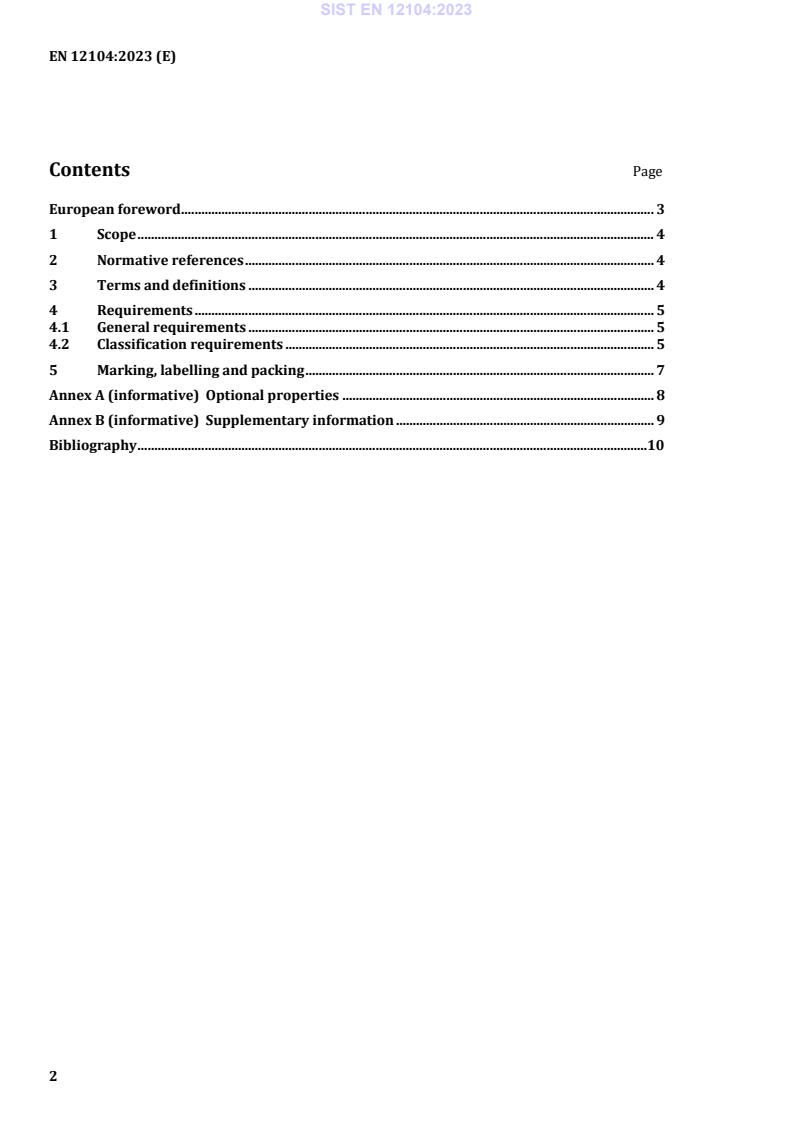
Contents Page
European foreword . 3
1 Scope . 4
2 Normative references . 4
3 Terms and definitions . 4
4 Requirements . 5
4.1 General requirements . 5
4.2 Classification requirements . 5
5 Marking, labelling and packing . 7
Annex A (informative) Optional properties . 8
Annex B (informative) Supplementary information . 9
Bibliography .10
European foreword
This document (EN 12104:2023) has been prepared by Technical Committee CEN/TC 134 “Resilient,
textile, laminate and modular mechanical locked floor coverings”, the secretariat of which is held by NBN.
This European Standard shall be given the status of a national standard, either by publication of an
identical text or by endorsement, at the latest by November 2023, and conflicting national standards shall
be withdrawn at the latest by November 2023.
Attention is drawn to the possibility that some of the elements of this document may be the subject of
patent rights. CEN shall not be held responsible for identifying any or all such patent rights.
This document supersedes EN 12104:2018.
The main changes compared to the previous edition are listed below:
— Scope review.
— Normative references.
— General requirements:
1) Dimensional stability requirement and test method.
— Classification requirements:
1) Residual indentation requirements review based on apparent density value.
2) Effect of Castor chair requirements review, surface type notes and test method update.
3) Wear resistance eliminate option EN 13329:2016+A1:2017, Annex E, and requirements review
for varnish surfaces.
— Optional Properties review.
— Bibliography update.
Any feedback and questions on this document should be directed to the users’ national standards body.
A complete listing of these bodies can be found on the CEN website.
According to the CEN-CENELEC Internal Regulations, the national standards organisations of the
following countries are bound to implement this European Standard: Austria, Belgium, Bulgaria, Croatia,
Cyprus, Czech Republic, Denmark, Estonia, Finland, France, Germany, Greece, Hungary, Iceland, Ireland,
Italy, Latvia, Lithuania, Luxembourg, Malta, Netherlands, Norway, Poland, Portugal, Republic of North
Macedonia, Romania, Serbia, Slovakia, Slovenia, Spain, Sweden, Switzerland, Türkiye and the United
Kingdom.
1 Scope
This document specifies the requirements for cork floor coverings made from agglomerated composition
cork, with or without a decorative surface layer, with or without applied colours, supplied in tile form
which are designed to be used with a factory finish and/or an in situ finish.
The cork floor decorative surface layer can be made of cork or other bio-based decorative materials, e.g.
wood or bamboo veneers, linoleum, leather or natural fibres.
This document includes a classification system based on intensity of use which shows where cork floor
tiles with a factory finish can give satisfactory service (see EN ISO 10874). It also specifies requirements
for marking, labelling and packing.
2 Normative references
The following documents are referred to in th
...
Questions, Comments and Discussion
Ask us and Technical Secretary will try to provide an answer. You can facilitate discussion about the standard in here.
Loading comments...