


ASTM F1196-19
(Specification)Standard Specification for Sliding Watertight Door Assemblies
Standard Specification for Sliding Watertight Door Assemblies
ABSTRACT
This specification covers the design, manufacture, and testing of sliding watertight door assemblies intended to ensure the watertight integrity of personnel access openings in watertight bulkheads. Sliding watertight doors consist of four types: type IA - horizontal doors, type IB - vertical doors, type IIA - horizontal doors, and type IIB - vertical doors. Watertight doors consist of three classes: class 1 - doors that are hinged and dogged, class 2 - sliding doors that are operable both locally and remotely by hand gear, and class 3 - sliding doors that are operable both locally and remotely by hand and by power. Hydrostatic test and visual examination shall be performed to meet the requirements prescribed.
SCOPE
1.1 This specification covers the design, manufacture, and testing of sliding watertight door assemblies intended to ensure the watertight integrity of personnel access openings in watertight bulkheads.
1.2 The values stated in inch-pound units are to be regarded as standard. The values given in parentheses are mathematical conversions to SI units that are provided for information only and are not considered standard.
1.3 This international standard was developed in accordance with internationally recognized principles on standardization established in the Decision on Principles for the Development of International Standards, Guides and Recommendations issued by the World Trade Organization Technical Barriers to Trade (TBT) Committee.
General Information
- Status
- Published
- Publication Date
- 28-Feb-2019
- Technical Committee
- F25 - Ships and Marine Technology
- Drafting Committee
- F25.03 - Outfitting and Deck Machinery
Relations
- Effective Date
- 01-Mar-2019
- Effective Date
- 01-Nov-2012
- Effective Date
- 01-Jun-2012
- Effective Date
- 15-May-2008
- Effective Date
- 15-Oct-2007
- Effective Date
- 01-Mar-2005
- Effective Date
- 01-Apr-2004
- Effective Date
- 10-May-2003
- Effective Date
- 10-Apr-2003
- Effective Date
- 10-Dec-2002
- Effective Date
- 10-Sep-2001
- Effective Date
- 10-Sep-2001
- Effective Date
- 10-Dec-2000
- Effective Date
- 10-Dec-2000
- Effective Date
- 01-Mar-2019
Overview
ASTM F1196-19 is the internationally recognized standard specification for sliding watertight door assemblies, published by ASTM International. This specification outlines the essential requirements for the design, manufacture, and testing of sliding watertight doors intended for use in personnel access openings within watertight bulkheads, particularly in marine environments. By adhering to the provisions in ASTM F1196-19, manufacturers, shipbuilders, and regulatory agencies ensure the watertight integrity and operational reliability of these critical safety components in vessels.
The standard encompasses multiple door types and classes, provides guidelines for material selection, manufacturing processes, and delineates test procedures to ensure compliance. It is developed in accordance with established principles for international standards and aligns with applicable maritime regulatory frameworks, such as those set forth by the International Maritime Organization (IMO) and the U.S. Coast Guard.
Key Topics
- Scope and Purpose: Covers the requirements for sliding watertight doors installed in bulkheads to maintain watertight integrity in vessels, ensuring marine safety.
- Door Types & Classes:
- Types: Horizontal (Type IA, Type IIA) and vertical (Type IB, Type IIB) doors, with both standard and special requirements doors.
- Classes: Class 2 (sliding, hand gear operation) and Class 3 (sliding, hand and power operation). Hinged doors (Class 1) are excluded.
- Design Requirements:
- Substantial and rigid construction to withstand prescribed water pressure heads.
- Replaceable watertight interface (e.g., gasket or brass strip) between door and frame.
- Features to maintain watertightness as components wear during normal use.
- Material & Manufacturing:
- Corrosion-resistant and ABS-accepted materials for all watertight components.
- Stainless steel or brass fasteners.
- Specified minimum thickness for structural elements and finishing procedures for longevity.
- Testing & Certification:
- Hydrostatic pressure tests and visual inspections for each assembly.
- Certification documenting compliance with ASTM F1196-19.
- Additional shock and fire-resistance testing where specified.
- Marking and Packaging:
- Permanent, corrosion-resistant nameplates identifying manufacturer, performance ratings, and compliance information.
- Requirements for shipment, marking, and preservation for delivery integrity.
Applications
- Marine Vessels: Primarily designed for use in ships, commercial vessels, and maritime installations where maintaining watertight compartmentalization is essential for crew safety and vessel integrity.
- Bulkhead Access: Installation in watertight bulkheads, ensuring personnel access zones retain water resistance in the event of flooding.
- Regulatory Compliance: Ensures conformity to IMO rules, ABS regulations, U.S. Coast Guard requirements, and other maritime authority standards.
- Safety Equipment: Utilized as essential shipboard equipment in the outfitting and construction phases as well as in maintenance and upgrade projects.
- Fire and Shock Resistance: Designs may include insulation and structural features to enhance resistance to fire spread and shock impacts per military and IMO standards.
Related Standards
- ASTM F1197 - Specification for Sliding Watertight Door Control Systems.
- ASTM A36/A36M - Specification for Carbon Structural Steel.
- MIL-DTL-901 - Shock testing requirements for shipboard machinery and equipment.
- ABS Rules - American Bureau of Shipping Rules for Building and Classing Steel Vessels.
- CFR Title 46, Parts 159.010 and 163.001 - U.S. Coast Guard regulations for door and control system acceptance.
- IMO FTP Code - International Maritime Organization Fire Test Procedures Code.
ASTM F1196-19 is a critical standard for stakeholders in the maritime industry, supporting the design and implementation of robust, compliant sliding watertight door assemblies for enhanced marine safety and vessel performance.
Buy Documents
ASTM F1196-19 - Standard Specification for Sliding Watertight Door Assemblies
REDLINE ASTM F1196-19 - Standard Specification for Sliding Watertight Door Assemblies
Get Certified
Connect with accredited certification bodies for this standard

ICC Evaluation Service
Building products evaluation and certification.

QAI Laboratories
Building and construction product testing and certification.

Aboma Certification B.V.
Specialized in construction, metal, and transport sectors.
Sponsored listings
Frequently Asked Questions
ASTM F1196-19 is a technical specification published by ASTM International. Its full title is "Standard Specification for Sliding Watertight Door Assemblies". This standard covers: ABSTRACT This specification covers the design, manufacture, and testing of sliding watertight door assemblies intended to ensure the watertight integrity of personnel access openings in watertight bulkheads. Sliding watertight doors consist of four types: type IA - horizontal doors, type IB - vertical doors, type IIA - horizontal doors, and type IIB - vertical doors. Watertight doors consist of three classes: class 1 - doors that are hinged and dogged, class 2 - sliding doors that are operable both locally and remotely by hand gear, and class 3 - sliding doors that are operable both locally and remotely by hand and by power. Hydrostatic test and visual examination shall be performed to meet the requirements prescribed. SCOPE 1.1 This specification covers the design, manufacture, and testing of sliding watertight door assemblies intended to ensure the watertight integrity of personnel access openings in watertight bulkheads. 1.2 The values stated in inch-pound units are to be regarded as standard. The values given in parentheses are mathematical conversions to SI units that are provided for information only and are not considered standard. 1.3 This international standard was developed in accordance with internationally recognized principles on standardization established in the Decision on Principles for the Development of International Standards, Guides and Recommendations issued by the World Trade Organization Technical Barriers to Trade (TBT) Committee.
ABSTRACT This specification covers the design, manufacture, and testing of sliding watertight door assemblies intended to ensure the watertight integrity of personnel access openings in watertight bulkheads. Sliding watertight doors consist of four types: type IA - horizontal doors, type IB - vertical doors, type IIA - horizontal doors, and type IIB - vertical doors. Watertight doors consist of three classes: class 1 - doors that are hinged and dogged, class 2 - sliding doors that are operable both locally and remotely by hand gear, and class 3 - sliding doors that are operable both locally and remotely by hand and by power. Hydrostatic test and visual examination shall be performed to meet the requirements prescribed. SCOPE 1.1 This specification covers the design, manufacture, and testing of sliding watertight door assemblies intended to ensure the watertight integrity of personnel access openings in watertight bulkheads. 1.2 The values stated in inch-pound units are to be regarded as standard. The values given in parentheses are mathematical conversions to SI units that are provided for information only and are not considered standard. 1.3 This international standard was developed in accordance with internationally recognized principles on standardization established in the Decision on Principles for the Development of International Standards, Guides and Recommendations issued by the World Trade Organization Technical Barriers to Trade (TBT) Committee.
ASTM F1196-19 is classified under the following ICS (International Classification for Standards) categories: 91.060.50 - Doors and windows. The ICS classification helps identify the subject area and facilitates finding related standards.
ASTM F1196-19 has the following relationships with other standards: It is inter standard links to ASTM F1196-00(2013), ASTM A36/A36M-12, ASTM F1197-00(2012), ASTM A36/A36M-08, ASTM F1197-00(2007), ASTM A36/A36M-05, ASTM A36/A36M-04, ASTM A36/A36M-03a, ASTM A36/A36M-03, ASTM A36/A36M-02, ASTM A36/A36M-01, ASTM A36/A36M-00a, ASTM F1197-00, ASTM F1197-89(2000), ASTM F1197-19. Understanding these relationships helps ensure you are using the most current and applicable version of the standard.
ASTM F1196-19 is available in PDF format for immediate download after purchase. The document can be added to your cart and obtained through the secure checkout process. Digital delivery ensures instant access to the complete standard document.
Standards Content (Sample)
This international standard was developed in accordance with internationally recognized principles on standardization established in the Decision on Principles for the
Development of International Standards, Guides and Recommendations issued by the World Trade Organization Technical Barriers to Trade (TBT) Committee.
Designation:F1196 −19 An American National Standard
Standard Specification for
Sliding Watertight Door Assemblies
This standard is issued under the fixed designation F1196; the number immediately following the designation indicates the year of
original adoption or, in the case of revision, the year of last revision. A number in parentheses indicates the year of last reapproval. A
superscript epsilon (´) indicates an editorial change since the last revision or reapproval.
1. Scope Title 46 Part 163.001, Doors, Watertight, Sliding (and Door
Controls),forMerchantVessels(throughthe1991edition)
1.1 This specification covers the design, manufacture, and
2.5 IMO Standard:
testing of sliding watertight door assemblies intended to ensure
International Code for the Application of Fire Test Proce-
the watertight integrity of personnel access openings in water-
dures (FTP)
tight bulkheads.
3. Terminology
1.2 The values stated in inch-pound units are to be regarded
as standard. The values given in parentheses are mathematical
3.1 Definitions:
conversions to SI units that are provided for information only
3.1.1 door assembly, n—a door panel and its associated
and are not considered standard.
panel stiffening.
1.3 This international standard was developed in accor-
3.1.2 frame assembly, n—a rigid frame designed to be
dance with internationally recognized principles on standard-
attached to a watertight bulkhead. The guide tracks necessary
ization established in the Decision on Principles for the
to ensure proper door and frame alignment are also included as
Development of International Standards, Guides and Recom-
part of the frame assembly.
mendations issued by the World Trade Organization Technical
3.1.3 horizontal sliding watertight door, n—a sliding water-
Barriers to Trade (TBT) Committee.
tight door that opens and closes with a horizontal movement.
2. Referenced Documents
3.1.4 opening hand, n—the direction in which a horizontal
sliding watertight door opens. A left-hand opening door opens
2.1 ASTM Standards:
totheleftwhenviewedfromthesideofthebulkheadonwhich
A36/A36M Specification for Carbon Structural Steel
the door assembly is located.Aright-hand opening door opens
F1197 Specification for Sliding Watertight Door Control
to the right when viewed from the side of the bulkhead on
Systems
which the door assembly is located.
2.2 Military Specification:
MIL-DTL-901 Shock Test, H.I. (High Impact); Shipboard
3.1.5 pressure head, n—the pressure which a sliding water-
Machinery, Equipment and Systems, Requirements for
tight door assembly is designed to withstand. For a door
2.3 ABS Standard:
located below the bulkhead deck, it is equivalent to the
Rules for Building and Classing Steel Vessels
pressure exerted by a column of water the height of which is
2.4 Code of Federal Regulations (CFR) Standards:
equal to the vertical distance from the bulkhead deck to the
Title 46 Part 159.010, Independent Laboratory: Acceptance,
door sill in its installed location. For a door located above the
Listing and Termination
bulkhead deck, it is equivalent to the pressure exerted by the
maximum head of water for its location, as determined in the
This specification is under the jurisdiction of Committee F25 on Ships and
damage stability calculations.
Marine Technology and is the direct responsibility of Subcommittee F25.03 on
3.1.6 sliding watertight door assembly, n—a steel door
Outfitting and Deck Machinery.
Current edition approved March 1, 2019. Published April 2019. Originally assembly and a steel frame assembly fitted with a replaceable
approved in 1989. Last previous edition approved in 2013 as F1196 – 00 (2013).
interface between the two that ensures watertightness between
DOI: 10.1520/F1196-19.
door and frame at the design pressure head.
For referenced ASTM standards, visit the ASTM website, www.astm.org, or
contact ASTM Customer Service at service@astm.org. For Annual Book of ASTM
3.1.7 vertical sliding watertight door, n—a sliding water-
Standards volume information, refer to the standard’s Document Summary page on
tight door that opens and closes with a vertical movement.
the ASTM website.
Available from DLA Document Services, Building 4/D, 700 Robbins Ave.,
4. Classification
Philadelphia, PA 19111-5094, http://quicksearch.dla.mil.
Available from American Bureau of Shipping (ABS), ABS Plaza, 1701 City
4.1 Sliding watertight doors consist of four types:
Plaza Dr., Spring, TX 77389, http://www.eagle.org.
Available from U.S. Government Printing Office, Superintendent of
Documents, 732 N. Capitol St., NW, Washington, DC 20401-0001, http:// Available from the International Maritime Organization (IMO), 4 Albert
www.access.gpo.gov. Embankment, London, SE1 7SR UK, http://www.imo.org.
Copyright © ASTM International, 100 Barr Harbor Drive, PO Box C700, West Conshohocken, PA 19428-2959. United States
F1196−19
4.1.1 Type IA—Horizontal doors that conform to the sizes
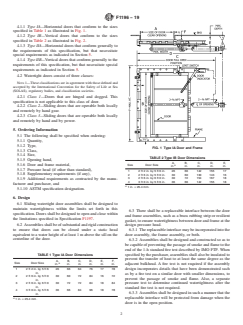
specified in Table 1 as illustrated in Fig. 1.
4.1.2 Type IB—Vertical doors that conform to the sizes
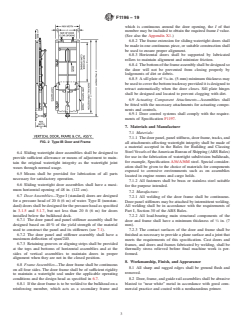
specified in Table 2 as illustrated in Fig. 2.
4.1.3 Type IIA—Horizontal doors that conform generally to
the requirements of this specification, but that necessitate
special requirements as indicated in Section 5.
4.1.4 Type IIB—Vertical doors that conform generally to the
requirements of this specification, but that necessitate special
requirements as indicated in Section 5.
4.2 Watertight doors consist of three classes:
NOTE 1—These classifications are in agreement with those defined and
accepted by the International Convention for the Safety of Life at Sea
(SOLAS), regulatory bodies, and classification societies.
4.2.1 Class 1—Doors that are hinged and dogged. This
specification is not applicable to this class of door.
4.2.2 Class 2—Sliding doors that are operable both locally
and remotely by hand gear.
4.2.3 Class 3—Sliding doors that are operable both locally
and remotely by hand and by power.
5. Ordering Information
5.1 The following shall be specified when ordering:
5.1.1 Quantity,
5.1.2 Type,
FIG. 1 Type IA Door and Frame
5.1.3 Class,
5.1.4 Size,
TABLE 2 Type IB Door Dimensions
5.1.5 Opening hand,
A, B, C, D, E,
Size Door Size
5.1.6 Door and frame material, A
in. in. in. in. in.
5.1.7 Pressure head (if other than standard),
1 2 ft 2 in. by 5 ft 6 in. 26 66 142 155 17
5.1.8 Supplementary requirements (if any), 2 2 ft 6 in. by 5 ft 0 in. 30 60 130 143 16
3 2 ft 6 in. by 6 ft 0 in. 30 72 154 167 18
5.1.9 Additional requirements as contracted by the manu-
4 3 ft 0 in. by 5 ft 6 in. 36 66 142 155 18
facturer and purchaser, and
A
1 in. = 25.4 mm.
5.1.10 ASTM specification designation.
6. Design
6.1 Sliding watertight door assemblies shall be designed to
maintain watertightness within the limits set forth in this
6.3 There shall be a replaceable interface between the door
specification. Doors shall be designed to open and close within
and frame assemblies, such as a brass rubbing strip or resilient
the limitations specified in Specification F1197.
gasket, to ensure watertightness between door and frame at the
6.2 Assembliesshallbeofsubstantialandrigidconstruction
design pressure head.
to ensure that doors can be closed under a static head
6.3.1 Thereplaceableinterfacemaybeincorporatedintothe
equivalent to a water height of at least 1 m above the sill on the
door assembly, the frame assembly, or both.
centerline of the door.
6.3.2 Assemblies shall be designed and constructed so as to
be capable of preventing the passage of smoke and flame to the
end of the 1-h standard fire test described by IMO FTP. When
specified by the purchaser, assemblies shall also be insulated to
TABLE 1 Type IA Door Dimensions
prevent the transfer of heat to at least the same degree as the
A, B, C, D, E, F,
Size Door Size
A
adjacent bulkhead. A fire test is not required if the assembly
in. in. in. in. in. in.
1 2ft2in.by5ft6 26 66 64 76 17 78 design incorporates details that have been demonstrated such
in.
as by a fire test on a similar door with smaller dimensions, to
2 2ft6in.by5ft0 30 60 72 84 16 72
prevent the passage of smoke and flame. Also, a separate
in.
3 2ft6in.by6ft0 30 72 72 84 18 84 pressure test to determine continued watertightness after the
in.
standard fire test is not required.
4 3ft0in.by5ft6 36 66 84 96 18 78
6.3.3 Assembles shall be designed in such a manner that the
in.
A replaceable interface will be protected from damage when the
1 in. = 25.4 mm.
door is in the open position.
F1196−19
which is continuous around the door opening, the I of that
member may be included to obtain the required frame I value.
(See also the Appendix X1.)
6.8.2 The frame extension for sliding watertight doors shall
be made in one continuous piece, or suitable construction shall
be used to ensure proper alignment.
6.8.3 Horizontal doors shall be supported by lubricated
rollers to maintain alignment and minimize friction.
6.8.4 Thebottomoftheframeassemblyshallbedesignedso
the door will not be prevented from closing properly by
lodgements of dirt or debris.
6.8.5 Asill plate of ⁄16-in. (5-mm) minimum thickness may
beusedtocoverthebottomtrackwayprovideditisdesignedto
retract automatically when the door closes. Sill plate hinges
shall be designed and located to prevent clogging with dirt.
6.9 Actuating Component Attachments—Assemblies shall
be fitted with the necessary attachments for actuating compo-
nents and controls.
6.9.1 Door control systems shall comply with the require-
ments of Specification F1197.
7. Materials and Manufacture
7.1 Materials:
7.1.1 Thedoorpanel,panelstiffness,doorframe,tracks,and
FIG. 2 Type IB Door and Frame
all attachments affecting watertight integrity shall be made of
a material accepted in the Rules for Building and Classing
SteelVesselsoftheAmericanBureauofShipping(ABSRules)
6.4 Sliding watertight door assemblies shall be designed to
for use in the fabrication of watertight subdivision bulkheads,
provide sufficient allowance or means of adjustment to main-
for example, Specification A36/A36M steel. Special consider-
tain the original watertight integrity as the watertight joint
ation shall be given to the choice of materials for components
wears through normal usage.
exposed to corrosive environments such as on assemblies
6.5 Means shall be provided for lubrication of all parts
located in engine rooms and cargo holds.
necessary for satisfactory operation.
7.1.2 All fasteners shall be brass or stainless steel suitable
6.6 Sliding watertight door assemblies shall have a maxi-
for the purpose intended.
mum horizontal opening of 48 in. (122 cm).
7.2 Manufacture:
6.7 Door Assemblies—Type I (standard) doors are designed
7.2.1 All welding of the door frame shall be continuous.
for a pressure head of 20 ft (6 m) of water. Type II (nonstan-
Door panel stiffeners may be attached by intermittent welding.
dard) doors shall be designed for the pressure head as specified
All welding shall be in accordance with the requirements of
in 3.1.5 and 5.1.7, but not less than 20 ft (6 m) for doors
Part I, Section 30 of the ABS Rules.
installed below the bulkhead deck.
7.2.2 All load-bearing main structural components of
...
This document is not an ASTM standard and is intended only to provide the user of an ASTM standard an indication of what changes have been made to the previous version. Because
it may not be technically possible to adequately depict all changes accurately, ASTM recommends that users consult prior editions as appropriate. In all cases only the current version
of the standard as published by ASTM is to be considered the official document.
Designation: F1196 − 00 (Reapproved 2013) F1196 − 19 An American National Standard
Standard Specification for
Sliding Watertight Door Assemblies
This standard is issued under the fixed designation F1196; the number immediately following the designation indicates the year of
original adoption or, in the case of revision, the year of last revision. A number in parentheses indicates the year of last reapproval. A
superscript epsilon (´) indicates an editorial change since the last revision or reapproval.
1. Scope
1.1 This specification covers the design, manufacture, and testing of sliding watertight door assemblies intended to ensure the
watertight integrity of personnel access openings in watertight bulkheads.
1.2 The values stated in inch-pound units are to be regarded as the standard. The values given in parentheses are for information
only. mathematical conversions to SI units that are provided for information only and are not considered standard.
1.3 This international standard was developed in accordance with internationally recognized principles on standardization
established in the Decision on Principles for the Development of International Standards, Guides and Recommendations issued
by the World Trade Organization Technical Barriers to Trade (TBT) Committee.
2. Referenced Documents
2.1 ASTM Standards:
A36/A36M Specification for Carbon Structural Steel
F1197 Specification for Sliding Watertight Door Control Systems
2.2 Military Specification:
MIL-S-901MIL-DTL-901 Shock Test, H.I. (High Impact); Shipboard Machinery, Equipment and Systems, Requirements for
2.3 American Bureau of Shipping:ABS Standard:
Rules for Building and Classing Steel Vessels
2.4 Code of Federal Regulations:Regulations (CFR) Standards:
Title 46 Part 159.010, Independent Laboratory: Acceptance, Listing and Termination
Title 46 Part 163.001, Doors, Watertight, Sliding (and Door Controls), for Merchant Vessels (through the 1991 edition)
2.5 International Maritime Organization:IMO Standard:
International Code for the Application of Fire Test Procedures (FTP)
3. Terminology
3.1 Definitions:
3.1.1 door assembly—assembly, n—a door panel and its associated panel stiffening.
3.1.2 frame assembly—assembly, n—a rigid frame designed to be attached to a watertight bulkhead. The guide tracks necessary
to ensure proper door and frame alignment are also included as part of the frame assembly.
3.1.3 horizontal sliding watertight door—door, n—a sliding watertight door that opens and closes with a horizontal movement.
3.1.4 opening hand—hand, n—the direction in which a horizontal sliding watertight door opens. A left-hand opening door opens
to the left when viewed from the side of the bulkhead on which the door assembly is located. A right-hand opening door opens
to the right when viewed from the side of the bulkhead on which the door assembly is located.
This specification is under the jurisdiction of Committee F25 on Ships and Marine Technology and is the direct responsibility of Subcommittee F25.03 on Outfitting and
Deck Machinery.
Current edition approved May 1, 2013March 1, 2019. Published May 2013April 2019. Originally approved in 1989. Last previous edition approved in 20082013 as
F1196 – 00 (2008).(2013). DOI: 10.1520/F1196-00R13.10.1520/F1196-19.
For referenced ASTM standards, visit the ASTM website, www.astm.org, or contact ASTM Customer Service at service@astm.org. For Annual Book of ASTM Standards
volume information, refer to the standard’sstandard’s Document Summary page on the ASTM website.
Available from DLA Document Services, Building 4/D, 700 Robbins Ave., Philadelphia, PA 19111-5094, http://quicksearch.dla.mil.
Available from American Bureau of Shipping (ABS), ABS Plaza, 16855 Northchase Dr., Houston, TX 77060,1701 City Plaza Dr., Spring, TX 77389,
http://www.eagle.org.
Available from U.S. Government Printing Office, Superintendent of Documents, 732 N. Capitol St., NW, Washington, DC 20401-0001, http://www.access.gpo.gov.
Available from the International Maritime Organization (IMO), 4 Albert Embankment, London, SE1 7SR UK, http://www.imo.org.
Copyright © ASTM International, 100 Barr Harbor Drive, PO Box C700, West Conshohocken, PA 19428-2959. United States
F1196 − 19
3.1.5 pressure head—head, n—the pressure which a sliding watertight door assembly is designed to withstand. For a door
located below the bulkhead deck, it is equivalent to the pressure exerted by a column of water the height of which is equal to the
vertical distance from the bulkhead deck to the door sill in its installed location. For a door located above the bulkhead deck, it
is equivalent to the pressure exerted by the maximum head of water for its location, as determined in the damage stability
calculations.
3.1.6 sliding watertight door assembly—assembly, n—a steel door assembly and a steel frame assembly fitted with a replaceable
interface between the two that ensures watertightness between door and frame at the design pressure head.
3.1.7 vertical sliding watertight door—door, n—a sliding watertight door that opens and closes with a vertical movement.
4. Classification
4.1 Sliding watertight doors consist of four types:
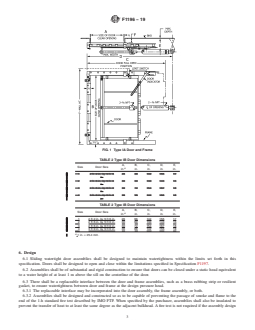
4.1.1 Type IA—Horizontal doors that conform to the sizes specified in Table 1 as illustrated in Fig. 1.
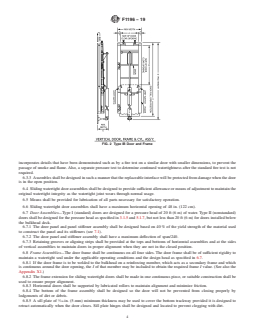
4.1.2 Type IB—Vertical doors that conform to the sizes specified in Table 2 as illustrated in Fig. 2.
4.1.3 Type IIA—Horizontal doors that conform generally to the requirements of this specification, but that necessitate special
requirements as indicated in Section 5.
4.1.4 Type IIB—Vertical doors that conform generally to the requirements of this specification, but that necessitate special
requirements as indicated in Section 5.
4.2 Watertight doors consist of three classes:
NOTE 1—These classifications are in agreement with those defined and accepted by the International Convention for the Safety of Life at Sea (SOLAS),
regulatory bodies, and classification societies.
4.2.1 Class 1—Doors that are hinged and dogged. This specification is not applicable to this class of door.
4.2.2 Class 2—Sliding doors that are operable both locally and remotely by hand gear.
4.2.3 Class 3—Sliding doors that are operable both locally and remotely by hand and by power.
5. Ordering Information
5.1 The following shall be specified when ordering:
5.1.1 Quantity,
5.1.2 Type,
5.1.3 Class,
5.1.4 Size,
5.1.5 Opening hand,
5.1.6 Door and frame material,
5.1.7 Pressure head (if other than standard),
5.1.8 Supplementary requirements (if any),
5.1.9 Additional requirements as contracted by the manufacturer and purchaser, and
5.1.10 ASTM specification designation.
TABLE 1 Type IA Door Dimensions
A, B, C, D, E, F,
Size Door Size
A
in. in. in. in. in. in.
1 2 ft. 2 in. by 5 ft. 6 26 66 64 76 17 78
in.
2 2 ft. 6 in. by 5 ft. 0 30 60 72 84 16 72
in.
3 2 ft. 6 in. by 6 ft. 0 30 72 72 84 18 84
in.
4 3 ft. 0 in. by 5 ft. 6 36 66 84 96 18 78
in.
TABLE 1 Type IA Door Dimensions
A, B, C, D, E, F,
Size Door Size
A
in. in. in. in. in. in.
1 2 ft 2 in. by 5 ft 6 26 66 64 76 17 78
in.
2 2 ft 6 in. by 5 ft 0 30 60 72 84 16 72
in.
3 2 ft 6 in. by 6 ft 0 30 72 72 84 18 84
in.
4 3 ft 0 in. by 5 ft 6 36 66 84 96 18 78
in.
A
1 in. = 25.4 mm.
F1196 − 19
FIG. 1 Type IA Door and Frame
TABLE 2 Type IB Door Dimensions
A, B, C, D, E,
Size Door Size
A
in. in. in. in. in.
1 2 ft. 2 in. by 5 ft. 6 26 66 142 155 17
in.
2 2 ft. 6 in. by 5 ft. 0 30 60 130 143 16
in.
3 2 ft. 6 in. by 6 ft. 0 30 72 154 167 18
in.
4 3 ft. 0 in. by 5 ft. 6 36 66 142 155 18
in.
TABLE 2 Type IB Door Dimensions
A, B, C, D, E,
Size Door Size
A
in. in. in. in. in.
1 2 ft 2 in. by 5 ft 6 in. 26 66 142 155 17
2 2 ft 6 in. by 5 ft 0 in. 30 60 130 143 16
3 2 ft 6 in. by 6 ft 0 in. 30 72 154 167 18
4 3 ft 0 in. by 5 ft 6 in. 36 66 142 155 18
A
1 in. = 25.4 mm.
6. Design
6.1 Sliding watertight door assemblies shall be designed to maintain watertightness within the limits set forth in this
specification. Doors shall be designed to open and close within the limitations specified in Specification F1197.
6.2 Assemblies shall be of substantial and rigid construction to ensure that doors can be closed under a static head equivalent
to a water height of at least 1 m above the sill on the centerline of the door.
6.3 There shall be a replaceable interface between the door and frame assemblies, such as a brass rubbing strip or resilient
gasket, to ensure watertightness between door and frame at the design pressure head.
6.3.1 The replaceable interface may be incorporated into the door assembly, the frame assembly, or both.
6.3.2 Assemblies shall be designed and constructed so as to be capable of preventing the passage of smoke and flame to the
end of the 1-h standard fire test described by IMO FTP. When specified by the purchaser, assemblies shall also be insulated to
prevent the transfer of heat to at least the same degree as the adjacent bulkhead. A fire test is not required if the assembly design
F1196 − 19
FIG. 2 Type IB Door and Frame
incorporates details that have been demonstrated such as by a fire test on a similar door with smaller dimensions, to prevent the
passage of smoke and flame. Also, a separate pressure test to determine continued watertightness after the standard fire test is not
required.
6.3.3 Assembles shall be designed in such a manner that the replaceable interface will be protected from damage when the door
is in the open position.
6.4 Sliding watertight door assemblies shall be designed to provide sufficient allowance or means of adjustment to maintain the
original watertight integrity as the watertight joint wears through normal usage.
6.5 Means shall be provided for lubrication of all parts necessary for satisfactory operation.
6.6 Sliding watertight door assemblies shall have a maximum horizontal opening of 48 in. (122 cm).
6.7 Door Assemblies—Type I (standard) doors are designed for a pressure head of 20 ft (6 m) of water. Type II (nonstandard)
doors shall be designed for the pressure head as specified in 3.1.5 and 5.1.7, but not less than 20 ft (6 m) for doors installed below
the bulkhead deck.
6.7.1 The door panel and panel stiffener assembly shall be designed based on 40 % of the yield strength of the material used
to construct the panel and its stiffeners (see 7.1).
6.7.2 The door panel and stiffener assembly shall have a maximum deflection of span/240.
6.7.3 Retaining grooves or aligning strips shall be provided at the tops and bottoms of horizontal assemblies and at the sides
of vertical assemblies to maintain doors in proper alignment when they are not in the closed position.
6.8 Frame Assemblies—The door frame shall be continuous on all four sides. The door frame shall be of sufficient rigidity to
maintain a watertight seal under the applicable operating conditions and the design head as specified in 6.7.
6.8.1 If the door frame is to be welded to the bulkhead on a reinforcing member, which acts as a secondary frame and which
is continuous around the door opening, the I of that member may be included to obtain the required frame I value. (See also the
Appendix X1.)
6.8.2 The frame extension for sliding watertight doors shall be made in one continuous piece, or suitable construction shall be
used to ensure proper alignment.
6.8.3 Horizontal doors shall be supported by lubricated rollers to maintain alignment and minimize friction.
6.8.4 The bottom of the frame assembly shall be designed so the door will not be prevented from closing properly by
lodgements of dirt or debris.
6.8.5 A sill plate of ⁄16-in. (5-mm) minimum thickness may be used to cover the bottom trackway provided it is design
...
Questions, Comments and Discussion
Ask us and Technical Secretary will try to provide an answer. You can facilitate discussion about the standard in here.
Loading comments...