

ASTM D8041/D8041M-16(2023)
(Test Method)Standard Test Method for Whole Boot Breathability (MVTR)
General Information
- Abstract
SIGNIFICANCE AND USE
4.1 The materials and construction methods used in the manufacture of footwear play a significant role in the “breathability” of the footwear. This test method provides a means to measure moisture vapor permeability, expressed as MVTR, which is one aspect of comfort of the footwear.
SCOPE
1.1 The whole boot breathability test method is designed to indicate the Moisture Vapor Transmission Rate (MVTR) through the boot upper by means of a difference in temperature and moisture vapor concentration between the interior of the boot and the exterior environment. This method is intended for a size 10 R U.S. (Regular width) boot that is at least 6 in. [15.2 cm] tall above the insole.
1.2 The values stated in either inch-pound units or SI units are to be regarded separately as standard. Within the text, the SI units are shown in brackets. The values stated in each system are not exact equivalents; therefore, each system is to be used independently of the other, without combining values in any way. Combining values from the two systems may result in non-conformance with the standard.
1.3 This standard does not purport to address all of the safety concerns, if any, associated with its use. It is the responsibility of the user of this standard to establish appropriate safety, health, and environmental practices and determine the applicability of regulatory limitations prior to use.
1.4 This international standard was developed in accordance with internationally recognized principles on standardization established in the Decision on Principles for the Development of International Standards, Guides and Recommendations issued by the World Trade Organization Technical Barriers to Trade (TBT) Committee.
- Status
- Published
- Publication Date
- 30-Sep-2023
- Technical Committee
- D31 - Leather
- Drafting Committee
- D31.03 - Footwear
Overview
ASTM D8041/D8041M-16(2023) is the Standard Test Method for Whole Boot Breathability (Moisture Vapor Transmission Rate, MVTR), published by ASTM International. This widely recognized standard is designed to evaluate the breathability of whole boots by measuring their moisture vapor transmission rate. Boot breathability is a critical factor affecting the overall comfort and performance of footwear, particularly in applications demanding extended wear and challenging conditions.
This method focuses on measuring MVTR through the boot upper, using a test setup that creates controlled differences in temperature and moisture vapor concentration between a boot's interior and the external environment. The test is specified for a size 10 Regular U.S. boot that is at least 6 inches (15.2 cm) tall above the insole, ensuring consistency and comparability of results.
Key Topics
- Moisture Vapor Transmission Rate (MVTR): A quantitative indicator of how well a boot allows water vapor to escape, directly linked to user comfort and material performance.
- Whole Boot Evaluation: Unlike methods that test only materials, this standard evaluates breathability in the entire boot, accounting for construction and material interactions.
- Controlled Environmental Conditions: Standardizes relative humidity, temperature, and air movement during testing to reduce variability and increase repeatability.
- Terminology:
- Boot: Footwear where the upper extends above the ankle.
- WHBI (Water Holding Bootie Insert): A flexible, waterproof, and vapor-permeable insert used in the test setup.
- Upper, Sole, Insert, Eyelet, Plug, Gusset, Heel: Key boot components relevant to the test method.
Applications
ASTM D8041/D8041M-16(2023) is essential for:
- Footwear Manufacturers: Testing and verifying whole boot breathability to improve product comfort and performance, differentiate products, and meet customer expectations.
- Product Development: Aiding in the selection and evaluation of materials, construction techniques, and design modifications for better thermal and moisture management.
- Quality Assurance: Ensuring consistency in manufacturing processes and compliance with breathability requirements during regular production.
- Purchasers and Specifiers: Establishing benchmarks for moisture vapor transmission in procurement documents and technical specifications.
- Research and Comparative Testing: Supporting the development of enhanced footwear by providing a standardized method for breathability testing in performance studies and research projects.
- Standards Compliance: Meeting internationally recognized testing criteria, which is critical for global trade and regulatory acceptance.
Related Standards
For comprehensive evaluation and consistency in footwear performance, the following standards may also be relevant:
- ASTM E96/E96M: Standard Test Methods for Water Vapor Transmission of Materials, often used for evaluating material breathability.
- ASTM D6612: Standard Specification for Leather Used in Footwear.
- ISO 20344, ISO 20345, ISO 20346: International standards for safety, protective, and occupational footwear, addressing aspects including comfort and material performance.
- ASTM D5331: Standard Test Method for Evaluation of Hybrid Breathable Moisture Barrier Materials.
Practical Value
The adoption of ASTM D8041/D8041M-16(2023) enables organizations to:
- Quantitatively assess whole boot breathability, leading to improved wearer comfort and market appeal.
- Identify and rectify issues in material selection and footwear construction that impact moisture management.
- Align products with buyer specifications, industry regulations, and international standards in global markets.
- Aid in the continuous improvement of safety, work, military, hiking, or athletic footwear by benchmarking against standardized MVTR values.
By following ASTM D8041/D8041M-16(2023), stakeholders ensure transparent, objective, and repeatable assessment of whole boot breathability - a key aspect in the development and selection of high-performance footwear.
Relations
- Effective Date
- 01-Oct-2023
Get Certified
Connect with accredited certification bodies for this standard

CIS Institut d.o.o.
Personal Protective Equipment (PPE) certification body. Notified Body NB-2890 for EU Regulation 2016/425 PPE.

Kiwa BDA Testing
Building and construction product certification.
Kmetijski inštitut Slovenije
Agricultural Institute of Slovenia. Soil testing, plant health, agricultural product analysis.
Sponsored listings
Frequently Asked Questions
ASTM D8041/D8041M-16(2023) is a standard published by ASTM International. Its full title is "Standard Test Method for Whole Boot Breathability (MVTR)". This standard covers: SIGNIFICANCE AND USE 4.1 The materials and construction methods used in the manufacture of footwear play a significant role in the “breathability” of the footwear. This test method provides a means to measure moisture vapor permeability, expressed as MVTR, which is one aspect of comfort of the footwear. SCOPE 1.1 The whole boot breathability test method is designed to indicate the Moisture Vapor Transmission Rate (MVTR) through the boot upper by means of a difference in temperature and moisture vapor concentration between the interior of the boot and the exterior environment. This method is intended for a size 10 R U.S. (Regular width) boot that is at least 6 in. [15.2 cm] tall above the insole. 1.2 The values stated in either inch-pound units or SI units are to be regarded separately as standard. Within the text, the SI units are shown in brackets. The values stated in each system are not exact equivalents; therefore, each system is to be used independently of the other, without combining values in any way. Combining values from the two systems may result in non-conformance with the standard. 1.3 This standard does not purport to address all of the safety concerns, if any, associated with its use. It is the responsibility of the user of this standard to establish appropriate safety, health, and environmental practices and determine the applicability of regulatory limitations prior to use. 1.4 This international standard was developed in accordance with internationally recognized principles on standardization established in the Decision on Principles for the Development of International Standards, Guides and Recommendations issued by the World Trade Organization Technical Barriers to Trade (TBT) Committee.
SIGNIFICANCE AND USE 4.1 The materials and construction methods used in the manufacture of footwear play a significant role in the “breathability” of the footwear. This test method provides a means to measure moisture vapor permeability, expressed as MVTR, which is one aspect of comfort of the footwear. SCOPE 1.1 The whole boot breathability test method is designed to indicate the Moisture Vapor Transmission Rate (MVTR) through the boot upper by means of a difference in temperature and moisture vapor concentration between the interior of the boot and the exterior environment. This method is intended for a size 10 R U.S. (Regular width) boot that is at least 6 in. [15.2 cm] tall above the insole. 1.2 The values stated in either inch-pound units or SI units are to be regarded separately as standard. Within the text, the SI units are shown in brackets. The values stated in each system are not exact equivalents; therefore, each system is to be used independently of the other, without combining values in any way. Combining values from the two systems may result in non-conformance with the standard. 1.3 This standard does not purport to address all of the safety concerns, if any, associated with its use. It is the responsibility of the user of this standard to establish appropriate safety, health, and environmental practices and determine the applicability of regulatory limitations prior to use. 1.4 This international standard was developed in accordance with internationally recognized principles on standardization established in the Decision on Principles for the Development of International Standards, Guides and Recommendations issued by the World Trade Organization Technical Barriers to Trade (TBT) Committee.
ASTM D8041/D8041M-16(2023) is classified under the following ICS (International Classification for Standards) categories: 13.340.50 - Leg and foot protection; 61.060 - Footwear. The ICS classification helps identify the subject area and facilitates finding related standards.
ASTM D8041/D8041M-16(2023) has the following relationships with other standards: It is inter standard links to ASTM D8041/D8041M-16. Understanding these relationships helps ensure you are using the most current and applicable version of the standard.
ASTM D8041/D8041M-16(2023) is available in PDF format for immediate download after purchase. The document can be added to your cart and obtained through the secure checkout process. Digital delivery ensures instant access to the complete standard document.
Standards Content (Sample)
This international standard was developed in accordance with internationally recognized principles on standardization established in the Decision on Principles for the
Development of International Standards, Guides and Recommendations issued by the World Trade Organization Technical Barriers to Trade (TBT) Committee.
Designation: D8041/D8041M − 16 (Reapproved 2023)
Standard Test Method for
Whole Boot Breathability (MVTR)
This standard is issued under the fixed designation D8041/D8041M; the number immediately following the designation indicates the
year of original adoption or, in the case of revision, the year of last revision. A number in parentheses indicates the year of last
reapproval. A superscript epsilon (´) indicates an editorial change since the last revision or reapproval.
1. Scope 2.1.4 footwear, n—wearing apparel for feet (such as shoes,
boots, slippers).
1.1 The whole boot breathability test method is designed to
2.1.5 gusset, n—the part of the vamp that extends over the
indicate the Moisture Vapor Transmission Rate (MVTR)
instep of the foot between the eyestays and allows expansions
through the boot upper by means of a difference in temperature
of the opening at the top of the footwear.
and moisture vapor concentration between the interior of the
2.1.5.1 Discussion—For slip-on footwear this may include
boot and the exterior environment. This method is intended for
an elastic gusset that allows expansion at the opening at the top
a size 10 R U.S. (Regular width) boot that is at least 6 in.
of the footwear.
[15.2 cm] tall above the insole.
2.1.6 heel, n—the part of the boot which supports the back
1.2 The values stated in either inch-pound units or SI units
part of the foot.
are to be regarded separately as standard. Within the text, the
SI units are shown in brackets. The values stated in each
2.1.7 insert, n—removable foot bed which is shaped or
system are not exact equivalents; therefore, each system is to
molded to match the approximate contour of the bottom
be used independently of the other, without combining values
surface of the foot.
in any way. Combining values from the two systems may result
2.1.8 plug, n—a circular or oval shaped (non metallic) boot
in non-conformance with the standard.
plug that holds the (copper foot form) water heating assembly
1.3 This standard does not purport to address all of the
and seals the top of the water holding bootie insert and upper
safety concerns, if any, associated with its use. It is the
at the water interface. The plug must be made from material
responsibility of the user of this standard to establish appro-
that is impervious to both liquid water and water vapor.
priate safety, health, and environmental practices and deter-
2.1.9 sole or outsole, n—the bottom layer of the footwear,
mine the applicability of regulatory limitations prior to use.
including the heel, in contact with the ground forming the
1.4 This international standard was developed in accor-
walking surface.
dance with internationally recognized principles on standard-
2.1.10 upper, n—the entire part of the footwear located
ization established in the Decision on Principles for the
above the sole. Includes external leather and synthetic materi-
Development of International Standards, Guides and Recom-
als as well as internal linings.
mendations issued by the World Trade Organization Technical
2.1.11 water holding bootie insert (WHBI), n—a thin,
Barriers to Trade (TBT) Committee.
flexible, waterproof, breathable bootie meeting the require-
ments of 6.3.
2. Terminology
2.1 Definitions:
3. Summary of Test Method
2.1.1 boot, n—footwear in which the upper reaches above
3.1 A test sample boot fitted with a water holding bootie
the ankle.
insert (WHBI) is filled with preheated water and weighed. The
2.1.2 eyelet, n—textile, metal or plastic reinforcements
water is kept at a constant temperature for 6 h and then the boot
around the holes which carry the lace.
(with water) is reweighed. The loss in weight is used to
2.1.3 foot form assembly, n—relating to this test method, the
calculate the Moisture Vapor Transmission Rate (MVTR) of
foot form consists of boot plug with copper tubing in a shape
the footwear, otherwise known as breathability.
of a foot.
4. Significance and Use
4.1 The materials and construction methods used in the
This test method is under the jurisdiction of ASTM Committee D31 on Leather
manufacture of footwear play a significant role in the “breath-
and is the direct responsibility of Subcommittee D31.03 on Footwear.
ability” of the footwear. This test method provides a means to
Current edition approved Oct. 1, 2023. Published October 2023. Originally
measure moisture vapor permeability, expressed as MVTR,
approved in 2016. Last previous edition approved in 2016 as D8041/
D8041M – 16. DOI: 10.1520/D8041_D8041M-16R23. which is one aspect of comfort of the footwear.
Copyright © ASTM International, 100 Barr Harbor Drive, PO Box C700, West Conshohocken, PA 19428-2959. United States
D8041/D8041M − 16 (2023)
5. Interferences 6.9 The stationary fan shall be positioned perpendicular to
the test surface, aimed at the toe of the boot, and be raised so
5.1 Temperature, humidity or air movement fluctuations.
the center of the fan is 5 in. [12.7 cm] above the base of the test
platform.
6. Apparatus
6.10 The air current origin shall be 15.5 in. [39.4 cm] from
6.1 The external test environment control system shall be
the back heel edge of the boot (D). Refer to Fig. 4.
capable of maintaining 73 °F 6 2 °F [23.0 °C 6 1.0 °C] and
6.11 The wind speed shall be 250 ft ⁄min 6 30 ft/min
50 % 6 2 % relative humidity throughout the test duration.
[1.3 m ⁄s 60.15 m/s] at the heel edge of the boot (S) as
6.2 The weight scale shall be capable of determining weight
measured with a 2.8 in. [7.1 cm] diameter fan anemometer.
of boot, plus foot form assembly and WHBI filled with water
Measurement shall be taken without the boot assembly in
to an accuracy of 60.1 g.
place, utilizing a holding device to support the 2.8 in. [7.1 cm]
6.3 The WHBI shall be flexible so that it can be inserted into
diameter fan anemometer perpendicular to the test platform.
the boot and conform to the interior contours; it must be thin
The center of the anemometer shall be 2 in. [5 cm] above the
enough so that folds do not create air gaps. The WHBI must be
base of the test platform and 15.5 in. [39.4 cm] from the fan.
waterproof so that only moisture vapor can penetrate through
the bootie, rather than liquid water. Check the WHBI for 7. Whole Boot Breathability Bench-top Set-up
leakage before each test by filling the interior with water and
7.1 D—Distance from the boot heel back edge to fan
visually looking for water moisture on the exterior surface. A
surface.
WHBI should only be used for five 6-h tests, including the first
7.2 S—Wind speed at boot heel back edge.
conditioning test (see 11.2).
7.3 If there is more than one station, a divider wall must be
6.4 The foot-form assembly used with the water circulating
3 between them. Divider walls shall be a minimum of 4 in.
system is constructed of ¼-in. or ⁄8-in. [6 mm or 10 mm] OD
[10 cm] from the center line of the fan box, equal in height to
copper tubing passing through the boot plug. (See the critical
the fan box, and extend from the fan box to the back of the test
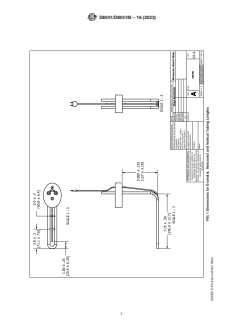
dimensions for the diameter, horizontal and vertical tubing
platform.
lengths in Fig. 1.) The tubing is measured from the bottom of
the plug surface to the end of the elbow or bend.
7.4 The fan box may need baffles, an adjustable rheostat or
a variable autotransformer to meet requirements for the air
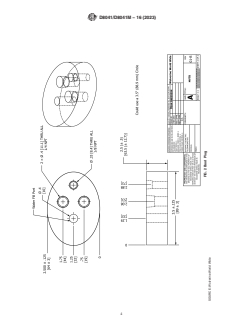
6.5 The boot plug (Fig. 2) shall be circular shaped measur-
1 1 1 current to be 250 ft ⁄min 6 30 ft/min [1.3 m ⁄s 6 0.15 m/s].
ing 3- ⁄2 in. diameter by 2- ⁄2 in. thick 6 ⁄2 in. [89 mm
1 1
diameter by 64 mm] or an oval 2- ⁄2 in. wide by 3- ⁄2 in. long
8. Reagents and Materials
by 2- ⁄2 in. thick [64 mm by 89 mm by 64 mm], nonmetallic,
8.1 Distilled or deionized water.
and impervious to water vapor and liquid water.
NOTE 1—Critical measurements are plug thickness and ensuring probe
9. Water Holding Bootie Insert (WHBI) Test
is 1 in. [2.54 cm] from inside edge of tubing.
9.1 Weigh WHBI to accuracy of 60.1 g. This is the original
6.5.1 In addition, the boot plug shall have a water filling
weight and used if the test is aborted to verify the WHBI is dry
hole with stopper and at least one temperature probe, (6.6)
before using it for testing.
which will be used to monitor the internal water temperature in
9.2 The top of the WHBI shall be sealed around the
the WHBI at the toe area of the boot (see Fig. 1). The foot form
foot-form assembly plug using boot laces or hook and loop
assembly is detachable from the water circulating system (6.7)
bundling tape. A stand and clamp can be used to help hold the
to facilitate weighing. Both the inlet and outlet lines from the
WHBI upright (see Fig. 5). Fill with distilled or deionized
foot form assembly to the water circulating system shall consist
water preheated to 95 °F 6 2 °F [35 °C 6 1 °C] to just past the
of clear tubing, each marked with a line or alternate means to
bottom of the plug.
ensure the water volume within the system is constant during
weighing.
9.3 Check the WHBI for any leakage before continuing the
test. If any moisture is observed on the exterior surface, the test
6.6 There is one temperature probe (see Fig. 1) which is
must be restarted with a new WHBI.
inserted into the top of the boot plug and reaches to the toe area
of the boot. It cannot be wrapped around, or come in contact
9.4 Weigh the entire assembly and record as W . The water
i
with, the copper tubing. Note that all tubes, hoses or lines
volume in the tubing system shall be noted at the time of
running through the plug shall be sealed to prevent vapor from
weighing, by a visual mark or alternate means of ensuring
escaping.
constant water volume. The volume of water in the tubing
system shall be the same at the start and end of the test to
6.7 The water circulating system (see Fig. 3) for the boot
prevent any effect on the weight loss calculation.
shall be capable of controlling the temperature of the water in
the boot uniformly at 95 °F 6 2 °F [35 °C 6 1 °C] when
NOTE 2—You may need to add or remove water from the tubing system
measured with the temperature probe, without touching the
in order to ensure it is the same volume.
WHBI or water circulating apparatus. (See Fig. 1).
9.5 After weighing, connect the water circulating system
6.8 A stationary 6 in. [15.2 cm] diamet
...