

ASTM D6287-17
(Practice)Standard Practice for Cutting Film and Sheeting Test Specimens
General Information
- Abstract
SIGNIFICANCE AND USE
3.1 Many test methods including Test Methods D882, D2838, F88, F1921/F1921M, and F2029 require the use of narrow strips of varying length. The quality of the sample preparation directly affects test results. This practice describes three techniques for preparing samples with straight, clean, parallel edges with no visible imperfections.
Note 2: After cutting, each specimen should be examined visually to insure the edges are undamaged (free of nicks). On a periodic basis specimen edge quality should be evaluated by microscopic examination. To determine when cutting blades need to be replaced or sharpened, a control chart of tensile strength and percent elongation at break (see Test Method D882) of a uniform material may be maintained. Tensile strength and percent elongation at break will decrease as the quality of specimen cutting decreases.
SCOPE
1.1 This practice covers equipment and techniques for cutting film and sheeting specimens for testing.2 The specimens are nick-free, non-stretched and can be rapidly prepared.
1.2 The values given in SI units are to be considered standard. The values given in parentheses are for information only.
1.3 This standard does not purport to address all of the safety concerns, if any, associated with its use. It is the responsibility of the user of this standard to establish appropriate safety, health, and environmental practices and determine the applicability of regulatory limitations prior to use.
Note 1: There is no known ISO equivalent to this standard.
1.4 This international standard was developed in accordance with internationally recognized principles on standardization established in the Decision on Principles for the Development of International Standards, Guides and Recommendations issued by the World Trade Organization Technical Barriers to Trade (TBT) Committee.
- Status
- Published
- Publication Date
- 14-Dec-2017
- Technical Committee
- D20 - Plastics
- Drafting Committee
- D20.19 - Film, Sheeting, and Molded Products
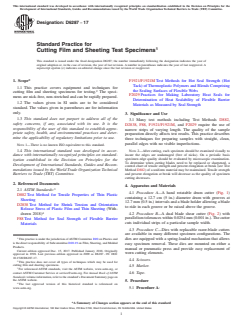



Overview
ASTM D6287-17: Standard Practice for Cutting Film and Sheeting Test Specimens provides a comprehensive guide for preparing high-quality test specimens from film and sheeting materials. Published by ASTM International, this standard outlines three primary techniques to ensure specimens are accurately cut with straight, clean, and parallel edges, free from nicks or visible imperfections. The correct preparation of test specimens is critical, as flaws can significantly impact the results of downstream physical, mechanical, or barrier property tests.
ASTM D6287-17 is widely referenced in laboratory environments and quality control processes for plastics, flexible packaging, and material science industries. The standard covers both the required equipment and detailed procedures to help laboratories achieve reliable, repeatable, and representative results across various cutting methods.
Key Topics
Specimen Preparation Quality
The standard emphasizes the importance of preparing specimens that are nick-free and non-stretched, as damaged edges or inconsistent cuts can lead to inaccurate test results.Cutting Techniques
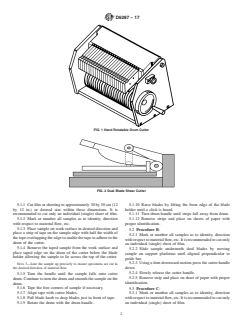
ASTM D6287-17 describes three practical methods for specimen preparation:- Hand Rotatable Drum Cutter: Ideal for high-volume, reproducible cuts
- Dual Blade Shear Cutter: Delivers straight, parallel strips, especially for critical dimensional accuracy
- Dies with Replaceable Razor Blades: Suitable for varied specimen shapes and easy blade replacement
Inspection and Blade Maintenance
Visual and microscopic examination of cut specimens is encouraged to ensure edge quality. Maintaining a control chart of tensile strength and elongation (as referenced in ASTM D882) helps monitor cutting efficacy over time and indicates when blades require replacement or sharpening.Safety and Compliance
The responsibility for implementing suitable safety, health, and environmental practices is placed on the user, as the standard does not cover all possible risks.
Applications
ASTM D6287-17 is essential for any setting where reproducible material characterization is required. Key applications include:
- Quality Control in Manufacturing: Plastics and flexible packaging industries use these standardized cutting procedures for routine quality inspection of films and sheet products.
- Material Testing Labs: Laboratories performing standardized tests such as tensile strength (ASTM D882), seal strength (ASTM F88), and hot tack (ASTM F1921/F1921M) rely on consistent specimen preparation as established in this standard.
- Research and Development: Ensures experimental reproducibility when comparing new material formulations or product designs.
- Regulatory and Compliance Testing: Adheres to the procedural rigor expected in third-party or certification lab environments.
These cutting techniques support accurate evaluation of properties like tensile strength, elongation, heat sealability, and shrink tension, enhancing the reliability of test results and facilitating international material comparisons.
Related Standards
To maximize the practical value of ASTM D6287-17, familiarity with the following standards is recommended:
- ASTM D882 - Test Method for Tensile Properties of Thin Plastic Sheeting
- ASTM F88 - Test Method for Seal Strength of Flexible Barrier Materials
- ASTM F1921/F1921M - Test Methods for Hot Seal Strength of Thermoplastic Polymers
- ASTM F2029 - Practices for Making Laboratory Heat Seals for Determination of Heat Sealability
- Note: There is no direct ISO equivalent to ASTM D6287-17.
Mastering specimen cutting according to ASTM D6287-17 is a critical step toward robust and reproducible film and sheeting material testing, supporting quality assurance and product development efforts across the plastics and flexible packaging industries.
Relations
- Effective Date
- 15-Dec-2017
- Effective Date
- 01-May-2009
- Effective Date
- 01-May-2009
- Effective Date
- 01-Jan-2009
- Effective Date
- 01-Nov-2008
- Effective Date
- 01-Apr-2008
- Effective Date
- 01-Sep-2007
- Effective Date
- 01-May-2007
- Effective Date
- 01-Apr-2006
- Effective Date
- 01-Apr-2005
- Effective Date
- 10-Apr-2002
- Effective Date
- 10-Apr-2002
- Effective Date
- 10-Apr-2002
- Effective Date
- 10-Apr-2002
- Effective Date
- 10-Apr-2002
Get Certified
Connect with accredited certification bodies for this standard

DVS-ZERT GmbH
German welding certification society.
CARES (UK Certification Authority for Reinforcing Steels)
UK certification for reinforcing steels and construction.
EWF/IIW (European/International Welding Federation)
International welding personnel certification.
Sponsored listings
Frequently Asked Questions
ASTM D6287-17 is a standard published by ASTM International. Its full title is "Standard Practice for Cutting Film and Sheeting Test Specimens". This standard covers: SIGNIFICANCE AND USE 3.1 Many test methods including Test Methods D882, D2838, F88, F1921/F1921M, and F2029 require the use of narrow strips of varying length. The quality of the sample preparation directly affects test results. This practice describes three techniques for preparing samples with straight, clean, parallel edges with no visible imperfections. Note 2: After cutting, each specimen should be examined visually to insure the edges are undamaged (free of nicks). On a periodic basis specimen edge quality should be evaluated by microscopic examination. To determine when cutting blades need to be replaced or sharpened, a control chart of tensile strength and percent elongation at break (see Test Method D882) of a uniform material may be maintained. Tensile strength and percent elongation at break will decrease as the quality of specimen cutting decreases. SCOPE 1.1 This practice covers equipment and techniques for cutting film and sheeting specimens for testing.2 The specimens are nick-free, non-stretched and can be rapidly prepared. 1.2 The values given in SI units are to be considered standard. The values given in parentheses are for information only. 1.3 This standard does not purport to address all of the safety concerns, if any, associated with its use. It is the responsibility of the user of this standard to establish appropriate safety, health, and environmental practices and determine the applicability of regulatory limitations prior to use. Note 1: There is no known ISO equivalent to this standard. 1.4 This international standard was developed in accordance with internationally recognized principles on standardization established in the Decision on Principles for the Development of International Standards, Guides and Recommendations issued by the World Trade Organization Technical Barriers to Trade (TBT) Committee.
SIGNIFICANCE AND USE 3.1 Many test methods including Test Methods D882, D2838, F88, F1921/F1921M, and F2029 require the use of narrow strips of varying length. The quality of the sample preparation directly affects test results. This practice describes three techniques for preparing samples with straight, clean, parallel edges with no visible imperfections. Note 2: After cutting, each specimen should be examined visually to insure the edges are undamaged (free of nicks). On a periodic basis specimen edge quality should be evaluated by microscopic examination. To determine when cutting blades need to be replaced or sharpened, a control chart of tensile strength and percent elongation at break (see Test Method D882) of a uniform material may be maintained. Tensile strength and percent elongation at break will decrease as the quality of specimen cutting decreases. SCOPE 1.1 This practice covers equipment and techniques for cutting film and sheeting specimens for testing.2 The specimens are nick-free, non-stretched and can be rapidly prepared. 1.2 The values given in SI units are to be considered standard. The values given in parentheses are for information only. 1.3 This standard does not purport to address all of the safety concerns, if any, associated with its use. It is the responsibility of the user of this standard to establish appropriate safety, health, and environmental practices and determine the applicability of regulatory limitations prior to use. Note 1: There is no known ISO equivalent to this standard. 1.4 This international standard was developed in accordance with internationally recognized principles on standardization established in the Decision on Principles for the Development of International Standards, Guides and Recommendations issued by the World Trade Organization Technical Barriers to Trade (TBT) Committee.
ASTM D6287-17 is classified under the following ICS (International Classification for Standards) categories: 25.100.01 - Cutting tools in general. The ICS classification helps identify the subject area and facilitates finding related standards.
ASTM D6287-17 has the following relationships with other standards: It is inter standard links to ASTM D6287-09, ASTM D2838-09e1, ASTM D2838-09, ASTM D882-09, ASTM D2838-08, ASTM F2029-08, ASTM D2838-07, ASTM F88-07, ASTM F88-06, ASTM F88-05, ASTM D882-02, ASTM D2838-95, ASTM D882-01, ASTM D2838-02, ASTM D882-00. Understanding these relationships helps ensure you are using the most current and applicable version of the standard.
ASTM D6287-17 is available in PDF format for immediate download after purchase. The document can be added to your cart and obtained through the secure checkout process. Digital delivery ensures instant access to the complete standard document.
Standards Content (Sample)
This international standard was developed in accordance with internationally recognized principles on standardization established in the Decision on Principles for the
Development of International Standards, Guides and Recommendations issued by the World Trade Organization Technical Barriers to Trade (TBT) Committee.
Designation: D6287 − 17
Standard Practice for
Cutting Film and Sheeting Test Specimens
This standard is issued under the fixed designation D6287; the number immediately following the designation indicates the year of
original adoption or, in the case of revision, the year of last revision. A number in parentheses indicates the year of last reapproval. A
superscript epsilon (´) indicates an editorial change since the last revision or reapproval.
1. Scope* F1921/F1921M Test Methods for Hot Seal Strength (Hot
Tack) of Thermoplastic Polymers and Blends Comprising
1.1 This practice covers equipment and techniques for
2 the Sealing Surfaces of Flexible Webs
cutting film and sheeting specimens for testing. The speci-
F2029 Practices for Making Laboratory Heat Seals for
mens are nick-free, non-stretched and can be rapidly prepared.
Determination of Heat Sealability of Flexible Barrier
1.2 The values given in SI units are to be considered
Materials as Measured by Seal Strength
standard. The values given in parentheses are for information
only.
3. Significance and Use
1.3 This standard does not purport to address all of the
3.1 Many test methods including Test Methods D882,
safety concerns, if any, associated with its use. It is the
D2838, F88, F1921/F1921M, and F2029 require the use of
responsibility of the user of this standard to establish appro-
narrow strips of varying length. The quality of the sample
priate safety, health, and environmental practices and deter-
preparation directly affects test results. This practice describes
mine the applicability of regulatory limitations prior to use.
three techniques for preparing samples with straight, clean,
parallel edges with no visible imperfections.
NOTE 1—There is no known ISO equivalent to this standard.
1.4 This international standard was developed in accor- NOTE 2—After cutting, each specimen should be examined visually to
insure the edges are undamaged (free of nicks). On a periodic basis
dance with internationally recognized principles on standard-
specimen edge quality should be evaluated by microscopic examination.
ization established in the Decision on Principles for the
To determine when cutting blades need to be replaced or sharpened, a
Development of International Standards, Guides and Recom-
control chart of tensile strength and percent elongation at break (see Test
mendations issued by the World Trade Organization Technical
Method D882) of a uniform material may be maintained. Tensile strength
and percent elongation at break will decrease as the quality of specimen
Barriers to Trade (TBT) Committee.
cutting decreases.
2. Referenced Documents
4. Apparatus and Materials
2.1 ASTM Standards:
4.1 Procedure A—A hand rotatable drum cutter (Fig. 1)
D882 Test Method for Tensile Properties of Thin Plastic
containing a 12.7 cm (5 in.) diameter drum with grooves at
Sheeting
12.7 mm (0.5 in.) intervals and a blade holder allowing a blade
D2838 Test Method for Shrink Tension and Orientation
to ride in each groove or be raised above the groove.
Release Stress of Plastic Film and Thin Sheeting (With-
4.2 Procedure B—A dual blade shear cutter (Fig. 2) with
drawn 2018)
parallelismtoleranceswithin0.0254mm(0.001in.).Thecutter
F88 Test Method for Seal Strength of Flexible Barrier
cuts individual strips of a particular sample width.
Materials
4.3 Procedure C—Dies with replacable razor-blade cutters
are available in many different specimen configurations. The
This practice is under the jurisdiction ofASTM Committee D20 on Plastics and dies are equipped with a spring-loaded mechanism that allows
is the direct responsibility of Subcommittee D20.19 on Film, Sheeting, and Molded
easy specimen removal. These dies are mounted on either a
Products.
manual or pneumatic press and provide easy replacement of
Current edition approved Dec. 15, 2017. Published January 2018. Originally
worn cutting elements.
approved in 1998. Last previous edition approved in 2009 as D6287 - 09. DOI:
10.1520/D6287-17.
4.4 Scissors.
This practice does not cover all types of techniques which may be used for
cutting film and sheeting specimens.
4.5 Marker.
For referenced ASTM standards, visit the ASTM website, www.astm.org, or
contact ASTM Customer Service at service@astm.org. For Annual Book of ASTM 4.6 Tape.
Standards volume information, refer to the standard’s Document Summary page on
the ASTM website.
5. Procedure
The last approved version of this historical standard is referenced on
www.astm.org. 5.1 Procedure A:
*A Summary of Changes section appears at the end of this standard
Copyright © ASTM International, 100 Barr Harbor Drive, PO Box C700, West Conshohocken, PA 19428-2959. United States
D6287 − 17
FIG. 1 Hand Rotatable Drum Cutter
FIG. 2 Dual Blade Shear Cutter
5.1.1 Cut film or sheeting to appro
...
This document is not an ASTM standard and is intended only to provide the user of an ASTM standard an indication of what changes have been made to the previous version. Because
it may not be technically possible to adequately depict all changes accurately, ASTM recommends that users consult prior editions as appropriate. In all cases only the current version
of the standard as published by ASTM is to be considered the official document.
Designation: D6287 − 09 D6287 − 17
Standard Practice for
Cutting Film and Sheeting Test Specimens
This standard is issued under the fixed designation D6287; the number immediately following the designation indicates the year of
original adoption or, in the case of revision, the year of last revision. A number in parentheses indicates the year of last reapproval. A
superscript epsilon (´) indicates an editorial change since the last revision or reapproval.
1. Scope*
1.1 This practice covers equipment and techniques for cutting film and sheeting specimens for testing. The specimens are
nick-free, non-stretched and can be rapidly prepared.
1.2 The values given in SI units are to be considered standard. The values given in parentheses are for information only.
1.3 This standard does not purport to address all of the safety concerns, if any, associated with its use. It is the responsibility
of the user of this standard to establish appropriate safety safety, health, and healthenvironmental practices and determine the
applicability of regulatory limitations prior to use.
NOTE 1—There is no known ISO equivalent to this standard.
1.4 This international standard was developed in accordance with internationally recognized principles on standardization
established in the Decision on Principles for the Development of International Standards, Guides and Recommendations issued
by the World Trade Organization Technical Barriers to Trade (TBT) Committee.
2. Referenced Documents
2.1 ASTM Standards:
D882 Test Method for Tensile Properties of Thin Plastic Sheeting
D2838 Test Method for Shrink Tension and Orientation Release Stress of Plastic Film and Thin Sheeting (Withdrawn 2018)
F88 Test Method for Seal Strength of Flexible Barrier Materials
F1921/F1921M Test Methods for Hot Seal Strength (Hot Tack) of Thermoplastic Polymers and Blends Comprising the Sealing
Surfaces of Flexible Webs
F2029 Practices for Making Laboratory Heat Seals for Determination of Heat Sealability of Flexible Barrier Materials as
Measured by Seal Strength
3. Significance and Use
3.1 Many test methods including Test Methods D882, D2838, F88and, F88F1921/F1921M, and F2029 require the use of narrow
strips of varying length. The quality of the sample preparation directly affects test results. This practice describes twothree
techniques for preparing samples with straight, clean, parallel edges with no visible imperfections.
NOTE 2—After cutting, each specimen should be examined visually to insure the edges are undamaged (free of nicks). On a periodic basis specimen
edge quality should be evaluated by microscopic examination. To determine when cutting blades need to be replaced or sharpened, a control chart of
tensile strength and percent elongation at break (see Test Method D882) of a uniform material may be maintained. Tensile strength and percent elongation
at break will decrease as the quality of specimen cutting decreases.
4. Apparatus and Materials
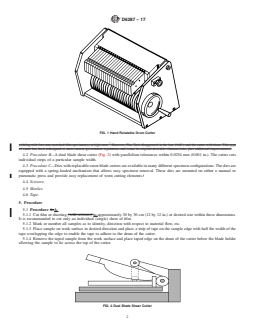
4.1 Procedure A—A hand rotatable drum cutter (Fig. 1) containing a 12.7 cm (5 in.) diameter drum with grooves at 12.7 mm
,
(0.5 in.) intervals and a blade holder allowing a blade to ride in each groove or be raised above the groove.
NOTE 3—Plas-Tech in Boston offered a rotary drum cutter in the 1950’s and 1960’s which was shown to be an excellent instrument with respect to
This practice is under the jurisdiction of ASTM Committee D20 on Plastics and is the direct responsibility of Subcommittee D20.19 on Film and SheetingFilm, Sheeting,
and Molded Products.
Current edition approved Sept. 1, 2009Dec. 15, 2017. Published September 2009January 2018. Originally approved in 1998. Last previous edition approved in 20052009
as D6287 - 05.D6287 - 09. DOI: 10.1520/D6287-09.10.1520/D6287-17.
This practice does not cover all types of techniques which may be used for cutting film and sheeting specimens.
For referenced ASTM standards, visit the ASTM website, www.astm.org, or contact ASTM Customer Service at service@astm.org. For Annual Book of ASTM Standards
volume information, refer to the standard’s Document Summary page on the ASTM website.
The last approved version of this historical standard is referenced on www.astm.org.
*A Summary of Changes section appears at the end of this standard
Copyright © ASTM International, 100 Barr Harbor Drive, PO Box C700, West Conshohocken, PA 19428-2959. United States
D6287 − 17
FIG. 1 Hand Rotatable Drum Cutter
yielding nick free non-stretched film specimen(s) at high rates. However, Plas-Tech disappeared in the late 1960’s and the cutter with them. This type
of cutter has been redesigned to meet current government regulations and retain its original desirable characteristics plus additional improvements.
4.2 Procedure B—A dual blade shear cutter (Fig. 2) with parallelism tolerances within 0.0254 mm (0.001 in.). The cutter cuts
individual strips of a particular sample width.
4.3 Procedure C—Dies with replacable razor-blade cutters are available in many different specimen configurations. The dies are
equipped with a spring-loaded mechanism that allows easy specimen removal. These dies are mounted on either a manual or
,
pneumatic press and provide easy replacement of worn cutting elements.
4.4 Scissors.
4.5 Marker.
4.6 Tape.
5. Procedure
5.1 Procedure A:A:
5.1.1 Cut film or sheeting (with scissors) to approximately 30 by 30 cm (12 by 12 in.) or desired size within these dimensions.
It is recommended to cut only an individual (single) sheet of film.
5.1.2 Mark or number all samples as to identity, direction with respect
...