

ASTM D7400/D7400M-19
(Test Method)Standard Test Methods for Downhole Seismic Testing
General Information
- Abstract
SIGNIFICANCE AND USE
5.1 The seismic downhole method provides a designer with information pertinent to the seismic wave velocities of the materials in question (1)3. The P-wave and S-wave velocities are directly related to the important geotechnical elastic constants of Poisson’s ratio, shear modulus, bulk modulus, and Young’s modulus. Accurate in-situ P-wave and S-wave velocity profiles are essential in geotechnical foundation designs. These parameters are used in both analyses of soil behavior under both static and dynamic loads where the elastic constants are input variables into the models defining the different states of deformations such as elastic, elasto-plastic, and failure. Another important use of estimated shear wave velocities in geotechnical design is in the liquefaction assessment of soils.
5.2 A fundamental assumption inherent in the test methods is that a laterally homogeneous medium is being characterized. In a laterally homogeneous medium the source wave train trajectories adhere to Snell’s law of refraction. Another assumption inherent in the test methods is that the stratigraphic medium to be characterized can have transverse isotropy. Transverse isotropy is a particularly simple form of anisotropy because velocities only vary with vertical incidence angle and not with azimuth. By placing and actuating the seismic source at offsets rotated 90° in plan view, it may be possible to confirm that a more complex model is needed to evaluate the field data.
5.3 In soft saturated soil, where the P-wave velocity of the soil is less than the P-wave velocity of water, which is about 1450 m/s [4750 ft/s], the P-wave velocity measurement will primarily be controlled by the P-wave velocity of water and a direct measurement of the soil P-wave velocity will not be possible.
Note 1: The quality of the results produced by this standard is dependent on the competence of the personnel performing it, and the suitability of the equipment and facilities. Agencies that meet the crit...
SCOPE
1.1 These test methods address compression (P) and shear (S) waves propagating in the downward direction in a nearly vertical plane. The seismic waves can be denoted as PV or PZ for a downward propagating compression wave and as SVH or SZX for downward propagating and horizontally polarized shear wave. The SVH or SZX is also referred to as an SH wave. These test methods are limited to the determination of the interval velocities from arrival times and relative arrival times of compression (P) waves and vertically (SV) and horizontally (SH) oriented shear (S) seismic waves which are generated near surface and travel down to an array of vertically installed seismic sensors. Two methods are discussed, which include using either one or two downhole sensors (receivers).
1.2 Various applications of the data will be addressed and acceptable procedures and equipment, such as seismic sources, receivers, and recording systems will be discussed. Other items addressed include source-to-receiver spacing, drilling, casing, grouting, a procedure for borehole installation, and conducting actual borehole and seismic cone tests. Data reduction and interpretation is limited to the identification of various seismic wave types, apparent velocity relation to true velocity, example computations, use of Snell's law of refraction, and assumptions.
1.3 There are several acceptable devices that can be used to generate a high-quality P or SV source wave or both and SH source waves. Several types of commercially available receivers and recording systems can also be used to conduct an acceptable downhole survey. Special consideration should be given to the types of receivers used and their configuration to provide an output that accurately reflects the input motion. These test methods primarily concern the actual test procedure, data interpretation, and specifications for equipment which will yield uniform test results.
1.4 All recorded and ...
- Status
- Published
- Publication Date
- 31-Jan-2019
- Technical Committee
- D18 - Soil and Rock
- Drafting Committee
- D18.09 - Cyclic and Dynamic Properties of Soils
Overview
ASTM D7400/D7400M-19: Standard Test Methods for Downhole Seismic Testing establishes procedures for measuring the in-situ velocity of seismic compression (P) and shear (S) waves in soils and rocks. This testing method is essential for characterizing geotechnical elastic properties and is widely adopted in foundation and site investigation work. By directly measuring P-wave and S-wave velocities, engineers and geotechnical professionals obtain critical data to compute elastic constants such as Poisson’s ratio, shear modulus, bulk modulus, and Young’s modulus. The resulting seismic velocity profiles are crucial for sound geotechnical foundation design and dynamic soil analysis.
Key Topics
- Seismic Wave Types: The standard covers the measurement of both downward-propagating compression waves (P-waves) and horizontally (SH) or vertically (SV) polarized shear waves using borehole or cone penetrometer tests.
- Test Methods: Two main testing approaches are addressed:
- Using a single downhole sensor
- Using two downhole sensors for improved accuracy
- Apparatus and Equipment: Acceptable seismic sources (e.g., explosives, hammers), various types of seismic receivers (geophones and accelerometers), and data recording systems are all described, with criteria for selection and configuration to ensure accurate results.
- Test Procedure: Guidance includes borehole preparation, casing and grouting techniques, installation of seismic sensors, and systematic data collection at specified intervals and depths.
- Data Analysis: Procedures for interpreting seismic arrivals, calculating interval velocities, applying Snell’s law of refraction, and quality assurance in data recording and reduction.
Applications
- Foundation and Site Characterization: Downhole seismic testing provides high-quality data for determining the dynamic and elastic properties of the subsurface, which informs safe and efficient foundation design.
- Liquefaction Assessment: Accurate shear wave velocity profiles are invaluable for evaluating the susceptibility of soils to liquefaction under seismic loading.
- Soil Behavior Analysis: Using measured P-wave and S-wave velocities, engineers model soil behavior under static and dynamic loads, critical for the stability assessment of structures.
- Geotechnical Modeling: The derived velocities are used in advanced soil models representing different states of deformation, such as elastic and elasto-plastic conditions, as well as failure modes.
- Quality Assurance for Construction and Engineering Projects: Ensures that site investigations adhere to industry best practices, supporting reliable design and construction outcomes.
Related Standards
- ASTM D653: Terminology relating to soil, rock, and contained fluids.
- ASTM D3740: Practice for minimum requirements for agencies engaged in geotechnical testing and inspection.
- ASTM D4428/D4428M: Standard test methods for crosshole seismic testing, a complementary approach to downhole methods.
- ASTM D5778: Electronic friction cone and piezocone penetration testing, which may be used in conjunction with seismic testing.
- ASTM D6026: Practice for using significant digits in geotechnical data.
Practical Value
Implementing ASTM D7400/D7400M-19 ensures uniformity and repeatability in downhole seismic testing, maximizes the accuracy of subsurface profiles, and aligns site investigation procedures with recognized international standards. Data yielded from these methods play an essential role in risk mitigation, cost-effective design, and regulatory compliance within civil engineering, infrastructure, and geotechnical projects.
Keywords: ASTM D7400, downhole seismic testing, P-wave velocity, S-wave velocity, geotechnical elastic constants, shear wave velocity, site characterization, liquefaction assessment, dynamic soil analysis, seismic site investigation, foundation design, seismic testing standards.
Relations
- Effective Date
- 01-Feb-2019
- Effective Date
- 01-Nov-2023
- Effective Date
- 01-Jun-2020
- Effective Date
- 01-Oct-2019
- Effective Date
- 01-Aug-2014
- Effective Date
- 01-May-2012
- Effective Date
- 01-Mar-2012
- Effective Date
- 01-Jan-2012
- Effective Date
- 01-Sep-2011
- Effective Date
- 01-Sep-2011
- Effective Date
- 01-Mar-2010
- Effective Date
- 01-Jan-2009
- Effective Date
- 01-Dec-2008
- Effective Date
- 01-Nov-2008
- Effective Date
- 01-Mar-2008
Get Certified
Connect with accredited certification bodies for this standard

BSMI (Bureau of Standards, Metrology and Inspection)
Taiwan's standards and inspection authority.
Sponsored listings
Frequently Asked Questions
ASTM D7400/D7400M-19 is a standard published by ASTM International. Its full title is "Standard Test Methods for Downhole Seismic Testing". This standard covers: SIGNIFICANCE AND USE 5.1 The seismic downhole method provides a designer with information pertinent to the seismic wave velocities of the materials in question (1)3. The P-wave and S-wave velocities are directly related to the important geotechnical elastic constants of Poisson’s ratio, shear modulus, bulk modulus, and Young’s modulus. Accurate in-situ P-wave and S-wave velocity profiles are essential in geotechnical foundation designs. These parameters are used in both analyses of soil behavior under both static and dynamic loads where the elastic constants are input variables into the models defining the different states of deformations such as elastic, elasto-plastic, and failure. Another important use of estimated shear wave velocities in geotechnical design is in the liquefaction assessment of soils. 5.2 A fundamental assumption inherent in the test methods is that a laterally homogeneous medium is being characterized. In a laterally homogeneous medium the source wave train trajectories adhere to Snell’s law of refraction. Another assumption inherent in the test methods is that the stratigraphic medium to be characterized can have transverse isotropy. Transverse isotropy is a particularly simple form of anisotropy because velocities only vary with vertical incidence angle and not with azimuth. By placing and actuating the seismic source at offsets rotated 90° in plan view, it may be possible to confirm that a more complex model is needed to evaluate the field data. 5.3 In soft saturated soil, where the P-wave velocity of the soil is less than the P-wave velocity of water, which is about 1450 m/s [4750 ft/s], the P-wave velocity measurement will primarily be controlled by the P-wave velocity of water and a direct measurement of the soil P-wave velocity will not be possible. Note 1: The quality of the results produced by this standard is dependent on the competence of the personnel performing it, and the suitability of the equipment and facilities. Agencies that meet the crit... SCOPE 1.1 These test methods address compression (P) and shear (S) waves propagating in the downward direction in a nearly vertical plane. The seismic waves can be denoted as PV or PZ for a downward propagating compression wave and as SVH or SZX for downward propagating and horizontally polarized shear wave. The SVH or SZX is also referred to as an SH wave. These test methods are limited to the determination of the interval velocities from arrival times and relative arrival times of compression (P) waves and vertically (SV) and horizontally (SH) oriented shear (S) seismic waves which are generated near surface and travel down to an array of vertically installed seismic sensors. Two methods are discussed, which include using either one or two downhole sensors (receivers). 1.2 Various applications of the data will be addressed and acceptable procedures and equipment, such as seismic sources, receivers, and recording systems will be discussed. Other items addressed include source-to-receiver spacing, drilling, casing, grouting, a procedure for borehole installation, and conducting actual borehole and seismic cone tests. Data reduction and interpretation is limited to the identification of various seismic wave types, apparent velocity relation to true velocity, example computations, use of Snell's law of refraction, and assumptions. 1.3 There are several acceptable devices that can be used to generate a high-quality P or SV source wave or both and SH source waves. Several types of commercially available receivers and recording systems can also be used to conduct an acceptable downhole survey. Special consideration should be given to the types of receivers used and their configuration to provide an output that accurately reflects the input motion. These test methods primarily concern the actual test procedure, data interpretation, and specifications for equipment which will yield uniform test results. 1.4 All recorded and ...
SIGNIFICANCE AND USE 5.1 The seismic downhole method provides a designer with information pertinent to the seismic wave velocities of the materials in question (1)3. The P-wave and S-wave velocities are directly related to the important geotechnical elastic constants of Poisson’s ratio, shear modulus, bulk modulus, and Young’s modulus. Accurate in-situ P-wave and S-wave velocity profiles are essential in geotechnical foundation designs. These parameters are used in both analyses of soil behavior under both static and dynamic loads where the elastic constants are input variables into the models defining the different states of deformations such as elastic, elasto-plastic, and failure. Another important use of estimated shear wave velocities in geotechnical design is in the liquefaction assessment of soils. 5.2 A fundamental assumption inherent in the test methods is that a laterally homogeneous medium is being characterized. In a laterally homogeneous medium the source wave train trajectories adhere to Snell’s law of refraction. Another assumption inherent in the test methods is that the stratigraphic medium to be characterized can have transverse isotropy. Transverse isotropy is a particularly simple form of anisotropy because velocities only vary with vertical incidence angle and not with azimuth. By placing and actuating the seismic source at offsets rotated 90° in plan view, it may be possible to confirm that a more complex model is needed to evaluate the field data. 5.3 In soft saturated soil, where the P-wave velocity of the soil is less than the P-wave velocity of water, which is about 1450 m/s [4750 ft/s], the P-wave velocity measurement will primarily be controlled by the P-wave velocity of water and a direct measurement of the soil P-wave velocity will not be possible. Note 1: The quality of the results produced by this standard is dependent on the competence of the personnel performing it, and the suitability of the equipment and facilities. Agencies that meet the crit... SCOPE 1.1 These test methods address compression (P) and shear (S) waves propagating in the downward direction in a nearly vertical plane. The seismic waves can be denoted as PV or PZ for a downward propagating compression wave and as SVH or SZX for downward propagating and horizontally polarized shear wave. The SVH or SZX is also referred to as an SH wave. These test methods are limited to the determination of the interval velocities from arrival times and relative arrival times of compression (P) waves and vertically (SV) and horizontally (SH) oriented shear (S) seismic waves which are generated near surface and travel down to an array of vertically installed seismic sensors. Two methods are discussed, which include using either one or two downhole sensors (receivers). 1.2 Various applications of the data will be addressed and acceptable procedures and equipment, such as seismic sources, receivers, and recording systems will be discussed. Other items addressed include source-to-receiver spacing, drilling, casing, grouting, a procedure for borehole installation, and conducting actual borehole and seismic cone tests. Data reduction and interpretation is limited to the identification of various seismic wave types, apparent velocity relation to true velocity, example computations, use of Snell's law of refraction, and assumptions. 1.3 There are several acceptable devices that can be used to generate a high-quality P or SV source wave or both and SH source waves. Several types of commercially available receivers and recording systems can also be used to conduct an acceptable downhole survey. Special consideration should be given to the types of receivers used and their configuration to provide an output that accurately reflects the input motion. These test methods primarily concern the actual test procedure, data interpretation, and specifications for equipment which will yield uniform test results. 1.4 All recorded and ...
ASTM D7400/D7400M-19 is classified under the following ICS (International Classification for Standards) categories: 17.160 - Vibrations, shock and vibration measurements. The ICS classification helps identify the subject area and facilitates finding related standards.
ASTM D7400/D7400M-19 has the following relationships with other standards: It is inter standard links to ASTM D7400-17, ASTM D3740-23, ASTM D5778-20, ASTM D3740-19, ASTM D653-14, ASTM D3740-12a, ASTM D3740-12, ASTM D5778-12, ASTM D3740-11, ASTM D653-11, ASTM D3740-10, ASTM D653-09, ASTM D653-08a, ASTM D653-08, ASTM D3740-08. Understanding these relationships helps ensure you are using the most current and applicable version of the standard.
ASTM D7400/D7400M-19 is available in PDF format for immediate download after purchase. The document can be added to your cart and obtained through the secure checkout process. Digital delivery ensures instant access to the complete standard document.
Standards Content (Sample)
This international standard was developed in accordance with internationally recognized principles on standardization established in the Decision on Principles for the
Development of International Standards, Guides and Recommendations issued by the World Trade Organization Technical Barriers to Trade (TBT) Committee.
Designation: D7400/D7400M − 19
Standard Test Methods for
Downhole Seismic Testing
This standard is issued under the fixed designation D7400/D7400M; the number immediately following the designation indicates the
year of original adoption or, in the case of revision, the year of last revision. A number in parentheses indicates the year of last
reapproval. A superscript epsilon (´) indicates an editorial change since the last revision or reapproval.
1. Scope* 1.4.1 Theproceduresusedtospecifyhowdataarecollected/
recorded and calculated in these test methods are regarded as
1.1 These test methods address compression (P) and shear
theindustrystandard.Inaddition,theyarerepresentativeofthe
(S) waves propagating in the downward direction in a nearly
significant digits that should generally be retained. The proce-
vertical plane. The seismic waves can be denoted as P or P
V Z
dures used do not consider material variation, purpose for
for a downward propagating compression wave and as S or
VH
obtaining the data, special purpose studies, or any consider-
S for downward propagating and horizontally polarized
ZX
ations for the user’s objectives; and it is common practice to
shear wave. The S or S is also referred to as an S wave.
VH ZX H
These test methods are limited to the determination of the
increase or reduce significant digits of reported data to be
interval velocities from arrival times and relative arrival times
commensuratewiththeseconsiderations.Itisbeyondthescope
of compression (P) waves and vertically (SV) and horizontally
of these test methods to consider significant digits used in
(SH) oriented shear (S) seismic waves which are generated
analysis methods for engineering design.
near surface and travel down to an array of vertically installed
1.4.2 Measurements made to more significant digits or
seismic sensors. Two methods are discussed, which include
better sensitivity than specified in these test methods shall not
using either one or two downhole sensors (receivers).
be regarded a nonconformance with this standard.
1.2 Various applications of the data will be addressed and
1.5 Units—The values stated in either SI units or inch-
acceptable procedures and equipment, such as seismic sources,
pound units are to be regarded separately as standard. The
receivers,andrecordingsystemswillbediscussed.Otheritems
values stated in each system may not be exact equivalents;
addressed include source-to-receiver spacing, drilling, casing,
therefore,eachsystemshallbeusedindependentlyoftheother.
grouting, a procedure for borehole installation, and conducting
Combining values from the two systems may result in non-
actual borehole and seismic cone tests. Data reduction and
conformance with the standard.
interpretation is limited to the identification of various seismic
wavetypes,apparentvelocityrelationtotruevelocity,example
1.5.1 The gravitational system of inch-pound units is used
computations, use of Snell’s law of refraction, and assump-
when dealing with inch-pound units. In this system, the pound
tions.
(lbf) represents a unit of force (weight), while the unit for mass
1.3 There are several acceptable devices that can be used to isslugs.Therationalizedslugunitisnotgiven,unlessdynamic
generate a high-quality P or SV source wave or both and SH (F = ma) calculations are involved.
source waves. Several types of commercially available receiv-
1.5.2 It is common practice in the engineering/construction
ers and recording systems can also be used to conduct an
profession to concurrently use pounds to represent both a unit
acceptable downhole survey. Special consideration should be
of mass (lbm) and of force (lbf). This implicitly combines two
given to the types of receivers used and their configuration to
separate systems of units; that is, the absolute system and the
provide an output that accurately reflects the input motion.
gravitational system. It is scientifically undesirable to combine
Thesetestmethodsprimarilyconcerntheactualtestprocedure,
the use of two separate sets of inch-pound units within a single
datainterpretation,andspecificationsforequipmentwhichwill
standard. As stated, this standard includes the gravitational
yield uniform test results.
system of inch-pound units and does not use/present the slug
1.4 All recorded and calculated values shall conform to the
unit for mass. However, the use of balances or scales recording
guide for significant digits and rounding established in Practice
pounds of mass (lbm) or recording density in lbm/ft shall not
D6026.
be regarded as nonconformance with this standard.
1.6 This standard does not purport to address all of the
ThistestmethodisunderthejurisdictionofASTMCommitteeD18onSoiland
Rock and is the direct responsibility of Subcommittee D18.09 on Cyclic and safety concerns, if any, associated with its use. It is the
Dynamic Properties of Soils.
responsibility of the user of this standard to establish appro-
Current edition approved Feb. 1, 2019. Published February 2019. Originally
priate safety, health, and environmental practices and deter-
approved in 2007. Last previous edition approved in 2017 as D7400 – 17. DOI:
10.1520/D7400_D7400M-19. mine the applicability of regulatory limitations prior to use.
*A Summary of Changes section appears at the end of this standard
Copyright © ASTM International, 100 Barr Harbor Drive, PO Box C700, West Conshohocken, PA 19428-2959. United States
D7400/D7400M − 19
1.7 This international standard was developed in accor- 5. Significance and Use
dance with internationally recognized principles on standard-
5.1 The seismic downhole method provides a designer with
ization established in the Decision on Principles for the
information pertinent to the seismic wave velocities of the
Development of International Standards, Guides and Recom- 3
materials in question (1) . The P-wave and S-wave velocities
mendations issued by the World Trade Organization Technical
are directly related to the important geotechnical elastic con-
Barriers to Trade (TBT) Committee.
stants of Poisson’s ratio, shear modulus, bulk modulus, and
Young’s modulus. Accurate in-situ P-wave and S-wave veloc-
2. Referenced Documents
ity profiles are essential in geotechnical foundation designs.
These parameters are used in both analyses of soil behavior
2.1 ASTM Standards:
underbothstaticanddynamicloadswheretheelasticconstants
D653 Terminology Relating to Soil, Rock, and Contained
are input variables into the models defining the different states
Fluids
of deformations such as elastic, elasto-plastic, and failure.
D3740 Practice for Minimum Requirements for Agencies
Another important use of estimated shear wave velocities in
Engaged in Testing and/or Inspection of Soil and Rock as
geotechnical design is in the liquefaction assessment of soils.
Used in Engineering Design and Construction
D4428/D4428M Test Methods for Crosshole Seismic Test-
5.2 A fundamental assumption inherent in the test methods
ing
is that a laterally homogeneous medium is being characterized.
D5778 Test Method for Electronic Friction Cone and Piezo-
In a laterally homogeneous medium the source wave train
cone Penetration Testing of Soils
trajectories adhere to Snell’s law of refraction. Another as-
D6026 Practice for Using Significant Digits in Geotechnical
sumption inherent in the test methods is that the stratigraphic
Data
medium to be characterized can have transverse isotropy.
Transverse isotropy is a particularly simple form of anisotropy
3. Terminology
because velocities only vary with vertical incidence angle and
not with azimuth. By placing and actuating the seismic source
3.1 Definitions:
atoffsetsrotated90°inplanview,itmaybepossibletoconfirm
3.1.1 For definitions of common technical terms in this
that a more complex model is needed to evaluate the field data.
standard, refer to Terminology D653.
5.3 In soft saturated soil, where the P-wave velocity of the
3.2 Definitions of Terms Specific to This Standard:
soil is less than the P-wave velocity of water, which is about
3.2.1 seismic wave train—the recorded motion of a seismic
1450 m/s [4750 ft/s], the P-wave velocity measurement will
disturbance with time.
primarily be controlled by the P-wave velocity of water and a
direct measurement of the soil P-wave velocity will not be
4. Summary of Test Method
possible.
NOTE 1—The quality of the results produced by this standard is
4.1 TheDownholeSeismicTestmakesdirectmeasurements
dependent on the competence of the personnel performing it, and the
of compression (P-) or shear (S-) wave velocities, or both, in a
suitability of the equipment and facilities. Agencies that meet the criteria
boreholeadvancedthroughsoilorrockorinaconepenetration
of Practice D3740 are generally considered capable of competent and
test sounding. It is similar in several respects to the Crosshole
objective testing/sampling/inspection/etc. Users of this standard are cau-
tioned that compliance with Practice D3740 does not in itself assure
Seismic Test Method (Test Methods D4428/D4428M). A
reliable results. Reliable results depend on many factors; Practice D3740
seismic source is used to generate a seismic wave train at the
provides a means of evaluating some of those factors.
ground surface offset horizontally from the top of a cased
borehole. Downhole receivers are used to detect the arrival of
6. Apparatus
the seismic wave train. The downhole receiver(s) may be
6.1 The basic data acquisition system consists of the fol-
positioned at selected test depths in a borehole or advanced as
lowing:
part of the instrumentation package on an electronic cone
6.1.1 Energy Sources—These energy sources are chosen
penetrometer (Test Method D5778). The seismic source is
according to the needs of the survey, the primary consideration
connected to and triggers a data recording system that records
being whether P-wave or S-wave velocities are to be deter-
the response of the downhole receiver(s), thus measuring the
mined. The source should be rich in the type of energy
travel time of the wave train between the source and receiv-
required, that is, to produce good P-wave data, the energy
er(s). Measurements of the arrival times (travel time from
source must transmit adequate energy to the medium in
source to sensor) of the generated P- and S- waves are then
compression or volume change. Impulsive sources, such as
–4
made so that the low strain (<10 %) in-situ P-wave and
explosives, hammers, or air guns, are all acceptable P-wave
S-wave velocities can be determined. The calculated seismic
generators. To produce an identifiable S wave, the source
velocities are used to characterize the natural or man-made (or
should transmit energy to the ground with a particle motion
both) properties of the stratigraphic profile.
perpendicularortransversetotheaxisofthesurvey.Impulseor
vibratory S-wave sources are acceptable, but the source must
be repeatable and, although not mandatory, reversible.
For referenced ASTM standards, visit the ASTM website, www.astm.org, or
contact ASTM Customer Service at service@astm.org. For Annual Book of ASTM
Standards volume information, refer to the standard’s Document Summary page on The boldface numbers in parentheses refer to a list of references at the end of
the ASTM website. this standard.
D7400/D7400M − 19
6.1.1.1 Shear Beam—Ashear beam is a common form of an a seismic wave train that has the opposite polarity relative to
SH-wave energy source (2). The beam can be metal or wood, thewavetrainproducedatthefirstend.Fig.1showsadiagram
and may be encased at the ends and bottom with a steel plate.
of the typical shear beam configuration that will produce
Strike plates may optionally be provided at the beam ends.The
SH-wave trains. Fig. 2 shows an example of an impulse
bottomplatemayoptionallyhavecleatstopenetratetheground
seismic source wave train that contains both P- and S-wave
and to prevent sliding when struck.Acommonly utilized shear
components.Although the shear beam of dimensions 2.4 m [8
beam has approximate dimensions of 2.4 m [8 ft] long by 150
ft] long by 150 mm [6 in.] wide is commonly utilized, it may
mm [6 in.] wide. The center of the shear beam is placed on the
be desirable to implement beams of shorter length so that
ground at a horizontal offset ranging from 1 to4m[3to12ft]
SH-sourcemorecloselyapproximatesa“pointsource”fortests
from the receiver borehole (or cone insertion point). This
less than 20 m [60 ft] in depth. The “point source” SH-wave
horizontal offset should be selected carefully since borehole
beam allows for the accurate specification of the source
disturbance, rod noise, and refraction through layers with
Cartesian location (x, y, and z coordinates) which is required
significantly different properties may impact the test results.
forthesubsequentintervalvelocitycalculation.Forexample,if
Larger horizontal offsets of 4 to 6 m [12 to 20 ft] for the
a large SH-hammer beam is utilized, it becomes difficult to
seismic source may be necessary to avoid response effects due
specify the exact location of the seismic source. In addition, it
to surface or near-surface features. In this case the possibility
is preferable to initially excite a small area if complex
of raypath refraction must be taken into account. The ends of
stratigraphy exist and shorter SH-hammer beams mitigate
the beam should be positioned equidistant from the receiver
problems arising from poor beam-ground coupling.
borehole. The shear beam is typically then loaded by the axle
loadofvehiclewheelsorthelevelingjacksoftheconerig.The
NOTE 2—The ranges of dimensions and hammer units shown in Fig. 1
ground should be level enough to provide good continuous are examples of typical energy source configurations but are not the only
means to produce acceptable seismic wave trains. In this typical case,
contact along the whole length of the beam to ensure good
heavier hammers and longer pivot arms will generally produce higher
coupling between the beam and the ground. Beam-to-ground
energy wave trains and deeper penetration into the soil and rock as long
coupling should be accomplished by scraping the ground level
as ground coupling with the shear beam is maintained.
to a smooth, intact surface. Backfilling to create a flat spot will
6.1.2 Receivers—In the downhole seismic test, the seismic
not provide good beam-ground coupling and should be
receivers are installed vertically with depth within a borehole
avoided. The shear beam is typically struck on a strike plate at
one end using a nominal 1- to 15-kg [2- to 33-lb] hammer to or as part of the instrumentation in a cone penetrometer probe.
produce a seismic wave train. Striking the other end will create The receivers intended for use in the downhole test shall be
FIG. 1 Typical Downhole Shear Wave Source (Produces SH- Wave Train)
D7400/D7400M − 19
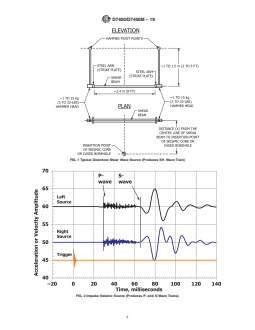
FIG. 2 Impulse Seismic Source (Produces P- and S-Wave Trains)
transducers having appropriate frequency and sensitivity char- etrometer probe, there is no borehole since the container is
acteristics to determine the seismic wave train arrival and to pusheddirectlythroughthesoilsothereisalwaysfirmcontact.
provide an output that accurately reflects the input motion
The diameter of the cone penetrometer at the location of the
(both source wave and measurement noise).Typical transducer
seismic instrumentation package (transducers) should be
examples include geophones, which measure particle velocity,
greater than that of the sections immediately below the
and accelerometers, which measure particle acceleration. Both
instrumentation package to promote good coupling between
geophones and accelerometers are acceptable for downhole
the instrument and the surrounding soil.
seismic testing. High precision, low noise (operational ampli-
(1) Each receiving unit should consist of three transducers
fier integrated into sensor) accelerometers are generally more
combined orthogonally to form a triaxial array, that is, one
accurate due to their desirable transient response times (that is,
vertical and two horizontal transducers mounted at right
delay, rise and peak times (3)) and high bandwidths compared
angles, one to the other.
to geophones. Sensors with fast transient response times are
(2) While triaxial receivers are preferred, a single uniaxial
advantageous when carrying out downhole seismic testing
or biaxial receiver(s) may be used provided that care is taken
within hard rock stratigraphy and high energy ambient noise
to orient the transducer(s) in the direction most nearly parallel
environments.Thefrequencyresponseofthetransducershould
to the direction of the source for S-waves or radially for
not vary more than 5 % over a range of frequencies from 0.5 to
P-waves.
2 times the predominant frequency of the site-specific S-wave
train. The geophones should not be heavily damped to mini-
NOTE 3—The most practical ways to attempt to do this are either by
using grooved casing and receivers equipped with guides, or by using a
mize spectral smearing. The receiver section should be housed
sensor package with an internal orientation mechanism.
in a single container (cylindrical shape preferred) so that
multiple axis sensors (transducers) are located within 10 cm [4
6.1.2.1 Method A—Two Receivers—For this option, two
in.] of each other. Provision must be made for the container to
receiving units will be deployed, either as separate units
be held in firm contact with the sidewall of the borehole.
operating independently or separated vertically in the same
Examples of acceptable methods include: air bladder, wedge,
container.
stiff spring, or mechanical expander. Using a wedge to hold the
NOTE 4—Signals received in transducers separated vertically in the
sensor in place can result in erroneous data if the sensor is
same container may be impacted by transmission through the container
supported at the bottom. If a wedge is used, it should be
itself and may require special signal processing to reduce this impact.
positioned near the center of the receiver container mass. The
6.1.2.2 Method B—One Receiver—For this option, a single
receiver packages can also be grouted within the borehole
(permanent array). When using the instrumented cone pen- receiving unit will be deployed.
D7400/D7400M − 19
6.1.3 Recording System—The system shall consist of sepa-
rate recording channels, one for each transducer being
recorded, having identical phase characteristics and one chan-
nel for the trigger output is recommended. Adjustable gain
control is recommended but not required if analog-to-digital
converters have adequate dynamic range. If used, appropriate
anti-alias filtering should be applied to the sensor signals prior
to analog-to-digital conversion. No further filtering shall be
applied before data is recorded and stored. Permanent records
of the seismic events should be made, or if digital seismo-
graphs are used with no permanent hard copy print records
available on site, data should be recorded on suitable digital
media and copied to a second digital storage device for backup
before leaving the site.
6.1.3.1 Recording System Accuracy—Timing accuracy of
the recording system may be demonstrated with a calibration
by an accredited calibration laboratory either annually or
within the time frame recommended by the instrument manu-
facturer.Asanoptionalmethod,accuracymaybedemonstrated
by inducing and recording on the receiver channels an oscil-
FIG. 3 Acceptable Grouting Techniques Schematic
lating signal of 1000 Hz derived from a quartz-controlled
oscillator, which has been calibrated by an accredited labora-
tory.
sidewall (Fig. 3 side B). Another acceptable method would be
6.1.3.2 Trigger Accuracy—The triggering mechanism shall
to fill the borehole with grout which would be displaced by
be repeatable and accurate to <1 % of the approximate relative
end-capped fluid-filled casing. The grout mixture should be
arrival time. For example, if it is assumed that there will be a
formulated to approximate closely the density of the surround-
maximum 400 m/s interval velocity over a 1 m increment with
ing in situ material after solidification. That portion of the
a corresponding relative arrival time of 2.5 ms, then the timing
boring that penetrates rock should be grouted with a conven-
of the trigger shall be determined within 0.025 ms. The
tional portland cement which will harden to a density of about
repeatability and accuracy shall be determined by (1)a 3 3
2.20 Mg/m [140 lb/ft ]. That portion of the boring in contact
simultaneousdisplayofthetriggeringmechanismalongwithat
with soils, sands, or gravels should be grouted with a mixture
least one receiver, or (2) field or laboratory tests to determine
simulating the average density of the medium (about 1.80 to
3 3
thelapsedtimebetweenthetriggerclosureanddevelopmentof
1.90 Mg/m [110 to 120 lb/ft ] by premixing 450 g [1 lb] of
that voltage required to initiate the sweep on an oscilloscope,
bentonite and 450 g [1 lb] of portland cement to 2.80 kg [6.25
seismograph, or dynamic signal analyzer.
lb] of water. Anchor the casing and pump the grout using a
conventional, circulating pump capable of moving the grout
7. Procedure
through the grout pipe to the bottom of the casing upw
...
This document is not an ASTM standard and is intended only to provide the user of an ASTM standard an indication of what changes have been made to the previous version. Because
it may not be technically possible to adequately depict all changes accurately, ASTM recommends that users consult prior editions as appropriate. In all cases only the current version
of the standard as published by ASTM is to be considered the official document.
Designation: D7400 − 17 D7400/D7400M − 19
Standard Test Methods for
Downhole Seismic Testing
This standard is issued under the fixed designation D7400;D7400/D7400M; the number immediately following the designation indicates
the year of original adoption or, in the case of revision, the year of last revision. A number in parentheses indicates the year of last
reapproval. A superscript epsilon (´) indicates an editorial change since the last revision or reapproval.
1. Scope*
1.1 These test methods address compression (P) and shear (S) waves propagating in the downward direction in a nearly vertical
plane. The seismic waves can be denoted as P or P for a downward propagating compression wave and as S or S for
V Z VH ZX
downward propagating and horizontally polarized shear wave. The S or S is also referred to as an S wave. These test
VH ZX H
methods are limited to the determination of the interval velocities from arrival times and relative arrival times of compression (P)
waves and vertically (SV) and horizontally (SH) oriented shear (S) seismic waves which are generated near surface and travel
down to an array of vertically installed seismic sensors. Two methods are discussed, which include using either one or two
downhole sensors (receivers).
1.2 Various applications of the data will be addressed and acceptable procedures and equipment, such as seismic sources,
receivers, and recording systems will be discussed. Other items addressed include source-to-receiver spacing, drilling, casing,
grouting, a procedure for borehole installation, and conducting actual borehole and seismic cone tests. Data reduction and
interpretation is limited to the identification of various seismic wave types, apparent velocity relation to true velocity, example
computations, use of Snell’s law of refraction, and assumptions.
1.3 There are several acceptable devices that can be used to generate a high-quality P or SV source wave or both and SH source
waves. Several types of commercially available receivers and recording systems can also be used to conduct an acceptable
downhole survey. Special consideration should be given to the types of receivers used and their configuration to provide an output
that accurately reflects the input motion. These test methods primarily concern the actual test procedure, data interpretation, and
specifications for equipment which will yield uniform test results.
1.4 All recorded and calculated values shall conform to the guide for significant digits and rounding established in Practice
D6026.
1.4.1 The procedures used to specify how data are collected/recorded and calculated in these test methods are regarded as the
industry standard. In addition, they are representative of the significant digits that should generally be retained. The procedures
used do not consider material variation, purpose for obtaining the data, special purpose studies, or any considerations for the user’s
objectives; and it is common practice to increase or reduce significant digits of reported data to be commensurate with these
considerations. It is beyond the scope of these test methods to consider significant digits used in analysis methods for engineering
design.
1.4.2 Measurements made to more significant digits or better sensitivity than specified in these test methods shall not be
regarded a nonconformance with this standard.
1.5 Units—The values stated in either SI units or inch-pound units (given in brackets) are to be regarded separately as standard.
The values stated in each system may not be exact equivalents; therefore, each system shall be used independently of the other.
Combining values from the two systems may result in non-conformance with the standard. Reporting of test results in units other
than SI shall not be regarded as non-conformance with this standard.
1.5.1 The gravitational system of inch-pound units is used when dealing with inch-pound units. In this system, the pound (lbf)
represents a unit of force (weight), while the unit for mass is slugs. The rationalized slug unit is not given, unless dynamic (F = ma)
calculations are involved.
1.5.2 It is common practice in the engineering/construction profession to concurrently use pounds to represent both a unit of
mass (lbm) and of force (lbf). This implicitly combines two separate systems of units; that is, the absolute system and the
gravitational system. It is scientifically undesirable to combine the use of two separate sets of inch-pound units within a single
This test method is under the jurisdiction of ASTM Committee D18 on Soil and Rock and is the direct responsibility of Subcommittee D18.09 on Cyclic and Dynamic
Properties of Soils.
Current edition approved Nov. 1, 2017Feb. 1, 2019. Published December 2017February 2019. Originally approved in 2007. Last previous edition approved in 20142017
as D7400 – 14.D7400 – 17. DOI: 10.1520/D7400-17.10.1520/D7400_D7400M-19.
*A Summary of Changes section appears at the end of this standard
Copyright © ASTM International, 100 Barr Harbor Drive, PO Box C700, West Conshohocken, PA 19428-2959. United States
D7400/D7400M − 19
standard. As stated, this standard includes the gravitational system of inch-pound units and does not use/present the slug unit for
mass. However, the use of balances or scales recording pounds of mass (lbm) or recording density in lbm/ft shall not be regarded
as nonconformance with this standard.
1.6 This standard does not purport to address all of the safety concerns, if any, associated with its use. It is the responsibility
of the user of this standard to establish appropriate safety, health, and environmental practices and determine the applicability of
regulatory limitations prior to use.
1.7 This international standard was developed in accordance with internationally recognized principles on standardization
established in the Decision on Principles for the Development of International Standards, Guides and Recommendations issued
by the World Trade Organization Technical Barriers to Trade (TBT) Committee.
2. Referenced Documents
2.1 ASTM Standards:
D653 Terminology Relating to Soil, Rock, and Contained Fluids
D3740 Practice for Minimum Requirements for Agencies Engaged in Testing and/or Inspection of Soil and Rock as Used in
Engineering Design and Construction
D4428/D4428M Test Methods for Crosshole Seismic Testing
D5778 Test Method for Electronic Friction Cone and Piezocone Penetration Testing of Soils
D6026 Practice for Using Significant Digits in Geotechnical Data
3. Terminology
3.1 Definitions:
3.1.1 For definitions of common technical terms in this standard, refer to Terminology D653.
3.2 Definitions of Terms Specific to This Standard:
3.2.1 seismic wave train—the recorded motion of a seismic disturbance with time.
3.2.2 shear wave—A seismic wave in which the disturbance is an elastic deformation perpendicular to the direction of motion
of the wave.
3.2.3 shear wave velocity—the speed (velocity) of a shear wave through soil or rock.
4. Summary of Test Method
4.1 The Downhole Seismic Test makes direct measurements of compression (P-) or shear (S-) wave velocities, or both, in a
borehole advanced through soil or rock or in a cone penetration test sounding. It is similar in several respects to the Crosshole
Seismic Test Method (Test Methods D4428/D4428M). A seismic source is used to generate a seismic wave train at the ground
surface offset horizontally from the top of a cased borehole. Downhole receivers are used to detect the arrival of the seismic wave
train. The downhole receiver(s) may be positioned at selected test depths in a borehole or advanced as part of the instrumentation
package on an electronic cone penetrometer (Test Method D5778). The seismic source is connected to and triggers a data recording
system that records the response of the downhole receiver(s), thus measuring the travel time of the wave train between the source
and receiver(s). Measurements of the arrival times (travel time from source to sensor) of the generated P- and S- waves are then
–4
made so that the low strain (<10 %) in-situ P-wave and S-wave velocities can be determined. The calculated seismic velocities
are used to characterize the natural or man-made (or both) properties of the stratigraphic profile.
5. Significance and Use
5.1 The seismic downhole method provides a designer with information pertinent to the seismic wave velocities of the materials
in question (1) . The P-wave and S-wave velocities are directly related to the important geotechnical elastic constants of Poisson’s
ratio, shear modulus, bulk modulus, and Young’s modulus. Accurate in-situ P-wave and S-wave velocity profiles are essential in
geotechnical foundation designs. These parameters are used in both analyses of soil behavior under both static and dynamic loads
where the elastic constants are input variables into the models defining the different states of deformations such as elastic,
elasto-plastic, and failure. Another important use of estimated shear wave velocities in geotechnical design is in the liquefaction
assessment of soils.
5.2 A fundamental assumption inherent in the test methods is that a laterally homogeneous medium is being characterized. In
a laterally homogeneous medium the source wave train trajectories adhere to Snell’s law of refraction. Another assumption inherent
in the test methods is that the stratigraphic medium to be characterized can have transverse isotropy. Transverse isotropy is a
particularly simple form of anisotropy because velocities only vary with vertical incidence angle and not with azimuth. By placing
For referenced ASTM standards, visit the ASTM website, www.astm.org, or contact ASTM Customer Service at service@astm.org. For Annual Book of ASTM Standards
volume information, refer to the standard’s Document Summary page on the ASTM website.
The boldface numbers in parentheses refer to a list of references at the end of this standard.
D7400/D7400M − 19
and actuating the seismic source at offsets rotated 90° in plan view, it may be possible to evaluate the transverse anisotropy of the
medium.confirm that a more complex model is needed to evaluate the field data.
5.3 In soft saturated soil, where the P-wave velocity of the soil is less than the P-wave velocity of water, which is about 1450
m/s [4750 ft/s], the P-wave velocity measurement will primarily be controlled by the P-wave velocity of water and a direct
measurement of the soil P-wave velocity will not be possible.
NOTE 1—The quality of the results produced by this standard is dependent on the competence of the personnel performing it, and the suitability of the
equipment and facilities. Agencies that meet the criteria of Practice D3740 are generally considered capable of competent and objective
testing/sampling/inspection/etc. Users of this standard are cautioned that compliance with Practice D3740 does not in itself assure reliable results. Reliable
results depend on many factors; Practice D3740 provides a means of evaluating some of those factors.
6. Apparatus
6.1 The basic data acquisition system consists of the following:
6.1.1 Energy Sources—These energy sources are chosen according to the needs of the survey, the primary consideration being
whether P-wave or S-wave velocities are to be determined. The source should be rich in the type of energy required, that is, to
produce good P-wave data, the energy source must transmit adequate energy to the medium in compression or volume change.
Impulsive sources, such as explosives, hammers, or air guns, are all acceptable P-wave generators. To produce an identifiable S
wave, the source should transmit energy to the ground with a particle motion perpendicular or transverse to the axis of the survey.
Impulse or vibratory S-wave sources are acceptable, but the source must be repeatable and, although not mandatory, reversible.
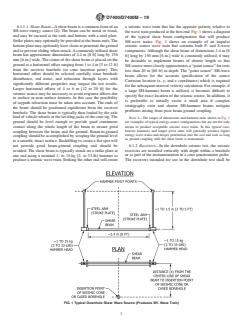
6.1.1.1 Shear Beam—A shear beam is a common form of an SH-wave energy source (2). The beam can be metal or wood, and
may be encased at the ends and bottom with a steel plate. Strike plates may optionally be provided at the beam ends. The bottom
plate may optionally have cleats to penetrate the ground and to prevent sliding when struck. A commonly utilized shear beam has
approximate dimensions of 2.4 m [8 ft] long by 150 mm [6 in.] wide. The center of the shear beam is placed on the ground at a
horizontal offset ranging from 1 to 4 m [3 to 12 ft] from the receiver borehole (or cone insertion point). This horizontal offset should
be selected carefully since borehole disturbance, rod noise, and refraction through layers with significantly different properties may
impact the test results. Larger horizontal offsets of 4 to 6 m [12 to 20 ft] for the seismic source may be necessary to avoid response
effects due to surface or near-surface features. In this case the possibility of raypath refraction must be taken into account. The ends
of the beam should be positioned equidistant from the receiver borehole. The shear beam is typically then loaded by the axle load
of vehicle wheels or the leveling jacks of the cone rig. The ground should be level enough to provide good continuous contact along
the whole length of the beam to ensure good coupling between the beam and the ground. Beam-to-ground coupling should be
accomplished by scraping the ground level to a smooth, intact surface. Backfilling to create a flat spot will not provide good
beam-ground coupling and should be avoided. The shear beam is typically struck on a strike plate at one end using a nominal 1-
to 15-kg [2- to 33-lb] hammer to produce a seismic wave train. Striking the other end will create a seismic wave train that has the
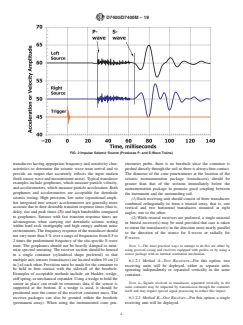
opposite polarity relative to the wave train produced at the first end. Fig. 1 shows a diagram of the typical shear beam configuration
that will produce SH-wave trains. Fig. 2 shows an example of an impulse seismic source wave train that contains both P- and
S-wave components. Although the shear beam of dimensions 2.4 m [8 ft] long by 150 mm [6 in.] wide is commonly utilized, it
may be desirable to implement beams of shorter length so that SH-source more closely approximates a “point source” for tests less
than 20 m [60 ft] in depth. The “point source” SH-wave beam allows for the accurate specification of the source Cartesian location
(x, y, and z coordinates) which is required for the subsequent interval velocity calculation. For example, if a large SH-hammer
beam is utilized, it becomes difficult to specify the exact location of the seismic source. In addition, it is preferable to initially excite
a small area if complex stratigraphy exist and shorter SH-hammer beams mitigate problems arising from poor beam-ground
coupling.
NOTE 2—The ranges of dimensions and hammer units shown in Fig. 1 are examples of typical energy source configurations but are not the only means
to produce acceptable seismic wave trains. In this typical case, heavier hammers and longer pivot arms will generally produce higher energy wave trains
and deeper penetration into the soil and rock as long as ground coupling with the shear beam is maintained.
6.1.2 Receivers—In the downhole seismic test, the seismic receivers are installed vertically with depth within a borehole or as
part of the instrumentation in a cone penetrometer probe. The receivers intended for use in the downhole test shall be transducers
having appropriate frequency and sensitivity characteristics to determine the seismic wave train arrival and to provide an output
that accurately reflects the input motion (both source wave and measurement noise). Typical transducer examples include
geophones, which measure particle velocity, and accelerometers, which measure particle acceleration. Both geophones and
accelerometers are acceptable for downhole seismic testing. High precision, low noise (operational amplifier integrated into sensor)
accelerometers are generally more accurate due to their desirable transient response times (that is, delay, rise and peak times (3))
and high bandwidths compared to geophones. Sensors with fast transient response times are advantageous when carrying out
downhole seismic testing within hard rock stratigraphy and high energy ambient noise environments. The frequency response of
the transducer should not vary more than 5 % over a range of frequencies from 0.5 to 2 times the predominant frequency of the
site-specific S-wave train. The geophones should not be heavily damped to minimize spectral smearing. The receiver section
should be housed in a single container (cylindrical shape preferred) so that multiple axis sensors (transducers) are located within
10 cm [4 in.] of each other. Provision must be made for the container to be held in firm contact with the sidewall of the borehole.
Examples of acceptable methods include: air bladder, wedge, stiff spring, or mechanical expander. Using a wedge to hold the
D7400/D7400M − 19
FIG. 1 Typical Downhole Shear Wave Source (Produces SH- Wave Train)
FIG. 2 Impulse Seismic Source (Produces P- and S-Wave Trains)
D7400/D7400M − 19
sensor in place can result in erroneous data if the sensor is supported at the bottom. If a wedge is used, it should be positioned
near the center of the receiver container mass. The receiver packages can also be grouted within the borehole (permanent array).
When using the instrumented cone penetrometer probe, there is no borehole since the container is pushed directly through the soil
so there is always firm contact. The diameter of the cone penetrometer at the location of the seismic instrumentation package
(transducers) should be greater than that of the sections immediately below the instrumentation package to promote good coupling
between the instrument and the surrounding soil.
(1) Each receiving unit should consist of three transducers combined orthogonally to form a triaxial array, that is, one vertical
and two horizontal transducers mounted at right angles, one to the other.
(2) While triaxial receivers are preferred, a single uniaxial or biaxial receiver(s) may be used provided that care is taken to
orient the transducer(s) in the direction most nearly parallel to the direction of the source for S-waves or radially for P-waves.
NOTE 3—The most practical ways to attempt to do this are either by using grooved casing and receivers equipped with guides, or by using a sensor
package with an internal orientation mechanism.
6.1.2.1 Method A—Two Receivers—For this option, two receiving units will be deployed, either as separate units operating
independently or separated vertically in the same container.
NOTE 4—Signals received in transducers separated vertically in the same container may be impacted by transmission through the container itself and
may require special signal processing to reduce this impact.
6.1.2.2 Method B—One Receiver—For this option, a single receiving unit will be deployed.
6.1.3 Recording System—The system shall consist of separate recording channels, one for each transducer being recorded,
having identical phase characteristics. characteristics and one channel for the trigger output is recommended. Adjustable gain
control is recommended but not required if analog-to-digital converters have adequate dynamic range. If used, appropriate
anti-alias filtering should be applied to the sensor signals prior to analog-to-digital conversion. No further filtering shall be applied
before data is recorded and stored. Permanent records of the seismic events should be made, or if digital seismographs are used
with no permanent hard copy print records available on site, data should be recorded on suitable digital media and copied to a
second digital storage device for backup before leaving the site.
6.1.3.1 Recording System Accuracy—Timing accuracy of the recording system may be demonstrated with a calibration by an
accredited calibration laboratory either annually or within the time frame recommended by the instrument manufacturer. As an
optional method, accuracy may be demonstrated by inducing and recording on the receiver channels an oscillating signal of 1000
Hz derived from a quartz-controlled oscillator, which has been calibrated by an accredited laboratory.
6.1.3.2 Trigger Accuracy—The triggering mechanism shall be repeatable and accurate to <1 % of the approximate relative
arrival time. For example, if it is assumed that there will be a maximum 400 m/s interval velocity over a 1 m increment with a
corresponding relative arrival time of 2.5 ms, then the timing of the trigger shall be determined within 0.025 ms. The repeatability
and accuracy shall be determined by (1) a simultaneous display of the triggering mechanism along with at least one receiver, or
(2) afieldfield or laboratory tests to determine the lapsed time between the trigger closure and development of that voltage required
to initiate the sweep on an oscilloscope or seismograph.oscilloscope, seismograph, or dynamic signal analyzer.
7. Procedure
7.1 Borehole Preparation:
7.1.1 The borehole should be prepared for downhole testing as illustrated in either Fig. 3A or Fig. 3B. A dry test hole (that is,
no fluid inside the casing) is preferred to avoid signal noise caused by waves transmitted through the water column in a water-filled
test hole.
7.1.1.1 Drill the borehole, with minimum sidewall disturbance, to a diameter not exceeding 175 mm [7.0 in.]. After the drilling
is completed, case the boring with 50 to 100 mm [2 to 4 in.] inside diameter PVC pipe or aluminum casing, taking into
consideration the size of the downhole receivers. Before inserting the casing, close the bottom of the casing with a cap. If grouting
using a tremie pipe through the center of the casing, use a cap that has a one-way ball-check valve capable of accommodating a
40 mm [1.5 in.] outside diameter grout pipe. Center the casing with spacers and insert it into the bottom of the borehole. Grout
the casing in place by (1) inserting a 40 mm [1.5 in.] PVC pipe through the center of the casing, contacting the one-way valve
fixed to the end cap (Fig. 3 side A), or (2) by a small diameter grout tube inserted to the bottom of the borehole between the casing
and the borehole sidewall (Fig. 3 side B). Another acceptable method would be to fill the borehole with grout which would be
displaced by end-capped fluid-filled casing. The grout mixture should be formulated to approximate closely the density
...