

ASTM F1583-95(2019)
(Practice)Standard Practice for Communications Procedures—Phonetics
General Information
- Abstract
SIGNIFICANCE AND USE
4.1 Communications Errors and Delays—Communications systems, including their procedures and channels, are subject to errors due to noise, interference, weak signals, mistakes, and other causes. They are also subject to delays due to the necessity to detect and correct these errors. There may also be errors and delays due to the lack of trained and experienced operators.
4.2 Error Control—Phonetics enables the control of errors through error detection, and usually prompt correction, for words and characters in speech and printed text. It employs an error correcting system of symbols and procedures that are standardized and easily recognized under adverse or high error communications conditions.
4.3 Symbol Characteristics—The phonetic alphabet is an error detecting and correcting code composed of phonetic symbols that are carefully selected to have distinctive sounds or appearances (or other unique characteristics) that improve detection under adverse conditions (such as severe noise or high errors) and enhance differentiation from each other.
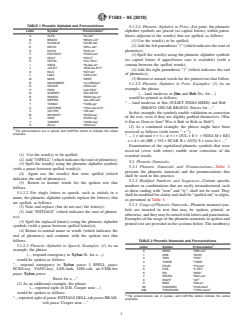
4.3.1 Phonetics are inherently language-dependent. For English text letters, there are 26 phonetic alphabet symbols, that correspond to the 26 letters (from A to Z) that may be used to compose the words in a message. Additional symbols are used for numerals and punctuations.
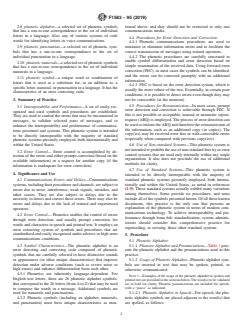
4.3.2 Phonetic symbols (including an alphabet, numerals, and punctuation) must have unique characteristics as mentioned above, and they should not be restricted to only one communications media.
4.4 Procedures for Error Detection and Correction:
4.4.1 Phonetic communications procedures are used to minimize or eliminate information errors and to facilitate the correct transmission of messages using trained operators.
4.4.2 The phonetic procedures are carefully structured to enable symbol differentiation and error detection based on simple examination of the received data. Using forward error correction (FEC), in most cases the symbols ca...
SCOPE
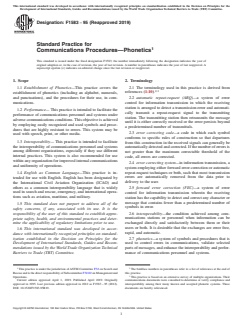
1.1 Establishment of Phonetics—This practice covers the establishment of phonetics (including an alphabet, numerals, and punctuations), and the procedures for their use, in communications.
1.2 Performance—This practice is intended to facilitate the performance of communications personnel and systems under adverse communications conditions. This objective is achieved by employing easily recognized and used symbols and procedures that are highly resistant to errors. This system may be used with speech, print, or other media.
1.3 Interoperability—This practice is intended to facilitate the interoperability of communications personnel and systems among different organizations, especially if they use different internal practices. This system is also recommended for use within any organization for improved internal communications and uniformity of operations.
1.4 English as Common Language—This practice is intended for use with English. English has been designated by the International Civil Aviation Organization (ICAO) and others as a common interoperability language that is widely used in search and rescue, emergency, and international operations such as aviation, maritime, and military.
1.5 This standard does not purport to address all of the safety concerns, if any, associated with its use. It is the responsibility of the user of this standard to establish appropriate safety, health, and environmental practices and determine the applicability of regulatory limitations prior to use.
1.6 This international standard was developed in accordance with internationally recognized principles on standardization established in the Decision on Principles for the Development of International Standards, Guides and Recommendations issued by the World Trade Organization Technical Barriers to Trade (TBT) Committee.
- Status
- Published
- Publication Date
- 31-Mar-2019
- Technical Committee
- F32 - Search and Rescue
- Drafting Committee
- F32.02 - Management and Operations
Overview
ASTM F1583-95(2019), Standard Practice for Communications Procedures-Phonetics, provides comprehensive guidelines for establishing and using a standardized system of phonetics in communications. Developed by ASTM, this standard ensures clarity, accuracy, and interoperability for spoken, printed, and digital messages, especially under adverse conditions. The phonetic alphabet, numerals, and punctuation covered by the standard enhance error detection and correction, supporting high-performance communication systems in critical fields such as emergency response, aviation, maritime, and military operations where English is commonly used.
Key Topics
- Error Control and Detection: The standard emphasizes minimizing communication errors due to noise, interference, weak signals, or human mistakes. By applying phonetic procedures and robust error-correcting symbols, critical information can be clarified, validated, and corrected promptly.
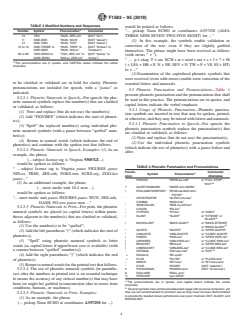
- Phonetic Alphabet, Numerals, and Punctuation: The system assigns unique, easily distinguished phonetic symbols to letters (A-Z), numerals (0-9), and common punctuation marks. This one-to-one correspondence enhances clarity and reduces ambiguity.
- Procedures for Use: Clear instructions are provided for incorporating phonetic symbols into spoken and printed messages. Methods include context-specific cues (such as "ISPELL" or "FIGURES") and examples for both speech and text.
- Interoperability: The guidelines facilitate seamless communication among diverse organizations and operators, even if internal practices differ. This supports effective coordination during joint operations.
- Language Dependence: While inherently based on the English language, the phonetic system can be adapted for use across various media-not limited to voice, but also print and digital formats.
Applications
- Public Safety and Emergency Communication: Enhances reliability in dispatch, search and rescue, disaster response, and law enforcement communications by mitigating errors under stress or poor transmission conditions.
- Aviation and Maritime Operations: Ensures international crews accurately transmit coordinates, names, procedures, and critical details, complying with ICAO and related bodies' best practices.
- Military and Defense: Supports mission-critical operations where message integrity is paramount. Compatible with existing NATO and military phonetic standards, helping avoid misinterpretation under combat or field conditions.
- Interagency and Organizational Communication: Promotes consistent internal protocols for organizations, reducing training barriers and fostering operational uniformity across departments or with external partners.
Related Standards
- ACP-125 (NATO Radiotelephone Procedures): Provides phonetic procedures for North Atlantic Treaty Organization operations.
- ICAO Annex 10, Volume II: Specifies communication procedures, including phonetic standards for international aviation.
- APCO, CAP, NAVY, and MARS Communication Manuals: National and operational standards referenced within ASTM F1583 for interoperability.
- ITU Radio Regulations Appendix 24: International guidelines for phonetic alphabets and figure codes.
Practical Value
Adopting ASTM F1583-95(2019) ensures messages are conveyed and understood with precision even when communication channels are compromised. The phonetic alphabet, numerals, and punctuation contribute to effective error correction and validation, empowering organizations to maintain operational integrity and safety. Consistent implementation bridges gaps between agencies and disciplines, making this standard essential for any organization prioritizing reliable English-language communications.
Keywords: phonetic alphabet, communications procedures, error correction, interoperability, emergency communication, aviation, maritime, military communication, ASTM standard, English language phonetics, message validation.
Relations
- Effective Date
- 01-Apr-2019
- Effective Date
- 01-Apr-2019
Get Certified
Connect with accredited certification bodies for this standard

ANCE
Mexican certification and testing association.

Intertek Slovenia
Intertek testing, inspection, and certification services in Slovenia.

LNE (Laboratoire National de Métrologie et d'Essais)
French national laboratory for metrology and testing.
Sponsored listings
Frequently Asked Questions
ASTM F1583-95(2019) is a standard published by ASTM International. Its full title is "Standard Practice for Communications Procedures—Phonetics". This standard covers: SIGNIFICANCE AND USE 4.1 Communications Errors and Delays—Communications systems, including their procedures and channels, are subject to errors due to noise, interference, weak signals, mistakes, and other causes. They are also subject to delays due to the necessity to detect and correct these errors. There may also be errors and delays due to the lack of trained and experienced operators. 4.2 Error Control—Phonetics enables the control of errors through error detection, and usually prompt correction, for words and characters in speech and printed text. It employs an error correcting system of symbols and procedures that are standardized and easily recognized under adverse or high error communications conditions. 4.3 Symbol Characteristics—The phonetic alphabet is an error detecting and correcting code composed of phonetic symbols that are carefully selected to have distinctive sounds or appearances (or other unique characteristics) that improve detection under adverse conditions (such as severe noise or high errors) and enhance differentiation from each other. 4.3.1 Phonetics are inherently language-dependent. For English text letters, there are 26 phonetic alphabet symbols, that correspond to the 26 letters (from A to Z) that may be used to compose the words in a message. Additional symbols are used for numerals and punctuations. 4.3.2 Phonetic symbols (including an alphabet, numerals, and punctuation) must have unique characteristics as mentioned above, and they should not be restricted to only one communications media. 4.4 Procedures for Error Detection and Correction: 4.4.1 Phonetic communications procedures are used to minimize or eliminate information errors and to facilitate the correct transmission of messages using trained operators. 4.4.2 The phonetic procedures are carefully structured to enable symbol differentiation and error detection based on simple examination of the received data. Using forward error correction (FEC), in most cases the symbols ca... SCOPE 1.1 Establishment of Phonetics—This practice covers the establishment of phonetics (including an alphabet, numerals, and punctuations), and the procedures for their use, in communications. 1.2 Performance—This practice is intended to facilitate the performance of communications personnel and systems under adverse communications conditions. This objective is achieved by employing easily recognized and used symbols and procedures that are highly resistant to errors. This system may be used with speech, print, or other media. 1.3 Interoperability—This practice is intended to facilitate the interoperability of communications personnel and systems among different organizations, especially if they use different internal practices. This system is also recommended for use within any organization for improved internal communications and uniformity of operations. 1.4 English as Common Language—This practice is intended for use with English. English has been designated by the International Civil Aviation Organization (ICAO) and others as a common interoperability language that is widely used in search and rescue, emergency, and international operations such as aviation, maritime, and military. 1.5 This standard does not purport to address all of the safety concerns, if any, associated with its use. It is the responsibility of the user of this standard to establish appropriate safety, health, and environmental practices and determine the applicability of regulatory limitations prior to use. 1.6 This international standard was developed in accordance with internationally recognized principles on standardization established in the Decision on Principles for the Development of International Standards, Guides and Recommendations issued by the World Trade Organization Technical Barriers to Trade (TBT) Committee.
SIGNIFICANCE AND USE 4.1 Communications Errors and Delays—Communications systems, including their procedures and channels, are subject to errors due to noise, interference, weak signals, mistakes, and other causes. They are also subject to delays due to the necessity to detect and correct these errors. There may also be errors and delays due to the lack of trained and experienced operators. 4.2 Error Control—Phonetics enables the control of errors through error detection, and usually prompt correction, for words and characters in speech and printed text. It employs an error correcting system of symbols and procedures that are standardized and easily recognized under adverse or high error communications conditions. 4.3 Symbol Characteristics—The phonetic alphabet is an error detecting and correcting code composed of phonetic symbols that are carefully selected to have distinctive sounds or appearances (or other unique characteristics) that improve detection under adverse conditions (such as severe noise or high errors) and enhance differentiation from each other. 4.3.1 Phonetics are inherently language-dependent. For English text letters, there are 26 phonetic alphabet symbols, that correspond to the 26 letters (from A to Z) that may be used to compose the words in a message. Additional symbols are used for numerals and punctuations. 4.3.2 Phonetic symbols (including an alphabet, numerals, and punctuation) must have unique characteristics as mentioned above, and they should not be restricted to only one communications media. 4.4 Procedures for Error Detection and Correction: 4.4.1 Phonetic communications procedures are used to minimize or eliminate information errors and to facilitate the correct transmission of messages using trained operators. 4.4.2 The phonetic procedures are carefully structured to enable symbol differentiation and error detection based on simple examination of the received data. Using forward error correction (FEC), in most cases the symbols ca... SCOPE 1.1 Establishment of Phonetics—This practice covers the establishment of phonetics (including an alphabet, numerals, and punctuations), and the procedures for their use, in communications. 1.2 Performance—This practice is intended to facilitate the performance of communications personnel and systems under adverse communications conditions. This objective is achieved by employing easily recognized and used symbols and procedures that are highly resistant to errors. This system may be used with speech, print, or other media. 1.3 Interoperability—This practice is intended to facilitate the interoperability of communications personnel and systems among different organizations, especially if they use different internal practices. This system is also recommended for use within any organization for improved internal communications and uniformity of operations. 1.4 English as Common Language—This practice is intended for use with English. English has been designated by the International Civil Aviation Organization (ICAO) and others as a common interoperability language that is widely used in search and rescue, emergency, and international operations such as aviation, maritime, and military. 1.5 This standard does not purport to address all of the safety concerns, if any, associated with its use. It is the responsibility of the user of this standard to establish appropriate safety, health, and environmental practices and determine the applicability of regulatory limitations prior to use. 1.6 This international standard was developed in accordance with internationally recognized principles on standardization established in the Decision on Principles for the Development of International Standards, Guides and Recommendations issued by the World Trade Organization Technical Barriers to Trade (TBT) Committee.
ASTM F1583-95(2019) is classified under the following ICS (International Classification for Standards) categories: 33.020 - Telecommunications in general. The ICS classification helps identify the subject area and facilitates finding related standards.
ASTM F1583-95(2019) has the following relationships with other standards: It is inter standard links to ASTM F1583-95(2012), ASTM F2685-14(2022). Understanding these relationships helps ensure you are using the most current and applicable version of the standard.
ASTM F1583-95(2019) is available in PDF format for immediate download after purchase. The document can be added to your cart and obtained through the secure checkout process. Digital delivery ensures instant access to the complete standard document.
Standards Content (Sample)
This international standard was developed in accordance with internationally recognized principles on standardization established in the Decision on Principles for the
Development of International Standards, Guides and Recommendations issued by the World Trade Organization Technical Barriers to Trade (TBT) Committee.
Designation: F1583 − 95 (Reapproved 2019)
Standard Practice for
Communications Procedures—Phonetics
This standard is issued under the fixed designation F1583; the number immediately following the designation indicates the year of
original adoption or, in the case of revision, the year of last revision. A number in parentheses indicates the year of last reapproval. A
superscript epsilon (´) indicates an editorial change since the last revision or reapproval.
1. Scope 2. Terminology
2.1 The terminology used in this practice is derived from
1.1 Establishment of Phonetics—This practice covers the
2,3
references (1-10).
establishment of phonetics (including an alphabet, numerals,
and punctuations), and the procedures for their use, in com-
2.2 automatic repeat-request (ARQ)—a system of error
munications. control for information transmission in which the receiving
station is arranged to detect a transmission error and automati-
1.2 Performance— This practice is intended to facilitate the
cally transmit a repeat-request signal to the transmitting
performance of communications personnel and systems under
station. The transmitting station then retransmits the message
adverse communications conditions.This objective is achieved
until it is either correctly received or the error persists beyond
by employing easily recognized and used symbols and proce-
a predetermined number of transmittals.
dures that are highly resistant to errors. This system may be
2.3 error correcting code—a code in which each symbol
used with speech, print, or other media.
conforms to specific rules of construction so that departures
1.3 Interoperability— This practice is intended to facilitate
from this construction in the received signals can generally be
the interoperability of communications personnel and systems
automatically detected and corrected. If the number of errors is
among different organizations, especially if they use different
not greater than the maximum correctable threshold of the
internal practices. This system is also recommended for use
code, all errors are corrected.
within any organization for improved internal communications
2.4 error correcting system—in information transmission, a
and uniformity of operations.
system employing either forward error correction or automatic
repeat-request techniques or both, such that most transmission
1.4 English as Common Language—This practice is in-
errors are automatically removed from the data prior to
tended for use with English. English has been designated by
delivery to the user.
the International Civil Aviation Organization (ICAO) and
others as a common interoperability language that is widely
2.5 forward error correction (FEC)—a system of error
used in search and rescue, emergency, and international opera-
control for information transmission wherein the receiving
tions such as aviation, maritime, and military.
station has the capability to detect and correct any character or
message that contains fewer than a predetermined number of
1.5 This standard does not purport to address all of the
symbols in error.
safety concerns, if any, associated with its use. It is the
2.6 interoperability—the condition achieved among com-
responsibility of the user of this standard to establish appro-
priate safety, health, and environmental practices and deter- munications stations or personnel when information can be
exchanged directly and satisfactorily between them or their
mine the applicability of regulatory limitations prior to use.
users or both. It is desirable that the exchanges are error free,
1.6 This international standard was developed in accor-
rapid, and automatic.
dance with internationally recognized principles on standard-
ization established in the Decision on Principles for the 2.7 phonetics—a system of symbols and procedures that is
Development of International Standards, Guides and Recom- used to control errors in communications, validate selected
mendations issued by the World Trade Organization Technical parts of messages, and enhance the interoperability and perfor-
Barriers to Trade (TBT) Committee. mance of communications personnel and systems.
1 2
This practice is under the jurisdiction ofASTM Committee F32 on Search and The boldface numbers in parentheses refer to a list of references at the end of
RescueandisthedirectresponsibilityofSubcommitteeF32.02onManagementand this practice.
Operations. This practice is based on an extensive survey of multiple organizations. Their
Current edition approved April 1, 2019. Published April 2019. Originally communications documents were consulted to determine or verify compliance and
approved in 1995. Last previous edition approved in 2012 as F1583 – 95 (2012). interoperability among their many known and accepted phonetic systems. These
DOI: 10.1520/F1583-95R19. documents are hereby referenced.
Copyright © ASTM International, 100 Barr Harbor Drive, PO Box C700, West Conshohocken, PA 19428-2959. United States
F1583 − 95 (2019)
2.8 phonetic alphabet—a selected set of phonetic symbols tioned above, and they should not be restricted to only one
that has a one-to-one correspondence to the set of individual communications media.
letters in a language. Also, any of various systems of code
4.4 Procedures for Error Detection and Correction:
words for identifying letters in voice communications.
4.4.1 Phonetic communications procedures are used to
2.9 phonetic punctuation—a selected set of phonetic sym- minimize or eliminate information errors and to facilitate the
bols that has a one-to-one correspondence to the set of correct transmission of messages using trained operators.
individual punctuation in a language. 4.4.2 The phonetic procedures are carefully structured to
enable symbol differentiation and error detection based on
2.10 phonetic numerals—a selected set of phonetic symbols
simple examination of the received data. Using forward error
that has a one-to-one correspondence to the set of individual
correction (FEC), in most cases the symbols can be identified,
numerals in a language.
and the errors can be corrected promptly with no additional
2.11 phonetic symbol—a unique word or combination of
information.
letters that is used as a substitute for, or an addition to, a
4.4.3 FEC is based on the error detection system, which is
specific letter, numeral, or punctuation in a language. It has the
usually the more robust of the two. Essentially, in certain poor
characteristics of an error correcting code.
conditions, it is possible to detect errors even though they may
not be correctable (at the moment).
3. Summary of Practice
4.5 Procedures for Retransmission—In most cases, prompt
3.1 Interoperability and Performance—A set of easily rec-
error detection and correction is achievable through FEC. If
ognized and used symbols and procedures are established.
this is not possible or acceptable, manual or automatic repeat-
They are used to control the errors that may be encountered in
request (ARQ) is employed. The process of error detection can
messages, to validate selected parts of messages, and to
be used to initiate theARQ and therefore the retransmission of
enhance the interoperability and performance of communica-
the information, such as an additional copy (or copies). The
tions personnel and systems. This phonetic system is intended
copy(ies) may be received error free or with correctable errors
to be directly interoperable with the majority of standard
(especially when compared with previous copy(ies)).
phonetic systems presently employed, both internationally and
within the United States. 4.6 Use of Non-standard Systems—This phonetic system is
notintendedtoprohibittheuseofnon-standardbrevityorerror
3.2 Error Control— Error control is accomplished by de-
control systems that are used only internally within any single
tection of the errors and either prompt correction (based on the
organization. It also does not preclude the use of additional
available information) or a request for another copy (if the
methods for clarity.
information is inadequate for error correction).
4.7 Use of Standard Systems—This phonetic system is
4. Significance and Use
intended to be directly interoperable with the majority of
standard phonetic systems presently employed, both interna-
4.1 Communications Errors and Delays—Communications
tionally and within the United States, as noted in references
systems,includingtheirproceduresandchannels,aresubjectto
(1-9). These standard systems actually exhibit many variations
errors due to noise, interference, weak signals, mistakes, and
among themselves. Some provide no procedures, and none
other causes. They are also subject to delays due to the
include all of the symbols presented herein. Of all these known
necessity to detect and correct these errors. There may also be
documents, this practice is the only one that presents an
errors and delays due to the lack of trained and experienced
explanation of the phonetic system in terms of modern com-
operators.
munications technology. To achieve interoperability and per-
4.2 Error Control— Phonetics enables the control of errors
formance through bona fide standardization, system adminis-
through error detection, and usually prompt correction, for
trators should consider this comprehensive practice for
words and characters in speech and printed text. It employs an
superseding, or revising, these other standard systems.
error correcting system of symbols and procedures that are
standardized and easily recognized under adverse or high error
5. Procedure
communications conditions.
5.1 Phonetic Alphabet:
4.3 Symbol Characteristics—The phonetic alphabet is an
5.1.1 Phonetic Alphabet and Pronunciations—Table 1 pres-
error detecting and correcting code composed of phonetic ents the phonetic alphabet and the pronunciations used in this
symbols that are carefully selected to have distinctive sounds
practice.
or appearances (or other unique characteristics) that improve 5.1.2 Usage of Phonetic Alphabet—Phonetic alphabet sym-
detection under adverse conditions (such as severe noise or
bols are inserted in text that may be spoken, printed, or
high errors) and enhance differentiation from each other. otherwise communicated.
4.3.1 Phonetics are inherently language-dependent. For
NOTE 1—Examples of the usage of the phonetic alphabet in spoken and
English text letters, there are 26 phonetic alphabet symbols,
printedtextareprovidedinthesectionsbelow.Theword(s)tobevalidated
that correspond to the 26 letters (fromAto Z) that may be used are in bold for clarity. Phonetic pronunciations are included for speech,
with a “pause” as indicated:
to compose the words in a message. Additional symbols are
used for numerals and punctuations. 5.1.2.1 Phonetic Alphabet in Speech—For speech, the pho-
4.3.2 Phonetic symbols (including an alphabet, numerals, netic alphabet symbols are placed adjacent to the word(s) that
and punctuation) must have unique characteristics as men- are spelled, as follows:
F1583 − 95 (2019)
TABLE 1 Phonetic Alphabet and Pronunciations
5.1.2.4 Phonetic Alphabet in Print—For print, the phonetic
A
Letter Symbol Pronunciation alphabet symbols are placed (as capital letters) within paren-
A ALFA “AL-fah” theses adjacent to the word(s) that are spelled, as follows:
B BRAVO “BRAH-voh”
(1) Use the word(s) to be spelled;
C CHARLIE “CHAR-lee”
(2) Addtheleftparenthesis“(”(whichindicatesthestartof
D DELTA “DELL-tah”
E ECHO “ECK-oh” phonetics);
F FOXTROT “FOKS-trot”
(3) Spell the word(s) using the phonetic alphabet symbols
G GOLF “GOLF”
(as capital letters if upper/lower case is available) (with a
H HOTEL “hoh-TELL”
I INDIA “IN-dee-ah” comma between the spelled words);
J JULIET “JEW-lee-ETT”
(4) Add the right parenthesis “)” (which indicates the end
K KILO “KEY-loh”
of phonetics);
L LIMA “LEE-mah”
M MIKE “MIKE”
(5) Return to normal words for the printed text that follow.
N NOVEMBER “no-VEM-ber”
5.1
...