

ASTM D7780-20
(Practice)Standard Practice for Minimum Geospatial Data for Representing Coal Mining Features
General Information
- Abstract
SIGNIFICANCE AND USE
4.1 This practice addresses coal mining geospatial data in general and is significant to the coal mining community because it provides uniformity of geospatial data pertaining to coal mining features.
4.2 Some RA data for coal mining feature attributes may not have values. Those RAs may not collect those attributes as part of their regulatory program or those attributes may not be applicable within their area of responsibility. As a result, a national dataset of coal mining features may appear to be incomplete for those RAs.
4.3 Within its area of exclusive jurisdiction, each RA is the ADS for the coal mining geospatial data that it creates and uses to regulate mining activity.
4.4 Limitations of Use—Uses of a national dataset are limited by several factors affecting the completeness, currency, and accuracy, of various data sources.
4.4.1 Completeness—Participation in the compilation of spatial data may not be uniform across RAs, which may affect completeness, both in terms of spatial data, and associated attributes. For some RAs, this standard may not be applicable because features described herein do not occur within their area of responsibility.
4.4.2 Currency—Source data is subject to change as a result of regulatory actions that may change the geographical location, extent, or attributes of particular features which may not be reflected in the national dataset. If detailed information is needed for individual features, the appropriate RA should be contacted for additional information.
4.4.3 Data compiled in accordance with this standard is not intended to be used as a primary source for evaluating risk or safety.
4.4.4 Data compiled in accordance with this standard is intended for informative purposes; it is not authoritative.
SCOPE
1.1 This practice defines a set of terms, procedures, and data required to define the accurate location and description of the minimum geospatial data for surface coal mining operations (CMO), underground coal mining extents, land reclamation and performance bond statuses, lands unsuitable for mining petitions (LUMP) and designated areas, coal spoil and refuse features, coal preparation plants, environmental resource monitoring locations (ERMLs), and postmining land uses.
1.2 Units—The values stated in inch-pound units are to be regarded as standard. No other units of measurement are included in this standard.
1.3 This standard does not purport to address all of the safety concerns, if any, associated with its use. It is the responsibility of the user of this standard to establish appropriate safety and health practices and determine the applicability of regulator limitations prior to use.
1.3.1 This practice offers a set of instructions for performing one or more specific operations. This document cannot replace education or experience and should be used in conjunction with professional judgment. Not all aspects of this practice may be applicable in all circumstances. This ASTM standard is not intended to represent or replace the adequacy of a professional service, nor should this document be applied without consideration of a project’s many unique aspects. The word “Standard” in the title of this document means only that the document has been approved through the ASTM consensus process.
1.4 Surface CMOs—As used in this practice, a surface CMO represents an area where coal removal, reclamation, and related supporting activities have occurred, is occurring, is pending authorization or is authorized by the Regulatory Authority (RA) within a defined surface CMO or any other unpermitted area that has been identified by the RA.
1.4.1 This practice addresses coal mining geospatial data, interim permits, and permanent program permits. Each RA shall be the authoritative data source (ADS) for coal mining geospatial data.
1.5 Underground Coal Mining Extents—This practice addresses underground coal mining extents that represent a...
- Status
- Published
- Publication Date
- 31-Oct-2020
- Technical Committee
- D18 - Soil and Rock
- Drafting Committee
- D18.01 - Surface and Subsurface Investigation
Buy Documents
ASTM D7780-20 - Standard Practice for Minimum Geospatial Data for Representing Coal Mining Features
REDLINE ASTM D7780-20 - Standard Practice for Minimum Geospatial Data for Representing Coal Mining Features
Overview
ASTM D7780-20, Standard Practice for Minimum Geospatial Data for Representing Coal Mining Features, is a key standard developed by ASTM International to address the uniform representation and sharing of geospatial data related to coal mining activities across the United States. This practice sets out the minimum datasets necessary to define the accurate location and description of coal mining features, helping regulatory authorities (RAs), federal and state agencies, and the mining community achieve consistent data reporting and spatial analysis. The standard supports critical activities under frameworks like the Surface Mining Control and Reclamation Act of 1977 (SMCRA), ensuring transparency, proper regulation, and efficient data management for coal mining operations.
Key Topics
- Minimum Geospatial Data Elements: Defines the essential terms, procedures, and data for representing coal mining operations (surface and underground), reclamation status, performance bond status, lands unsuitable for mining, coal spoil and refuse sites, preparation plants, environmental resource monitoring locations (ERMLs), and postmining land uses.
- Data Uniformity: Promotes nationwide consistency in how coal mining features are identified, attributed, and managed geospatially.
- Authority and Completeness: Emphasizes that each RA is the authoritative data source (ADS) for regulating mining activity within its jurisdiction and acknowledges varying completeness of national datasets due to the presence or absence of features across different regions.
- Limitations of Use: Highlights that compiled data are intended for information-sharing and not as primary sources for risk or safety evaluation, as data completeness, currency, and accuracy can vary.
Applications
- Regulatory Compliance: Enables regulatory authorities and mining companies to utilize standardized geospatial information for permitting, monitoring, and reclamation tasks, in alignment with SMCRA requirements.
- Reclamation Tracking: Supports monitoring of reclamation activities and performance bond statuses, streamlining the process for demonstrating compliance and bond release.
- Land Use Management: Assists in tracking postmining land use, helping ensure mined areas are restored to approved uses such as cropland, grazing, habitat, water resources, or recreation.
- Spatial Analysis and Data Sharing: Facilitates seamless data integration across jurisdictions, aiding in interagency collaboration, environmental assessments, and public resource mapping.
- Environmental Monitoring: Standardizes the location and documentation of ERMLs, crucial for ongoing water, air, soil, and subsidence monitoring.
- Public Information: Enhances transparency for the coal mining community and the public by allowing better access to geospatial data about coal mining features and reclamation progress.
Related Standards
- ASTM D653: Terminology Relating to Soil, Rock, and Contained Fluids - provides key definitions for terms used in mining and geospatial data.
- ANSI INCITS 61 & 320: Standards for representing point locations and spatial data transfer, supporting technical data exchange.
- FGDC Standards: Including the Content Standard for Digital Geospatial Metadata, which guides the documentation and sharing of geospatial data.
- 30 CFR Part 700, 800: U.S. federal regulations that govern coal mining and reclamation under the SMCRA framework.
- Surface Mining Control and Reclamation Act of 1977 (SMCRA): The central legislative authority for regulating coal mining operations and reclamation activities in the United States.
By setting clear requirements for minimum geospatial data, ASTM D7780-20 streamlines regulatory procedures, improves data sharing, and enhances the management of coal mining features for all stakeholders. Adopting this standard ensures that data related to surface and underground coal mining, environmental monitoring sites, reclamation, and postmining land use are accurately represented and uniformly accessible across relevant systems.
Relations
- Effective Date
- 01-Aug-2014
- Effective Date
- 01-Sep-2011
- Effective Date
- 01-Jan-2009
- Effective Date
- 01-Dec-2008
- Effective Date
- 01-Nov-2008
- Effective Date
- 15-Dec-2007
- Effective Date
- 01-Nov-2007
- Effective Date
- 01-Aug-2007
- Effective Date
- 01-Jul-2007
- Effective Date
- 01-May-2007
- Effective Date
- 01-Nov-2006
- Effective Date
- 01-Jul-2005
- Effective Date
- 01-Aug-2004
- Effective Date
- 01-Dec-2003
- Effective Date
- 10-Dec-2002
Buy Documents
ASTM D7780-20 - Standard Practice for Minimum Geospatial Data for Representing Coal Mining Features
REDLINE ASTM D7780-20 - Standard Practice for Minimum Geospatial Data for Representing Coal Mining Features
Get Certified
Connect with accredited certification bodies for this standard

BSI Group
BSI (British Standards Institution) is the business standards company that helps organizations make excellence a habit.

Bureau Veritas Chile
Bureau Veritas certification services in Chile.
Bureau Veritas Peru
Bureau Veritas certification services in Peru.
Sponsored listings
Frequently Asked Questions
ASTM D7780-20 is a standard published by ASTM International. Its full title is "Standard Practice for Minimum Geospatial Data for Representing Coal Mining Features". This standard covers: SIGNIFICANCE AND USE 4.1 This practice addresses coal mining geospatial data in general and is significant to the coal mining community because it provides uniformity of geospatial data pertaining to coal mining features. 4.2 Some RA data for coal mining feature attributes may not have values. Those RAs may not collect those attributes as part of their regulatory program or those attributes may not be applicable within their area of responsibility. As a result, a national dataset of coal mining features may appear to be incomplete for those RAs. 4.3 Within its area of exclusive jurisdiction, each RA is the ADS for the coal mining geospatial data that it creates and uses to regulate mining activity. 4.4 Limitations of Use—Uses of a national dataset are limited by several factors affecting the completeness, currency, and accuracy, of various data sources. 4.4.1 Completeness—Participation in the compilation of spatial data may not be uniform across RAs, which may affect completeness, both in terms of spatial data, and associated attributes. For some RAs, this standard may not be applicable because features described herein do not occur within their area of responsibility. 4.4.2 Currency—Source data is subject to change as a result of regulatory actions that may change the geographical location, extent, or attributes of particular features which may not be reflected in the national dataset. If detailed information is needed for individual features, the appropriate RA should be contacted for additional information. 4.4.3 Data compiled in accordance with this standard is not intended to be used as a primary source for evaluating risk or safety. 4.4.4 Data compiled in accordance with this standard is intended for informative purposes; it is not authoritative. SCOPE 1.1 This practice defines a set of terms, procedures, and data required to define the accurate location and description of the minimum geospatial data for surface coal mining operations (CMO), underground coal mining extents, land reclamation and performance bond statuses, lands unsuitable for mining petitions (LUMP) and designated areas, coal spoil and refuse features, coal preparation plants, environmental resource monitoring locations (ERMLs), and postmining land uses. 1.2 Units—The values stated in inch-pound units are to be regarded as standard. No other units of measurement are included in this standard. 1.3 This standard does not purport to address all of the safety concerns, if any, associated with its use. It is the responsibility of the user of this standard to establish appropriate safety and health practices and determine the applicability of regulator limitations prior to use. 1.3.1 This practice offers a set of instructions for performing one or more specific operations. This document cannot replace education or experience and should be used in conjunction with professional judgment. Not all aspects of this practice may be applicable in all circumstances. This ASTM standard is not intended to represent or replace the adequacy of a professional service, nor should this document be applied without consideration of a project’s many unique aspects. The word “Standard” in the title of this document means only that the document has been approved through the ASTM consensus process. 1.4 Surface CMOs—As used in this practice, a surface CMO represents an area where coal removal, reclamation, and related supporting activities have occurred, is occurring, is pending authorization or is authorized by the Regulatory Authority (RA) within a defined surface CMO or any other unpermitted area that has been identified by the RA. 1.4.1 This practice addresses coal mining geospatial data, interim permits, and permanent program permits. Each RA shall be the authoritative data source (ADS) for coal mining geospatial data. 1.5 Underground Coal Mining Extents—This practice addresses underground coal mining extents that represent a...
SIGNIFICANCE AND USE 4.1 This practice addresses coal mining geospatial data in general and is significant to the coal mining community because it provides uniformity of geospatial data pertaining to coal mining features. 4.2 Some RA data for coal mining feature attributes may not have values. Those RAs may not collect those attributes as part of their regulatory program or those attributes may not be applicable within their area of responsibility. As a result, a national dataset of coal mining features may appear to be incomplete for those RAs. 4.3 Within its area of exclusive jurisdiction, each RA is the ADS for the coal mining geospatial data that it creates and uses to regulate mining activity. 4.4 Limitations of Use—Uses of a national dataset are limited by several factors affecting the completeness, currency, and accuracy, of various data sources. 4.4.1 Completeness—Participation in the compilation of spatial data may not be uniform across RAs, which may affect completeness, both in terms of spatial data, and associated attributes. For some RAs, this standard may not be applicable because features described herein do not occur within their area of responsibility. 4.4.2 Currency—Source data is subject to change as a result of regulatory actions that may change the geographical location, extent, or attributes of particular features which may not be reflected in the national dataset. If detailed information is needed for individual features, the appropriate RA should be contacted for additional information. 4.4.3 Data compiled in accordance with this standard is not intended to be used as a primary source for evaluating risk or safety. 4.4.4 Data compiled in accordance with this standard is intended for informative purposes; it is not authoritative. SCOPE 1.1 This practice defines a set of terms, procedures, and data required to define the accurate location and description of the minimum geospatial data for surface coal mining operations (CMO), underground coal mining extents, land reclamation and performance bond statuses, lands unsuitable for mining petitions (LUMP) and designated areas, coal spoil and refuse features, coal preparation plants, environmental resource monitoring locations (ERMLs), and postmining land uses. 1.2 Units—The values stated in inch-pound units are to be regarded as standard. No other units of measurement are included in this standard. 1.3 This standard does not purport to address all of the safety concerns, if any, associated with its use. It is the responsibility of the user of this standard to establish appropriate safety and health practices and determine the applicability of regulator limitations prior to use. 1.3.1 This practice offers a set of instructions for performing one or more specific operations. This document cannot replace education or experience and should be used in conjunction with professional judgment. Not all aspects of this practice may be applicable in all circumstances. This ASTM standard is not intended to represent or replace the adequacy of a professional service, nor should this document be applied without consideration of a project’s many unique aspects. The word “Standard” in the title of this document means only that the document has been approved through the ASTM consensus process. 1.4 Surface CMOs—As used in this practice, a surface CMO represents an area where coal removal, reclamation, and related supporting activities have occurred, is occurring, is pending authorization or is authorized by the Regulatory Authority (RA) within a defined surface CMO or any other unpermitted area that has been identified by the RA. 1.4.1 This practice addresses coal mining geospatial data, interim permits, and permanent program permits. Each RA shall be the authoritative data source (ADS) for coal mining geospatial data. 1.5 Underground Coal Mining Extents—This practice addresses underground coal mining extents that represent a...
ASTM D7780-20 is classified under the following ICS (International Classification for Standards) categories: 35.240.99 - IT applications in other fields; 73.020 - Mining and quarrying. The ICS classification helps identify the subject area and facilitates finding related standards.
ASTM D7780-20 has the following relationships with other standards: It is inter standard links to ASTM D653-14, ASTM D653-11, ASTM D653-09, ASTM D653-08a, ASTM D653-08, ASTM D653-07f, ASTM D653-07e, ASTM D653-07d, ASTM D653-07c, ASTM D653-07b, ASTM D653-06, ASTM D653-05, ASTM D653-04, ASTM D653-03, ASTM D653-02a. Understanding these relationships helps ensure you are using the most current and applicable version of the standard.
ASTM D7780-20 is available in PDF format for immediate download after purchase. The document can be added to your cart and obtained through the secure checkout process. Digital delivery ensures instant access to the complete standard document.
Standards Content (Sample)
This international standard was developed in accordance with internationally recognized principles on standardization established in the Decision on Principles for the
Development of International Standards, Guides and Recommendations issued by the World Trade Organization Technical Barriers to Trade (TBT) Committee.
Designation: D7780 − 20
Standard Practice for
Minimum Geospatial Data for Representing Coal Mining
Features
This standard is issued under the fixed designation D7780; the number immediately following the designation indicates the year of
original adoption or, in the case of revision, the year of last revision. A number in parentheses indicates the year of last reapproval. A
superscript epsilon (´) indicates an editorial change since the last revision or reapproval.
1. Scope 1.4.1 This practice addresses coal mining geospatial data,
interim permits, and permanent program permits. Each RA
1.1 Thispracticedefinesasetofterms,procedures,anddata
shall be the authoritative data source (ADS) for coal mining
required to define the accurate location and description of the
geospatial data.
minimum geospatial data for surface coal mining operations
(CMO), underground coal mining extents, land reclamation
1.5 Underground Coal Mining Extents—This practice ad-
and performance bond statuses, lands unsuitable for mining dresses underground coal mining extents that represent an area
petitions (LUMP) and designated areas, coal spoil and refuse
where coal removal has occurred within a defined underground
features,coalpreparationplants,environmentalresourcemoni- CMO.
toring locations (ERMLs), and postmining land uses.
1.6 Land Reclamation Status—This practice addresses the
1.2 Units—The values stated in inch-pound units are to be
land reclamation status of surface areas within a permitted
regarded as standard. No other units of measurement are CMO where coal removal, reclamation and related supporting
included in this standard.
activities has occurred, is occurring, or is planned and autho-
rized by the RA.
1.3 This standard does not purport to address all of the
safety concerns, if any, associated with its use. It is the
1.7 Performance Bond Status—This practice shows the
responsibility of the user of this standard to establish appro-
status of coal mine reclamation as outlined by each phase of
priate safety and health practices and determine the applica-
reclamation. In addition to defining the status of individual
bility of regulator limitations prior to use.
areas covered by a performance bond, use of this standard will
1.3.1 Thispracticeoffersasetofinstructionsforperforming
identify the changes of the reclamation and bond status to
one or more specific operations. This document cannot replace minedareasastheychangeovertime.Referencetobondstatus
educationorexperienceandshouldbeusedinconjunctionwith
means performance bond status.
professional judgment. Not all aspects of this practice may be NOTE 1—A single bond may cover multiple permits or multiple bonds
may cover a single permit.
applicable in all circumstances. This ASTM standard is not
intended to represent or replace the adequacy of a professional
1.8 Lands Unsuitable for Mining Petition—This practice
service, nor should this document be applied without consid-
addresses boundary data pertaining to areas that have been
eration of a project’s many unique aspects. The word “Stan-
petitioned and designated as unsuitable for mining. It also
dard” in the title of this document means only that the
addressesthoselandsthathavebeenfoundbytheRA’sprocess
document has been approved through the ASTM consensus
to be designated unsuitable for all or certain types of mining.
process.
These areas may be petitioned to be unsuitable for CMOs
because they meet criterion that include, but are not limited to:
1.4 Surface CMOs—Asusedinthispractice,asurfaceCMO
fragile, historic, cultural, scientific, having esthetic values and
representsanareawherecoalremoval,reclamation,andrelated
natural systems such as aquifers that could be significantly
supporting activities have occurred, is occurring, is pending
damaged due to a CMO.
authorization or is authorized by the Regulatory Authority
(RA) within a defined surface CMO or any other unpermitted
1.9 Refuse Structures—This practice addresses excess spoil
area that has been identified by the RA.
and refuse features produced by CMOs.These features include
excess spoil structures, coal refuse structures, and coal prepa-
ration plants.
1.9.1 Excess Spoil Structures—These structures are created
This practice is under the jurisdiction of ASTM Committee D18 on Soil and
Rock and is the direct responsibility of Subcommittee D18.01 on Surface and
when the total spoil produced during mining exceeds the
Subsurface Characterization.
volume of material that can be utilized for reclamation. This
Current edition approved Nov. 1, 2020. Published December 2020. Originally
occurrence is common in steep slope areas, where the final
approved in 2012. Last previous edition approved in 2012 as D7780–12. DOI:
10.1520/D7780-20. grade of reclaimed slopes is limited by stability requirements.
Copyright © ASTM International, 100 Barr Harbor Drive, PO Box C700, West Conshohocken, PA 19428-2959. United States
D7780 − 20
It also occurs where overburden volume is significantly larger mendations issued by the World Trade Organization Technical
than the volume of minable coal. Spoil also exhibits a net Barriers to Trade (TBT) Committee.
increase in volume due to the introduction of void spaces in
2. Referenced Documents
fragmented rock when overburden is removed to expose
underlying coal seams.The production of excess spoil requires
2.1 ASTM Standards:
thecreationofdisposalstructuresthatextendoutsidethemined D653 Terminology Relating to Soil, Rock, and Contained
area.
Fluids
1.9.2 Coal Preparation Plants—Facilities where impurities 2.2 ANSI Standards:
are removed from coal and potentially crushed, resized, and
ANSI INCITS 61-1986 (R2007) Geographic Point Loca-
blended with other grades of coal. Preparation plants produce tions for Information Interchange, Representation of (for-
refuse as a byproduct.
merly ANSI X3.61-1986 (R1997))
1.9.3 Refuse—Awaste byproduct of coal processing, gener- ANSI INCITS 320-1998 (R2013) Information
ally categorized as either coarse or fine. Fine coal refuse often
Technology—Spatial Data Transfer
ishandledasaslurrycontainingablendofwater,finecoal,silt, 2.3 Federal Geographic Data Committee (FGDC) Stan-
sand, and clay particles. dards
1.9.4 Impounding Refuse Structures—These structures cre-
FGDC-STD-001 Content Standard for Digital Geospatial
ate a holding area for slurry that allows solids to settle out and Metadata
water to be recovered. Cross-valley and diked impoundments
Project 1574-D Information Technology—Geographic In-
utilize an embankment, often constructed of coarse coal refuse, formation Framework Data Content Standard, Part 5
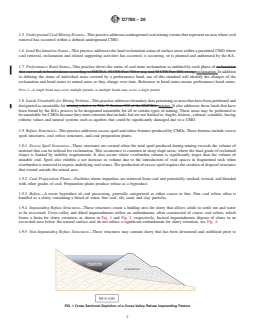
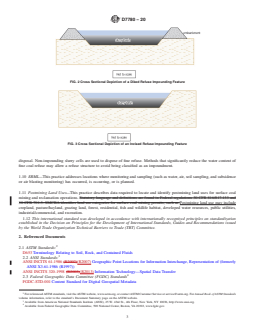
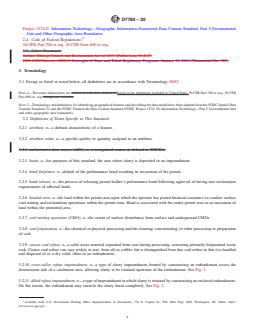
whichformsabasinforslurryretention,asshowninFig.1and
Governmental Unit and Other Geographic Area Boundar-
Fig. 2, respectively. Incised impoundments dispose of slurry in ies
an excavated area below the natural surface and do not utilize
2.4 Code of Federal Regulations:
a significant embankment for slurry retention, see Fig. 3. 30 CFR Part 700 et seq. 30 CFR Parts 800 et seq.
1.9.5 Non-Impounding Refuse Structures—These structures
3. Terminology
may contain slurry that has been dewatered and stabilized prior
to disposal. Non-impounding slurry cells are used to dispose of
3.1 Except as listed or noted below, all definitions are in
fine refuse. Methods that significantly reduce the water content
accordance with Terminology D653.
of fine coal refuse may allow a refuse structure to avoid being
NOTE 2—The terms defined here are based on the definitions included
classified as an impoundment.
in United States 30 CFR Part 700 et seq., 30 CFR Part 800 et. seq.
NOTE 3—Terminology and definitions for identifying geographical
1.10 ERML—This practice addresses locations where moni-
features and describing the data model have been adopted from the FGDC
toring and sampling (such as water, air, soil sampling, and
Spatial Data Transfer Standard (3) and the FGDC Framework Data
subsidence or air blasting monitoring) has occurred, is
ContentStandard(FGDCProject1574-D)InformationTechnology—Part
occurring, or is planned.
5 Governmental unit and other geographic area boundaries.
1.11 Postmining Land Uses—This practice describes data
3.2 Definitions of Terms Specific to This Standard:
required to locate and identify postmining land uses for surface
coal mining and reclamation operations. Postmining land use
For referenced ASTM standards, visit the ASTM website, www.astm.org, or
may include cropland, pasture/hayland, grazing land, forest,
contact ASTM Customer Service at service@astm.org. For Annual Book of ASTM
residential, fish and wildlife habitat, developed water Standards volume information, refer to the standard’s Document Summary page on
the ASTM website.
resources, public utilities, industrial/commercial, and recre-
Available from American National Standards Institute (ANSI), 25 W. 43rd St.,
ation.
4th Floor, New York, NY 10036, http://www.ansi.org.
Available from Federal Geographic Data Committee, 590 National Center,
1.12 This international standard was developed in accor-
Reston, VA 20192, www.fgdc.gov.
dance with internationally recognized principles on standard-
AvailablefromU.S.GovernmentPrintingOfficeSuperintendentofDocuments,
ization established in the Decision on Principles for the
732 N. Capitol St., NW, Mail Stop: SDE, Washington, DC 20401, http://
Development of International Standards, Guides and Recom- www.access.gpo.gov.
FIG. 1 Cross Sectional Depiction of a Cross-Valley Refuse Impounding Feature
D7780 − 20
FIG. 2 Cross Sectional Depiction of a Diked Refuse Impounding Feature
FIG. 3 Cross Sectional Depiction of an Incised Refuse Impounding Feature
3.2.1 attribute, n—a defined characteristic of a feature. 3.2.11 diked refuse impoundment, n—a type of impound-
ment in which slurry is retained by constructing an enclosed
3.2.2 attribute value, n—a specific quality or quantity as-
embankment. On flat terrain, the embankment may encircle the
signed to an attribute.
slurry basin completely. See Fig. 2.
3.2.3 basin, n—for purposes of this standard, the area where
3.2.12 disturbed, n—an area where vegetation, topsoil, or
slurry is deposited in an impoundment.
overburden is removed or upon which topsoil, spoil, coal
3.2.4 bond forfeiture, n—default of the performance bond
processing waste, underground development waste, or non-
resulting in revocation of the permit.
coal waste is placed by CMO’s. Those areas are classified as
3.2.5 bond release, n—the process of releasing permit
disturbed until reclamation is complete.
holder’s performance bond following approval of having met
3.2.13 domain, n—a range of permissible values for a
reclamation requirements of affected lands.
specified attribute.
3.2.6 bonded area, n—the land within the permit area upon
3.2.14 durable rock fill, n—a type of valley fill, containing
which the operator has posted financial assurance to conduct
excess overburden spoil that consists of at least 80 percent
surface coal mining and reclamation operations within the
durable rock on a unit volume basis, or rock that can pass
permit term. Bond is associated with the entire permit area or
certain strength and weathering tests, such as a slake durability
an increment of land within the permitted area.
test.
3.2.7 coal mining operation (CMO), n—the extent of sur-
3.2.15 embankment, n—man-made deposits of earth or
face disturbance from surface and underground CMOs.
coarse coal refuse that is raised above the natural surface of the
3.2.8 coal preparation, n—thechemicalorphysicalprocess-
land. For the purposes of this standard, embankments are a
ing and the cleaning, concentrating, or other processing or
component of an impoundment used to retain slurry.
preparation of coal.
3.2.16 ERML point, n—a geometric point that specifies the
3.2.9 coarse coal refuse, n—asolidwastematerialseparated
locations of environmental resources associated with permitted
from coal during processing, consisting primarily fragmented
CMO’s, as indicated on the latest map approved by the RA.
waste rock. Coarse coal refuse can vary widely in size, from
3.2.17 excess spoil, n—spoil material disposed of in a
silt to cobble, but is distinguished from fine coal refuse in that
locationoutsideofthemined-outarea,excludingspoilmaterial
it is handled and disposed of as a dry solid, often in an
used to achieve the approximate original contour or to blend
embankment.
the mined-out area with the surrounding terrain.
3.2.10 cross-valley refuse impoundment, n—a type of slurry
impoundment formed by constructing an embankment across 3.2.18 feature, n—a geographical representation of either a
the downstream side of a catchment area, allowing slurry to be discrete real-world phenomenon, such as a building, or an
retained upstream of the embankment. See Fig. 1. abstract concept, such as a governmental boundary.
D7780 − 20
3.2.19 feature class, n—a collection of similar features 3.2.33 permit area, n—the area of land described by a legal
having the same geometry type, coordinate system, and a description, metes and bounds, or indicated on the latest map
common set of descriptive attributes. approved by the RA, upon which the permittee has approval to
conduct surface coal mining and reclamation operations.
3.2.20 fine coal refuse, n—waste material that is hydrauli-
cally separated from coal during processing. Particle size
3.2.34 permit boundary, n—the perimeter of the land on
varies from clay or very fine silt to fine sands. Solids are
which the permittee may conduct surface coal mining and
suspended in a water solution, or slurry, and usually trans-
reclamation operations described by a legal description, metes
ported through a pipeline.
andbounds,orindicatedonthelatestmapapprovedbytheRA.
3.2.21 head-of-hollow fill, n—a type of valley fill, in which
3.2.35 point, n—a one-dimensional geometric object that
the top surface of the fill, when completed is at or blends into
specifies a geographic location.
the adjacent ridge line, and no significant area of natural
3.2.36 polygon, n—a two-dimensional closed geometric
drainage occurs above the fill draining into the fill area.
shape that specifies the boundaries of a geographic area.
3.2.22 hydrologic balance, n—the relationship between the
3.2.37 preparation plant, n—a facility where coal is sub-
quality and quantity of water inflow to and water outflow from
jected to chemical or physical processing, cleaning,
a hydrologic unit including water stored in the unit. It encom-
concentrating, or other preparation. It includes facilities asso-
passes the dynamic relationships between precipitation, runoff,
ciated with coal preparation activities, including, but not
evaporation, and changes in ground and surface water avail-
limited to: loading facilities; storage and stockpile facilities;
ability.
sheds; shops and other buildings; water-treatment and water-
3.2.23 impoundment, n—astructurecreatedfortheretention
storage facilities.
of water, slurry, refuse, or sediment.
3.2.38 reclamation, n—those actions taken to reestablish
3.2.24 incised refuse impoundment, n—an impoundment
and return mined land to an approved land use from the effects
formed by excavation below the original surface elevation, see
of mining and mining-related disturbances.
Fig. 3.
3.2.39 regulatory authority, n—entity(s) with exclusive ju-
3.2.25 incremental bond area, n—a portion of a permitted
risdiction over the regulation of coal or non-coal mining, or
area which allows each independent area and its posted
both, and reclamation operations or mitigation, or both, of
performance bond to be released according to its reclamation
AML problems.
schedule.
3.2.40 side-hill fill, n—a controlled earth and rock fill
3.2.26 mine boundary, n—the perimeter defining the land
located on the side of an existing hill that is designed as a
area upon which surface CMOs have occurred. Some RAs
stable, permanent structure for excess spoil.
refer to these lands as affected lands. Mine boundaries may
3.2.41 slurry, n—awasteproductgeneratedfromprocessing
include surface CMOs that existed in the early 1900s before
coal,consistingofamixtureofwaterandfineparticulatewaste
any formal permitting or regulatory process had been devel-
which is most commonly disposed of in an impoundment.
oped and there was no permit or permittee.
3.2.27 mine discharge, n—discharge of water emanating 3.2.42 slurry cell, n—adisposalmethodinwhichcoalslurry
refuseisplacedindug-outisolatedtroughs.Theslurrymaterial
from or hydrologically connected to a mined area or an area of
mining-related activities, which may remain after activities is covered with coarse refuse encapsulating the cell.
have been completed or abandoned. These discharges have the
3.2.43 spoil, n—overburden that has been removed during a
potential to pollute groundwater or surface water or both, with
CMO.
a detrimental impact upon the environment or public safety.
3.2.44 valley fill, n—an excess spoil structure where side
3.2.28 National Mine Map Repository, n—the central data-
slopes of the existing valley, measured at the steepest point, are
base location for the collection, archival, maintenance, and
greater than 20 degrees, or where the average slope of the
retention of abandoned (coal and non-coal) mine map images
profile of the valley from the toe of the fill to the top of the fill
and information.
is greater than 10 degrees, see Fig. 4.
3.2.29 National Pollutant Discharge Elimination System
3.3 Acronyms:
(NPDES), n—apermitprogramthatcontrolswaterpollutionby
3.3.1 ADS—Authoritative Data Source
regulating point sources that could potentially discharge pol-
3.3.2 AMD—Acid Mine Drainage
lutants into waters of the United States.
3.3.3 CAD—Computer Aided Design
3.2.30 overburden, n—consolidated or unconsolidated ma-
terial of any nature which overlies a coal deposit, excluding
3.3.4 CMO—Coal Mining Operation
topsoil.
3.3.5 ERML—Environmental Resource Monitoring Loca-
3.2.31 Offıce of Surface Mining (OSM), n—the national
tion
agency with responsibility for regulation of CMO’s and recla-
3.3.6 GIS—Geographic Information System
mation of abandoned mine land.
3.3.7 LUMP—Lands Unsuitable for Mining Petition (also
3.2.32 permit, n—written authorization to conduct surface
known as “petition”)
coal mining and reclamation operations issued by an RA to a
permittee. 3.3.8 NMMR—National Mine Map Repository
D7780 − 20
FIG. 4 Planimetric View of a Reclaimed Excess Spoil Valley Fill
3.3.9 NPDES—National Pollutant Discharge Elimination is needed for individual features, the appropriate RAshould be
System contacted for additional information.
4.4.3 Data compiled in accordance with this standard is not
3.3.10 OSM—Office of Surface Mining
intended to be used as a primary source for evaluating risk or
3.3.11 RA—Regulatory Authority
safety.
3.3.12 TOJ—Termination of Jurisdiction
4.4.4 Data compiled in accordance with this standard is
intended for informative purposes; it is not authoritative.
4. Significance and Use
4.1 This practice addresses coal mining geospatial data in
5. Procedure
general and is significant to the coal mining community
5.1 Introduction—The individual location and attribute
because it provides uniformity of geospatial data pertaining to
characteristicslistedinthissectionrepresentthedatanecessary
coal mining features.
to develop and maintain these geospatial datasets. Geospatial
4.2 SomeRAdataforcoalminingfeatureattributesmaynot
data and descriptions may be obtained from state, tribal, and
have values.Those RAs may not collect those attributes as part
federal RAs. The use of this standard’s data will help ensure
of their regulatory program or those attributes may not be
uniformity of the geospatial data developed and maintained by
applicable within their area of responsibility. As a result, a
RAs.
national dataset of coal mining features may appear to be
5.2 Coordinates and Related Data—Coordinatesandrelated
incomplete for those RAs.
geospatial data allow features to be accurately positioned on
4.3 Within its area of exclusive jurisdiction, each RA is the
the earth’s surface in a variety of recognized datums, grid
ADSforthecoalmininggeospatialdatathatitcreatesanduses
systems, and geographic projections. The data is generally
to regulate mining activity.
compiledfromvarioussourcesthatmayutilizedifferentknown
4.4 Limitations of Use—Uses of a national dataset are
datum, coordinate, and projection systems. All submitted data
limited by several factors affecting the completeness, currency,
will have known datum, coordinate, and projection systems
and accuracy, of various data sources.
which will be described in the metadata statement. ANSI
4.4.1 Completeness—Participation in the compilation of
INCITS 61-1986 (R2007) contains additional guidance on
spatial data may not be uniform across RAs, which may affect
representation of coordinates.
completeness, both in terms of spatial data, and associated
5.3 ADS Responsibilities—Subject to the applicability and
attributes. For some RAs, this standard may not be applicable
capability of theADS. EachADS will provide relevant data for
becausefeaturesdescribedhereindonotoccurwithintheirarea
its area of responsibility, compiled in accordance with this
of responsibility.
standard, to OSM for compilation in a national dataset.
4.4.2 Currency—Source data is subject to change as a result
of regulatory actions that may change the geographical 5.4 A designee within OSM will serve as the data steward
location, extent, or attributes of particular features which may for the national geospatial dataset that complies with this
not be reflected in the national dataset. If detailed information standard. This designee will coordinate with individual RA’s
D7780 − 20
for submission of data that adheres to this standard. OSM will 5.6.12 Permit Application Approval Date—The date the
compile a national dataset and map service. permit application was approved by the RAthat could result in
creation or change to a geospatial feature.
5.5 Source Data—Information for each feature class will be
5.6.13 Permit Application Types—Permittypesasdefinedin
compiled by each ADS from the best available source. Digital
Table 4.
data in CAD or GIS format should be used if available.
5.6.14 Permit ID—TheuniqueidentifierassignedbytheRA
5.5.1 Data Format—Data should be provided in a com-
which issues a coal mining and reclamation permit; the
monly recognized format, such as shapefile, coverage,
identifier is usually a number or alphanumeric combination.
geodatabase, or XML recordset.
5.6.15 Permit Status—The status of the coal mining and
5.5.2 Coordinate System—The coordinate system and da-
reclamation permit operations, as defined by the RA.
tum used will be identified by the ADS. This information will
5.6.16 Permittee—The entity to whom a permit has been
be sufficient for OSM to reproject the dataset to a common
issued by the RAto conduct surface coal mining and reclama-
coordinate system.
tion operations.
5.5.3 Metadata—Metadata documentation must be in accor-
5.6.17 Reported Area—The area of a feature as reported to
dance with published standard (for example, the United States,
the RA (acres).
FGDC-STD-001).
5.6.18 Local Mine ID—The unique identifier assigned by
5.5.4 Update Frequency—Subject to the applicability and
the RA which issues a coal mining and reclamation mine ID;
capability of the ADS. Each ADS will provide updated
theidentifierisusuallyanumberoralphanumericcombination.
versions of their dataset periodically, so that changes can be
propagated to the national dataset.
5.7 Coal Mining Operations (CMO)—This dataset defines
5.5.5 Feature Classes—Features relevant to this standard
theextentofsurfacedisturbancefromsurfaceandunderground
are organized into multiple feature classes. Each feature class
CMOs.
is defined by describing what features are to be included, how
5.7.1 CMOs Feature Class—This feature class contains
the features are represented geographically, and what descrip-
polygons depicting boundaries of surface CMOs and surface
tive attributes are associated with each feature.
disturbance due to underground CMOs.
5.6 Common Descriptive Attributes—Defined characteris- 5.7.2 The list of CMOs attributes represent the data neces-
ticsassociatedwithafeatureclass.Commonattributesinclude: sary to develop and maintain a nationwide geospatial data set
depicting surface coal mining boundary locations.
5.6.1 Calculated Area—The area of a feature as calculated
from a polygon (acres). 5.7.3 Origin of CMOs Geometry—The feature geometry
must originate from the most accurate data available to the
5.6.2 Coal Bed Name(s)—The geologic name of the coal
ADS. If a permit has been issued, the most recently approved
seam extracted as reported in the permit document, determined
map in the permit application issued by the RAshould be used.
by the RA, or identified as unknown/undetermined.
Otherwise, the best available map available to theADS should
5.6.3 Comment—Any additional comments as reported by
be used regardless of whether or not a permit had been issued.
the RA.
5.7.4 Geographical Representation—CMOs features will be
5.6.4 Company—The name of the coal company that oper-
represented using a polygon.
ated the underground mine.
5.7.5 CMOs Attributes—Individual attributes contain infor-
5.6.5 Contact—The name of the RA responsible for over-
mation about a particular polygon. Each attribute associated
seeing the permitted and non-permitted mining operation(s)
withapolygoncontributestotheuniqueidentityofthesiteand
and for creating or maintaining the CMO geospatial data.
helps in analysis and retrieval of additional information. The
5.6.6 Date of Map—The date of the source document used
featureattributesspecifictotheCMOsfeaturelayeraredefined
to generate the underground coal mining extent data. The
below. See Table 1 for attributes.
source document may not represent the actual “final” extent of
5.7.5.1 Coal Mine Operation Status—The status of coal
mining.
mining and reclamation operations, as defined by the RA.
5.6.7 Edit Date—Represents the last date the record was
5.7.5.2 Inspectable Unit—An Inspectable Unit is defined by
updated or changed for a coal mining feature or attribute, or
the regulatory authority and may include multiple small and
both, as recorded by the ADS.
neighboring Initial Program Sites or Permanent Program Per-
5.6.8 Mine Name—The legal name for a CMO.
mits that have been grouped together as one Inspectable Unit
5.6.9 Mine ID—The unique identifier for a CMO, which is
for inspection efficiency. An Inspectable Unit also may be one
usually a number or an alphanumeric combination.
of multiple inspectable units for one Permanent Program
5.6.10 National ID—Aunique identifier created by combin-
Permit that was divided into multiple inspectable units to allow
ing a location code and the Permit ID assigned by the RA; this
full coverage of complete inspections of the site.
unique identifier helps in organization, retrieval, and analysis
5.7.5.3 Surface Mining Method(s)—Method of coal mine
of individual state or tribal data combined into the nationwide
operations/activities/mine types within the surface coal mining
data set.
boundary.
5.6.11 Permit Application Date—The date of the original
application or an application to revise the permit that brings 5.8 Underground Coal Mining Extents—This dataset de-
about a change to the geospatial feature. fines the extent of an underground mining operation.
D7780 − 20
A
TABLE 1 Surface CMOs Attributes
Attribute Name Definition Example Data Type Preferred Domain Clarification
Permittee See 5.6.16 ACME Coal Mining Co., Inc. Text The ADS should consider naming
conventions for this attribute
Company See 5.6.4 XYZ Coal Co. Text
Coal Mine Operation Status See 5.7.5.1 Active Text See Table 2 for Status of mining operations
domains and definitions
Mine Name See 5.6.8 Peterson Mine No. 1 Text
Permit ID See 5.6.14 1201834 Text
Mine ID See 5.6.9 39-39022 Text
Local Mine ID See 5.6.18 WA001 Text Identification number
issued by RA
National ID See 5.6.10 VA2020010 Text
Coal Bed Name(s) See 5.6.2 Appleton No. 2 Text Local/regional name or state geological
survey stratigraphic name
Date of Map See 5.6.6 3/11/1977 Date The source document used to show
the actual “final” extent of mining
Inspectable Unit Status See 5.7.5.2 Active Text See Table 3 for Use terms as defined by the
domains and definitions approved RA
Calculated Area See 5.6.1 23200 Numeric For comparison with reported value
Reported Area See 5.6.17 23300 Numeric For comparison with calculated value
Permit Application Types See 5.6.13 IBR Text See Table 4 for
domains and definitions
Permit Application Date See 5.6.11 01/30/2009 Date
Permit Application Approval Date See 5.6.12 01/30/2010 Date
Edit Date See 5.6.7 01/30/2011 Date Last update of data
Surface Mining Method(s) See 5.7.5.3 Area mine Text See Table 5 for Type of surface mining method(s)
domains and definitions
Comment See 5.6.3 Text
Contact See 5.6.5 Virginia Department of Mines, Text
Minerals, and Energy
A
This data is also associated with the bonded areas for underground coal mine operations.
D7780 − 20
TABLE 2 Preferred Domain Definitions for CMO Status and Permit Status
Domain Value Definition
Active Mine site has ongoing coal production and/or reclamation activities.
Inactive Mine site has no coal extraction or reclamation activity taking place.
Abandoned All surface coal mining activities have ceased and operator has left the site without completing reclamation.
Revoked Surface mine permit that has been repealed, rescinded, cancelled, or annulled by the RA.
Initial (Interim) Program Interim surface mine permit has been issued by the RA.
Released The permittee has met all reclamation requirements for final bond release.
TABLE 3 Preferred Domain Definitions for Inspectable Unit
Domain Value Definition
Active Mine site has ongoing coal production and/or reclamation activities.
Inactive Mine site has no coal extraction or reclamation activity taking place.
Abandoned All surface and underground coal mining activities have ceased and operator has left the site without completing reclamation.
Unpermitted or Illegal Coal mining activity is occurring without a permit.
TABLE 4 Preferred Domain Definitions for CMO Permit Application Types
Domain Value Definition
Pending Application Surface mine permit application that has been submitted, but not approved by the RA.
Permit Revision A revision that is a significant departure from the existing permit which may result in a significant impact in the health, safety, and
welfare of the public, the hydrologic balance in the area of the operation and in the postmining land use.
Incremental Boundary A revision limited to minor shifts or extensions of the permit boundary into non-coal area(s) where any coal extraction is incidental.
Revision (IBR) IBR’s also includes the addition or deletion of bonded permit acreage.
TABLE 5 Preferred Domain Definitions for Surface Mining Method(s)
Domain Value Definition
Area Mine A surface mining method that is carried out on level to gently rolling topography or relatively large tracts of land.
Contour A mining method commonly used in eastern mountainous topography where coal is removed in a narrow strip around the hillside.
Mountaintop A mining operation that removes an entire coal seam or seam(s) in an upper fraction of a mountain, ridge, or hill and creating a level
plateau or a gently rolling contour with no highwalls.
Steep Slope Coal mining and reclamation operations on natural slopes that exceed 20 degrees that are subject to performance standards.
Highwall Highwall mining systems capable of mining parallel underground entries from the surface to predetermined depths to maximize
mineral recovery and limit personnel exposure to underground hazards.
Auger Method of recovering coal by boring into the coal seam exposed by excavation.
5.8.1 Underground Coal Mining Extents Feature Class— additional information. The feature attributes specific to the
This feature class contains polygons depicting the locations of Underground Coal Mining Extents feature layer are defined
underground coal mining extents. below. See Table 2 for attributes.
5.8.2 The list of Underground Coal Mining Extents attri-
5.8.6.1 Mine Status—The regulatory status of the under-
butes represent the data necessary to develop and maintain a
ground mining operation, as reported by the RA.
nationwide geospatial data set depicting underground coal
5.8.6.2 National Mine Map Repository ID—The unique
mining extents.
identifier assigned by the NMMR when a map is added to the
5.8.3 The dataset is subject to change as a result of
repository collection. The identifier is usually an alphanumeric
regulatory actions that may change the boundary area or
combination.
feature attribute data. If detailed underground coal mining
5.8.6.3 Underground Mining Method(s)—The type of min-
extents information is needed, the appropriate RA should be
ing operation, as reported in the permit document, that is,
contacted for additional information.
longwall, room and pillar, breast and pillar, highwall, and
5.8.4 Origin of Underground Coal Mining Extents
auger.
Geometry—The feature geometry must originate from the best
5.9 Performance Bond and Land Reclamation Status—This
data available to the RA. For contemporary underground coal
dataset defines the status of an area where coal removal,
mining extents, feature geometry and attributes will be cap-
reclamation and related supporting activities has occurred, is
tured using the most recently approved map submitted to the
occurring, or is planned within a CMO.
RA. For older underground mining extents, feature geometry
5.9.1 Performance Bond and Land Reclamation Status Fea-
and attributes will be captured using the best available map
ture Class—This feature class contains polygons depicting
resources.
performance bond and land reclamation statuses for CMO’s.
5.8.5 Geographical Representation—Underground Coal
Mining Extents features will be represented using a polygon. 5.9.2 The list of coal mining Performance Bond and Land
5.8.6 Underground Coal Mining Extents Attributes— Reclamation Status attributes represent the data necessary to
Attributes contain information about a particular polygon. develop and maintain a nationwide geospatial data set depict-
Each attribute associated with a polygon contributes to the ing the performance bond and land reclamation status of
unique identity of the site and helps in analysis and retrieval of individual areas within each CMO.
D7780 − 20
A
TABLE 6 Underground Coal Mining Extents Attributes
Attribute Name Definition Example Data Type Preferred Domain Clarification
Permittee See 5.6.16 ACME Coal Mining Text The ADS should consider
Co., Inc. naming conventions for
this attribute
Company See 5.6.4 XYZ Coal Co. Text
Mine Name See 5.6.8 Peterson Mine No.1 Text
Permit ID See 5.6.14 2939829 Text
Mine ID See 5.6.9 39-39022 Text
Local Mine ID See 5.6.18 WA001 Text Alternate mine identification
number
National ID See 5.6.10 WV1201834 Text Unique OSM identifier
National Mine Map See 5.8.6.2 700000A Alphanumeric
Repository ID
Coal Bed Name(s) See 5.6.2 Appleton No. 2 Text Local/regional name or state
geological survey
stratigraphic name
Date of Map See 5.6.6 3/11/1977 Date The source document used to
show the actual “final” extent
of mining
Mine Status See 5.8.6.1 Active Text See Table 7 for As defined by the approved RA
domains and definitions
Underground Mining See 5.8.6.3 Longwall Text See Table 8 for
Method(s) domains and definitions
Calculated Area See 5.6.1 23400 Numeric For comparison with reported
value
Reported Area See 5.6.17 23600 Numeric For comparison with calculated
value
Permit Application See 5.6.13 IBR Text See Table 4 for
Types domains and definitions
Permit Application See 5.6.11 01/30/2009 Date
Date
Permit Application See 5.6.12 01/30/2009 Date
Approval Date
Edit Date See 5.6.7 01/30/2007 Date To determine last update of data
Comment See 5.6.3 Multi seam, combined surface Text
and underground operation,
highwall
Contact See 5.6.5 West Virginia Department Text
of Environmental Protection
A
This data is also associated with the bonded areas for underground coal mine operations.
D7780 − 20
TABLE 7 Preferred Domain Definitions for Underground Mine Status
Domain Value Definition
Active Mine site has ongoing coal production and/or reclamation activities.
Inactive Mine site has no coal extraction or reclamation activity taking place.
Abandoned All surface and underground coal mining activities have ceased and operator has left the site without completing reclamation.
Temporary Cessation RA has granted cessation of mining.
TABLE 8 Preferred Domain Definitions for Underground Mining Method(s)
Domain Value Definition
Long wall A method of working a coal seam in a single operation by means of a long working face in a continuous line, generally several
hundred feet in width. The resultant space from which the coal has been removed is allowed to collapse (caving) behind the mining
face.
Room & Pillar System of mining in which typically flat-lying beds of coal are mined in room-type openings, separated by pillars of undisturbed coal
left for roof support.
Breast and Pillar A system of working anthracite coal using passages with narrow pillars between them, connected at specific intervals.
Highwall Highwall mining systems capable of mining parallel underground entries from the surface to predetermined depths to maximize
mineral recovery and limit personnel exposure to underground hazards.
Auger Method of recovering coal by boring into the coal seam exposed by excavation.
5.9.3 Origin of Coal Mining Performance Bond and Land 5.10 Lands Unsuitable for Mining Petition Area (LUMP)—
Reclamation Status Geometry—The feature geometry and This dataset defines an area(s) that has been petitioned to be
attributes must originate from the most accurate data available designated as unsuitable for mining.
to the RA, using the most recently approved permit application 5.10.1 LUMP Area Feature Class—This feature class con-
map. tains polygons that depict areas that have been petitioned to be
designated as unsuitable for CMO’s.
5.9.4 Geographical Representation—Performance Bond
andLandReclamationStatusfeatureswillberepresentedusing 5.10.2 The list of LUMP Area attributes represent the data
necessarytodevelopandmaintainanationwidegeospatialdata
a polygon.
5.9.5 Permitted Coal Mining Performance Bond and Land set depicting these area types.
5.10.3 Origin of LUMP Area Geometry—The feature geom-
Reclamation Status Attributes—Attributes contain information
about a particular polygon. Each attribute associated with a etry and attributes must originate from the most accurate data
available to the RA.
polygon contributes to the unique identity of the site and helps
in analysis and retrieval of additional information. The feature 5.10.4 Geographical Representation—LUMP Area features
will be represented using a polygon.
attributes specific to the Performance Bond and Land Recla-
mation Status feature layer are defined below. See Table 9 and 5.10.5 LUMP Area Attributes—Attributes contain informa-
tion about a particular polygon. Each attribute associated with
Table 11 for attributes.
a polygon contributes to the unique identity of the site to help
5.9.5.1 Bond Amount—Amountofpostedbondattachedtoa
in analysis and retrieval of additional information. The feature
specificpermitorincrementalbondareawithinthepermitarea.
attributes specific to the LUMPArea feature layer are defined
5.9.5.2 Increment Area ID—An identifier that helps in
below. See Table 14 for attributes.
organization, retrieval, and analysis of individual state or tribal
5.10.5.1 LUMP Basis—The rationale for the petition or
data associated with the area, based on increment identifica-
LUMP.
tion(s) issued by the RA.
5.10.5.2 LUMP Date—Date petition received for review by
5.9.5.3 Land Reclamation Status—Designates the current
the RA.
state of reclamation on individual areas within permitted coal
5.10.5.3 LUMP Designation Date—Designation date of pe-
mining and reclamation operations represented by disturbed,
tition decision assigned by RA.
backfilled/regraded, revegetated, topsoiled, TOJ, and not dis-
5.10.5.4 LUMP Name—Name given to petition by RA.
turbed.
5.10.5.5 LUMP Status—Thestatusofthedecisionregarding
5.9.5.4 Reclamation Bond Status—Designated by the RA
petition area.
for individual areas within permitted coal mining and reclama-
tion operations. The bond statuses may be represented by
5.11 Lands Unsuitable for Mining Designated Areas—This
bonded, not bonded, Phase I Release, Phase II Release, or
dataset defines an area(s) that is designated as unsuitable for
Phase III Release, Forfeited or TOJ.
mining.
5.9.5.5 Reclamation Bond Status Date—Dateofapprovalby 5.11.1 Lands Unsuitable for Mining Designated Areas Fea-
the RA.
ture Class—This feature class contains polygons that depict
5.9.5.6 Release Eligibility—Designates the phase of bond areas that are designated lands unsuitable for mining.
release for which an individual area within a permitted coal 5.11.2 The list of Lands Unsuitable for Mining Designated
miningandreclamationoperationboundaryiseligibleandmay Areas attributes represent the data necessary to develop and
represent Phase I, Phase II, and Phase III or Not Applicable maintain a nationwide geospatial data set depicting these area
(NA) if on interim lands. types.
D7780 − 20
TABLE 9 Bond Status Attributes
Attribute Name Definition Example Data Type Preferred Domain Clarification
Permittee See 5.6.16 ACME Coal Mining, Text The ADS should consider
Inc. naming conventions for this
attribute
Company See 5.6.4 XYZ Coal Co. Text
Permit ID See 5.6.14 1201834 Text
National ID See 5.6.10 VA1201834 Text
Increment Area ID See 5.9.5.2 Increment 3 Text Area, Increment ID, or
permit ID(s) associated
with a bond
Reclamation Bond See 5.9.5.4 Phase II Release Text See Table 10 for Status of reclamation according
Status domains and definitions to phase
Reclamation Bond See 5.9.5.5 10/01/2000 Date
Status Date
Bond Amount See 5.9.5.1 4200000 Numeric
Calculated Area See 5.6.1 1402 Numeric For comparison with
reported value
Reported Area See 5.6.17 1400 Numeric For comparison with
calculated value
Permit Application See 5.6.11 01/30/2009 Date
Date
Permit Application See 5.6.12 01/30/2009 Date
Approval Date
Edit Date See 5.6.7 01/30/2007 Date Last update of data
Comment See 5.6.3 Text
Contact See 5.6.5 West Virginia Department Text
of Environmental Protection
D7780 − 20
TABLE 10 Preferred Domain Definitions for Reclamation Bond Status
Domain Value Definition
Phase I Release Evaluated and released upon completion of backfill/grading, and drainage control for areas under the performance bond, in
accordance with the approved reclamation plan.
Phase II Release Evaluated and released upon establishment of vegetation on the graded mined lands for areas under the performance bond, in
accordance with the approved reclamation plan.
Phase III Release Evaluated and released upon completion of all reclamation and hydrologic requirements fully met for areas under the performance
bond.
Forfeited Default of the performance bond resulting in revocation of the permit.
Bonded Fully bonded by the permittee to conduct surface coal mining and reclamation operations within the permit term.
Not Bonded Approved for surface coal mining and reclamation operations. Performance bond not yet submitted.
Termination of Jurisdiction An area subject to the initial and permanent program regulations where the RA has released jurisdiction.
5.11.3 Origin of Lands Unsuitable for Mining Designated 5.12.5.2 Excess Spoil Valley Fill Placement Status—
Areas Geometry—The feature geometry and attributes must Construction status of feature.
originate from the most accurate data available to the RA.
5.12.5.3 Feature ID—Identifier used to uniquely identify
5.11.4 Geographical Representation—Lands Unsuitable for
multiple spoil features that may be associated with a single
Mining Designated Areas features will be represented using a
permit.
polygon.
5.12.5.4 Permanent Feature—The feature is designated per-
5.11
...
This document is not an ASTM standard and is intended only to provide the user of an ASTM standard an indication of what changes have been made to the previous version. Because
it may not be technically possible to adequately depict all changes accurately, ASTM recommends that users consult prior editions as appropriate. In all cases only the current version
of the standard as published by ASTM is to be considered the official document.
Designation: D7780 − 12 D7780 − 20
Standard Practice for
Minimum Geospatial Data for Representing Coal Mining
Features
This standard is issued under the fixed designation D7780; the number immediately following the designation indicates the year of
original adoption or, in the case of revision, the year of last revision. A number in parentheses indicates the year of last reapproval. A
superscript epsilon (´) indicates an editorial change since the last revision or reapproval.
1. Scope
1.1 This practice defines a set of terms, procedures, and data required to define the accurate location and description of the
minimum geospatial data for surface coal mining operations (CMO), underground coal mining extents, land reclamation and
performance bond statuses, lands unsuitable for mining petitions (LUMP) and designated areas, coal spoil and refuse features, coal
preparation plants, environmental resource monitoring locations (ERMLs), and postmining land uses.
1.2 This practice addresses mining geospatial data relative to the Surface Mining Control and Reclamation Act of 1977 (SMCRA).
This geospatial data shall be obtained from each state, tribal, or federal coal mining regulatory authority (RA), or combinations
thereof, authorized under SMCRA to regulate CMOs.
1.2 Units—The values stated in inch-pound units are to be regarded as standard. No other units of measurement are included in
this standardstandard.
1.3 This standard does not purport to address all of the safety concerns, if any, associated with its use. It is the responsibility of
the user of this standard to establish appropriate safety and health practices and determine the applicability of regulator
limitations prior to use.
1.3.1 This practice offers a set of instructions for performing one or more specific operations. This document cannot replace
education or experience and should be used in conjunction with professional judgment. Not all aspects of this practice may be
applicable in all circumstances. This ASTM standard is not intended to represent or replace the adequacy of a professional service,
nor should this document be applied without consideration of a project’s many unique aspects. The word “Standard” in the title
of this document means only that the document has been approved through the ASTM consensus process.
1.5 This practice applies to pre-SMCRA or post-SMCRA coal mining features or both.
1.4 Surface CMOs—As used in this practice, a surface CMO represents an area where coal removal, reclamation, and related
supporting activities have occurred, is occurring, is pending authorization or is authorized by the RA Regulatory Authority (RA)
within a defined surface CMO or any other unpermitted area that has been identified by the RA prior to SMCRA.RA.
1.4.1 This practice addresses coal mining geospatial data relative to SMCRA, data, interim permits, permanent program permits,
as well as CMOs before the enactment of SMCRA. and permanent program permits. Each RA shall be the authoritative data source
(ADS) for coal mining geospatial data.
This practice is under the jurisdiction of ASTM Committee D18 on Soil and Rock and is the direct responsibility of Subcommittee D18.01 on Surface and Subsurface
Characterization.
Current edition approved Jan. 1, 2012Nov. 1, 2020. Published February 2012December 2020. Originally approved in 2012. Last previous edition approved in 2012 as
D7780–12. DOI: 10.1520/D7780-12.10.1520/D7780-20.
Copyright © ASTM International, 100 Barr Harbor Drive, PO Box C700, West Conshohocken, PA 19428-2959. United States
D7780 − 20
1.5 Underground Coal Mining Extents—This practice addresses underground coal mining extents that represent an area where coal
removal has occurred within a defined underground CMO.
1.6 Land Reclamation Status—This practice addresses the land reclamation status of surface areas within a permitted CMO where
coal removal, reclamation and related supporting activities has occurred, is occurring, or is planned and authorized by the RA.
1.7 Performance Bond Status—This practice shows the status of coal mine reclamation as outlined by each phase of reclamation
that can result in bond release, according to SMCRA, 30 CFR Part 700 et seq, and 30 CFR Part 800, et seq. reclamation. In addition
to defining the status of individual areas covered by a performance bond, use of this standard will identify the changes of the
reclamation and bond status to mined areas as they change over time. Reference to bond status means performance bond status.
NOTE 1—A single bond may cover multiple permits or multiple bonds may cover a single permit.
1.8 Lands Unsuitable for Mining Petition—This practice addresses boundary data pertaining to areas that have been petitioned and
designated as unsuitable for mining relative to Title V Section 522 of the SMCRA. mining. It also addresses those lands that have
been found by the RA’s process to be designated unsuitable for all or certain types of mining. These areas may be petitioned to
be unsuitable for CMOs because they meet criterion that include, but are not limited to: fragile, historic, cultural, scientific, having
esthetic values and natural systems such as aquifers that could be significantly damaged due to a CMO.
1.9 Refuse Structures—This practice addresses excess spoil and refuse features produced by CMOs. These features include excess
spoil structures, coal refuse structures, and coal preparation plants.
1.9.1 Excess Spoil Structures—These structures are created when the total spoil produced during mining exceeds the volume of
material that can be utilized for reclamation. This occurrence is common in steep slope areas, where the final grade of reclaimed
slopes is limited by stability requirements. It also occurs where overburden volume is significantly larger than the volume of
minable coal. Spoil also exhibits a net increase in volume due to the introduction of void spaces in fragmented rock when
overburden is removed to expose underlying coal seams. The production of excess spoil requires the creation of disposal structures
that extend outside the mined area.
1.9.2 Coal Preparation Plants—Facilities where impurities are removed from coal and potentially crushed, resized, and blended
with other grades of coal. Preparation plants produce refuse as a byproduct.
1.9.3 Refuse—A waste byproduct of coal processing, generally categorized as either coarse or fine. Fine coal refuse often is
handled as a slurry containing a blend of water, fine coal, silt, sand, and clay particles.
1.9.4 Impounding Refuse Structures—These structures create a holding area for slurry that allows solids to settle out and water
to be recovered. Cross-valley and diked impoundments utilize an embankment, often constructed of coarse coal refuse, which
forms a basin for slurry retention, as shown in Fig. 1 and Fig. 2, respectively. Incised impoundments dispose of slurry in an
excavated area below the natural surface and do not utilize a significant embankment for slurry retention, see Fig. 3.
1.9.5 Non-Impounding Refuse Structures—These structures may contain slurry that has been dewatered and stabilized prior to
FIG. 1 Cross Sectional Depiction of a Cross-Valley Refuse Impounding Feature
D7780 − 20
FIG. 2 Cross Sectional Depiction of a Diked Refuse Impounding Feature
FIG. 3 Cross Sectional Depiction of an Incised Refuse Impounding Feature
disposal. Non-impounding slurry cells are used to dispose of fine refuse. Methods that significantly reduce the water content of
fine coal refuse may allow a refuse structure to avoid being classified as an impoundment.
1.10 ERML—This practice addresses locations where monitoring and sampling (such as water, air, soil sampling, and subsidence
or air blasting monitoring) has occurred, is occurring, or is planned.
1.11 Postmining Land Uses—This practice describes data required to locate and identify postmining land uses for surface coal
mining and reclamation operations. Statutory language and definitions are found in Federal regulations 30 CFR 816/817.133 and
30 CFR 701.5. SMCRA identifies land use categories for surface coal mining permits, such as Postmining land use may include
cropland, pasture/hayland, grazing land, forest, residential, fish and wildlife habitat, developed water resources, public utilities,
industrial/commercial, and recreation.
1.12 This international standard was developed in accordance with internationally recognized principles on standardization
established in the Decision on Principles for the Development of International Standards, Guides and Recommendations issued
by the World Trade Organization Technical Barriers to Trade (TBT) Committee.
2. Referenced Documents
2.1 ASTM Standards:
D653 Terminology Relating to Soil, Rock, and Contained Fluids
2.2 ANSI Standards:
ANSI INCITS 61-1986 (R2002)(R2007) Geographic Point Locations for Information Interchange, Representation of (formerly
ANSI X3.61-1986 (R1997))
ANSI INCITS 320-1998 (R2003)(R2013) Information Technology—Spatial Data Transfer
2.3 Federal Geographic Data Committee (FGDC) Standards
FGDC-STD-001 Content Standard for Digital Geospatial Metadata
For referenced ASTM standards, visit the ASTM website, www.astm.org, or contact ASTM Customer Service at service@astm.org. For Annual Book of ASTM Standards
volume information, refer to the standard’s Document Summary page on the ASTM website.
Available from American National Standards Institute (ANSI), 25 W. 43rd St., 4th Floor, New York, NY 10036, http://www.ansi.org.
Available from Federal Geographic Data Committee, 590 National Center, Reston, VA 20192, www.fgdc.gov.
D7780 − 20
Project 1574-D Information Technology—Geographic Information Framework Data Content Standard, Part 5 Governmental
Unit and Other Geographic Area Boundaries
2.4 Code of Federal Regulations:
30 CFR Part 700 et seq. 30 CFR Parts 800 et seq.
2.5 Other Documents
Surface Mining Control and Reclamation Act of 1977 (Public Law 95-87)
DOI-OSM Directive REG-8 Oversight of State and Tribal Regulatory Programs, January 31, 2011 (Transmittal No. 967)
3. Terminology
3.1 Except as listed or noted below, all definitions are in accordance with Terminology D653.
NOTE 2—The terms defined here are consistent with those defined in based on the definitions included in United States 30 CFR Part 700 et seq., 30 CFR
Part 800 et. seq. though not verbatim.
NOTE 3—Terminology and definitions for identifying geographical features and describing the data model have been adopted from the FGDC Spatial Data
Transfer Standard (3) and the FGDC Framework Data Content Standard (FGDC Project 1574- D) Information Technology—Part 5 Governmental unit
and other geographic area boundaries.
3.2 Definitions of Terms Specific to This Standard:
3.2.1 attribute, n—a defined characteristic of a feature.
3.2.2 attribute value, n—a specific quality or quantity assigned to an attribute.
3.2.3 authoritative data source (ADS), n—a recognized source as defined in SMCRA.
3.2.3 basin, n—for purposes of this standard, the area where slurry is deposited in an impoundment.
3.2.4 bond forfeiture, n—default of the performance bond resulting in revocation of the permit.
3.2.5 bond release, n—the process of releasing permit holder’s performance bond following approval of having met reclamation
requirements of affected lands.
3.2.6 bonded area, n—the land within the permit area upon which the operator has posted financial assurance to conduct surface
coal mining and reclamation operations within the permit term. Bond is associated with the entire permit area or an increment of
land within the permitted area.
3.2.7 coal mining operation (CMO), n—the extent of surface disturbance from surface and underground CMOs.
3.2.8 coal preparation, n—the chemical or physical processing and the cleaning, concentrating, or other processing or preparation
of coal.
3.2.9 coarse coal refuse, n—a solid waste material separated from coal during processing, consisting primarily fragmented waste
rock. Coarse coal refuse can vary widely in size, from silt to cobble, but is distinguished from fine coal refuse in that it is handled
and disposed of as a dry solid, often in an embankment.
3.2.10 cross-valley refuse impoundment, n—a type of slurry impoundment formed by constructing an embankment across the
downstream side of a catchment area, allowing slurry to be retained upstream of the embankment. See Fig. 1.
3.2.11 diked refuse impoundment, n—a type of impoundment in which slurry is retained by constructing an enclosed embankment.
On flat terrain, the embankment may encircle the slurry basin completely. See Fig. 2.
Available from U.S. Government Printing Office Superintendent of Documents, 732 N. Capitol St., NW, Mail Stop: SDE, Washington, DC 20401, http://
www.access.gpo.gov.
D7780 − 20
3.2.12 disturbed, n—an area where vegetation, topsoil, or overburden is removed or upon which topsoil, spoil, coal processing
waste, underground development waste, or non-coal waste is placed by CMO’s. Those areas are classified as disturbed until
reclamation is complete.
3.2.13 domain, n—a range of permissible values for a specified attribute.
3.2.14 durable rock fill, n—a type of valley fill, containing excess overburden spoil that consists of at least 80 percent durable rock
on a unit volume basis, or rock that can pass certain strength and weathering tests, such as a slake durability test.
3.2.15 embankment, n—man-made deposits of earth or coarse coal refuse that is raised above the natural surface of the land. For
the purposes of this standard, embankments are a component of an impoundment used to retain slurry.
3.2.16 ERML point, n—a geometric point that specifies the locations of environmental resources associated with permitted CMO’s,
as indicated on the latest map approved by the RA.
3.2.17 excess spoil, n—spoil material disposed of in a location outside of the mined-out area, excluding spoil material used to
achieve the approximate original contour or to blend the mined-out area with the surrounding terrain.
3.2.18 feature, n—a geographical representation of either a discrete real-world phenomenon, such as a building, or an abstract
concept, such as a governmental boundary.
3.2.19 feature class, n—a collection of similar features having the same geometry type, coordinate system, and a common set of
descriptive attributes.
3.2.20 fine coal refuse, n—waste material that is hydraulically separated from coal during processing. Particle size varies from clay
or very fine silt to fine sands. Solids are suspended in a water solution, or slurry, and usually transported through a pipeline.
3.2.21 head-of-hollow fill, n—a type of valley fill, in which the top surface of the fill, when completed is at or blends into the
adjacent ridge line, and no significant area of natural drainage occurs above the fill draining into the fill area.
3.2.22 hydrologic balance, n—the relationship between the quality and quantity of water inflow to and water outflow from a
hydrologic unit including water stored in the unit. It encompasses the dynamic relationships between precipitation, runoff,
evaporation, and changes in ground and surface water availability.
3.2.23 impoundment, n—a structure created for the retention of water, slurry, refuse, or sediment.
3.2.24 incised refuse impoundment, n—an impoundment formed by excavation below the original surface elevation, see Fig. 3.
3.2.25 incremental bond area, n—a portion of a permitted area which allows each independent area and its posted performance
bond to be released according to its reclamation schedule.
3.2.26 mine boundary, n—the perimeter defining the land area upon which surface CMOs have occurred. Some RAs refer to these
lands as affected lands. Mine boundaries may include surface CMOs that existed in the early 1900s before any formal permitting
or regulatory process had been developed and there was no permit or permittee.
3.2.27 mine discharge, n—Dischargedischarge of water emanating from or hydrologically connected to a mined area or an area
of mining-related activities, which may remain after activities have been completed or abandoned. These discharges have the
potential to pollute groundwater or surface water or both, with a detrimental impact upon the environment or public safety.
3.2.28 National Mine Map Repository, n—the National Mine Map Repository (NMMR), is part of the United States Department
of the Interior (DOI), Office of Surface Mining Reclamation and Enforcement (OSM). It is the central database location for the
collection, archival, maintenance, and retention of over 134,000 abandoned (coal and non-coal) mine map images and information
on microfilm for the United States. This information is available to the public.information.
D7780 − 20
3.2.29 National Pollutant Discharge Elimination System (NPDES), n—a permit program authorized by the Clean Water Act that
controls water pollution by regulating point sources that could potentially discharge pollutants into waters of the United States.
3.2.30 overburden, n—consolidated or unconsolidated material of any nature which overlies a coal deposit, excluding topsoil.
3.2.31 Offıce of Surface Mining Reclamation and Enforcement (OSM), n—OSM is the Federal Government agency established
under Title II of SMCRA, within the DOI. SMCRA provides OSM a legal basis for assigning primary the national agency with
responsibility for regulation of CMO’s and reclamation of abandoned mine land to the states and Indian tribes. The twenty four
coal resource states that have been granted primary regulatory authority, also known as “primacy,” have the exclusive jurisdiction
of the implementation of SMCRA. In coal states that do not have primacy (federal program and Indian lands) OSM issues the coal
mine permits, conducts the inspections, and handles the enforcement and reclamation responsibilities.land.
3.2.32 permit, n—written authorization to conduct surface coal mining and reclamation operations issued by an RA to a permittee.
3.2.33 permit area, n—the area of land described by a legal description, metes and bounds, or indicated on the latest map approved
by the RA, upon which the permittee has approval to conduct surface coal mining and reclamation operations.
3.2.34 permit boundary, n—the perimeter of the land on which the permittee may conduct surface coal mining and reclamation
operations described by a legal description, metes and bounds, or indicated on the latest map approved by the RA.
3.2.35 point, n—a one-dimensional geometric object that specifies a geographic location.
3.2.36 polygon, n—a two-dimensional closed geometric shape that specifies the boundaries of a geographic area.
3.2.37 preparation plant, n—a facility where coal is subjected to chemical or physical processing, cleaning, concentrating, or other
preparation. It includes facilities associated with coal preparation activities, including, but not limited to: loading facilities; storage
and stockpile facilities; sheds; shops and other buildings; water-treatment and water-storage facilities.
3.2.38 reclamation, n—those actions taken to reestablish and return mined land to an approved land use from the effects of mining
and mining-related disturbances.
3.2.39 regulatory authority, n—entity(s) with exclusive jurisdiction over the regulation of coal or non-coal mining, or both, and
reclamation operations or mitigation, or both, of AML problems under a program approved by the Secretary of the DOI.problems.
3.2.40 side-hill fill, n—a controlled earth and rock fill located on the side of an existing hill that is designed as a stable, permanent
structure for excess spoil.
3.2.41 slurry, n—a waste product generated from processing coal, consisting of a mixture of water and fine particulate waste which
is most commonly disposed of in an impoundment.
3.2.42 slurry cell, n—a disposal method in which coal slurry refuse is placed in dug-out isolated troughs. The slurry material is
covered with coarse refuse encapsulating the cell.
3.2.43 spoil, n—overburden that has been removed during a CMO.
3.2.45 state, n—a state of the United States of America recognized by the DOI Secretary that has been granted full regulatory
authority over the administration and enforcement of mining and mining-related operations or abandoned mine lands.
3.2.46 termination of jurisdiction, n—an area subject to the initial and permanent program regulations where the RA has released
jurisdiction as defined under 30 CFR 700.11(d)(1)(i and ii).
3.2.47 tribe, n—any Native American or Alaskan Native tribe, band, group, or community having a governing body recognized
D7780 − 20
by the DOI Secretary that has been granted full regulatory authority over the administration and enforcement of coal mining
operations or abandoned mine lands on Native American lands. Navajo, Hopi, and Crow tribes have initiated efforts to assume
primacy in being the RA.
3.2.44 valley fill, n—an excess spoil structure where side slopes of the existing valley, measured at the steepest point, are greater
than 20 degrees, or where the average slope of the profile of the valley from the toe of the fill to the top of the fill is greater than
10 degrees, see Fig. 4.
3.3 Acronyms:
3.3.1 ADS—Authoritative Data Source
3.3.2 AMD—Acid Mine Drainage
3.3.3 CAD—Computer Aided Design
3.3.4 CFR—Code of Federal Regulations
3.3.4 CMO—Coal Mining Operation
3.3.6 DOI—U.S. Department of the Interior
3.3.5 ERML—Environmental Resource Monitoring Location
3.3.8 FGDC—Federal Geographic Data Committee
3.3.6 GIS—Geographic Information System
3.3.7 LUMP—Lands Unsuitable for Mining Petition (also known as “petition”)
3.3.11 MSHA—Mine Safety and Health Administration (U.S. Department of Labor)
FIG. 4 Planimetric View of a Reclaimed Excess Spoil Valley Fill
D7780 − 20
3.3.8 NMMR—National Mine Map Repository
3.3.9 NPDES—National Pollutant Discharge Elimination System
3.3.10 OSM—Office of Surface Mining Reclamation and Enforcement
3.3.11 RA—Regulatory Authority
3.3.16 SMCRA—Surface Mining Control and Reclamation Act (of 1977 as amended)
3.3.12 TOJ—Termination of Jurisdiction
4. Significance and Use
4.1 This practice addresses coal mining geospatial data in general, as well as data relative to SMCRA, 30 CFR Part 700, et seq.,
and 30 CFR Part 800, et seq. This practice general and is significant to the coal mining community because it provides uniformity
of geospatial data pertaining to coal mining features throughout the United States. Currently, each coal producing state organizes
their data in a different method with their own naming conventions and terminology. By establishing national geospatial data
standards, guidance is provided to RA programs that do not have geospatial data standards of their own. This practice will create
an easier and more efficient way to utilize and share coal mining geospatial data relative to SMCRA between RAs and the coal
mining community.features.
4.1.1 The datasets may be served as layers, for example, in The National Map (http://nationalmap.gov), an online, interactive map
service sponsored by a consortium of Federal, State, and local partners and hosted by the U.S. Geological Survey (USGS).
4.2 Some RA data for coal mining feature attributes may not have values. Those RAs may not collect those attributes as part of
their regulatory program or those attributes may not be applicable within their area of responsibility. As a result, a national dataset
of coal mining features may appear to be incomplete for those RAs.
4.3 Within its area of exclusive jurisdiction, each RA is the ADS for the coal mining geospatial data that it creates and uses to
regulate mining activity.
4.4 Limitations of Use—Uses of a national dataset are limited by several factors affecting the completeness, currency, and
accuracy, of various data sources.
4.4.1 Completeness—Participation in the compilation of spatial data may not be uniform across RAs, which may affect
completeness, both in terms of spatial data, and associated attributes. For some RAs, this standard may not be applicable because
features described herein do not occur within their area of responsibility.
4.4.2 Currency—Source data is subject to change as a result of regulatory actions that may change the geographical location,
extent, or attributes of particular features which may not be reflected in the national dataset. If detailed information is needed for
individual features, the appropriate RA should be contacted for additional information.
4.4.3 Data compiled in accordance with this standard is not intended to be used as a primary source for evaluating risk or safety.
4.4.4 Data compiled in accordance with this standard is intended for informative purposes; it is not authoritative.
5. Procedure
5.1 Introduction—The individual location and attribute characteristics listed in this section represent the data necessary to develop
and maintain these geospatial datasets. Geospatial data and descriptions may be obtained from state, tribal, and federal RAs. The
use of this standard’s data will help ensure uniformity of the geospatial data developed and maintained by RAs.
5.2 Coordinates and Related Data—Coordinates and related geospatial data allow features to be accurately positioned on the
earth’s surface in a variety of recognized datums, grid systems, and geographic projections. The data is generally compiled from
D7780 − 20
federal, state, and tribal resources various sources that may utilize different known datum, coordinate, and projection systems. All
submitted data will have known datum, coordinate, and projection systems which will be described in the metadata statement.
ANSI INCITS 61-1986 (R2002)(R2007) contains additional guidance on representation of coordinates.
5.3 ADS Responsibilities—Subject to the applicability and capability of the ADS. Each ADS will provide relevant data for its area
of responsibility, compiled in accordance with this standard, to OSM for compilation in a national dataset.
5.4 A designee within OSM will serve as the data steward for the national geospatial dataset that complies with this standard. This
designee will coordinate with individual RA’s for submission of data that adheres to this standard. OSM will compile a national
dataset and map service.
5.5 Source Data—Information for each feature class will be compiled by each ADS from the best available source. Digital data
in CAD or GIS format should be used if available.
5.5.1 Data Format—Data should be provided in a commonly recognized format, such as shapefile, coverage, geodatabase, or
XML recordset.
5.5.2 Coordinate System—The coordinate system and datum used will be identified by the ADS. This information will be sufficient
for OSM to reproject the dataset to a common coordinate system.
5.5.3 Metadata—Metadata documentation must meet FGDC-STD-001.be in accordance with published standard (for example, the
United States, FGDC-STD-001).
5.5.4 Update Frequency—Subject to the applicability and capability of the ADS. Each ADS will provide updated versions of their
dataset periodically, so that changes can be propagated to the national dataset.
5.5.5 Feature Classes—Features relevant to this standard are organized into multiple feature classes. Each feature class is defined
by describing what features are to be included, how the features are represented geographically, and what descriptive attributes are
associated with each feature.
5.6 Common Descriptive Attributes—Defined characteristics associated with a feature class. Common attributes include:
5.6.1 Calculated Area—The area of a feature as calculated from a polygon (acres).
5.6.2 Coal Bed Name(s)—The geologic name of the coal seam extracted as reported in the permit document, determined by the
RA, or identified as unknown/undetermined.
5.6.3 Comment—Any additional comments as reported by the RA.
5.6.4 Company—The name of the coal company that operated the underground mine.
5.6.5 Contact—The name of the RA responsible for overseeing the permitted and non-permitted mining operation(s) and for
creating or maintaining the CMO geospatial data.
5.6.6 Date of Map—The date of the source document used to generate the underground coal mining extent data. The source
document may not represent the actual “final” extent of mining.
5.6.7 Edit Date—Represents the last date the record was updated or changed for a coal mining feature or attribute, or both, as
recorded by the ADS.
5.6.8 Mine Name—The legal name for a CMO.
5.6.9 MSHAMine ID—The unique identifier assigned by the Mine Safety and Health Administration. The identifier for a CMO,
which is usually a number or an alphanumeric combination.
D7780 − 20
5.6.10 National ID—A unique identifier created by combining the standard state or tribal abbreviation a location code and the
Permit ID assigned by the RA; this unique identifier helps in organization, retrieval, and analysis of individual state or tribal data
combined into the nationwide data set.
5.6.11 Permit Application Date—The date of the original application or an application to revise the permit that brings about a
change to the geospatial feature.
5.6.12 Permit Application Approval Date—The date the permit application was approved by the RA that could result in creation
or change to a geospatial feature.
5.6.13 Permit Application Types—SMCRA permit Permit types as defined in Table 4.
5.6.14 Permit ID—The unique identifier assigned by the RA which issues a coal mining and reclamation permit; the identifier is
usually a number or alphanumeric combination.
5.6.15 Permit Status—The status of the coal mining and reclamation permit operations, as defined by the RA.
5.6.16 Permittee—The entity to whom a permit has been issued by the RA to conduct surface coal mining and reclamation
operations.
5.6.17 Post-SMCRA—Indicates whether mining occurred after the passage of SMCRA.
5.6.17 Reported Area—The area of a feature as reported to the RA (acres).
5.6.18 State/TribeLocal Mine ID—The unique identifier assigned by the RA which issues a coal mining and reclamation mine ID;
the identifier is usually a number or alphanumeric combination.
5.7 Coal Mining Operations (CMO)—This dataset defines the extent of surface disturbance from surface and underground CMOs.
5.7.1 CMOs Feature Class—This feature class contains polygons depicting boundaries of surface CMOs and surface disturbance
due to underground CMOs.
5.7.2 The list of CMOs attributes represent the data necessary to develop and maintain a nationwide geospatial data set depicting
surface coal mining boundary locations.
5.7.3 Origin of CMOs Geometry—The feature geometry must originate from the most accurate data available to the ADS. For
surface coal mining boundaries of post-SMCRA surface CMOs, If a permit has been issued, the most recently approved map in
the permit application issued by the RA should be used. For surface coal mining boundaries of pre-SMCRA surface CMOs,
Otherwise, the best available map available to the ADS should be used regardless of whether or not a permit had been issued.
5.7.4 Geographical Representation—CMOs features will be represented using a polygon.
5.7.5 CMOs Attributes—Individual attributes contain information about a particular polygon. Each attribute associated with a
polygon contributes to the unique identity of the site and helps in analysis and retrieval of additional information. The feature
attributes specific to the CMOs feature layer are defined below. See Table 1 for attributes.
5.7.5.1 Coal Mine Operation Status—The status of coal mining and reclamation operations, as defined by the RA.
5.7.5.2 Inspectable Unit—As per OSM’s Directive REG-8, Table 6, An Inspectable Unit is defined by the regulatory authority and
may include multiple small and neighboring Initial Program Sites or Permanent Program Permits that have been grouped together
as one Inspectable Unit for inspection efficiency. An Inspectable Unit also may be one of multiple inspectable units for one
Permanent Program Permit that was divided into multiple inspectable units to allow full coverage of complete inspections of the
site.
5.7.5.3 Surface Mining Method(s)—Method of coal mine operations/activities/mine types within the surface coal mining
boundary.
D7780 − 20
A
TABLE 1 Surface CMOs Attributes
Attribute Name Definition Example Data Type Preferred Domain Clarification
Permittee See 5.6.16 ACME Coal Mining Co., Inc. Text The ADS should consider naming
conventions for this attribute
Company See 5.6.4 XYZ Coal Co. Text
Coal Mine Operation Status See 5.7.5.1 Active Text See Table 2 for Status of mining operations
domains and definitions
Mine Name See 5.6.8 Peterson Mine No. 1 Text
Permit ID See 5.6.14 1201834 Text
MSHA ID See 5.6.9 39-39022 Text
Mine ID See 5.6.9 39-39022 Text
State/Tribe Mine ID See 5.6.19 WA001 Text Identification number
issued by RA
Local Mine ID See 5.6.18 WA001 Text Identification number
issued by RA
National ID See 5.6.10 VA2020010 Text
Coal Bed Name(s) See 5.6.2 Appleton No. 2 Text Local/regional name or state geological
survey stratigraphic name
Date of Map See 5.6.6 3/11/1977 Date The source document used to show
the actual “final” extent of mining
Inspectable Unit Status See 5.7.5.2 Active Text See Table 3 for Use terms as defined by the
domains and definitions approved RA
Post-SMCRA See 5.6.16 Yes Text Yes, No To determine whether mining has
occurred post- SMCRA
Calculated Area See 5.6.1 23200 Numeric For comparison with reported value
Reported Area See 5.6.18 23300 Numeric For comparison with calculated value
Reported Area See 5.6.17 23300 Numeric For comparison with calculated value
Permit Application Types See 5.6.13 IBR Text See Table 4 for
domains and definitions
Permit Application Date See 5.6.11 01/30/2009 Date
Permit Application Approval Date See 5.6.12 01/30/2010 Date
Edit Date See 5.6.7 01/30/2011 Date Last update of data
Surface Mining Method(s) See 5.7.5.3 Area mine Text See Table 5 for Type of surface mining method(s)
domains and definitions
Comment See 5.6.3 Text
Comment See 5.6.3 Text
Contact See 5.6.5 Virginia Department of Mines, Text
Minerals, and Energy
A
This data is also associated with the bonded areas for underground coal mine operations.
D7780 − 20
TABLE 2 Preferred Domain Definitions for CMO Status and Permit Status
Domain Value Definition
Active Mine site has ongoing coal production and/or reclamation activities.
Inactive Mine site has no coal extraction or reclamation activity taking place as defined in 30 CFR 840.11(f).
Inactive Mine site has no coal extraction or reclamation activity taking place.
Abandoned All surface coal mining activities have ceased and operator has left the site without completing reclamation as defined in 30 CFR
840.11(g)(1-2).
Abandoned All surface coal mining activities have ceased and operator has left the site without completing reclamation.
Not Applicable Surface mine operations mined prior to the enactment of SMCRA, August 3, 1977.
Revoked Surface mine permit that has been repealed, rescinded, cancelled, or annulled by the RA.
Initial (Interim) Program Those permits issued by the RAs between the enactment of SMCRA on August 3, 1977 and the date they gained primacy over the
permanent regulatory program. The exact date of primacy varies by State RA.
Initial (Interim) Program Interim surface mine permit has been issued by the RA.
Released The permittee has met all reclamation requirements for final bond release.
TABLE 3 Preferred Domain Definitions for Inspectable Unit Status
Domain Value Definition
Active Mine site has ongoing coal production and/or reclamation activities.
Inactive Mine site has no coal extraction or reclamation activity taking place as defined in 30 CFR 840.11(f).
Inactive Mine site has no coal extraction or reclamation activity taking place.
Abandoned All surface and underground coal mining activities have ceased and operator has left the site without completing reclamation as
defined in 30 CFR 840.11(g)(1-2).
Abandoned All surface and underground coal mining activities have ceased and operator has left the site without completing reclamation.
Unpermitted or Illegal Coal mining activity is occurring without a permit.
TABLE 4 Preferred Domain Definitions for CMO Permit Application Types
Domain Value Definition
Pending Application Surface mine permit application that has been submitted, but not approved by the RA.
Permit Revision A revision that is a significant departure from the existing permit which may result in a significant impact in the health, safety, and
welfare of the public, the hydrologic balance in the area of the operation and in the postmining land use. (30 CFR 774.13 (a) - (c)).
Permit Revision A revision that is a significant departure from the existing permit which may result in a significant impact in the health, safety, and
welfare of the public, the hydrologic balance in the area of the operation and in the postmining land use.
Incremental Boundary A revision limited to minor shifts or extensions of the permit boundary into non-coal area(s) where any coal extraction is incidental.
Revision (IBR) IBR’s also includes the addition or deletion of bonded permit acreage (30 CFR 774.13 (d)).
Incremental Boundary A revision limited to minor shifts or extensions of the permit boundary into non-coal area(s) where any coal extraction is incidental.
Revision (IBR) IBR’s also includes the addition or deletion of bonded permit acreage.
TABLE 5 Preferred Domain Definitions for Surface Mining Method(s)
Domain Value Definition
Area Mine A surface mining method that is carried out on level to gently rolling topography or relatively large tracts of land.
Contour A mining method commonly used in eastern mountainous topography where coal is removed in a narrow strip around the hillside.
Mountaintop A mining operation that removes an entire coal seam or seam(s) in an upper fraction of a mountain, ridge, or hill and creating a level
plateau or a gently rolling contour with no highwalls.
Steep Slope Coal mining and reclamation operations on natural slopes that exceed 20 degrees that are subject to performance standards
specified in 30 CFR 716.2.
Steep Slope Coal mining and reclamation operations on natural slopes that exceed 20 degrees that are subject to performance standards.
Highwall Highwall mining systems capable of mining parallel underground entries from the surface to predetermined depths to maximize
mineral recovery and limit personnel exposure to underground hazards.
Auger Method of recovering coal by boring into the coal seam exposed by excavation.
5.8 Underground Coal Mining Extents—This dataset defines the extent of an underground mining operation.
5.8.1 Underground Coal Mining Extents Feature Class—This feature class contains polygons depicting the locations of
underground coal mining extents.
5.8.2 The list of Underground Coal Mining Extents attributes represent the data necessary to develop and maintain a nationwide
geospatial data set depicting underground coal mining extents.
5.8.3 The dataset is subject to change as a result of regulatory actions that may change the boundary area or feature attribute data.
If detailed underground coal mining extents information is needed, the appropriate RA should be contacted for additional
information.
5.8.4 Origin of Underground Coal Mining Extents Geometry—The feature geometry must originate from the best data available
D7780 − 20
A
TABLE 6 Underground Coal Mining Extents Attributes
Attribute Name Definition Example Data Type Preferred Domain Clarification
Permittee See 5.6.16 ACME Coal Mining Text The ADS should consider
Co., Inc. naming conventions for
this attribute
Company See 5.6.4 XYZ Coal Co. Text
Mine Name See 5.6.8 Peterson Mine No.1 Text
Permit ID See 5.6.14 2939829 Text
MSHA ID See 5.6.9 39-39022 Text
Mine ID See 5.6.9 39-39022 Text
State/Tribe Mine ID See 5.6.19 WA001 Text Alternate mine identification
number
Local Mine ID See 5.6.18 WA001 Text Alternate mine identification
number
National ID See 5.6.10 WV1201834 Text Unique OSM identifier
National Mine Map See 5.8.6.2 700000A Alphanumeric
Repository ID
Coal Bed Name(s) See 5.6.2 Appleton No. 2 Text Local/regional name or state
geological survey
stratigraphic name
Date of Map See 5.6.6 3/11/1977 Date The source document used to
show the actual “final” extent
of mining
Mine Status See 5.8.6.1 Active Text See Table 7 for As defined by the approved RA
domains and definitions
Underground Mining See 5.8.6.3 Longwall Text See Table 8 for
Method(s) domains and definitions
Post-SMCRA See 5.6.17 Yes Text Yes, No To determine whether mining
has occurred post-SMCRA
Calculated Area See 5.6.1 23400 Numeric For comparison with reported
value
Reported Area See 5.6.18 23600 Numeric For comparison with calculated
value
Reported Area See 5.6.17 23600 Numeric For comparison with calculated
value
Permit Application See 5.6.13 IBR Text See Table 4 for
Types domains and definitions
Permit Application See 5.6.11 01/30/2009 Date
Date
Permit Application See 5.6.12 01/30/2009 Date
Approval Date
Edit Date See 5.6.7 01/30/2007 Date To determine last update of data
Comment See 5.6.3 Multi seam, combined surface Text
and underground operation,
highwall
Contact See 5.6.5 West Virginia Department Text
of Environmental Protection
A
This data is also associated with the bonded areas for underground coal mine operations.
D7780 − 20
TABLE 7 Preferred Domain Definitions for Underground Mine Status
Domain Value Definition
Active Mine site has ongoing coal production and/or reclamation activities.
Inactive Mine site has no coal extraction or reclamation activity taking place as defined in 30 CFR 840.11(f).
Inactive Mine site has no coal extraction or reclamation activity taking place.
Abandoned All surface and underground coal mining activities have ceased and operator has left the site without completing reclamation as
defined in 30 CFR 840.11(g)(1-2).
Abandoned All surface and underground coal mining activities have ceased and operator has left the site without completing reclamation.
Temporary Cessation RA has granted cessation of mining pursuant to 30 CFR 816/817.131(b).
Temporary Cessation RA has granted cessation of mining.
Pre-SMCRA Underground mining that has occurred prior to the passage of SMCRA
TABLE 8 Preferred Domain Definitions for Underground Mining Method(s)
Domain Value Definition
Long wall A method of working a coal seam in a single operation by means of a long working face in a continuous line, generally several
hundred feet in width. The resultant space from which the coal has been removed is allowed to collapse (caving) behind the mining
face.
Room & Pillar System of mining in which typically flat-lying beds of coal are mined in room-type openings, separated by pillars of undisturbed coal
left for roof support.
Breast and Pillar A system of working anthracite coal using passages with narrow pillars between them, connected at specific intervals.
Highwall Highwall mining systems capable of mining parallel underground entries from the surface to predetermined depths to maximize
mineral recovery and limit personnel exposure to underground hazards.
Auger Method of recovering coal by boring into the coal seam exposed by excavation.
to the RA. For contemporary, post-SMCRA, contemporary underground coal mining extents, feature geometry and attributes will
be captured using the most recently approved map submitted to the RA. For older, pre-SMCRA older underground mining extents,
feature geometry and attributes will be captured using the best available map resources.
5.8.5 Geographical Representation—Underground Coal Mining Extents features will be represented using a polygon.
5.8.6 Underground Coal Mining Extents Attributes—Attributes contain information about a particular polygon. Each attribute
associated with a polygon contributes to the unique identity of the site and helps in analysis and retrieval of additional info
...