

ASTM E2377-18
(Specification)Standard Specification for Shelter, Electrical Equipment, Lightweight
General Information
- Abstract
ABSTRACT
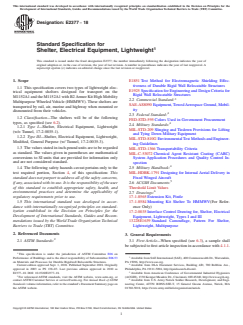
This specification covers two types of lightweight electrical equipment shelters designed for transport on both the M1037 and M1097 high mobility multipurpose wheeled vehicle (HMMWV) by rail, air, marine, and highway when mounted or dismounted from their vehicles. The shelters will be of the following types: Type I —shelters without tunnel(17-2-0035-1); and Type III —modified general-purpose shelters with tunnel (17-2-0035-3). Shelters shall undergo rigid verification procedures to inspect their conformance to requirements pertaining to physical performance, environmental performance, transportability performance, identification, toxicity, and flame resistance.
SCOPE
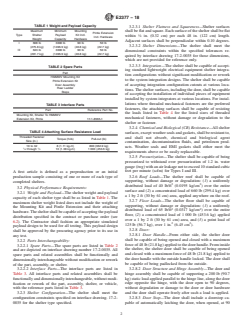
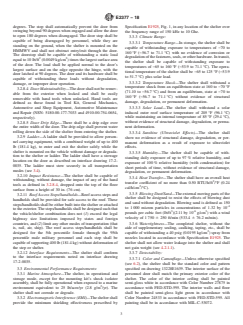
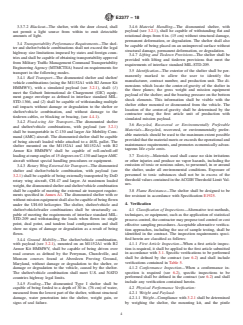
1.1 This specification covers two types of lightweight electrical equipment shelters designed for transport on the M1152A1 and the M1152A1 with B2 Armor Kit High Mobility Multipurpose Wheeled Vehicle (HMMWV). These shelters are transported by rail, air, marine and highway when mounted or dismounted from their vehicles.
1.2 Classification—The shelters will be of the following types, as specified (see 6.2).
1.2.1 Type I—Shelter, Electrical Equipment, Lightweight (w/o Tunnel, 17-2-0035-1).
1.2.2 Type III—Shelter, Electrical Equipment, Lightweight, Modified, General Purpose (w/ Tunnel, 17-2-0035-3).
1.3 The values stated in inch-pound units are to be regarded as standard. The values given in parentheses are mathematical conversions to SI units that are provided for information only and are not considered standard.
1.4 The following safety hazards caveat pertains only to the test required portion, Section 4, of this specification: This standard does not purport to address all of the safety concerns, if any, associated with its use. It is the responsibility of the user of this standard to establish appropriate safety, health, and environmental practices and determine the applicability of regulatory requirements prior to use.
1.5 This international standard was developed in accordance with internationally recognized principles on standardization established in the Decision on Principles for the Development of International Standards, Guides and Recommendations issued by the World Trade Organization Technical Barriers to Trade (TBT) Committee.
- Status
- Published
- Publication Date
- 31-Aug-2018
- Technical Committee
- E06 - Performance of Buildings
Buy Documents
ASTM E2377-18 - Standard Specification for Shelter, Electrical Equipment, Lightweight
REDLINE ASTM E2377-18 - Standard Specification for Shelter, Electrical Equipment, Lightweight
Overview
ASTM E2377-18 is the Standard Specification for Shelter, Electrical Equipment, Lightweight, developed by ASTM International. This standard establishes requirements for lightweight electrical equipment shelters intended for deployment and transport with High Mobility Multipurpose Wheeled Vehicles (HMMWV), notably the M1152A1 series and their armored configurations. These shelters are designed for reliable operation across multiple transport modes, including highway, rail, air, and marine environments, both when mounted to or dismounted from their vehicle platforms.
The specification details two primary shelter types:
- Type I: Shelter without tunnel (17-2-0035-1)
- Type III: Modified general-purpose shelter with tunnel (17-2-0035-3)
Key performance attributes outlined in ASTM E2377-18 include physical and environmental durability, transportability, safety, flame resistance, and identification criteria, ensuring these shelters meet demanding operational and logistical needs for military and governmental applications.
Key Topics
- Shelter Performance Requirements: Specifies operational parameters for weight, payload, roof and floor load capacities, pressurization, chemical and biological resistance, electromagnetic interference shielding, and more.
- Parts Interchangeability: Requires all spare and interface parts to be functionally and dimensionally interchangeable without modification, supporting field logistics.
- Environmental Testing: Shelters must withstand exposure to marine atmospheres, humidity, dust, sand, intense solar load, temperature extremes, and ultraviolet radiation. Heat transfer performance and watertightness are also verified.
- Transportability: Ensures shelters and shelter/vehicle combinations meet legal size limits and can be safely transported by rail, highway, air (fixed and rotary wing), and marine vessels. Specific lift and tie-down provisions are defined.
- Physical Design Features:
- Secure, maintainable doors with load requirements.
- Integrated roof access steps/handholds and a stowable ladder for safe access.
- Camouflage, color, and blackout requirements in line with military standards.
- Markings for identification and payload information.
- Safety and Health: Addresses toxicological properties of materials and ensures compliance with relevant occupational thresholds and fire resistance specifications.
Applications
ASTM E2377-18 is critical for:
- Military Deployments: Providing standardized, mobile shelter environments for electronic and communication equipment, command posts, or other mission-critical applications.
- Government and Emergency Services: Serving as mobile command centers or technical shelter solutions where rapid deployment and multi-modal transport are necessary.
- Defense Contractors and Integrators: Guiding the design, manufacturing, and verification of shelter systems and subcomponents required to meet strict performance and interoperability criteria.
- Transport and Logistics Planning: Ensuring shelters are compatible with a range of vehicles and transport modes, promoting efficient mobilization and deployment in diverse environments.
Related Standards
When working with or referencing ASTM E2377-18, consider these related standards for a comprehensive approach to relocatable shelter systems:
- ASTM E1851: Test Method for Electromagnetic Shielding Effectiveness of Durable Rigid Wall Relocatable Structures
- ASTM E1925: Specification for Engineering and Design Criteria for Rigid Wall Relocatable Structures
- SAE-AS8090: Equipment, Towed Aerospace Ground, Mobility
- FED-STD-595: Colors Used in Government Procurement
- MIL-STD-209: Slinging and Tiedown Provisions for Lifting and Tying Down Military Equipment
- MIL-STD-810: Environmental Test Methods and Engineering Guidelines
- MIL-STD-1366: Transportability Criteria
- MIL-C-53072: Chemical Agent Resistant Coating (CARC) Application Procedures
- MIL-HDBK-1791: Designing for Internal Aerial Delivery in Fixed Winged Aircraft
Engaging with ASTM E2377-18 ensures that lightweight electrical equipment shelters are manufactured and maintained to the highest standards of durability, safety, and logistical efficiency for military and government operations.
Relations
- Effective Date
- 01-Sep-2018
- Effective Date
- 01-Oct-2018
- Effective Date
- 01-Oct-2010
- Effective Date
- 01-Nov-2009
- Effective Date
- 01-Nov-2004
- Effective Date
- 01-Oct-2004
- Effective Date
- 10-Apr-2002
- Effective Date
- 10-Apr-2001
- Effective Date
- 10-Apr-2001
Buy Documents
ASTM E2377-18 - Standard Specification for Shelter, Electrical Equipment, Lightweight
REDLINE ASTM E2377-18 - Standard Specification for Shelter, Electrical Equipment, Lightweight
Get Certified
Connect with accredited certification bodies for this standard

IMQ S.p.A. (Certification)
Italian electrical product certification.

SLG Prüf- und Zertifizierungs GmbH
German testing and certification body.

UL Solutions
Global safety science company with testing, inspection and certification.
Sponsored listings
Frequently Asked Questions
ASTM E2377-18 is a technical specification published by ASTM International. Its full title is "Standard Specification for Shelter, Electrical Equipment, Lightweight". This standard covers: ABSTRACT This specification covers two types of lightweight electrical equipment shelters designed for transport on both the M1037 and M1097 high mobility multipurpose wheeled vehicle (HMMWV) by rail, air, marine, and highway when mounted or dismounted from their vehicles. The shelters will be of the following types: Type I —shelters without tunnel(17-2-0035-1); and Type III —modified general-purpose shelters with tunnel (17-2-0035-3). Shelters shall undergo rigid verification procedures to inspect their conformance to requirements pertaining to physical performance, environmental performance, transportability performance, identification, toxicity, and flame resistance. SCOPE 1.1 This specification covers two types of lightweight electrical equipment shelters designed for transport on the M1152A1 and the M1152A1 with B2 Armor Kit High Mobility Multipurpose Wheeled Vehicle (HMMWV). These shelters are transported by rail, air, marine and highway when mounted or dismounted from their vehicles. 1.2 Classification—The shelters will be of the following types, as specified (see 6.2). 1.2.1 Type I—Shelter, Electrical Equipment, Lightweight (w/o Tunnel, 17-2-0035-1). 1.2.2 Type III—Shelter, Electrical Equipment, Lightweight, Modified, General Purpose (w/ Tunnel, 17-2-0035-3). 1.3 The values stated in inch-pound units are to be regarded as standard. The values given in parentheses are mathematical conversions to SI units that are provided for information only and are not considered standard. 1.4 The following safety hazards caveat pertains only to the test required portion, Section 4, of this specification: This standard does not purport to address all of the safety concerns, if any, associated with its use. It is the responsibility of the user of this standard to establish appropriate safety, health, and environmental practices and determine the applicability of regulatory requirements prior to use. 1.5 This international standard was developed in accordance with internationally recognized principles on standardization established in the Decision on Principles for the Development of International Standards, Guides and Recommendations issued by the World Trade Organization Technical Barriers to Trade (TBT) Committee.
ABSTRACT This specification covers two types of lightweight electrical equipment shelters designed for transport on both the M1037 and M1097 high mobility multipurpose wheeled vehicle (HMMWV) by rail, air, marine, and highway when mounted or dismounted from their vehicles. The shelters will be of the following types: Type I —shelters without tunnel(17-2-0035-1); and Type III —modified general-purpose shelters with tunnel (17-2-0035-3). Shelters shall undergo rigid verification procedures to inspect their conformance to requirements pertaining to physical performance, environmental performance, transportability performance, identification, toxicity, and flame resistance. SCOPE 1.1 This specification covers two types of lightweight electrical equipment shelters designed for transport on the M1152A1 and the M1152A1 with B2 Armor Kit High Mobility Multipurpose Wheeled Vehicle (HMMWV). These shelters are transported by rail, air, marine and highway when mounted or dismounted from their vehicles. 1.2 Classification—The shelters will be of the following types, as specified (see 6.2). 1.2.1 Type I—Shelter, Electrical Equipment, Lightweight (w/o Tunnel, 17-2-0035-1). 1.2.2 Type III—Shelter, Electrical Equipment, Lightweight, Modified, General Purpose (w/ Tunnel, 17-2-0035-3). 1.3 The values stated in inch-pound units are to be regarded as standard. The values given in parentheses are mathematical conversions to SI units that are provided for information only and are not considered standard. 1.4 The following safety hazards caveat pertains only to the test required portion, Section 4, of this specification: This standard does not purport to address all of the safety concerns, if any, associated with its use. It is the responsibility of the user of this standard to establish appropriate safety, health, and environmental practices and determine the applicability of regulatory requirements prior to use. 1.5 This international standard was developed in accordance with internationally recognized principles on standardization established in the Decision on Principles for the Development of International Standards, Guides and Recommendations issued by the World Trade Organization Technical Barriers to Trade (TBT) Committee.
ASTM E2377-18 is classified under the following ICS (International Classification for Standards) categories: 29.260.99 - Other electrical equipment for working in special conditions. The ICS classification helps identify the subject area and facilitates finding related standards.
ASTM E2377-18 has the following relationships with other standards: It is inter standard links to ASTM E2377-10, ASTM E1925-18, ASTM E1925-10, ASTM E1851-09, ASTM E1851-04, ASTM E1925-04, ASTM E1851-02, ASTM E1925-99, ASTM E1925-01. Understanding these relationships helps ensure you are using the most current and applicable version of the standard.
ASTM E2377-18 is available in PDF format for immediate download after purchase. The document can be added to your cart and obtained through the secure checkout process. Digital delivery ensures instant access to the complete standard document.
Standards Content (Sample)
This international standard was developed in accordance with internationally recognized principles on standardization established in the Decision on Principles for the
Development of International Standards, Guides and Recommendations issued by the World Trade Organization Technical Barriers to Trade (TBT) Committee.
Designation:E2377 −18
Standard Specification for
Shelter, Electrical Equipment, Lightweight
This standard is issued under the fixed designation E2377; the number immediately following the designation indicates the year of
original adoption or, in the case of revision, the year of last revision.Anumber in parentheses indicates the year of last reapproval.A
superscript epsilon (´) indicates an editorial change since the last revision or reapproval.
1. Scope E1851Test Method for Electromagnetic Shielding Effec-
tiveness of Durable Rigid Wall Relocatable Structures
1.1 This specification covers two types of lightweight elec-
E1925Specification for Engineering and Design Criteria for
trical equipment shelters designed for transport on the
Rigid Wall Relocatable Structures
M1152A1andtheM1152A1withB2ArmorKitHighMobility
2.2 Commercial Standard:
MultipurposeWheeledVehicle (HMMWV).These shelters are
SAE-AS8090Equipment,TowedAerospaceGround,Mobil-
transported by rail, air, marine and highway when mounted or
ity
dismounted from their vehicles.
2.3 Federal Standard:
1.2 Classification—The shelters will be of the following
FED-STD-595Colors Used in Government Procurement
types, as specified (see 6.2).
2.4 Military Standards:
1.2.1 Type I—Shelter, Electrical Equipment, Lightweight
MIL-STD-209Slinging and Tiedown Provisions for Lifting
(w/o Tunnel, 17-2-0035-1).
and Tying Down Military Equipment
1.2.2 Type III—Shelter, Electrical Equipment, Lightweight,
MIL-STD-810GEnvironmentalTestMethodsandEngineer-
Modified, General Purpose (w/ Tunnel, 17-2-0035-3).
ing Guidelines
1.3 The values stated in inch-pound units are to be regarded
MIL-STD-1366Transportability Criteria
as standard. The values given in parentheses are mathematical
MIL-C-53072Chemical Agent Resistant Coating (CARC)
conversions to SI units that are provided for information only
System Application Procedures and Quality Control In-
and are not considered standard.
spection
2.5 Military Handbook:
1.4 The following safety hazards caveat pertains only to the
MIL-HDBK-1791Designing for InternalAerial Delivery in
test required portion, Section 4, of this specification: This
Fixed Winged Aircraft
standard does not purport to address all of the safety concerns,
if any, associated with its use. It is the responsibility of the user 2.6 ACGIH Documents:
of this standard to establish appropriate safety, health, and ThresholdLimitValues
environmental practices and determine the applicability of
2.7 Drawings:
regulatory requirements prior to use.
17-1-8565Extension Kit, Pintle
1.5 This international standard was developed in accor-
17-1-8584Mounting Kit Shelter To HMMWV(For Refer-
dance with internationally recognized principles on standard-
ence Only)
ization established in the Decision on Principles for the
17-2-0035Interface Control Drawing for, Shelter, Electrical
Development of International Standards, Guides and Recom-
Equipment, Lightweight, Types I and III
mendations issued by the World Trade Organization Technical
13228E1639 Standard Camouflage, Pattern For Shelter,
Barriers to Trade (TBT) Committee.
Lightweight, Multipurpose
2. Referenced Documents 3. General Requirements
2.1 ASTM Standards: 3.1 First Article—When specified (see 6.3), a sample shall
besubjectedtofirstarticleinspectioninaccordancewith4.1.1.
This specification is under the jurisdiction of ASTM Committee E06 on
Performance of Buildings and is the direct responsibility of Subcommittee E06.53 AvailablefromSAEInternational(SAE),400CommonwealthDr.,Warrendale,
on Materials and Processes for Durable Rigidwall Relocatable Structures. PA 15096, http://www.sae.org.
Current edition approved Sept. 1, 2018. Published September 2018. Originally Available from DLA Document Services, Building 4/D, 700 Robbins Ave.,
approved in 2003 as PS 138–03. Last previous edition approved in 2010 as Philadelphia, PA 19111-5094, http://quicksearch.dla.mil.
E2377–10. DOI: 10.1520/E2377–18. Available from American Conference of Governmental Industrial Hygienists
For referenced ASTM standards, visit the ASTM website, www.astm.org, or (ACGIH),1330KemperMeadowDr.,Cincinnati,OH45240,http://www.acgih.org.
contact ASTM Customer Service at service@astm.org. For Annual Book of ASTM Available from U.S. Army Natick Soldier Research, Development, and Engi-
Standards volume information, refer to the standard’s Document Summary page on neering Center, ATTN: RDNS-SEE-T, 15 General Greene Avenue, Natick, MA
the ASTM website. 01760-5018, https://www.army.mil/info/organization/natick.
Copyright © ASTM International, 100 Barr Harbor Drive, PO Box C700, West Conshohocken, PA 19428-2959. United States
E2377−18
TABLE 1 Weight and Payload Capacity
3.2.3.1 Shelter Flatness and Squareness—Shelter surfaces
Maximum Minimum Mounting shallbeflatandsquare.Eachsurfaceofthesheltershallbeflat
Pintle Extension
Type Shelter Payload Kit Incl.
within ⁄8 in. (0.32 cm) per each 48 in. (122 cm) length.
Incl. Hardware
Weight Capacity Hardware
Adjacent surfaces shall be perpendicular within 0.10 degrees.
I 608 lb 3300 lb 90 lb 50 lb
3.2.3.2 Shelter Dimensions—The shelter shall meet the
(275.8 kg) (1496.9 kg) (40.8 kg) (22.7 kg)
III 643 lb 3300 lb 90 lb 50 lb
dimensional constraints within the specified tolerances re-
(291.7 kg) (1496.9 kg) (40.8 kg) (22.7 kg)
quired by interface drawing 17-2-0035 for those dimensions,
which are not provided for reference only.
3.2.3.3 Integration—The shelter shall be capable of accept-
TABLE 2 Spare Parts
ing standard lightweight electrical equipment shelter integra-
Part
tion configurations without significant modification or rework
HMMWV Mounting Kit
to the system integration designs. The shelter shall be capable
Pintle Extension Kit
Door Assembly
of accepting integration configuration cutouts at various loca-
Rear Ladder
tions.The shelter surfaces, including the door, shall be capable
Steps
of accepting the installation of individual pieces of equipment
installed by system integrators at various locations. For instal-
lations where threaded mechanical fasteners are the preferred
TABLE 3 Interface Parts
fasteners, the attaching surfaces shall be capable of resisting
Part Reference Part No.
the loads listed in Table 4 for the listed sizes of threaded
Mounting Kit, Shelter To HMMWV
mechanical fasteners, without damage or degradation to the
Extension Kit, Pintle 17-1-8565-1
shelter or fastener.
3.2.4 Chemical and Biological (CB) Resistance—Allshelter
TABLE 4 Attaching Surface Resistance Load
surfaces,exceptweathersealsandgaskets,shallberesistantto,
Threaded Fastener
and shall not absorb, chemical and biological agent
Torque (ft-lb) Pull-out (lb)
Size (in.)
contamination, decontamination fluids, and petroleum prod-
10 to 32 8 (1.11 kg-m) 800 (362.9 kg)
ucts. Weather seals and EMI gaskets shall either meet the
1 1
⁄4 through ⁄2 10 (1.38 kg-m) 1 000 (453.6 kg)
requirements above or be easily replaceable.
3.2.5 Pressurization—The shelter shall be capable of being
pressurized to withstand over pressurization of 1.2 in. water
gauge(iwg)withanairleakagenottoexceed10standardcubic
feet per minute (scfm) for Types I and III.
A first article is defined as a preproduction or an initial
3.2.6 Roof Loads—The shelter roof shall be capable of
production sample consisting of one or more of each type of
supporting, without damage or degradation: (1) a uniformly
completed shelters.
2 2
distributed load of 40 lb/ft (0.0195 kg/cm ) over the entire
3.2 Physical Performance Requirements:
surface and (2) a concentrated load of 660 lb (299.4 kg) over
3.2.1 Weight and Payload—The shelter weight and payload
a 1 by 2 ft (30 by 61 cm) area, applied anywhere on the roof.
capacity of each shelter type shall be as listed in Table 1. The
3.2.7 Floor Loads—The shelter floor shall be capable of
maximum shelter weight listed does not include the weight of
supporting, without damage or degradation: (1) a uniformly
the Mounting Kit and Pintle Extension and their attaching
2 2
distributed load of 65 lb/ft (0.0317 kg/cm ) over the entire
hardware.Thesheltershallbecapableofacceptingthepayload
floor, (2) a concentrated load of 1000 lb (453.6 kg) applied
distribution specified in the contract or purchase order (see
overa1by2ft(30by61cm) area, and (3) a point load of
6.2). The Contractor shall fashion an appropriate simulated
2 2
125lb (56.7 kg), over 1 in. (6.45 cm ).
payload design to be used for all testing. This payload design
3.2.8 Door:
shall be approved by the procuring agency prior to its use in
3.2.8.1 Door Handle—From either side, the shelter door
any test.
shall be capable of being opened and closed with a maximum
3.2.2 Parts InterchangeabiIity:
forceof48lb(21.8kg)appliedtothedoorhandle.Frominside
3.2.2.1 Spare Parts—The spare parts are listed in Table 2
the shelter, the shelter door shall be capable of being opened
and are depicted on interface drawing number 17-2-0035. All
and closed with a maximum force of 48 lb (21.8 kg) applied to
spare parts and related assemblies shall be functionally and
the door handle with the outside handle locked.The door shall
dimensionally interchangeable without modification or rework
be capable of being padlocked from the outside.
of the part, assembly, or shelter.
3.2.8.2 Door Structure and Hinge Assembly—The door and
3.2.2.2 Interface Parts—The interface parts are listed in
hinge assembly shall be capable of supporting a 200 lb (90.7
Table 3. All interface parts and related assemblies shall be
kg)staticloadappliedparalleltothehingeline,alongthedoor
functionallyanddimensionallyinterchangeable,withoutmodi-
edge opposite the hinge, with the door open to 90 degrees,
fication or rework of the part, assembly, shelter, or vehicle,
without degradation or damage to the door or door hardware
with the reference parts listed in Table 3.
and the door shall operate freely after such a load is applied.
3.2.3 Shelter Configuration—The shelter shall meet the
configuration constraints specified on interface drawing. 17-2- 3.2.8.3 Door Stop—The door shall include a doorstop ca-
0035 for the shelter type specified. pable of automatically latching the door, when opened, at 90
E2377−18
degrees. The stop shall automatically prevent the door from Specification E1925, Fig. 1, in any location of the shelter over
swingingbeyond90degreeswhenengagedandallowthedoor the frequency range of 150 kHz to 10 Ghz.
to open 180 degrees when disengaged. The door stop shall be
3.3.3 Climate Range:
capable of being disengaged by personnel, while they are
3.3.3.1 Temperature Range—In storage, the shelter shall be
standing on the ground, when the shelter is mounted on the
capable of withstanding exposure to temperatures of −70 to
HMMWV and shall not obstruct entry/exit through the door.
160°F (−56.7 to 71.1°C) with no evidence of corrosion or
The doorstop shall be capable of withstanding a static load
degradationofthefasteners,seals,orotherhardware.Intransit,
2 2
equalto10lb/ft (0.0049kg/cm )timesthelargestsurfacearea
the shelter shall be capable of withstanding exposure to
of the door. The load shall be applied normal to the door’s
temperatures of −65 to 160°F (−53.9 to 71.1°C). The opera-
largest surface and on the edge opposite the hinge, with the
tional temperature of the shelter shall be −65 to 125°F (−53.9
door latched at 90 degrees. The door and its hardware shall be
to 51.7°C) plus solar load.
capable of withstanding these loads without degradation,
3.3.3.2 Temperature Shock—The shelter shall withstand a
damage, or improper door operation.
temperature shock from an equilibrium state at 160 to −70°F
3.2.8.4 Door Maintainability—Thedoorshallnotberemov-
(71.10 to −56.7°C) and from an equilibrium, state at −70 to
able from the exterior when locked and shall be easily
160°F (−56.7 to 71.1°C) without evidence of structural
removable with hand tools when unlocked. Hand tools are
damage, degradation, or permanent deformation.
defined as those found in Tool Kit, General Mechanics,
3.3.3.3 Solar Load—The shelter shall withstand a solar
Automotive and Shop Equipment, Automotive Maintenance
and Repair (NSN: 5180-00-177-7033 and 4910-00-754-0654, induced outer roof surface temperature of 205°F (96.1°C)
while maintaining an internal temperature of 85°F (29.4°C),
respectively).
without evidence of structural damage, degradation, or perma-
3.2.8.5 Door Drip Edge—There shall be a drip edge over
the entire width of the door. The drip edge shall prevent water nent deformation.
rolling down the side of the shelter from entering the shelter.
3.3.3.4 Sunshine (Ultraviolet Effects)—The shelter shall
3.2.9 Ladder—A ladder shall be provided to allow person-
show no evidence of structural damage, degradation, or per-
nel carrying equipment, with a combined weight of up to 400
manent deformation as a result of exposure to ultraviolet
lb (181.4 kg), to enter and exit the shelter safely while the
effects.
shelter is mounted on the vehicle without damage or degrada-
3.3.3.5 Humidity—The shelter shall be capable of with-
tion to the shelter or ladder. The ladder shall have a stowage
standing daily exposure of up to 97% relative humidity, and
location on the door as described on interface drawing 17-2-
exposure of 100% relative humidity (with condensation) for
0035. The ladder must stow securely in all transportation
short periods of time, without evidence of structural damage,
modes (see 3.4).
degradation, or permanent deformation.
3.2.10 Impact Resistance—The shelter shall be capable of
3.3.4 Heat Transfer—The shelter shall have an overall heat
withstanding, without damage, the impact of any of the hand
transfer coefficient of no more than 0.50 BTU/h/ft /°F (0.24
tools as defined in 3.2.8.4, dropped onto the top of the floor
cal/h/cm /°C).
surface from a height of 30 in. (76 cm).
3.3.5 Blowing Dust/Sand—Theexternalmovingpartsofthe
3.2.11 Roof Access Steps/handholds—Roofaccessstepsand
shelter shall be designed to resist the effects of blowing dust
handholds shall be provided for safe access to the roof. These
and sand without degradation. Blowing sand is defined as 150
steps/handholdsshallbeeitherbuiltintotheshelterorattached
-4
to 1000 micron particles in concentrations of 1.32 by 10
totheexterior.Thesteps/handholdsshallbedesignedsuchthat
3 -6 3
pounds per cubic feet (lb/ft )(2.11 by 10 g/cm ) with a wind
the vehicle/shelter combination does not (1) exceed the legal
velocity of 1750 6 250 ft/min (533.4 6 76.2 m/min).
highway size limitations imposed by states and foreign
3.3.6 Watertightness—The completed shelter, without the
countries, and (2) limit any other modes of transportation (that
is, rail, air, ship). The roof access steps/handholds shall be aide of supplementary sealing, caulking, taping, etc., shall be
designed for the 5th percentile female through the 95th capable of withstanding a 40 psig (0.0195 kg/cm ) spray from
percentile male military personnel and each step shall be nozzles located in accordance with Specification E1925. The
capableofsupporting400lb(181.4kg)withoutdeformationof shelter shall not allow water leakage into the shelter and shall
the step or shelter.
not gain weight (see 4.2.1.1).
3.2.12 Interface Requirements—The shelter shall conform
3.3.7 Detectability:
to the interface requirements noted on interface drawing
3.3.7.1 Color and Camouflage—Unless otherwise specified
17-2-0035.
(see 6.2), the shelter shall be the standard color and pattern
3.3 Environmental Performance Requirements: specified on drawing 13228E1639. The interior surface of the
3.3.1 Marine Atmosphere—The shelter, in operational and personnel door shall match the primary exterior color of the
storage mode, except for the mounting kit’s shock isolator shelter. The color of the interior ceiling shall be painted
assembly, shall be fully operational when exposed to a marine semi-gloss white in accordance with Color Number 27875 in
environment equivalent to 25 lb/acre/yr (2.8 g/m /yr). The accordance with FED-STD-595. The interior walls and floor
shelter shall not corrode or degrade.
shall be painted semi-gloss light green in accordance with
3.3.2 ElectromagneticInterference(EMI)—Thesheltershall Color Number 24533 in accordance with FED-STD-595. All
provide the minimum shielding effectiveness prescribed by painting shall be in accordance with MIL-C-53072.
E2377−18
3.3.7.2 Blackout—The shelter, with the door closed, shall 3.4.6 Material Handling—The dismounted shelter, with
not permit a light source from within to emit detectable payload (see 3.2.1), shall he capable of withstanding flat and
amounts of light. rotational drops from 6 in. (15 cm) without structural damage,
permanent deformation, or degradation. The shelter shall also
3.4 Transportability Performance Requirements—The shel-
be capable of being placed on an unimproved surface without
ter and shelter/vehicle combinations shall not exceed the legal
structural damage, permanent deformation, or degradation.
highway size limitations imposed by states and foreign coun-
3.4.7 Lifting and Tiedown Provisions—The shelter shall be
triesandshallbecapableofobtainingtransportabilityapproval
provided with lifting and tiedown provisions that meet the
from Military Traffic Management Command Transportability
requirements of interface standard MIL-STD-209.
Engineering Agency (MTMCTEA) based on requirements for
3.5 Identification—The exterior of the shelter shall be per-
transport in the following modes.
manently marked to allow the user to identify the
3.4.1 Rail Transport—The dismounted shelter and shelter/
manufacturer, contract number, and production unit. The di-
vehicle combinations (using the M1152A1 with B2Armor Kit
mensions which locate the center-of-gravity of the shelter in
HMMWV), with a simulated payload (see 3.2.1), shall: (1)
the three planes; the gross weight and mission equipment
meet the Gabarit International de Chargement (GIC) equip-
payload of the shelter; and the bearing pressure on the bottom
ment gauge envelope as defined in interface standard MIL-
shock elements. This information shall be visible with the
STD-1366, and (2) shall be capable of withstanding multiple
shelter either mounted or dismounted from the vehicle. The
rail impacts without damage or degradation to the shelter or
location of the center-of-gravity shall be determined by the
shelter/vehicle combination, and without damage to the
contractor using the first article unit of production with
tiedown cables, or blocking or bracing, (see 4.4.1).
simulated mission payload.
3.4.2 Fixed-wing Air Transport—The dismounted shelter
3.6 Recycled, Recovered or Environmentally Preferable
and shelter/vehicle combinations, with payload (see 3.2.1)
Materials—Recycled, recovered, or environmentally prefer-
shall be transportable in C-130 and larger Air Mobility Com-
able materials should be used to the maximum extent possible
mand (AMC) aircraft.The dismounted shelter shall be capable
providedthatthematerialmeetsorexceedstheoperationaland
of being aircraft loaded while attached to a 463L pallet. The
maintenance requirements, and promotes economically advan-
shelter mounted on the M1152A1 and M1152A1 with B2
tageous life cycle costs.
Armor Kit HMMWV shall be capable of roll-on/roll-off
loadingatrampanglesof15degreesonC-130andlargerAMC 3.7 Toxicity—Materials used shall cause no skin irritations
or other injuries and produce no vapor hazards, including the
aircraft without special handling procedures or equipment.
emission of toxic or noxious odors, to personnel, in or around
3.4.3 Rotary Wing ExternalAir Transport—Thedismounted
the shelter, under all environmental conditions. Exposure of
shelter and shelter/vehicle combination, with payload (see
personnel to toxic substances shall not be in excess of the
3.2.1) shall be capable of being externally transported by DoD
thresholdvaluescontainedintheACGIHThresholdLimitVal-
rotary wing aircraft, CH-47 and larger. At maximum loaded
ues.
weight,thedismountedshelterandshelter/vehiclecombination
shall be capable of meeting the external air transport require-
3.8 Flame Resistance—The shelter shall be designed to be
ments specified in Annex A1. The dismounted shelter with or fire resistant in accordance with Specification E1925.
withoutmissionequipmentshallalsobecapableofbeingflown
4. Verification
under the UH-60 helicopter. The shelter, shelter/vehicle and
shelter/vehicle/trailer combinations shall be structurally ca-
4.1 Classification of Inspections—Alternative test methods,
pable of meeting the requirements of interface standard MIL-
techniques, or equipment, such as the application of statistical
STD-209 and withstanding the loads when flown in: single
processcontrol,thecontractormayproposetoolcontrolorcost
point, dual point, and tandem load configurations and shall
effective sampling procedures.Acceptable alternative verifica-
show no signs of damage or degradation as a result of being
tion approaches, including the use of sample testing, shall be
flown.
identified in the contract. The inspection requirements speci-
fied herein are classified as follows:
3.4.4 Ground Mobility—The shelter/vehicle combination,
4.1.1 First Article Inspection—When a first article inspec-
with payload (see
3.2.1), mounted on an M1152A1 with B2
tion is required, it shall be applied to the first article submitted
Armor Kit HMMWV, shall be capable of being driven over
in accordance with 3.1. Specific verifications to be performed
road courses as defined by the Perryman, Churchville, and
shall be defined by the contract (see 6.2) and shall include
Munson courses found at Aberdeen Proving Ground,
verifications contained in Table 5.
Maryland, without damage or degradation to the shelter, or
4.1.2 Conformance Inspection—When a conformance in-
damage or degradation to the vehicle, caused by the shelter.
spection is required (see 6.2), specific inspections to be
The shelter/vehicle combination shall meet U.S. and NATO
performed shall be defined in the contract (see 6.2) and shall
countries highway legal limits.
include any verification contained herein.
3.4.5 Fording—The dismounted Type I shelter shall be
capable of being forded to a depth of 30 in. (76 cm) of water, 4.2 Physical Performance Verification:
measuredfromthelowestpartoftheshelter,withoutstructural 4.2.1 Weight and Payload:
damage, water penetration into the shelter, weight gain, or 4.2.1.1 Weight—Compliance with 3.2.1 shall be determined
signs of seal failure. by weighing the shelter, the mounting kit, and the pintle
E2377−18
TABLE 5 Sequence Of First Article Verifications
shelves, or attaching hardware) attributable to the shelter
Requirement Verification during the course of the test shall constitute failure of the test
Verification
Paragraph Paragraph
being performed.
Flame Resistance 3.8 4.7
4.2.2 Parts Interchangeability:
Color and camouflage 3.3.7.1 4.3.7.1
Identification 3.5 4.5 4.2.2.1 Spare-parts—Compliance with 3.2.2.1 shall be de-
Weight 3.2.1 4.2.1.1
termined by selecting two shelters from the production lot of
Spare parts 3.2.2.1 4.2.2.1
completed shelters. The parts listed in Table 2 shall be
Interface parts 3.2.2.2 4.2.2.2
Door handle 3.2.8.1 4.2.8.1 interchanged between the shelters. The interchange shall be
Shelter 3.2.3 4.2.3
accomplished by removing the fasteners, interchanging the
Flatness 3.2.3.1 4.2.3.1(1)
parts and reinstalling the fasteners. Inability to interchange the
Squareness 3.2.3.1 4.2.3.1(2)
Electromagnetic interference (EMI) 3.3.2 4.3.2
parts or loss of functionality in accordance with 3.2.2.1 shall
Roof loads 3.2.6 4.2.6
constitute failure of this test.
Floor loads 3.2.7 4.2.7
4.2.2.2 Interface Parts—Compliance with 3.2.2.2 shall be
Door structure and hinge assembly 3.2.8.2 4.2.8.2
Door stop 3.2.8.3 4.2.8.3
determined by selecting one of each of the parts listed in Table
Door maintainability 3.2.8.4 4.2.8.4
3 from the production lot of completed shelters. The inter-
Door drip edge 3.2.8.5 4.2.8.5
Ladder 3.2.9 4.2.9 change shall be accomplished by removing the fasteners,
Roof access steps/handholds 3.2.11 4.2.11
interchanging the parts and reinstalling the fasteners with a
Interface requirements 3.2.12 4.2.12
government furnished shelter/vehicle combination. Inability to
Chemical and biological (CB) resistance 3.2.4 4.2.4
interchangethepartsinaccordancewith3.2.2.2shallconstitute
Pressurization 3.2.5 4.2.5
Temperature range 3.3.3.1 4.3.3.1
failure of this test.
Toxicity 3.7 4.6
4.2.3 Shelter Configuration—The shelter shall be inspected
Humidity 3.3.3.5 4.3.3.5
Toxicity 3.7 4.6
to determine compliance with 3.2.3. Failure to meet the
Marine atmosphere 3.3.1 4.3.1
requirements of 3.2.3 shall constitute failure of this test.
Temperature shock 3.3.3.2 4.3.3.2
4.2.3.1 Shelter Flatness and Squareness—The following
Heat transfer 3.3.4 4.3.4
Blowing dust/sand 3.3.5 4.3.5
flatness and squareness tests shall be performed to determine
Sunshine (ultraviolet effects) 3.3.3.4 4.3.3.4
compliancewiththerequirementswith3.2.3.1.Failuretomeet
Solar load 3.3.3.3 4.3.3.3
Blackout 3.3.7.2 4.3.7.2 the requirements of 3.2.3.1 shall constitute failure of this test.
Payload 3.2.1 4.2.1.2
(1) Flatness—The flatness of the shelter panels shall be
Fixed-wing air transport 3.4.2 4.4.2
determinedusingastraightedge,thatisatleast48in.(120cm)
Flat-drop 3.4.6 4.4.6.1
Rotational drop 3.4.6 4.4.6.2 long, which is flat within 0.005 in. (0.13 mm) total.Two ⁄8-in.
Shelter placement 3.4.6 4.4.6.3
(3.2 mm) shims shall be placed under the straight edge, one at
Lifting and tiedown provisions 3.4.7 4.4.7
each end. A series of measurements shall be taken along the
Rotary-wing air transport 3.4.3 4.4.3
Rail transport 3.4.1 4.4.1 length of the straight edge, in both the horizontal and vertical
Ground mobility 3.4.4 4.4.4
directions, across the shelter’s interior/exterior surfaces to
Watertightness 3.3.6 4.3.6
identify the largest cup or bow.
Fording 3.4.5 4.4.5
Impact Resistance 3.2.10 4.2.10 (2) Squareness—The shelter shall be tested in accordance
Electromagnetic interference (EMI) (2nd 3.3.2 4.3.2
with Specification E1925. For the purpose of this test, any
time)
horizontal surface shall be considered a roof/floor and any
Shelter dimensions 3.2.3.2 4.2.3.2
Door handle (2nd time) 3.2.8.1 4.2.8.1 vertical surface shall be considered a wall. In those regions
Integration 3.2.3.3 4.2.3.3
where a 36 in. (90 cm) square is impractical, a square of the
Torque 3.2.3.3 4.2.3.3(1)
appropriate size shall be used and the allowed gap shall be
Pull-out 3.2.3.3 4.2.3.3(2)
proportional.
4.2.3.2 Shelter Dimensions—Each non-reference dimension
specified on the interface drawing 17-2-0035 shall be mea-
sured. Failure to meet the requirements of 3.2.3.2 shall
constitute failure of this test.
extension including their associated hardware. The scale used
4.2.3.3 Integration—The shelter shall be examined to deter-
shall have 1 lb (453.6 g) or less graduation and shall have an
mine compliance with 3.2.3.3. A standard LMS integration
accuracy of at least 61 lb (453.6 g). The scale shall have a
configuration shall be used to determine test weight insert
current calibration, traceable to the National Institute for
locations in the primary First Article Test Unit. The threaded
Standards and Technology. Any item exceeding maximum
fasteners used to secure the test weights shall be tested. Test
weight listed in Table 1 shall be considered a f
...
This document is not an ASTM standard and is intended only to provide the user of an ASTM standard an indication of what changes have been made to the previous version. Because
it may not be technically possible to adequately depict all changes accurately, ASTM recommends that users consult prior editions as appropriate. In all cases only the current version
of the standard as published by ASTM is to be considered the official document.
Designation: E2377 − 10 E2377 − 18
Standard Specification for
Shelter, Electrical Equipment, Lightweight
This standard is issued under the fixed designation E2377; the number immediately following the designation indicates the year of
original adoption or, in the case of revision, the year of last revision. A number in parentheses indicates the year of last reapproval. A
superscript epsilon (´) indicates an editorial change since the last revision or reapproval.
1. Scope
1.1 This specification covers two types of lightweight electrical equipment shelters designed for transport on the M1152A1,
M1152A1 M1152A1 and the M1152A1 with B2 Armor Kit, M1037, and M1097 Kit High Mobility Multipurpose Wheeled Vehicle
(HMMWV). These shelters are transported by rail, air, marine and highway when mounted or dismounted from their vehicles.
1.2 Classification—The shelters will be of the following types, as specified (see 6.2).
1.2.1 Type I—Shelter, Electrical Equipment, Lightweight (w/o Tunnel, 17-2-0035-1).
1.2.2 Type III—Shelter, Electrical Equipment, Lightweight, Modified, General Purpose (w/ Tunnel, 17-2-0035-3).
1.3 The values stated in inch-pound units are to be regarded as standard. The values given in parentheses are mathematical
conversions to SI units that are provided for information only and are not considered standard.
1.4 The following safety hazards caveat pertains only to the test required portion, Section 4, of this specification: This standard
does not purport to address all of the safety concerns, if any, associated with its use. It is the responsibility of the user of this
standard to establish appropriate safety safety, health, and healthenvironmental practices and determine the applicability of
regulatory requirements prior to use.
1.5 This international standard was developed in accordance with internationally recognized principles on standardization
established in the Decision on Principles for the Development of International Standards, Guides and Recommendations issued
by the World Trade Organization Technical Barriers to Trade (TBT) Committee.
2. Referenced Documents
2.1 ASTM Standards:
E1851 Test Method for Electromagnetic Shielding Effectiveness of Durable Rigid Wall Relocatable Structures
E1925 Specification for Engineering and Design Criteria for Rigid Wall Relocatable Structures
2.2 Commercial Standard:
SAE-AS8090 Equipment, Towed Aerospace Ground, Mobility
2.3 Federal Standard:
FED-STD-595 Colors Used in Government Procurement
2.4 Military Standards:
MIL-STD-209 Slinging and Tiedown Provisions for Lifting and Tying Down Military Equipment
MIL-STD-810MIL-STD-810G Environmental Test Methods and Engineering Guidelines
MIL-STD-1366 Transportability Criteria
MIL-C-53072 Chemical Agent Resistant Coating (CARC) System Application Procedures and Quality Control Inspection
2.5 Military Handbook:
MIL-HDBK-1791 Designing for Internal Aerial Delivery in Fixed Winged Aircraft
2.6 ACGIH Documents:
Threshold Limit Values
This specification is under the jurisdiction of ASTM Committee E06 on Performance of Buildings and is the direct responsibility of Subcommittee E06.53 on Materials
and Processes for Durable Rigidwall Relocatable Structures.
Current edition approved Oct. 1, 2010Sept. 1, 2018. Published October 2010September 2018. Originally approved in 2003 as PS 138 - 03.138–03. Last previous edition
approved in 20042010 as E2377 – 04.E2377–10. DOI: 10.1520/E2377-10.10.1520/E2377–18.
For referenced ASTM standards, visit the ASTM website, www.astm.org, or contact ASTM Customer Service at service@astm.org. For Annual Book of ASTM Standards
volume information, refer to the standard’sstandard’s Document Summary page on the ASTM website.
Available from SAE International (SAE), 400 Commonwealth Dr., Warrendale, PA 15096-0001,15096, http://www.sae.org.
Available from Standardization Documents Order Desk, DODSSP, Bldg. 4, Section D, DLA Document Services, Building 4/D, 700 Robbins Ave., Philadelphia, PA
19111-5098, http://dodssp.daps.dla.mil.19111-5094, http://quicksearch.dla.mil.
Available from American Conference of Governmental Industrial Hygienists, Inc. Hygienists (ACGIH), 1330 Kemper Meadow Dr., Cincinnati, OH 45240,
http://www.acgih.org.
Copyright © ASTM International, 100 Barr Harbor Drive, PO Box C700, West Conshohocken, PA 19428-2959. United States
E2377 − 18
TABLE 1 Weight and Payload Capacity
Maximum Minimum Mounting
Pintle Extension
Type Shelter Payload Kit Incl.
Incl. Hardware
Weight Capacity Hardware
I 608 lb 3300 lb 88 lb 50 lb
(275.8 kg) (1496.9 kg) (39.9 kg) (22.7 kg)
III 643 lb 3300 lb 88 lb 50 lb
(291.7 kg) (1496.9 kg) (39.9 kg) (22.7 kg)
TABLE 1 Weight and Payload Capacity
Maximum Minimum Mounting
Pintle Extension
Type Shelter Payload Kit Incl.
Incl. Hardware
Weight Capacity Hardware
I 608 lb 3300 lb 90 lb 50 lb
(275.8 kg) (1496.9 kg) (40.8 kg) (22.7 kg)
III 643 lb 3300 lb 90 lb 50 lb
(291.7 kg) (1496.9 kg) (40.8 kg) (22.7 kg)
TABLE 2 Spare Parts
Part
HMMWV Mounting Kit
Pintle Extension Kit
Door Assembly
Rear Ladder
Steps
T-bar Door Holder
TABLE 3 Interface Parts
Part Reference Part No.
Mounting Kit, Shelter To HMMWV 17-1-8584-1
Mounting Kit, Shelter To HMMWV
Extension Kit, Pintle 17-1-8565-1
TABLE 54 Attaching Surface Resistance Load
Threaded Fastener
Torque (ft-lb) Pull-out (lb)
Size (in.)
10 to 32 8 (1.11 kg-m) 800 (362.9 kg)
1 1
⁄4 through ⁄2 10 (1.38 kg-m) 1 000 (453.6 kg)
2.7 Drawings:
17-1-8565 Extension Kit, Pintle
17-1-8584 Mounting Kit Shelter To HMMWV(For Reference Only)
17-2-0035 Interface Control Drawing for, Shelter, Electrical Equipment, Lightweight, Types I and III
13228E1639 Standard Camouflage, Pattern For Shelter, Lightweight, Multipurpose
3. General Requirements
3.1 First Article—When specified (see 6.3), a sample shall be subjected to first article inspection in accordance with 4.1.1. A
first article is defined as a preproduction or an initial production sample consisting of one or more of each type of completed
shelters.
3.2 Physical Performance Requirements:
3.2.1 Weight and Payload—The shelter weight and payload capacity of each shelter type shall be as listed in Table 1. The
maximum shelter weight listed does not include the weight of the Mounting Kit and Pintle Extension and their attaching hardware.
The shelter shall be capable of accepting the payload distribution specified in the contract or purchase order (see 6.2). The
Contractor shall fashion an appropriate simulated payload design to be used for all testing. This payload design shall be approved
by the procuring agency prior to its use in any test.
3.2.2 Parts InterchangeabiIity:
Available from Shelter Technology, Engineering & Fabrication Directorate, U.S. Army Natick Soldier RD&E Center, ATTN: RDNS-ST, Kansas Street, Research,
Development, and Engineering Center, ATTN: RDNS-SEE-T, 15 General Greene Avenue, Natick, MA 01760-5018, http://www.natick.army.mil.https://www.army.mil/info/
organization/natick.
E2377 − 18
3.2.2.1 Spare Parts—The spare parts are listed in Table 2 and are depicted on interface drawing number 17-2-0035. All spare
parts and related assemblies shall be functionally and dimensionally interchangeable without modification or rework of the part,
assembly, or shelter.
3.2.2.2 Interface Parts—The interface parts are listed in Table 3. All interface parts and related assemblies shall be functionally
and dimensionally interchangeable, without modification or rework of the part, assembly, shelter, or vehicle, with the reference
parts listed in Table 3.
3.2.3 Shelter Configuration—The shelter shall meet the configuration constraints specified on interface drawing. 17-2-0035 for
the shelter type specified.
3.2.3.1 Shelter Flatness and Squareness—Shelter surfaces shall be flat and square. Each surface of the shelter shall be flat within
⁄8 in. (0.32 cm) per each 48 in. (122 cm) length. Adjacent surfaces shall be perpendicular within 0.10 degrees.
3.2.3.2 Shelter Dimensions—The shelter shall meet the dimensional constraints within the specified tolerances required by
interface drawing 17-2-0035 for those dimensions, which are not provided for reference only.
3.2.3.3 Integration—The shelter shall be capable of accepting all integration configurations of the systems listed in standard
lightweight electrical equipment shelter integration configurations Table 4 (see 6.2) without significant modification or rework to
the system integration designs listed in designs. Table 4. The shelter shall be capable of accepting integration configuration cutouts
at various locations. Shelter surfaces The shelter surfaces, including the door, shall be capable of accepting the installation of
individual pieces of equipment installed by system integrators at various locations. For installations where threaded mechanical
fasteners are the preferred fasteners, the attaching surfaces shall be capable of resisting the loads listed in Table 54 for the listed
sizes of threaded mechanical fasteners, without damage or degradation to the shelter or fastener.
3.2.4 Chemical and Biological (CB) Resistance—All shelter surfaces, except weather seals and gaskets, shall be resistant to, and
shall not absorb, chemical and biological agent contamination, decontamination fluids, and petroleum products. Weather seals and
EMI gaskets shall either meet the requirements above or be easily replaceable.
3.2.5 Pressurization—The shelter shall be capable of being pressurized to withstand over pressurization of 1.2 in. water gauge
(iwg) with an air leakage not to exceed 10 standard cubic feet per minute (scfm) for Types I and III.
3.2.6 Roof Loads—The shelter roof shall be capable of supporting, without damage or degradation: (1) a uniformly distributed
2 2
load of 40 lb/ft (0.0195 kg/cm ) over the entire surface and (2) a concentrated load of 660 lb (299.4 kg) over a 1 by 2 ft (30 by
61 cm) area, applied anywhere on the roof.
3.2.7 Floor Loads—The shelter floor shall be capable of supporting, without damage or degradation: (1) a uniformly distributed
2 2
load of 65 lb/ft (0.0317 kg/cm ) over the entire floor, (2) a concentrated load of 1 000 lb (453.6 kg) applied over a 1 by 2 ft (30
2 2
by 61 cm) area, and (3) a point load of 125 lb 125 lb (56.7 kg), over 1 in. (6.45 cm ).
3.2.8 Door:
3.2.8.1 Door Handle—From either side, the shelter door shall be capable of being opened and closed with a maximum force
of 48 lb (21.8 kg) applied to the door handle. From inside the shelter, the shelter door shall be capable of being opened and closed
with a maximum force of 48 lb (21.8 kg) applied to the door handle with the outside handle locked. The door shall be capable of
being padlocked from the outside.
3.2.8.2 Door Structure and Hinge Assembly—The door and hinge assembly shall be capable of supporting a 200 lb (90.7 kg)
static load applied parallel to the hinge line, along the door edge opposite the hinge, with the door open to 90 degrees, without
degradation or damage to the door or door hardware and the door shall operate freely after such a load is applied.
3.2.8.3 Door Stop—The door shall include a doorstop capable of automatically latching the door, when opened, at 90 degrees.
The stop shall automatically prevent the door from swinging beyond 90 degrees when engaged and allow the door to open 180
degrees when disengaged. The door stop shall be capable of being disengaged by personnel, while they are standing on the ground,
when the shelter is mounted on the HMMWV and shall not obstruct entry/exit through the door. The doorstop shall be capable of
2 2
withstanding a static load equal to 10 lb/ft (0.0049 kg/cm ) times the largest surface area of the door. The load shall be applied
normal to the door’sdoor’s largest surface and on the edge opposite the hinge, with the door latched at 90 degrees. The door and
its hardware shall be capable of withstanding these loads without degradation, damage, or improper door operation.
3.2.8.4 Door Maintainability—The door shall not be removable from the exterior when locked and shall be easily removable
with hand tools when unlocked. Hand tools are defined as those found in Tool Kit, General Mechanics, Automotive and Shop
Equipment, Automotive Maintenance and Repair (NSN: 5180-00-177-7033 and 4910-00-754-0654, respectively).
3.2.8.5 Door Drip Edge—There shall be a drip edge over the entire width of the door. The drip edge shall prevent water rolling
down the side of the shelter from entering the shelter.
3.2.9 Ladder—A ladder shall be provided to allow personnel carrying equipment, with a combined weight of up to 400 lb (181.4
kg), to enter and exit the shelter safely while the shelter is mounted on the vehicle without damage or degradation to the shelter
or ladder. The ladder shall have a stowage location on the door as described on interface drawing 17-2-0035. The ladder must stow
securely in all transportation modes (see 3.4).
3.2.10 Impact Resistance—The shelter shall be capable of withstanding, without damage, the impact of any of the hand tools
as defined in 3.2.8.4, dropped onto the top of the floor surface from a height of 30 in. (76 cm).
3.2.11 Roof Access Steps/handholds—Roof access steps and handholds shall be provided for safe access to the roof. These
steps/handholds shall be either built into the shelter or attached to the exterior. The steps/handholds shall be designed such that
E2377 − 18
the vehicle/shelter combination does not (1) exceed the legal highway size limitations imposed by states and foreign countries, and
(2) limit any other modes of transportation (that is, rail, air, ship). The roof access steps/handholds shall be designed for the 5th
percentile female through the 95th percentile male military personnel and each step shall be capable of supporting 400 lb (181.4
kg) without deformation of the step or shelter.
3.2.12 Interface Requirements—The shelter shall conform to the interface requirements noted on interface drawing 17-2-0035.
3.3 Environmental Performance Requirements:
3.3.1 Marine Atmosphere—The shelter, in operational and storage mode, except for the mounting kit’s shock isolator assembly,
shall be fully operational when exposed to a marine environment equivalent to 25 lb/acre/yr (2.8 g/m /yr). The shelter shall not
corrode or degrade.
3.3.2 Electromagnetic Interference (EMI)—The shelter shall provide the minimum shielding effectiveness prescribed by
Specification E1925, FigureFig. 1, in any location of the shelter over the frequency range of 150 kHz to 10 Ghz.
3.3.3 Climate Range:
3.3.3.1 Temperature Range—In storage, the shelter shall be capable of withstanding exposure to temperatures of −70 to
160°F160 °F (−56.7 to 71.1°C)71.1 °C) with no evidence of corrosion or degradation of the fasteners, seals, or other hardware. In
transit, the shelter shall be capable of withstanding exposure to temperatures of −65 to 160°F160 °F (−53.9 to 71.1°C).71.1 °C).
The operational temperature of the shelter shall be −65 to 125°F125 °F (−53.9 to 51.7°C)51.7 °C) plus solar load.
3.3.3.2 Temperature Shock—The shelter shall withstand a temperature shock from an equilibrium state at 160 to −70°F−70 °F
(71.10 to −56.7°C)−56.7 °C) and from an equilibrium, state at −70 to 160°F160 °F (−56.7 to 71.1°C)71.1 °C) without evidence
of structural damage, degradation, or permanent deformation.
3.3.3.3 Solar Load—The shelter shall withstand a solar induced outer roof surface temperature of 205°F (96.1°C)205 °F
(96.1 °C) while maintaining an internal temperature of 85°F (29.4°C),85 °F (29.4 °C), without evidence of structural damage,
degradation, or permanent deformation.
3.3.3.4 Sunshine (Ultraviolet Effects)—The shelter shall show no evidence of structural damage, degradation, or permanent
deformation as a result of exposure to ultraviolet effects.
3.3.3.5 Humidity—The shelter shall be capable of withstanding daily exposure of up to 97 % relative humidity, and exposure
of 100 % relative humidity (with condensation) for short periods of time, without evidence of structural damage, degradation, or
permanent deformation.
3.3.4 Heat Transfer—The shelter shall have an overall heat transfer coefficient of no more than 0.50 BTU/h/ft /°F (0.24
cal/h/cm /°C).
3.3.5 Blowing Dust/Sand—The external moving parts of the shelter shall be designed to resist the effects of blowing dust and
-4
sand without degradation. Blowing sand is defined as 150 to 1 000 micron particles in concentrations of 1.32 by 10 pounds per
3 -6 3
cubic feet (lb/ft )(2.11 by 10 g/cm ) with a wind velocity of 1 750 6 250 ft/min (533.4 6 76.2 m/min).
3.3.6 Watertightness—The completed shelter, without the aide of supplementary sealing, caulking, taping, etc., shall be capable
of withstanding a 40 psig (0.0195 kg/cm ) spray from nozzles located in accordance with Specification E1925. The shelter shall
not allow water leakage into the shelter and shall not gain weight (see 4.2.1.1).
3.3.7 Detectability:
3.3.7.1 Color and Camouflage—Unless otherwise specified (see 6.2), the shelter shall be the standard color and pattern specified
on drawing 13228E1639. The interior surface of the personnel door shall match the primary exterior color of the shelter. The color
of the interior ceiling shall be painted semi-gloss white in accordance with Color Number 27875 in accordance with
FED-STD-595. The interior walls and floor shall be painted semi-gloss light green in accordance with Color Number 24533 in
accordance with FED-STD-595. All painting shall be in accordance with MIL-C-53072.
3.3.7.2 Blackout—The shelter, with the door closed, shall not permit a light source from within to emit detectable amounts of
light.
3.4 Transportability Performance Requirements—The shelter and shelter/vehicle combinations shall not exceed the legal
highway size limitations imposed by states and foreign countries and shall be capable of obtaining transportability approval from
Military Traffic Management Command Transportability Engineering Agency (MTMCTEA) based on requirements for transport
in the following modes.
3.4.1 Rail Transport—The dismounted shelter and shelter/vehicle combinations, with combinations (using the M1152A1 with
B2 Armor Kit HMMWV), with a simulated payload (see 3.2.1), shall: (1) meet the Gabarit International de Chargement (GIC)
equipment gauge envelope as defined in interface standard MIL-STD-1366, and (2) shall be capable of withstanding multiple rail
impacts without damage or degradation to the shelter or shelter/vehicle combination, and without damage to the tiedown cables,
or blocking or bracing, (see 4.4.1).
3.4.2 Fixed-wing Air Transport—The dismounted shelter and shelter/vehicle combinations, with payload (see 3.2.1) shall be
transportable in C-130 and larger Air Mobility Command (AMC) aircraft. The dismounted shelter shall be capable of being aircraft
loaded while attached to a 463L pallet. The shelter mounted on the M1097 M1152A1 and M1152A1 with B2 Armor Kit HMMWV
shall be capable of roll-on/roll-off loading at ramp angles of 15 degrees on C-130 and larger AMC aircraft without special handling
procedures or equipment.
E2377 − 18
3.4.3 Rotary Wing External Air Transport—The dismounted shelter and shelter/vehicle combination, with payload (see 3.2.1)
shall be capable of being externally transported by DoD rotary wing aircraft, CH-47 and larger. At maximum loaded weight, the
dismounted shelter and shelter/vehicle combination shall be capable of meeting the external air transport requirements specified
in Annex A1. The dismounted shelter with or without mission equipment shall also be capable of being flown under the UH-60
helicopter. The shelter, shelter/vehicle and shelter/vehicle/trailer combinations shall be structurally capable of meeting the
requirements of interface standard MIL-STD-209 and withstanding the loads when flown in: single point, dual point, and tandem
load configurations and shall show no signs of damage or degradation as a result of being flown.
3.4.4 Ground Mobility—The shelter/vehicle combination, with payload (see 3.2.1), mounted on an M1097 HMMWW,
M1152A1 with B2 Armor Kit HMMWV, shall be capable of being driven over road courses as defined by the Perryman,
Churchville, and Munson courses found at Aberdeen Proving Ground, Maryland, without damage or degradation to the shelter, or
damage or degradation to the vehicle, caused by the shelter. The shelter/vehicle combination shall meet U.S. and NATO countries
highway legal limits.
3.4.5 Fording—The dismounted Type I shelter shall be capable of being forded to a depth of 30 in. (76 cm) of water, measured
from the lowest part of the shelter, without structural damage, water penetration into the shelter, weight gain, or signs of seal
failure.
3.4.6 Material Handling—The dismounted shelter, with payload (see 3.2.1), shall he capable of withstanding flat and rotational
drops from 6 in. (15 cm) without structural damage, permanent deformation, or degradation. The shelter shall also be capable of
being placed on an unimproved surface without structural damage, permanent deformation, or degradation.
3.4.7 Lifting and Tiedown Provisions—The shelter shall be provided with lifting and tiedown provisions that meet the
requirements of interface standard MIL-STD-209.
3.5 Identification—The exterior of the shelter shall be permanently marked to allow the user to identify the manufacturer,
contract number, and production unit. The dimensions which locate the center-of-gravity of the shelter in the three planes; the gross
weight and mission equipment payload of the shelter; and the bearing pressure on the bottom shock elements. This information
shall be visible with the shelter either mounted or dismounted from the vehicle. The location of the center-of-gravity shall be
determined by the contractor using the first article unit of production with simulated mission payload.
3.6 Recycled, Recovered or Environmentally Preferable Materials—Recycled, recovered, or environmentally preferable
materials should be used to the maximum extent possible provided that the material meets or exceeds the operational and
maintenance requirements, and promotes economically advantageous life cycle costs.
3.7 Toxicity—Materials used shall cause no skin irritations or other injuries and produce no vapor hazards, including the
emission of toxic or noxious odors, to personnel, in or around the shelter, under all environmental conditions. Exposure of
personnel to toxic substances shall not be in excess of the threshold values contained in the ACGIH Threshold Limit Values.
3.8 Flame Resistance—The shelter shall be designed to be fire resistant in accordance with Specification E1925.
4. Verification
4.1 Classification of Inspections—Alternative test methods, techniques, or equipment, such as the application of statistical
process control, the contractor may propose tool control or cost effective sampling procedures. Acceptable alternative verification
approaches, including the use of sample testing, shall be identified in the contract. The inspection requirements specified herein
are classified as follows:
4.1.1 First Article Inspection—When a first article inspection is required, it shall be applied to the first article submitted in
accordance with 3.1. Specific verifications to be performed shall be defined by the contract (see 6.2) and shall include verifications
contained in Table 65.
4.1.2 Conformance Inspection—When a conformance inspection is required (see 6.2), specific inspections to be performed shall
be defined in the contract (see 6.2) and shall include any verification contained herein.
4.2 Physical Performance Verification:
4.2.1 Weight and Payload:
4.2.1.1 Weight—Compliance with 3.2.1 shall be determined by weighing the shelter, the mounting kit, and the pintle extension
including their associated hardware. The scale used shall have 1 lb (453.6 g) or less graduation and shall have an accuracy of at
least 61 lb (453.6 g). The scale shall have a current calibration, traceable to the National Institute for Standards and Technology.
Any item exceeding maximum weight listed in Table 1 shall be considered a failure.
4.2.1.2 Payload—Racks, shelves, attaching hardware, and individual weights shall be installed in the shelter to simulate a
payload of 3300 lb (1496.9 kg) (see 3.2.1) The simulated payload shall be distributed throughout the shelter (see 6.2). This
simulated payload shall be used for all verifications which require a payload, and any failure of this payload (racks, shelves, or
attaching hardware) attributable to the shelter during the course of the test shall constitute failure of the test being performed.
4.2.2 Parts Interchangeability:
4.2.2.1 Spare-parts—Compliance with 3.2.2.1 shall be determined by selecting two shelters from the production lot of
completed shelters. The parts listed in Table 2 shall be interchanged between the shelters. The interchange shall be accomplished
E2377 − 18
TABLE 65 Sequence Of First Article Verifications
Requirement Verification
Verification
Paragraph Paragraph
Flame Resistance 3.8 4.7
Color and camouflage 3.3.7.1 4.3.7.1
Identification 3.5 4.5
Weight 3.2.1 4.2.1.1
Spare parts 3.2.2.1 4.2.2.1
Interface parts 3.2.2.2 4.2.2.2
Door handle 3.2.8.1 4.2.8.1
Shelter 3.2.3 4.2.3
Flatness 3.2.3.1 4.2.3.1(1)
Squareness 3.2.3.1 4.2.3.1(2)
Electromagnetic interference (EMI) 3.3.2 4.3.2
Roof loads 3.2.6 4.2.6
Floor loads 3.2.7 4.2.7
Door structure and hinge assembly 3.2.8.2 4.2.8.2
Door stop 3.2.8.3 4.2.8.3
Door maintainability 3.2.8.4 4.2.8.4
Door drip edge 3.2.8.5 4.2.8.5
Ladder 3.2.9 4.2.9
Roof access steps/handholds 3.2.11 4.2.11
Interface requirements 3.2.12 4.2.12
Chemical and biological (CB) resistance 3.2.4 4.2.4
Pressurization 3.2.5 4.2.5
Temperature range 3.3.3.1 4.3.3.1
Toxicity 3.7 4.6
Humidity 3.3.3.5 4.3.3.5
Toxicity 3.7 4.6
Marine atmosphere 3.3.1 4.3.1
Temperature shock 3.3.3.2 4.3.3.2
Heat transfer 3.3.4 4.3.4
Blowing dust/sand 3.3.5 4.3.5
Sunshine (ultraviolet effects) 3.3.3.4 4.3.3.4
Solar load 3.3.3.3 4.3.3.3
Blackout 3.3.7.2 4.3.7.2
Payload 3.2.1 4.2.1.2
Fixed-wing air transport 3.4.2 4.4.2
Flat-drop 3.4.6 4.4.6.1
Rotational drop 3.4.6 4.4.6.2
Shelter placement 3.4.6 4.4.6.3
Lifting and tiedown provisions 3.4.7 4.4.7
Rotary-wing air transport 3.4.3 4.4.3
Rail transport 3.4.1 4.4.1
Ground mobility 3.4.4 4.4.4
Watertightness 3.3.6 4.3.6
Fording 3.4.5 4.4.5
Impact Resistance 3.2.10 4.2.10
Electromagnetic interference (EMI) (2nd 3.3.2 4.3.2
time)
Shelter dimensions 3.2.3.2 4.2.3.2
Door handle (2nd time) 3.2.8.1 4.2.8.1
Integration 3.2.3.3 4.2.3.3
Torque 3.2.3.3 4.2.3.3(1)
Pull-out 3.2.3.3 4.2.3.3(2)
by removing the fasteners, interchanging the parts and reinstalling the fasteners. Inability to interchange the parts or loss of
functionality in accordance with 3.2.2.1 shall constitute failure of this test.
4.2.2.2 Interface Parts—Compliance with 3.2.2.2 shall be determined by selecting one of each of the parts listed in Table 3 from
the production lot of completed shelters. The interchange shall be accomplished by removing the fasteners, interchanging the parts
and reinstalling the fasteners with a government furnished shelter/vehicle combination. Inability to interchange the parts in
accordance with 3.2.2.2 shall constitute failure of this test.
4.2.3 Shelter Configuration—The shelter shall be inspected to determine compliance with 3.2.3. Failure to meet the
requirements of 3.2.3 shall constitute failure of this test.
4.2.3.1 Shelter Flatness and Squareness—The following flatness and squareness tests shall be performed to determine
compliance with the requirements with 3.2.3.1. Failure to meet the requirements of 3.2.3.1 shall constitute failure of this test.
(1) Flatness—The flatness of the shelter panels shall be determined using a straight edge, that is at least 48 in. (120 cm) long,
which is flat within 0.005 in. (0.13 mm) total. Two ⁄8-in. (3.2 mm) shims shall be placed under the straight edge, one at each end.
A series of measurements shall be taken along the length of the straight edge, in both the horizontal and vertical directions, across
the shelter’s interior/exterior surfaces to identify the largest cup or bow.
E2377 − 18
(2) Squareness—The shelter shall be tested in accordance with Specification E1925. For the purpose of this test, any horizontal
surface shall be considered a roof/floor and any vertical surface shall be considered a wall. In those regions where a 36 in. (90 cm)
square is impractical, a square of the appropriate size shall be used and the allowed gap shall be proportional.
4.2.3.2 Shelter Dimensions—Each non-reference dimension specified on the interface drawing 17-2-0035 shall be measured.
Failure to meet the requirements of 3.2.3.2 shall constitute failure of
...