

ASTM C778-21
(Specification)Standard Specification for Standard Sand
General Information
- Abstract
ABSTRACT
This specification covers standard sand for use in the testing of hydraulic cements. Sand shall meet the requirements with respect to grading, source of sand, and absence of undesirable air entraining characteristics. Sieve analysis shall be performed by sieving the sand by hand or mechanically as prescribed. Results of the sieve analysis shall be reported as total percentage passing each sieve. Small amounts of some surfactants or other contaminants will produce air voids in mortars with 20-30 sand, graded sands or both. Tests for air-entraining potential of standard sand shall be made on a single day by a single operator.
SCOPE
1.1 This specification covers standard sand for use in the testing of hydraulic cements.
1.2 The values stated in SI units are to be regarded as the standard.
1.3 Values in SI units shall be obtained by measurement in SI units or by appropriate conversion, using the Rules for Conversion and Rounding given in IEEE/ASTM SI 10, of measurements made in other units.
1.4 This standard does not purport to address all of the safety concerns, if any, associated with its use. It is the responsibility of the user of this standard to establish appropriate safety, health, and environmental practices and determine the applicability of regulatory limitations prior to use.
1.5 This international standard was developed in accordance with internationally recognized principles on standardization established in the Decision on Principles for the Development of International Standards, Guides and Recommendations issued by the World Trade Organization Technical Barriers to Trade (TBT) Committee.
- Status
- Published
- Publication Date
- 30-Nov-2021
- Technical Committee
- C01 - Cement
- Drafting Committee
- C01.95 - Coordination of Standards


Overview
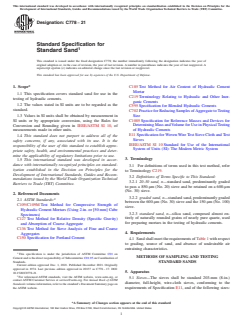
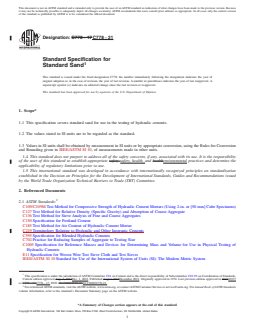
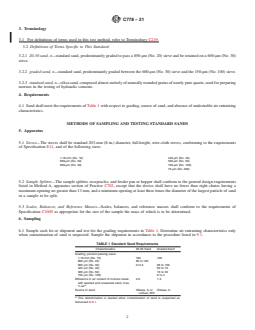
ASTM C778-21 is the globally recognized standard specification for standard sand used in testing hydraulic cements. Published by ASTM International, this standard provides clear requirements for the characteristics, grading, source, and purity of sand to ensure consistent and reliable results during cement testing. The use of standardized sand is crucial for laboratory accuracy and comparability in evaluating the physical properties of hydraulic cements, such as strength and air content.
This standard is notably referenced by cement testing laboratories and quality control teams across the construction and materials sectors to support compliant and repeatable testing processes.
Key Topics
- Purpose: Defines the quality and grading of standard sand used for testing hydraulic cements, ensuring reliable and consistent results across different labs and projects.
- Sand Types: Covers both 20-30 sand (primarily passing a 850 μm sieve and retained on 600 μm) and graded sand (passing between 600 μm and 150 μm sieves).
- Sieve Analysis: Specifies mandatory sieve analysis (by hand or mechanical means) to verify sand grading by reporting the percentage passing each specified sieve size.
- Air-Entraining Characteristics: Requires testing for undesirable air-entraining properties, since small contaminants can create air voids in mortar, potentially compromising test integrity.
- Sampling and Testing: Detailed criteria for sampling methods, frequencies, and testing batch sizes to ensure proper representation of shipments and lots.
- Packaging and Marking: Guidance on appropriate packaging-requiring impervious liners to prevent contamination-and standard labeling protocols.
Applications
ASTM C778-21 standard sand is widely employed in:
- Hydraulic Cement Testing: Used as a reference material for preparing mortar specimens in procedures such as compressive strength testing and air content testing.
- Quality Control in Cement Manufacture: Provides a benchmark for validating the properties of newly produced cements against recognized standards, supporting consistent product quality.
- Research and Development: Critical in laboratories and research centers conducting comparative studies involving cementitious materials.
- Compliance and Certification: Used by agencies and certification bodies to assess conformity with ASTM, ISO, or regional cement standards.
Industries including construction, infrastructure, cement manufacturing, and independent testing laboratories depend on ASTM C778-21 for accurate and harmonized cement testing processes.
Related Standards
ASTM C778-21 is frequently referenced alongside other consensus standards for comprehensive material testing, including:
- ASTM C109/C109M: Test Method for Compressive Strength of Hydraulic Cement Mortars
- ASTM C185: Test Method for Air Content of Hydraulic Cement Mortar
- ASTM C136: Test Method for Sieve Analysis of Fine and Coarse Aggregates
- ASTM C150: Specification for Portland Cement
- ASTM C219: Terminology Relating to Hydraulic and Other Inorganic Cements
- IEEE/ASTM SI 10: Standard for Use of the International System of Units (SI)
For detailed test procedures and calibration requirements, users should refer to the full catalog of referenced ASTM standards.
Keywords: ASTM C778-21, standard sand, cement testing, 20-30 sand, graded sand, hydraulic cement, mortar testing, sand grading, sieve analysis, air content, quality control, laboratory standards, construction materials
Relations
- Effective Date
- 01-Apr-2024
- Effective Date
- 15-Dec-2023
- Effective Date
- 01-Aug-2020
- Effective Date
- 01-Apr-2020
- Effective Date
- 01-Apr-2020
- Effective Date
- 01-Dec-2019
- Effective Date
- 15-Nov-2019
- Effective Date
- 01-Jun-2019
- Effective Date
- 01-May-2018
- Effective Date
- 15-Mar-2017
- Effective Date
- 01-Jul-2015
- Effective Date
- 01-Jul-2014
- Effective Date
- 01-Oct-2013
- Effective Date
- 01-Aug-2013
- Effective Date
- 15-Jun-2013
Get Certified
Connect with accredited certification bodies for this standard

DIBt (Deutsches Institut für Bautechnik)
German Institute for Building Technology.
DIN CERTCO
DIN Group product certification.

Aboma Certification B.V.
Specialized in construction, metal, and transport sectors.
Sponsored listings
Frequently Asked Questions
ASTM C778-21 is a technical specification published by ASTM International. Its full title is "Standard Specification for Standard Sand". This standard covers: ABSTRACT This specification covers standard sand for use in the testing of hydraulic cements. Sand shall meet the requirements with respect to grading, source of sand, and absence of undesirable air entraining characteristics. Sieve analysis shall be performed by sieving the sand by hand or mechanically as prescribed. Results of the sieve analysis shall be reported as total percentage passing each sieve. Small amounts of some surfactants or other contaminants will produce air voids in mortars with 20-30 sand, graded sands or both. Tests for air-entraining potential of standard sand shall be made on a single day by a single operator. SCOPE 1.1 This specification covers standard sand for use in the testing of hydraulic cements. 1.2 The values stated in SI units are to be regarded as the standard. 1.3 Values in SI units shall be obtained by measurement in SI units or by appropriate conversion, using the Rules for Conversion and Rounding given in IEEE/ASTM SI 10, of measurements made in other units. 1.4 This standard does not purport to address all of the safety concerns, if any, associated with its use. It is the responsibility of the user of this standard to establish appropriate safety, health, and environmental practices and determine the applicability of regulatory limitations prior to use. 1.5 This international standard was developed in accordance with internationally recognized principles on standardization established in the Decision on Principles for the Development of International Standards, Guides and Recommendations issued by the World Trade Organization Technical Barriers to Trade (TBT) Committee.
ABSTRACT This specification covers standard sand for use in the testing of hydraulic cements. Sand shall meet the requirements with respect to grading, source of sand, and absence of undesirable air entraining characteristics. Sieve analysis shall be performed by sieving the sand by hand or mechanically as prescribed. Results of the sieve analysis shall be reported as total percentage passing each sieve. Small amounts of some surfactants or other contaminants will produce air voids in mortars with 20-30 sand, graded sands or both. Tests for air-entraining potential of standard sand shall be made on a single day by a single operator. SCOPE 1.1 This specification covers standard sand for use in the testing of hydraulic cements. 1.2 The values stated in SI units are to be regarded as the standard. 1.3 Values in SI units shall be obtained by measurement in SI units or by appropriate conversion, using the Rules for Conversion and Rounding given in IEEE/ASTM SI 10, of measurements made in other units. 1.4 This standard does not purport to address all of the safety concerns, if any, associated with its use. It is the responsibility of the user of this standard to establish appropriate safety, health, and environmental practices and determine the applicability of regulatory limitations prior to use. 1.5 This international standard was developed in accordance with internationally recognized principles on standardization established in the Decision on Principles for the Development of International Standards, Guides and Recommendations issued by the World Trade Organization Technical Barriers to Trade (TBT) Committee.
ASTM C778-21 is classified under the following ICS (International Classification for Standards) categories: 91.100.15 - Mineral materials and products. The ICS classification helps identify the subject area and facilitates finding related standards.
ASTM C778-21 has the following relationships with other standards: It is inter standard links to ASTM C219-24, ASTM C109/C109M-23, ASTM C219-20a, ASTM C219-20, ASTM C185-20, ASTM C185-19, ASTM C219-19a, ASTM C219-19, ASTM C1005-18, ASTM C1005-17, ASTM C185-15, ASTM C219-14, ASTM E11-13, ASTM C219-13a, ASTM C219-13. Understanding these relationships helps ensure you are using the most current and applicable version of the standard.
ASTM C778-21 is available in PDF format for immediate download after purchase. The document can be added to your cart and obtained through the secure checkout process. Digital delivery ensures instant access to the complete standard document.
Standards Content (Sample)
This international standard was developed in accordance with internationally recognized principles on standardization established in the Decision on Principles for the
Development of International Standards, Guides and Recommendations issued by the World Trade Organization Technical Barriers to Trade (TBT) Committee.
Designation:C778 −21
Standard Specification for
Standard Sand
This standard is issued under the fixed designation C778; the number immediately following the designation indicates the year of
original adoption or, in the case of revision, the year of last revision. A number in parentheses indicates the year of last reapproval. A
superscript epsilon (´) indicates an editorial change since the last revision or reapproval.
This standard has been approved for use by agencies of the U.S. Department of Defense.
1. Scope* C185 Test Method for Air Content of Hydraulic Cement
Mortar
1.1 This specification covers standard sand for use in the
C219 Terminology Relating to Hydraulic and Other Inor-
testing of hydraulic cements.
ganic Cements
1.2 The values stated in SI units are to be regarded as the
C595 Specification for Blended Hydraulic Cements
standard.
C702 PracticeforReducingSamplesofAggregatetoTesting
1.3 Values in SI units shall be obtained by measurement in Size
C1005 Specification for Reference Masses and Devices for
SI units or by appropriate conversion, using the Rules for
Conversion and Rounding given in IEEE/ASTM SI 10,of DeterminingMassandVolumeforUseinPhysicalTesting
of Hydraulic Cements
measurements made in other units.
E11 Specification for Woven Wire Test Sieve Cloth and Test
1.4 This standard does not purport to address all of the
Sieves
safety concerns, if any, associated with its use. It is the
IEEE/ASTM SI 10 Standard for Use of the International
responsibility of the user of this standard to establish appro-
System of Units (SI): The Modern Metric System
priate safety, health, and environmental practices and deter-
mine the applicability of regulatory limitations prior to use.
3. Terminology
1.5 This international standard was developed in accor-
dance with internationally recognized principles on standard-
3.1 For definitions of terms used in this test method, refer
ization established in the Decision on Principles for the
to Terminology C219.
Development of International Standards, Guides and Recom-
3.2 Definitions of Terms Specific to This Standard:
mendations issued by the World Trade Organization Technical
3.2.1 20-30 sand, n—standard sand, predominantly graded
Barriers to Trade (TBT) Committee.
to pass a 850-µm (No. 20) sieve and be retained on a 600-µm
(No. 30) sieve.
2. Referenced Documents
3.2.2 graded sand, n—standard sand, predominantly graded
2.1 ASTM Standards:
between the 600-µm (No. 30) sieve and the 150-µm (No. 100)
C109/C109M Test Method for Compressive Strength of
sieve.
Hydraulic Cement Mortars (Using 2-in. or [50 mm] Cube
3.2.3 standard sand, n—silica sand, composed almost en-
Specimens)
tirely of naturally rounded grains of nearly pure quartz, used
C127 Test Method for Relative Density (Specific Gravity)
for preparing mortars in the testing of hydraulic cements.
and Absorption of Coarse Aggregate
C136 Test Method for Sieve Analysis of Fine and Coarse
4. Requirements
Aggregates
C150 Specification for Portland Cement
4.1 SandshallmeettherequirementsofTable1withrespect
to grading, source of sand, and absence of undesirable air
entraining characteristics.
This specification is under the jurisdiction of ASTM Committee C01 on
METHODS OF SAMPLING AND TESTING
Cement and is the direct responsibility of Subcommittee C01.95 on Coordination of
Standards.
STANDARD SANDS
Current edition approved Dec. 1, 2021. Published December 2021. Originally
approved in 1974. Last previous edition approved in 20137 as C778 – 17. DOI:
5. Apparatus
10.1520/C0778-21.
For referenced ASTM standards, visit the ASTM website, www.astm.org, or
5.1 Sieves—The sieves shall be standard 203-mm (8-in.)
contact ASTM Customer Service at service@astm.org. For Annual Book of ASTM
diameter, full-height, wire-cloth sieves, conforming to the
Standards volume information, refer to the standard’s Document Summary page on
the ASTM website. requirements of Specification E11, and of the following sizes:
*A Summary of Changes section appears at the end of this standard
Copyright © ASTM International, 100 Barr Harbor Drive, PO Box C700, West Conshohocken, PA 19428-2959. United States
C778−21
TABLE 1 Standard Sand Requirements
8.1.1 Obtain a sample of at least 2800 g from a full bag of
Characteristics 20-30 Sand Graded Sand sand. Place the remainder of the sand from the bag in a
Grading, percent passing sieve: concrete mixer of the drum type. Add sufficient potable water
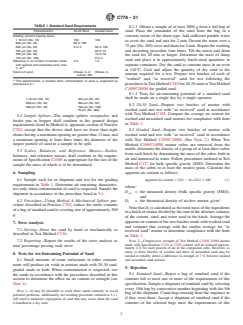
1.18 mm (No. 16) 100 100
to cover the sand and mix for 2 min. Decant the water over a
850 µm (No. 20) 85 to 100
75 µm (No. 200) sieve and drain for 2 min. Repeat the washing
600 µm (No. 30) 0 to 5 96 to 100
425 µm (No. 40) 60 to 75 and decanting procedure four times. Tilt the mixer and drain
300 µm (No. 50) 16 to 30
the sand for 20 min or longer. Determine the mass of damp
150 µm (No. 100) 0 to 4
sand and place it in approximately batch-sized quantities in
Difference in air content of mortars made 2.0 1.5
with washed and unwashed sand, max, separate containers. Dry the sand to constant mass in an oven
A
%air
at 110°C. Cool and adjust the quantity of dry sand to the
Source of sand Ottawa, IL or Ottawa, IL
amount required for a test. Prepare two batches of each of
LeSuer, MN
A “washed” and “as received” sand for test following the
This determination is needed when contamination of sand is suspected as
discussed in 8.1. proceduresinTestMethodC185for20-30sandorTestMethod
C109/C109M for graded sand.
8.1.2 Tests for air-entraining potential of a standard sand
shall be made on a single day by a single operator.
1.18-mm (No. 16) 425-µm (No. 40)
850-µm (No. 20) 300-µm (No. 50)
8.2 20-30 Sand—Prepare two batches of mortar with
600-µm (No. 30) 150-µm (No. 100)
washed sand and two with “as received” sand in accordance
75-µm (No. 200)
with Test Method C185. Compare the average air content for
5.2 Sample Splitter—The sample splitter, receptacles, and
washed and unwashed sand mortars for compliance with limit
feeder pan or hopper shall conform to the general design
in Table 1.
requirements listed in MethodA, apparatus section of Practice
C702, except that the device shall have no fewer than eight 8.3 Graded Sand—Prepare two batches of mortar with
chutes having a maximum opening no greater than 13 mm, and
washed sand and two with “as received” sand in accordance
a minimum opening at least three times the diameter of the with Test Method C109/C109M. (See Note 2.) When Test
largest particle of sand in a sample to be split.
Method C109/C109M mortar cubes are removed from the
molds, determine the density of a group of at least three cubes
5.3 Scales, Balances, and Reference Masses—Scales,
from each batch by determining the mass of the cubes both in
balances, and reference masses shall conform to the require-
air and immersed in water. Follow procedures ou
...
This document is not an ASTM standard and is intended only to provide the user of an ASTM standard an indication of what changes have been made to the previous version. Because
it may not be technically possible to adequately depict all changes accurately, ASTM recommends that users consult prior editions as appropriate. In all cases only the current version
of the standard as published by ASTM is to be considered the official document.
Designation: C778 − 17 C778 − 21
Standard Specification for
Standard Sand
This standard is issued under the fixed designation C778; the number immediately following the designation indicates the year of
original adoption or, in the case of revision, the year of last revision. A number in parentheses indicates the year of last reapproval. A
superscript epsilon (´) indicates an editorial change since the last revision or reapproval.
This standard has been approved for use by agencies of the U.S. Department of Defense.
1. Scope*
1.1 This specification covers standard sand for use in the testing of hydraulic cements.
1.2 The values stated in SI units are to be regarded as the standard.
1.3 Values in SI units shall be obtained by measurement in SI units or by appropriate conversion, using the Rules for Conversion
and Rounding given in IEEE/ASTM SI 10, of measurements made in other units.
1.4 This standard does not purport to address all of the safety concerns, if any, associated with its use. It is the responsibility
of the user of this standard to establish appropriate safety safety, health, and healthenvironmental practices and determine the
applicability of regulatory limitations prior to use.
1.5 This international standard was developed in accordance with internationally recognized principles on standardization
established in the Decision on Principles for the Development of International Standards, Guides and Recommendations issued
by the World Trade Organization Technical Barriers to Trade (TBT) Committee.
2. Referenced Documents
2.1 ASTM Standards:
C109/C109M Test Method for Compressive Strength of Hydraulic Cement Mortars (Using 2-in. or [50 mm] Cube Specimens)
C127 Test Method for Relative Density (Specific Gravity) and Absorption of Coarse Aggregate
C136 Test Method for Sieve Analysis of Fine and Coarse Aggregates
C150 Specification for Portland Cement
C185 Test Method for Air Content of Hydraulic Cement Mortar
C219 Terminology Relating to Hydraulic and Other Inorganic Cements
C595 Specification for Blended Hydraulic Cements
C702 Practice for Reducing Samples of Aggregate to Testing Size
C1005 Specification for Reference Masses and Devices for Determining Mass and Volume for Use in Physical Testing of
Hydraulic Cements
E11 Specification for Woven Wire Test Sieve Cloth and Test Sieves
IEEE/ASTM SI 10 Standard for Use of the International System of Units (SI): The Modern Metric System
This specification is under the jurisdiction of ASTM Committee C01 on Cement and is the direct responsibility of Subcommittee C01.95 on Coordination of Standards.
Current edition approved Aug. 1, 2017Dec. 1, 2021. Published August 2017December 2021. Originally approved in 1974. Last previous edition approved in 201320137
as C778 – 13.C778 – 17. DOI: 10.1520/C0778-17.10.1520/C0778-21.
For referenced ASTM standards, visit the ASTM website, www.astm.org, or contact ASTM Customer Service at service@astm.org. For Annual Book of ASTM Standards
volume information, refer to the standard’s Document Summary page on the ASTM website.
*A Summary of Changes section appears at the end of this standard
Copyright © ASTM International, 100 Barr Harbor Drive, PO Box C700, West Conshohocken, PA 19428-2959. United States
C778 − 21
3. Terminology
3.1 For definitions of terms used in this test method, refer to Terminology C219.
3.2 Definitions of Terms Specific to This Standard:
3.2.1 20-30 sand, n—standard sand, predominantly graded to pass a 850-μm (No. 20) sieve and be retained on a 600-μm (No. 30)
sieve.
3.2.2 graded sand, n—standard sand, predominantly graded between the 600-μm (No. 30) sieve and the 150-μm (No. 100) sieve.
3.2.3 standard sand, n—silica sand, composed almost entirely of naturally rounded grains of nearly pure quartz, used for preparing
mortars in the testing of hydraulic cements.
4. Requirements
4.1 Sand shall meet the requirements of Table 1 with respect to grading, source of sand, and absence of undesirable air entraining
characteristics.
METHODS OF SAMPLING AND TESTING STANDARD SANDS
5. Apparatus
5.1 Sieves—The sieves shall be standard 203-mm (8-in.) diameter, full-height, wire-cloth sieves, conforming to the requirements
of Specification E11, and of the following sizes:
1.18-mm (No. 16) 425-μm (No. 40)
850-μm (No. 20) 300-μm (No. 50)
600-μm (No. 30) 150-μm (No. 100)
75-μm (No. 200)
5.2 Sample Splitter—The sample splitter, receptacles, and feeder pan or hopper shall conform to the general design requirements
listed in Method A, apparatus section of Practice C702, except that the device shall have no fewer than eight chutes having a
maximum opening no greater than 13 mm, and a minimum opening at least three times the diameter of the largest particle of sand
in a sample to be split.
5.3 Scales, Balances, and Reference Masses—Scales, balances, and reference masses shall conform to the requirements of
Specification C1005 as appropriate for the size of the sample the mass of which is to be determined.
6. Sampling
6.1 Sample each lot or shipment and test for the grading requirements in Table 1. Determine air entraining characteristics only
when contamination of sand is suspected. Sample the shipment in accordance to the procedure listed in 9.1.
TABLE 1 Standard Sand Requirements
Characteristics 20-30 Sand Graded Sand
Grading, percent passing sieve:
1.18 mm (No. 16) 100 100
850 μm (No. 20) 85 to 100
600 μm (No. 30) 0 to 5 96 to 100
425 μm (No. 40) 60 to 75
300 μm (No. 50) 16 to 30
150 μm (No. 100) 0 to 4
Difference in air content of mortars made 2.0 1.5
with washed and unwashed sand, max,
A
% air
Source of sand Ottawa, IL or Ottawa, IL
LeSuer, MN
A
This determination is needed when contamination of sand is suspected as
discussed in 8.1.
C778 − 21
6.2 Procedure—Using Method A–Mechanical Splitter procedure described in Practice C702, reduce the entire contents of a bag
of standard sand to a testing size of approximately 300 g.
7. Sieve Analysis
7.1 Sieving—Sieve the sand by hand or mechanically as described in Test Method C136.
7.2 Reporting—Report the results of the sieve analysis as total percentage passing each sieve.
8. Tests for Air-Entraining Potential of Sand
8.1 Small amounts of some surfactants or other contaminants will produce air voids in mortars made with 20-30 sand, graded
sands or both. When contamination is suspected, test the sands in accordance with the procedures described in this section to
determine the effect on air content or strength (see Note 1).
NOTE 1—It may be desirable to wash these sands routinely to avoid potential problems. Additionally, the washing procedure outlined in 8.1.1 will tend
to minimize segregation of sand that may occur when the sand is handled in a dry state.
8.1.1 Obtain a sample of at least 2800 g from a full bag of sand. Place the remainder of the sand from the bag in a concrete mixer
of t
...