

ASTM D5185-18
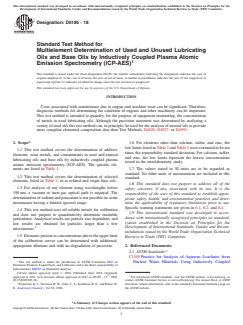
(Test Method)Standard Test Method for Multielement Determination of Used and Unused Lubricating Oils and Base Oils by Inductively Coupled Plasma Atomic Emission Spectrometry (ICP-AES)
General Information
- Abstract
SIGNIFICANCE AND USE
5.1 This test method covers the rapid determination of 22 elements in used and unused lubricating oils and base oils, and it provides rapid screening of used oils for indications of wear. Test times approximate a few minutes per test specimen, and detectability for most elements is in the low mg/kg range. In addition, this test method covers a wide variety of metals in virgin and re-refined base oils. Twenty-two elements can be determined rapidly, with test times approximating several minutes per test specimen.
5.2 When the predominant source of additive elements in used lubricating oils is the additive package, significant differences between the concentrations of the additive elements and their respective specifications can indicate that the incorrect oil is being used. The concentrations of wear metals can be indicative of abnormal wear if there are baseline concentration data for comparison. A marked increase in boron, sodium, or potassium levels can be indicative of contamination as a result of coolant leakage in the equipment. This test method can be used to monitor equipment condition and define when corrective actions are needed.
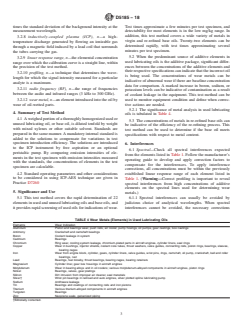
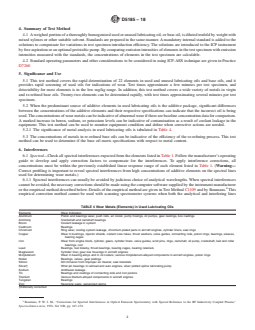
5.2.1 The significance of metal analysis in used lubricating oils is tabulated in Table 4.
5.3 The concentrations of metals in re-refined base oils can be indicative of the efficiency of the re-refining process. This test method can be used to determine if the base oil meets specifications with respect to metal content.
SCOPE
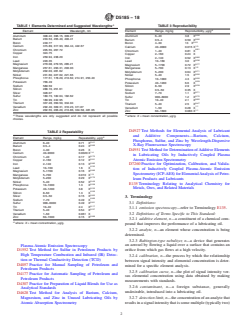
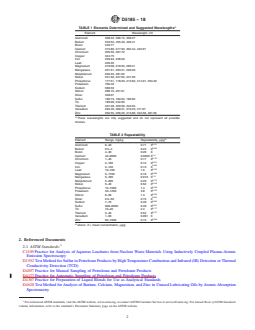
1.1 This test method covers the determination of additive elements, wear metals, and contaminants in used and unused lubricating oils and base oils by inductively coupled plasma atomic emission spectrometry (ICP-AES). The specific elements are listed in Table 1. (A) These wavelengths are only suggested and do not represent all possible choices.
1.2 This test method covers the determination of selected elements, listed in Table 1, in re-refined and virgin base oils.
1.3 For analysis of any element using wavelengths below 190 nm, a vacuum or inert-gas optical path is required. The determination of sodium and potassium is not possible on some instruments having a limited spectral range.
1.4 This test method uses oil-soluble metals for calibration and does not purport to quantitatively determine insoluble particulates. Analytical results are particle size dependent, and low results are obtained for particles larger than a few micrometers.2
1.5 Elements present at concentrations above the upper limit of the calibration curves can be determined with additional, appropriate dilutions and with no degradation of precision.
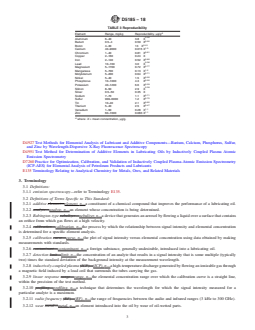
1.6 For elements other than calcium, sulfur, and zinc, the low limits listed in Table 2 and Table 3 were estimated to be ten times the repeatability standard deviation. For calcium, sulfur, and zinc, the low limits represent the lowest concentrations tested in the interlaboratory study. (A) where: X = mean concentration, μg/g. (A) where: X = mean concentration, μg/g.
1.7 The values stated in SI units are to be regarded as standard. No other units of measurement are included in this standard.
1.8 This standard does not purport to address all of the safety concerns, if any, associated with its use. It is the responsibility of the user of this standard to establish appropriate safety, health, and environmental practices and determine the applicability of regulatory limitations prior to use. Specific warning statements are given in 6.1, 8.2, and 8.4.
1.9 This international standard was developed in accordance with internationally recognized principles on standardization established in the Decision on Principles for the Development of International Standards, Guides and Recommendations issued by the World Trade Organization Technical Barriers to Trade (TBT) Committee.
- Status
- Published
- Publication Date
- 31-Mar-2018
- Technical Committee
- D02 - Petroleum Products, Liquid Fuels, and Lubricants
- Drafting Committee
- D02.03 - Elemental Analysis
Buy Documents
ASTM D5185-18 - Standard Test Method for Multielement Determination of Used and Unused Lubricating Oils and Base Oils by Inductively Coupled Plasma Atomic Emission Spectrometry (ICP-AES)
REDLINE ASTM D5185-18 - Standard Test Method for Multielement Determination of Used and Unused Lubricating Oils and Base Oils by Inductively Coupled Plasma Atomic Emission Spectrometry (ICP-AES)
Overview
ASTM D5185-18 is a widely recognized standard developed by ASTM International that outlines the test method for the multielement determination of both used and unused lubricating oils and base oils via Inductively Coupled Plasma Atomic Emission Spectrometry (ICP-AES). This method offers a rapid and efficient approach for measuring the concentrations of up to 22 elements-including both additive metals and contaminants-in lubricating oils. Accurate elemental analysis is essential for monitoring equipment condition, detecting wear, verifying oil formulation compliance, and evaluating oil cleanliness or contamination. The test times are short, usually just a few minutes per sample, and detectability for most elements reaches the low mg/kg (ppm) range.
Key Topics
Scope of Application
- Determination of additive elements, wear metals, and contaminants in used and unused lubricating oils and base oils.
- Applicable to both virgin and re-refined base oils.
ICP-AES Technique
- Utilizes inductively coupled plasma to excite atoms and measure their emission spectra.
- Capable of rapid, simultaneous multielement analysis.
Elements Detected
- Enables the quantification of metals such as aluminum, barium, boron, calcium, chromium, copper, iron, lead, magnesium, manganese, molybdenum, nickel, phosphorus, potassium, sodium, silicon, silver, sulfur, tin, titanium, vanadium, and zinc.
Significance in Oil Analysis
- Change in additive element concentration can signal use of an incorrect oil.
- Increased wear metals (e.g., iron, copper, chromium) can indicate abnormal wear or engine/component issues.
- Elevations in sodium, potassium, or boron point to possible coolant leaks or contamination.
Sample Preparation and Calibration
- Homogenization of samples is crucial for accuracy.
- Internal standardization compensates for variations in sample introduction.
Applications
Condition Monitoring
- Routine testing helps detect early signs of machinery wear, extending equipment life and optimizing maintenance schedules.
Quality Control
- Assures that new, recycled, or re-refined oils meet required specifications regarding metallic content.
- Validates the performance and consistency of additive packages.
Contamination Detection
- Identifies ingress of foreign substances such as coolant leaks (sodium, potassium, boron) or environmental dust (silicon).
Process Efficiency Assessment
- Evaluates the effectiveness of the oil re-refining process by monitoring residual metal contaminants.
Regulatory Compliance
- Supports compliance with industry requirements and international quality standards for lubricants and base oils.
Related Standards
- ASTM D4628: Analysis of barium, calcium, magnesium, and zinc in unused lubricating oils by atomic absorption spectrometry.
- ASTM D4951: Determination of additive elements in lubricating oils by ICP-AES.
- ASTM D4927: Elemental analysis of lubricant and additive components via wavelength-dispersive X-ray fluorescence.
- ASTM D7260: Optimization, calibration, and validation of ICP-AES for petroleum products and lubricants.
- ASTM D1552: Test method for sulfur in petroleum products.
- ASTM D4057 / D4177: Practices for manual and automatic sampling of petroleum and petroleum products.
Ensuring the precise, rapid detection of key elements, ASTM D5185-18 is an essential test standard for anyone concerned with the performance, reliability, and compliance of lubricating oils and base oils in industrial and automotive applications. This standard advances preventive maintenance, quality control, and contamination detection in lubrication systems.
Relations
- Effective Date
- 01-Apr-2018
- Effective Date
- 01-Dec-2023
- Effective Date
- 01-Jan-2020
- Effective Date
- 15-May-2019
- Effective Date
- 01-May-2019
- Effective Date
- 01-Jul-2016
- Effective Date
- 15-May-2016
- Effective Date
- 01-Oct-2015
- Effective Date
- 01-Jul-2015
- Effective Date
- 01-Jun-2015
- Effective Date
- 15-May-2015
- Effective Date
- 01-Dec-2014
- Effective Date
- 01-Dec-2014
- Effective Date
- 15-Aug-2014
- Effective Date
- 15-Jun-2014
Buy Documents
ASTM D5185-18 - Standard Test Method for Multielement Determination of Used and Unused Lubricating Oils and Base Oils by Inductively Coupled Plasma Atomic Emission Spectrometry (ICP-AES)
REDLINE ASTM D5185-18 - Standard Test Method for Multielement Determination of Used and Unused Lubricating Oils and Base Oils by Inductively Coupled Plasma Atomic Emission Spectrometry (ICP-AES)
Get Certified
Connect with accredited certification bodies for this standard

ECOCERT
Organic and sustainability certification.

Element Materials Technology
Materials testing and product certification.

ABS Group Brazil
ABS Group certification services in Brazil.
Sponsored listings
Frequently Asked Questions
ASTM D5185-18 is a standard published by ASTM International. Its full title is "Standard Test Method for Multielement Determination of Used and Unused Lubricating Oils and Base Oils by Inductively Coupled Plasma Atomic Emission Spectrometry (ICP-AES)". This standard covers: SIGNIFICANCE AND USE 5.1 This test method covers the rapid determination of 22 elements in used and unused lubricating oils and base oils, and it provides rapid screening of used oils for indications of wear. Test times approximate a few minutes per test specimen, and detectability for most elements is in the low mg/kg range. In addition, this test method covers a wide variety of metals in virgin and re-refined base oils. Twenty-two elements can be determined rapidly, with test times approximating several minutes per test specimen. 5.2 When the predominant source of additive elements in used lubricating oils is the additive package, significant differences between the concentrations of the additive elements and their respective specifications can indicate that the incorrect oil is being used. The concentrations of wear metals can be indicative of abnormal wear if there are baseline concentration data for comparison. A marked increase in boron, sodium, or potassium levels can be indicative of contamination as a result of coolant leakage in the equipment. This test method can be used to monitor equipment condition and define when corrective actions are needed. 5.2.1 The significance of metal analysis in used lubricating oils is tabulated in Table 4. 5.3 The concentrations of metals in re-refined base oils can be indicative of the efficiency of the re-refining process. This test method can be used to determine if the base oil meets specifications with respect to metal content. SCOPE 1.1 This test method covers the determination of additive elements, wear metals, and contaminants in used and unused lubricating oils and base oils by inductively coupled plasma atomic emission spectrometry (ICP-AES). The specific elements are listed in Table 1. (A) These wavelengths are only suggested and do not represent all possible choices. 1.2 This test method covers the determination of selected elements, listed in Table 1, in re-refined and virgin base oils. 1.3 For analysis of any element using wavelengths below 190 nm, a vacuum or inert-gas optical path is required. The determination of sodium and potassium is not possible on some instruments having a limited spectral range. 1.4 This test method uses oil-soluble metals for calibration and does not purport to quantitatively determine insoluble particulates. Analytical results are particle size dependent, and low results are obtained for particles larger than a few micrometers.2 1.5 Elements present at concentrations above the upper limit of the calibration curves can be determined with additional, appropriate dilutions and with no degradation of precision. 1.6 For elements other than calcium, sulfur, and zinc, the low limits listed in Table 2 and Table 3 were estimated to be ten times the repeatability standard deviation. For calcium, sulfur, and zinc, the low limits represent the lowest concentrations tested in the interlaboratory study. (A) where: X = mean concentration, μg/g. (A) where: X = mean concentration, μg/g. 1.7 The values stated in SI units are to be regarded as standard. No other units of measurement are included in this standard. 1.8 This standard does not purport to address all of the safety concerns, if any, associated with its use. It is the responsibility of the user of this standard to establish appropriate safety, health, and environmental practices and determine the applicability of regulatory limitations prior to use. Specific warning statements are given in 6.1, 8.2, and 8.4. 1.9 This international standard was developed in accordance with internationally recognized principles on standardization established in the Decision on Principles for the Development of International Standards, Guides and Recommendations issued by the World Trade Organization Technical Barriers to Trade (TBT) Committee.
SIGNIFICANCE AND USE 5.1 This test method covers the rapid determination of 22 elements in used and unused lubricating oils and base oils, and it provides rapid screening of used oils for indications of wear. Test times approximate a few minutes per test specimen, and detectability for most elements is in the low mg/kg range. In addition, this test method covers a wide variety of metals in virgin and re-refined base oils. Twenty-two elements can be determined rapidly, with test times approximating several minutes per test specimen. 5.2 When the predominant source of additive elements in used lubricating oils is the additive package, significant differences between the concentrations of the additive elements and their respective specifications can indicate that the incorrect oil is being used. The concentrations of wear metals can be indicative of abnormal wear if there are baseline concentration data for comparison. A marked increase in boron, sodium, or potassium levels can be indicative of contamination as a result of coolant leakage in the equipment. This test method can be used to monitor equipment condition and define when corrective actions are needed. 5.2.1 The significance of metal analysis in used lubricating oils is tabulated in Table 4. 5.3 The concentrations of metals in re-refined base oils can be indicative of the efficiency of the re-refining process. This test method can be used to determine if the base oil meets specifications with respect to metal content. SCOPE 1.1 This test method covers the determination of additive elements, wear metals, and contaminants in used and unused lubricating oils and base oils by inductively coupled plasma atomic emission spectrometry (ICP-AES). The specific elements are listed in Table 1. (A) These wavelengths are only suggested and do not represent all possible choices. 1.2 This test method covers the determination of selected elements, listed in Table 1, in re-refined and virgin base oils. 1.3 For analysis of any element using wavelengths below 190 nm, a vacuum or inert-gas optical path is required. The determination of sodium and potassium is not possible on some instruments having a limited spectral range. 1.4 This test method uses oil-soluble metals for calibration and does not purport to quantitatively determine insoluble particulates. Analytical results are particle size dependent, and low results are obtained for particles larger than a few micrometers.2 1.5 Elements present at concentrations above the upper limit of the calibration curves can be determined with additional, appropriate dilutions and with no degradation of precision. 1.6 For elements other than calcium, sulfur, and zinc, the low limits listed in Table 2 and Table 3 were estimated to be ten times the repeatability standard deviation. For calcium, sulfur, and zinc, the low limits represent the lowest concentrations tested in the interlaboratory study. (A) where: X = mean concentration, μg/g. (A) where: X = mean concentration, μg/g. 1.7 The values stated in SI units are to be regarded as standard. No other units of measurement are included in this standard. 1.8 This standard does not purport to address all of the safety concerns, if any, associated with its use. It is the responsibility of the user of this standard to establish appropriate safety, health, and environmental practices and determine the applicability of regulatory limitations prior to use. Specific warning statements are given in 6.1, 8.2, and 8.4. 1.9 This international standard was developed in accordance with internationally recognized principles on standardization established in the Decision on Principles for the Development of International Standards, Guides and Recommendations issued by the World Trade Organization Technical Barriers to Trade (TBT) Committee.
ASTM D5185-18 is classified under the following ICS (International Classification for Standards) categories: 71.040.50 - Physicochemical methods of analysis; 75.100 - Lubricants, industrial oils and related products. The ICS classification helps identify the subject area and facilitates finding related standards.
ASTM D5185-18 has the following relationships with other standards: It is inter standard links to ASTM D5185-13e1, ASTM C1109-23, ASTM E135-20, ASTM E135-19, ASTM D7260-19, ASTM D1552-16, ASTM E135-16, ASTM D4307-99(2015), ASTM E135-15a, ASTM C1109-10(2015), ASTM E135-15, ASTM D4628-14, ASTM D4927-14, ASTM E135-14b, ASTM D1552-08(2014). Understanding these relationships helps ensure you are using the most current and applicable version of the standard.
ASTM D5185-18 is available in PDF format for immediate download after purchase. The document can be added to your cart and obtained through the secure checkout process. Digital delivery ensures instant access to the complete standard document.
Standards Content (Sample)
This international standard was developed in accordance with internationally recognized principles on standardization established in the Decision on Principles for the
Development of International Standards, Guides and Recommendations issued by the World Trade Organization Technical Barriers to Trade (TBT) Committee.
Designation: D5185 − 18
Standard Test Method for
Multielement Determination of Used and Unused Lubricating
Oils and Base Oils by Inductively Coupled Plasma Atomic
Emission Spectrometry (ICP-AES)
This standard is issued under the fixed designation D5185; the number immediately following the designation indicates the year of
original adoption or, in the case of revision, the year of last revision. A number in parentheses indicates the year of last reapproval. A
superscript epsilon (´) indicates an editorial change since the last revision or reapproval.
This standard has been approved for use by agencies of the U.S. Department of Defense.
INTRODUCTION
Costs associated with maintenance due to engine and machine wear can be significant. Therefore,
diagnostic methods for determining the condition of engines and other machinery can be important.
This test method is intended to quantify, for the purpose of equipment monitoring, the concentration
of metals in used lubricating oils. Although the precision statement was determined by analyzing a
varietyofusedoilsthistestmethodcan,inprinciple,beusedfortheanalysisofunusedoilstoprovide
more complete elemental composition data than Test Methods D4628, D4927,or D4951.
1. Scope* 1.6 For elements other than calcium, sulfur, and zinc, the
lowlimitslistedinTable2andTable3wereestimatedtobeten
1.1 This test method covers the determination of additive
times the repeatability standard deviation. For calcium, sulfur,
elements, wear metals, and contaminants in used and unused
and zinc, the low limits represent the lowest concentrations
lubricating oils and base oils by inductively coupled plasma
tested in the interlaboratory study.
atomic emission spectrometry (ICP-AES). The specific ele-
1.7 The values stated in SI units are to be regarded as
ments are listed in Table 1.
standard. No other units of measurement are included in this
1.2 This test method covers the determination of selected
standard.
elements, listed in Table 1, in re-refined and virgin base oils.
1.8 This standard does not purport to address all of the
1.3 For analysis of any element using wavelengths below
safety concerns, if any, associated with its use. It is the
190 nm, a vacuum or inert-gas optical path is required. The
responsibility of the user of this standard to establish appro-
determinationofsodiumandpotassiumisnotpossibleonsome
priate safety, health, and environmental practices and deter-
instruments having a limited spectral range.
mine the applicability of regulatory limitations prior to use.
Specific warning statements are given in 6.1, 8.2, and 8.4.
1.4 This test method uses oil-soluble metals for calibration
1.9 This international standard was developed in accor-
and does not purport to quantitatively determine insoluble
dance with internationally recognized principles on standard-
particulates.Analytical results are particle size dependent, and
ization established in the Decision on Principles for the
low results are obtained for particles larger than a few
Development of International Standards, Guides and Recom-
micrometers.
mendations issued by the World Trade Organization Technical
1.5 Elementspresentatconcentrationsabovetheupperlimit
Barriers to Trade (TBT) Committee.
of the calibration curves can be determined with additional,
appropriate dilutions and with no degradation of precision.
2. Referenced Documents
2.1 ASTM Standards:
C1109 Practice for Analysis of Aqueous Leachates from
This test method is under the jurisdiction of ASTM Committee D02 on
Nuclear Waste Materials Using Inductively Coupled
Petroleum Products, Liquid Fuels, and Lubricants and is the direct responsibility of
Subcommittee D02.03 on Elemental Analysis.
Current edition approved April 1, 2018. Published April 2018. Originally
ɛ1
approved in 1991. Last previous edition approved in 2013 as D5185 – 13 . DOI: For referenced ASTM standards, visit the ASTM website, www.astm.org, or
10.1520/D5185-18. contact ASTM Customer Service at service@astm.org. For Annual Book of ASTM
Eisentraut, K. J., Newman, R. W., Saba, C. S., Kauffman, R. E., and Rhine, W. Standards volume information, refer to the standard’s Document Summary page on
E., Analytical Chemistry, Vol 56, 1984. the ASTM website.
*A Summary of Changes section appears at the end of this standard
Copyright © ASTM International, 100 Barr Harbor Drive, PO Box C700, West Conshohocken, PA 19428-2959. United States
D5185 − 18
A
TABLE 1 Elements Determined and Suggested Wavelengths TABLE 3 Reproducibility
A
Element Wavelength, nm
Element Range, mg/kg Reproducibility, µg/g
0.26
Aluminum 308.22, 396.15, 309.27
Aluminum 6–40 3.8 X
0.92
Barium 233.53, 455.40, 493.41
Barium 0.5–4 0.59 X
0.01
Boron 249.77
Boron 4–30 13 X
1.3
Calcium 315.89, 317.93, 364.44, 422.67
Calcium 40–9000 0.015 X
0.61
Chromium 205.55, 267.72
Chromium 1–40 0.81 X
Copper 324.75
Copper 2–160 0.24 X
0.80
Iron 259.94, 238.20
Iron 2–140 0.52 X
0.36
Lead 220.35
Lead 10–160 3.0 X
0.77
Magnesium 279.08, 279.55, 285.21
Magnesium 5–1700 0.72 X
1.2
Manganese 257.61, 293.31, 293.93
Manganese 5–700 0.13 X
0.71
Molybdenum 202.03, 281.62
Molybdenum 5–200 0.64 X
0.50
Nickel 231.60, 227.02, 221.65
Nickel 5–40 1.5 X
0.50
Phosphorus 177.51, 178.29, 213.62, 214.91, 253.40
Phosphorus 10–1000 4.3 X
0.29
Potassium 766.49
Potassium 40–1200 6.6 X
0.39
Sodium 589.59
Silicon 8–50 2.9 X
Silicon 288.16, 251.61
Silver 0.5–50 0.35 X
0.71
Silver 328.07
Sodium 7–70 1.1 X
0.75
Sulfur 180.73, 182.04, 182.62
Sulfur 900–6000 1.2 X
0.62
Tin 189.99, 242.95
Tin 10–40 2.1 X
0.47
Titanium 337.28, 350.50, 334.94
Titanium 5–40 2.5 X
1.1
Vanadium 292.40, 309.31, 310.23, 311.07
Vanadium 1–50 0.28 X
1.1
Zinc 202.55, 206.20, 213.86, 334.58, 481.05
Zinc 60–1600 0.083 X
A
A
These wavelengths are only suggested and do not represent all possible
where: X = mean concentration, µg/g.
choices.
D4927 Test Methods for Elemental Analysis of Lubricant
TABLE 2 Repeatability
and Additive Components—Barium, Calcium,
A
Element Range, mg/kg Repeatability, µg/g
Phosphorus, Sulfur, and Zinc by Wavelength-Dispersive
0.41
Aluminum 6–40 0.71 X
0.66
X-Ray Fluorescence Spectroscopy
Barium 0.5–4 0.24 X
Boron 4–30 0.26 X
D4951 Test Method for Determination ofAdditive Elements
1.4
Calcium 40–9000 0.0020 X
in Lubricating Oils by Inductively Coupled Plasma
0.75
Chromium 1–40 0.17 X
0.91
Atomic Emission Spectrometry
Copper 2–160 0.12 X
0.80
Iron 2–140 0.13 X
D7260 Practice for Optimization, Calibration, and Valida-
0.32
Lead 10–160 1.6 X
tion of Inductively Coupled Plasma-Atomic Emission
0.86
Magnesium 5–1700 0.16 X
1.3
Spectrometry (ICP-AES) for ElementalAnalysis of Petro-
Manganese 5–700 0.010 X
0.70
Molybdenum 5–200 0.29 X
leum Products and Lubricants
0.49
Nickel 5–40 0.52 X
E135 Terminology Relating to Analytical Chemistry for
0.58
Phosphorus 10–1000 1.3 X
0.33
Metals, Ores, and Related Materials
Potassium 40–1200 3.8 X
0.26
Silicon 8–50 1.3 X
0.83
Silver 0.5–50 0.15 X
3. Terminology
0.66
Sodium 7–70 0.49 X
0.81
3.1 Definitions:
Sulfur 900–6000 0.49 X
0.17
Tin 10–40 2.4 X
3.1.1 emission spectroscopy—refer to Terminology E135.
0.37
Titanium 5–40 0.54 X
Vanadium 1–50 0.061 X
3.2 Definitions of Terms Specific to This Standard:
0.88
Zinc 60–1600 0.15 X
3.2.1 additive element, n—a constituent of a chemical com-
A
where: X = mean concentration, µg/g.
pound that improves the performance of a lubricating oil.
3.2.2 analyte, n—an element whose concentration is being
determined.
3.2.3 Babington-type nebulizer, n—a device that generates
Plasma-Atomic Emission Spectroscopy an aerosol by flowing a liquid over a surface that contains an
orifice from which gas flows at a high velocity.
D1552 Test Method for Sulfur in Petroleum Products by
High Temperature Combustion and Infrared (IR) Detec-
3.2.4 calibration, n—the process by which the relationship
tion or Thermal Conductivity Detection (TCD)
between signal intensity and elemental concentration is deter-
D4057 Practice for Manual Sampling of Petroleum and
mined for a specific element analysis.
Petroleum Products
3.2.5 calibration curve, n—the plot of signal intensity ver-
D4177 Practice for Automatic Sampling of Petroleum and
sus elemental concentration using data obtained by making
Petroleum Products
measurements with standards.
D4307 Practice for Preparation of Liquid Blends for Use as
3.2.6 contaminant, n—a foreign substance, generally
Analytical Standards
undesirable, introduced into a lubricating oil.
D4628 Test Method for Analysis of Barium, Calcium,
Magnesium, and Zinc in Unused Lubricating Oils by 3.2.7 detection limit, n—the concentration of an analyte that
Atomic Absorption Spectrometry resultsinasignalintensitythatissomemultiple(typicallytwo)
D5185 − 18
times the standard deviation of the background intensity at the Test times approximate a few minutes per test specimen, and
measurement wavelength. detectability for most elements is in the low mg/kg range. In
addition, this test method covers a wide variety of metals in
3.2.8 inductively-coupled plasma (ICP), n—a high-
virgin and re-refined base oils. Twenty-two elements can be
temperature discharge generated by flowing an ionizable gas
determined rapidly, with test times approximating several
through a magnetic field induced by a load coil that surrounds
minutes per test specimen.
the tubes carrying the gas.
5.2 When the predominant source of additive elements in
3.2.9 linear response range, n—the elemental concentration
used lubricating oils is the additive package, significant differ-
range over which the calibration curve is a straight line, within
ences between the concentrations of the additive elements and
the precision of the test method.
their respective specifications can indicate that the incorrect oil
3.2.10 profiling, n—a technique that determines the wave-
is being used. The concentrations of wear metals can be
length for which the signal intensity measured for a particular
indicative of abnormal wear if there are baseline concentration
analyte is a maximum.
data for comparison. A marked increase in boron, sodium, or
3.2.11 radio frequency (RF), n—the range of frequencies
potassium levels can be indicative of contamination as a result
between the audio and infrared ranges (3 kHz to 300 GHz).
of coolant leakage in the equipment. This test method can be
3.2.12 wear metal, n—an element introduced into the oil by used to monitor equipment condition and define when correc-
wear of oil-wetted parts.
tive actions are needed.
5.2.1 The significance of metal analysis in used lubricating
4. Summary of Test Method
oils is tabulated in Table 4.
4.1 Aweighedportionofathoroughlyhomogenizedusedor
5.3 The concentrations of metals in re-refined base oils can
unused lubricating oil, or base oil, is diluted tenfold by weight
be indicative of the efficiency of the re-refining process. This
with mixed xylenes or other suitable solvent. Standards are
test method can be used to determine if the base oil meets
prepared in the same manner.Amandatory internal standard is
specifications with respect to metal content.
added to the solutions to compensate for variations in test
specimen introduction efficiency. The solutions are introduced
6. Interferences
to the ICP instrument by free aspiration or an optional
6.1 Spectral—Check all spectral interferences expected
peristaltic pump. By comparing emission intensities of ele-
from the elements listed in Table 1. Follow the manufacturer’s
ments in the test specimen with emission intensities measured
operating guide to develop and apply correction factors to
with the standards, the concentrations of elements in the test
compensate for the interferences. To apply interference
specimen are calculable.
corrections, all concentrations must be within the previously
4.2 Standard operating parameters and other considerations
established linear response range of each element listed in
to be considered in using ICP-AES technique are given in
Table 1.(Warning—Correct profiling is important to reveal
Practice D7260
spectral interferences from high concentrations of additive
elements on the spectral lines used for determining wear
5. Significance and Use
metals.)
5.1 This test method covers the rapid determination of 22 6.1.1 Spectral interferences can usually be avoided by
elements in used and unused lubricating oils and base oils, and judicious choice of analytical wavelengths. When spectral
it provides rapid screening of used oils for indications of wear. interferences cannot be avoided, the necessary corrections
TABLE 4 Wear Metals (Elements) in Used Lubricating Oils
Elements Wear Indication
Aluminum Piston and bearings wear, push rods, air cooler, pump hosings, oil pumps, gear castings, box castings
Antimony Crankshaft and camshaft bearings
Boron Coolant leakage in system
Cadmium Bearings
Chromium Ring wear, cooling system leakage, chromium-plated parts in aircraft engines, cylinder liners, seal rings
Copper Wear in bushings, injector shields, coolant core tubes, thrust washers, valve guides, connecting rods, piston rings, bearings, sleeves,
bearing cages
Iron Wear from engine block, cylinder, gears, cylinder liners, valve guides, wrist pins, rings, camshaft, oil pump, crankshaft, ball and roller
bearings, rust
Lead Bearings, fuel blowby, thrust bearings, bearing cages, bearing retainers
Magnesium Cylinder liner, gear box housings in aircraft engines
Molybdenum Wear in bearing alloys and in oil coolers; various molybdenum-alloyed components in aircraft engines, piston rings
Nickel Bearings, valves, gear platings
Silicon Dirt intrusion from improper air cleaner, seal materials
Silver† Wrist pin bearings in railroad and auto engines, silver plotted spline lubricating pump
Sodium Antifreeze leakage
Tin Bearings and coatings of connecting rods and iron pistons
Titanium Various titanium-alloyed components in aircraft engines
Tungsten Bearings
Zinc Neoprene seals, galvanized piping
†Editorially corrected.
D5185 − 18
should be made using the computer software supplied by the negative Kia can result when an interfering line is encountered
instrument manufacturer or the empirical method described atthebackgroundcorrectionwavelengthratherthanatthepeak
below. Details of the empirical method are given in Test wavelength.
Method C1109 and by Boumans. This empirical correction
6.2 Viscosity Effects—Differences in the viscosities of test
method cannot be used with scanning spectrometer systems
specimen solutions and standard solutions can cause differ-
whenboththeanalyticalandinterferinglinescannotbelocated
encesintheuptakerates.Thesedifferencescanadverselyaffect
precisely and reproducibly. With any instrument, the analyst
the accuracy of the analysis. The effects can be reduced by
must always be alert to the possible presence of unexpected
using a peristaltic pump to deliver solutions to the nebulizer or
elements producing interfering spectral lines.
by the use of internal standardization, or both. When severe
6.1.2 The empirical method of spectral interference correc-
viscosity effects are encountered, dilute the test specimen and
tion uses interference correction factors. These factors are
standard twenty-fold rather than tenfold while maintaining the
determined by analyzing the single-element, high-purity solu-
same concentration of the internal standard.
tions under conditions matching as closely as possible those
6.3 Particulates—Particulates can plug the nebulizer
used for test specimen analysis. Unless plasma conditions can
thereby causing low results. Use of a Babington type high-
be accurately reproduced from day to day, or for longer
solids nebulizer helps to minimize this effect. Also, the
periods, interference correction factors found to affect the
specimen introduction system can limit the transport of
results significantly must be redetermined each time specimens
particulates, and the plasma can incompletely atomize
are analyzed.
particulates, thereby causing low results.
6.1.3 Interference correction factors, Kia, are defined as
follows: For analyte a, we have:
7. Apparatus
Ca 5 Ia/Ha (1)
7.1 Balance, top loading or analytical, with automatic tare,
where:
capable of weighing to 0.001 g or 0.0001 g, with sufficient
Ca = concentration of analyte a,
capacity to weigh prepared solutions.
Ia = net line intensity (that is, background corrected) of
7.2 Inductively-Coupled Plasma Atomic Emission Spec-
analyte a, and
trometer —Either a sequential or simultaneous spectrometer is
Ha = sensitivity.
suitable, if equipped with a quartz ICP torch and RF generator
6.1.3.1 Similarly, for an interferent i at the same wave-
to form and sustain the plasma. Suggested wavelengths for the
length:
determination of the elements in used oils are given in Table 1.
For the analysis of sulfur, the spectrometer must be capable of
Ci 5 Ii/Hi (2)
operating in the wavelength region of 180 nm.
where:
5,6
7.3 Nebulizer—ABabington-type high-solids nebulizer is
Ii = contributionfromthepeakorwingoftheinterferentline
strongly recommended. This type of nebulizer reduces the
to the peak intensity of the analyte a.
possibility of clogging and minimizes aerosol particle effects.
6.1.3.2 The correction factor, Kia is defined as:
7.4 Peristaltic Pump, (Recommended)— A peristaltic pump
Kia 5 Hi/Ha 5 Ii/ Ci 3Ha (3)
~ !
is strongly recommended to provide a constant flow of solu-
tion. The pumping speed must be in the range 0.5 mL⁄min to
6.1.3.3 Analysis of high-purity stock solutions with a cali-
3 mL/min. The pump tubing must be able to withstand at least
brated instrument gives Ii/Ha, the concentration error that
6 h exposure to the dilution solvent. Viton tubing is typically
results when analyzing a solution containing an interferent of
usedwithhydrocarbonsolvents,andpoly-vinylchloridetubing
concentration Ci. Dividing by Ci gives the dimensionless
is typically used with methyl isobutyl ketone.
correction factor Kia. To apply these correction factors:
7.5 Solvent Dispenser, (Optional)— A solvent dispenser
Ca, apparent 5 ~Ia1Ii!/Ha (4)
calibrated to deliver the required weight of dilution solvent for
Ca, apparent 5 Ca1Ii/Ha (5)
a ten-fold dilution of test specimen is very useful.
Ca 5 Ca, apparent 2 Ii/Ha (6)
7.6 Specimen Solution Containers, of appropriate size, glass
Ca 5 Ca, apparent 2 Kia*Ci (7)
or plastic vials or bottles, with screw caps.
and, for more than one interferent:
7.7 Ultrasonic Homogenizer, (Recommended)—Abath-type
or probe-type ultrasonic homogenizer to homogenize the
Ca 5 Ca, apparent 2 K1a 3C1 2 K2a 3C2 2 … (8)
sample.
6.1.4 Interference correction factors can be negative if
7.8 Vortexer, (Optional)—Vortexing the sample is an alter-
off-peak background correction is employed for element i.A
native to ultrasonic homogenization.
Boumans, P. W. J. M., “Corrections for Spectral Interferences in Optical
Emission Spectrometry with Special Reference to the RF Inductively Coupled Babington, R. S., Popular Science, May 1973, p. 102.
Plasma,” Spectrochimica Acta, 1976, Vol 31B, pp. 147–152. Fry, R. C., and Denton, M. B., Analytical Chemistry , Vol 49, 1977.
D5185 − 18
8. Reagents and Materials 10. Preparation of Apparatus
8.1 Purity of Reagents—Reagent grade chemicals shall be 10.1 Instrument—Design differences between instruments,
used in all tests. Unless otherwise indicated, it is intended that
ICP excitation sources, and different selected analytical wave-
all reagents conform to the specifications of the Committee on lengths for individual spectrometers make it impractical to
Analytical Reagents of the American Chemical Society where
detail the operating conditions. Consult the manufacturer’s
such specifications are available. Other grades may be used, instructions for operating the instrument with organic solvents.
provided it is first ascertained that the reagent is of sufficiently
Set up the instrument for use with the particular dilution
high purity to permit its use without lessening the accuracy of solvent chosen.
the determination.
10.2 Peristaltic Pump—If a peristaltic pump is used, inspect
8.2 Base Oil—U.S.P. white oil, or a lubricating base oil that
the pump tubing and replace it, if necessary, before starting
is free of analytes, and having a viscosity at room temperature
each day. Verify the solution uptake rate and adjust it to the
as close as possible to that of the samples to be analyzed.
desired rate.
(Warning—Lubricating base oils contain sulfur. For sulfur
10.3 ICP Excitation Source—Initiate the plasma source at
determinations, white oil is recommended for the preparation
least 30 min before performing analysis. During this warm up
of standards.
period, nebulize dilution solvent. Inspect the t
...
This document is not an ASTM standard and is intended only to provide the user of an ASTM standard an indication of what changes have been made to the previous version. Because
it may not be technically possible to adequately depict all changes accurately, ASTM recommends that users consult prior editions as appropriate. In all cases only the current version
of the standard as published by ASTM is to be considered the official document.
´1
Designation: D5185 − 13 D5185 − 18
Standard Test Method for
Multielement Determination of Used and Unused Lubricating
Oils and Base Oils by Inductively Coupled Plasma Atomic
Emission Spectrometry (ICP-AES)
This standard is issued under the fixed designation D5185; the number immediately following the designation indicates the year of
original adoption or, in the case of revision, the year of last revision. A number in parentheses indicates the year of last reapproval. A
superscript epsilon (´) indicates an editorial change since the last revision or reapproval.
This standard has been approved for use by agencies of the U.S. Department of Defense.
ε NOTE—Table 4 was editorially corrected in April 2014.
INTRODUCTION
Costs associated with maintenance due to engine and machine wear can be significant. Therefore,
diagnostic methods for determining the condition of engines and other machinery can be important.
This test method is intended to quantify, for the purpose of equipment monitoring, the concentration
of metals in used lubricating oils. Although the precision statement was determined by analyzing a
variety of used oils this test method can, in principle, be used for the analysis of unused oils to provide
more complete elemental composition data than Test Methods D4628, D4927, or D4951.
1. Scope*
1.1 This test method covers the determination of additive elements, wear metals, and contaminants in used and unused
lubricating oils and base oils by inductively coupled plasma atomic emission spectrometry (ICP-AES). The specific elements are
listed in Table 1.
1.2 This test method covers the determination of selected elements, listed in Table 1, in re-refined and virgin base oils.
1.3 For analysis of any element using wavelengths below 190 nm, 190 nm, a vacuum or inert-gas optical path is required. The
determination of sodium and potassium is not possible on some instruments having a limited spectral range.
1.4 This test method uses oil-soluble metals for calibration and does not purport to quantitatively determine insoluble
particulates. Analytical results are particle size dependent, and low results are obtained for particles larger than a few micrometers.
1.5 Elements present at concentrations above the upper limit of the calibration curves can be determined with additional,
appropriate dilutions and with no degradation of precision.
1.6 For elements other than calcium, sulfur, and zinc, the low limits listed in Table 2 and Table 3 were estimated to be ten times
the repeatability standard deviation. For calcium, sulfur, and zinc, the low limits represent the lowest concentrations tested in the
interlaboratory study.
1.7 The values stated in SI units are to be regarded as standard. No other units of measurement are included in this standard.
1.8 This standard does not purport to address all of the safety concerns, if any, associated with its use. It is the responsibility
of the user of this standard to establish appropriate safety safety, health, and healthenvironmental practices and determine the
applicability of regulatory limitations prior to use. Specific warning statements are given in 6.1, 8.2, and 8.4.
1.9 This international standard was developed in accordance with internationally recognized principles on standardization
established in the Decision on Principles for the Development of International Standards, Guides and Recommendations issued
by the World Trade Organization Technical Barriers to Trade (TBT) Committee.
This test method is under the jurisdiction of ASTM Committee D02 on Petroleum Products, Liquid Fuels, and Lubricants and is the direct responsibility of Subcommittee
D02.03 on Elemental Analysis.
Current edition approved Sept. 15, 2013April 1, 2018. Published September 2013April 2018. Originally approved in 1991. Last previous edition approved in 20092013
ɛ1
as D5185 – 09.D5185 – 13 . DOI: 10.1520/D5185-13E01.10.1520/D5185-18.
Eisentraut, K. J., Newman, R. W., Saba, C. S., Kauffman, R. E., and Rhine, W. E., Analytical Chemistry, Vol 56, 1984.
*A Summary of Changes section appears at the end of this standard
Copyright © ASTM International, 100 Barr Harbor Drive, PO Box C700, West Conshohocken, PA 19428-2959. United States
D5185 − 18
A
TABLE 1 Elements Determined and Suggested Wavelengths
Element Wavelength, nm
Aluminum 308.22, 396.15, 309.27
Barium 233.53, 455.40, 493.41
Boron 249.77
Calcium 315.89, 317.93, 364.44, 422.67
Chromium 205.55, 267.72
Copper 324.75
Iron 259.94, 238.20
Lead 220.35
Magnesium 279.08, 279.55, 285.21
Manganese 257.61, 293.31, 293.93
Molybdenum 202.03, 281.62
Nickel 231.60, 227.02, 221.65
Phosphorus 177.51, 178.29, 213.62, 214.91, 253.40
Potassium 766.49
Sodium 589.59
Silicon 288.16, 251.61
Silver 328.07
Sulfur 180.73, 182.04, 182.62
Tin 189.99, 242.95
Titanium 337.28, 350.50, 334.94
Vanadium 292.40, 309.31, 310.23, 311.07
Zinc 202.55, 206.20, 213.86, 334.58, 481.05
A
These wavelengths are only suggested and do not represent all possible
choices.
TABLE 2 Repeatability
A
Element Range, mg/kg Repeatability, μg/g
0.41
Aluminum 6–40 0.71 X
0.66
Barium 0.5–4 0.24 X
Boron 4–30 0.26 X
1.4
Calcium 40–9000 0.0020 X
0.75
Chromium 1–40 0.17 X
0.91
Copper 2–160 0.12 X
0.80
Iron 2–140 0.13 X
0.32
Lead 10–160 1.6 X
0.86
Magnesium 5–1700 0.16 X
1.3
Manganese 5–700 0.010 X
0.70
Molybdenum 5–200 0.29 X
0.49
Nickel 5–40 0.52 X
0.58
Phosphorus 10–1000 1.3 X
0.33
Potassium 40–1200 3.8 X
0.26
Silicon 8–50 1.3 X
0.83
Silver 0.5–50 0.15 X
0.66
Sodium 7–70 0.49 X
0.81
Sulfur 900–6000 0.49 X
0.17
Tin 10–40 2.4 X
0.37
Titanium 5–40 0.54 X
Vanadium 1–50 0.061 X
0.88
Zinc 60–1600 0.15 X
A
where: X = mean concentration, μg/g.
2. Referenced Documents
2.1 ASTM Standards:
C1109 Practice for Analysis of Aqueous Leachates from Nuclear Waste Materials Using Inductively Coupled Plasma-Atomic
Emission Spectroscopy
D1552 Test Method for Sulfur in Petroleum Products by High Temperature Combustion and Infrared (IR) Detection or Thermal
Conductivity Detection (TCD)
D4057 Practice for Manual Sampling of Petroleum and Petroleum Products
D4177 Practice for Automatic Sampling of Petroleum and Petroleum Products
D4307 Practice for Preparation of Liquid Blends for Use as Analytical Standards
D4628 Test Method for Analysis of Barium, Calcium, Magnesium, and Zinc in Unused Lubricating Oils by Atomic Absorption
Spectrometry
For referenced ASTM standards, visit the ASTM website, www.astm.org, or contact ASTM Customer Service at service@astm.org. For Annual Book of ASTM Standards
volume information, refer to the standard’s Document Summary page on the ASTM website.
D5185 − 18
TABLE 3 Reproducibility
A
Element Range, mg/kg Reproducibility, μg/g
0.26
Aluminum 6–40 3.8 X
0.92
Barium 0.5–4 0.59 X
0.01
Boron 4–30 13 X
1.3
Calcium 40–9000 0.015 X
0.61
Chromium 1–40 0.81 X
Copper 2–160 0.24 X
0.80
Iron 2–140 0.52 X
0.36
Lead 10–160 3.0 X
0.77
Magnesium 5–1700 0.72 X
1.2
Manganese 5–700 0.13 X
0.71
Molybdenum 5–200 0.64 X
0.50
Nickel 5–40 1.5 X
0.50
Phosphorus 10–1000 4.3 X
0.29
Potassium 40–1200 6.6 X
0.39
Silicon 8–50 2.9 X
Silver 0.5–50 0.35 X
0.71
Sodium 7–70 1.1 X
0.75
Sulfur 900–6000 1.2 X
0.62
Tin 10–40 2.1 X
0.47
Titanium 5–40 2.5 X
1.1
Vanadium 1–50 0.28 X
1.1
Zinc 60–1600 0.083 X
A
where: X = mean concentration, μg/g.
D4927 Test Methods for Elemental Analysis of Lubricant and Additive Components—Barium, Calcium, Phosphorus, Sulfur,
and Zinc by Wavelength-Dispersive X-Ray Fluorescence Spectroscopy
D4951 Test Method for Determination of Additive Elements in Lubricating Oils by Inductively Coupled Plasma Atomic
Emission Spectrometry
D7260 Practice for Optimization, Calibration, and Validation of Inductively Coupled Plasma-Atomic Emission Spectrometry
(ICP-AES) for Elemental Analysis of Petroleum Products and Lubricants
E135 Terminology Relating to Analytical Chemistry for Metals, Ores, and Related Materials
3. Terminology
3.1 Definitions:
3.1.1 emission spectroscopy—refer to Terminology E135.
3.2 Definitions of Terms Specific to This Standard:
3.2.1 additive element—element, n—a constituent of a chemical compound that improves the performance of a lubricating oil.
3.2.2 analyte—analyte, n—an element whose concentration is being determined.
3.2.3 Babington-type nebulizer—nebulizer, n—a device that generates an aerosol by flowing a liquid over a surface that contains
an orifice from which gas flows at a high velocity.
3.2.4 calibration—calibration, n—the process by which the relationship between signal intensity and elemental concentration
is determined for a specific element analysis.
3.2.5 calibration curve—curve, n—the plot of signal intensity versus elemental concentration using data obtained by making
measurements with standards.
3.2.6 contaminant—contaminant, n—a foreign substance, generally undesirable, introduced into a lubricating oil.
3.2.7 detection limit—limit, n—the concentration of an analyte that results in a signal intensity that is some multiple (typically
two) times the standard deviation of the background intensity at the measurement wavelength.
3.2.8 inductively-coupled plasma (ICP)—(ICP), n—a high-temperature discharge generated by flowing an ionizable gas through
a magnetic field induced by a load coil that surrounds the tubes carrying the gas.
3.2.9 linear response range—range, n—the elemental concentration range over which the calibration curve is a straight line,
within the precision of the test method.
3.2.10 profiling—profiling, n—a technique that determines the wavelength for which the signal intensity measured for a
particular analyte is a maximum.
3.2.11 radio frequency (RF)—(RF), n—the range of frequencies between the audio and infrared ranges (3 kHz to 300 GHz).
3.2.12 wear metal—metal, n—an element introduced into the oil by wear of oil-wetted parts.
D5185 − 18
4. Summary of Test Method
4.1 A weighed portion of a thoroughly homogenized used or unused lubricating oil, or base oil, is diluted tenfold by weight with
mixed xylenes or other suitable solvent. Standards are prepared in the same manner. A mandatory internal standard is added to the
solutions to compensate for variations in test specimen introduction efficiency. The solutions are introduced to the ICP instrument
by free aspiration or an optional peristaltic pump. By comparing emission intensities of elements in the test specimen with emission
intensities measured with the standards, the concentrations of elements in the test specimen are calculable.
4.2 Standard operating parameters and other considerations to be considered in using ICP-AES technique are given in Practice
D7260
5. Significance and Use
5.1 This test method covers the rapid determination of 22 elements in used and unused lubricating oils and base oils, and it
provides rapid screening of used oils for indications of wear. Test times approximate a few minutes per test specimen, and
detectability for most elements is in the low mg/kg range. In addition, this test method covers a wide variety of metals in virgin
and re-refined base oils. Twenty-two elements can be determined rapidly, with test times approximating several minutes per test
specimen.
5.2 When the predominant source of additive elements in used lubricating oils is the additive package, significant differences
between the concentrations of the additive elements and their respective specifications can indicate that the incorrect oil is being
used. The concentrations of wear metals can be indicative of abnormal wear if there are baseline concentration data for comparison.
A marked increase in boron, sodium, or potassium levels can be indicative of contamination as a result of coolant leakage in the
equipment. This test method can be used to monitor equipment condition and define when corrective actions are needed.
5.2.1 The significance of metal analysis in used lubricating oils is tabulated in Table 4.
5.3 The concentrations of metals in re-refined base oils can be indicative of the efficiency of the re-refining process. This test
method can be used to determine if the base oil meets specifications with respect to metal content.
6. Interferences
6.1 Spectral—Check all spectral interferences expected from the elements listed in Table 1. Follow the manufacturer’s operating
guide to develop and apply correction factors to compensate for the interferences. To apply interference corrections, all
concentrations must be within the previously established linear response range of each element listed in Table 1. (Warning—
Correct profiling is important to reveal spectral interferences from high concentrations of additive elements on the spectral lines
used for determining wear metals.)
6.1.1 Spectral interferences can usually be avoided by judicious choice of analytical wavelengths. When spectral interferences
cannot be avoided, the necessary corrections should be made using the computer software supplied by the instrument manufacturer
or the empirical method described below. Details of the empirical method are given in Test Method C1109 and by Boumans. This
empirical correction method cannot be used with scanning spectrometer systems when both the analytical and interfering lines
TABLE 4 Wear Metals (Elements) in Used Lubricating Oils
Elements Wear Indication
Aluminum Piston and bearings wear, push rods, air cooler, pump hosings, oil pumps, gear castings, box castings
Antimony Crankshaft and camshaft bearings
Boron Coolant leakage in system
Cadmium Bearings
Chromium Ring wear, cooling system leakage, chromium-plated parts in aircraft engines, cylinder liners, seal rings
Copper Wear in bushings, injector shields, coolant core tubes, thrust washers, valve guides, connecting rods, piston rings, bearings, sleeves,
bearing cages
Iron Wear from engine block, cylinder, gears, cylinder liners, valve guides, wrist pins, rings, camshaft, oil pump, crankshaft, ball and roller
bearings, rust
Lead Bearings, fuel blowby, thrust bearings, bearing cages, bearing retainers
Magnesium Cylinder liner, gear box housings in aircraft engines
Molybdenum Wear in bearing alloys and in oil coolers; various molybdenum-alloyed components in aircraft engines, piston rings
Nickel Bearings, valves, gear platings
Silicon Dirt intrusion from improper air cleaner, seal materials
Silver† Wrist pin bearings in railroad and auto engines, silver plotted spline lubricating pump
Sodium Antifreeze leakage
Tin Bearings and coatings of connecting rods and iron pistons
Titanium Various titanium-alloyed components in aircraft engines
Tungsten Bearings
Zinc Neoprene seals, galvanized piping
†Editorially corrected.
Boumans, P. W. J. M., “Corrections for Spectral Interferences in Optical Emission Spectrometry with Special Reference to the RF Inductively Coupled Plasma,”
Spectrochimica Acta, 1976, Vol 31B, pp. 147–152.
D5185 − 18
cannot be located precisely and reproducibly. With any instrument, the analyst must always be alert to the possible presence of
unexpected elements producing interfering spectral lines.
6.1.2 The empirical method of spectral interference correction uses interference correction factors. These factors are determined
by analyzing the single-element, high-purity solutions under conditions matching as closely as possible those used for test
specimen analysis. Unless plasma conditions can be accurately reproduced from day to day, or for longer periods, interference
correction factors found to affect the results significantly must be redetermined each time specimens are analyzed.
6.1.3 Interference correction factors, Kia, are defined as follows: For analyte a, we have:
Ca 5 Ia/Ha (1)
where:
where:
Ca = concentration of analyte a,
Ia = net line intensity (that is, background corrected) of analyte a, and
Ha = sensitivity.
6.1.3.1 Similarly, for an interferent i at the same wavelength:
Ci 5 Ii/Hi (2)
where:
where:
Ii = contribution from the peak or wing of the interferent line to the peak intensity of the analyte a.
6.1.3.2 The correction factor, Kia is defined as:
Kia 5 Hi/Ha 5 Ii/~Ci 3Ha! (3)
6.1.3.3 Analysis of high-purity stock solutions with a calibrated instrument gives Ii/Ha, the concentration error that results when
analyzing a solution containing an interferent of concentration Ci. Dividing by Ci gives the dimensionless correction factor Kia.
To apply these correction factors:
Ca, apparent 5 ~Ia1Ii!/Ha (4)
Ca, apparent 5 Ca1Ii/Ha (5)
Ca 5 Ca, apparent 2 Ii/Ha (6)
Ca 5 Ca, apparent 2 Kia*Ci (7)
and, for more than one interferent:
Ca 5 Ca, apparent 2 K1a 3C12 K2a 3C22 … (8)
6.1.4 Interference correction factors can be negative if off-peak background correction is employed for element i. A negative
Kia can result when an interfering line is encountered at the background correction wavelength rather than at the peak wavelength.
6.2 Viscosity Effects—Differences in the viscosities of test specimen solutions and standard solutions can cause differences in
the uptake rates. These differences can adversely affect the accuracy of the analysis. The effects can be reduced by using a
peristaltic pump to deliver solutions to the nebulizer or by the use of internal standardization, or both. When severe viscosity effects
are encountered, dilute the test specimen and standard twenty-fold rather than tenfold while maintaining the same concentration
of the internal standard.
6.3 Particulates—Particulates can plug the nebulizer thereby causing low results. Use of a Babington type high-solids nebulizer
helps to minimize this effect. Also, the specimen introduction system can limit the transport of particulates, and the plasma can
incompletely atomize particulates, thereby causing low results.
7. Apparatus
7.1 Balance, top loading or analytical, with automatic tare, capable of weighing to 0.001 g or 0.0001 g, 0.001 g or 0.0001 g,
with sufficient capacity to weigh prepared solutions.
7.2 Inductively-Coupled Plasma Atomic Emission Spectrometer —Either a sequential or simultaneous spectrometer is suitable,
if equipped with a quartz ICP torch and RF generator to form and sustain the plasma. Suggested wavelengths for the determination
of the elements in used oils are given in Table 1. For the analysis of sulfur, the spectrometer must be capable of operating in the
wavelength region of 180 nm.180 nm.
5,6
7.3 Nebulizer—A Babington-type high-solids nebulizer is strongly recommended. This type of nebulizer reduces the
possibility of clogging and minimizes aerosol particle effects.
Babington, R. S., Popular Science, May 1973, p. 102.
Fry, R. C., and Denton, M. B., Analytical Chemistry , Vol 49, 1977.
D5185 − 18
7.4 Peristaltic Pump, (Recommended)— A peristaltic pump is strongly recommended to provide a constant flow of solution. The
pumping speed must be in the range 0.50.5 mL ⁄min to 3 mL/min. The pump tubing must be able to withstand at least 6 h 6 h
exposure to the dilution solvent. Viton tubing is typically used with hydrocarbon solvents, and poly-vinyl chloride tubing is
typically used with methyl isobutyl ketone.
7.5 Solvent Dispenser, (Optional)— A solvent dispenser calibrated to deliver the required weight of dilution solvent for a
ten-fold dilution of test specimen is very useful.
7.6 Specimen Solution Containers , Containers, of appropriate size, glass or plastic vials or bottles, with screw caps.
7.7 Ultrasonic Homogenizer, (Recommended)—A bath-type or probe-type ultrasonic homogenizer to homogenize the sample.
7.8 Vortexer, (Optional)—Vortexing the sample is an alternative to ultrasonic homogenization.
8. Reagents and Materials
8.1 Purity of Reagents—Reagent grade chemicals shall be used in all tests. Unless otherwise indicated, it is intended that all
reagents conform to the specifications of the Committee on Analytical Reagents of the American Chemical Society where such
specifications are available. Other grades may be used, provided it is first ascertained that the reagent is of sufficiently high purity
to permit its use without lessening the accuracy of the determination.
8.2 Base Oil—U.S.P. white oil, or a lubricating base oil that is free of analytes, and having a viscosity at room temperature as
close as possible to that of the samples to be analyzed. (Warning—Lubricating base oils contain sulfur. For sulfur determinations,
white oil is recommended for the preparation of standards.
8.3 Internal Standard—Oil-soluble cadmium, cobalt, or yttrium (or any other suitable metal) are required when using internal
standardization.
8.4 Organometallic Standards—Multi-element standards, containing 0.0500 0.0500 % by mass % of each element, can be
prepared from the individual concentrates. Refer to Practice D4307 for a procedure for preparation of multicomponent liquid
blends. When preparing multi-element standards, be certain that proper mixing is achieved. An ultrasonic bath is recommended.
Standard multi-element concentrates, containing 0.0500 0.0500 % by mass % of each element, are also satisfactory. (Warning—
Some commercially available organometallic standards are prepared from metal sulfonates and therefore contain sulfur. For sulfur
determinations, a separate sulfur standard would be required.)
NOTE 1—Secondary
...