

ASTM D7648/D7648M-18
(Practice)Standard Practice for Active Soil Gas Sampling for Direct Push or Manual-Driven Hand-Sampling Equipment
General Information
- Abstract
SIGNIFICANCE AND USE
5.1 Soil gas is simply the gas phase (air) that exists in the open spaces between soil particles in the unsaturated portion of the vadose zone. VOCs can potentially migrate through the soil, or ground water, or both, and present an impact to the environment and human health.
Note 1: Not all VOCs in soil gas are due to spills or leaks. Simple VOCs, such as acetone, methanol, and ethanol may also arise from natural biological processes.
5.2 Application of Soil Gas Surveys—Soil gas surveying offers an effective, quick and cost-effective method of detecting volatile contaminants in the vadose zone. Soil gas surveying has been demonstrated to be effective for selection of suitable and representative samples for other more costly and definitive investigative methods. This method is highly useful at the initiation of the preliminary site investigation for determining the existence and extent of volatile or semi volatile organic contamination, and determination of location of highest concentrations, as well as, monitoring the effectiveness of on-going remedial activities (D6196).
5.3 Samples are collected by inserting a sampling device into a borehole with hydraulically-driven direct push drilling or manually-driven driven hand sampling equipment (see Note 2).
Note 2: Soil gas sampling can be performed beneath impervious surfaces, such as concrete slabs or pavement by drilling or boring through the surface.
5.4 Soil gas surveys can be performed over a wide range of spatial designs. Spatial designs include soil gas sampling in profiles or grid patterns at a single depth or multiple depths. Multiple depth sampling is particularly useful for contaminant determinations in cases with complex soil type distribution and multiple sources. Depth profiling can also be useful in the determination of the most appropriate depth(s) at which to monitor soil gas, as well as the demonstration of migration and degradation processes in the vadose zone.
5.5 Soil gas surveys are...
SCOPE
1.1 This practice details the collection of active soil gas samples using a variety of sample collection techniques with tooling associated with direct push drilling (DP) or manual-driven hand-sampling equipment, for the express purpose of conducting soil gas surveys.
1.2 This practice proceeds on the premise that soil gas surveys are primarily used for two (2) purposes: 1) as a preliminary site investigative tool and 2) for the monitoring of ongoing remediation activities (D7663).
1.3 The practicality of field use demands that soil gas surveys are relatively accurate, as well as being simple, quick, and inexpensive. This guide suggests that the objective of soil gas surveys is linked to three factors:
1.3.1 VOC detection and quantitation, including determination of depth of VOC contamination.
1.3.2 Sample retrieval ease and time.
1.3.3 Cost.
1.4 This practice may increase the awareness of a fundamental difference between soil gas sampling for the purpose of soil gas surveys versus sub-slab or vapor intrusion investigations or both. Specifically, the purpose of a soil gas survey is to provide quick and inexpensive data to the investigator that will allow the investigator to 1) develop a site investigation plan that is strategic in its efforts, 2) determine success or progress of on-going remedial activities, or 3) select the most suitable subsequent investigation equipment, or combinations thereof. On the other hand, the objective of soil gas sampling for sub-slab and vapor intrusion investigations is not preliminary, but rather the end result of the site investigation or long-term precise monitoring. As such, stringent sampling methods and protocol are necessary for precise samples and data collection.
1.5 Details included in this practice include a broad spectrum of practices and applications of soil gas surveys, including:
1.5.1 Sample recovery and handling,
1.5.2 Sample analysis,
1.5.3 D...
- Status
- Published
- Publication Date
- 30-Nov-2018
- Technical Committee
- D18 - Soil and Rock
- Drafting Committee
- D18.21 - Groundwater and Vadose Zone Investigations
Buy Documents
ASTM D7648/D7648M-18 - Standard Practice for Active Soil Gas Sampling for Direct Push or Manual-Driven Hand-Sampling Equipment
REDLINE ASTM D7648/D7648M-18 - Standard Practice for Active Soil Gas Sampling for Direct Push or Manual-Driven Hand-Sampling Equipment
Overview
ASTM D7648/D7648M-18: Standard Practice for Active Soil Gas Sampling for Direct Push or Manual-Driven Hand-Sampling Equipment establishes procedures for the collection of active soil gas samples using direct push (DP) or manual hand-driven techniques. The primary aim of this standard is to provide reliable, practical, and cost-effective methods for conducting soil gas surveys, particularly for detecting volatile organic compounds (VOCs) in the vadose zone. These techniques are especially important in preliminary site investigations and in monitoring ongoing remedial activities at potentially contaminated sites. Soil gas data can inform environmental assessments and guide further, more definitive site investigations.
Key Topics
Purpose of Soil Gas Surveys
- Early detection of VOCs and semi-volatile organic compounds (SVOCs) in unsaturated soils.
- Efficient, preliminary screening tool for site investigation and remediation assessment.
- Identification of contamination “hot spots” for targeted remediation.
Sampling Techniques
- Utilizes direct push drilling or manually-driven hand sampling equipment to access subsurface gases.
- Enables active sampling by withdrawing soil gas phase (usually a mix of air, VOCs, and SVOCs) from targeted subsurface locations.
- Adaptable for use beneath impervious surfaces such as concrete slabs or pavements by drilling through the surface.
Spatial and Depth Design
- Flexible survey designs: grid patterns, profiles, single or multiple depths.
- Multiple-depth sampling is useful in complex geological settings for understanding contaminant plume behavior and optimal monitoring depths.
Sample Handling and Analysis
- Emphasis on maintaining sample integrity from collection to analysis.
- Active methods favor short-term, real-time data collection and rapid decision-making over long-term precise monitoring.
Quality Assurance/Quality Control (QA/QC)
- Stresses the importance of QA/QC for validating soil gas data.
- Considers procedural factors such as method selection, equipment decontamination, and field protocols.
- Acknowledgement of limitations, including potential sources of false positives/negatives and environmental variables (e.g., soil type, moisture).
Applications
Environmental Site Assessments
- Rapid screening during Phase I or Phase II environmental site assessments for the presence and extent of VOC contamination.
- Data guide more detailed investigations and inform risk assessment processes.
Remediation Monitoring
- Track the effectiveness of ongoing remediation activities by monitoring changes in soil gas composition over time.
- Identifies areas where contamination persists, helping to refine remediation strategies.
Brownfield and Redevelopment Projects
- Quick assessment tools for property development, especially in former industrial or commercial sites.
Regulatory Compliance
- Supports compliance with environmental regulations requiring investigation and monitoring of subsurface contamination.
Note: The practice defined in ASTM D7648/D7648M is not intended for long-term monitoring or final site closure confirmation, nor for passive gas flow studies.
Related Standards
- ASTM D7663 - Active Soil Gas Sampling in the Vadose Zone for Vapor Intrusion Evaluations.
- ASTM D653 - Terminology Relating to Soil, Rock, and Contained Fluids.
- ASTM D1452 - Practice for Soil Exploration and Sampling by Auger Borings.
- ASTM D3614 - Guide for Laboratories Engaged in Sampling and Analysis of Atmospheres and Emissions.
- ASTM D6196 - Practice for Choosing Sorbents, Sampling Parameters and Analytical Conditions for Monitoring Volatile Organic Chemicals in Air.
- EPA Method TO-15 - Determination of VOCs in air using canister collection and GC/MS.
- EPA Method TO-17 - Determination of VOCs in ambient air via sorbent tube sampling.
Practical Value
Using ASTM D7648/D7648M-18 enables environmental professionals to collect actionable soil gas data efficiently and cost-effectively during the early phases of site investigation. This approach facilitates timely decisions, optimizes resource use, and supports compliance with environmental investigation protocols while maintaining data quality through recommended field procedures and QA/QC practices.
Relations
- Effective Date
- 01-Dec-2018
- Effective Date
- 01-Nov-2023
- Effective Date
- 01-Oct-2019
- Effective Date
- 01-Oct-2019
- Effective Date
- 15-Feb-2018
- Effective Date
- 01-Nov-2015
- Effective Date
- 01-Aug-2014
- Effective Date
- 01-May-2012
- Effective Date
- 15-Mar-2012
- Effective Date
- 01-Mar-2012
- Effective Date
- 01-Oct-2011
- Effective Date
- 01-Sep-2011
- Effective Date
- 01-Sep-2011
- Effective Date
- 15-Apr-2011
- Effective Date
- 01-Mar-2010
Buy Documents
ASTM D7648/D7648M-18 - Standard Practice for Active Soil Gas Sampling for Direct Push or Manual-Driven Hand-Sampling Equipment
REDLINE ASTM D7648/D7648M-18 - Standard Practice for Active Soil Gas Sampling for Direct Push or Manual-Driven Hand-Sampling Equipment
Get Certified
Connect with accredited certification bodies for this standard

Element Materials Technology
Materials testing and product certification.

ABS Group Brazil
ABS Group certification services in Brazil.

ABS Quality Evaluations Inc.
American Bureau of Shipping quality certification.
Sponsored listings
Frequently Asked Questions
ASTM D7648/D7648M-18 is a standard published by ASTM International. Its full title is "Standard Practice for Active Soil Gas Sampling for Direct Push or Manual-Driven Hand-Sampling Equipment". This standard covers: SIGNIFICANCE AND USE 5.1 Soil gas is simply the gas phase (air) that exists in the open spaces between soil particles in the unsaturated portion of the vadose zone. VOCs can potentially migrate through the soil, or ground water, or both, and present an impact to the environment and human health. Note 1: Not all VOCs in soil gas are due to spills or leaks. Simple VOCs, such as acetone, methanol, and ethanol may also arise from natural biological processes. 5.2 Application of Soil Gas Surveys—Soil gas surveying offers an effective, quick and cost-effective method of detecting volatile contaminants in the vadose zone. Soil gas surveying has been demonstrated to be effective for selection of suitable and representative samples for other more costly and definitive investigative methods. This method is highly useful at the initiation of the preliminary site investigation for determining the existence and extent of volatile or semi volatile organic contamination, and determination of location of highest concentrations, as well as, monitoring the effectiveness of on-going remedial activities (D6196). 5.3 Samples are collected by inserting a sampling device into a borehole with hydraulically-driven direct push drilling or manually-driven driven hand sampling equipment (see Note 2). Note 2: Soil gas sampling can be performed beneath impervious surfaces, such as concrete slabs or pavement by drilling or boring through the surface. 5.4 Soil gas surveys can be performed over a wide range of spatial designs. Spatial designs include soil gas sampling in profiles or grid patterns at a single depth or multiple depths. Multiple depth sampling is particularly useful for contaminant determinations in cases with complex soil type distribution and multiple sources. Depth profiling can also be useful in the determination of the most appropriate depth(s) at which to monitor soil gas, as well as the demonstration of migration and degradation processes in the vadose zone. 5.5 Soil gas surveys are... SCOPE 1.1 This practice details the collection of active soil gas samples using a variety of sample collection techniques with tooling associated with direct push drilling (DP) or manual-driven hand-sampling equipment, for the express purpose of conducting soil gas surveys. 1.2 This practice proceeds on the premise that soil gas surveys are primarily used for two (2) purposes: 1) as a preliminary site investigative tool and 2) for the monitoring of ongoing remediation activities (D7663). 1.3 The practicality of field use demands that soil gas surveys are relatively accurate, as well as being simple, quick, and inexpensive. This guide suggests that the objective of soil gas surveys is linked to three factors: 1.3.1 VOC detection and quantitation, including determination of depth of VOC contamination. 1.3.2 Sample retrieval ease and time. 1.3.3 Cost. 1.4 This practice may increase the awareness of a fundamental difference between soil gas sampling for the purpose of soil gas surveys versus sub-slab or vapor intrusion investigations or both. Specifically, the purpose of a soil gas survey is to provide quick and inexpensive data to the investigator that will allow the investigator to 1) develop a site investigation plan that is strategic in its efforts, 2) determine success or progress of on-going remedial activities, or 3) select the most suitable subsequent investigation equipment, or combinations thereof. On the other hand, the objective of soil gas sampling for sub-slab and vapor intrusion investigations is not preliminary, but rather the end result of the site investigation or long-term precise monitoring. As such, stringent sampling methods and protocol are necessary for precise samples and data collection. 1.5 Details included in this practice include a broad spectrum of practices and applications of soil gas surveys, including: 1.5.1 Sample recovery and handling, 1.5.2 Sample analysis, 1.5.3 D...
SIGNIFICANCE AND USE 5.1 Soil gas is simply the gas phase (air) that exists in the open spaces between soil particles in the unsaturated portion of the vadose zone. VOCs can potentially migrate through the soil, or ground water, or both, and present an impact to the environment and human health. Note 1: Not all VOCs in soil gas are due to spills or leaks. Simple VOCs, such as acetone, methanol, and ethanol may also arise from natural biological processes. 5.2 Application of Soil Gas Surveys—Soil gas surveying offers an effective, quick and cost-effective method of detecting volatile contaminants in the vadose zone. Soil gas surveying has been demonstrated to be effective for selection of suitable and representative samples for other more costly and definitive investigative methods. This method is highly useful at the initiation of the preliminary site investigation for determining the existence and extent of volatile or semi volatile organic contamination, and determination of location of highest concentrations, as well as, monitoring the effectiveness of on-going remedial activities (D6196). 5.3 Samples are collected by inserting a sampling device into a borehole with hydraulically-driven direct push drilling or manually-driven driven hand sampling equipment (see Note 2). Note 2: Soil gas sampling can be performed beneath impervious surfaces, such as concrete slabs or pavement by drilling or boring through the surface. 5.4 Soil gas surveys can be performed over a wide range of spatial designs. Spatial designs include soil gas sampling in profiles or grid patterns at a single depth or multiple depths. Multiple depth sampling is particularly useful for contaminant determinations in cases with complex soil type distribution and multiple sources. Depth profiling can also be useful in the determination of the most appropriate depth(s) at which to monitor soil gas, as well as the demonstration of migration and degradation processes in the vadose zone. 5.5 Soil gas surveys are... SCOPE 1.1 This practice details the collection of active soil gas samples using a variety of sample collection techniques with tooling associated with direct push drilling (DP) or manual-driven hand-sampling equipment, for the express purpose of conducting soil gas surveys. 1.2 This practice proceeds on the premise that soil gas surveys are primarily used for two (2) purposes: 1) as a preliminary site investigative tool and 2) for the monitoring of ongoing remediation activities (D7663). 1.3 The practicality of field use demands that soil gas surveys are relatively accurate, as well as being simple, quick, and inexpensive. This guide suggests that the objective of soil gas surveys is linked to three factors: 1.3.1 VOC detection and quantitation, including determination of depth of VOC contamination. 1.3.2 Sample retrieval ease and time. 1.3.3 Cost. 1.4 This practice may increase the awareness of a fundamental difference between soil gas sampling for the purpose of soil gas surveys versus sub-slab or vapor intrusion investigations or both. Specifically, the purpose of a soil gas survey is to provide quick and inexpensive data to the investigator that will allow the investigator to 1) develop a site investigation plan that is strategic in its efforts, 2) determine success or progress of on-going remedial activities, or 3) select the most suitable subsequent investigation equipment, or combinations thereof. On the other hand, the objective of soil gas sampling for sub-slab and vapor intrusion investigations is not preliminary, but rather the end result of the site investigation or long-term precise monitoring. As such, stringent sampling methods and protocol are necessary for precise samples and data collection. 1.5 Details included in this practice include a broad spectrum of practices and applications of soil gas surveys, including: 1.5.1 Sample recovery and handling, 1.5.2 Sample analysis, 1.5.3 D...
ASTM D7648/D7648M-18 is classified under the following ICS (International Classification for Standards) categories: 75.060 - Natural gas. The ICS classification helps identify the subject area and facilitates finding related standards.
ASTM D7648/D7648M-18 has the following relationships with other standards: It is inter standard links to ASTM D7648-12, ASTM D3740-23, ASTM D3249-95(2019), ASTM D3740-19, ASTM D7663-12(2018)e1, ASTM D6196-15, ASTM D653-14, ASTM D3740-12a, ASTM D7663-12, ASTM D3740-12, ASTM D3249-95(2011), ASTM D653-11, ASTM D3740-11, ASTM D7663-11, ASTM D3740-10. Understanding these relationships helps ensure you are using the most current and applicable version of the standard.
ASTM D7648/D7648M-18 is available in PDF format for immediate download after purchase. The document can be added to your cart and obtained through the secure checkout process. Digital delivery ensures instant access to the complete standard document.
Standards Content (Sample)
This international standard was developed in accordance with internationally recognized principles on standardization established in the Decision on Principles for the
Development of International Standards, Guides and Recommendations issued by the World Trade Organization Technical Barriers to Trade (TBT) Committee.
Designation: D7648/D7648M − 18
Standard Practice for
Active Soil Gas Sampling for Direct Push or Manual-Driven
Hand-Sampling Equipment
This standard is issued under the fixed designation D7648/D7648M; the number immediately following the designation indicates the
year of original adoption or, in the case of revision, the year of last revision. A number in parentheses indicates the year of last
reapproval. A superscript epsilon (´) indicates an editorial change since the last revision or reapproval.
1. Scope* 1.5.1 Sample recovery and handling,
1.5.2 Sample analysis,
1.1 This practice details the collection of active soil gas
1.5.3 Data interpretation, and
samples using a variety of sample collection techniques with
1.5.4 Data reporting.
tooling associated with direct push drilling (DP) or manual-
driven hand-sampling equipment, for the express purpose of 1.6 Units—The values stated in either SI units or Inch-
conducting soil gas surveys. pound units [given in brackets] are to be regarded separately as
standard. The values stated in each system may not be exact
1.2 This practice proceeds on the premise that soil gas
equivalents;therefore,eachsystemshallbeusedindependently
surveys are primarily used for two (2) purposes: 1)asa
of the other. Combining values from the two systems may
preliminary site investigative tool and 2) for the monitoring of
result in non-conformance with the standard.
ongoing remediation activities (D7663).
1.7 All observed and calculated values shall conform to the
1.3 The practicality of field use demands that soil gas
guidelines for significant digits and rounding established in
surveys are relatively accurate, as well as being simple, quick,
Practice D6026.
and inexpensive. This guide suggests that the objective of soil
1.7.1 Theproceduresusedtospecifyhowdataarecollected/
gas surveys is linked to three factors:
recorded and calculated in the standard are regarded as the
1.3.1 VOC detection and quantitation, including determina-
industry standard. In addition, they are representative of the
tion of depth of VOC contamination.
significant digits that generally should be retained. The proce-
1.3.2 Sample retrieval ease and time.
dures used do not consider material variation, purpose for
1.3.3 Cost.
obtaining the data, special purpose studies, or any consider-
1.4 This practice may increase the awareness of a funda-
ation for the user’s objectives; and it is common practice to
mental difference between soil gas sampling for the purpose of
increase or reduce significant digits of reported data to be
soil gas surveys versus sub-slab or vapor intrusion investiga-
commensuratewiththeseconsiderations.Itisbeyondthescope
tions or both. Specifically, the purpose of a soil gas survey is to
of this standard to consider significant digits used in analysis
provide quick and inexpensive data to the investigator that will
methods for engineering data.
allow the investigator to 1) develop a site investigation plan
1.8 This practice offers a set of instructions for performing
that is strategic in its efforts, 2) determine success or progress
one or more specific operations. This standard cannot replace
of on-going remedial activities, or 3) select the most suitable
educationorexperienceandshouldbeusedinconjunctionwith
subsequent investigation equipment, or combinations thereof.
professional judgment. Not all aspects of this practice may be
On the other hand, the objective of soil gas sampling for
applicable in all circumstances. This ASTM standard is not
sub-slab and vapor intrusion investigations is not preliminary,
intended to represent or replace the standard of care by which
but rather the end result of the site investigation or long-term
the adequacy of a given professional service must be judged,
precise monitoring. As such, stringent sampling methods and
nor should this document be applied without consideration of
protocol are necessary for precise samples and data collection.
a project’s many unique aspects. The word “Standard” in the
1.5 Details included in this practice include a broad spec-
title of this document means only that the document has been
trum of practices and applications of soil gas surveys, includ-
approved through the ASTM consensus process.
ing:
1.9 This practice is not to be used for long term monitoring
of contaminated sites or for site closure confirmation.
This practice is under the jurisdiction of ASTM Committee D18 on Soil and
1.10 This practice is not to be used for passive determina-
Rock and is the direct responsibility of Subcommittee D18.21 on Groundwater and
Vadose Zone Investigations.
tion of flow patterns at contaminated sites.
Current edition approved Dec. 1, 2018. Published December 2018. Originally
1.11 This standard does not purport to address all of the
approved in 2012. Last previous edition approved in 2012 as D7648 – 12. DOI:
10.1520/D7648_D7648M-18. safety concerns, if any, associated with its use. It is the
*A Summary of Changes section appears at the end of this standard
Copyright © ASTM International, 100 Barr Harbor Drive, PO Box C700, West Conshohocken, PA 19428-2959. United States
D7648/D7648M − 18
responsibility of the user of this standard to establish appro- water content with increasing elevation above the water table.
priate safety, health, and environmental practices and deter- Also see Terminology D653.
mine the applicability of regulatory limitations prior to use.
3.2.3 free vapor phase, n—in vadose zone, a condition of
1.12 This practice does not purport to set standard levels of
contaminant residence in which volatilized contaminants occur
acceptable risk. Use of this practice for purposes of risk
in porosity that is effective to free and open gaseous flow and
assessment is wholly the responsibility of the user.
exchange, such porosity generally being macroporosity.
1.13 Concerns of practitioner liability or protection from or
3.2.4 hot spot, n—in vadose zone, areas where contaminants
release from such liability, or both, are not addressed by this
exceedcleanupstandardsorthehighestlevelatacontaminated
practice.
site.
1.14 This international standard was developed in accor-
3.2.5 partitioning, n—in vadose zone, the act of movement
dance with internationally recognized principles on standard-
of contaminants from one soil residence phase to another.
ization established in the Decision on Principles for the
3.2.6 soil gas, n—in vadose zone, vadose zone atmosphere.
Development of International Standards, Guides and Recom-
3.2.7 volatile organic compound (VOC), n—an organic
mendations issued by the World Trade Organization Technical
compound with boiling points typically ranging from a lower
Barriers to Trade (TBT) Committee.
limit between 50°C and 100°C, and an upper limit between
240°C and 260°C, where the upper limits represent mostly
2. Referenced Documents
polar compounds.
2.1 ASTM Standards:
D653 Terminology Relating to Soil, Rock, and Contained
4. Summary of Guide
Fluids
4.1 Sampling of soil gases (volatile compounds such as
D1452 Practice for Soil Exploration and Sampling byAuger
methane and carbon dioxide, which are indicators of increased
Borings
microbial activity resulting from organic contaminants) in the
D3249 Practice for General Ambient Air Analyzer Proce-
vadose zone is an industry-accepted method used to directly
dures
measure characteristics of the soil atmosphere. Characteristics
D3614 Guide for Laboratories Engaged in Sampling and
determined from soil gas sampling are frequently used as
Analysis of Atmospheres and Emissions
indirect indicators of processes occurring in and below a
D3740 Practice for Minimum Requirements for Agencies
sampling horizon, including the presence, composition, origin
Engaged in Testing and/or Inspection of Soil and Rock as
and distribution of contaminants in and below the vadose zone.
Used in Engineering Design and Construction
4.2 Originally,soilgassamplingwasusedmoreasatoolfor
D5314 Guide for Soil Gas Monitoring in the Vadose Zone
laying the groundwork for further soil exploration. The ability
(Withdrawn 2015)
to quickly, accurately, and inexpensively determine VOCs
D6026 Practice for Using Significant Digits in Geotechnical
presence, levels, and depths have allowed this method to
Data
becomeastandardpracticeforpreliminarysiteinvestigationas
D6196 Practice for Choosing Sorbents, Sampling Param-
well as for monitoring the success of on-going site remediation
eters and Thermal Desorption Analytical Conditions for
efforts. Currently soil gas sampling has been gaining accep-
Monitoring Volatile Organic Chemicals in Air
tance as a reasonable method for the determination of risk
D7663 Practice for Active Soil Gas Sampling in the Vadose
assessment of contaminated sites, known as soil gas investiga-
Zone for Vapor Intrusion Evaluations
tions. Soil gas sampling is now playing a major role in the
development of new methodologies with a current trend
3. Terminology
towards more stringent soil gas sampling methods and proto-
3.1 For definitions of common technical terms used in this
cols.
standard, refer to Terminology D653.
4.3 However,thepracticalityoffieldusedemandsthatthere
3.2 Definitions of Terms Specific to This Standard:
isasoilgassamplingmethodthatisaccurateaswellassimple,
3.2.1 active sampling, n—in vadose zone, a means of
quick, and inexpensive, for the purposes of preliminary site
collecting an airborne or emission substance that employs a
investigation and the monitoring of on-going remediation
mechanical device such as a pump or vacuum assisted orifice
efforts. This practice refers to this method as a soil gas survey.
to draw air or emissions onto or through the sampling device.
4.4 The objective of a soil gas survey is to determine,
3.2.2 capillary fringe, n—in vadose zone,thebasalregionof
through relative data, the highest level of contamination at a
the vadose zone comprising sediments that are saturated, or
site (hot spot). Data collected from soil gas surveys provides
nearly saturated, near the water table, gradually decreasing in
information useful for the development of strategic and cost
effective site investigation plans.
4.5 While the need for stringent methodology is strongly
For referenced ASTM standards, visit the ASTM website, www.astm.org, or
contact ASTM Customer Service at service@astm.org. For Annual Book of ASTM
supported for soil gas investigations, (sub-slab and vapor
Standards volume information, refer to the standard’s Document Summary page on
intrusion investigations) those same stringent methods and
the ASTM website.
protocols, when used for the purpose of soil gas surveying, are
The last approved version of this historical standard is referenced on
www.astm.org. not cost effective nor time efficient.
D7648/D7648M − 18
4.6 Soil gas surveys need to use quick, time efficient, and 5.4 Soil gas surveys can be performed over a wide range of
cost effective soil gas methods. The economic limits coupled spatial designs. Spatial designs include soil gas sampling in
with the objective of a soil gas survey must be the leading profiles or grid patterns at a single depth or multiple depths.
factor behind the development of soil gas survey methodology Multiple depth sampling is particularly useful for contaminant
and protocol. If it takes as much time or much cost to survey determinations in cases with complex soil type distribution and
as to investigate, then investigators will not utilize this tool/ multiple sources. Depth profiling can also be useful in the
practice. determination of the most appropriate depth(s) at which to
monitor soil gas, as well as the demonstration of migration and
4.7 Vadosezonesamplingmethodshaveasetofprocedures,
degradation processes in the vadose zone.
both general and specific, that must be consistently followed in
order to provide maximum data quality and usefulness. Soil 5.5 Soil gas surveys are used extensively in preliminary site
gas surveys have the primary procedures common to most soil
investigations and monitoring of effectiveness of on-going site
gas sampling techniques. The procedures include: remediation efforts. Project objectives should be known and
(1) Planning and preparation,
the limitation of this method considered. Limitations include:
(2) The act of sampling soil gas in the field,
5.5.1 Data generated from soil gas surveying is relative and
(3) Handling and transporting the sample, and
not of the quality necessary for final decisions; and
(4) This method does not recommend a sample analysis,
5.5.2 Soil gas surveys need to be done quickly, so this
interpretation of the results of analysis, nor specific format for
method is for active soil-gas sampling devices only.
the preparation of a report of findings. Instead it indicates
minimum information to be included in a report of findings.
6. Apparatus
4.7.1 The planning and preparation step begins with the
6.1 Soil gas samples are collected by inserting a sampling
formulation of project objectives, including purpose of the
device into an open borehole or telescopically pushed into
survey, appropriate application of the data to be collected and
native lithology, through other subsurface conduits, with hy-
data quality objectives.
draulically driven direct push drilling or manual driven hand
4.7.2 Actual field work consists of recovery of soil gas
(D1452) sampling equipment (Figs. 1 and 2). Table 1 provides
samples. The method selected should be based upon site
a summary of potential causes of false positive and false
specific factors and dictated by the project objectives.
negative values.
4.7.3 As samples are being recovered or collected, they
6.2 Whether the sampling device is driven by direct push
should be handled, field screened, or transported, or combina-
equipment or by hand it should be sealed and isolated at the
tions thereof, in such a way as to preserve the sample prior to
depth to which it is opened and exposed, so that soil gas that is
analysis.
drawn comes from the specific target depth.The sampling inlet
can range from less than 0.65 cm to 0.3 m [0.25 to 12 in.] in
5. Significance and Use
length (Figs. 1 and 2).
5.1 Soil gas is simply the gas phase (air) that exists in the
NOTE3—Theuseofbentoniteslurriesforsealinginthevadosezonefor
openspacesbetweensoilparticlesintheunsaturatedportionof
more than short term can be problematic as the bentonite lacking moisture
the vadose zone. VOCs can potentially migrate through the
will potentially shrink and allow air leakage. An extensive research
soil, or ground water, or both, and present an impact to the
program on annular sealants was conducted from 2001 through 2009 and
environment and human health.
subsequent years by the Nebraska Grout Task Force. This research
included cement and bentonite grouts. The general finding of the study
NOTE 1—Not all VOCs in soil gas are due to spills or leaks. Simple
indicates all sealing methods suffer from some shrinkage in the unsatu-
VOCs,suchasacetone,methanol,andethanolmayalsoarisefromnatural
rated zone. The best grouts were cement-sand, bentonite chips, neat
biological processes.
cements and bentonite slurries with more than 20 % solids bentonite.
Bentonite slurry was not recommended in the unsaturated zone regardless
5.2 Application of Soil Gas Surveys—Soil gas surveying
of solids content for longer term use. When bentonite is used for sealing,
offersaneffective,quickandcost-effectivemethodofdetecting
it should be properly hydrated to form an adequate seal with cautions to
volatile contaminants in the vadose zone. Soil gas surveying
avoid the intrusion of water into the sampling zone.
has been demonstrated to be effective for selection of suitable
6.3 The inlet of the sampling device should eliminate or
and representative samples for other more costly and definitive
minimizethechanceofsoilparticlesorotherdebrisfrombeing
investigative methods. This method is highly useful at the
drawn to the surface or into the sample container (Figs. 1 and
initiation of the preliminary site investigation for determining
2).Alistofacceptablesamplecontainersormonitoringdevices
the existence and extent of volatile or semi volatile organic
is included in Table 2.
contamination, and determination of location of highest
concentrations, as well as, monitoring the effectiveness of
6.4 The sample train from the inlet to the container of
on-going remedial activities (D6196).
choice should be of closed loop configuration and valving
components that will allow for purging of ambient air existing
5.3 Samples are collected by inserting a sampling device
from the installation and set up (Figs. 3 and 4).
intoaboreholewithhydraulically-drivendirectpushdrillingor
manually-drivendrivenhandsamplingequipment(seeNote2).
6.5 Once the ambient air and a purge volume equal to three
times the total volume of the sample train has been purged the
NOTE 2—Soil gas sampling can be performed beneath impervious
sample train should be isolated to make sure that ambient air
surfaces, such as concrete slabs or pavement by drilling or boring through
the surface. does not reenter the sample train.
D7648/D7648M − 18
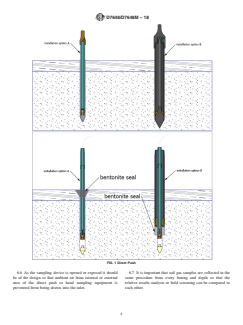
FIG. 1 Direct Push
6.6 As the sampling device is opened or exposed it should 6.7 It is important that soil gas samples are collected in the
be of the design so that ambient air from internal or external same procedure from every boring and depth so that the
area of the direct push or hand sampling equipment is relative results analysis or field screening can be compared to
prevented from being drawn into the inlet. each other.
D7648/D7648M − 18
FIG. 2 Hand Sampling
6.8 Lithology can affect the existence of a contaminant or gassamplingaspartofasurveycanprovideusefulinformation
the ability of the contaminant to migrate in the subsurface. Soil
D7648/D7648M − 18
TABLE 1 Summary of Potential Explanations for Unexpected Results
Result Causes
False negatives, that is, falsely low values Barriers to gaseous diffusion, such as perched water, clay lenses, impervious man-made
debris, saturation of soil pores with water (as from rain), low subsurface temperatures.
Biological or chemical degradation.
Leakage or blockage in the sample train, improper purge procedure, loss of sample from
sample container, problem with analytical system.
False positives, that is, falsely high values Contamination in sampling train, sample container, or analytical system.
Contribution of volatile organic contaminants from vegetation. Significant contamination in
overlying soil.
TABLE 2 Soil Gas Containers or Monitoring Devices
Type Application Advantages Limitations References
Summa canisters Sample collection Durability Higher cost
for offsite analysis Ease of sample collection Bulky to transport/store
Re-usable Incomplete recovery of less volatile cpds (>
More stable than other containers— n-C10), for example, middle distillate fuels, and
especially for very volatile, non-polar polar compounds
compounds Regeneration requires expensive vacuum
Allow replicate analysis equipment
Sampling of very volatiles Can be difficult to decontaminate
Can’t be used for TWA monitoring
Tedlar bags Sample collection Lower cost Significant analyte losses after extended storage
for offsite analysis Good for very volatiles (>24 hrs)
Allow replicate analysis Incomplete recovery of less volatile cpds, for
Useful for sampling reduced sulfur example, middle distillate fuels, and polars
compounds (RSCs) Some bags can introduce contaminants
Not easily re-usable
Leaks in valves
Active sampling Sample collection Low cost Not suitable for ultra-volatiles (for example, C2 ASTM D6196
onto sorbent tubes for offsite analysis Reusable hydrocarbons or CF4) ASTM D7663
using large gas Most commercial apparatus now Multi-sorbent tubes require refrigeration for USEPA TO-17
syringe/hand compatible with repeat analysis storage over 7 days
pump or low Easy to use for example, with large gas Repeat analysis requires modern TD
cost bellows syringe, bellows pump or constant flow instrumentation (but the 2 main commercial
pumps pump brands now offer this capability)
Versatile analyte range—for example, Potential for artifacts if tubes are incorrectly stored
butadiene to n-C30 on a single tube, plus or incompletely desorbed.
compatible with polars Potential for background contamination.
Cheap to store/transport
Proven storage stability Allows TWA or grab
sampling
Facilitates sampling of large air/gas
volumes for trace analysis
Self re-generate during analysis—no extra
cleaning needed
Eliminates losses due to condensation or
dissolution in condensed water during
sample storage/transport
Syringe Sample collection Ease of sample collection Very limited sample volume limits sensitivity
for onsite analysis Does not require special instrumentation to Higher
...
This document is not an ASTM standard and is intended only to provide the user of an ASTM standard an indication of what changes have been made to the previous version. Because
it may not be technically possible to adequately depict all changes accurately, ASTM recommends that users consult prior editions as appropriate. In all cases only the current version
of the standard as published by ASTM is to be considered the official document.
Designation: D7648 − 12 D7648/D7648M − 18
Standard Practice for
Active Soil Gas Sampling for Direct Push or Manual-Driven
Hand-Sampling Equipment
This standard is issued under the fixed designation D7648;D7648/D7648M; the number immediately following the designation indicates
the year of original adoption or, in the case of revision, the year of last revision. A number in parentheses indicates the year of last
reapproval. A superscript epsilon (´) indicates an editorial change since the last revision or reapproval.
1. Scope Scope*
1.1 This practice details the collection of active soil gas samples using a variety of sample collection techniques with tooling
associated with direct push drilling technology (DPT) (DP) or manual-driven hand-sampling equipment, for the express purpose
of conducting soil gas surveys.
1.2 This practice proceeds on the premise that soil gas surveys are primarily used for two (2) purposes,purposes: 1)1) as a
preliminary site investigative tool and 2)2) for the monitoring of ongoing remediation activities.activities (D7663).
1.3 The practicality of field use demands that soil gas surveys are relatively accurate, as well as being simple, quick, and
inexpensive. This guide suggests that the objective of soil gas surveys is linked to three factors:
1.3.1 VOC detection and quantitation, including determination of depth of VOC contamination.
1.3.2 Sample retrieval ease and time.
1.3.3 Cost.
1.4 This practice will likely may increase the awareness of a fundamental difference between soil gas sampling for the purpose
of soil gas surveys versus sub-slab or vapor intrusion investigations or both. Specifically, the purpose of a soil gas survey is to
provide quick and inexpensive data to the investigator that will allow the investigator to 1) develop a site investigation plan that
is strategic in its efforts, 2) determine success or progress of on-going remedial activities, or 3) select the most suitable subsequent
investigation equipment, or combinations thereof. On the other hand, the objective of soil gas sampling for sub-slab and vapor
intrusion investigations (1,2,3, etc.) is not preliminary, but rather the end result of the site investigation or long-term precise
monitoring. As such, stringent sampling methods and protocol are necessary for precise samples and data collection.
1.5 Details included in this practice include a broad spectrum of practices and applications of soil gas surveys, including:
1.5.1 Sample recovery and handling,
1.5.2 Sample analysis,
1.5.3 Data interpretation, and
1.5.4 Data reporting.
1.6 Units—The values stated in either SI units or Inch-pound units [given in brackets] are to be regarded separately as standard.
The values stated in each system may not be exact equivalents; therefore, each system shall be used independently of the other.
Combining values from the two systems may result in non-conformance with the standard.
1.7 All observed and calculated values shall conform to the guidelines for significant digits and rounding established in Practice
D6026.
1.7.1 The procedures used to specify how data are collected/recorded and calculated in the standard are regarded as the industry
standard. In addition, they are representative of the significant digits that generally should be retained. The procedures used do not
consider material variation, purpose for obtaining the data, special purpose studies, or any consideration for the user’s objectives;
and it is common practice to increase or reduce significant digits of reported data to be commensurate with these considerations.
It is beyond the scope of this standard to consider significant digits used in analysis methods for engineering data.
1.8 This practice suggestsoffers a variety of approaches useful to conducting successful soil gas surveys but set of instructions
for performing one or more specific operations. This standard cannot replace education or experience and should be used in
conjunction with professional judgment. Not all aspects of this practice may be applicable in all circumstances. This ASTM
This practice is under the jurisdiction of ASTM Committee D18 on Soil and Rock and is the direct responsibility of Subcommittee D18.21 on Groundwater and Vadose
Zone Investigations.
Current edition approved March 1, 2012Dec. 1, 2018. Published April 2012December 2018. Originally approved in 2012. Last previous edition approved in 2012 as
D7648 – 12. DOI: 10.1520/D7648-12.10.1520/D7648_D7648M-18.
*A Summary of Changes section appears at the end of this standard
Copyright © ASTM International, 100 Barr Harbor Drive, PO Box C700, West Conshohocken, PA 19428-2959. United States
D7648/D7648M − 18
standard is not intended to represent or replace the standard of care by which the adequacy of a given professional service must
be judged, nor should this document be applied without consideration of a project’sproject’s many unique aspects. The word
“Standard” in the title of this document means only that the document has been approved through the ASTM consensus process.
1.7 This practice offers an organized collection of information or a series of options and does not recommend a specific course
of action. The success of any one soil gas survey methodology is strongly dependent upon the environment in which it is applied.
1.9 This practice is not to be used for long term monitoring of contaminated sites or for site closure conformation.confirmation.
1.10 This practice is not to be used for passive determination of flow patterns at contaminated sites.
1.11 This practicestandard does not purport to address all of the safety concerns, if any, associated with its use. It is the
responsibility of the user of this practicestandard to establish appropriate safety safety, health, and healthenvironmental practices
and determine the applicability of regulatory limitations prior to use.
1.12 This practice does not purport to set standard levels of acceptable risk. Use of this practice for purposes of risk assessment
is wholly the responsibility of the user.
1.13 Concerns of practitioner liability or protection from or release from such liability, or both, are not addressed by this
practice.
1.14 This international standard was developed in accordance with internationally recognized principles on standardization
established in the Decision on Principles for the Development of International Standards, Guides and Recommendations issued
by the World Trade Organization Technical Barriers to Trade (TBT) Committee.
2. Referenced Documents
2.1 ASTM Standards:
D653 Terminology Relating to Soil, Rock, and Contained Fluids
D1356 Terminology Relating to Sampling and Analysis of Atmospheres
D1357 Practice for Planning the Sampling of the Ambient Atmosphere
D1452 Practice for Soil Exploration and Sampling by Auger Borings
D3249 Practice for General Ambient Air Analyzer Procedures
D3614 Guide for Laboratories Engaged in Sampling and Analysis of Atmospheres and Emissions
D3740 Practice for Minimum Requirements for Agencies Engaged in Testing and/or Inspection of Soil and Rock as Used in
Engineering Design and Construction
D5314 Guide for Soil Gas Monitoring in the Vadose Zone (Withdrawn 2015)
D6026 Practice for Using Significant Digits in Geotechnical Data
D6196 Practice for Choosing Sorbents, Sampling Parameters and Thermal Desorption Analytical Conditions for Monitoring
Volatile Organic Chemicals in Air
D7663 Practice for Active Soil Gas Sampling in the Vadose Zone for Vapor Intrusion Evaluations
2.2 EPA Standards:
EPA Method TO-15 Determination Of Volatile Organic Compounds (VOCs) In Air Collected In Specially-Prepared Canisters
And Analyzed By Gas Chromatography/ Mass Spectrometry (GC/MS)
EPA Method TO-17 Determination of Volatile Organic Compounds in Ambient Air Using Active Sampling Onto Sorbent Tubes
3. Terminology
3.1 For definitions of common technical terms used in this standard, refer to Terminology D653.
3.2 Definitions of Terms Specific to This Standard:
3.2.1 active sampling, n—in vadose zone, a means of collecting an airborne or emission substance that employs a mechanical
device such as a pump or vacuum assisted critical orifice to draw air or emissions onto or through the sampling device.
3.2.2 capillary fringe, n—in vadose zone, the basal region of the vadose zone comprising sediments that are saturated, or nearly
saturated, near the water table, gradually decreasing in water content with increasing elevation above the water table. Also see
Terminology D653.
3.1.3 contaminant, n—a material added by human or natural activities which may, in sufficient concentrations, render the
atmosphere unacceptable.
3.1.4 emplacement, n—the establishment of contaminant residence in the vadose zone in a particular phase.
3.1.5 free product, n—liquid phase contaminants released into the environment.
For referenced ASTM standards, visit the ASTM website, www.astm.org, or contact ASTM Customer Service at service@astm.org. For Annual Book of ASTM Standards
volume information, refer to the standard’s Document Summary page on the ASTM website.
The last approved version of this historical standard is referenced on www.astm.org.
D7648/D7648M − 18
3.2.3 free vapor phase, n—in vadose zone, a condition of contaminant residence in which volatilized contaminants occur in
porosity that is effective to free and open gaseous flow and exchange, such porosity generally being macroporosity.
3.2.4 hot spot, n—in vadose zone, areas where contaminants exceed cleanup standards or the highest level at a contaminated
site.
3.1.8 liquid phase, n—contaminant residing as a liquid in vadose zone pore space, often referred to as “free product.”
3.2.5 partitioning, n—in vadose zone, the act of movement of contaminants from one soil residence phase to another.
3.1.10 semivolatile organic compound (SVOC), n—an organic compound with a saturated vapor pressure between 10-2kPa and
10-8 kPa at 26 °C.
3.2.6 soil gas, n—in vadose zone, vadose zone atmosphere.
3.1.12 solute phase, n—a condition of contaminant residence in which contaminants are dissolved in ground water in either the
saturated or the vadose zone.
3.1.13 sorbed phase, n—a condition of contaminant residence in which contaminants are adsorbed onto the surface of soil
particles or absorbed by soil organic matter.
3.1.14 sorbent, n—a solid or liquid medium in or upon which materials are collected by absorption, adsorption, or
chemisorption.
3.1.15 sorption, n—a process by which one material (the sorbent) takes up and retains another material (the sorbate) by
processes of absorption, adsorption, or chemisorption.
3.1.16 vadose zone, n—the hydrogeological region extending from the soil surface to the top of the principal water table.
3.2.7 volatile organic compound (VOC), n—an organic compound with a saturation vapor pressure greater than 10-2kPa at 26
°C.boiling points typically ranging from a lower limit between 50°C and 100°C, and an upper limit between 240°C and 260°C,
where the upper limits represent mostly polar compounds.
4. Summary of Guide
4.1 Sampling of soil gases (volatile contaminantscompounds such as methane and carbon dioxide, which are indicators of
increased microbial activity resulting from organic contaminants) in the vadose zone is an industry-accepted method used to
directly measure characteristics of the soil atmosphere. Characteristics determined from soil gas sampling are frequently used as
indirect indicators of processes occurring in and below a sampling horizon, including the presence, composition, origin and
distribution of contaminants in and below the vadose zone.
4.2 Previously,Originally, soil gas sampling was used more as a tool for laying the groundwork for further soil exploration. The
ability to quickly, accurately, and inexpensively determine VOCs,VOCs presence, levels, and depths have allowed this method to
become a standard practice for preliminary site investigation as well as for monitoring the success of on-going site remediation
efforts. Currently soil gas sampling has been gaining acceptance as a reasonable method for the determination of risk assessment
of contaminated sites, known as soil gas investigations. This new direction in soil Soil gas sampling is now playing a major role
in the development of new methodologies with a current trend towards more stringent soil gas sampling methods and protocols.
4.3 However, the practicality of field use demands that there is a soil gas sampling method that is accurate as well as simple,
quick, and inexpensive, for the purposes of preliminary site investigation and the monitoring of on-going remediation efforts. This
guidepractice refers to this method as a soil gas survey.
4.4 The objective of a soil gas survey is to determine, through relative data, the highest level of contamination at a site (hot
spot). Data collected from soil gas surveys provides information useful for the development of strategic and cost effective site
investigation plans.
4.5 The leading principle behind this guide is that there is a difference between soil gas surveys and soil gas investigations
(1,2,3).
4.5 While the need for stringent methodology is strongly supported for soil gas investigations, (sub-slab and vapor intrusion
investigations) those same stringent methods and protocols, when used for the purpose of soil gas surveying, are not cost effective
nor time efficient.
4.6 Soil gas surveys need to be more use quick, time efficient, and cost effective than soil gas investigation methods. The
economic limits coupled with the objective of a soil gas survey must be the leading factor behind the development of soil gas
survey methodology and protocol. If it takes as much time or much moneycost to survey as to investigate, then investigators will
not utilize this tool/practice.
4.7 Vadose zone sampling methods have a set of procedures, both general and specific, that must be consistently followed in
order to provide maximum data quality and usefulness. Soil gas surveys are no exception, with have the primary procedures
common to allmost soil gas sampling techniques. The procedures include:
(1) Planning and preparation,
D7648/D7648M − 18
(2) The act of sampling soil gas in the field,
(3) Handling and transporting the sample, and
(4) This method does not recommend a sample analysis, interpretation of the results of analysis, nor specific format for the
preparation of a report of findings. Instead it indicates minimum information to be included in a report of findings.
4.7.1 The planning and preparation step begins with the formulation of project objectives, including purpose of the survey,
appropriate application of the data to be collected and data quality objectives.
4.7.2 Actual field work consists of recovery of soil gas samples. The method selected should be based upon site specific factors
and dictated by the project objectives.
4.7.3 As samples are being recovered or collected, they mustshould be handled, field screened, or transported, or combinations
thereof, in such a way as to assure preservation preserve the sample prior to analysis.
5. Significance and Use
5.1 Soil gas is simply the gas phase (air) that exists in the open spaces between soil particles in the unsaturated portion of the
vadose zone. Normally comprised of nitrogen and oxygen, soil gas becomes contaminated when volatile organic compounds
(VOCs) are released in the subsurface due to spills or leaks, and they begin to evaporate from a fluid phase and become part of
the soil gas. Over time, VOCs can potentially migrate through the soil, or groundwater ground water, or both, and present a
probleman impact to the environment and human health.
NOTE 1—Not all VOCs in soil gas are due to spills or leaks. Simple VOCs, such as acetone, methanol, and ethanol may also arise from natural
biological processes.
5.2 Application of Soil Gas Surveys—Soil gas surveying offers an effective, quick and cost-effective method of detecting volatile
contaminants in the vadose zone. Soil gas surveying has been demonstrated to be effective for selection of suitable and
representative samples for other more costly and definitive investigative methods. This method is highly useful at the initiation of
an investigation into the preliminary site investigation offor determining the existence and extent of volatile or semivolatile semi
volatile organic contamination, and determination of location of highest concetrations,concentrations, as well as, monitoring the
effectiveness of on-going remedial activities.activities (D6196).
5.3 Samples are collected by inserting a sampling device into a borehole with hydraulically-driven direct push drilling
technology or manually-driven driven hand sampling equipment.equipment (see Note 2).
NOTE 2—Soil gas sampling can be performed beneath impervious surfaces, such as concrete slabs or pavement by drilling or boring through the surface.
5.4 Soil gas surveys can be performed over a wide range of spatial designs. Spatial designs include soil gas sampling in profiles
or grid patterns at a single depth or multiple depths. Multiple depth sampling is particularly useful for contaminant determinations
in cases with complex soil type distribution and multiple sources. Depth profiling can also be useful in the determination of the
most appropriate depth(s) at which to monitor soil gas, as well as the demonstration of migration and degradation processes in the
vadose zone.
5.5 Soil gas surveys are used extensively in preliminary site investigations and monitoring of effectiveness of on-going site
remediation efforts. Project objectives mustshould be known and the limitation of this method considered. Limitations include:
5.5.1 Data generated from soil gas surveying is relative and not of the quality necessary for a single data set; final decisions;
and
5.5.2 Soil gas surveys need to be done quickly, so this method is for active soil-gas sampling devices only.
6. Apparatus
6.1 Soil gas samples are collected by inserting a sampling device into an open borehole or telescopically pushed into native
lithology, through other subsurface conduits, with hydraulically driven direct push drilling technology or manual driven hand
(D1452) sampling equipment (Figs. 1 and 2). Table 1 provides a summary of possiblepotential causes of false positive and false
negative values.
6.2 Whether the sampling device is driven by direct push equipment or by hand it should be sealed and isolated at the depth
to which it is opened and exposed, so that soil gas that is drawn comes from the specific target depth. The sampling inlet can range
from less than 0.25 to 12 in.0.65 cm to 0.3 m [0.25 to 12 in.] in length (Figs. 31 and 42).
NOTE 3—The use of bentonite slurries for sealing in the vadose zone for more than short term can be problematic as the bentonite lacking moisture
will potentially shrink and allow air leakage. An extensive research program on annular sealants was conducted from 2001 through 2009 and subsequent
years by the Nebraska Grout Task Force. This research included cement and bentonite grouts. The general finding of the study indicates all sealing
methods suffer from some shrinkage in the unsaturated zone. The best grouts were cement-sand, bentonite chips, neat cements and bentonite slurries with
more than 20 % solids bentonite. Bentonite slurry was not recommended in the unsaturated zone regardless of solids content for longer term use. When
bentonite is used for sealing, it should be properly hydrated to form an adequate seal with cautions to avoid the intrusion of water into the sampling zone.
6.3 The inlet of the sampling device should eliminate or minimize the chance of soil particles or other debris from being drawn
to the surface or into the sample container (Figs. 31 and 42). A list of acceptable sample containers or monitoring devices is
included in Table 2.
D7648/D7648M − 18
FIG. 1 Direct Push
6.4 The sample train from the inlet to the container of choice should be of closed loop configuration and valving components
that will allow for purging of ambient air existing from the installation and set up (Figs. 53 and 64).
6.5 Once the ambient air and a purge volume equal to twothree times the total volume of the sample train has been purged the
sample train mustshould be isolated to ensure make sure that ambient air does not reenter the sample train.
6.6 The maximum flow of the purging and subsequent sample collection should be between 100 to 200 ml per minute.
D7648/D7648M − 18
FIG. 2 Hand Sampling
6.6 As the sampling device is opened or exposed it should be of the design so that ambient air from internal or external area
of the direct push or hand sampling equipment is prevented from being drawn into the inlet.
D7648/D7648M − 18
TABLE 1 Summary of Possible Causes of False Positive and False Negative ValuesPotential Explanations for Unexpected Results
Result Causes
False negatives, that is, falsely low values Barriers to gaseous diffusion, such as perched water, clay lenses, impervious man-made
debris, saturation of soil pores with water (as from rain), low subsurface temperatures.
Biological or chemical degradation.
Leakage or blockage in the sample train, improper purge procedure, loss of sample from
sample container, problem with analytical system.
False positives, that is, falsely high values Contamination in sampling train, sample container, or analytical system.
Contribution of volatile organic contaminants from vegetation. Significant contamination in
overlying soil.
6.7 It is important that soil gas samples are collected in the same procedure from every boring and depth so that the relative
results analysis or field screening can be compared to each other.
6.8 Lithology can affect the existence of a contaminant or the ability of the contaminant to migrate in the subsurface. Soil gas
sampling as part of a survey can provide useful information to provide preliminary indications as to what has happened or is
happening in the subsurface.
6.9 It is up to the project manager, remedial engineer, or regulatory oversight personnel, or combinations thereof, to determine
how to use the analytical results or field screening readings for planning or reporting on different phases of the site investigation
and remedial activities.
7. Sampling Method or Procedure
7.1 Sampling Methodology—Soil gas sampling methodology has evolved over time and through practice in several industries.
The equipment with which to perform this monitoring technique is highly varied; however, noa single method or procedure is
cannot be recommended to the reader due to the variation in site specific factors. The selection of a soil gas sampling method
involves consideration of three primary issues. These are the type of sampling system, the methodology of application of that
sampling system and the rigor of the field QA/QC protocol. Informed investigators must assume the responsibility of selecting the
technique most appropriate to the subject application, whether that technique is commercially available from contractors or
equipment suppliers, or reliant upon the ingenuity of the investigator in the field utilizing commonly available materials. Success
in choosing an appropriate sampling device or an entire sampling system is dependent upon the investigator’s level of
understanding of vadose zone processes, contaminant properties and appropriate applicability of the soil gas method. The target
analyte volatility range is a key criteria affecting sampling method selection.
7.1.1 The application of any of these methods must needs to be controlled by strict adherence to a standard operating procedure.
Occasional deviations as dictated by unusual field conditions should be recorded in the project field notebook. Inadvertent minor
deviations in field procedure can result in misinterpretation of the data acquired.
7.2 Soil types should be taken into consideration as soil gas samples are collected across a given site. Although the level of
concentration of VOCs in soil gas samples collected from different lithologies is expected to be different as migration of soil gas
can be influenced by the parameters of a particular lithology.
7.3 Active Soil Gas Surveying—Active methods are those that obtain a soil gas sample by positioning a sampling device in the
subsurface and the withdrawal of soil atmosphere through the device from the sampling horizon. (Passive methods are those that
obtain a soil gas sample by placing a collection device in the soil or on the soil surface, and allowing the atmosphere within the
device to come into compositional equilibrium with the soil atmosphere.)
7.4 Methodology in Application of a Sampling Technique—The likelihood of success of the soil gas sampling technique selected
is controlled in part by the methodology in application of that sampling technique. This methodology should be guided by the
objectives of the subject project and the perceived spatial and temporal array of the potential sampling targets.
7.4.1 Grids—Many problems suitable for soil gas monitoring are bestoften solved by obtaining data distributed over a
geographic area. Sampling in grid patterns of variable design and sp
...