

ASTM B1001-23
(Specification)Standard Specification for Copper Electrode Wire Used for Welding Seams of Steel Cans
General Information
- Abstract
ABSTRACT
This specification covers drawn, soft annealed round copper electrode wire used in welding machines for the purpose of seam welding of cans. It does not purport to address all of the safety concerns, if any, associated with its use. It is the responsibility of the user of this specification to establish appropriate safety and health practices and determine the applicability of regulatory limitations prior to use.
SCOPE
1.1 This specification covers the requirements for drawn, soft annealed round copper electrode wire used in welding machines for the purpose of seam welding of cans.
1.2 Units—The values stated in SI units are to be regarded as standard. The values given in parentheses are mathematical conversions to inch-pound units that are provided for information only and are not considered standard.
1.3 This standard does not purport to address all of the safety concerns, if any, associated with its use. It is the responsibility of the user of this standard to establish appropriate safety, health, and environmental practices and determine the applicability of regulatory limitations prior to use.
1.4 This international standard was developed in accordance with internationally recognized principles on standardization established in the Decision on Principles for the Development of International Standards, Guides and Recommendations issued by the World Trade Organization Technical Barriers to Trade (TBT) Committee.
- Status
- Published
- Publication Date
- 30-Sep-2023
- Technical Committee
- B05 - Copper and Copper Alloys
- Drafting Committee
- B05.02 - Rod, Bar, Wire, Shapes and Forgings
Buy Documents
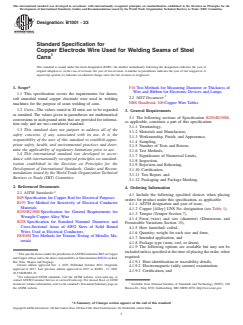
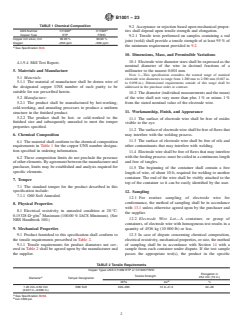
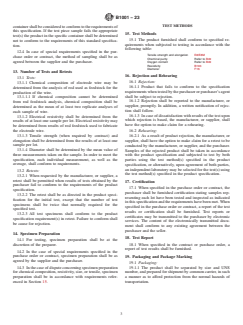

ASTM B1001-23 - Standard Specification for Copper Electrode Wire Used for Welding Seams of Steel Cans
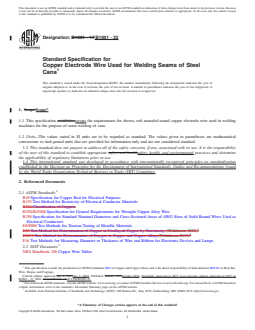
REDLINE ASTM B1001-23 - Standard Specification for Copper Electrode Wire Used for Welding Seams of Steel Cans
Overview
ASTM B1001-23: Standard Specification for Copper Electrode Wire Used for Welding Seams of Steel Cans provides comprehensive requirements for drawn, soft annealed round copper electrode wire specifically designed for use in the seam welding of steel cans. This standard, developed by ASTM International, outlines critical material, manufacturing, and quality aspects necessary to ensure reliable performance in industrial welding applications. ASTM B1001-23 also addresses proper safety, regulatory considerations, and international standardization practices, making it a key reference for manufacturers and users in the metal packaging and welded container industries.
Key Topics
Material Requirements:
- Specifies the use of copper wire with UNS numbers C11000 (Electrolytic Tough Pitch, ETP) or C11020 (Fire Refined High Conductivity, FRHC) with a minimum copper content of 99.90%.
- Limits oxygen content to less than 650 ppm for both copper types.
Mechanical and Physical Properties:
- Defines temper as O60 Soft Annealed for optimal welding performance.
- Establishes tensile strength and elongation requirements for wires ranging from 1.20 mm to 2.50 mm in diameter.
- Sets electrical resistivity in the annealed condition at a maximum of 0.15328 Ω·g/m (minimum 100% IACS conductivity).
Manufacturing and Workmanship:
- Copper wire must be uniformly manufactured by hot-working, cold-working, and annealing to achieve consistent properties.
- Requires wire surfaces to be free from oxides, flaws, oils, and other contaminants to prevent welding or feeding issues.
- Mandates continuous, tangle-free coiling and clear identification of wire ends for operational efficiency.
Testing and Inspection:
- Outlines standard test methods for evaluating diameter, tensile strength, elongation, resistivity, and chemical purity.
- Details procedures for sampling, retesting, and criteria for product rejection and rehearing.
Applications
Seam Welding of Steel Cans:
- The primary application of ASTM B1001-23 copper electrode wire is in resistance seam welding machines used to fabricate steel cans for food, beverage, and industrial packaging.
- The specified wire delivers high conductivity and mechanical integrity, crucial for producing strong, leak-proof seams in metal containers.
Industrial Metal Packaging:
- Used extensively by can manufacturers to ensure reliable, high-speed production lines.
- The quality requirements in this standard help minimize weld defects, boost process efficiency, and maintain product safety for consumers.
Compliance and Global Trade:
- Adoption of ASTM B1001-23 supports conformity with international standards and regulatory expectations, facilitating cross-border commerce and uniform product quality.
Related Standards
For effective use and specification of copper electrode wire, the following related standards are referenced or may be applicable:
- ASTM B49: Specification for Copper Rod for Electrical Purposes
- ASTM B193: Test Method for Resistivity of Electrical Conductor Materials
- ASTM B224: Classification of Coppers
- ASTM B250/B250M: General Requirements for Wrought Copper Alloy Wire
- ASTM B258: Standard Nominal Diameters and Cross-Sectional Areas of AWG Sizes of Solid Round Wires
- ASTM E8/E8M: Test Methods for Tension Testing of Metallic Materials
- ASTM F16: Test Methods for Measuring Diameter or Thickness of Wire and Ribbon
- NIST Handbook 100: Copper Wire Tables
By implementing ASTM B1001-23, organizations benefit from globally recognized best practices in selecting, using, and verifying copper electrode wire for seam welding applications in steel can manufacturing. This ensures durable welds, consistent production quality, and compliance with regulatory and industry requirements.
Relations
- Effective Date
- 01-Oct-2023
- Effective Date
- 01-Jan-2024
- Effective Date
- 01-May-2022
- Effective Date
- 01-May-2022
Buy Documents
ASTM B1001-23 - Standard Specification for Copper Electrode Wire Used for Welding Seams of Steel Cans
REDLINE ASTM B1001-23 - Standard Specification for Copper Electrode Wire Used for Welding Seams of Steel Cans
Get Certified
Connect with accredited certification bodies for this standard

DVS-ZERT GmbH
German welding certification society.
CARES (UK Certification Authority for Reinforcing Steels)
UK certification for reinforcing steels and construction.
EWF/IIW (European/International Welding Federation)
International welding personnel certification.
Sponsored listings
Frequently Asked Questions
ASTM B1001-23 is a technical specification published by ASTM International. Its full title is "Standard Specification for Copper Electrode Wire Used for Welding Seams of Steel Cans". This standard covers: ABSTRACT This specification covers drawn, soft annealed round copper electrode wire used in welding machines for the purpose of seam welding of cans. It does not purport to address all of the safety concerns, if any, associated with its use. It is the responsibility of the user of this specification to establish appropriate safety and health practices and determine the applicability of regulatory limitations prior to use. SCOPE 1.1 This specification covers the requirements for drawn, soft annealed round copper electrode wire used in welding machines for the purpose of seam welding of cans. 1.2 Units—The values stated in SI units are to be regarded as standard. The values given in parentheses are mathematical conversions to inch-pound units that are provided for information only and are not considered standard. 1.3 This standard does not purport to address all of the safety concerns, if any, associated with its use. It is the responsibility of the user of this standard to establish appropriate safety, health, and environmental practices and determine the applicability of regulatory limitations prior to use. 1.4 This international standard was developed in accordance with internationally recognized principles on standardization established in the Decision on Principles for the Development of International Standards, Guides and Recommendations issued by the World Trade Organization Technical Barriers to Trade (TBT) Committee.
ABSTRACT This specification covers drawn, soft annealed round copper electrode wire used in welding machines for the purpose of seam welding of cans. It does not purport to address all of the safety concerns, if any, associated with its use. It is the responsibility of the user of this specification to establish appropriate safety and health practices and determine the applicability of regulatory limitations prior to use. SCOPE 1.1 This specification covers the requirements for drawn, soft annealed round copper electrode wire used in welding machines for the purpose of seam welding of cans. 1.2 Units—The values stated in SI units are to be regarded as standard. The values given in parentheses are mathematical conversions to inch-pound units that are provided for information only and are not considered standard. 1.3 This standard does not purport to address all of the safety concerns, if any, associated with its use. It is the responsibility of the user of this standard to establish appropriate safety, health, and environmental practices and determine the applicability of regulatory limitations prior to use. 1.4 This international standard was developed in accordance with internationally recognized principles on standardization established in the Decision on Principles for the Development of International Standards, Guides and Recommendations issued by the World Trade Organization Technical Barriers to Trade (TBT) Committee.
ASTM B1001-23 is classified under the following ICS (International Classification for Standards) categories: 25.160.01 - Welding, brazing and soldering in general. The ICS classification helps identify the subject area and facilitates finding related standards.
ASTM B1001-23 has the following relationships with other standards: It is inter standard links to ASTM B1001-17, ASTM E8/E8M-24, ASTM F16-12(2022), ASTM E8/E8M-22. Understanding these relationships helps ensure you are using the most current and applicable version of the standard.
ASTM B1001-23 is available in PDF format for immediate download after purchase. The document can be added to your cart and obtained through the secure checkout process. Digital delivery ensures instant access to the complete standard document.
Standards Content (Sample)
This international standard was developed in accordance with internationally recognized principles on standardization established in the Decision on Principles for the
Development of International Standards, Guides and Recommendations issued by the World Trade Organization Technical Barriers to Trade (TBT) Committee.
Designation: B1001 − 23
Standard Specification for
Copper Electrode Wire Used for Welding Seams of Steel
Cans
This standard is issued under the fixed designation B1001; the number immediately following the designation indicates the year of
original adoption or, in the case of revision, the year of last revision. A number in parentheses indicates the year of last reapproval. A
superscript epsilon (´) indicates an editorial change since the last revision or reapproval.
1. Scope* F16 Test Methods for Measuring Diameter or Thickness of
Wire and Ribbon for Electronic Devices and Lamps
1.1 This specification covers the requirements for drawn,
2.2 NIST Document:
soft annealed round copper electrode wire used in welding
NBS Handbook 100 Copper Wire Tables
machines for the purpose of seam welding of cans.
1.2 Units—The values stated in SI units are to be regarded
3. General Requirements
as standard. The values given in parentheses are mathematical
3.1 The following sections of Specification B250/B250M,
conversions to inch-pound units that are provided for informa-
as applicable, constitute a part of this specification:
tion only and are not considered standard.
3.1.1 Terminology,
1.3 This standard does not purport to address all of the
3.1.2 Materials and Manufacture,
safety concerns, if any, associated with its use. It is the
3.1.3 Workmanship, Finish, and Appearance,
responsibility of the user of this standard to establish appro-
3.1.4 Sampling,
priate safety, health, and environmental practices and deter-
3.1.5 Number of Tests and Retests,
mine the applicability of regulatory limitations prior to use.
3.1.6 Test Methods,
1.4 This international standard was developed in accor-
3.1.7 Significance of Numerical Limits,
dance with internationally recognized principles on standard-
3.1.8 Inspection,
ization established in the Decision on Principles for the
3.1.9 Rejection and Rehearing,
Development of International Standards, Guides and Recom-
3.1.10 Certification,
mendations issued by the World Trade Organization Technical
3.1.11 Test Report, and
Barriers to Trade (TBT) Committee.
3.1.12 Packaging and Package Marking.
2. Referenced Documents
4. Ordering Information
2.1 ASTM Standards:
4.1 Include the following specified choices when placing
B49 Specification for Copper Rod for Electrical Purposes
orders for product under this specification, as applicable:
B193 Test Method for Resistivity of Electrical Conductor
4.1.1 ASTM designation and year of issue,
Materials
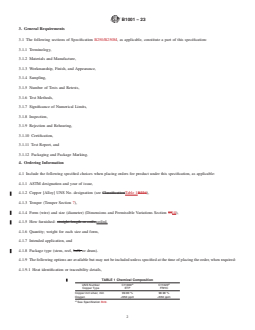
4.1.2 Copper [Alloy] UNS No. designation (see Table 1),
B250/B250M Specification for General Requirements for
4.1.3 Temper (Temper Section 7),
Wrought Copper Alloy Wire
4.1.4 Form (wire) and size (diameter) (Dimensions and
B258 Specification for Standard Nominal Diameters and
Permissible Variations Section 10),
Cross-Sectional Areas of AWG Sizes of Solid Round
4.1.5 How furnished: coiled,
Wires Used as Electrical Conductors
4.1.6 Quantity; weight for each size and form,
E8/E8M Test Methods for Tension Testing of Metallic Ma-
4.1.7 Intended application, and
terials
4.1.8 Package type (stem, reel, or drum).
4.1.9 The following options are available but may not be
included unless specified at the time of placing the order, when
This specification is under the jurisdiction of ASTM Committee B05 on Copper
required:
and Copper Alloys and is the direct responsibility of Subcommittee B05.02 on Rod,
Bar, Wire, Shapes and Forgings. 4.1.9.1 Heat identification or traceability details,
Current edition approved Oct. 1, 2023. Published October 2023. Originally
4.1.9.2 Electromagnetic (eddy current) examination,
approved in 2017. Last previous edition approved in 2017 as B1001 – 17. DOI:
4.1.9.3 Certification, and
10.1520/B1001-23.
For referenced ASTM standards, visit the ASTM website, www.astm.org, or
contact ASTM Customer Service at service@astm.org. For Annual Book of ASTM
Standards volume information, refer to the standard’s Document Summary page on Available from National Institute of Standards and Technology (NIST), 100
the ASTM website. Bureau Dr., Stop 1070, Gaithersburg, MD 20899-1070, http://www.nist.gov.
*A Summary of Changes section appears at the end of this standard
Copyright © ASTM International, 100 Barr Harbor Drive, PO Box C700, West Conshohocken, PA 19428-2959. United States
B1001 − 23
TABLE 1 Chemical Composition
9.2 Acceptance or rejection based upon mechanical proper-
A A
UNS Number C11000 C11020
ties shall depend upon tensile strength and elongation.
Copper Type ETP FRHC
9.2.1 Tensile tests performed on samples containing a rod
Copper incl silver, min 99.90 % 99.90 %
joint (weld) shall provide a tensile strength of at least 95 % of
Oxygen <650 ppm <650 ppm
the minimum requirement provided in 9.2.
A
See Specification B49.
10. Dimensions, Mass, and Permissible Variations
10.1 Electrode wire diameter sizes shall be expressed as the
4.1.9.4 Mill Test Report.
nominal diameter of the wire in decimal fractions of a
5. Materials and Manufacture millimeter to the nearest 0.001 mm.
NOTE 1—This specification considers the normal range of nominal
5.1 Materials:
electrode wire diameters to range from 1.200 mm to 2.500 mm (0.047 in.
5.1.1 The material of manufacture shall be drawn wire of
to 0.098 in.). Dimensional requirements outside of this range shall be
the designated copper UNS number of such purity to be addressed in the purchase order or contract.
suitable for use prescribed herein.
10.2 The diameter (individual measurements and the mean)
of the wire shall not vary more than plus 1 % or minus 1 %
5.2 Manufacture:
from the stated nominal value of the electrode wire.
5.2.1 The product shall be manufactured by hot-working,
cold-working, and annealing processes to produce a uniform
11. Workmanship, Finish, and Appearance
structure in the finished product.
5.2.2 The product shall be hot- or cold-worked to the
11.1 The surface of electrode wire shall be free of oxides
finished size and subsequently annealed to meet the temper
visible to the eye.
properties specified.
11.2 The surface of electrode wire shall be free of flaws that
may interfere with the welding process.
6. Chemical Composition
11.3 The surface of electrode wire shall be free of oils and
6.1 The material shall conform to the chemical composition
other contaminants that may interfere with welding.
requirements in Table 1 for the copper UNS number designa-
tion specified in ordering information.
11.4 Electrode wire shall be free of flaws that may interfere
with the feeding process: must be coiled in a continuous length
6.2 These composition limits do not preclude the presence
and free of tangles.
of other elements. By agreement between the manufacturer and
purchaser, limits may be established and analysis required for
11.5 The beginning of the container shall contain a free
specific elements.
length of wire, of about 10 ft, required for welding to another
container. The end of the wire shall be visibly attached to the
7. Temper
top of the container so it can be easily identified by the user.
7.1 The standard temper for the product described in this
specification include:
12. Sampling
7.1.1 O60 Soft Annealed.
12.1 For routine sampling of electrode wire for
conformance, the method of sampling shall be in accordance
8. Physical Properties
with 13.1 unless otherwise agreed upon by the purchaser and
8.1 Electrical resistivity in annealed condition at 20 °C:
the supplier.
0.15328 Ω٠g/m Maximum (100.00 % IACS Minimum). (See
12.2 Electrode Wire Lot—A container, or group of
NBS Handbook 100.)
containers, of electrode wire with homogenous test results in a
9. Mechanical Properties quantity of 4536 kg (10 000 lb) or less.
9.1 Product furnished to this specification shall conform to 12.3 In case of dispute concerning chemical composition,
the tensile requirements prescribed in Table 2. electr
...
This document is not an ASTM standard and is intended only to provide the user of an ASTM standard an indication of what changes have been made to the previous version. Because
it may not be technically possible to adequately depict all changes accurately, ASTM recommends that users consult prior editions as appropriate. In all cases only the current version
of the standard as published by ASTM is to be considered the official document.
Designation: B1001 − 17 B1001 − 23
Standard Specification for
Copper Electrode Wire Used for Welding Seams of Steel
Cans
This standard is issued under the fixed designation B1001; the number immediately following the designation indicates the year of
original adoption or, in the case of revision, the year of last revision. A number in parentheses indicates the year of last reapproval. A
superscript epsilon (´) indicates an editorial change since the last revision or reapproval.
1. Scope Scope*
1.1 This specification establishescovers the requirements for drawn, soft annealed round copper electrode wire used in welding
machines for the purpose of seam welding of cans.
1.2 Units—The values stated in SI units are to be regarded as standard. The values given in parentheses are mathematical
conversions to inch-pound units that are provided for information only and are not considered standard.
1.3 This standard does not purport to address all of the safety concerns, if any, associated with its use. It is the responsibility
of the user of this standard to establish appropriate safety and healthsafety, health, and environmental practices and determine
the applicability of regulatory limitations prior to use.
1.4 This international standard was developed in accordance with internationally recognized principles on standardization
established in the Decision on Principles for the Development of International Standards, Guides and Recommendations issued
by the World Trade Organization Technical Barriers to Trade (TBT) Committee.
2. Referenced Documents
2.1 ASTM Standards:
B49 Specification for Copper Rod for Electrical Purposes
B193 Test Method for Resistivity of Electrical Conductor Materials
B224 Classification of Coppers
B250/B250M Specification for General Requirements for Wrought Copper Alloy Wire
B258 Specification for Standard Nominal Diameters and Cross-Sectional Areas of AWG Sizes of Solid Round Wires Used as
Electrical Conductors
E8/E8M Test Methods for Tension Testing of Metallic Materials
E53 Test Method for Determination of Copper in Unalloyed Copper by Gravimetry (Withdrawn 2022)
E2575 Test Method for Determination of Oxygen in Copper and Copper Alloys(Withdrawn 2017)
F16 Test Methods for Measuring Diameter or Thickness of Wire and Ribbon for Electronic Devices and Lamps
2.2 NIST Document:
NBS Handbook 100 Copper Wire Tables
This specification is under the jurisdiction of ASTM Committee B05 on Copper and Copper Alloys and is the direct responsibility of Subcommittee B05.02 on Rod, Bar,
Wire, Shapes and Forgings.
Current edition approved Jan. 1, 2017Oct. 1, 2023. Published January 2017October 2023. Originally approved in 2017. Last previous edition approved in 2017 as
B1001 – 17. DOI: 10.1520/B1001-17.10.1520/B1001-23.
For referenced ASTM standards, visit the ASTM website, www.astm.org, or contact ASTM Customer Service at service@astm.org. For Annual Book of ASTM Standards
volume information, refer to the standard’s Document Summary page on the ASTM website.
Available from National Institute of Standards and Technology (NIST), 100 Bureau Dr., Stop 1070, Gaithersburg, MD 20899-1070, http://www.nist.gov.
*A Summary of Changes section appears at the end of this standard
Copyright © ASTM International, 100 Barr Harbor Drive, PO Box C700, West Conshohocken, PA 19428-2959. United States
B1001 − 23
3. General Requirements
3.1 The following sections of Specification B250/B250M, as applicable, constitute a part of this specification:
3.1.1 Terminology,
3.1.2 Materials and Manufacture,
3.1.3 Workmanship, Finish, and Appearance,
3.1.4 Sampling,
3.1.5 Number of Tests and Retests,
3.1.6 Test Methods,
3.1.7 Significance of Numerical Limits,
3.1.8 Inspection,
3.1.9 Rejection and Rehearing,
3.1.10 Certification,
3.1.11 Test Report, and
3.1.12 Packaging and Package Marking.
4. Ordering Information
4.1 Include the following specified choices when placing orders for product under this specification, as applicable:
4.1.1 ASTM designation and year of issue,
4.1.2 Copper [Alloy] UNS No. designation (see ClassificationTable 1B224),
4.1.3 Temper (Temper Section 7),
4.1.4 Form (wire) and size (diameter) (Dimensions and Permissible Variations Section 1110),
4.1.5 How furnished: straight length or coils,coiled,
4.1.6 Quantity; weight for each size and form,
4.1.7 Intended application, and
4.1.8 Package type (stem, reel, bulk or drum).
4.1.9 The following options are available but may not be included unless specified at the time of placing the order, when required:
4.1.9.1 Heat identification or traceability details,
TABLE 1 Chemical Composition
A A
UNS Number C11000 C11020
Copper Type ETP FRHC
Copper incl silver, min 99.90 % 99.90 %
Oxygen <650 ppm <650 ppm
A
See Specification B49.
B1001 − 23
4.1.9.2 Electromagnetic (eddy current) examination,
4.1.9.3 Certification, and
4.1.9.4 Mill Test Report.
5. Materials and Manufacture
5.1 Materials:
5.1.1 The material of manufacture shall be drawn wire of the designated copper UNS number of such purity to be suitable for use
prescribed herein.
5.2 Manufacture:
5.2.1 The product shall be manufactured by hot-working, cold-working, and annealing processes to produce a uniform structure
in the finished product.
5.2.2 The product shall be hot- or cold-worked to the finished size and subsequently annealed to meet the temper properties
specified.
6. Chemical Composition
6.1 The material shall conform to the chemical composition requirements in Table 1 for the copper UNS number designation
specified in ordering information.
6.2 These composition limits do not preclude the presence of other elements. By agreement between the manufacturer and
purchaser, limits may be established and analysis required for specific elements.
7. Temper
7.1 The standard temper for the product described in this specification include:
7.1.1 O60 Soft Annealed or Hard Temper H04.Annealed.
8. Physical Properties
8.1 Electrical resistivity in annealed condition at 20 °C: 0.15328 Ω٠g/m Maximum (100.00 % IACS Minimum). (See NBS
Handbook 100.)
9. Mechanical Properties
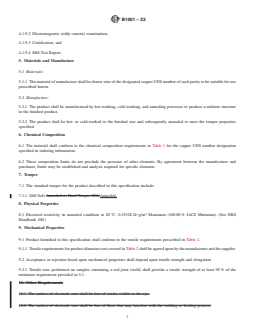
9.1 Product furnished to this specification shall conform to the tensile requirements prescribed in Table 2.
9.1.1 Tensile requirements for product diameters not covered in Table 2 shall be agreed upon by the manufacturer and the supplier.
9.2 Acceptance or rejection based upon mechanical properties shall depend upon tensile strength and elongation.
9.2.1 Tensile tests performed on samples containing a rod joint (weld) shall provide a tensile strength of at least 95 % of the
minimum requirement provided in 9.2.
10. Other Requirements
10.1 The surface of electrode wire shall be free of oxides visible to the eye.
10.2 The surface of electrode wire shall be free of flaws that may interfere with the welding or feeding process.
B1001 − 23
TABLE 2 Tensile Requirements
Copper Types UNS C11000 ETP or C11020 FRHC
Elongation in
Tensile Strength
A
254 mm (10 in.)
Diameter Temper Designation
B
MPa ksi %
1.20–2.50 mm (0.047–0.098 in.) O60 Soft 220–285 31.9–41.3 22–28
1.20–2.50 mm (0.047–0.098 in.) H04 Hard 400–440 58.0–63.8 N/A
TABLE 2 Tensile Requirements
Copper Types UNS C11000 ETP or C11020 FRHC
Elongation in
Tensile Strength
A
254 mm (10 in.)
Diameter Temper Designation
B
MPa ksi %
1.20 mm–2.50 mm O60 Soft 220–285 31.9–41.3 22–28
(0.047 in.–0.098 in.)
A
See Specification B258.
B
ksi=1000 psi.
10.3 The surface of electrode wire shall be free of oils and other contaminants that may interfere with welding.
10. Dimensions, Mass, and Permissible Variations
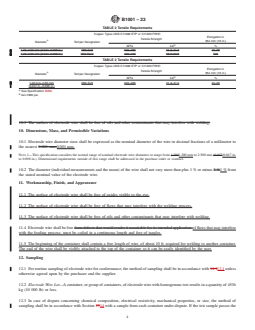
10.1 Electrode wire diameter sizes shall be expressed as the nominal diameter of the wire in decimal fractions of a millimeter to
the nearest 0.001 mm.0.001 mm.
NOTE 1—This specification considers the normal range of nominal electrode wire diameters to range from 1.2001.200 mm to 2.500 mm (0.047(0.047 in.
to 0.098 in.). Dimensional requirements outside of this range shall be addressed in the purchase order or contract.
10.2 The diameter (individual measurements and the mean) of the wire shall not vary more than plus 1 % or minus 2 %1 % from
the stated nominal value of the electrode wire.
11. Workmanship, Finish, and Appearance
11.1 The surface of electrode wire shall be free of oxides visible to the eye.
11.2 The surface of electrode wire shall be free of flaws that may interfere with the welding process.
11.3 The surface of electrode wire shall be free of oils and other conta
...