

ASTM A1127/A1127M-23
(Specification)Standard Specification for Stainless Steel Laser and Laser-Hybrid Welded, Sharp-Cornered Profile (SCP) or Built-Up Rounded Corner Square, Rectangular, and Special Shape Structural Tube
General Information
- Abstract
SCOPE
1.1 This specification covers laser or laser-hybrid welded stainless steel square, rectangular, or custom shape structural tubing for welded, riveted, or bolted construction. This tube has either a sharp-cornered profile (SCP) or is built-up tube with rounded corners. This product is used in, but not limited to, the following applications: buildings and structures, including architecturally exposed steel structures (AESS); architectural steel profiles such as curtain wall, staircases, and others; industrial; and general structural applications.
Note 1: The term laser fusion is also used to describe laser welding.
1.2 This tubing is manufactured from multiple pieces of plate, bar, sheet, strip, or shapes, potentially in different thicknesses by laser or laser-hybrid welding in accordance with the requirements of Specification A1069/A1069M. It is available in sizes up to 36 in. (914 mm) outside dimension, and the wall thickness tolerance is ±5 % of the specified wall thickness. Corner welds are permissible.
1.3 This specification establishes the minimum requirements for manufacturing of laser and laser hybrid welded stainless steel tube and requires the welds to, at a minimum, match the tensile and yield strength of the base metal. If base metals of different strengths are used, the lower strength base metal shall be matched.
1.4 This specification refers to Specifications A240/A240M, A276/A276M or A479/A479M for chemical requirements, but the mechanical test requirements are determined by the mechanical properties section of this standard. This standard includes four strength grades. The default strength grade 1 is determined by the base metal standard. Grades 2 through 4 are for specification of higher strength levels.
1.5 Supplementary requirements (S1 Charpy V- notch, S2 Corrosion, S3 Tensile, and S4 Bend) of an optional nature are provided. They shall apply only when specified by the purchaser.
Note 2: Because of the varying requirements of the end-use applications, different length tolerance, weld inspection levels, strength levels and other requirements may be specified.
Note 3: Product covered by this specification is manufactured in small lots on dedicated production lines. Product quality requirements are ensured through welding procedure and operator qualification at each manufacturing facility in accordance with Specification A1069/A1069M. The country of origin and base metal heat numbers are identified by wall thickness on the product test report.
1.6 The text of this specification contains notes and footnotes that provide explanatory material. Such notes and footnotes, excluding those in tables and figures, do not contain any mandatory requirements.
1.7 Units—This specification is expressed in both inch-pound units and in SI units; however, unless the purchase order or contract specifies the applicable M specification designation (SI units), the inch-pound units shall apply. The values stated in either inch-pound units or SI units are to be regarded separately as standard. Within the text, the SI units are shown in brackets. The values stated in each system may not be exact equivalents; therefore, each system shall be used independently of the other. Combining values from the two systems may result in nonconformance with the standard.
1.8 This standard does not purport to address all of the safety concerns, if any, associated with its use. It is the responsibility of the user of this standard to establish appropriate safety, health, and environmental practices and determine the applicability of regulatory limitations prior to use.
1.9 This international standard was developed in accordance with internationally recognized principles on standardization established in the Decision on Principles for the Development of International Standards, Guides and Recommendations issued by the World Trade Organization Technical Barriers to Trade (TBT) Committee.
- Status
- Published
- Publication Date
- 31-Oct-2023
- Technical Committee
- A01 - Steel, Stainless Steel and Related Alloys
- Drafting Committee
- A01.10 - Stainless and Alloy Steel Tubular Products
Overview
ASTM A1127/A1127M-23 is the standard specification developed by ASTM International for stainless steel laser and laser-hybrid welded structural tubes. This specification encompasses square, rectangular, and custom-shaped stainless steel tubes featuring either sharp-cornered profiles (SCP) or built-up rounded corners. Products covered by this standard are designed for welded, riveted, or bolted construction, offering increased flexibility and precision for a range of architectural, industrial, and general structural applications.
This standard ensures that stainless steel tubes meet strict requirements for mechanical strength, weld quality, dimensional tolerances, and surface finish, making them suitable for demanding building and structural uses, including architecturally exposed steel structures (AESS) and architectural profiles.
Key Topics
- Product Types: Stainless steel tubes produced using advanced laser or laser-hybrid welding processes from multiple pieces of plate, bar, sheet, strip, or shapes.
- Profiles and Shapes: Includes sharp-cornered profiles and built-up tubes with rounded corners, in square, rectangular, or custom special shapes.
- Material Requirements: References ASTM standards for raw material chemical composition and mechanical properties, such as A240/A240M, A276/A276M, or A479/A479M.
- Weld Quality: Requires that laser or laser-hybrid welds match or exceed the tensile and yield strength of the base metal used.
- Tolerances: Specifies permissible dimensional variations for factors such as wall thickness, outside dimensions, squareness, twist, and camber.
- Strength Grades: Defines four strength grades to accommodate a range of design and application needs, with grade selection dependent on desired performance.
- Inspection & Testing: Details requirements for weld inspection levels, optional supplementary mechanical and corrosion testing, and quality documentation.
- Finish & Appearance: Outlines acceptable surface finishes and requirements for burr removal, ensuring aesthetic and functional suitability for structural and architectural use.
Applications
Structural tubing manufactured according to ASTM A1127/A1127M-23 is used in a wide array of critical and visible applications:
- Buildings and Structures: Ideal for architecturally exposed steel structures (AESS), supporting both structural integrity and design aesthetics.
- Architectural Components: Suitable for use as profiles in curtain walls, staircases, and other visually prominent elements requiring precise shapes and clean finishes.
- Industrial Installations: With robust welding and material standards, these tubes offer strength and durability for machinery frames, process lines, and load-bearing supports.
- General Structural Uses: Provides a reliable option for any application requiring stainless steel tubing with rigorous mechanical properties and dimensional controls.
The laser-welded design allows for customized shapes and sizes, with increased efficiency and consistency in production, benefiting both large-scale and specialized construction projects.
Related Standards
Several key standards are referenced or related to ASTM A1127/A1127M-23, helping ensure material traceability, weld quality, and standardized properties:
- ASTM A1069/A1069M: Specification for stainless steel laser and laser hybrid welded bars, plates, SCP, and built-up shapes.
- ASTM A240/A240M: Specification for chromium and chromium-nickel stainless steel plate, sheet, and strip.
- ASTM A276/A276M: Specification for stainless steel bars and shapes.
- ASTM A479/A479M: Specification for stainless steel bars and shapes for use in boilers and other pressure vessels.
- AWS D1.6/D1.6M: Structural Welding Code for Stainless Steel.
- ISO 13919-1, ISO 11666, ISO 17640: International standards for weld quality and ultrasonic testing in welded joints.
- A380/A380M: Practice for cleaning, descaling, and passivation of stainless steel parts and equipment.
These standards ensure that products manufactured under ASTM A1127/A1127M-23 meet international norms for quality, safety, and performance.
Keywords: ASTM A1127, stainless steel tube, laser welded tubing, structural tubing specification, architecturally exposed steel structures, SCP profile, built-up rounded corner tube, structural stainless steel, laser-hybrid welding, tube standards, architectural steel profiles, ASTM International.
Relations
- Effective Date
- 01-Mar-2024
- Effective Date
- 01-Mar-2024
- Effective Date
- 01-Feb-2024
- Effective Date
- 01-Jan-2024
- Effective Date
- 01-Jan-2024
- Effective Date
- 15-Sep-2023
- Effective Date
- 01-Sep-2023
- Effective Date
- 01-Aug-2023
- Effective Date
- 01-May-2023
Frequently Asked Questions
ASTM A1127/A1127M-23 is a technical specification published by ASTM International. Its full title is "Standard Specification for Stainless Steel Laser and Laser-Hybrid Welded, Sharp-Cornered Profile (SCP) or Built-Up Rounded Corner Square, Rectangular, and Special Shape Structural Tube". This standard covers: SCOPE 1.1 This specification covers laser or laser-hybrid welded stainless steel square, rectangular, or custom shape structural tubing for welded, riveted, or bolted construction. This tube has either a sharp-cornered profile (SCP) or is built-up tube with rounded corners. This product is used in, but not limited to, the following applications: buildings and structures, including architecturally exposed steel structures (AESS); architectural steel profiles such as curtain wall, staircases, and others; industrial; and general structural applications. Note 1: The term laser fusion is also used to describe laser welding. 1.2 This tubing is manufactured from multiple pieces of plate, bar, sheet, strip, or shapes, potentially in different thicknesses by laser or laser-hybrid welding in accordance with the requirements of Specification A1069/A1069M. It is available in sizes up to 36 in. (914 mm) outside dimension, and the wall thickness tolerance is ±5 % of the specified wall thickness. Corner welds are permissible. 1.3 This specification establishes the minimum requirements for manufacturing of laser and laser hybrid welded stainless steel tube and requires the welds to, at a minimum, match the tensile and yield strength of the base metal. If base metals of different strengths are used, the lower strength base metal shall be matched. 1.4 This specification refers to Specifications A240/A240M, A276/A276M or A479/A479M for chemical requirements, but the mechanical test requirements are determined by the mechanical properties section of this standard. This standard includes four strength grades. The default strength grade 1 is determined by the base metal standard. Grades 2 through 4 are for specification of higher strength levels. 1.5 Supplementary requirements (S1 Charpy V- notch, S2 Corrosion, S3 Tensile, and S4 Bend) of an optional nature are provided. They shall apply only when specified by the purchaser. Note 2: Because of the varying requirements of the end-use applications, different length tolerance, weld inspection levels, strength levels and other requirements may be specified. Note 3: Product covered by this specification is manufactured in small lots on dedicated production lines. Product quality requirements are ensured through welding procedure and operator qualification at each manufacturing facility in accordance with Specification A1069/A1069M. The country of origin and base metal heat numbers are identified by wall thickness on the product test report. 1.6 The text of this specification contains notes and footnotes that provide explanatory material. Such notes and footnotes, excluding those in tables and figures, do not contain any mandatory requirements. 1.7 Units—This specification is expressed in both inch-pound units and in SI units; however, unless the purchase order or contract specifies the applicable M specification designation (SI units), the inch-pound units shall apply. The values stated in either inch-pound units or SI units are to be regarded separately as standard. Within the text, the SI units are shown in brackets. The values stated in each system may not be exact equivalents; therefore, each system shall be used independently of the other. Combining values from the two systems may result in nonconformance with the standard. 1.8 This standard does not purport to address all of the safety concerns, if any, associated with its use. It is the responsibility of the user of this standard to establish appropriate safety, health, and environmental practices and determine the applicability of regulatory limitations prior to use. 1.9 This international standard was developed in accordance with internationally recognized principles on standardization established in the Decision on Principles for the Development of International Standards, Guides and Recommendations issued by the World Trade Organization Technical Barriers to Trade (TBT) Committee.
SCOPE 1.1 This specification covers laser or laser-hybrid welded stainless steel square, rectangular, or custom shape structural tubing for welded, riveted, or bolted construction. This tube has either a sharp-cornered profile (SCP) or is built-up tube with rounded corners. This product is used in, but not limited to, the following applications: buildings and structures, including architecturally exposed steel structures (AESS); architectural steel profiles such as curtain wall, staircases, and others; industrial; and general structural applications. Note 1: The term laser fusion is also used to describe laser welding. 1.2 This tubing is manufactured from multiple pieces of plate, bar, sheet, strip, or shapes, potentially in different thicknesses by laser or laser-hybrid welding in accordance with the requirements of Specification A1069/A1069M. It is available in sizes up to 36 in. (914 mm) outside dimension, and the wall thickness tolerance is ±5 % of the specified wall thickness. Corner welds are permissible. 1.3 This specification establishes the minimum requirements for manufacturing of laser and laser hybrid welded stainless steel tube and requires the welds to, at a minimum, match the tensile and yield strength of the base metal. If base metals of different strengths are used, the lower strength base metal shall be matched. 1.4 This specification refers to Specifications A240/A240M, A276/A276M or A479/A479M for chemical requirements, but the mechanical test requirements are determined by the mechanical properties section of this standard. This standard includes four strength grades. The default strength grade 1 is determined by the base metal standard. Grades 2 through 4 are for specification of higher strength levels. 1.5 Supplementary requirements (S1 Charpy V- notch, S2 Corrosion, S3 Tensile, and S4 Bend) of an optional nature are provided. They shall apply only when specified by the purchaser. Note 2: Because of the varying requirements of the end-use applications, different length tolerance, weld inspection levels, strength levels and other requirements may be specified. Note 3: Product covered by this specification is manufactured in small lots on dedicated production lines. Product quality requirements are ensured through welding procedure and operator qualification at each manufacturing facility in accordance with Specification A1069/A1069M. The country of origin and base metal heat numbers are identified by wall thickness on the product test report. 1.6 The text of this specification contains notes and footnotes that provide explanatory material. Such notes and footnotes, excluding those in tables and figures, do not contain any mandatory requirements. 1.7 Units—This specification is expressed in both inch-pound units and in SI units; however, unless the purchase order or contract specifies the applicable M specification designation (SI units), the inch-pound units shall apply. The values stated in either inch-pound units or SI units are to be regarded separately as standard. Within the text, the SI units are shown in brackets. The values stated in each system may not be exact equivalents; therefore, each system shall be used independently of the other. Combining values from the two systems may result in nonconformance with the standard. 1.8 This standard does not purport to address all of the safety concerns, if any, associated with its use. It is the responsibility of the user of this standard to establish appropriate safety, health, and environmental practices and determine the applicability of regulatory limitations prior to use. 1.9 This international standard was developed in accordance with internationally recognized principles on standardization established in the Decision on Principles for the Development of International Standards, Guides and Recommendations issued by the World Trade Organization Technical Barriers to Trade (TBT) Committee.
ASTM A1127/A1127M-23 has the following relationships with other standards: It is inter standard links to ASTM A941-24, ASTM A370-24, ASTM A276/A276M-24a, ASTM A276/A276M-24, ASTM A484/A484M-24, ASTM A370-23, ASTM A484/A484M-23a, ASTM A276/A276M-23, ASTM A941-23. Understanding these relationships helps ensure you are using the most current and applicable version of the standard.
ASTM A1127/A1127M-23 is available in PDF format for immediate download after purchase. The document can be added to your cart and obtained through the secure checkout process. Digital delivery ensures instant access to the complete standard document.
Standards Content (Sample)
This international standard was developed in accordance with internationally recognized principles on standardization established in the Decision on Principles for the
Development of International Standards, Guides and Recommendations issued by the World Trade Organization Technical Barriers to Trade (TBT) Committee.
Designation: A1127/A1127M − 23
Standard Specification for
Stainless Steel Laser and Laser-Hybrid Welded, Sharp-
Cornered Profile (SCP) or Built-Up Rounded Corner Square,
Rectangular, and Special Shape Structural Tube
This standard is issued under the fixed designation A1127/A1127M; the number immediately following the designation indicates the
year of original adoption or, in the case of revision, the year of last revision. A number in parentheses indicates the year of last
reapproval. A superscript epsilon (´) indicates an editorial change since the last revision or reapproval.
NOTE 2—Because of the varying requirements of the end-use
1. Scope
applications, different length tolerance, weld inspection levels, strength
1.1 This specification covers laser or laser-hybrid welded
levels and other requirements may be specified.
stainless steel square, rectangular, or custom shape structural NOTE 3—Product covered by this specification is manufactured in small
lots on dedicated production lines. Product quality requirements are
tubing for welded, riveted, or bolted construction. This tube
ensured through welding procedure and operator qualification at each
has either a sharp-cornered profile (SCP) or is built-up tube
manufacturing facility in accordance with Specification A1069/A1069M.
with rounded corners. This product is used in, but not limited
The country of origin and base metal heat numbers are identified by wall
to, the following applications: buildings and structures, includ-
thickness on the product test report.
ing architecturally exposed steel structures (AESS); architec-
1.6 The text of this specification contains notes and foot-
tural steel profiles such as curtain wall, staircases, and others;
notes that provide explanatory material. Such notes and
industrial; and general structural applications.
footnotes, excluding those in tables and figures, do not contain
NOTE 1—The term laser fusion is also used to describe laser welding.
any mandatory requirements.
1.2 This tubing is manufactured from multiple pieces of
1.7 Units—This specification is expressed in both inch-
plate, bar, sheet, strip, or shapes, potentially in different
pound units and in SI units; however, unless the purchase order
thicknesses by laser or laser-hybrid welding in accordance with
or contract specifies the applicable M specification designation
the requirements of Specification A1069/A1069M. It is avail-
(SI units), the inch-pound units shall apply. The values stated in
able in sizes up to 36 in. (914 mm) outside dimension, and the
either inch-pound units or SI units are to be regarded separately
wall thickness tolerance is 65 % of the specified wall
as standard. Within the text, the SI units are shown in brackets.
thickness. Corner welds are permissible.
The values stated in each system may not be exact equivalents;
1.3 This specification establishes the minimum require-
therefore, each system shall be used independently of the other.
ments for manufacturing of laser and laser hybrid welded
Combining values from the two systems may result in noncon-
stainless steel tube and requires the welds to, at a minimum,
formance with the standard.
match the tensile and yield strength of the base metal. If base
1.8 This standard does not purport to address all of the
metals of different strengths are used, the lower strength base
safety concerns, if any, associated with its use. It is the
metal shall be matched.
responsibility of the user of this standard to establish appro-
1.4 This specification refers to Specifications A240/A240M,
priate safety, health, and environmental practices and deter-
A276/A276M or A479/A479M for chemical requirements, but
mine the applicability of regulatory limitations prior to use.
the mechanical test requirements are determined by the me-
1.9 This international standard was developed in accor-
chanical properties section of this standard. This standard
dance with internationally recognized principles on standard-
includes four strength grades. The default strength grade 1 is
ization established in the Decision on Principles for the
determined by the base metal standard. Grades 2 through 4 are
Development of International Standards, Guides and Recom-
for specification of higher strength levels.
mendations issued by the World Trade Organization Technical
1.5 Supplementary requirements (S1 Charpy V- notch, S2 Barriers to Trade (TBT) Committee.
Corrosion, S3 Tensile, and S4 Bend) of an optional nature are
2. Referenced Documents
provided. They shall apply only when specified by the pur-
chaser.
2.1 ASTM Standards:
This specification is under the jurisdiction of ASTM Committee A01 on Steel,
Stainless Steel and Related Alloys and is the direct responsibility of Subcommittee For referenced ASTM standards, visit the ASTM website, www.astm.org, or
A01.10 on Stainless and Alloy Steel Tubular Products. contact ASTM Customer Service at service@astm.org. For Annual Book of ASTM
Current edition approved Nov. 1, 2023. Published December 2023. DOI: Standards volume information, refer to the standard’s Document Summary page on
10.1520/A1127_A1127M-23. the ASTM website.
Copyright © ASTM International, 100 Barr Harbor Drive, PO Box C700, West Conshohocken, PA 19428-2959. United States
A1127/A1127M − 23
A240/A240M Specification for Chromium and Chromium- 2.5 ISO Standards:
Nickel Stainless Steel Plate, Sheet, and Strip for Pressure ISO 11666 Non-destructive testing of welds—Ultrasonic
Vessels and for General Applications testing—Acceptance levels
A262 Practices for Detecting Susceptibility to Intergranular ISO 13919-1 Welding and Laser-beam Welded Joints-
Attack in Austenitic Stainless Steels guidance on Quality Levels for Imperfections—Part 1:
A276/A276M Specification for Stainless Steel Bars and Steel
Shapes ISO 17640 Non-destructive testing of welds—Ultrasonic
A370 Test Methods and Definitions for Mechanical Testing testing—Techniques, testing levels, and assessment
of Steel Products
2.6 SAE Standard:
A380/A380M Practice for Cleaning, Descaling, and Passi-
SAE J 1086 Numbering Metals and Alloys
vation of Stainless Steel Parts, Equipment, and Systems
2.7 ANSI/AISC Standard:
A479/A479M Specification for Stainless Steel Bars and
ANSI/AISC 370 Specification for Structural Stainless Steel
Shapes for Use in Boilers and Other Pressure Vessels
Buildings
A480/A480M Specification for General Requirements for
Flat-Rolled Stainless and Heat-Resisting Steel Plate,
3. Terminology
Sheet, and Strip
3.1 Definitions:
A484/A484M Specification for General Requirements for
3.1.1 For definitions of general terms pertaining to this
Stainless Steel Bars, Billets, Shapes, and Forgings
specification, refer to Terminology A941.
A673/A673M Specification for Sampling Procedure for Im-
3.1.2 Definitions of terms pertaining to welding terminol-
pact Testing of Structural Steel
ogy shall be those of AWS A3.0M /A3.0.
A700 Guide for Packaging, Marking, and Loading Methods
for Steel Products for Shipment
3.2 Definitions of Terms Specific to This Standard:
A751 Test Methods and Practices for Chemical Analysis of
3.2.1 sharp cornered profile (SCP), n—structural compo-
Steel Products
nent manufactured by laser or laser hybrid welding together
A923 Test Methods for Detecting Detrimental Intermetallic plates at the corners, so that the sharp edge of the cut plate is
Phase in Duplex Austenitic/Ferritic Stainless Steels
retained.
A941 Terminology Relating to Steel, Stainless Steel, Related
Alloys, and Ferroalloys 4. Ordering Information
A1069/A1069M Specification for Stainless Steel Laser and
4.1 It shall be the responsibility of the purchaser to specify
Laser Hybrid Welded Bars, Plates, Sharp-Cornered Profile
all requirements that are necessary for material ordered to this
(SCP), and Built-up Shapes
specification. Such requirements shall include but are not
A1084 Test Method for Detecting Detrimental Phases in
limited to the following:
Lean Duplex Austenitic/Ferritic Stainless Steels
4.1.1 Name of structural product [laser or laser-hybrid
E164 Practice for Contact Ultrasonic Testing of Weldments
welded stainless steel sharp cornered profile (SCP) or built-up
E190 Test Method for Guided Bend Test for Ductility of
shape tube].
Welds
4.1.2 Shape designation and applicable dimensions, such as
E290 Test Methods for Bend Testing of Material for Ductil-
size, wall thickness, width, and sharp or rounded corners.
ity
4.1.3 Length(s) in feet (meters) and length tolerance level
E527 Practice for Numbering Metals and Alloys in the
(L1, L2, L3 or L4, default is L1).
Unified Numbering System (UNS)
4.1.4 Alloy UNS designation.
2.2 AWS Standards:
NOTE 4—Stainless steel alloys are identified in the ASTM standards by
AWS A3.0M/A3.0 Standard Welding Terms and Definition,
Unified Numbering System (UNS) number in accordance with Practice
Including Adhesive Bonding, Brazing, Soldering, Thermal
E527 and SAE J1086.
Cutting, and Thermal Spraying
4.1.5 Quantity (weight or number of pieces).
AWS D1.6/D1.6M Structural Welding Code – Stainless
4.1.6 ASTM specification designation and edition year, if
Steel
other than the latest edition.
2.3 EN Standard:
4.1.7 Welding procedure and operator qualification require-
EN 10204 Metallic Products: Types of Inspection Docu-
ments (AWS, ASME, or ISO; if not specified, the choice is at
ments
the manufacturer’s discretion).
2.4 Federal Standard:
NOTE 5—Product quality requirements are ensured through laser and
Fed. Std. No. 123 Marking for Shipments (Civil Agencies)
Available from International Organization for Standardization (ISO), ISO
Available from American Welding Society (AWS), 8669 NW 36 St., #130, Central Secretariat, Chemin de Blandonnet 8, CP 401, 1214 Vernier, Geneva,
Miami, FL 33166-6672, http://www.aws.org. Switzerland, https://www.iso.org.
4 7
Available from European Committee for Standardization (CEN), Rue de la Available from SAE International (SAE), 400 Commonwealth Dr., Warrendale,
Science 23, B-1000, Brussels, Belgium, http://www.cen.eu. PA 15096, http://www.sae.org.
5 8
Available from U.S. Government Publishing Office (GPO), 732 N. Capitol St., Available from American National Standards Institute (ANSI), 25 W. 43rd St.,
NW, Washington, DC 20401, http://www.gpo.gov. 4th Floor, New York, NY 10036, http://www.ansi.org.
A1127/A1127M − 23
laser hybrid welding procedure and operator qualification at each manu-
A479/A479M, and shall conform to the applicable require-
facturing facility in accordance with the requirements of ASME, AWS, or
ments of Specifications A480/A480M or A484/A484M.
ISO in accordance with Specification A1069/A1069M.
NOTE 7—The following austenitic stainless steels (UNS number (com-
mon name)) are most commonly used for structural applications: UNS
4.1.8 Strength grade level [1, 2, 3, or 4]; default is strength
S30403 (304L), S30409 (304H), S31254, S31603 (316L), S31653
grade 1.
(316LN), S31703 (317L), S32100 (321), S34700 (347), N08367, N08904
4.2 The purchaser has the option to specify additional (904L), and N08926. Other alloys can be used to manufacture products to
this specification.
requirements, including but not limited to the following:
NOTE 8—The following duplex stainless steels (UNS number (common
4.2.1 Supplementary Requirements, if invoked.
name)) are most commonly used for structural applications: S32003,
4.2.2 Finish (default is descaled and passivated).
S32101, S32202, S32205 (2205), S32750, and S32760, S82011, and
4.2.3 Weld inspection level (W1, W2, W3, or W4; default is
S82441. Other alloys can be used to manufacture products to this
W1). specification.
4.2.4 Copy of process welding procedure qualification cer-
6.2 The chemical analysis of each heat used for products
tification.
made to this specification shall be determined in accordance
4.2.5 Burr removal and end condition.
with the applicable materials specification and Test Methods
4.2.6 Certificate of compliance.
and Practices A751.
4.2.7 Other special requirements.
6.3 The steel manufacturer’s test report or certificate of
compliance is sufficient evidence of the composition of the
5. Materials and Manufacture
base metal.
5.1 Raw Materials—The supplier of the steel plate, bar,
sheet, strip or shape shall be required to provide test reports
7. Mechanical Properties
documenting compliance with the raw material requirements.
7.1 The steel manufacturer’s test report is sufficient evi-
The stainless steel plate, bar, sheet, strip or shape used to
dence of the strength of the base metal.
produce tube in accordance with the requirements of this
standard shall have a thickness within 65 % of the specified
7.2 Tube manufactured to this standard is available in
wall thickness and shall conform with the requirements of the
different strength grades, which are limited by plate thickness.
following Specifications:
Strength Grades 1 through 4 are addressed in 7.2.1 through
5.1.1 Plate, sheet, and strip shall conform to the require-
7.2.4. The tensile properties required when Strength Grades 2,
ments of Specifications A480/A480M and A240/A240M.
3, or 4 is specified are given in Table 1.
5.1.2 Bars and shapes shall conform to the requirements of
7.2.1 Strength Grade 1—The minimum mechanical prop-
Specifications A484/A484M and A276/A276M.
erty requirements for each alloy shall be those in Specifications
5.1.3 Bars and shapes for use in boilers and other pressure
A240/A240M, A276/A276M, or A479/A479M. If strength
vessels shall conform to the requirements of Specification
grade is not specified, the default is Grade 1.
A484/A484M and A479/A479M.
7.2.2 Strength Grade 2—This strength grade can be speci-
fied for austenitic alloys UNS S30403 (304L), S30409 (304H),
NOTE 6—Manufacturers should consider the tolerance requirements of
S31603 (316L), S31653 (316LN), and S31703 (317L) in
the plate, bar, sheet, or strip standard, since specification of tighter
tolerances may be necessary. thicknesses up to 2.5 in. (64 mm).
7.2.3 Strength Grade 3—This strength grade can be speci-
5.2 Welding—Tube complying with this standard shall be
fied for duplex S32205 in thicknesses up to 2.5 in. (64 mm).
manufactured by welding steel plate, bar, sheet, strip or shape
7.2.4 Strength Grade 4—This strength grade can be speci-
using the laser beam or laser hybrid welding process in
fied for super duplexes like S32750 and S32760 in thicknesses
accordance with the requirements of Specification A1069/
of up to 2 inches (50 mm).
A1069M.
5.2.1 Specification A1069/A1069M requires welding proce-
dure and operator qualification to be performed one time for
each stainless steel alloy or alloy family within a strength grade
A,B,C,D
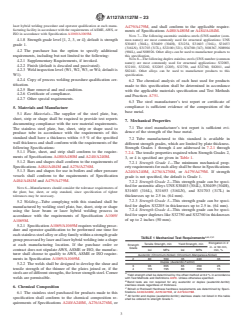
TABLE 1 Mechanical Test Requirements
group processed by laser and laser hybrid welding into a shape
Elongation in 2
Tensile Strength, min Yield Strength, min
at each manufacturing location. If the purchase order or
Strength
in. or 50 mm,
Grade
contract does not stipulate AWS, ASME or ISO, the manufac- ksi MPa ksi MPa
min, %
turer shall choose to qualify to AWS, ASME or ISO require-
Austenitic (Chromium-Nickel) (Chromium-Manganese-Nickel)
2 80 550 35 240 35
ments in Specification A1069/A1069M.
Duplex (Austenitic-Ferritic)
5.2.2 The welds shall be designed to develop the shear and
3 95 655 65 450 25
tensile strength of the thinner of the plates joined or, if the
4 116 795 80 550 15
steels are of different strengths, the lower strength steel. Corner
A
Yield strength shall be determined by the offset method at 0.2 % in accordance
welds are permissible. with Test Methods and Definitions A370. Unless otherwise specified.
B
Bend tests are not required for any austenitic or duplex (austenitic-ferritic)
stainless steels regardless of thickness.
6. Chemical Composition
C
Brinell or Rockwell Hardness hardness requirements are determined by Speci-
fications A240/A240M, A276/A276M, or A479/A479M.
6.1 The stainless steel purchased for products made to this
D
All ferritic and duplex (austenitic-ferritic) stainless steels not listed in this table
specification shall conform to the chemical composition re-
shall be ordered to strength Grade 1.
quirements of Specifications A240/A240M, A276/A276M, or
A1127/A1127M − 23
TABLE 3 Permissible Variations in Concavity or Convexity for
8. Dimensions, Mass, and Permissible Variations
Laser or Laser-Hybrid Welded Tube
8.1 The permitted variations in shape dimensions of laser or
Outside Dimensions, Permissible Variations,
laser-hybrid welded SCP and built-up rounded corner tube
in. [mm] in. [mm]
manufactured in accordance with the qualification require-
#2 [#50] 0.020 [0.5]
ments of Specification A1069/A1069M shall conform to the >2 [>50] 0.01 times outer flat dimen
...