

ASTM D8526-23
(Test Method)Standard Test Method for Analytical Procedure Using Transmission Electron Microscopy for the Determination of the Concentration of Carbon Nanotubes and Carbon Nanotube-containing Particles in Ambient Atmospheres
General Information
- Abstract
SIGNIFICANCE AND USE
5.1 This test method is applicable to the measurement of airborne carbon nanotubes in a wide range of ambient air situations and for evaluation of any atmosphere for carbon nanotube structures. Single carbon nanotube structures in ambient atmospheres have diameters below the resolution limit of the light microscope. This test method is based on transmission electron microscopy, which has adequate resolution to allow detection of small thin single carbon nanotubes and is currently a reliable technique capable of unequivocal identification of the majority of nanotube structures. Carbon nanotubes are often found, not as single carbon nanotubes, but as very complex, aggregated structures, which may or may not be aggregated with other particles.
5.2 This test method applies to the analysis of a single filter and describes the precision attributable to measurements for a single filter. Multiple air samples are usually necessary to characterize airborne nanotube structure concentrations across time and space. The number of samples necessary for this purpose is proportional to the variation in measurement across samples, which may be greater than the variation in measurement for a single sample.
SCOPE
1.1 This test method is an analytical procedure using transmission electron microscopy (TEM) for the determination of the concentration of carbon nanotubes and carbon nanotube-containing particles in ambient atmospheres.
1.1.1 This test method is suitable for determination of carbon nanotubes in both ambient (outdoor) and building atmospheres.
1.2 This test method is defined for polycarbonate capillary pore filters through which a known volume of air has been drawn and for blank filters.
1.3 The direct analytical method cannot be used if the general particulate matter loading of the sample collection filter as analyzed exceeds approximately 25 % coverage of the collection filter by particulate matter.
1.4 Units—The values stated in SI units are to be regarded as standard. No other units of measurement are included in this standard.
1.5 This standard does not purport to address all of the safety concerns, if any, associated with its use. It is the responsibility of the user of this standard to establish appropriate safety, health, and environmental practices and determine the applicability of regulatory limitations prior to use.
1.6 This international standard was developed in accordance with internationally recognized principles on standardization established in the Decision on Principles for the Development of International Standards, Guides and Recommendations issued by the World Trade Organization Technical Barriers to Trade (TBT) Committee.
- Status
- Published
- Publication Date
- 31-Aug-2023
- Technical Committee
- D22 - Air Quality
Overview
ASTM D8526-23 is a standardized test method developed by ASTM International, focusing on the analytical determination of the concentration of carbon nanotubes and carbon nanotube-containing particles in ambient air. This procedure employs Transmission Electron Microscopy (TEM) as a primary analytical tool due to its superior resolution, enabling the reliable detection and identification of even the smallest carbon nanotube structures, which are typically below the resolution limit of standard light microscopes.
The standard is applicable to both indoor and outdoor (ambient) atmospheric environments. By analyzing air samples collected on polycarbonate capillary pore filters, the method enables the measurement of carbon nanotube concentrations, supporting environmental monitoring, occupational safety, and health assessments where nanomaterial exposure is a concern.
Key Topics
- Transmission Electron Microscopy (TEM): The method utilizes TEM for both qualitative and quantitative analysis of airborne carbon nanotubes and their aggregates.
- Analytical Sensitivity: The test method defines and calculates the sensitivity based on the volume of air sampled and filter area analyzed, optimizing detection limits for low concentrations.
- Sample Preparation: Airborne particles are collected on polycarbonate filters, prepared via vacuum evaporation, solvent extraction, and special handling to ensure sample integrity.
- Filter Coverage Limit: The methodology is valid if the total particulate coverage on the collection filter does not exceed approximately 25%, ensuring reliable analysis.
- Quality Control: The procedure includes directives for using blanks, calibration, and ongoing quality assurance to minimize contamination and maximize data accuracy.
- Safety and Compliance: Users must follow all appropriate health, environmental, and regulatory practices when employing the method.
Applications
ASTM D8526-23 is instrumental in a variety of practical applications where monitoring of carbon nanotubes is critical:
- Environmental Monitoring: Enables accurate measurement of carbon nanotube concentrations in urban, suburban, or rural outdoor air, supporting regulatory compliance and public health studies.
- Occupational Health and Safety: Facilitates the assessment of worker exposure to nanomaterials in industrial, laboratory, or manufacturing settings handling carbon nanotubes.
- Indoor Air Quality: Useful in evaluating air quality in buildings where carbon nanotubes may be present due to materials, processes, or equipment, contributing to comprehensive risk assessments.
- Research and Development: Provides reproducible and reliable data for scientific investigations into the environmental fate, transport, and potential impact of nanomaterials.
- Regulatory Compliance: Assists organizations in meeting health, safety, and environmental regulations related to nanomaterial emissions and exposure limits.
Related Standards
The following standards are referenced within or associated with ASTM D8526-23 and contribute to the robustness and consistency of analytical results:
- ASTM D1193: Specification for Reagent Water - ensures the purity of water used in analysis.
- ASTM D1356 & D7712: Terminology standards relating to sampling and microscopic particle analysis.
- ASTM D5337: Practice for Setting and Verifying Sampling Flow Rates.
- ASTM D6281: Methods for asbestos concentration determination by TEM in air.
- NIOSH 7400 & NIOSH 7402: National Institute for Occupational Safety and Health methods for asbestos and fiber analysis using PCM and TEM, providing methodological parallels.
- ASTM E2456: Terminology relating to nanotechnology.
Practical Value
By employing ASTM D8526-23, organizations benefit from a reliable, scientifically validated method to detect and quantify airborne carbon nanotubes. This not only aids in protecting workers and the public from potential nanomaterial-related hazards but also ensures operational compliance with international safety and environmental standards. The TEM-based approach guarantees true identification at the nanometer scale, making it the standard of choice where precision and unequivocal analytical results are essential.
Relations
- Effective Date
- 01-Sep-2020
- Effective Date
- 15-Mar-2020
- Effective Date
- 01-Aug-2019
- Effective Date
- 15-Apr-2018
- Effective Date
- 15-Oct-2015
- Effective Date
- 01-Jul-2015
- Effective Date
- 01-Dec-2014
- Effective Date
- 01-May-2014
- Effective Date
- 15-Jan-2014
- Effective Date
- 15-Nov-2011
- Effective Date
- 01-Oct-2011
- Effective Date
- 01-Sep-2011
- Effective Date
- 01-Sep-2011
- Effective Date
- 01-Apr-2010
- Effective Date
- 01-Dec-2009
Frequently Asked Questions
ASTM D8526-23 is a standard published by ASTM International. Its full title is "Standard Test Method for Analytical Procedure Using Transmission Electron Microscopy for the Determination of the Concentration of Carbon Nanotubes and Carbon Nanotube-containing Particles in Ambient Atmospheres". This standard covers: SIGNIFICANCE AND USE 5.1 This test method is applicable to the measurement of airborne carbon nanotubes in a wide range of ambient air situations and for evaluation of any atmosphere for carbon nanotube structures. Single carbon nanotube structures in ambient atmospheres have diameters below the resolution limit of the light microscope. This test method is based on transmission electron microscopy, which has adequate resolution to allow detection of small thin single carbon nanotubes and is currently a reliable technique capable of unequivocal identification of the majority of nanotube structures. Carbon nanotubes are often found, not as single carbon nanotubes, but as very complex, aggregated structures, which may or may not be aggregated with other particles. 5.2 This test method applies to the analysis of a single filter and describes the precision attributable to measurements for a single filter. Multiple air samples are usually necessary to characterize airborne nanotube structure concentrations across time and space. The number of samples necessary for this purpose is proportional to the variation in measurement across samples, which may be greater than the variation in measurement for a single sample. SCOPE 1.1 This test method is an analytical procedure using transmission electron microscopy (TEM) for the determination of the concentration of carbon nanotubes and carbon nanotube-containing particles in ambient atmospheres. 1.1.1 This test method is suitable for determination of carbon nanotubes in both ambient (outdoor) and building atmospheres. 1.2 This test method is defined for polycarbonate capillary pore filters through which a known volume of air has been drawn and for blank filters. 1.3 The direct analytical method cannot be used if the general particulate matter loading of the sample collection filter as analyzed exceeds approximately 25 % coverage of the collection filter by particulate matter. 1.4 Units—The values stated in SI units are to be regarded as standard. No other units of measurement are included in this standard. 1.5 This standard does not purport to address all of the safety concerns, if any, associated with its use. It is the responsibility of the user of this standard to establish appropriate safety, health, and environmental practices and determine the applicability of regulatory limitations prior to use. 1.6 This international standard was developed in accordance with internationally recognized principles on standardization established in the Decision on Principles for the Development of International Standards, Guides and Recommendations issued by the World Trade Organization Technical Barriers to Trade (TBT) Committee.
SIGNIFICANCE AND USE 5.1 This test method is applicable to the measurement of airborne carbon nanotubes in a wide range of ambient air situations and for evaluation of any atmosphere for carbon nanotube structures. Single carbon nanotube structures in ambient atmospheres have diameters below the resolution limit of the light microscope. This test method is based on transmission electron microscopy, which has adequate resolution to allow detection of small thin single carbon nanotubes and is currently a reliable technique capable of unequivocal identification of the majority of nanotube structures. Carbon nanotubes are often found, not as single carbon nanotubes, but as very complex, aggregated structures, which may or may not be aggregated with other particles. 5.2 This test method applies to the analysis of a single filter and describes the precision attributable to measurements for a single filter. Multiple air samples are usually necessary to characterize airborne nanotube structure concentrations across time and space. The number of samples necessary for this purpose is proportional to the variation in measurement across samples, which may be greater than the variation in measurement for a single sample. SCOPE 1.1 This test method is an analytical procedure using transmission electron microscopy (TEM) for the determination of the concentration of carbon nanotubes and carbon nanotube-containing particles in ambient atmospheres. 1.1.1 This test method is suitable for determination of carbon nanotubes in both ambient (outdoor) and building atmospheres. 1.2 This test method is defined for polycarbonate capillary pore filters through which a known volume of air has been drawn and for blank filters. 1.3 The direct analytical method cannot be used if the general particulate matter loading of the sample collection filter as analyzed exceeds approximately 25 % coverage of the collection filter by particulate matter. 1.4 Units—The values stated in SI units are to be regarded as standard. No other units of measurement are included in this standard. 1.5 This standard does not purport to address all of the safety concerns, if any, associated with its use. It is the responsibility of the user of this standard to establish appropriate safety, health, and environmental practices and determine the applicability of regulatory limitations prior to use. 1.6 This international standard was developed in accordance with internationally recognized principles on standardization established in the Decision on Principles for the Development of International Standards, Guides and Recommendations issued by the World Trade Organization Technical Barriers to Trade (TBT) Committee.
ASTM D8526-23 has the following relationships with other standards: It is inter standard links to ASTM D1356-20a, ASTM D1356-20, ASTM D1357-95(2019), ASTM D7712-18, ASTM D1356-15a, ASTM D1356-15, ASTM D1356-14b, ASTM D1356-14a, ASTM D1356-14, ASTM D5337-11, ASTM D1357-95(2011), ASTM D7712-11, ASTM D7712-11e1, ASTM D1356-05(2010), ASTM D6281-09. Understanding these relationships helps ensure you are using the most current and applicable version of the standard.
ASTM D8526-23 is available in PDF format for immediate download after purchase. The document can be added to your cart and obtained through the secure checkout process. Digital delivery ensures instant access to the complete standard document.
Standards Content (Sample)
This international standard was developed in accordance with internationally recognized principles on standardization established in the Decision on Principles for the
Development of International Standards, Guides and Recommendations issued by the World Trade Organization Technical Barriers to Trade (TBT) Committee.
Designation: D8526 − 23
Standard Test Method for
Analytical Procedure Using Transmission Electron
Microscopy for the Determination of the Concentration of
Carbon Nanotubes and Carbon Nanotube-containing
Particles in Ambient Atmospheres
This standard is issued under the fixed designation D8526; the number immediately following the designation indicates the year of
original adoption or, in the case of revision, the year of last revision. A number in parentheses indicates the year of last reapproval. A
superscript epsilon (´) indicates an editorial change since the last revision or reapproval.
1. Scope 2. Referenced Documents
2.1 ASTM Standards:
1.1 This test method is an analytical procedure using trans-
mission electron microscopy (TEM) for the determination of D1193 Specification for Reagent Water
D1356 Terminology Relating to Sampling and Analysis of
the concentration of carbon nanotubes and carbon nanotube-
containing particles in ambient atmospheres. Atmospheres
D1357 Practice for Planning the Sampling of the Ambient
1.1.1 This test method is suitable for determination of
Atmosphere
carbon nanotubes in both ambient (outdoor) and building
D5337 Practice for Setting and Verifying the Flow Rate of
atmospheres.
Personal Sampling Pumps
1.2 This test method is defined for polycarbonate capillary
D6281 Test Method for Airborne Asbestos Concentration in
pore filters through which a known volume of air has been
Ambient and Indoor Atmospheres as Determined by
drawn and for blank filters.
Transmission Electron Microscopy Direct Transfer (TEM)
1.3 The direct analytical method cannot be used if the
D7712 Terminology for Sampling and Analysis of Asbestos
general particulate matter loading of the sample collection filter
E2456 Terminology Relating to Nanotechnology
as analyzed exceeds approximately 25 % coverage of the 3
2.2 NIOSH Standards:
collection filter by particulate matter.
NIOSH 7400 Asbestos and Other Fibers by PCM
1.4 Units—The values stated in SI units are to be regarded NIOSH 7402 Asbestos by TEM
as standard. No other units of measurement are included in this
standard. 3. Terminology
1.5 This standard does not purport to address all of the 3.1 Definitions—For definitions of general terms used in this
safety concerns, if any, associated with its use. It is the test method, refer to Terminologies D1356, D7712, and E2456.
responsibility of the user of this standard to establish appro-
3.2 Definitions of Terms Specific to This Standard:
priate safety, health, and environmental practices and deter-
3.2.1 analytical sensitivity, n—the calculated airborne nano-
mine the applicability of regulatory limitations prior to use.
tube structure concentration in nanotube structures per liter,
1.6 This international standard was developed in accor-
equivalent to the counting of one nanotube structure in the
dance with internationally recognized principles on standard-
analysis.
ization established in the Decision on Principles for the
3.2.2 carbon nanotube, n—an allotrope of carbon structur-
Development of International Standards, Guides and Recom-
ally defined by a size of less than 100 nm in two or more
mendations issued by the World Trade Organization Technical
Barriers to Trade (TBT) Committee.
For referenced ASTM standards, visit the ASTM website, www.astm.org, or
contact ASTM Customer Service at service@astm.org. For Annual Book of ASTM
This test method is under the jurisdiction of ASTM Committee D22 on Air Standards volume information, refer to the standard’s Document Summary page on
Quality and is the direct responsibility of Subcommittee D22.07 on Sampling, the ASTM website.
Analysis, Management of Asbestos, and Other Microscopic Particles. Available from National Institute for Occupational Health and Safety (NIOSH),
Current edition approved Sept. 1, 2023. Published September 2023. DOI: 400 7th Street S.W., Suite 5W, Washington, D.C. 20024, https://www.cdc.gov/niosh/
10.1520/D8526-23. index.htm.
Copyright © ASTM International, 100 Barr Harbor Drive, PO Box C700, West Conshohocken, PA 19428-2959. United States
D8526 − 23
dimensions and a tubular morphology often comprised of one 5. Significance and Use
or more coaxial cylinders of graphene (that is, walls).
5.1 This test method is applicable to the measurement of
3.2.2.1 Discussion—This method is also applicable to other
airborne carbon nanotubes in a wide range of ambient air
micrometer or nanometer size carbon fibers, including amor-
situations and for evaluation of any atmosphere for carbon
phous carbon nanotubes, carbon nanofibers, carbon nanorods,
nanotube structures. Single carbon nanotube structures in
cellulose nanofibers, and carbon tubes with diameters greater
ambient atmospheres have diameters below the resolution limit
than or equal to 100 nm.
of the light microscope. This test method is based on transmis-
sion electron microscopy, which has adequate resolution to
3.2.3 carbon nanotube structure, n—a term applied to
allow detection of small thin single carbon nanotubes and is
isolated carbon nanotubes or to any connected or overlapping
currently a reliable technique capable of unequivocal identifi-
grouping of carbon nanotubes or bundles of carbon nanotubes,
cation of the majority of nanotube structures. Carbon nano-
with or without other non-nanotube particles.
tubes are often found, not as single carbon nanotubes, but as
3.2.3.1 Discussion—See Annex A1 for terminology related
very complex, aggregated structures, which may or may not be
to reported structure types.
aggregated with other particles.
5.2 This test method applies to the analysis of a single filter
4. Summary of Test Method
and describes the precision attributable to measurements for a
4.1 A sample of airborne particulate matter is collected by
single filter. Multiple air samples are usually necessary to
drawing a measured volume of air through a capillary-pore
characterize airborne nanotube structure concentrations across
polycarbonate membrane filter of maximum pore size 0.4 μm
time and space. The number of samples necessary for this
by means of a battery-powered or mains-powered pump. TEM
purpose is proportional to the variation in measurement across
specimens are prepared from filters by applying a thin film of
samples, which may be greater than the variation in measure-
carbon to the filter surface by vacuum evaporation. Small areas
ment for a single sample.
are cut from the carbon-coated filter, supported on TEM
specimen grids, and the filter medium is dissolved away by a 6. Apparatus
solvent extraction procedure. This procedure leaves a thin film
6.1 Air Sampling Equipment and Consumable Supplies:
of carbon that bridges the openings in the TEM specimen grid
6.1.1 Carbon Rods, for use in vacuum coating unit during
and that supports each particle from the original filter in its
carbon coating of filters.
original position. The TEM specimen grids are examined at
6.1.1.1 Use of carbon fiber type evaporators should be
both low and high magnifications to check that they are
avoided since they may not be capable of preparing clean
suitable for analysis before carrying out a quantitative structure
laboratory blanks and may introduce carbon fibers during the
count on randomly-selected grid openings. In the TEM
coating process.
analysis, the elemental composition of a nanotube structure
6.1.2 Filter Cassette, 25 mm to 50 mm diameter, commer-
may be confirmed by energy dispersive X-ray analysis
cially manufactured, non-reusable, three-piece cassettes, with
(EDXA).
cowls in front of the filter surface, used for sample collection.
Electrically conductive cowls are preferred.
4.2 In addition to isolated single carbon nanotubes, ambient
6.1.2.1 Cassette should be loaded with a capillary pore
air samples often contain more complex aggregates of single
polycarbonate filter of maximum pore size 0.4 μm. Back filter
carbon nanotubes, with or without other particles. Some
with a 5 μm pore size mixed cellulose ester (MCE) filter and
particles are composites of nanotube structures with other
support it by a cellulose back-up pad. Apply a shrink cellulose
materials. Individual carbon nanotubes and these more com-
band or adhesive tape when the filters are in position to prevent
plex structures are referred to as nanotube structures. Any
air leakage. Ensure that the filters are tightly clamped in the
continuous grouping of particles in which a single carbon
assembly so that significant air leakage around the filter cannot
nanotube with a length greater than or equal to 250 nm is
occur.
detected shall be recorded on the count sheet. These will be
6.1.2.2 A cassette with the same design, filter media, and
designated nanotube structures and classified according to the
pore size as the cassettes to be used for collecting air samples
counting rules specified in Annex A1. The number of nanotube
should be reserved and used exclusively for adjusting the flow
structures found on a known area of the microscope sample,
rate of sampling equipment.
together with the equivalent volume of air filtered through this
6.1.2.3 It is recommended that representative filters from
area, is used to calculate the airborne concentration in nanotube
the filter lot be analyzed as described in Section 12 for the
structures per liter of air.
presence of nanotube structures before any are used for air
4.2.1 For this method, a minimum length of 250 nm has
sample collection.
been defined as the shortest carbon nanotube to be incorporated
6.1.2.4 Alternatively, a cassette as described above loaded
in the reported test results. However, fibers identified as shorter
with a 0.45 μm pore size (or less) MCE filter in place of the
than 250 nm may be reported separately by the analyst.
polycarbonate filter (commonly used for asbestos TEM air
4.3 The upper range of concentrations that can be deter- clearance sampling) may be used if standard MCE filter
mined by this test method is 7000 structures per square preparation techniques, such as those described by NIOSH
millimeter. The air concentration represented by this value is a (Method 7402) or Test Method D6281 without plasma etching,
function of the volume of air sampled. are used to prepare the TEM grids.
D8526 − 23
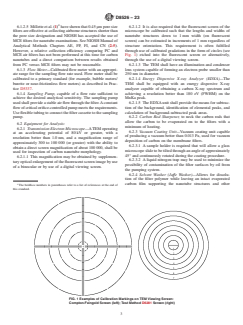
6.1.2.5 Millette et al. (1) have shown that 0.45 μm pore size 6.2.1.2 It is also required that the fluorescent screen of the
filters are effective at collecting airborne structures shorter than microscope be calibrated such that the lengths and widths of
the pore size designation and NIOSH has accepted the use of nanotube structures down to 1 mm width (on fluorescent
MCE filters for nanotube examinations. See NIOSH Manual of screen) can be estimated in increments of 1 mm regardless of
Analytical Methods Chapters AE, FP, FI, and CN (2-5). structure orientation. This requirement is often fulfilled
However, a relative collection efficiency comparing PC and through use of calibrated gradations in the form of circles (see
MCE air filters has not been performed at this time for carbon Fig. 1) etched into the fluorescent screen or alternatively,
nanotubes and a direct comparison between results obtained through the use of a digital viewing screen.
from PC versus MCE filters may not be reasonable. 6.2.1.3 The TEM shall have an illumination and condenser
6.1.3 Flow Meter—Calibrated flow meter with an appropri- lens system capable of forming an electron probe smaller than
ate range for the sampling flow rate used. Flow meter shall be 250 nm in diameter.
calibrated to a primary standard (for example, bubble meters/ 6.2.1.4 Energy Dispersive X-ray Analyzer (EDXA)—The
burette or near-frictionless flow meters) as described in Prac- TEM shall be equipped with an energy dispersive X-ray
tice D5337. analyzer capable of obtaining a carbon X-ray spectrum and
6.1.4 Sampling Pump, capable of a flow rate sufficient to achieving a resolution better than 180 eV (FWHM) on the
achieve the desired analytical sensitivity. The sampling pump MnKa peak.
used shall provide a stable air flow through the filter. A constant 6.2.1.5 The EDXA unit shall provide the means for subtrac-
flow of critical orifice-controlled pump meets the requirements. tion of the background, identification of elemental peaks, and
Use flexible tubing to connect the filter cassette to the sampling calculation of background-subtracted peak areas.
pump. 6.2.2 Carbon Rod Sharpener, to neck the carbon rods that
allow the carbon to be evaporated on to the filters with a
6.2 Equipment for Analysis:
minimum of heating.
6.2.1 Transmission Electron Microscope—A TEM operating
6.2.3 Vacuum Coating Unit—Vacuum coating unit capable
at an accelerating potential of 80 kV or greater, with a
of producing a vacuum better than 0.013 Pa, used for vacuum
resolution better than 1.0 nm, and a magnification range of
deposition of carbon on the membrane filters.
approximately 300 to 100 000 (or greater) with the ability to
6.2.3.1 A sample holder is required that will allow a glass
obtain a direct screen magnification of about 100 000, shall be
microscope slide to be tilted through an angle of approximately
used for inspection of carbon nanotube morphology.
45° and continuously rotated during the coating procedure.
6.2.1.1 This magnification may be obtained by supplemen-
6.2.3.2 A liquid nitrogen trap may be used to minimize the
tary optical enlargement of the fluorescent screen image by use
possibility of contamination of the filter surfaces by oil from
of a binocular or by use of a digital viewing screen.
the pumping system.
6.2.4 Solvent Washer (Jaffe Washer)—Allows for dissolu-
tion of the filter polymer while leaving an intact evaporated
4 carbon film supporting the nanotube structures and other
The boldface numbers in parentheses refer to a list of references at the end of
this standard.
FIG. 1 Examples of Calibration Markings on TEM Viewing Screen:
Compton-Feingold Screen (left); Test Method D6281 Screen (right)
D8526 − 23
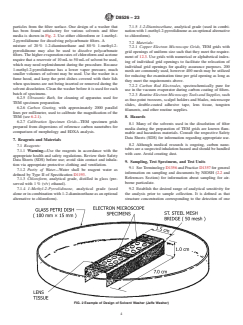
particles from the filter surface. One design of a washer that 7.1.5 1-2-Diaminoethane, analytical grade (used in combi-
has been found satisfactory for various solvents and filter nation with 1-methyl-2-pyrrolidinone as an optional alternative
media is shown in Fig. 2. Use either chloroform or 1-methyl- to chloroform).
2-pyrrolidinone for dissolving polycarbonate filters. A
7.2 Materials:
mixture of 20 % 1-2-diaminoethane and 80 % 1-methyl-2-
7.2.1 Copper Electron Microscope Grids, TEM grids with
pyrrolidinone may also be used to dissolve polycarbonate
grid openings of uniform size such that they meet the require-
filters. The higher evaporation rates of chloroform and acetone
ment of 12.3. Use grids with numerical or alphabetical index-
require that a reservoir of 10 mL to 50 mL of solvent be used,
ing of individual grid openings to facilitate the relocation of
which may need replenishment during the procedure. Because
individual grid openings for quality assurance purposes. 200
1-methyl-2-pyrrolidinone has a lower vapor pressure, much
mesh are commonly used, however 400 mesh may be utilized
smaller volumes of solvent may be used. Use the washer in a
for reducing the examination time per grid opening as long as
fume hood, and keep the petri dishes covered with their lids
they meet the requirements above.
when specimens are not being inserted or removed during the
7.2.2 Carbon Rod Electrodes, spectrochemically pure for
solvent dissolution. Clean the washer before it is used for each
use in the vacuum evaporator during carbon coating of filters.
batch of specimens.
7.2.3 Routine Electron Microscopy Tools and Supplies, such
6.2.5 Ultrasonic Bath, for cleaning of apparatus used for
as fine-point tweezers, scalpel holders and blades, microscope
TEM specimen preparation.
slides, double-coated adhesive tape, lens tissue, tungsten
6.2.6 Carbon Grating, with approximately 2000 parallel
filaments, and other routine supplies.
lines per millimeter, used to calibrate the magnification of the
TEM (see 6.2.1). 8. Hazards
6.2.7 Calibration Specimen Grids—TEM specimen grids
8.1 Many of the solvents used in the dissolution of filter
prepared from dispersions of reference carbon nanotubes for
media during the preparation of TEM grids are known flam-
comparison of morphology and EDXA analysis.
mable and hazardous materials. Consult the respective Safety
Data Sheets (SDS) for information regarding appropriate use.
7. Reagents and Materials
8.2 Although medical research is ongoing, carbon nano-
7.1 Reagents:
tubes are a suspected inhalation hazard and should be handled
7.1.1 Warning—Use the reagents in accordance with the
with care. Avoid creating dust.
appropriate health and safety regulations. Review their Safety
Data Sheets (SDS) before use; avoid skin contact and inhala-
9. Sampling, Test Specimens, and Test Units
tion via appropriate protective clothing and ventilation.
9.1 See Terminology D1356 and Practice D1357 for general
7.1.2 Purity of Water—Water shall be reagent water as
information on sampling and documents by NIOSH (2.2 and
defined by Type II of Specification D1193.
References Section) for information about sampling for air-
7.1.3 Chloroform, analytical grade, distilled in glass (pre-
borne particulate.
served with 1 % (v/v) ethanol).
7.1.4 1-Methyl-2-Pyrrolidinone, analytical grade (used 9.2 Establish the desired range of analytical sensitivity for
alone or in combination with 1-2-diaminoethane as an optional the analysis prior to sample collection. It is defined as that
alternative to chloroform). structure concentration corresponding to the detection of one
FIG. 2 Example of Design of Solvent Washer (Jaffe Washer)
D8526 − 23
structure in the analysis. For direct transfer methods of TEM exterior surfaces of each sampling cassette before the cassette
specimen preparation the analytical sensitivity is a function of is taken into the clean facility or laminar flow hood.
the volume of air sampled, the active area of the collection
10.3 Direct Preparation of TEM Specimens from Polycar-
filter, and the area of the TEM specimen over which structures
bonate Filters:
are counted. Select the sampling rate and the period of
10.3.1 Selection of Filter Area for Carbon Coating—Use a
sampling to yield the required analytical sensitivity, as detailed
cleaned microscope slide to support representative portions of
in Table 1.
polycarbonate filter during the carbon evaporation. Use
9.2.1 Measure the sampling flow-rate, both at the beginning
double-coated adhesive tape to hold the edges of filter portions
and end of the sampling period, using a calibrated flow meter
to the glass slide. Take care not to stretch the polycarbonate
(6.1.3) and a cassette with the same media type and pore size
filters during handling. Remove the polycarbonate filter from
as that used during the sampling period (6.1.2.2). Use the mean
the sampling cassette, using freshly-cleaned tweezers, and
value of these two measurements to calculate the total air
place it onto a second cleaned glass microscope slide that is
volume sampled. If the difference in flow rate at the beginning
used as a cutting surface. Cut the filter by rocking the blade
and end of the sampling period is greater than 10 %, the result
from the point, using a freshly-cleaned curved scalpel blade,
should be labeled as suspect or void due to sampling errors.
pressing it into contact with the filter. Repeat the process as
9.2.2 Collect air samples using cassettes (6.1.2), monitoring
necessary. Several such portions may be mounted on the same
sampling pumps on a periodic basis during the entire sampling
microscope slide. Wash and dry the scalpel blade and tweezers
time. Place a cap over the open end of the cassette after
between the handling of each filter. Identify the filter portions
sampling, and store the cassette with the filter face-upwards for
by writing on the glass slide.
return to the laboratory. Include blank field filters, as described
10.3.2 Carbon Coating of Filter Portions—Place the slide
in 12.7, and process them through the remaining analytical
holding the filter portions on the rotation-tilting device, ap-
procedures along with the samples.
proximately 100 mm to 120 mm from the evaporation source,
9.2.3 Determine the analytical sensitivity S in structures per
and evacuate the evaporator chamber to a vacuum better than
liter as described in 13.3.
0.013 Pa. Perform the evaporation of carbon in very short
9.2.4 To achieve a particular analytical sensitivity when the
bursts, separated by a few seconds to allow the electrodes to
total airborne dust levels are high, it may be necessary to
cool.
collect low volumes of air and examine many grid openings.
10.3.2.1 If evaporation of carbon is too rapid, the strips of
polycarbonate filter will begin to curl, and cross-linking of the
10. Preparation of Apparatus
surface will occur. This cross-linking produces a layer of
10.1 The ability to meet the blank sample criteria is depen-
polymer that is relatively insoluble in organic solvents, and it
dent on the cleanliness of equipment and supplies. Consider all
will not be possible to prepare satisfactory TEM specimens.
supplies, such as microscope slides and glassware, as potential
The thickness of carbon required is dependent on the size of
sources of carbon nanotube contamination. Wash all glassware
particles on the filter, and approximately 30 nm to 50 nm has
before it is used. Wash any tools or glassware that come into
been found to be satisfactory. If the carbon film is too thin,
contact with the air sampling filters or TEM specimen
large particles will break out of the film during the later stages
preparations, both before use and between handling of indi-
of preparation, and there will be few complete and undamaged
vidual samples. Use disposable supplies whenever possible.
grid openings on the specimen. Ensure that the carbon film
10.2 Cleaning of Sample Cassette—Nanotube structures can thickness is the minimum possible while retaining most of the
grid openings of the TEM specimen intact.
adhere to the exterior surfaces of air sampling cassettes and
these particles can inadvertently be transferred to the sample 10.3.3 Preparation of the Jaffe Washer—Place several
during handling. To prevent this possibility of contamination, pieces of lens tissue, as shown in Fig. 2, on the stainless steel
and after ensuring that the cassette is tightly sealed, wipe the bridge, and fill the washer (6.2.4) with chloroform to a level
TABLE 1 Examples of the Minimum Number of Grid Openings Required to Achieve a Particular Analytical Sensitivity for a Collection
2 2
Filter Area of 385 mm and TEM Grid Openings of 85 mm (0.0072 mm )
Analytical Volume of Air Sampled, Liters
Sensitivity 500 1000 1200 2000 3000 4000 5000
0.1 1066 533 444 267 178 134 107
0.2 533 267 223 134 89 67 54
0.3 356 178 148 89 60 45 36
0.4 267 134 112 67 45 34 27
0.5 214 107 89 54 36 27 22
0.7 153 77 64 39 26 20 16
1.0 107 54 45 27 18 14 11
2.0 54 27 23 14 9 7 6
3.0 36 18 15 9 6 5 4
4.0 27 14 14 7 5 4 4
5.0 22 11 13 6 4 4 4
7.0 16 8 7 4 4 4 4
10.0 11 6 5 4 4 4 4
D8526 − 23
where the meniscus contacts the underside of the mesh, mesh and allow the grids to dry. If it is desirable to retain the
resulting in saturation of the lens tissue. Alternatively, with or water-soluble particle species on the TEM grids, ethanol may
without using lens paper, fill the washer with 1-methyl-2- be used instead of distilled water for the second wash.
pyrrolidone or a mixture of 20 % 1,2-diaminoethane and 80 % 10.3.4 Reproducible results for carbon nanotubes have also
been reported when using MCE filters; however, these results
1-methyl-2-pyrrolidinone to a level where the meniscus con-
tacts the underside of the mesh. Use of the Jaffe washer and the have not been validated to determine if short nanotube struc-
tures are retained within the dissolved MCE filter during TEM
chosen reagent (6.2.4) shall be in accordance with one of the
three procedures below depending on which reagent is used. grid preparation. Use of MCE filters instead of PC filters may
be acceptable, if comparative analyses are conducted between
10.3.3.1 Use of the Jaffe Washer with Chloroform—Cut
PC filters prepared according to this method and MCE filters
three 3 mm square pieces of carbon-coated polycarbonate filter
prepared according to standard filter preparation techniques
from the carbon-coated filter portion, using a curved scalpel
published by NIOSH (5).
blade. Select three squares to represent the center and the outer
periphery of the active surface of the filter. Place each square
10.4 Criteria for Acceptable TEM Specimen Grids—Valid
of filter, carbon side up, on a TEM specimen grid, and place the
data cannot be obtained unless the TEM specimens meet
grid and filter onto the saturated lens tissue in the Jaffe washer.
specified quality criteria. Examine the TEM specimen grid in
Place the three specimen grids from one sample on the same
the TEM at a magnification sufficiently low (300 to 1000) so
piece of lens tissue. Any number of separate pieces of lens that complete grid openings can be inspected. Reject the grid
tissue may be placed in the same Jaffe washer. Cover the Jaffe
if:
washer with the lid, and allow the washer to stand for at least 10.4.1 The TEM specimen has not been cleared of filter
8 h. It has been found that some lots of polycarbonate filters
medium by the filter dissolution step. If the TEM specimen
will not completely dissolve in the Jaffe washer, even after exhibits areas of undissolved filter medium, and if at least two
exposure to chloroform for as long as three days. This problem
of the three specimen grids are not cleared, either additional
also occurs if the surface of the filter was overheated during the solvent washing shall be carried out or new specimens shall be
carbon evaporation. prepared from the filter;
10.4.2 The sample is overloaded with particulate matter. If
10.3.3.2 Use of the Jaffe Washer with 1-Methyl-2-
the specimen grid exhibits more than approximately 25 %
Pyrrolidinone—Cut three 3 mm square pieces of carbon-coated
obscuration on the majority of the grid openings, designate the
polycarbonate filter from the carbon-coated filter portion, using
specimen as overloaded. While the detection of carbon nano-
a curved scalpel blade. Select three squares to represent the
tubes may be possible, the filter cannot be analyzed satisfac-
center and the outer periphery of the active surface of the filter.
torily for purposes of reporting a structure concentration using
Place each square of filter, carbon side up, on a TEM specimen
the direct preparation methods because the grid is too heavily
grid, and place the grid and filter on the stainless steel mesh in
loaded with debris to allow separate examination of individual
the Jaffe washer. Any number of separate grids may be placed
particles by EDXA, and obscuration of single carbon nano-
in the same Jaffe washer. Cover the Jaffe washer with the lid,
tubes by other particulate matter may lead to underestimation
and allow the washer to stand for 2 h to 6 h. After dissolution
of the nanotube structure count;
is complete, remove the stainless steel mesh from the Jaffe
10.4.3 The particulate matter deposits on the specimen are
washer and allow the grids to dry. 1-methyl-2-pyrrolidinone
not uniformly distributed from one grid opening to the next. If
evaporates very slowly. If it is required to dry the grids more
the particulate matter deposits on the specimen are obviously
rapidly, transfer the stainless steel bridge into another petri
not uniform from one grid opening to the next, designate the
dish, and add distilled water until the meniscus contacts the
specimen as nonuniform. This condition is a function either of
underside of the mesh. After approximately 15 min, remove the
the air sampling conditions or of the fundamental nature of the
mesh and allow the grids to dry. If it is desirable to retain the
airborne particulate matter. Satisfactory analysis of this filter
water-soluble particle species on the TEM grids, ethanol may
may not be possible unless a large number of grid openings are
be used instead of distilled water for the second wash.
examined;
10.3.3.3 Use of the Jaffe Washer with a Mixture of 20 %
10.4.4 The TEM grid is too heavily loaded with fibrous
1,2-Diaminoethane and 80 % 1-Methyl-2-Pyrrolidinone—Cut
structures to make an accurate count. Accurate counts cannot
three 3 mm square pieces of carbon-coated polycarbonate filter
be made if the grid has more than approximately 7000 struc-
from the carbon-coated filter portion, using a curved scalpel
tures ⁄mm ; or
blade. Select three squares to represent the center and the outer
10.4.5 More than approximately 25 % of the grid openings
periphery of the active surface of the filter. Place each square
have broken carbon film over the whole grid opening. Since the
of filter, carbon side up, on a TEM specimen grid, and place the
breakage of carbon film is usually more frequent in areas of
grid and filter on the stainless steel mesh in the Jaffe washer.
heavy deposit, counting of the intact openings can lead to an
Any number of separate grids may be placed in the same Jaffe
underestimate of the structure count.
washer. Cover the Jaffe washer with the lid, and allow the
washer to stand for 15 min. After dissolution is complete 10.5 If the specimens are rejected because unacceptable
(15 min), remove the stainless steel mesh from the Jaffe washer numbers of grid openings exhibit broken carbon replica, apply
and transfer the stainless steel bridge into another petri dish, an additional carbon coating to the carbon coated filter, and
then add distilled water until the meniscus contacts the prepare new specimen grids. The larger particles can often be
underside of the mesh. After approximately 15 min, remove the supported by using a thicker carbon film. If this action does not
D8526 − 23
produce acceptable specimen grids, this filter cannot be ana- 12.3 Measurement of Mean Grid Opening Area—Measure
lyzed using the direct preparation methods. the mean grid opening area for the type of TEM specimen grids
in use. Ensure that the relative standard deviation of the mean
10.6 If one or more of the conditions described in 10.4.1 –
of ten openings selected from ten grids is less than 5 %. As an
10.4.5 exist, it may not be possible to analyze the sample by
optional procedure, or if the 5 % relative standard deviation
this method.
criterion cannot be demonstrated, measure the dimensions of
11. Calibration and Standardization
each grid opening examined in the TEM at a calibrated
magnification.
11.1 Calibration of TEM Screen Magnification—Align the
electron microscope according to the specifications of the
12.4 TEM Alignment and Calibration Procedures—Align
manufacturer. Initially, and at regular intervals, calibrate the
the TEM according to instrumental specifications before struc-
magnifications used for the analysis using a diffraction grating
ture counting is performed. Calibrate the TEM and EDXA
replica. Adjust the specimen height to the eucentric position
system according to the procedures in Section 11.
before carrying out the calibration. Measure the distance on the
12.5 Determination of Stopping Point—Before structure
fluorescent viewing screen or digital screen occupied by a
counting has begun, calculate the area of filter to be examined
convenient number of repeat distances of the grating image,
in order to achieve the selected analytical sensitivity. Deter-
and calculate the magnification. Repeat the calibration after
mine the maximum number of grid openings to be examined
any instrumental maintenance or change of operating condi-
from the formula:
tions. The magnification of the image on the viewing screen is
A
not the same as that obtained on photographic plates, film or f
K 5 ·V·S (1)
A
CCD camera sensors. The ratio between these is a constant g
value for the particular model of TEM. A sample TEM grid of
where:
reference carbon nanotubes should be analyzed as part of the
K = number of grid openings to be examined (round K up to
calibration process to make sure that carbon nanotubes are
the next highest integer),
observable.
A = area of sample filter exposed to the passage of air
f
11.2 Calibration of the EDXA System—Perform an energy (square millimeters),
position calibration of the EDXA system for a low-energy and A = mean area of TEM specimen grid openings (square
g
millimeters),
high-energy peak regularly. A sample copper grid of reference
V = volume of air sampled (liters), and
carbon nanotubes should be analyzed to make sure that x-ray
S = desired analytical sensitivity (structures per liter).
instrument is calibrated correctly for the peak positions of
carbon (0.277 keV) and copper (8.03 keV). The peak centers
12.6 General Procedure for Structure Counting and Size
should be within 60.01 keV.
Analysis—Two or more specimen grids prepared from the filter
will be used in the structure count. Several grid openings from
12. Procedure
each grid will be sele
...