

ASTM D6826-23
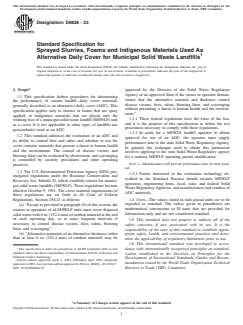
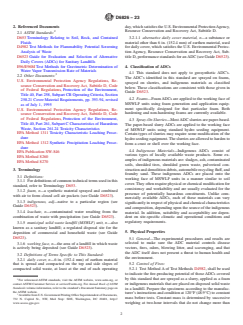
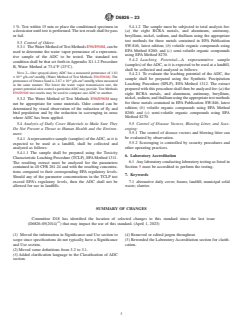
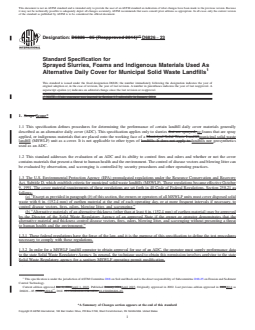
(Specification)Standard Specification for Sprayed Slurries, Foams and Indigenous Materials Used As Alternative Daily Cover for Municipal Solid Waste Landfills
General Information
- Abstract
ABSTRACT
This specification defines procedures for determining the performance of certain landfill daily cover materials such as sprayed slurries, foams, and indigenous materials generally described as an alternative daily cover (ADC) for municipal solid waste landfills. It is not applicable to other types of landfills and to geosynthetics used as an ADC. It addresses the evaluation of an ADC and its ability to control fires and odors and whether or not the cover contains materials that present a threat to human health and the environment. Materials shall be tested at accredited laboratories to determine the physical properties such as potential for fire production, water vapor permeance, toxicity, and leaching potential. The control of disease vectors and blowing litter shall be evaluated by observation while scavenging shall be controlled by security procedures and other operating practices.
SCOPE
1.1 This specification defines procedures for determining the performance of certain landfill daily cover materials generally described as an alternative daily cover (ADC). This specification applies only to slurries or foams that are spray applied, or indigenous materials that are placed onto the working face of a municipal solid waste landfill (MSWLF) unit as a cover. It is not applicable to other types of landfills nor geosynthetics used as an ADC.
1.2 This standard addresses the evaluation of an ADC and its ability to control fires and odors and whether or not the cover contains materials that present a threat to human health and the environment. The control of disease vectors and blowing litter can be evaluated by observation, and scavenging is controlled by security procedures and other operating practices.
1.3 The U.S. Environmental Protection Agency (EPA) promulgated regulations under the Resource Conservation and Recovery Act, Subtitle D, which establish criteria for municipal solid waste landfills (MSWLF). These regulations became effective October 9, 1991. The cover material requirements of these regulations are set forth in 40 Code of Federal Regulations, Section 258.21 as follows:
(a) “Except as provided in paragraph (b) of this section, the owners or operators of all MSWLF units must cover disposed solid waste with 6 in. (152.4 mm) of earthen material at the end of each operating day, or at more frequent intervals if necessary, to control disease vectors, fires, odors, blowing litter, and scavenging.”
(b) “Alternative materials of an alternative thickness (other than at least 6 in. (152.4 mm) of earthen material) may be approved by the Director of the Solid Waste Regulatory Agency of an approved State if the owner or operator demonstrates that the alternative material and thickness control disease vectors, fires, odors, blowing litter, and scavenging without presenting a threat to human health and the environment.”
1.3.1 These federal regulations have the force of the law, and it is the purpose of this specification to define the test procedures necessary to comply with these regulations.
1.3.2 In order for a MSWLF landfill operator to obtain approval for use of an ADC, the operator must supply performance data to the state Solid Waste Regulatory Agency. In general, the technique used to obtain this permission involves applying to the state Solid Waste Regulatory agency for a sanitary MSWLF operating permit modification.
Note 1: Manufacturers will provide performance data for their product.
1.3.3 Parties interested in the evaluation technology described in the Standard Practice should include MSWLF operators, engineering firms, local, state, and federal Solid Waste Regulatory Agencies, and manufacturers and vendors of ADC materials.
1.4 Units—The values stated in inch-pound units are to be regarded as standard. The values given in parentheses are mathematical conversions to SI units that are provided for information only and are not considered standard.
1.5 This standard does ...
- Status
- Published
- Publication Date
- 31-Mar-2023
- Technical Committee
- D18 - Soil and Rock
- Drafting Committee
- D18.25 - Erosion and Sediment Control Technology
Buy Documents

ASTM D6826-23 - Standard Specification for Sprayed Slurries, Foams and Indigenous Materials Used As Alternative Daily Cover for Municipal Solid Waste Landfills
REDLINE ASTM D6826-23 - Standard Specification for Sprayed Slurries, Foams and Indigenous Materials Used As Alternative Daily Cover for Municipal Solid Waste Landfills
Overview
ASTM D6826-23 is the Standard Specification for Sprayed Slurries, Foams, and Indigenous Materials Used as Alternative Daily Cover for Municipal Solid Waste Landfills. Issued by ASTM International, this specification outlines the performance and testing requirements for alternative daily covers (ADCs), specifically for use at municipal solid waste landfill (MSWLF) units. ADCs include sprayed slurries, foams, and locally sourced materials applied instead of the typical 6 inches (152.4 mm) of earthen material used to reduce odors, control fires, prevent disease vector proliferation, minimize blowing litter, and deter scavenging. This standard ensures that such materials meet regulatory requirements and do not pose risks to human health or the environment.
Key Topics
- Scope of Application: Applies exclusively to alternative daily cover materials such as sprayed slurries, foams, and indigenous materials for MSWLFs. It excludes geosynthetics and other landfill types.
- Regulatory Alignment: Conforms to the U.S. Environmental Protection Agency (EPA) Resource Conservation and Recovery Act, Subtitle D, and 40 CFR 258.21, which permit alternative covers provided they perform equivalently to soil in controlling health and safety hazards.
- Performance Evaluation: Specifies laboratory and observational procedures to assess an ADC’s ability to:
- Suppress fires (flammability testing)
- Control odors (water vapor permeance testing)
- Limit disease vectors and blowing litter (visual observation)
- Minimize scavenging (operational controls)
- Prevent leaching of toxic or hazardous substances (TCLP and SPLP procedures)
- Laboratory Accreditation: Requires all laboratory tests to be conducted in accredited laboratories to ensure reliable results.
- Material Types: Details the typical ADC classifications:
- Foams: Synthetic, sprayed-on foam forming air pockets
- Spray-On Slurries: Paper-based or similar, applied with hydro seeding equipment
- Indigenous Materials: Local waste byproducts such as sludges, ash, shredded tires, or debris
Applications
ASTM D6826-23 is vital for a range of stakeholders in landfill management and regulatory compliance:
- Landfill Operators: Enables submission of data to regulators for the approval and operational use of alternative daily covers, potentially reducing costs and extending landfill lifespans.
- Regulatory Agencies: Provides a standardized approach to evaluate the safety and efficacy of ADC products and materials, ensuring public health and environmental protection.
- Engineering Consultants: Assists in specifying, sourcing, and qualifying ADC materials for landfill projects in alignment with local and federal regulations.
- ADC Material Manufacturers and Vendors: Offers guidance for developing materials that can be approved for landfill use, requiring verified performance and compliance with EPA standards.
Key benefits of utilizing alternative daily cover as specified by ASTM D6826-23 include:
- Reduction in consumption of valuable soil resources
- Improved operational efficiency and cost savings
- Enhanced environmental protection by controlling odors, litter, pests, and reducing fire risks
Related Standards
For comprehensive coverage and understanding, the following ASTM and EPA-related documents are referenced in ASTM D6826-23:
- ASTM D653: Terminology Relating to Soil, Rock, and Contained Fluids
- ASTM D4982: Test Methods for Flammability Potential Screening Analysis of Waste
- ASTM D6523: Guide for Evaluation and Selection of Alternative Daily Covers (ADCs) for Sanitary Landfills
- ASTM E96/E96M: Gravimetric Determination of Water Vapor Transmission Rate of Materials
- EPA Method 1311 and 1312: Toxicity Characteristic Leaching Procedure (TCLP) & Synthetic Precipitation Leaching Procedure (SPLP)
- EPA Method 8260 and 8270: Analysis for volatile and semi-volatile organic compounds
Keywords: alternative daily cover, ADC, sprayed slurries, foams, indigenous materials, municipal solid waste landfill, MSWLF, ASTM D6826-23, landfill cover, EPA Subtitle D compliance, landfill odor control, landfill fire suppression, landfill health and safety
Relations
- Effective Date
- 01-Mar-2024
- Effective Date
- 15-Nov-2023
- Effective Date
- 01-May-2015
- Effective Date
- 15-Oct-2014
- Effective Date
- 01-Aug-2014
- Effective Date
- 01-Nov-2013
- Effective Date
- 15-Dec-2012
- Effective Date
- 01-Sep-2011
- Effective Date
- 01-Oct-2010
- Effective Date
- 01-Nov-2009
- Effective Date
- 01-Jan-2009
- Effective Date
- 01-Dec-2008
- Effective Date
- 01-Nov-2008
- Effective Date
- 15-Dec-2007
- Effective Date
- 01-Nov-2007
Buy Documents
ASTM D6826-23 - Standard Specification for Sprayed Slurries, Foams and Indigenous Materials Used As Alternative Daily Cover for Municipal Solid Waste Landfills
REDLINE ASTM D6826-23 - Standard Specification for Sprayed Slurries, Foams and Indigenous Materials Used As Alternative Daily Cover for Municipal Solid Waste Landfills
Get Certified
Connect with accredited certification bodies for this standard

DIN CERTCO
DIN Group product certification.
CIS Institut d.o.o.
Personal Protective Equipment (PPE) certification body. Notified Body NB-2890 for EU Regulation 2016/425 PPE.

Kiwa BDA Testing
Building and construction product certification.
Sponsored listings
Frequently Asked Questions
ASTM D6826-23 is a technical specification published by ASTM International. Its full title is "Standard Specification for Sprayed Slurries, Foams and Indigenous Materials Used As Alternative Daily Cover for Municipal Solid Waste Landfills". This standard covers: ABSTRACT This specification defines procedures for determining the performance of certain landfill daily cover materials such as sprayed slurries, foams, and indigenous materials generally described as an alternative daily cover (ADC) for municipal solid waste landfills. It is not applicable to other types of landfills and to geosynthetics used as an ADC. It addresses the evaluation of an ADC and its ability to control fires and odors and whether or not the cover contains materials that present a threat to human health and the environment. Materials shall be tested at accredited laboratories to determine the physical properties such as potential for fire production, water vapor permeance, toxicity, and leaching potential. The control of disease vectors and blowing litter shall be evaluated by observation while scavenging shall be controlled by security procedures and other operating practices. SCOPE 1.1 This specification defines procedures for determining the performance of certain landfill daily cover materials generally described as an alternative daily cover (ADC). This specification applies only to slurries or foams that are spray applied, or indigenous materials that are placed onto the working face of a municipal solid waste landfill (MSWLF) unit as a cover. It is not applicable to other types of landfills nor geosynthetics used as an ADC. 1.2 This standard addresses the evaluation of an ADC and its ability to control fires and odors and whether or not the cover contains materials that present a threat to human health and the environment. The control of disease vectors and blowing litter can be evaluated by observation, and scavenging is controlled by security procedures and other operating practices. 1.3 The U.S. Environmental Protection Agency (EPA) promulgated regulations under the Resource Conservation and Recovery Act, Subtitle D, which establish criteria for municipal solid waste landfills (MSWLF). These regulations became effective October 9, 1991. The cover material requirements of these regulations are set forth in 40 Code of Federal Regulations, Section 258.21 as follows: (a) “Except as provided in paragraph (b) of this section, the owners or operators of all MSWLF units must cover disposed solid waste with 6 in. (152.4 mm) of earthen material at the end of each operating day, or at more frequent intervals if necessary, to control disease vectors, fires, odors, blowing litter, and scavenging.” (b) “Alternative materials of an alternative thickness (other than at least 6 in. (152.4 mm) of earthen material) may be approved by the Director of the Solid Waste Regulatory Agency of an approved State if the owner or operator demonstrates that the alternative material and thickness control disease vectors, fires, odors, blowing litter, and scavenging without presenting a threat to human health and the environment.” 1.3.1 These federal regulations have the force of the law, and it is the purpose of this specification to define the test procedures necessary to comply with these regulations. 1.3.2 In order for a MSWLF landfill operator to obtain approval for use of an ADC, the operator must supply performance data to the state Solid Waste Regulatory Agency. In general, the technique used to obtain this permission involves applying to the state Solid Waste Regulatory agency for a sanitary MSWLF operating permit modification. Note 1: Manufacturers will provide performance data for their product. 1.3.3 Parties interested in the evaluation technology described in the Standard Practice should include MSWLF operators, engineering firms, local, state, and federal Solid Waste Regulatory Agencies, and manufacturers and vendors of ADC materials. 1.4 Units—The values stated in inch-pound units are to be regarded as standard. The values given in parentheses are mathematical conversions to SI units that are provided for information only and are not considered standard. 1.5 This standard does ...
ABSTRACT This specification defines procedures for determining the performance of certain landfill daily cover materials such as sprayed slurries, foams, and indigenous materials generally described as an alternative daily cover (ADC) for municipal solid waste landfills. It is not applicable to other types of landfills and to geosynthetics used as an ADC. It addresses the evaluation of an ADC and its ability to control fires and odors and whether or not the cover contains materials that present a threat to human health and the environment. Materials shall be tested at accredited laboratories to determine the physical properties such as potential for fire production, water vapor permeance, toxicity, and leaching potential. The control of disease vectors and blowing litter shall be evaluated by observation while scavenging shall be controlled by security procedures and other operating practices. SCOPE 1.1 This specification defines procedures for determining the performance of certain landfill daily cover materials generally described as an alternative daily cover (ADC). This specification applies only to slurries or foams that are spray applied, or indigenous materials that are placed onto the working face of a municipal solid waste landfill (MSWLF) unit as a cover. It is not applicable to other types of landfills nor geosynthetics used as an ADC. 1.2 This standard addresses the evaluation of an ADC and its ability to control fires and odors and whether or not the cover contains materials that present a threat to human health and the environment. The control of disease vectors and blowing litter can be evaluated by observation, and scavenging is controlled by security procedures and other operating practices. 1.3 The U.S. Environmental Protection Agency (EPA) promulgated regulations under the Resource Conservation and Recovery Act, Subtitle D, which establish criteria for municipal solid waste landfills (MSWLF). These regulations became effective October 9, 1991. The cover material requirements of these regulations are set forth in 40 Code of Federal Regulations, Section 258.21 as follows: (a) “Except as provided in paragraph (b) of this section, the owners or operators of all MSWLF units must cover disposed solid waste with 6 in. (152.4 mm) of earthen material at the end of each operating day, or at more frequent intervals if necessary, to control disease vectors, fires, odors, blowing litter, and scavenging.” (b) “Alternative materials of an alternative thickness (other than at least 6 in. (152.4 mm) of earthen material) may be approved by the Director of the Solid Waste Regulatory Agency of an approved State if the owner or operator demonstrates that the alternative material and thickness control disease vectors, fires, odors, blowing litter, and scavenging without presenting a threat to human health and the environment.” 1.3.1 These federal regulations have the force of the law, and it is the purpose of this specification to define the test procedures necessary to comply with these regulations. 1.3.2 In order for a MSWLF landfill operator to obtain approval for use of an ADC, the operator must supply performance data to the state Solid Waste Regulatory Agency. In general, the technique used to obtain this permission involves applying to the state Solid Waste Regulatory agency for a sanitary MSWLF operating permit modification. Note 1: Manufacturers will provide performance data for their product. 1.3.3 Parties interested in the evaluation technology described in the Standard Practice should include MSWLF operators, engineering firms, local, state, and federal Solid Waste Regulatory Agencies, and manufacturers and vendors of ADC materials. 1.4 Units—The values stated in inch-pound units are to be regarded as standard. The values given in parentheses are mathematical conversions to SI units that are provided for information only and are not considered standard. 1.5 This standard does ...
ASTM D6826-23 is classified under the following ICS (International Classification for Standards) categories: 13.030.10 - Solid wastes; 83.140.01 - Rubber and plastics products in general. The ICS classification helps identify the subject area and facilitates finding related standards.
ASTM D6826-23 has the following relationships with other standards: It is inter standard links to ASTM E96/E96M-24, ASTM E96/E96M-23, ASTM E96/E96M-15, ASTM E96/E96M-14, ASTM D653-14, ASTM E96/E96M-13, ASTM E96/E96M-12, ASTM D653-11, ASTM E96/E96M-10, ASTM D6523-00(2009), ASTM D653-09, ASTM D653-08a, ASTM D653-08, ASTM D653-07f, ASTM D653-07e. Understanding these relationships helps ensure you are using the most current and applicable version of the standard.
ASTM D6826-23 is available in PDF format for immediate download after purchase. The document can be added to your cart and obtained through the secure checkout process. Digital delivery ensures instant access to the complete standard document.
Standards Content (Sample)
This international standard was developed in accordance with internationally recognized principles on standardization established in the Decision on Principles for the
Development of International Standards, Guides and Recommendations issued by the World Trade Organization Technical Barriers to Trade (TBT) Committee.
Designation: D6826 − 23
Standard Specification for
Sprayed Slurries, Foams and Indigenous Materials Used As
Alternative Daily Cover for Municipal Solid Waste Landfills
This standard is issued under the fixed designation D6826; the number immediately following the designation indicates the year of
original adoption or, in the case of revision, the year of last revision. A number in parentheses indicates the year of last reapproval. A
superscript epsilon (´) indicates an editorial change since the last revision or reapproval.
1. Scope* approved by the Director of the Solid Waste Regulatory
Agency of an approved State if the owner or operator demon-
1.1 This specification defines procedures for determining
strates that the alternative material and thickness control
the performance of certain landfill daily cover materials
disease vectors, fires, odors, blowing litter, and scavenging
generally described as an alternative daily cover (ADC). This
without presenting a threat to human health and the environ-
specification applies only to slurries or foams that are spray
ment.”
applied, or indigenous materials that are placed onto the
1.3.1 These federal regulations have the force of the law,
working face of a municipal solid waste landfill (MSWLF) unit
and it is the purpose of this specification to define the test
as a cover. It is not applicable to other types of landfills nor
procedures necessary to comply with these regulations.
geosynthetics used as an ADC.
1.3.2 In order for a MSWLF landfill operator to obtain
1.2 This standard addresses the evaluation of an ADC and
approval for use of an ADC, the operator must supply
its ability to control fires and odors and whether or not the
performance data to the state Solid Waste Regulatory Agency.
cover contains materials that present a threat to human health
In general, the technique used to obtain this permission
and the environment. The control of disease vectors and
involves applying to the state Solid Waste Regulatory agency
blowing litter can be evaluated by observation, and scavenging
for a sanitary MSWLF operating permit modification.
is controlled by security procedures and other operating
NOTE 1—Manufacturers will provide performance data for their prod-
practices.
uct.
1.3 The U.S. Environmental Protection Agency (EPA) pro-
1.3.3 Parties interested in the evaluation technology de-
mulgated regulations under the Resource Conservation and
scribed in the Standard Practice should include MSWLF
Recovery Act, Subtitle D, which establish criteria for munici-
operators, engineering firms, local, state, and federal Solid
pal solid waste landfills (MSWLF). These regulations became
Waste Regulatory Agencies, and manufacturers and vendors of
effective October 9, 1991. The cover material requirements of
ADC materials.
these regulations are set forth in 40 Code of Federal
1.4 Units—The values stated in inch-pound units are to be
Regulations, Section 258.21 as follows:
regarded as standard. The values given in parentheses are
(a) “Except as provided in paragraph (b) of this section, the
mathematical conversions to SI units that are provided for
owners or operators of all MSWLF units must cover disposed
information only and are not considered standard.
solid waste with 6 in. (152.4 mm) of earthen material at the end
of each operating day, or at more frequent intervals if
1.5 This standard does not purport to address all of the
necessary, to control disease vectors, fires, odors, blowing
safety concerns, if any, associated with its use. It is the
litter, and scavenging.”
responsibility of the user of this standard to establish appro-
(b) “Alternative materials of an alternative thickness (other
priate safety, health, and environmental practices and deter-
than at least 6 in. (152.4 mm) of earthen material) may be
mine the applicability of regulatory limitations prior to use.
1.6 This international standard was developed in accor-
dance with internationally recognized principles on standard-
This specification is under the jurisdiction of ASTM Committee D18 on Soil
and Rock and is the direct responsibility of Subcommittee D18.25 on Erosion and
ization established in the Decision on Principles for the
Sediment Control Technology.
Development of International Standards, Guides and Recom-
Current edition approved April 1, 2023. Published April 2023. Originally
ɛ1
mendations issued by the World Trade Organization Technical
approved in 2002. Last previous edition approved in 2014 as D6826 – 05 (2014) .
DOI: 10.1520/D6826-23. Barriers to Trade (TBT) Committee.
*A Summary of Changes section appears at the end of this standard
Copyright © ASTM International, 100 Barr Harbor Drive, PO Box C700, West Conshohocken, PA 19428-2959. United States
D6826 − 23
2. Referenced Documents day, which satisfies the U.S. Environmental Protection Agency,
2 Resource Conservation and Recovery Act, Subtitle D.
2.1 ASTM Standards:
D653 Terminology Relating to Soil, Rock, and Contained 3.2.1.1 alternative daily cover material, n—a substance or
material other than 6 in. (152.4 mm) of earthen material, used
Fluids
D4982 Test Methods for Flammability Potential Screening for daily cover, which satisfies the U.S. Environmental Protec-
tion Agency, Resource Conservation and Recovery Act, Sub-
Analysis of Waste
D6523 Guide for Evaluation and Selection of Alternative title D, performance standards for an ADC (see Guide D6523).
Daily Covers (ADCs) for Sanitary Landfills
E96/E96M Test Methods for Gravimetric Determination of 4. Classification of ADCs
Water Vapor Transmission Rate of Materials
4.1 This standard does not apply to geosynthetic ADC’s.
2.2 Other Documents:
The ADC’s identified in this standard are sprayed on foams,
U.S. Environmental Protection Agency Regulations, Re-
sprayed on slurries, and indigenous materials as classified
source Conservation and Recovery Act, Subtitle D, Code
below. These classifications are consistent with those given in
of Federal Regulations, Protection of the Environment,
Guide D6523.
Title 40, Part 258, Subpart CB Operating Criteria, Section
4.2 Foams—Foam ADCs are applied to the working face of
258.21 Cover Material Requirements, pp. 393-94, revised
MSWLF units using foam generation and application equip-
as of July 1, 1995
ment specifically designed for that particular foam. Both
U.S. Environmental Protection Agency Regulations, Re-
hardening and non-hardening foams are currently available.
source Conservation and Recovery Act, Subtitle D, Code
of Federal Regulations, Protection of the Environment,
4.3 Spray-On Slurries—Most ADC slurries are paper-based.
Title 40, Part 261, Subpart C Characteristics of Hazardous
The paper-based slurry ADCs are applied to the working face
Waste, Section 261.24 Toxicity Characteristics
of MSWLF units using standard hydro seeding equipment.
EPA Method 1311 Toxicity Characteristic Leaching Proce-
Certain types of slurries may require some modification of the
dure
hydro seeding equipment. The slurries are allowed to harden to
EPA Method 1312 Synthetic Precipitation Leaching Proce-
form a crust or shell over the working face.
dure
4.4 Indigenous Materials—Indigenous ADCs consist of
EPA Publication SW-846
various types of locally available waste products. Some ex-
EPA Method 8260
amples of indigenous materials are: sludges, ash, contaminated
EPA Method 8270
soils, shredded tires, shredded green waste, pulverized con-
struction and demolition debris, automobile recycling fluff, and
3. Terminology
foundry sand. These indigenous ADCs are placed onto the
3.1 Definitions:
working face of MSWLF units in a manner similar to soil
3.1.1 For definitions of common technical terms used in this
cover. They often require physical or chemical modification for
standard, refer to T
...
This document is not an ASTM standard and is intended only to provide the user of an ASTM standard an indication of what changes have been made to the previous version. Because
it may not be technically possible to adequately depict all changes accurately, ASTM recommends that users consult prior editions as appropriate. In all cases only the current version
of the standard as published by ASTM is to be considered the official document.
´1
Designation: D6826 − 05 (Reapproved 2014) D6826 − 23
Standard Specification for
Sprayed Slurries, Foams and Indigenous Materials Used As
Alternative Daily Cover for Municipal Solid Waste Landfills
This standard is issued under the fixed designation D6826; the number immediately following the designation indicates the year of
original adoption or, in the case of revision, the year of last revision. A number in parentheses indicates the year of last reapproval. A
superscript epsilon (´) indicates an editorial change since the last revision or reapproval.
ε NOTE—Units statement was inserted in Section 1.3 editorially in January 2014.
1. Scope Scope*
1.1 This specification defines procedures for determining the performance of certain landfill daily cover materials generally
described as an alternative daily cover (ADC). This specification applies only to slurries that are sprayed, or foams that are spray
applied, or indigenous materials that are placed onto the working face of a Municipal Solid Waste Landfillmunicipal solid waste
landfill (MSWLF) unit as a cover. It is not applicable to other types of landfills. It does not apply to landfills nor geosynthetics
used as an ADC.
1.2 This standard addresses the evaluation of an ADC and its ability to control fires and odors and whether or not the cover
contains materials that present a threat to human health and the environment. The control of disease vectors and blowing litter can
be evaluated by observation, and scavenging is controlled by security procedures and other operating practices.
1.3 The U.S. Environmental Protection Agency (EPA) promulgated regulations under the Resource Conservation and Recovery
Act, Subtitle D, which establish criteria for municipal solid waste landfills (MSWLF). These regulations became effective October
9, 1991. The cover material requirements of these regulations are set forth in 40 Code of Federal Regulations, Section 258.21 as
follows:
(a) “Except as provided in paragraph (b) of this section, the owners or operators of all MSWLF units must cover disposed solid
waste with 6 in. (152.4 mm) of earthen material at the end of each operating day, or at more frequent intervals if necessary, to
control disease vectors, fires, odors, blowing litter, and scavenging.”
(b) “Alternative materials of an alternative thickness (other than at least 6 in. (152.4 mm) of earthen material) may be approved
by the Director of the Solid Waste Regulatory Agency of an approved State if the owner or operator demonstrates that the
alternative material and thickness control disease vectors, fires, odors, blowing litter, and scavenging without presenting a threat
to human health and the environment.”
1.3.1 These federal regulations have the force of the law, and it is the purpose of this specification to define the test procedures
necessary to comply with these regulations.
1.3.2 In order for a MSWLF landfill operator to obtain approval for use of an ADC, the operator must supply performance data
to the state Solid Waste Regulatory Agency. In general, the technique used to obtain this permission involves applying to the state
Solid Waste Regulatory agency for a sanitary MSWLF operating permit modification.
This specification is under the jurisdiction of ASTM Committee D18 on Soil and Rock and is the direct responsibility of Subcommittee D18.25 on Erosion and Sediment
Control Technology.
Current edition approved Jan. 1, 2014April 1, 2023. Published January 2014April 2023. Originally approved in 2002. Last previous edition approved in 20092014 as
ɛ1
D6826 – 05 (2009).(2014) . DOI: 10.1520/D6826-05R14E01.10.1520/D6826-23.
*A Summary of Changes section appears at the end of this standard
Copyright © ASTM International, 100 Barr Harbor Drive, PO Box C700, West Conshohocken, PA 19428-2959. United States
D6826 − 23
NOTE 1—Manufacturers will provide performance data for their product.
1.3.3 Parties interested in the evaluation technology described in the Standard Practice should include MSWLF operators,
engineering firms, local, state, and federal Solid Waste Regulatory Agencies, and manufacturers and vendors of ADC materials.
1.4 Units—The values stated in inch-pound units are to be regarded as standard. The values given in parentheses are mathematical
conversions to SI units that are provided for information only and are not considered standard.
1.3.1 Exception—Metric units are used in Note 2.
1.5 This standard does not purport to address all of the safety concerns, if any, associated with its use. It is the responsibility
of the user of this standard to establish appropriate safety, health, and environmental practices and determine the applicability of
regulatory limitations prior to use.
1.6 This international standard was developed in accordance with internationally recognized principles on standardization
established in the Decision on Principles for the Development of International Standards, Guides and Recommendations issued
by the World Trade Organization Technical Barriers to Trade (TBT) Committee.
2. Referenced Documents
2.1 ASTM Standards:
D653 Terminology Relating to Soil, Rock, and Contained Fluids
D4982 Test Methods for Flammability Potential Screening Analysis of Waste
D6523 Guide for Evaluation and Selection of Alternative Daily Covers (ADCs) for Sanitary Landfills
E96/E96M Test Methods for Gravimetric Determination of Water Vapor Transmission Rate of Materials
G40 Terminology Relating to Wear and Erosion
2.2 Other Documents:
U.S. Environmental Protection Agency Regulations, Resource Conservation and Recovery Act, Subtitle D, Code of Federal
Regulations, Protection of the Environment, Title 40, Part 258, Subpart CB Operating Criteria, Section 258.21 Cover Material
Requirements, pp. 393-94, revised as of July 1, 1995
U.S. Environmental Protection Agency Regulations, Resource Conservation and Recovery Act, Subtitle D, Code of Federal
Regulations, Protection of the Environment, Title 40, Part 261, Subpart C Characteristics of Hazardous Waste, Section 261.24
Toxicity Characteristics
EPA Method 1311 Toxicity Characteristic Leaching Procedure
EPA Method 1312 Synthetic Precipitation Leaching Procedure
EPA Publication SW-846
EPA Method 8260
EPA Method 8270
3. Terminology
3.1 Definitions—For definitions of some terms used in this specification, refer to Terminology G40.
3.1 Definitions:
3.1.1 For definitions of common technical terms used in this standard, refer to Terminology D653.
3.1.2 foam, n—a synthetic material sprayed and combined with air to form closed cell air pockets (see Guide D6523).
3.1.3 indigenous, adj—native to a particular region (see Guide D6523).
3.1.4 leachate, n—contaminated water resulting from the combination of waste with precipitation (see Guide D6523).
3.1.5 municipal solid waste landfill (MSWLF) unit, n—also known as a sanitary landfill; a regulated disposal site for the deposition
of commercial and household waste (see Guide D6523).
For referenced ASTM standards, visit the ASTM website, www.astm.org, or contact ASTM Customer Service at service@astm.org. For Annual Book of ASTM Standards
volume information, refer to the standard’s Document Summary page on the ASTM website.
Available from U.S. Government Printing Office Superintendent of Documents, 732 N. Capitol St., NW, Mail Stop: SDE, Washington, DC 20401, http://
www.access.gpo.gov.
D6826 − 23
3.1.6 working face, n—the area of a landfill in which waste is actively being deposited (see Guide D6523).
3.2 Definitions of Terms Specific to This Standard:
3.2.1 daily cover, n—6 in. (152.4 mm) of earthen material that is spread and compacted on the top and side slopes of compacted
solid waste, at least at the end of each operating day, which satisfies the U.S. Environmental Protection Agency, Resource
Conservation and Recovery Act, Subtitle D.
3.2.1.1 alternative daily cover material, n—a substance or material other than 6 in. (152.4 mm) of earthen material, used for
daily cover, which satisfies the U.S. Environmental Protection Agency, Resource Conservation and Recovery Act, Subtitle D,
performance standards for an ADC (see Guide D6523).
3.2.2 foam, n—a synthetic material sprayed and combined with air to form closed cell air pockets (see Guide D6523).
3.2.3 indigenous, adj—native to a particular region (see Guide D6523).
3.2.4 leachate, n—contaminated water resulting from the combination of waste with precipitation (see Guide D6523).
3.2.5 municipal solid waste landfill (MSWLF) unit, n—a regulated disposal site for the deposition of commercial and household
waste.
3.2.6 working face, n—the area of a landfill in which waste is actively being deposited (see Guide D6523).
4. Significance and Use
4.1 The U.S. Environmental Protection Agency promulgated regulations under the Resource Conservation and Recovery Act,
Subtitle D, which establish criteria for municipal solid waste landfills (MSWLF). These regulations became effective October 9,
1991. The cover material requirements of these regulations are set forth in 40 Code of Federal Regulations, Section 258.21 as
follows:
(a) “Except as provided in paragraph (b) of this section, the owners or operators of all MSWLF units must cover disposed solid
waste with 6 in. (152.4 mm) of earthen materia
...