

ASTM E1235-12(2020)e1
(Test Method)Standard Test Method for Gravimetric Determination of Nonvolatile Residue (NVR) in Environmentally Controlled Areas for Spacecraft
General Information
- Abstract
SIGNIFICANCE AND USE
5.1 The NVR determined by this test method is that amount that can reasonably be expected to exist on hardware exposed in environmentally controlled areas.
5.2 The evaporation of the solvent at or near room temperature is to quantify the NVR that exists at room temperature.
5.3 Numerous other methods are being used to determine NVR. This test method is not intended to replace methods used for other applications.
SCOPE
1.1 This test method covers the determination of nonvolatile residue (NVR) fallout in environmentally controlled areas used for the assembly, testing, and processing of spacecraft.
1.2 The NVR of interest is that which is deposited on sampling plate surfaces at room temperature: it is left to the user to infer the relationship between the NVR found on the sampling plate surface and that found on any other surfaces.
1.3 This standard does not purport to address all of the safety concerns, if any, associated with its use. It is the responsibility of the user of this standard to establish appropriate safety, health, and environmental practices and determine the applicability of regulatory limitations prior to use.
1.4 The values stated in SI units are to be regarded as standard. No other units of measurement are included in this standard.
1.5 This international standard was developed in accordance with internationally recognized principles on standardization established in the Decision on Principles for the Development of International Standards, Guides and Recommendations issued by the World Trade Organization Technical Barriers to Trade (TBT) Committee.
- Status
- Published
- Publication Date
- 31-Mar-2020
- Technical Committee
- E21 - Space Simulation and Applications of Space Technology
- Drafting Committee
- E21.05 - Contamination
Overview
ASTM E1235-12(2020)e1: Standard Test Method for Gravimetric Determination of Nonvolatile Residue (NVR) in Environmentally Controlled Areas for Spacecraft, establishes a consistent, quantitative approach to measuring nonvolatile residue fallout in controlled environments such as cleanrooms, controlled areas, and other facilities associated with spacecraft assembly, testing, and processing. Developed by ASTM International, this standard supports contamination control - a core requirement for successful spacecraft missions and sensitive hardware.
Nonvolatile residue (NVR) refers to residual solid or liquid contaminants left behind after the evaporation of a volatile solvent at or near room temperature. The presence of NVR can adversely impact spacecraft performance, making its accurate determination and control a critical aspect of aerospace facility operations and quality assurance programs.
Key Topics
- NVR Definition: Describes NVR as the total residual matter (soluble, suspended, and particulate) left on exposed surfaces after solvent evaporation.
- Test Method Scope: Focuses on fallout collected on sampling plates placed in environmentally controlled areas, allowing users to infer relationships with other surfaces.
- Environment Specifications: Applies to cleanrooms, controlled areas, and good housekeeping areas maintained to specific cleanliness levels as per ISO 14644 and other standards.
- Sample Collection and Testing: Outlines the use of electropolished stainless steel NVR collector plates, high-purity solvents (such as HPLC grade ethyl acetate or azeotrope blends), filtered air environments, and gravimetric analyses.
- Contamination Control: Emphasizes the role of HEPA filters, regular monitoring of particulate and molecular contaminants, and best practices in equipment cleaning and plate storage.
- Safety and Compliance: Places responsibility on users to implement applicable safety, health, and environmental practices and comply with regulatory limitations.
Applications
The ASTM E1235-12(2020)e1 standard is widely used in the aerospace industry, especially where stringent contamination control is necessary:
- Spacecraft Assembly Areas: Ensures hardware exposed during assembly, integration, and testing stays within contamination control limits, supporting mission reliability.
- Cleanrooms and Controlled Environments: Validates environmental cleanliness by providing a repeatable method for monitoring nonvolatile residue accumulation.
- Quality Assurance and Auditing: Supports certification and periodic verification of cleanliness protocols, instrumental for suppliers and contractors in space programs.
- Product and Hardware Qualification: Utilized during hardware acceptance processes to verify that contamination levels do not exceed mission-specific requirements.
- Comparison of Facilities: Permits standardized benchmarking across different sites and organizations with respect to environmental cleanliness.
- Support for Cleanliness Standards: Complementary to broader facility contamination control and cleanroom validation plans.
Related Standards
ASTM E1235-12(2020)e1 references and aligns with several key international and national standards that set requirements for cleanroom performance, filtration, and sampling:
- ISO 14644-1 & ISO 14644-2: Cleanroom classification and testing of air cleanliness and continued compliance.
- ISO 14951-3: Covers nitrogen fluid characteristics often used for purging and environmental control.
- FED-STD-209E: U.S. Federal Standard for airborne particulate cleanliness in cleanrooms and clean zones.
- IEST Standards: Including IEST-RP-CC001.3, IEST-RP-CC007.1, IEST-RP-CC034.1, and IEST-STD-CC1246, covering HEPA/ULPA filter performance, leak testing, and cleanliness level specifications.
- ASTM D1193: Specification for reagent water - ensures solvent purity used for rinsing and analysis.
- ANSI/ASME B46.1: Relates to surface texture, important for NVR plate finish and comparability.
- Practice E1234: Guidance for handling, transporting, and installing NVR sampling plates.
By following ASTM E1235, users ensure that environmental control practices meet rigorous, internationally recognized benchmarks, supporting both hardware protection and mission assurance for spacecraft and critical aerospace operations.
Relations
- Effective Date
- 01-Apr-2020
- Effective Date
- 01-Apr-2020
- Effective Date
- 01-Nov-2012
- Effective Date
- 01-Apr-2012
- Effective Date
- 01-Nov-2007
- Effective Date
- 01-Apr-2007
- Effective Date
- 01-Mar-2006
- Effective Date
- 10-May-2001
- Effective Date
- 10-May-2001
- Effective Date
- 10-Feb-1999
- Effective Date
- 10-Feb-1999
- Effective Date
- 15-May-1992
- Effective Date
- 15-May-1992
- Effective Date
- 01-Apr-2020
- Effective Date
- 01-Apr-2020
Get Certified
Connect with accredited certification bodies for this standard

BUREAU VERITAS Certification Germany
Bureau Veritas certification in Germany.

Element Materials Technology
Materials testing and product certification.

AQMS Ltd.
AQMS provides ISO certification to SMEs across the UK.
Sponsored listings
Frequently Asked Questions
ASTM E1235-12(2020)e1 is a standard published by ASTM International. Its full title is "Standard Test Method for Gravimetric Determination of Nonvolatile Residue (NVR) in Environmentally Controlled Areas for Spacecraft". This standard covers: SIGNIFICANCE AND USE 5.1 The NVR determined by this test method is that amount that can reasonably be expected to exist on hardware exposed in environmentally controlled areas. 5.2 The evaporation of the solvent at or near room temperature is to quantify the NVR that exists at room temperature. 5.3 Numerous other methods are being used to determine NVR. This test method is not intended to replace methods used for other applications. SCOPE 1.1 This test method covers the determination of nonvolatile residue (NVR) fallout in environmentally controlled areas used for the assembly, testing, and processing of spacecraft. 1.2 The NVR of interest is that which is deposited on sampling plate surfaces at room temperature: it is left to the user to infer the relationship between the NVR found on the sampling plate surface and that found on any other surfaces. 1.3 This standard does not purport to address all of the safety concerns, if any, associated with its use. It is the responsibility of the user of this standard to establish appropriate safety, health, and environmental practices and determine the applicability of regulatory limitations prior to use. 1.4 The values stated in SI units are to be regarded as standard. No other units of measurement are included in this standard. 1.5 This international standard was developed in accordance with internationally recognized principles on standardization established in the Decision on Principles for the Development of International Standards, Guides and Recommendations issued by the World Trade Organization Technical Barriers to Trade (TBT) Committee.
SIGNIFICANCE AND USE 5.1 The NVR determined by this test method is that amount that can reasonably be expected to exist on hardware exposed in environmentally controlled areas. 5.2 The evaporation of the solvent at or near room temperature is to quantify the NVR that exists at room temperature. 5.3 Numerous other methods are being used to determine NVR. This test method is not intended to replace methods used for other applications. SCOPE 1.1 This test method covers the determination of nonvolatile residue (NVR) fallout in environmentally controlled areas used for the assembly, testing, and processing of spacecraft. 1.2 The NVR of interest is that which is deposited on sampling plate surfaces at room temperature: it is left to the user to infer the relationship between the NVR found on the sampling plate surface and that found on any other surfaces. 1.3 This standard does not purport to address all of the safety concerns, if any, associated with its use. It is the responsibility of the user of this standard to establish appropriate safety, health, and environmental practices and determine the applicability of regulatory limitations prior to use. 1.4 The values stated in SI units are to be regarded as standard. No other units of measurement are included in this standard. 1.5 This international standard was developed in accordance with internationally recognized principles on standardization established in the Decision on Principles for the Development of International Standards, Guides and Recommendations issued by the World Trade Organization Technical Barriers to Trade (TBT) Committee.
ASTM E1235-12(2020)e1 is classified under the following ICS (International Classification for Standards) categories: 49.025.01 - Materials for aerospace construction in general; 49.140 - Space systems and operations. The ICS classification helps identify the subject area and facilitates finding related standards.
ASTM E1235-12(2020)e1 has the following relationships with other standards: It is inter standard links to ASTM E1235-12(2020), ASTM E1234-12(2020), ASTM E1234-12, ASTM F50-12, ASTM F50-07, ASTM E1234-07, ASTM D1193-06, ASTM E1234-01, ASTM E1234-95e1, ASTM D1193-99e1, ASTM D1193-99, ASTM F50-92(1996), ASTM F50-92(2001)e1, ASTM E2312-11(2019), ASTM G121-18. Understanding these relationships helps ensure you are using the most current and applicable version of the standard.
ASTM E1235-12(2020)e1 is available in PDF format for immediate download after purchase. The document can be added to your cart and obtained through the secure checkout process. Digital delivery ensures instant access to the complete standard document.
Standards Content (Sample)
This international standard was developed in accordance with internationally recognized principles on standardization established in the Decision on Principles for the
Development of International Standards, Guides and Recommendations issued by the World Trade Organization Technical Barriers to Trade (TBT) Committee.
ϵ1
Designation: E1235 − 12 (Reapproved 2020)
Standard Test Method for
Gravimetric Determination of Nonvolatile Residue (NVR) in
Environmentally Controlled Areas for Spacecraft
This standard is issued under the fixed designation E1235; the number immediately following the designation indicates the year of
original adoption or, in the case of revision, the year of last revision. A number in parentheses indicates the year of last reapproval. A
superscript epsilon (´) indicates an editorial change since the last revision or reapproval.
ε NOTE—Editorial changes to Fig. 4 and Fig. 5 were made in June 2020.
1. Scope borne Particles in Dust-Controlled Areas and Clean
Rooms Using Instruments Capable of Detecting Single
1.1 Thistestmethodcoversthedeterminationofnonvolatile
Sub-Micrometre and Larger Particles
residue(NVR)falloutinenvironmentallycontrolledareasused
2.2 ISO Standards:
for the assembly, testing, and processing of spacecraft.
14644-1 Cleanrooms and Associated Controlled
1.2 The NVR of interest is that which is deposited on
Environments—Part 1: Classification of Air Cleanliness
sampling plate surfaces at room temperature: it is left to the
14644-2 Cleanrooms and Associated Controlled
user to infer the relationship between the NVR found on the
Environments—Part 2: Specifications for Testing and
sampling plate surface and that found on any other surfaces.
Monitoring to Prove Continued Compliance with ISO
1.3 This standard does not purport to address all of the
14644-1
safety concerns, if any, associated with its use. It is the
14951-3 Space Systems—Fluid Characteristics—Part 3: Ni-
responsibility of the user of this standard to establish appro-
trogen
priate safety, health, and environmental practices and deter-
2.3 U.S. Federal Standard:
mine the applicability of regulatory limitations prior to use.
FED-STD-209E Airborne Particulate Cleanliness Classes in
1.4 The values stated in SI units are to be regarded as
Cleanrooms and Clean Zones
standard. No other units of measurement are included in this
2.4 Institute of Environmental Sciences and Technology:
standard.
IEST-RP-CC001.3 HEPA and ULPA Filters
IEST-RP-CC007.1 Testing ULPA Filters
1.5 This international standard was developed in accor-
IEST-RP-CC034.1 HEPA and ULPA Filter Leak Tests
dance with internationally recognized principles on standard-
IEST-STD-CC1246 Product Cleanliness Levels and Con-
ization established in the Decision on Principles for the
tamination Control Program
Development of International Standards, Guides and Recom-
mendations issued by the World Trade Organization Technical 2.5 American National Standards Institute:
ANSI/ASME B46.1-2009 Surface Texture (Surface
Barriers to Trade (TBT) Committee.
Roughness, Waviness, and Lay)
2. Referenced Documents
2.6 Other:
Industrial Ventilation, A Manual of Recommended Practice,
2.1 ASTM Standards:
Latest Edition
D1193 Specification for Reagent Water
SMC-TR-95-28, Nonvolatile Residue Solvent Replacement,
E1234 Practice for Handling, Transporting, and Installing
U.S. Air Force Space and Missile Systems Center, 1
Nonvolatile Residue (NVR) Sample Plates Used in Envi-
March 1995
ronmentally Controlled Areas for Spacecraft
F50 Practice for Continuous Sizing and Counting of Air-
3. Terminology
3.1 Definitions:
This test method is under the jurisdiction of ASTM Committee E21 on Space
Simulation andApplications of Space Technology and is the direct responsibility of
Subcommittee E21.05 on Contamination. Available fromAmerican National Standards Institute (ANSI), 25 W. 43rd St.,
Current edition approved April 1, 2020. Published April 2020. Originally 4th Floor, New York, NY 10036, http://www.ansi.org.
approved in 1988. Last previous edition approved in 2012 as E1235 – 12. DOI: Available from Standardization Documents Order Desk, Bldg. 4, Section D,
10.1520/E1235-12R20E01. 700 Robbins Ave., Philadelphia, PA, 19111-5094, Attn.: NPODS.
2 5
For referenced ASTM standards, visit the ASTM website, www.astm.org, or Available from Institute of Environmental Sciences, 940 E. Northwest
contact ASTM Customer Service at service@astm.org. For Annual Book of ASTM Highway, Mount Prospect, IL 60056.
Standards volume information, refer to the standard’s Document Summary page on Available from Committee on Industrial Ventilation, PO Box 16153, Lansing,
the ASTM website. MI 48901.
Copyright © ASTM International, 100 Barr Harbor Drive, PO Box C700, West Conshohocken, PA 19428-2959. United States
ϵ1
E1235 − 12 (2020)
3.1.1 ISO Class N (airborne particulate cleanliness class), 3.1.11 good housekeeping area, n—anenvironmentallycon-
n—level of airborne particulate concentrations as defined in trolled area without quantitative cleanliness requirements but
N
ISO 14644-1 and 14644-2, where 10 is the maximum maintained in a visibly clean condition.
allowable concentration (particles/m ). 3.1.11.1 Discussion—Office, laboratory, and storage areas
3.1.1.1 Discussion—The considered particle sizes (lower with air conditioning and janitorial service are typical of good
housekeeping areas.
threshold values) applicable for classification with ISO
14644-1 are limited to the range from 0.1 through 5 µm.
3.1.12 HEPA (high effıciency particulate air) filter, n—a
Particleslargerthan5µm(macroparticles)maybeexpressedin
filter for air with a removal efficiency in excess of 99.97 % for
accordance with Annex E of ISO 14644-1.
0.3-µm particles.
3.1.12.1 Discussion—For this application, HEPA filters
3.1.2 FS209 class, n—the level of cleanliness specified by
shall meet the requirements of IEST-RP-CC001.3, IEST-RP-
the maximum allowable number of particles/ft of air as
CC007.1, IEST-RP-CC034.1, and 6.4 of this test method.
defined in FED-STD-209E.
3.1.2.1 Discussion—This is provided for information and to
3.1.13 molecular contaminant— nonparticulate
facilitate the transition to the use of the ISO classification
contaminant, n—nonparticulate matter.
standard (ISO 14644-1).
3.1.13.1 Discussion—The molecular contaminant may be in
a gaseous, liquid, or solid state. It may be uniformly or
3.1.3 bumping, n—uneven boiling of a liquid caused by
nonuniformly distributed or be in the form of droplets. Mo-
irregular rapid escape of large bubbles of highly volatile
lecular contaminants account for most of the NVR.
components as the liquid mixture is heated or exposed to
vacuum.
3.1.14 NVR (nonvolatile residue), n—quantity of residual
soluble, suspended, and particulate matter remaining after the
3.1.4 clean area, n—a general term that includes
controlled evaporation of a volatile liquid at a specified
cleanrooms, controlled areas, good housekeeping areas, and
temperature.
other areas that have contamination control by physical design
3.1.14.1 Discussion—Theliquidisusuallyfilteredthrougha
and specified operating procedures.
membrane filter, of a specified size, before evaporation to
3.1.5 clean zone, n—a defined space in which the contami-
control the sizes of particles in the NVR. The process used to
nation is controlled to meet specified cleanliness levels.
determine the NVR may affect the quantitative measurement.
3.1.5.1 Discussion—The clean zone may be open or en-
Process factors include filter size, solvent, and the evaporation
closed and may or may not be located within a cleanroom.
temperature and atmosphere. For this reason, the process must
3.1.6 contaminant, n—unwanted molecular and particulate be defined as it is in this test method.
matter that could affect or degrade the performance of the
3.1.15 particle (particulate contaminant), n—a piece of
components upon which they reside.
matter in a solid or liquid (droplet) state with observable
length, width, and thickness.
3.1.7 contamination, n—a process of contaminating.
3.1.16 particle size, n—(1) the apparent maximum linear
3.1.8 controlled area, n—an environmentally controlled
dimensionofaparticleintheplaneofobservation,asobserved
area, operated as a cleanroom, with two prefilter stages but
with an optical microscope; (2) the equivalent diameter of a
without the final stage of HEPA (or better) filters used in
particle detected by automatic instrumentation. The equivalent
cleanrooms.
diameter is the diameter of a reference sphere having known
3.1.8.1 Discussion—Only rough filters (50 to 60 % effi-
properties and producing the same response in the sensing
ciency) and medium efficiency filters (80 to 85 % efficiency)
instrument as the particle being measured; (3) the diameter of
are required for a controlled area. The maximum allowable
acirclehavingthesameareaastheprojectedareaofaparticle,
airborne particle concentrations are ISO Class 8.5 (FS209
in the plane of observation, observed by image analysis; and
Class 283 000) area for particles 0.5 µm and ISO Class 8
(4) the size defined by the measurement technique and calibra-
(FS209 Class 100 000) for particles 5.0 µm.
tion procedure.
3.1.9 environmentally controlled areas, n—a general term
3.1.16.1 Discussion—Because the particle size is defined by
that includes cleanrooms, controlled areas, good housekeeping
the measurement method, the measurement method and size
areas, and other enclosures that are designed to provide an
definition should be stated when specifying or describing
environment suitable for people or products.
particle size.
3.1.9.1 Discussion—The environmental components that
3.1.17 azeotropic mixture, n—a solution of two or more
are controlled include, but are not be limited to, air purity,
liquids, the composition of which does not change upon
temperature, humidity, materials, garments, and personnel
distillation. Also known as azeotrope.
activities.
3.1.10 facility (clean facility), n—the total real property
4. Summary of Test Method
required to accomplish the cleanroom functions.
4.1 Astainless steel plate is exposed within an environmen-
3.1.10.1 Discussion—In addition to the cleanroom and as-
tally controlled area for a known time. It is handled and
sociated clean areas, this includes utility rooms, storage areas,
transported in accordance with Practice E1234.
offices, lockers, washrooms, and other areas that do not
necessarily require precise environmental control. 4.2 The plate is rinsed with a high purity solvent.
ϵ1
E1235 − 12 (2020)
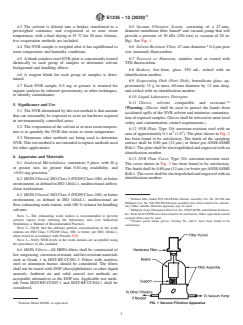
4.3 The solvent is filtered into a beaker, transferred to a 6.5 Vacuum Filtration System, consisting of a 47-mm-
preweighed container, and evaporated at or near room diameter membrane filter funnel and vacuum pump that will
temperature, with a final drying at 35 °C for 30 min. Alterna- provide a pressure of 30 kPa (250 torr) (a vacuum of 20 in.
tive evaporation methods are included. Hg). See Fig. 1.
4.4 The NVR sample is weighed after it has equilibrated to 6.6 Solvent-Resistant Filter, 47-mm diameter, 0.2-µm pore
room temperature and humidity conditions. size (nominal) fluorocarbon.
4.5 AblankstainlesssteelNVRplateisconcurrentlytreated 6.7 Tweezers or Hemostat, stainless steel or coated with
identically to each group of samples to determine solvent TFE-fluorocarbon.
background and handling effects.
6.8 Beakers, low-form, glass, 250 mL, etched with an
4.6 A reagent blank for each group of samples is deter- identification number.
mined.
6.9 Evaporating Dish (Petri Dish), borosilicate glass, ap-
4.7 Each NVR sample, 0.5 mg or greater, is retained for proximately 15 g in mass, 60-mm diameter by 12 mm deep,
organic analysis by infrared spectrometry, or other techniques, and etched with an identification number.
to identify contaminants.
6.10 Liquid Laboratory Detergent.
6.11 Gloves, solvent compatible and resistant.
5. Significance and Use
(Warning—Gloves shall be used to protect the hands from
5.1 The NVR determined by this test method is that amount
accidental spills of the NVR solvent and minimize contamina-
that can reasonably be expected to exist on hardware exposed
tion of exposed samples. Gloves shall be selected to meet local
in environmentally controlled areas.
safety and contamination control requirements.)
5.2 The evaporation of the solvent at or near room tempera-
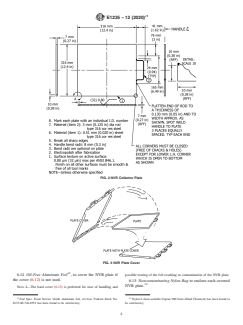
6.12 NVR Plate, Type 316 corrosion-resistant steel with an
ture is to quantify the NVR that exists at room temperature.
2 2
area of approximately 0.1 m (1 ft ). The plate shown in Fig. 2
5.3 Numerous other methods are being used to determine
has been found to be satisfactory. The finish of the sampling
NVR.Thistestmethodisnotintendedtoreplacemethodsused
surface shall be 0.80 µm (32 µin.) or better per ANSI/ASME
for other applications.
B46.1.The plate shall be electropolished and engraved with an
identification number.
6. Apparatus and Materials
6.13 NVR Plate Cover, Type 316 corrosion-resistant steel.
6.1 Analytical Microbalance, semimicro 5 place, with 30 g
The cover shown in Fig. 3 has been found to be satisfactory.
or greater tare, no greater than 0.01-mg readability, and
Thefinishshallbe0.80µm(32µin.)orbetterperANSI/ASME
60.01-mg precision.
B46.1.Thecovershallbeelectropolishedandengravedwithan
identification number.
6.2 HEPAFiltered,ISOClass5(FS209Class100),orbetter
environment,asdefinedinISO14644-1,unidirectionalairflow,
clean workstation.
6.3 HEPAFiltered,ISOClass5(FS209Class100),orbetter
Gelman filter funnel P/N 4012/Fisher filtrator assembly Cat. No. 09-788 and
environment, as defined in ISO 14644-1, unidirectional air
Millipore Cat. No. XX1504700 filtration assembly have been found to be satisfac-
flow,exhaustingworkstation,with100 %exhaustforhandling
tory. Other suitable filtration apparatus may be used.
solvents.
Millipore Corp. Fluoropore filter Cat. No. FGLP04700, and Gelman Sciences,
Inc. Prod. 66143 PTFE have been found to be satisfactory. Other equivalent solvent
NOTE 1—The exhausting work station is recommended to prevent
resistant filters may be used.
solvent vapors from entering the laboratory area (see Industrial
Pioneer green nitrile gloves, Catalog No. A10-1, have been found to be
Ventilation, a Manual of Recommended Practice).
satisfactory.
NOTE 2—Verify that the airborne particle concentrations in the work
stations are ISO Class 5 FS209 Class 100, or better, per ISO 14644-1,
when tested in accordance with Practice F50.
NOTE 3—Verify NVR levels in the work stations are acceptable using
the procedures in this standard.
6.4 HEPA Filters—All HEPA filters shall be constructed of
low outgassing, corrosion-resistant, and fire-resistant materials
such as Grade 1 in IEST-RP-CC001.3. Filters with stainless
steel or aluminum frames should be considered. The filters
shall not be tested with DOP (dioctylphthalate) or other liquid
aerosols. Ambient air and solid aerosol test methods are
acceptable alternatives to the DOP test. Applicable test meth-
ods from IEST-RP-CC007.1 and IEST-RP-CC034.1 shall be
considered.
Sartorius Model R180D, or equivalent. FIG. 1 Vacuum Filtration Apparatus
ϵ1
E1235 − 12 (2020)
FIG. 2 NVR Collector Plate
FIG. 3 NVR Plate Cover
possible tearing of the foil resulting in contamination of the NVR plate.
6.14 Oil-Free Aluminum Foil , to cover the NVR plate if
the cover (6.12) is not used.
6.15 Noncontaminating Nylon Bag to enclose each covered
NVR plate.
NOTE 4—The hard cover (6.13) is preferred for ease of handling and
11 12
Fed Spec. Food Service Grade aluminum foil, oil free, Federal Stock No. Nylon 6 (heat-sealable Capran 980 from Allied Chemical) has been found to
8135-00-724-0551 has been found to be satisfactory. be satisfactory.
ϵ1
E1235 − 12 (2020)
FIG. 5 NVR Plate Stand
prevent release into the atmosphere, protect the vacuum pump,
and allow recycling of the solvent.
6.21 Automatic, controlled environment (nitrogen atmo-
sphere) evaporator capable of controlling to a temperature of
37 °C (Method 3). Fig. 7 shows a typical arrangement.
6.22 600-mL (450-mL capacity) graduated, borosilicate
glass tubes, 75-mm diameter, 150 mm high with 2-mL stems,
to fit in the temperature controlled block in the evaporator
(Method 3).
7. Reagents
7.1 Purity of Reagents—Reagent grade chemicals shall be
FIG. 4 NVR Plate Carrier
used in all tests. Unless otherwise indicated, it is intended that
all reagents shall conform to the specifications of the Commit-
tee on Analytical reagents of the American Chemical Society,
6.15.1 Bags shall not contain or generate molecular or
when such specifications are available.
particulate matter that could contaminate the NVR plate or
7.2 Purity of Water—Deionized, organic-free water such as
NVR plate carrier.
reagent water, Type II in accordance with Specification D1193
6.16 NVR Plate Carrier—The sealable, aluminum carrier
with a minimum resistivity of 1.0 MΩ-cm.
shown in Fig. 4 has been found to be satisfactory (see Practice
7.3 Acetone, reagent grade.
E1234).
7.4 Methanol Absolute, reagent grade.
6.17 Drying Oven:
7.5 Nitrogen, ISO 14951-3, Type I (gaseous), Grade B or
6.17.1 The drying oven shall not produce molecular and
better.
particulate contaminants and shall not be used for other
operations that could contaminate samples.
7.6 NVR Solvent (see Note 5)—Methylene chloride, used in
Test Method E1235-95, is toxic , and is being phased out for
6.18 Plate Stand—The plate stand shown in Fig. 5 has been
found useful for holding the NVR plate during solvent flush-
ing.
RapidVap N , Model 79100, evaporation system, with No. 79065 sample
block, Labconco Corp., 8811 Prospect Ave., Kansas City, MO 641132-2696 has
6.19 Temperature and Relative Humidity Monitors, as
been found to be satisfactory.
required, to monitor processes that are sensitive to these
Catalog No. 79138-00 borosilicate glass tubes (6) with 2-mL stems to fit the
environments.
RapidVap Model 79100 has been found to be satisfactory.
Reagent Chemicals, American Chemical Society Specifications, American
6.20 Vacuum oven evaporation system (Method 2), consist-
Chemical Society, Washington, DC. For suggestions on the testing of reagents not
ing of a vacuum oven, a two-stage vacuum pump, and vacuum
listed by the American Chemical Society, see Analar Standards for Laboratory
Chemicals, BDH Ltd., Poole, Dorset, U.K., and the United States Pharmacopeia
gage. The vacuum oven shall be controllable to within 65°C
and National Formulary, U.S. Pharmacopeial Convention, Inc. (USPC), Rockville,
over an operating range of 25 to 100 °C. Fig. 6 shows a typical
MD.
vacuum oven evaporation system. Two solvent traps cooled
Material Safety Data Sheet No. 310, Genium Publishing Corp., 1145 Catalyn
with isopropanol/dry ice baths, collect the solvent vapors to St., Schenectady, NY 12303.
ϵ1
E1235 − 12 (2020)
FIG. 6 Vacuum Oven Evaporation System
degree of physical and health hazard. Use of ethyl acetate should be
according to the recommendations provided in the Material Safety Data
Sheet.
7.6.2 Cyclohexane/Ethyl Acetate Azeotrope Mixture—This
is an azeotrope consisting of 44 to 46 % cyclohexane and
54 % ethyl acetate by mass or 53 % cyclohexane and 47 %
21,22
ethyl acetate by volume. The solvent shall be certified to
contain <1-ppm (<1-mg/L) NVR using the procedure in
Section 10.
NOTE 6—Cyclohexane/ethyl acetate azeotrope is an organic solvent,
and as such, presents some degree of physical and health hazard. Use of
cyclohexane should be according to the recommendations provided in the
Material Safety Data Sheet. No commercial sources have been located
for this solvent mixture. Users have blended their own mixtures using
FIG. 7 Automatic Evaporator System
cyclohexane and ethyl acetate.
NOTE 7—Other solvents may be used to perform these measurements.
The use of different solvents may be required because of incompatibilities
many applications. Methylene chloride has been replaced in
of these solvents with surfaces being sampled or for other operational
this revision of Test Method E1235. The replacement solvents
reasons; however, the results may be different because the performance
were selected based on tests and analyses performed by The
characteristics of the solvents are different. This means that comparisons
Aerospace Corporation and described in SMC-TR-95-28. The
following solvents are acceptable:
Material Safety Data Sheet No. 437, Genium Publishing Corp., 145 Catalyn
7.6.1 HPLC (High-Purity Liquid Chromatography) Grade
St., Schenectady, NY 12303.
Ethyl Acetate —The solvent shall be certified to contain
Burdick & Jackson catalog No. 053, B&J Brand cyclohexane has been found
to be satisfactory.
<1-ppm (<1-mg/L) NVR using the procedure in Section 10.
Burdick & Jackson catalog No. 100, B&J Brand ethyl acetate has been found
NOTE5—Ethylacetateisanorganicsolvent,andassuch,presentssome to be satisfactory.
CRC Handbook of Chemistry and Physics, 52nd Ed, The Chemical Rubber
Co., Cleveland, OH.
17 22
Burdick & Jackson catalog No. 100, B&J Brand ethyl acetate has been found Data Source For Homogenious Azeotropes at the University of Edinburgh.
to be satisfactory. Material Safety Data Sheet No. B&J 0053, Burdick & Jackson.
ϵ1
E1235 − 12 (2020)
of NVR data determined with different solvents may not be possible.
8.11 Prepare a paper “traveler” (Fig. 5 in Practice E1234)in
accordance with Practice E1234.
8.12 Attach the paper “traveler” to the outer bag or con-
tainer.
8.13 Store the carrier inside the noncontaminating nylon
baginagoodhousekeepingareauntilrequiredforuse.Reclean
the NVR plates in accordance with 8.2 for acceptability after
six months or as determined by local conditions.
NOTE 8—An acceptable storage time for the NVR plates before
requiring recertification should be determined because local conditions
can affect the process.
9. Postexposure Handling
9.1 Storage of the carrier, following the return of the
FIG. 8 Typical Certification Tag
exposed samples, shall be in a good housekeeping area, or
cleaner environment.
9.2 RemovetheNVRplatecarrierfromtheouterplasticbag
8. Cleaning of Equipment
immediately before placing the carrier into a ISO Class 5
8.1 All operations, except weighings, shall be performed in
(FS209 Class 100) or better unidirectional air flow work
a unidirectional air flow, clean work station {ISO Class 5
station.
(FS209 Class 100) environment as defined in ISO 14644-1} or
9.3 Clean the outside of the NVR plate carrier if required.
an equivalent cleanroom or clean zone.
9.4 Remove the NVR sample plates individually, including
8.2 Clean the glassware, tools, plate cover, and NVR plates
the blank, and perform a visual inspection of each. Record
by washing twice with a strong liquid detergent in water
observations on the “traveler” form (see Fig. 5 of Practice
followed by a deionized water rinse.Then rinse the object with
E1234) accompanying the NVR plate carrier. Replace plates in
acetone, then with methanol, and finally with the NVR solvent
the carrier.
described in 7.6. Allow glassware to air dry in the clean work
station. Certify cleanliness by analysis.
NOTE9—Largeparticlesoforganicmaterialsontheplatewillaffectthe
NVR measurements if the NVR solvent extracts soluble matter from the
8.3 Verify that the carrier is visually clean. If cleaning is
particles. Large particle fallout is more severe on horizontally mounted
required, clean to Level 100A per IEST-STD-CC1246.
than on vertically mounted plates. To reduce possible errors, the plates
may be flushed with clean, dry nitrogen. If a nitrogen
...