

ASTM E1234-12(2020)
(Practice)Standard Practice for Handling, Transporting, and Installing Nonvolatile Residue (NVR) Sample Plates Used in Environmentally Controlled Areas for Spacecraft
General Information
- Abstract
ABSTRACT
This practice covers the proper procedures for handling, transporting, and installing sample plates used for the gravimetric determination of nonvolatile residue (NVR) within and between environmentally controlled facilities for spacecraft. This procedure shall appropriately require the following apparatuses and materials: Type 316 corrosion-resistant steel NVR plate; Type 316 corrosion-resistant steel NVR plate cover; noncontaminating nylon (polyamide bag); sealable aluminum NVR plate carrier; solvent compatible and resistant work gloves; oil-free aluminum foil; HEPA filters; and HEPA filtered workstation.
SCOPE
1.1 This practice covers the handling, transporting, and installing of sample plates used for the gravimetric determination of nonvolatile residue (NVR) within and between facilities.
1.2 The values stated in SI units are to be regarded as the standard.
1.3 This standard does not purport to address all of the safety concerns, if any, associated with its use. It is the responsibility of the user of this standard to establish appropriate safety, health, and environmental practices and determine the applicability of regulatory limitations prior to use.
1.4 This international standard was developed in accordance with internationally recognized principles on standardization established in the Decision on Principles for the Development of International Standards, Guides and Recommendations issued by the World Trade Organization Technical Barriers to Trade (TBT) Committee.
- Status
- Published
- Publication Date
- 31-Mar-2020
- Technical Committee
- E21 - Space Simulation and Applications of Space Technology
- Drafting Committee
- E21.05 - Contamination
Overview
ASTM E1234-12(2020): Standard Practice for Handling, Transporting, and Installing Nonvolatile Residue (NVR) Sample Plates Used in Environmentally Controlled Areas for Spacecraft is a critical international standard developed by ASTM for contamination control within the aerospace sector. This standard defines the minimum requirements and practices for ensuring that the collection, movement, and use of NVR sample plates in cleanrooms and environmentally controlled areas are performed consistently and effectively to support spacecraft cleanliness and performance. Its procedures help organizations prevent unwanted contamination during crucial phases of spacecraft manufacturing and assembly, ensuring compliance with stringent industry requirements.
Key Topics
- NVR Sample Plate Handling: Procedures to maintain plate integrity and prevent surface contamination, including use of clean gloves and protective packaging.
- Transport Practices: Guidelines for packaging NVR plates securely in Type 316 stainless steel carriers, enclosed in certified nylon bags, and using controlled vehicles or environments for transport.
- Installation in Controlled Areas: Instructions for introducing sample plates into cleanrooms or controlled zones, maintaining air quality through HEPA filtration, and minimizing personnel-induced contamination.
- Exposure & Retrieval: Specifying exposure durations, logging sample locations and identification, and careful retrieval and packaging of plates for laboratory analysis.
- Apparatus Requirements: Recommendations for materials and equipment, such as stainless steel NVR plates and covers, noncontaminating bags, oil-free aluminum foil, solvent-resistant gloves, and ISO Class 5 HEPA-filtered workstations.
- Documentation & Quality Control: Verification of labeling, tracking through traveler sheets, and adherence to contamination control plans and facility procedures.
Applications
The ASTM E1234-12(2020) standard is essential in various applications related to spacecraft and satellite production, assembly, and testing:
- Cleanroom Monitoring: Verifies the nonvolatile residue (NVR) content and general cleanliness of manufacturing and assembly environments. Ensures compliance with cleanliness classes such as ISO 14644-1 and FED-STD-209E.
- Contamination Control Programs: Supports contamination control programs by providing repeatable methods for assessing particulate and molecular residue levels on witness plates, reducing risk to spacecraft systems.
- Spacecraft Processing Facilities: Facilitates the safe movement and exposure of NVR plates between facilities and within different areas, such as cleanrooms and controlled storage, without cross-contamination.
- Auditing and Certification: Supports quality management, traceability, and documentation required for project audits, internal reviews, and customer assurance in aerospace projects.
- Surface Cleanliness Verification: Provides necessary procedures for verifying that critical spacecraft surfaces and assembly areas meet established NVR limits, crucial to mission reliability.
Related Standards
Several internationally recognized standards complement ASTM E1234-12(2020), offering comprehensive contamination control across cleanroom operations:
- ASTM E1235: Test Method for Gravimetric Determination of Nonvolatile Residue (NVR) in Environmentally Controlled Areas for Spacecraft.
- ISO 14644-1 & ISO 14644-2: Cleanrooms and Associated Controlled Environments - Classification of Air Cleanliness and Specifications for Testing and Monitoring.
- FED-STD-209E: Airborne Particulate Cleanliness Classes in Cleanrooms and Clean Zones.
- IEST-RP-CC001.3/CC007.1/CC034.1: Recommended practices for HEPA and ULPA filter selection, testing, and leak assessments.
- IEST-STD-CC1246: Product Cleanliness Levels and Contamination Control Program.
- ANSI/ASME B46.1: Surface Texture (Surface Roughness, Waviness, and Lay).
Practical Value
By following ASTM E1234-12(2020), aerospace organizations enhance product quality, reduce the risk of failure from contamination, and ensure industry best practices are consistently applied. The documented and repeatable methods for handling, transporting, and installing NVR sample plates support compliance with customer, regulatory, and international requirements while maintaining the cleanliness essential for sensitive spacecraft components. This standard is a pivotal resource for engineers, cleanroom managers, quality assurance personnel, and anyone involved in the maintenance and verification of environmentally controlled areas within the aerospace industry.
Relations
- Effective Date
- 01-Apr-2020
- Effective Date
- 01-Apr-2020
- Effective Date
- 01-Nov-2012
- Effective Date
- 01-May-2008
- Effective Date
- 10-Oct-2001
- Effective Date
- 10-Oct-2001
- Effective Date
- 01-Apr-2020
- Effective Date
- 01-Apr-2020
- Effective Date
- 01-Apr-2020
- Effective Date
- 01-Apr-2020
- Effective Date
- 01-Apr-2020
- Effective Date
- 01-Apr-2020
Get Certified
Connect with accredited certification bodies for this standard

BUREAU VERITAS Certification Germany
Bureau Veritas certification in Germany.

Element Materials Technology
Materials testing and product certification.

AQMS Ltd.
AQMS provides ISO certification to SMEs across the UK.
Sponsored listings
Frequently Asked Questions
ASTM E1234-12(2020) is a standard published by ASTM International. Its full title is "Standard Practice for Handling, Transporting, and Installing Nonvolatile Residue (NVR) Sample Plates Used in Environmentally Controlled Areas for Spacecraft". This standard covers: ABSTRACT This practice covers the proper procedures for handling, transporting, and installing sample plates used for the gravimetric determination of nonvolatile residue (NVR) within and between environmentally controlled facilities for spacecraft. This procedure shall appropriately require the following apparatuses and materials: Type 316 corrosion-resistant steel NVR plate; Type 316 corrosion-resistant steel NVR plate cover; noncontaminating nylon (polyamide bag); sealable aluminum NVR plate carrier; solvent compatible and resistant work gloves; oil-free aluminum foil; HEPA filters; and HEPA filtered workstation. SCOPE 1.1 This practice covers the handling, transporting, and installing of sample plates used for the gravimetric determination of nonvolatile residue (NVR) within and between facilities. 1.2 The values stated in SI units are to be regarded as the standard. 1.3 This standard does not purport to address all of the safety concerns, if any, associated with its use. It is the responsibility of the user of this standard to establish appropriate safety, health, and environmental practices and determine the applicability of regulatory limitations prior to use. 1.4 This international standard was developed in accordance with internationally recognized principles on standardization established in the Decision on Principles for the Development of International Standards, Guides and Recommendations issued by the World Trade Organization Technical Barriers to Trade (TBT) Committee.
ABSTRACT This practice covers the proper procedures for handling, transporting, and installing sample plates used for the gravimetric determination of nonvolatile residue (NVR) within and between environmentally controlled facilities for spacecraft. This procedure shall appropriately require the following apparatuses and materials: Type 316 corrosion-resistant steel NVR plate; Type 316 corrosion-resistant steel NVR plate cover; noncontaminating nylon (polyamide bag); sealable aluminum NVR plate carrier; solvent compatible and resistant work gloves; oil-free aluminum foil; HEPA filters; and HEPA filtered workstation. SCOPE 1.1 This practice covers the handling, transporting, and installing of sample plates used for the gravimetric determination of nonvolatile residue (NVR) within and between facilities. 1.2 The values stated in SI units are to be regarded as the standard. 1.3 This standard does not purport to address all of the safety concerns, if any, associated with its use. It is the responsibility of the user of this standard to establish appropriate safety, health, and environmental practices and determine the applicability of regulatory limitations prior to use. 1.4 This international standard was developed in accordance with internationally recognized principles on standardization established in the Decision on Principles for the Development of International Standards, Guides and Recommendations issued by the World Trade Organization Technical Barriers to Trade (TBT) Committee.
ASTM E1234-12(2020) is classified under the following ICS (International Classification for Standards) categories: 49.025.01 - Materials for aerospace construction in general; 49.140 - Space systems and operations. The ICS classification helps identify the subject area and facilitates finding related standards.
ASTM E1234-12(2020) has the following relationships with other standards: It is inter standard links to ASTM E1234-12, ASTM E1235-12(2020), ASTM E1235-12, ASTM E1235-08, ASTM E1235-01, ASTM E1235-95e1, ASTM E2900-19, ASTM E2352-19, ASTM E2312-11(2019), ASTM E2042/E2042M-09(2021), ASTM E2217-12(2019), ASTM E1235-12(2020)e1. Understanding these relationships helps ensure you are using the most current and applicable version of the standard.
ASTM E1234-12(2020) is available in PDF format for immediate download after purchase. The document can be added to your cart and obtained through the secure checkout process. Digital delivery ensures instant access to the complete standard document.
Standards Content (Sample)
This international standard was developed in accordance with internationally recognized principles on standardization established in the Decision on Principles for the
Development of International Standards, Guides and Recommendations issued by the World Trade Organization Technical Barriers to Trade (TBT) Committee.
Designation: E1234 − 12 (Reapproved 2020)
Standard Practice for
Handling, Transporting, and Installing Nonvolatile Residue
(NVR) Sample Plates Used in Environmentally Controlled
Areas for Spacecraft
This standard is issued under the fixed designation E1234; the number immediately following the designation indicates the year of
original adoption or, in the case of revision, the year of last revision. A number in parentheses indicates the year of last reapproval. A
superscript epsilon (´) indicates an editorial change since the last revision or reapproval.
1. Scope Monitoring to Prove Continued Compliance with ISO
14644-1
1.1 This practice covers the handling, transporting, and
2.3 U.S. Federal Standard:
installing of sample plates used for the gravimetric determina-
FED-STD-209E Airborne Particulate Cleanliness Classes in
tion of nonvolatile residue (NVR) within and between facili-
Cleanrooms and Clean Zones
ties.
2.4 Institute of Environmental Sciences and Technology:
1.2 The values stated in SI units are to be regarded as the 3
IEST-RP-CC001.3, HEPA and ULPA Filters
standard. 3
IEST-RP-CC007.1, Testing ULPA Filters
1.3 This standard does not purport to address all of the
IEST-RP-CC034.1, HEPA and ULPA Filter Leak Tests
safety concerns, if any, associated with its use. It is the
IEST-STD-CC1246, Product Cleanliness Levels and Con-
responsibility of the user of this standard to establish appro-
tamination Control Program
priate safety, health, and environmental practices and deter-
2.5 American National Standards Institute:
mine the applicability of regulatory limitations prior to use.
ANSI/ASME B46.1-2009, Surface Texture (Surface
1.4 This international standard was developed in accor-
Roughness, Waviness, and Lay)
dance with internationally recognized principles on standard-
3. Terminology
ization established in the Decision on Principles for the
Development of International Standards, Guides and Recom-
3.1 Definitions:
mendations issued by the World Trade Organization Technical
3.1.1 ISO Class N (airborne particulate cleanliness class),
Barriers to Trade (TBT) Committee.
n—level of airborne particulate concentrations as defined in
N
ISO 14644-1 and 14644-2, where 10 is the maximum
2. Referenced Documents
allowable concentrations (particles per cubic metre).
2.1 ASTM Standards:
3.1.1.1 Discussion—The considered particle sizes (lower
E1235 Test Method for Gravimetric Determination of Non-
threshold values) applicable for classification with ISO
volatile Residue (NVR) in Environmentally Controlled
14644-1 are limited to the range from 0.1 through 5 µm.
Areas for Spacecraft
Particleslargerthan5µm(macroparticles)maybeexpressedin
2.2 ISO Standards: accordance with Annex E of ISO 14644-1.
14644-1, Cleanrooms and Associated Controlled
3.1.2 FS209, n—the level of cleanliness specified by the
Environments—Part 1: Classification of Air Cleanliness
maximumallowablenumberofparticlespercubicfootofairas
14644-2, Cleanrooms and Associated Controlled
defined in FED-STD-209E.
Environments—Part 2: Specifications for Testing and
3.1.2.1 Discussion—This is provided for information and to
facilitate the transition to the use of the ISO classification
standard (ISO 14644-1).
This practice is under the jurisdiction of ASTM Committee E21 on Space
Simulation and Applications of Space Technology and is the responsibility of 3.1.3 clean area, n—a general term that includes
Subcommittee E21.05 on Contamination.
cleanrooms, controlled areas, good housekeeping areas, and
Current edition approved April 1, 2020. Published April 2020. Originally
other areas that have contamination control by physical design
approved in 1988. Last previous edition approved in 2012 as E1234 – 12. DOI:
and specified operating procedures.
10.1520/E1234-12R20.
For referenced ASTM standards, visit the ASTM website, www.astm.org, or
contact ASTM Customer Service at service@astm.org. For Annual Book of ASTM
Standards volume information, refer to the standard’s Document Summary page on Available from Institute of Environmental Sciences and Technology, 940 E.
the ASTM website. Northwest Highway, Mount Prospect, IL 60056, and U.S. government sources.
3 5
Available from Institute of Environmental Sciences and Technology, 940 E. Available from American Society of Mechanical Engineers, United Engineer-
Northwest Highway, Mount Prospect, IL 60056. ing Center, 345 E. 47th St., New York, NY 10017.
Copyright © ASTM International, 100 Barr Harbor Drive, PO Box C700, West Conshohocken, PA 19428-2959. United States
E1234 − 12 (2020)
3.1.4 clean zone, n—a defined space in which the contami- 3.1.15 separative device, n—equipment utilizing construc-
nation is controlled to meet specified cleanliness levels. tionalanddynamicmeanstocreateassuredlevelsofseparation
between the inside and outside of a defined volume. Some
3.1.5 contaminant, n—unwanted molecular and particulate
industry-specific examples of separative devices are clean air
matter that could affect or degrade the performance of the
hoods,containmentenclosures,gloveboxes,isolatorsandmini-
components upon which they reside.
environments.
3.1.6 contamination, n—a process of contaminating.
4. Summary of Practice
3.1.7 controlled area, n—an environmentally controlled
area, operated as a cleanroom, but without the final stage of
4.1 Covered, stainless steel, NVR plates are transported in a
HEPA (or better) filters used in cleanrooms.
sealed carrier within an outer nylon bag to the facility that is to
3.1.7.1 Discussion—Only rough filters (50 to 60 % effi-
be monitored for NVR deposition.
ciency) and medium efficiency filters (80 to 85 % efficiency)
4.2 The outer bag is removed from the plate carrier within
are required for a controlled area. The maximum allowable
the entrance air lock of the cleanroom, controlled area, or other
airborne particle concentrations are ISO Class 8.5 (FS209
environmentally controlled area in accordance with the opera-
Class 283 000) area for particles ≥0.5 µm and ISO Class 8
tional procedures for that facility and associated clean areas.
(FS209 Class 100 000) for particles ≥5.0 µm.
4.3 The clean NVR plate carrier is taken into the clean area.
3.1.8 environmentally controlled areas, n—cleanrooms,
controlled areas, good housekeeping areas, and other enclo-
4.4 Locations for attaching the plates within the clean area
sures that are designed to protect products from contamination. are in accordance with the facility contamination control plan,
3.1.8.1 Discussion—Cleanliness is achieved by controlling operating procedures, and other official documentation.
air purity, temperature, humidity, materials, garments, and
4.5 Each NVR plate is removed from the carrier, the cover
personnel activities.
is removed, and the plate is mounted in a vertical position
3.1.9 facility (clean facility), n—the total real property
within the clean area.
required to accomplish the cleanroom functions.
4.6 Thecoverisreturnedtotheplatecarrierforstorageuntil
3.1.10 good housekeeping area, n—an environmentally
required when the plates are collected after the required
controlled area without quantitative cleanliness requirements
exposure time.
but maintained in a visibly clean condition.
4.7 One of the NVR plates is removed from the carrier, the
3.1.10.1 Discussion—Office, laboratory, and storage areas
cover is removed, the cover is replaced, and the plate is
with air conditioning and janitorial service are typical of good
returned to the carrier. This NVR plate is handled in the same
housekeeping areas.
manner as the exposed plates. This plate is designated as the
3.1.11 HEPA (high effıciency particulate air) filter, n—a
blank or control sample.
filter for air with a removal efficiency in excess of 99.97 % for
4.8 After exposure, the NVR plates are removed from their
0.3-µm sized particles.
locations in the clean area and are replaced with clean NVR
3.1.11.1 Discussion—Forthisapplication,HEPAfiltersshall
plates in accordance with the facility and clean area contami-
meet the requirements of IEST-RP-CC001.3, IEST-RP-
nation control plan, operating procedures, and other official
CC007.1, IEST-RP-CC034.1, and 6.8 of this practice.
documents.
3.1.12 molecular contaminant—nonparticulate
4.9 The exposed plates are covered and placed into the
contaminant, n—nonparticulate matter.
original NVR plate carrier, returned to the analysis laboratory,
3.1.12.1 Discussion—The molecular contaminant may be in
and processed in accordance with Test Method E1235.
a gaseous, liquid, or solid state. It may be uniformly or
nonuniformly distributed or be in the form of droplets. Mo-
5. Apparatus and Materials
lecular contaminants account for most of the NVR.
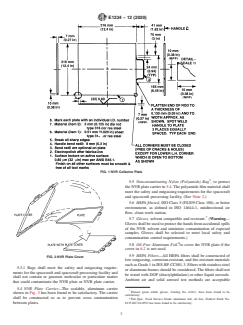
5.1 NVR Plate, Type 316 corrosion-resistant steel with an
3.1.13 NVR (nonvolatile residue), n—quantity of residual 2 2
area of approximately 0.1 m (1 ft ). The plate shown in Fig. 1
soluble, suspended, and particulate matter remaining after the
has been found to be satisfactory. The surface texture of the
controlled evaporation of a volatile liquid at a specified
sampling surface shall be 0.80 µm (32 µin.) or better per
temperature.
ANSI/ASME B46.1. The plate shall be electropolished and
3.1.13.1 Discussion—Theliquidisusuallyfilteredthrougha
engraved with an identification number.
membrane filter, of a specified size, before evaporation. The
5.2 NVR Plate Cover, Type 316 corrosion-resistant steel.
process used to determine the NVR may affect the quantitative
The cover shown in Fig. 2 has been found to be satisfactory.
measurement. Process factors include filter size, solvent, and
The surface texture shall be 0.80 µm (32 µin.) or better per
the evaporation temperature and atmosphere. For this reason,
ANSI/ASME B46.1.
the process must be defined.
5.3 Noncontaminating Nylon (Polyamide) Bag to enclose
3.1.14 particle (particulate contaminant), n—a piece of
each covered NVR plate.
matter in a solid or liquid (droplet) state with observable
length, width, and thickness. The size of a particle is usually
defined by its greatest dimension and is specified in microme-
Heat-sealable Capran 980 from Allied Chemical has been found to be
tr
...